Questions · Page 1 of 2

[2 Mark Questions]

Take a timed test

50 questions · self-marked practice — reveal the answer and mark yourself.

Question 12 Marks
Why do mice whose tails were surgically removed just after birth for generations, continue to produce mice with tails?
Answer
Acquired traits are structural, functional and behavioural changes that an individual develops during its life time. due to particular environment trauma use and disuse etc the changes which are acquired do not happen in reproductive cells they just happen in somatic cells. the removal of tails is a acquired trait which is not passed on to DNA of germ cells. They remain restricted to somatic cells. They are destroyed with the death of the mice. Hence the new generation continue to have tails.
View full question & answer
Question 22 Marks
What is meant by a species? Give two examples of plant species and two of animals.
Answer
A species is a population of organisms consisting of similar individuals which can breed together and produce fertile offspring’s.
Plant species: Wheat, Paddy, Sunflower etc.
Animal species: Cat, Dog, Tiger, etc.
View full question & answer
Question 32 Marks
List four modes of asexual reproduction.
Answer
Four modes of asexual reproduction are:-
  1. Binary Fission: In binary fission, a single cell divides into two halves. Some of the organisms that divide by binary fission are bacteria and Amoeba.
  2. Budding: It involves the formation of a new individual from a protrusion called a bud. It is very common in plants, yeasts and lower level animals such as Hydra.
In Hydra, cells divide rapidly at a specific site and develop as an outgrowth called a bud. This bud, while attached to the parent plant, develops into a small individual. When this individual becomes large enough, it detaches itself from the parent body to exist independently.
  1. Multiple Fission: In multiple fission, a single cell divides into many daughter cells simultaneously, for example, Plasmodium.
  2. Fragmentation: Fragmentation is the unintentional cutting up of the body of an organism in which each part grows into a different organism. It is most commonly seen in some annelids and fungi.
View full question & answer
Question 42 Marks
Name two animals having homologous organs and two having analogous organs. Name these organs.
Answer
Forelimb of humans and forelimb of lizard are the homologous organs and the wing of insect and the wing of bird are analogous organs.
View full question & answer
Question 52 Marks
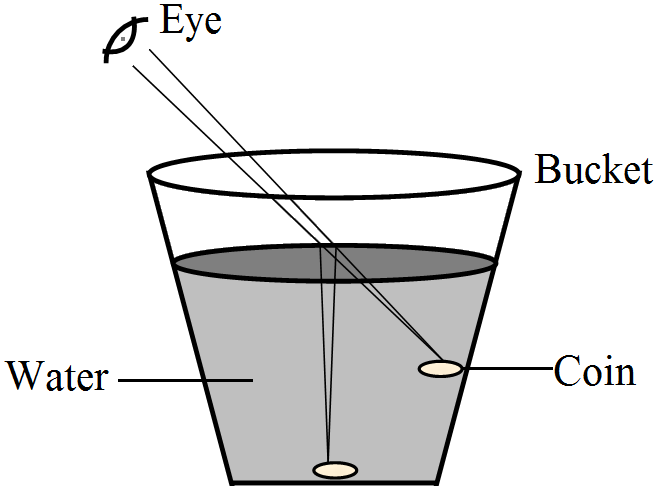
The depth of a bucket filled with water seems to be less than its actual depth. Name the phenomenon responsible for this?
Answer
The depth appears to be less because of refraction of light. Light coming from the bottom of the bucket gets refracted and we percieve the depth to be lesser.
Consider the following example.
The light coming from the coin placed at the bottom gets refracted away from the Normal because of refraction.

So, instead of appearing at its real depth, it appears raised. The same phenomenon is applicable to the bottom of the bucket itself. Hence, the bottom appears raised and we see that the bucket is filled slightly less than it actaully is.
View full question & answer
Question 62 Marks
Only variations that confer an advantage to an individual organism will survive in a population. Do you agree with this statement? Why or why not?
Answer
No, depending on the nature of variations different individuals have been different kinds of advantages. However, when a drastic change occurs in environment, only those organisms in the population will survive which have an advantageous variation in that population to survive in changed environment.
View full question & answer
Question 72 Marks
Define the term ‘Natural Selection’ given by Charles Darwin.
Answer
Charles Darwin set out his theory of evolution by natural selection as an explanation for adaptation and speciation. He defined natural selection as the "principle by which each slight variation [of a trait], if useful, is preserved".
Natural selection is a nature’s phenomenon in which the species which inherits variations and has better chances of survival are allowed to reproduce and produce a large number of off springs.
View full question & answer
Question 82 Marks
If the object distance for a concave mirror is 24cm and image distance is 12cm in front of a mirror. Then, find the magnification of the mirror.
Answer
Given that,
Object distance (u) = -24cm,
Image distance (v) = -12cm (image is in front of mirror hence v is negative).
Now,
Magnification $=-\frac{\text{v}}{\text{u}}$
⇒ Magnification $=-\frac{-12}{24}=-\frac{1}{2}$
$\therefore$ Magnification is -0.5. Which tells that image is real and inverted and half of the size of the object.
View full question & answer
Question 92 Marks
Which organs in two animals indicate that they are derived from a common ancestor?
Answer

When different animals which have organs originated from the same part of the body but function differently then they are known as homologous organs.
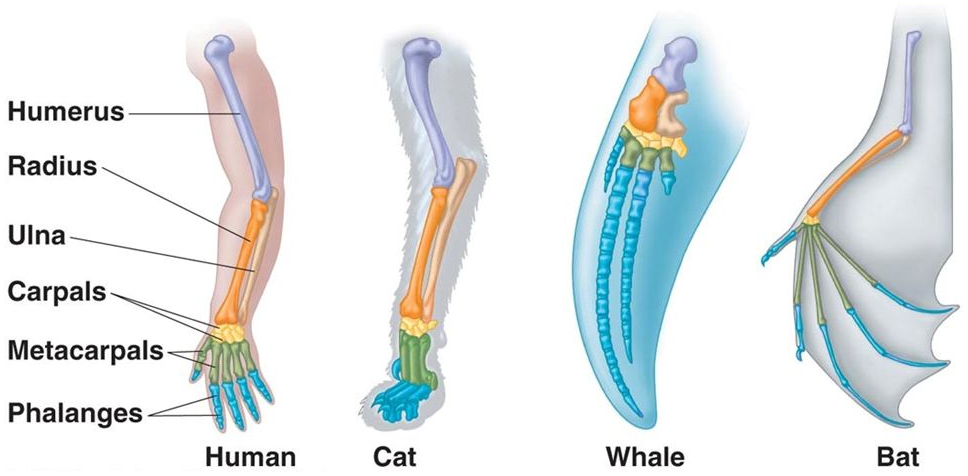
Example: Wings of a bat, wings of birds, dolphin, flipper and human arm are the homologous organs. They all are derived from the same set of bones which are humerus, radius, ulna, carpals, metacarpals, and phalanges. But all of them function differently.
View full question & answer
Question 102 Marks
Out of the following the traits like eye colour, height and physical strength which are genetically acquired.
Answer
The process in which new species are formed from the preexisting species is known as speciation.
Yes, traits like eye colour or height is genetically inherited because they can be passed on from one generation to the next. whereas physical strength is the acquired trait, the one acquired over a course of time.
View full question & answer
Question 112 Marks
In what way are homologous organs evidence for evolution?
Answer
The presence of homologous organs in different animals provides evidence for evolution by telling us that they are derived from the same ancestor who had the ‘basic design’ of the organ on which all the homologous organs are based.
View full question & answer
Question 122 Marks
Define ‘natural selection’.
Answer
Natural selection is the process of evolution of a species whereby characteristics which help individual organisms to survive and reproduce are passed on to their offspring, and those characteristics which do not help are not passed on.
View full question & answer
Question 132 Marks
Why are the traits acquired during the lifetime of an individual not inherited?
Answer
For a trait of an organism to be inherited, it should bring about a change in the genes present in the reproductive cells or gametes of that organism. The traits acquired during the life time of a person do not bring about a change in the genes present in its reproductive cells or gametes and hence they are not inherited by the offsprings.
View full question & answer
Question 142 Marks
In terms of evolution, what is the significance of homology between a human hand and a wing of a bird?
Answer

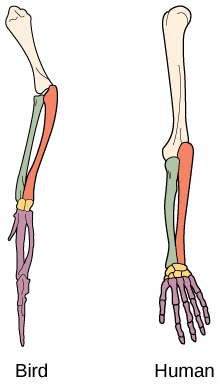
The forelimbs of humans and the wings of birds look different externally but their skeletal structure is similar. It means that their origin is similar (as wings in birds are modifications of forearm) but functions are different - the wings help in flight whereas human forearm helps in various activities.
View full question & answer
Question 152 Marks
In evolutionary terms, can we say which among bacteria, spiders, fish and chimpanzees have a ‘better’ body design? Why or why not?
Answer
Bacteria have better body design because it has so much variation to adjust in different climatic condition.
View full question & answer
Question 162 Marks
  1. E is the gene for brown eye colour and and e is the gene for blue eye colour. which gene is:
  1. Recessive.
  2. Dominant.
  1. Both father and mother have the genes Ee in their cells. What colour are their eyes?
  2. Which combination of genes in the zygote will produce children with blue eyes?
  3. Which combination of genes in the zygote will produce children with brown eyes?
Answer
  1.  
  1. E is recessive.
  2. E is dominant.
  1. The colour of their eyes is brown.
  2. Combination ee will produce children with blue eyes.
  3. Combination EE or Ee will produce children with brown eyes.
View full question & answer
Question 172 Marks
Choose the one term from the following which differs from the other three. Broccoli, wild cabbage, Cauliflower, and Kale.
Answer
Wild cabbage, which is the common ancestor of broccoli, cauliflower and cabbage.
Various plant parts of Wild Cabbage (Brassica Oleracea) are modified by artificial selection to give broccoli, cauliflower and cabbage. Thus, Wild cabbage includes the other three.
View full question & answer
Question 182 Marks
Name the various tools of tracing evolutionary relationships which have been used for studying human evolution.
Answer
Human evolution has been studied by using the various tools of tracing evolutionary relationships like excavating (digging earth), carbon-dating, studying fossils and determining DNA sequences.
View full question & answer
Question 192 Marks
Write the sex of the baby that inherits Y-chromosome from the father.
Answer
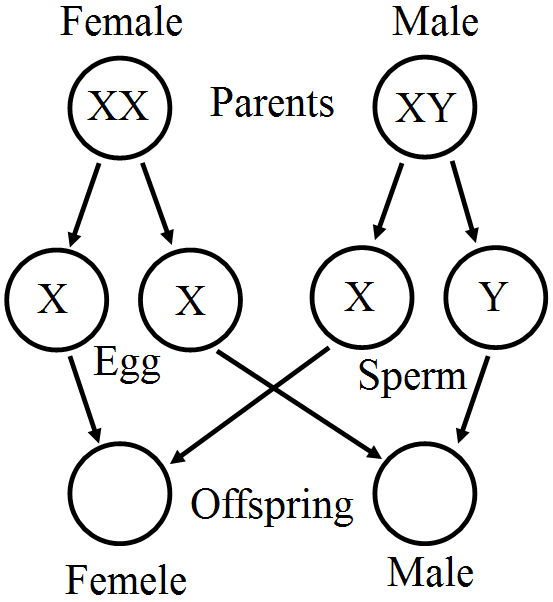
Men determine the sex of a baby depending on whether their sperm is carrying an X or Y chromosome. An X chromosome combines with the mother's X chromosome to make a baby girl (XX) and a Y chromosome will combine with the mother's to make a boy (XY).
View full question & answer
Question 202 Marks
A black mouse mates with a brown mouse, and all the offsprings are black.
  1. Why are no brown offsprings produced?
  2. If two of the black offsprings mate with each other what kind of offspring would you expect and in what proportions?
Give reason for your answer.
Answer
  1. No brown off springs are produced because brown colour is recessive, while black is dominant. The recessive trait does not occur in $F_1$ generation.
  2. We would expect black and brown off springs in the ratio 3 : 1. It is because brown colour reappears in $F_2$ generation.
View full question & answer
Question 212 Marks
A plant has two varieties, one with red petals and the other with white petals. When these two varieties are cross-pollinated, all the offsprings have red petals?
  1. Which gene is dominant?
  2. Choose suitable letters to represent the two genes.
Answer
  1. The gene for red petals is dominant, while the gene for white petals is recessive.
  2. The gene for red petals can be represented by R and the gene for white petals can be represented by r.
View full question & answer
Question 222 Marks
A red-haired woman marries a brown-haired man, and all the children are brown haired. Explain this genetically.
Answer
Brown hair color genes are dominant and the red hair color genes are recessive ; The genotype of brown hair is BB (dominant always represented by capital letter) and that of red hair bb (Recessive represented by small letter)
View full question & answer
Question 232 Marks
What are the different ways in which individuals with a particular trait may increase in a population?
Answer
Individuals with a particular trait may increase in a population as a result of the following:
  • Natural selection: When that trait offers some survival advantage.
  • Genetic drift: When some genes governing that trait become common in a population.
  • When that trait gets acquired during the individual's lifetime.
View full question & answer
Question 242 Marks
What are sex chromosomes? How many sex chromosomes are there? Name them.
Answer
The chromosomes which determine the sex of a person are called sex chromosomes. There are two types of sex chromosomes? X and Y chromosomes.
View full question & answer
Question 252 Marks
State Mendel’s first law of inheritance.
Answer
According to Mendel’s first law of inheritance: The characteristics (or traits) of an organism are determined by internal ‘factors’ which occur in pairs. Only one of a pair of such factors can be present in a single gamete.
View full question & answer
Question 262 Marks
In humans, if gene B gives brown eyes and gene b gives blue eyes. What will be the colour of eyes of the persons having the following combination of genes?
  1. Bb.
  2. bb.
  3. BB.
Answer
  1. Combination Bb will give brown eyes.
  2. Combination bb will give blue eyes.
  3. Combination BB will give brown eyes.
View full question & answer
Question 272 Marks
Which among the males and females are homogametic?
Answer
Human females have two X chromosomes whereas the human male has one X and one Y chromosome.
Thus females are homogametic.
View full question & answer
Question 282 Marks
When is a recessive trait able to show up?
Answer
Recessive trait is expressed only when the recessive alleles are present in a homozygous condition, i.e. that the individual has both the alleles as recessive alleles.
When di-Hybrid cross is conducted between two heterozygous parents with contrasting traits then it produces offspring which are 3 dominant and 1 recessive.
Tt × Tt = TT, Tt, Tt, tt
the ratio would be - 1 : 2 : 1
View full question & answer
Question 292 Marks
Does geographical isolation of individuals of a species lead to the formation of a new species? Provide a suitable explanation for your answer.
Answer
Geographical isolation is the major factor in the speciation of sexually reproducing animals because it interrupts the flow of genes between their isolated populations through the gametes.
View full question & answer
Question 302 Marks
Which of the following represent tall plants and which represent short plants (or dwarf plants)? Which of the following represent tall plants and which represent short plants (or dwarf plants)?
  1. Tt
  2. tt
  3. TT
Give reason for your choice (The symbols have their usual meaning).
Answer
  1. Tall: Tt will have tall plants because of the presence of T which is dominant gene and t is recessive gene.
  2. Dwarf plants: It is dwarf due to the presence of both the recessive genes.
  3. Tall plants: These plants are tall due to the presence of both the dominant genes.
View full question & answer
Question 312 Marks
What are genes? Where are they located in our body?
Answer
Genes are the units of heredity which transfer characteristic from parents to their offspring’s during reproduction. Genes are located on the chromosomes.
View full question & answer
Question 322 Marks
How are traits expressed?
Answer
Traits are expressed in the form of genotypes and phenotypes. Proteins are responsible for the traits. Traits are expressed in the form of proteins. Traits exhibited can be represented by genotype and phenotype of an individual. Genotype is the internal genetic constitution of a particular trait. Phenotype is the physical character that is expressed in the form of a trait.
View full question & answer
Question 332 Marks
‘‘The chromosomal number of the sexually producing parents and their offspring is the same.’’ Justify this statement.
Answer
The first step in sexual reproduction is gamete formation. In this step, the number of chromosomes gets halved. Thus, each gamete receives half the number of chromosomes to that of somatic cells. During fertilisation, the fusion of male and female gametes takes place, which results in the number of chromosomes in the zygote to be equal to that of somatic cells. Thus, the chromosomal number of the sexually producing parents and their offspring is the same.
View full question & answer
Question 342 Marks
The image formed by a convex mirror is observed to be virtual, erect and extremely diminished than the object, what should be the position of the object?
Answer
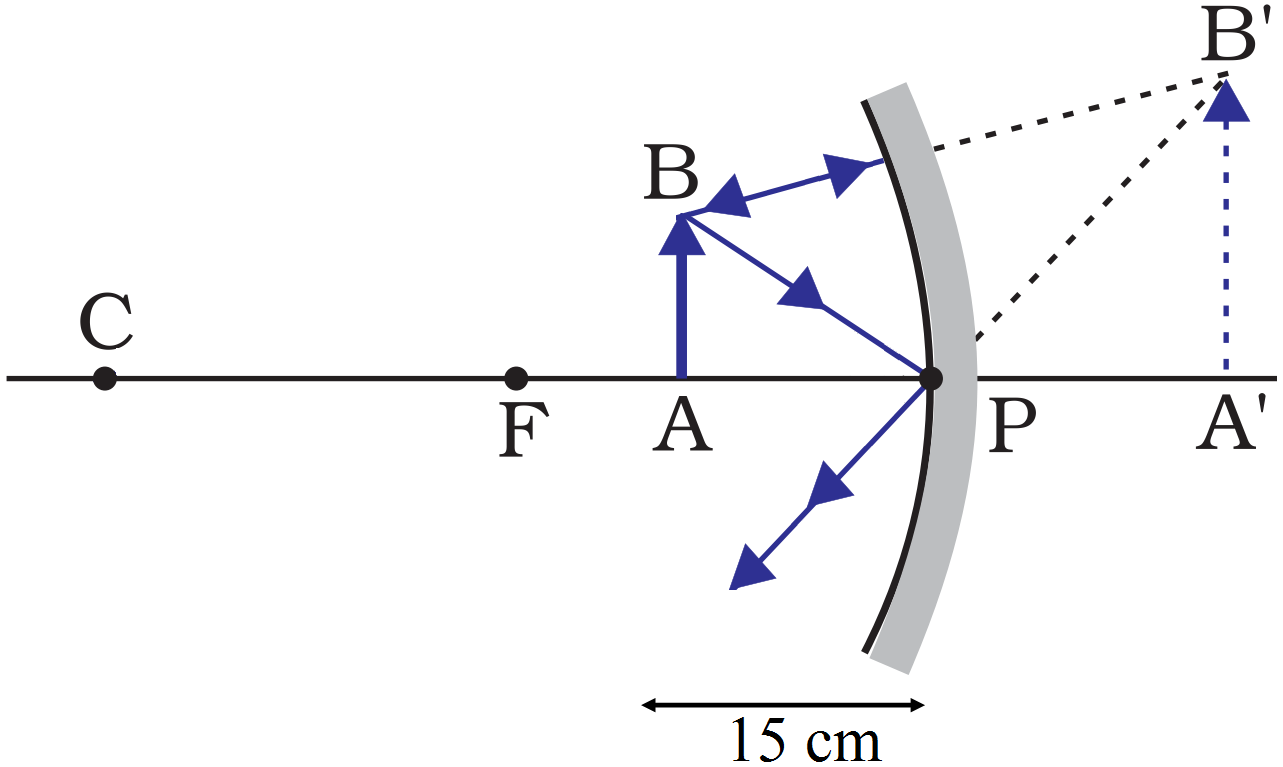
When the object is placed between pole and focus of the concave mirror, the image formed is virtual, erect and magnified.
View full question & answer
Question 352 Marks
Explain with an example how variation took place due to inheritance.
Answer
In sexual reproduction gametes undergo meiosis which introduces variation by recommendation crossing over, fertilization of gametes also introduces variation. Off springs genetic material varies from the parents & thus inheritance of traits in sexual reproduction introduces variations in species.
View full question & answer
Question 362 Marks
Bacteria have a simpler body plan when compared with human beings. Does it mean that human beings are more evolved than bacteria? Explain your answer.
Answer
Bacteria have simpler body plan when compared with human beings. Both of them have evolved differently. Bacteria can inhabit most of the unfavourable habitats such as hot springs, deep- sea thermal vents and the ice in Antarctica.
View full question & answer
Question 372 Marks
What factors could lead to the rise of a new species?
Answer
Natural selection, genetic drift and acquisition of traits during the life time of an individual can give rise to new species.
View full question & answer
Question 382 Marks
List any four disadvantages of using fossil for the production of energy.
Answer
  1. The fossil fuels are non-renewable sources of energy.
  2. Air-pollution is caused by burning of fossil fuels.
  3. The oxides of C, S and N are released on burning fossil fuels which lead to acid rain.
  4. $\text{CO}_{2}$ produced by burning these fuels causes green house effect.
View full question & answer
Question 392 Marks
What is the parameter which decides inheritance?
Answer
The process by which different characters are passed on from the parent to the progeny is known as inheritance. The rule of inheritance of such traits in human being are related to the fact that both father and the mother contribute practically equal amounts of genetic material to the child. This means that each trait can be influenced by both paternal and maternal DNA. Thus, for each trait there will be two versions in each child.
View full question & answer
Question 402 Marks
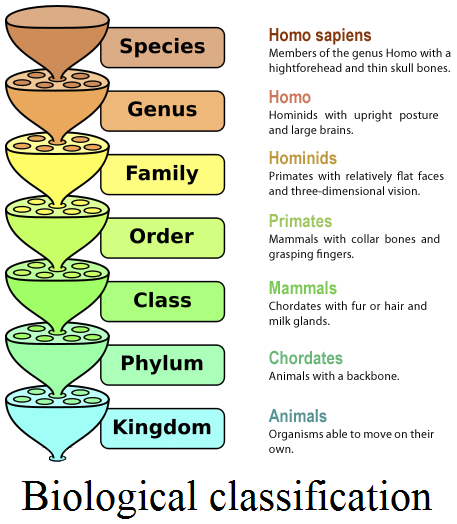
State the basis of classification of the organisms.
Answer

Biodiversity refers to all the diverse plants, animals and micro organisms present on earth.
Biological diversity or biodiversity is the occurrence of diverse or varied forms of living beings which differ from one another in external appearance, size, colour pattern, internal structure, nutrition, behaviour, habitat, etc.
There are various categories of classification. These are:
View full question & answer
Question 412 Marks
Where are genes located in an organism?
Answer
Genes are simply short regions of DNA which code for either a protein or RNA molecule. In eukaryotes, genes are mostly found in the nucleus of the cell, but some (13 in humans) are also located in the cell's mitochondria, in mitochondrial DNA.
View full question & answer
Question 422 Marks
How variation in a population leads to a survival advantage?
Answer
The advantages of sexual reproduction:
  • It produces variation in the off spring.
  • The species can adapt to new environments due to variation, which gives them a survival advantage.
  • A disease or change in environment is less likely to affect all the individuals in a population.
View full question & answer
Question 432 Marks
What is meant by variations found in a population?
Answer
Genetic variation in a population describes the existence in that population of different alleles, or alternative forms, for a given gene. The presence of genetic variation implies that individuals of the population vary in the alleles they possess, meaning that individuals differ in genotype.
View full question & answer
Question 442 Marks
Give one example each of characters that are inherited and the ones that are acquired in humans. Mention the difference between the inherited and the acquired characters.
Answer
  1. Characters that are passed on from parents to offspring are inherited characters. For example, colour of seeds, colour of eyes, etc.
  2. Characters appearing in an individual’s lifetime but cannot be transmitted to next generation are acquired characters. For example, obese body, loss of a finger in an accident, etc.
Acquired Inherited
  • The acquired traits are the traits which are experienced by an individual during his life time.
  • The acquired traits of an organism cannot be passed on to its future generations.
  • For e.g., 'low weight' of beetle. ' cut tail' of a mouse.
  • Inherited traits are distinguishing qualities or characteristics which one acquires from the ancestors.
  • The inherited traits of an organism are passed on to its future generations.
  • For e.g., red colour of beetles, fur coat of guinea pigs.
View full question & answer
Question 452 Marks
Why did Mendel choose pea plants for conducting his experiments on inheritance?
Answer
Mendel choose pea plants for studying inheritance because pea plants had a number of clear cut differences which were easy to tell apart. Another reason for choosing pea plants are they were self pollinating and many generations can be produced in a short time span.
View full question & answer
Question 462 Marks
Does genetic combination of mother play a significant role in determining the sex of a new born baby?
Answer
No, because mother has a pair of X chromosomes. All new born babies will inherit an Xchromosome from mother whether they are baby boys or baby girls.
View full question & answer
Question 472 Marks
How is variation brought in the progeny in the sexually reproducing organisms?
Answer
During sexual reproduction two different parent i.e. male and female take part as a result of which the newly formed zygote possess genetic material of both parents. It leads to interchange of genetic information between two gametes which is passed to the progeny and develops variation.
View full question & answer
Question 482 Marks
“Genes and chromosomes have similar behaviour.” Justify.
Answer
DNA is present on chromosomes, and genes are segment of DNA. Hence they are indirectly related. They both contain genetic material of the parent and passed on to the progeny. Thus we can say that they both have similar behaviour.
View full question & answer
Question 492 Marks
Explain the terms analogous and homologous organs with examples.
Answer
Analogous organs: Such organs which perform similar function but are different in structure and origin are called analogous organs. Example - Wings of birds and wings of insects.
Homologous organs: Such organs which may have different functions but similar structure and origin are called homologous organs. Example - forearm of frogs, lizards and birds.
View full question & answer
Question 502 Marks
Will geographical isolation be a major factor in the speciation of a self-pollinating plant species? Give reason for your answer.
Answer
Geographical isolation will not be a major factor in the speciation of a self pollinating plant because it does not depend on other plants for its process of reproduction to be carried out.
View full question & answer
[2 Mark Questions] - Science STD 10 Questions - Vidyadip