Questions

[5 marks Questions]

Take a timed test

28 questions · self-marked practice — reveal the answer and mark yourself.

Question 15 Marks
‘There is no real progress occurring in the concept of evolution. ‘ Explain.
Answer
There is no real 'progress' in the idea of evolution. Evolution is simply the generation of diversity and shaping diversity by environmental selection. There are multiple branches possible at each and every stage during evolution. The only trend in evolution seems to be that more complex body designs have emerged over time. However It is not as if the older designs are inefficient. In fact both older and simpler design also still survive. Bacteria, one of the simplest life forms inhabit in the most adverse environment like hot springs, deep sea, thermal vents and the ice in Antarctica.
Thus, evolution should not be equated as 'ladder of progress' rather occurs as branches of trees. Even human beings are not the pinnacle of evolution, but simply yet another species in the teeming spectrum of evolving life.
View full question & answer
Question 25 Marks
Give a brief idea of the formation of the fossil.
Answer
Paleontologists, or scientists who study fossils, help paint a picture of what life used to look like on earth millions of years ago. Fossils are remains or traces of past organisms that have been preserved by nature. And here's a fun fact: the word 'fossil' is Latin and actually means 'obtained by digging,' which makes sense because they are often buried.
Types of Fossils:
There are many ways fossils can form, and we'll get to all that in a minute. First, let's discuss the two main ways that fossils can be classified:
  1. Body fossils
  2. Trace fossils
The remains of a Hadrosaur are an example of a body fossil, or fossils of the actual organism. Typically, hard structures like bones, shells, and teeth fossilize more often than soft-bodied structures like tissues or plant leaves, but as is seen with the horsetail relative, plants can become fossils.
The other type of fossil is called a trace fossil, where evidence of the organism but not the actual organism is preserved, such as a track, a burrow, a nest, or even feces.
View full question & answer
Question 35 Marks
How are evolutionary relations between organisms traced?
Answer
Evolutionary relationships can be traced by following methods:
  1. Fossils: Fossils are the preserved traces of the organisms which lived in the past. They are a connecting link between two classes. They provide evidence for evolution. Analysing the organ structure in fossils helps us to judge how far the evolutionary relationship goes. For example: Presence of feathers in some fossils of dinosaurs indicate the birds are closely related to reptiles.
  2. Homologous and analogous organs: Homologous and analogous organs provide evidences for single ancestral linkage e.g. forelimbs of a man, a lizard, a frog, etc. seem to be built from the same basic design of bones, but they perform different functions. Similarly, the wings of an insect, and a bird, have different structures, but they perform the same function of flying. Analogous organs actually provide mechanism and evolution.
  3. Embryological evidences: Development stages of embryos help to understand the common ancestry. For example, similarity in the embryos of vertebrates indicate that they have evolved from a common ancestor.
View full question & answer
Question 45 Marks
An animal (guinea pig) having black colour is crossed with guinea pig having the same colour.
They produced 100 offsprings, of which 75 were black and 25 were white.
Find out
  1. What is the possible genotype?
  2. Which trait is dominant and which is recessive?
Answer
Possible genotype of the guinea pig: Bb × Bb
  1. The cross is called monohybrid cross. Phenotypic ratio of $F_2$ progeny is 3 : 1 Genotypic ratio of $F_2$ progeny is 1 : 2 : 1 as they produced offspring in the ratio of 3 : 1. The 25 of the black pigs have the gene BB whereas the rest 50 of the black pigs have genes Bb and the white pigs have bb.
  2. Black colour is dominant and white colour is recessive.
View full question & answer
Question 55 Marks
  1. What is the law of dominance of traits? Explain with an example.
  2. Why are the traits acquired during the life time of an individual not inherited? Explain.
Answer
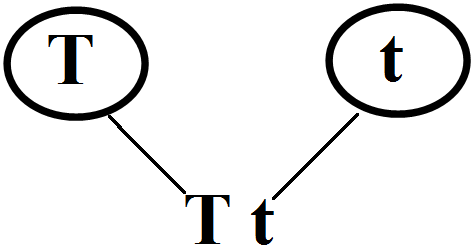
  1. Law of dominance of traits: -In a cross between a pair of contrasting characters, only one parental character will be expressed in F1 generation which is called dominant trait and the other is called recessive trait.
For example – in pea plants,


All plants in F1 generation were tall proving that the gene for tallness is dominant over the gene for dwarfness/ short, which is not able to express itself in the presence of dominant trait.
  1. Traits acquired by an organism during its lifetime are known as aquired traits.
These traits are not inherited because they occur in somatic cells only/ do not cause any change in the DNA of the germ cells.
View full question & answer
Question 65 Marks
What are fossils? How are they formed? Describe in brief two methods of determining the age of fossils. State any one role of fossils in the study of the process of evolution.
Answer
Fossils are the dead remains of plants and animals that are embedded in sedimentary rocks, preserved and petrified.
When a plant or an animal dies, its remains fall on the ground. Over a period of time, its bodies get covered by sediments brought by rivers, winds, etc. These sediments keep on getting accumulated for over hundreds of years and when that land gets eroded, the fossils can be seen clearly. Thus, the process of accumulation of dead remains of plants and animals for over hundreds of years results in the formation of fossils.
The age of fossils can be determined by the following ways:
  • Radiometric dating: In this method, the age of fossils can be determined by tracing the radioactive elements present in the rocks and by examining them chemically.
  • Relative dating: Fossils are found in sedimentary rocks in the form of layers accumulated over a large span of time. Considering the fact that fossils found in the bottom layers are older than those found in the layers above them, geologists find the age of the fossils.
Fossils play an important role in tracing evolutionary relationships. The depth at which fossils are found tells us their age and the period in which they existed. Fossils found closer to the surface of the Earth are more recent than those present in the deeper layers.
View full question & answer
Question 75 Marks
Evolution has exhibited a greater stability of molecular structure when compared with morphological structures. Comment on the statement and justify your opinion.
Answer
The apparent structures in an organism, are termed morphological structures. Morphological structures can be easily seen by all us. Molecular structure is about the structure of biomolecules which are the integral components of organisms.
We see lot of diversity all around us. This diversity is possible because of diversity in morphological structures. This shows that morphological structures are least stable. Life which began as simple forms on the earth in now composed of many complex forms.
But despite all the evolution which have taken place through millions of years, the structure biomolecules remains the same. A DNA is same in a human and in a mouse. A protein has same structure in a bird and in a fungi. So, the molecular basis of life has not changed through all these years. This shows that evolution has exhibited a greater stability of molecular structure when compared with morphological structure.
View full question & answer
Question 85 Marks
Define evolution. How does it occur? Describe how fossils provide us evidences in support of evolution.
Answer
Biological evolution is any change in the frequency of alleles in a population of organisms. Evolution is a slow change in the heritable characteristics of biological populations over successive generations. Evolutionary processes give rise to biodiversity at every level of biological organization, including the levels of species, individual organisms, and molecules.Evolution occurs due to the following:
  1. Accumulation of variations over generations: The variations arise due to crossing over, recombination, fertilisation or errors during DNA replication, mutation, recombination during sexual reproduction, etc . Geographical barrier also plays a great role in the accumulation of these variations.
  2. Natural Selection: The organisms with the favourable mutations are selected by nature and have better chances of survival than those who do not have favourable variations.
  3. Genetic Drift refers to the fact that variations in gene frequencies within populations can occur by chance rather than by natural selection. Random genetic drift may be an important mechanism in evolutionary change in small population.
All this leads to changes in the heritable characters and finally results in evolution of the organism. Fossils: they represent plants and animals that lived millions of years ago and are now extinct. Different aged rock sediments contain fossils of different life-forms, which probably died during the formation of the particular sediment. It is observed that although fossils appeared different from the existing species they may show certain features similar to the existing species thus providing linkages between pre-existing and existing forms Provide information about the extinct species which were different from the existing species.
View full question & answer
Question 95 Marks
Explain with example how characteristics of a population changes over the years for the following situations:
  1. To gain survival advantage.
  2. Due to accidental survival.
  3. Temporary change of characteristics.
Answer
  1. To gain survival advantage the best example is provided by peppered moth. When industrialization occurred in England the green coloured peppered moth who blended perfectly with the green lichen coloured trees were easily preyed upon by predators as the tree trunks became black due to soot covering. In order to survive these moths then changed their colour to grey and now blended perfectly with soot coated trees.
  2. Beetles have two colours either red or blue. It was seen that elephants crushed all red coloured beetle but not blue. Thus blue colour survives and hence this example shows accidental variation.
  3. Speciation of any plant or animal to the modern one is an example of temporary change of characteristics so as to bring about a finally best suited species.
View full question & answer
Question 105 Marks
How is the equal genetic contribution of male and female parents ensured in the progeny?
Answer
In human beings, equal genetic contribution of male and female parents is ensured in the progeny through inheritance of equal number of chromosomes from both parents There are 23 pairs of chromosomes All human chromosomes are not paired. Out of these 23 pairs, the first 22 pairs are known as autosomes and the remaining one pair is known as sex chromosomes represented as X and Y. Females have a perfect pair of two X sex chromosomes and males have a mismatched pair of one X and one Y sex chromosome. During the course of reproduction, as fertilization process takes place, the male gamete (haploid) fuses with the female gamete(haploid) resulting in formation of the diploid zygote. The zygote in the progeny receive an equal contribution of genetic material from the parents. Out of 23 pairs of chromosomes in progeny, male parent contributes 22 autosomes and one X or Y chromosome and female parent contributes 22 autosomes and one X chromosom.
View full question & answer
Question 115 Marks
What do you understand by the term ‘evolution’? State Darwin’s theory of evolution.
Answer
Evolution is the sequence of gradual changes that takes place in the primitive organisms over vmillions of year in which new species are produced. Darwin’s theory of evolution is known as:"The Theory of Natural Selection". It can be described as follows:
  1. Within any population there is natural variation. Some individuals have more favourable variations than others.
  2. Even though all species produce a large number of offspring’s, populations remain fairly constant naturally.
  3. This is due to the struggle between members of the same species and different species for food, space and mate.
  4. The struggle for survival within populations eliminates the unfit individuals. The fit individuals possessing favourable variations survive and reproduce. This is called natural selection.
  5. The individuals having favourable variations pass on these variations to their progeny from generation to generation.
  6. These variations when accumulated over a long period of time, lead to the origin of a new species.
View full question & answer
Question 125 Marks
Give an account of the experiment performed Miller and Urey in 1953.
Answer
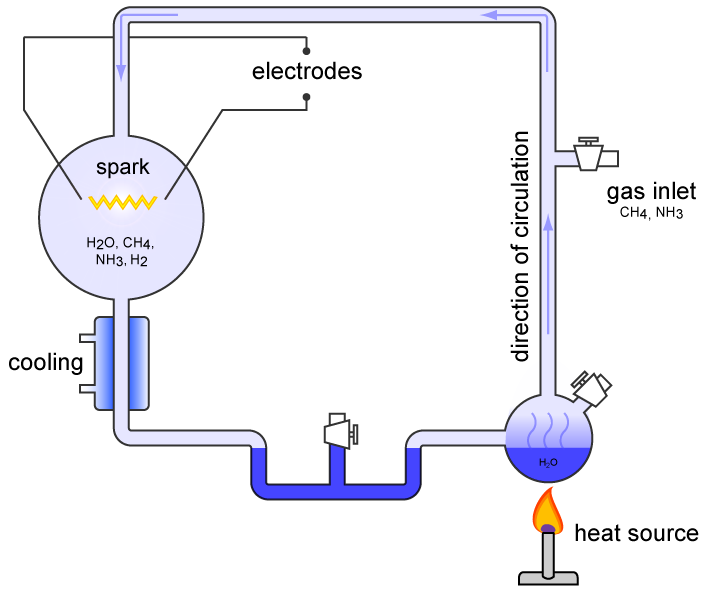
 The Miller-Urey experiment (or Miller experiment) was a chemical experiment that simulated the conditions thought at the time to be present on the early Earth, and tested the chemical origin of life under those conditions. The experiment used water $\left( H _2 O \right)$, methane $\left( CH _4\right)$, ammonia $\left( NH _3\right)$, and hydrogen $\left( H _2\right)$. The chemicals were all sealed inside a sterile 5 liter glass flask connected to a 500 ml flask half-full of water. The water in the smaller flask was heated to induce evaporation, and the water vapour was allowed to enter the larger flask. Continuous electrical sparks were fired between the electrodes to simulate lightning in the water vapour and gaseous mixture, and then the simulated atmosphere was cooled again so that the water condensed and trickled into a U-shaped trap at the bottom of the apparatus. After a day, the solution collected at the trap had turned pink in colour.
This experiment gave some evidences of formation of life from some inorganic/chemical sources.
View full question & answer
Question 135 Marks
  1. Why did Mendel choose garden pea for his experiments? Write two reasons.
  2. List two contrasting visible characters of garden pea Mendel used for his experiment.
  3. Explain in brief how Mendel interpreted his results to show that the traits may be dominant or recessive.
Answer
  1. Mendel selected garden pea for his experiment because of the following reasons:
  1. Garden pea have a sort lifecycle and thus can produce more number of off springs in a short duration.
  2. It had well defined and contrasting characters.
  3. Peas could reproduce by cross-pollination as well as self-pollination.
  1. Following contrasting visible characters of garden pea Mendel used for his experiment.
  1. Round/ Wrinkled seeds.
  2. Tall/ Short plants.
  3. White/ purple flowers.
  4. Green/ yellow seeds.
  1. When Mendel crossed two pea plants with a pair of contrasting characters only one character appeared in all the members of $F_1$ progeny, the others remain hidden.

    On selfing $F_1$, the hidden characters reappeared in just $25 \%$ of the off springs and the other $75 \%$ shared the characters expressed in $F _1$.

    Mendel concluded that the character which expresses itself in $F_1$ and in $75 \%$ of the individuals of $F_2$ is dominating while the other is recessive.
View full question & answer
Question 145 Marks
What are fossils? How are they formed? List two methods of determining the age of fossils. Explain in brief the importance of fossils in deciding the evolutionary relatrionships.
Answer
Fossils are the preserved remains or traces of animals, plants and other organisms from the remote past. They are formed by a continuous process of
burying and decomposition over a certain period. Fossil formation:
  1. Some invertebrates living on the sea bed died and were buried in the sand.
  2. More sand was accumulated and formed sandstone under pressure.
  3. After millions of years, dinosaurs living in the area died and their bodies were buried in the mud.
  4. The mud got compressed into the rock, just above the rock containing earlier invertebrate fossils.
  5. Again millions of years later, the bodies of horse-like creatures dying in the area were fossilized in the rocks above the earlier rocks.
  6. Much later, because of erosion and water flow, some rocks wore out and exposed the horse-like fossils.
Two methods to determine the age of fossils:
  1. When dug into the Earth, the fossils closer to the surface are more recent as compared to the fossils found in deeper layers.
  2. The fossils can also be dated by detecting the ratios of different isotopes of the same element in the fossil material. This process is known as radiocarbon dating. When living organisms change into fossils, their rate of radioactive $C _{14}$ decay decreases slowly. In this way, the age of fossils can be determined with the help of radioactive $C _{14}$.
Two roles of fossils in tracing evolutionary relationships:
  1. To tell us about the similarities between two species.
  2. To provide links between two groups indicating that perhaps one species evolved from the other.
View full question & answer
Question 155 Marks
How do Mendel’s experiments show that the:
  1. Traits may be dominant or recessive,
  2. Traits are inherited independently?
Answer
  1. a. Mendel demonstrated that traits can be either dominant or recessive through his monohybrid cross. He crossed truebreeding tall (TT) and dwarf (tt) pea plants. The seeds formed after fertilisation were grown and the plants that were formed represent the first filial or $F_1$ generation. All the $F_1$ plants obtained were tall. Then, Mendel self-pollinated the $F_1$ plants and observed that all plants obtained in the $F_2$ generation were not tall. Instead, one-fourth of the $F_2$ plants were short. From this experiment, Mendel concluded that the $F_1$ tall plants were not true breeding; they were carrying traits of both short height and tall height. They appeared tall only because the tall trait was dominant over the dwarf trait. This shows that traits may be dominant or recessive.
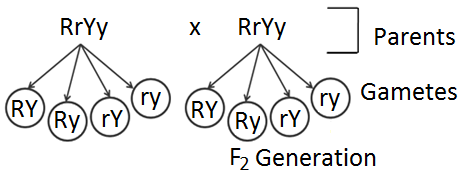
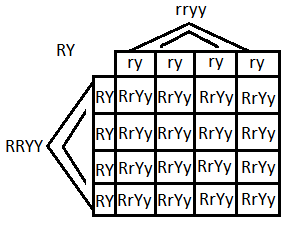
    b. Mendel demonstrated that traits are inherited independently through his dihybrid cross. He considered two traits at a time, seed colour and seed shape in which yellow colour ( $Y Y$ ) and round shape (RR) are dominant over green colour (yy) and wrinkled shape (rr), respectively. Mendel observed that the $F_2$ progeny of dihybrid cross had a phenotypic ratio of $9: 3: 3: 1$ and produced nine plants with round yellow seeds, three plants with round green seeds, three plants with wrinkled yellow seeds and one plant with wrinkled green seeds. In this experiment, he found that round yellow and wrinkled green are parental combinations whereas round green and wrinkled yellow are new combinations. In a dihybrid cross between two plants having round yellow (RRYY) and wrinkled green seeds (rryy), four types of gametes (RY, Ry, rY, ry ) are produced. Each of these gametes segregate independently of each other and each have a frequency of $25 \%$ of the total gametes produced. From this experiment, he concluded that when two pairs of traits are combined together in a hybrid, one pair of character segregates independent of the other pair of character. This is known as the law of independent assortment.
View full question & answer
Question 165 Marks
In question 44 , what are the combinations of character in the $F_2$ progeny? What are their ratios?
Answer
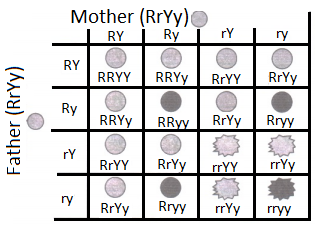
A dihybrid cross shows inheritance of two different traits simultaneously. A cross between two pure breeding dominant and recessive parents gives heterozygous dominant offspring. All $F_1$ progeny in this cross will have genotype RrYy and will exhibit round and yellow phenotype. Self cross in $F_1$ progeny gives $F_2$ generation and follow law of independent assortment of characters. characters.
Gametes
RY
Ry
rY
ry
RY
RRYY
Round Yellow
RRyy
Round Yellow
RrYY
Round Yellow
RrYy
Round Yellow
Ry
RRYy
Round Yellow
RRyy
Round Green
RrYy
Round Yellow
Rryy
Round Green
rY
RrYY
Round Yellow
RrYy
Round Yellow
rrYY
Wrinkled Yellow
rrYy
Wrinkled Yellow
ry
RrYy
Round Yellow
Rryy
Round Green
rrYy
Wrinkled Yellow
rryy
Wrinkled Green
Combination of characters:
Phenotypic ratio = 9 round yellow, 3 round green, 3 wrinkled yellow, 1 wrinkled green. So, $F_2$generation exhibits both parental and recombinant offspring. Hence, the ratio is = 9 : 3 : 3 : 1
View full question & answer
Question 175 Marks
Explain the development/origin of the theory of the chemical origin of life.
Answer
solution The Miller-Urey experiment (or Miller experiment) was a chemical experiment that simulated the conditions thought at the time to be present on the early Earth, and tested the chemical origin of life under those conditions. The experiment used water $\left( H _2 O \right)$, methane $\left( CH _4\right)$, ammonia $\left( NH _3\right)$, and hydrogen $\left( H _2\right)$. The chemicals were all sealed inside a sterile 5-liter glass flask connected to a 500 ml flask half-full of water. The water in the smaller flask was heated to induce evaporation, and the water vapour was allowed to enter the larger flask. Continuous electrical sparks were fired between the electrodes to simulate lightning in the water vapour and gaseous mixture, and then the simulated atmosphere was cooled again so that the water condensed and trickled into a U-shaped trap at the bottom of the apparatus. After a day, the solution collected at the trap had turned pink in colour.
View full question & answer
Question 185 Marks
What is meant by pair of contrasting characters?
Answer
Principles of Mendel:
  • Each characteristic in an organism is represented by two factors (it means that each cell has two chromosomes, carrying the gene for the same character).
  • When two contrasting factors (opposite factors) are present in an organism then one of them can mask the presence of the other. Therefore, one is called the dominant factor, while the other is called the recessive factor. The seven pair of contrasting characters (opposite characters) observed my Mendel are as follows:
S.No.
Character
Dominant
Recessive
1
Stem height
Tall
Dwarf
2
Flower colour
Violet
White
3
Flower position
Axial
Terminal
4
Pod shape
Inflated
Constructed
5
Pod colour
Green
Yellow
6
Seed shape
Round
Wrinkled
7
Seed colour
Yellow
Green
View full question & answer
Question 195 Marks
Match the terms given in column I with those given in column II:
Column I Column II
i. Fossil a. A famous evolutionist
ii. A theory of evolution b. Survial of the fitted
iii. Probale ancestor of birds c. Petried remains of the perhistoric life
iv. Charles Dawin d. Father of genetics
v. Gregor Mendal e. Archaeopteryx
Answer
Column I Column II
i. Fossil c. Petried remains of the perhistoric life
ii. A theory of evolution b. Survial of the fitted
iii. Probale ancestor of birds e. Archaeopteryx
iv. Charles Dawin a. A famous evolutionist
v. Gregor Mendal d. Father of genetics
View full question & answer
Question 205 Marks
What is meant by speciation? List four factors that could lead to speciation. Which of these cannot be a major factor in the speciation of a self-pollinating plant species. Give reason to justify your answer.
Answer
The process by which a new species develops from the existing species is known as speciation. Factors that lead to speciation:
  1. Geographical isolation
  2. Genetic drift
  3. Natural selection
  4. Reduction in Gene flow
  5. Reproductive isolation
In the case of plant species with self pollinating flowers the factor reproductive isolation will not have much effect because the plant is not dependent on any other species for reproduction but has male and female parts in the same flower or the same plant. Thus there is no effect of reproductive isolation.
View full question & answer
Question 215 Marks
Give the basic features of the mechanism of inheritance.
Answer
Basic Features of Inheritance:
  1. Unit Characters: An organism is made of a large number of characters, each of which behaves as a unit.
  2. Genes: Characters are controlled by genes.
  3. One Gene-One Character: A single gene generally controls one character.
  4. Location of Genes: Genes are located on chromosomes.
  5. Alleles: A gene may have two or more forms called alleles. They represent different traits of a character.
  6. Paired Alleles: An individual possesses two alleles of every gene. The two may be similar or dissimilar.
  7. Dominance: Where there are two different forms or alleles of the gene, generally one expresses its effect. It is called dominant allele. The other which does not express its effect in presence of dominant allele, is called recessive allele.
  8. Segregation: The two alleles separate at the time of gamete formation. A gamete has only one allele or form of the gene.
  9. Independent Assortment: The alleles of different genes located on separate chromosomes behave independent of one another.
  10. Pairing: Fusion of gametes during fertilization, brings together the two forms of a gene in the zygote.
View full question & answer
Question 225 Marks
What are fossils? How are fossils formed and how is their age determined? State the importance of fossils in the study of evolution.
Answer
Fossils are the preserved remains or traces of animals, plants and other organisms from the remote past. They are formed by a continuous process of burying and decomposition over a certain period.Fossil formation:
  1. Some invertebrates living on the sea bed died and were buried in the sand.
  2. More sand was accumulated and formed sandstone under pressure.
  3. After millions of years, dinosaurs living in the area died and their bodies were buried in the mud.
  4. The mud got compressed into the rock, just above the rock containing earlier invertebrate fossils.
  5. Again millions of years later, the bodies of horse-like creatures dying in the area were fossilized in the rocks above the earlier rocks.
  6. Much later, because of erosion and water flow, some rocks wore out and exposed the horse-like fossils.
Two methods to determine the age of fossils:
  1. When dug into the Earth, the fossils closer to the surface are more recent as compared to the fossils found in deeper layers.
  2. The fossils can also be dated by detecting the ratios of different isotopes of the same element in the fossil material. This process is known as radiocarbon dating. When living organisms change into fossils, their rate of radioactive $C _{14}$ decay decreases slowly. In this way, the age of fossils can be determined with the help of radioactive $C _{14}$.
Two roles of fossils in tracing evolutionary relationships:
  1. To tell us about the similarities between two species.
  2. To provide links between two groups indicating that perhaps one species evolved from the other.
View full question & answer
Question 235 Marks
How many pairs of chromosomes are present in human beings? Out of these how many are sex chromosomes? How many types of sex chromosomes are found in human beings?
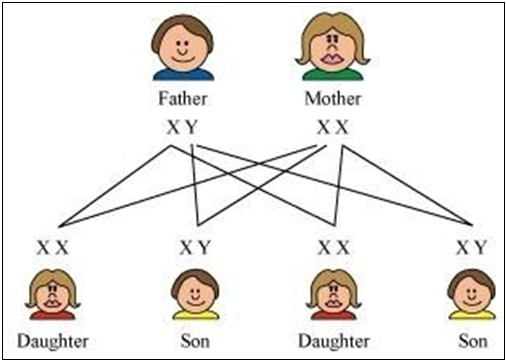
"The sex of a newborn child is a matter of chance and none of the parents may be considered responsible for it". Draw a flow chart showing determination of sex of a newborn to justify this statement.
Answer
There are 23 pairs of chromosomes present in human beings. There is 1 pair of sex chromosomes present in human beings. The chromosomes which determine the sex of a person are called sex chromosomes.
In human body, there are 23 pairs of chromosomes in the cell. Out of these, 22 pairs have a maternal and a paternal copy of genes, but do not take part in sex-determination in human being. The 23rd pair, which is not always a perfect pair, is called sex chromosomes.
Women have a perfect pair of sex chromosomes XX. But men have a mismatched pair of chromosomes in the form XY. This cell is divided meiotically in both men and women to form gametes. All children will inherit an X chromosome from their mother regardless of whether they are boys or girls and an X or Y chromosomes from their father. Thus, the sex of the children will be determined by what they inherit from their father. A child who inherits an X chromosome from her father will be a girl, and one who inherits a Y chromosome from him will be a boy.
View full question & answer
Question 245 Marks
With the help of one example for each, distinguish between the acquired traits and the inherited traits. Why are the traits/ experiences acquired during the entire lifetime of an individual not inherited in the next generation? Explain the reason of this fact with an example.
Answer
Colour of hair, eye colour is inherited characters but the weight of the body is an acquired character.
Inherited Characters
Acquired Characters
These are controlled by genes and are passed from generation to generations.
They are acquired by organisms in their life time.
These are genetic variations caused in reproductive tissues.
These are somatic variations caused in non-reproductive tissues.
The absence of tail in the mouse after surgical removal and low weight of a starving beetle cannot be passed on to the progeny as they are acquired traits and they do not cause any change in the DNA of germ cells. These changes occur in somatic tissues hence are not transmitted to their progeny. Whereas a rudimentary eye of Planaria is controlled by specific genes present in germ cells which can be transmitted from generation to generation.
View full question & answer
Question 255 Marks
Give reasons for the appearance of new combinations of characters in the $F_2$ progeny.
Answer
Independent assortment: The two forms of a gene separate and pair independent of the two forms of other genes during gametogenesis and fertilisation. It causes new combination of characters, e.g.;
Parents RrYy RrYy
Gametes RYRyrYry RYRyrYry
 
RY
Ry
rY
ry
RY
RRYY
Round Yellow
RRYy
Round Yellow
RrYY
Round Yellow
RrYy
Round Yellow
Ry
RRYy
Round Yellow
RRyy
Round Green
RrYy
Round Yellow
Rryy
Round Green
rY
RrYY
Round Yellow
RrYy
Round Yellow
rrYY
Wrinkled Yellow
rrYy
Wrinkled Yellow
ry
RrYy
Round Yellow
Rryy
Round Green
rrYy
Wrinkled Yellow
rryy
Wrinkled Green
Round Yellow = 9
Round Green = 3
Wrinkled Yellow = 3
Wrinkled Green = 1
Recombinants $=\frac{6}{16}$
View full question & answer
Question 265 Marks
How do Mendel’s experiments show that.
  1. Traits may be dominant or recessive?
  2. Inheritance of two traits is independent of each other?
Answer
  1. a. Mendel selected true breeding tall $( TT )$ and dwarf $( tt )$ pea plants. When a tall pea plant is crossed with a short (dwarf) pea plant, all the $F_1$ hybrids are tall. (i.e., in this case, the gene causing tallness is dominant while the gene causing dwarfness is recessive.).The trait expressing itself in the hybrid is the dominant one.
    (Mendel's first law of inheritance states that when a pair of contrasting factors is brought in a hybrid, one factor inhibits the appearance of the other. The one which inhibits is the dominant one and which is inhibited is recessive.)
    b. Mendel demonstrated that traits are inherited independently through his dihybrid cross. He considered two traits at a time, seed colour and seed shape in which yellow colour ( $Y Y$ ) and round shape (RR) are dominant over green colour ( yy ) and wrinkled shape ( rr ), respectively. Mendel observed that the $F_2$ progeny of dihybrid cross had a phenotypic ratio of $9: 3: 3: 1$ and produced nine plants with round yellow seeds, three plants with round green seeds, three plants with wrinkled yellow seeds and one plant with wrinkled green seeds. In this experiment, he found that round yellow and wrinkled green are parental combinations whereas round green and wrinkled yellow are new combinations. In a dihybrid cross between two plants having round yellow (RRYY) and wrinkled green seeds (rryy), four types of gametes (RY, Ry, rY, ry) are produced. Each of these gametes segregate independently of each other and each have a frequency of $25 \%$ of the total gametes produced. From this experiment, he concluded that when two pairs of traits are combined together in a hybrid, one pair of character segregates independent of the other pair of character. This is known as the law of independent assortment.
View full question & answer
Question 275 Marks
How do genes control the traits? Explain in detail.
Answer
Cellular DNA is the information source for making proteins in the cell. A section of DNA that provides information for one protein is called the gene for that protein. Genes are sections or segments of DNA that are carried on the chromosomes and determine specific human characteristics, such as height or hair color. proteins control the characteristics.
Heredity is the passing of genes from one generation to the next. Genes hold the instructions for making protein products (like the enzymes to digest food or the pigment that gives your eyes their color). As your cells duplicate, they pass this genetic information to the new cells.
But genes do not carry out the actual work. Rather, they serve as instruction books for making functional molecules such as ribonucleic acid (RNA) and proteins, which perform the chemical reactions in our bodies. It is these proteins which carry out the actual function of performing different functions and controlling various characteristics. So genes produce the proteins which in turn controls the characteristics, or traits.
Example: Plant height is dependent on the amount of a particular plant hormone. The amount of the plant hormone made will depend on the efficiency of the process for making it. Consider now an enzyme that is important for this process. If this enzyme works efficiently, a lot of hormone will be made, and the plant will be tall. If the gene for that enzyme has an alteration that makes the enzyme less efficient, the amount of hormone will be less, and the plant will be short.
View full question & answer
Question 285 Marks
In the following crosses write the characteristics of the progeny.
 
Cross
Progeny
a.
RRYY × RRYY
Round, yellow Round, yellow
..............
b.
RrYy × RrYy
Round, yellow Round, yellow
..............
c.
rryy × rryy
wrinkled, green wrinkled, green
..............
d.
RRYY × rryy
Round, yellow wrinkled green
..............
Answer
  1. Round yellow (RRYY)
  2. Round yellow (RRYY), Round yellow (RrYy), Round green (RRyy), Round green (Rryy), wrinkled yellow (rrYY), wrinkled yellow (rrYy), wrinkled green (rryy).
  1. Wrinkled green (rryy)
  2. Round yellow (RrYy)
View full question & answer
[5 marks Questions] - Science STD 10 Questions - Vidyadip