Questions

[5 marks Questions]

Take a timed test

19 questions · self-marked practice — reveal the answer and mark yourself.

Question 15 Marks
A man with blood group A marries a woman with blood group O and their daughter has blood group O. Is this information enough to tell you which of the traits-blood group A or O - is dominant? Why or why not?
Answer
Case I: If the father's blood group is $A$, and is the dominant trait, his genotypes will be $I^A I^A$ and $I^A I^O$ and the mother's blood group O being a recessive trait, her genotype will be $I ^{ O } I ^{ O }$. So, the daughter can receive one recessive allele $I ^{ O }$ from the father and another from the mother to have genotype $I ^{ O } I ^{ O }$ and the blood group O .
Case II: If the father's blood group A is a recessive trait, his genotype will be $I^A I^A$ the mother's blood group O being a dominant trait, her genotype will be $I ^{ O } I ^{ O }$ and $I ^{ O } I ^{ A }$. So, the daughter can receive one dominant allele $I ^{ O }$ from the mother and one recessive allele $I ^{ A }$ from the father to have genotype $I ^{ O } I ^{ A }$ and blood group O .
View full question & answer
Question 25 Marks
There are five animals A, B, C, D and E. The animal A uses its modified forelimbs for flying. The animal B uses its forelimbs for running whereas the animal C uses its forelimbs for grasping. The animal D can live on land as well as in water and uses its forelimbs to prop up the front end of its body when at rest. The animal E which respires by using spiracles and tracheae uses wings for flying but its wings are analogous to the modified forelimbs of animal A.
  1. What could the animals A, B, C, D and E be?
  2. Why are the forelimbs of animals A, B, C, D called homologous organs?
  3. What does the existence of homologous organs in animals A, B, C and D tell us about their ancestors?
  4. Why are the modified forelimbs of animal A and the wings of animal E called analogous organs?
  5. State whether animals A and E have a common ancestor or not.
Answer
  1. The animal A could be a bird or a bat, animal B could be lizard, animal C could be human, animal D could be frog, animal E could be an insect.
  2. Forelimbs of A, B, C, and D are called homologous organs because they have the same basic structure but different functions.
  3. It suggests that these organisms have evolved from a common ancestor.
  4. It is because forelimbs of animal A and wings of animal E have different basic structures but perform a similar function.
  5. Animals A and E do not have a common ancestor.
View full question & answer
Question 35 Marks
X, Y, and Z are three animals. The animal X can fly but animal Y can only run on ground or walls. The forelimbs of animals X and Y have the same basic design but they are used for different purposes such as flying and running respectively. The animal Z became extinct an long time ago. The study of fossils of Z tells us that it had some features like those of X and some like those of Y. In fact, Z is said to form a connecting link in the evolutionary chain of X and Y.
  1. What could the animals X, Y and Z be?
  2. What name is given to the forelimbs like those of X and Y which have the same basic design but different functions?
  3. Name one feature in which Z resembled X.
  4. Name one feature in which Z resembled Y.
  5. Which is the correct evolutionary chain involving X, Y and Z : X → Z → Y or Y → Z → X?
Answer
  1. X is birds, Y is reptiles and Z is Archaeopteryx.
  2. Forelimbs like those of X and Y are called homologous organs.
  3. X and Z had feathers.
  4. Z had teeth and tail like Y.
  5. The correct evolutionary sequence is Y → Z → X.
View full question & answer
Question 45 Marks
Explain how, sex is determined in human babies.
Answer
The sex of a child depends on what happens at fertilisation:
  1. If a sperm carrying X chromosome fertilises an ovum (or egg) which carries X chromosome, then the child born will be a girl. This is because the child will have XX combination of sex chromosomes.
  2. If a sperm carrying Y chromosome fertilises an ovum (or egg) which carries X chromosome, then the child born will be a boy. This is because the child will have XY combination of sex chromosomes.
View full question & answer
Question 55 Marks
“Only variations that confer an advantage to an individual organism will survive in a population”. Do you agree with this statement? Give reason for your answer.
Answer
Yes, only those variations that confer advantage to an individual organism will survive in a population. This will become clear from the following example. Suppose there is a population of red beetles in the green bushes and a colour variation arises during reproduction so that one beetle is now green in colour (instead of red). This variation offers advantage of survival because the green beetle can mix up with green bushes, it cannot be spotted and eaten up by a crow and hence its population will increase. If, however, the variation had produced a blue coloured beetle, then this colour could not offer any survival advantage because blue beetle in green bushes could be easily spotted by a crow and eaten by it.
View full question & answer
Question 65 Marks
The organs P and Q of two animals have different structures but similar functions. On the other hand, the two organs R and S of two other animals have the same basic structure but different functions.
  1. What are the organs like P and Q known as?
  2. Name the organs like P and Q. Also name the animals which have such organs.
  3. What are the organs like R and S called?
  4. Name the organs like R and S. Also name the animals which have such organs.
Answer
  1. Organs P and Q are known as analogous organs.
  2. Wings of an insect and a bird are like P and Q.
  3. Organs R and S are called homologous organs.
  4. Forelimbs of humans and wings of birds are like R and S.
View full question & answer
Question 75 Marks
A population of red beetles lives in green bushes in a garden. Once during the process of breeding, a green beetle is produced.
  1. State whether the change in colour of beetle is a process of evolution or not.
  2. Can the new colour of green beetle be passed on to its next generations?
  3. What will be the advantage (if any) of the green colour to the beetle?
  4. State whether the production of green colour involved a change in genetic material or not.
Answer
  1. It is a process of evolution.
  2. The green colour of the beetle is an inherited trait, which can be passed on to the next generation.
  3. It helps in survival of green beetle as it can mixing with green bushes, and hide from predators.
  4. The production of green colour has been brought about by a change in the DNA of the reproductive cells.
View full question & answer
Question 85 Marks
They are not correct. The father with blood group A has genotype $I ^{ A } I ^{ O }$. The mother with blood group B has genotype $I ^{ B } I ^{ O }$. Hence, the possible genotypes of the children will be $I ^{ A } I ^{ B }, I ^{ A } I ^{ O }, I ^{ B } I ^{ O }$ and $I ^{ O } I ^{ O }$. Thus, the possible blood groups of children will be AB, A, B and O. Hence, if the father has blood group A, and the mother has blood group B, it is possible for them to have children with blood group 0 .
Answer
No, the parents are not correct. The father is type A and the Mother is type B; the possible genotypes that are inherited by the baby are $I ^{ A } I ^{ B }, I ^{ A } I ^{ O }, I ^{ B } I ^{ O }$ and $I ^{ O } I ^{ O }$. This means that any of the blood type $AB , A , B$, and O can be inherited by the child. If the child inherits any of the one blood type, which is occurring here in this case that the child is inheriting type O blood group, no error has occurred.
View full question & answer
Question 95 Marks
A person first crossed pure-bred pea plants having round-yellow seeds with pure-bred pea plants having wrinkled-green seeds and found that only A-B type of seeds were produced in the $F_1$ generation. When $F_1$ generation pea plants having A-B type of seeds were cross-bred by self-pollination, then in addition to the original round-yellow and wrinkled-green seeds, two new varieties A-D and C-B type of seeds were also obtained.
  1. What are A-B type of seeds?
  2. State whether A and B are dominant traits or recessive traits.
  3. What are A-D type of seeds?
  4. What are C-B type of seeds?
  5. Out of A-B and A-D types of seeds, which one will be produced in (i) minimum numbers, and (ii) maximum numbers, in the $F_2$ generation?
Answer
  1. A-B types of seeds are round-yellow.
  2. A (round) and B (yellow) are dominant traits.
  3. A-D types of seeds are round-green.
  4. C-B type of seeds are wrinkled-yellow.
  5. In the $F_2$ generations,
  1. A-D type seeds will be produced in minimum numbers.
  2. A-B type of seeds will be produced in maximum numbers.
View full question & answer
Question 105 Marks
A Mendelian experiment consisted of breeding tall pea plants bearing violet flowers with short pea plants bearing white flowers. The progeny all bore violet flowers, but almost half of them were short. This suggested that the genetic make up (or genotype) of the tall parent can be depicted as:
  1. TTWW
  2. TTww
  3. TtWW
  4. TtWw
Give reason for your choice.
Answer
The genetic makeup of the tall parent can be depicted as:
  1. TtWW: As the question says, Tall Pea plants bearing violet flowers; Tallness is a dominant trait and is always represented by capital letters so ‘T’ and short/dwarfness is represented by small letters so ‘t’ – hence Tt. Violet Flowers is a dominant trait and is represented by capital letters so ‘W’. The progeny had short plants but no white flowers which means that Violet flowers are being passed on. Therefore, the genotype of the tall parent can be depicted as TtWW. There is a dominant gene for tallness which suppresses the recessive gene for height and for all violet flowers were present in tall pea plant.
View full question & answer
Question 115 Marks
Define ‘speciation’. Explain how speciation occurs.
Answer
The process by which new species develop from the existing species is known as speciation. New species are formed when the population of same species splits into two separate groups which then get isolated from each other geographically by the barriers such as mountain ranges, rivers or the sea. The geographical isolation of the two groups of population leads to their reproductive isolation due to which no genes are exchanged between them. However, breeding continues within the isolated populations producing more and more generations. Over the generations, the processes of genetic drift (random change in gene frequency), and natural selection operate in different ways in the two isolated groups of population and make them more and more different from each other. After thousands of years, the individuals of these isolated groups of population become so different that they will be incapable of reproducing with each other even if they happen to meet again. We then say that two new species have been formed.
View full question & answer
Question 125 Marks
Explain with an example, how genes control the characteristics (or traits).
Answer
The characteristics or traits in animals and plants are controlled by genes. For example the transmission of color of hair from the parents to the child. If a mother has black hair and the father has blonde hair and the child has black hair then the transmission of genes for hair colour from the mother and father to the child is as follows: Mother’s cell contains two genes HH for black hair. Both the genes HH are dominant genes, so the mother has black hair. Father’s cell contains two genes (hh) for blonde hair. The two genes hh are recessive genes, so the father has blonde hair. Now, during the process of reproduction, the mother transmits one of the dominant genes H for black hair to the child and the father transmits one of his recessive genes h for blonde hair to the child. Due to this, the child has the genes Hh for her hair. Now the gene H for black hair is the dominant gene but the gene h for blonde hair is the recessive gene. The dominant gene H for black hair shows its effect due to which the child has black hair.
View full question & answer
Question 135 Marks
What are the possible blood groups likely to be inherited by children born to a group A mother and a group B father? Explain your reasoning.
Answer
 The possible genotype that will be inherited by the children when the mother is group $A$ and the father is group $B$ are $I^A I^B, I^A I^O, I^B I^O$ and $I^O I^O$. The possible blood group likely to be inherited will be either $A B, A, B$ and $O$
(image)
View full question & answer
Question 145 Marks
Name the scientist who gave the theory of origin of life on earth. What is this theory?
Answer
The theory of origin of life on earth was given by J.B.S Haldane. He suggested in 1929 that life must have developed from the simple inorganic molecules (such as methane, ammonia,hydrogen sulphide, etc.) which were present on the earth soon after it was formed. He said that the conditions on earth at that time (including frequent lightning) could have converted simple inorganic molecules into complex organic molecules which were necessary for life. These complex organic molecules must have joined together to form first primitive living organisms. Haldane also suggested from theoretical considerations that life (or living
organisms) originated in the sea water.
View full question & answer
Question 155 Marks
Pure-bred tall pea plants are first crossed with pure-bred dwarf pea plants. The pea plants obtained in $F_1$ generation are then cross-bred to produce $F_2$ generation of pea plants.
a. What do the plants of $F_1$ generation look like?
b. What is the ratio of tall plants to dwarf plants in $F _2$ generation?
c. Which type of plants were missing in $F_1$ generation but reappeared in $F_2$ generation?
Answer
a. All plants in $F_1$ generation will be tall.
b. In $F_2$ generation, the ratio of tall plants to dwarf plants will be $3: 1$.
c. Dwarf pea plants were missing in $F_1$ generation, but reappeared in $F_2$ generation.
View full question & answer
Question 165 Marks
How do Mendel’s experiments show that traits are inherited independently?
Answer
When Mendel crossed pure-bred tall pea plants with pure-bred dwarf pea plants, he found that only tall pea plants were produced in the F generation. When Mendel further crossed the tall pea plants of the F generation, he found that the tall plants and dwarf plants were obtained in the ratio 3 : 1 in the F generation. Mendel noted that all the pea plants produced in the F generation were either tall or dwarf. There were no plants with intermediate height (or medium height) in-between the tall and dwarf plants. In this way, Mendel’s experiment showed that the traits (like tallness and dwarfness) are inherited independently. This is because if the traits of tallnes and dwarfness had blended (or mixed up), then medium sized pea plants would have been produced.
View full question & answer
Question 175 Marks
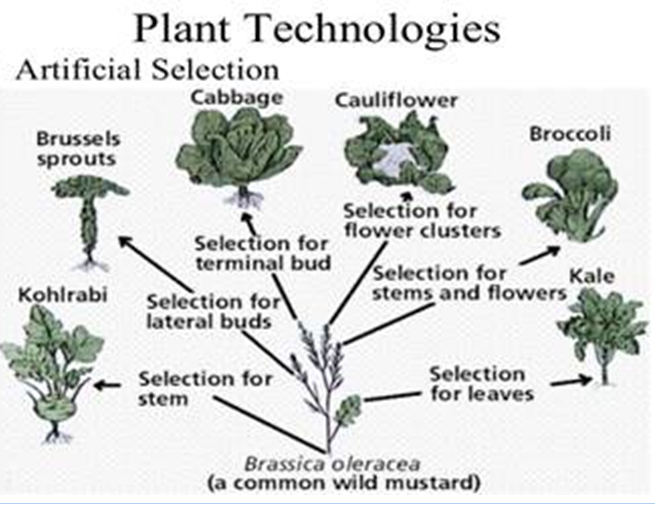
The farmers have been cultivating a food plant X for over two thousand years and have produced as many as five entirely different looking vegetables A, B, C, D and E from it.
  1. What could the plant X be?
  2. What are A, B, C, D and E?
  3. What is the process of evolution involved in this example known as?
Answer
  1. X- Wild Cabbage (Brassica oleracea) is made to produce 5 different varieties of vegetables by artificial selection.
  2. These 5 different looking vegetables are Cabbage, Kohlrabi, Kale, Broccoli, and Cauliflower.
  1. The process of evolution involved in this example is known as Artificial Selection. Artificial Selection is the intentional reproduction of individuals having desired characteristics.
View full question & answer
Question 185 Marks
What do you understand by the term ‘evolution’? State Darwin’s theory of evolution.
Answer
Evolution is the sequence of gradual changes that takes place in the primitive organisms over vmillions of year in which new species are produced. Darwin’s theory of evolution is known as:"The Theory of Natural Selection". It can be described as follows:
  1. Within any population there is natural variation. Some individuals have more favourable variations than others.
  2. Even though all species produce a large number of offspring’s, populations remain fairly constant naturally.
  3. This is due to the struggle between members of the same species and different species for food, space and mate.
  4. The struggle for survival within populations eliminates the unfit individuals. The fit individuals possessing favourable variations survive and reproduce. This is called natural selection.
  5. The individuals having favourable variations pass on these variations to their progeny from generation to generation.
  6. These variations when accumulated over a long period of time, lead to the origin of a new species.
View full question & answer
Question 195 Marks
Match the terms given in column I with those given in column II:
Column I Column II
i. Fossil a. A famous evolutionist
ii. A theory of evolution b. Survial of the fitted
iii. Probale ancestor of birds c. Petried remains of the perhistoric life
iv. Charles Dawin d. Father of genetics
v. Gregor Mendal e. Archaeopteryx
Answer
Column I Column II
i. Fossil c. Petried remains of the perhistoric life
ii. A theory of evolution b. Survial of the fitted
iii. Probale ancestor of birds e. Archaeopteryx
iv. Charles Dawin a. A famous evolutionist
v. Gregor Mendal d. Father of genetics
View full question & answer
[5 marks Questions] - Science STD 10 Questions - Vidyadip