Question types

How do Organisms Reproduce? question types

58 questions across 5 question groups — pick any mix to generate a Science paper with step-by-step answer keys.

58
Questions
5
Question groups
5
Question types
Sample Questions

How do Organisms Reproduce? questions

One sample from each question group in this chapter. Select any group above to see the full set with answer keys.

Q 1M.C.Q1 Mark
Characters that are transmitted from parents to offspring during reproduction show:
  • A
    Only similarities with parents.
  • B
    Only variations with parents.
  • Both similarities and variations with parents.
  • D
    Neither similarities nor variations.

Answer: C.

View full solution
Q 2M.C.Q1 Mark
Which among the following statements are true for sexual reproduction in flowering plants?
  1. It requires two types of gametes.
  2. Fertilisation is a compulsory event.
  3. It always results in formation of zygote.
  4. Offspring formed are clones.
  • A
    $(i)$ and $(iv)$
  • B
    $(i), (ii)$ and $(iv)$
  • C
    $(i), (ii)$ and $(iii)$
  • $(i), (ii)$ and $(iv)$

Answer: D.

View full solution
Q 3M.C.Q1 Mark
Which among the following is not the function of testes at puberty?
  1. Formation of germ cells.
  2. Secretion of testosterone.
  3. Development of placenta.
  4. Secretion of estrogen.
  • A
    $(i)$ and $(ii)$
  • B
    $(ii)$ and $(iii)$
  • $(iii)$ and $(iv)$
  • D
    $(i)$ and $(iv)$

Answer: C.

View full solution
Q 4M.C.Q1 Mark
Factors responsible for the rapid spread of bread mould on slices of bread are :
  1. Large number of spores.
  2. Availability of moisture and nutrients in bread.
  3. Presence of tubular branched hyphae.
  4. Formation of round shaped sporangia.
  • A
    $(i)$ and $(iii)$
  • B
    $(ii)$ and $(iv)$
  • $(i)$ and $(ii)$
  • D
    $(iii)$ and $(iv)$

Answer: C.

View full solution
Q 5M.C.Q1 Mark
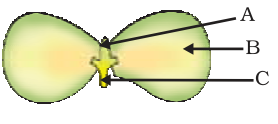
In Figure, the parts A, B and C are sequentially:
  • A
    Cotyledon, plumule and radicle.
  • B
    Plumule, radicle and cotyledon.
  • Plumule, cotyledon and radicle.
  • D
    Radicle, cotyledon and plumule.

Answer: C.

View full solution
Is the chromosome number of zygote, embryonal cells and adult of a particular organism always constant? How is the constancy maintained in these three stages?
View full solution
In a bisexual flower inspite of the young stamens being removed artificially, the flower produces fruit. Provide a suitable explanation for the above situation.
View full solution
From the internet, gather information about the chromosome numbers of five animals and five plants. Correlate the number with the size of organism and answer the following questions.
  1. Do larger organisms have more number of chromosomes/ cells?
  2. Can organism with fewer chromosomes reproduce more easily than organisms with more number of chromosomes?
  3. More the number of chromosomes/ cells greater is the DNA content. Justify.
View full solution
Distinguish between pollination and fertilisation. Mention the site and product of fertilisation in a flower.
Draw a neat, labelled diagram of a pistil showing pollen tube growth and its entry into the ovule.
View full solution
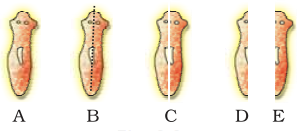
Why are budding, fragmentation and regeneration all considered as asexual types of reproduction? With neat diagrams explain the process of regeneration in Planaria.
View full solution

Generate a How do Organisms Reproduce? paper free

Pick question groups from the list above, set marks and difficulty, and export a branded PDF with step-by-step answer keys. First 3 chapters free — no signup.

Download App