Question types

Human Eye and Colourful World question types

31 questions across 4 question groups — pick any mix to generate a Science paper with step-by-step answer keys.

31
Questions
4
Question groups
5
Question types
Sample Questions

Human Eye and Colourful World questions

One sample from each question group in this chapter. Select any group above to see the full set with answer keys.

Q 1M.C.Q1 Mark
Twinkling of stars is due to atmospheric:
  • A
    Dispersion of light by water droplets.
  • Refraction of light by different layers of varying refractive indices.
  • C
    Scattering of light by dust particles.
  • D
    Internal reflection of light by clouds.

Answer: B.

View full solution
Q 2M.C.Q1 Mark
The danger signals installed at the top of tall buildings are red in colour. These can be easily seen from a distance because among all other colours, the red light:
  • A
    Is scattered the most by smoke or fog.
  • Is scattered the least by smoke or fog.
  • C
    Is absorbed the most by smoke or fog.
  • D
    Moves fastest in air.

Answer: B.

View full solution
Q 3M.C.Q1 Mark
A person cannot see distinctly objects kept beyond 2m. This defect can be corrected by using a lens of power:
  • A
    +0.5D
  • -0.5D
  • C
    +0.2D
  • D
    -0.2D

Answer: B.

View full solution
Q 4M.C.Q1 Mark
Which of the following phenomena of light are involved in the formation of a rainbow?
  • A
    Reflection, refraction and dispersion.
  • B
    Refraction, dispersion and total internal reflection.
  • Refraction, dispersion and internal reflection.
  • D
    Dispersion, scattering and total internal reflection.

Answer: C.

View full solution
Q 5M.C.Q1 Mark
The focal length of the eye lens increases when eye muscles:
  • Are relaxed and lens becomes thinner.
  • B
    Contract and lens becomes thicker.
  • C
    Are relaxed and lens becomes thicker.
  • D
    Contract and lens becomes thinner.

Answer: A.

View full solution
A person needs a lens of power -4.5D for correction of her vision.
  1. What kind of defect in vision is she suffering from?
  2. What is the focal length of the corrective lens?
  3. What is the nature of the corrective lens?
    1. She is suffering from myopia.
    2. $\text{f}=\frac{1}{\text{P}}=-\frac{1}{4.5}=-0.22\text{m}=-22\text{cm}.$
    3. Concave lens.

Answer: A.

View full solution
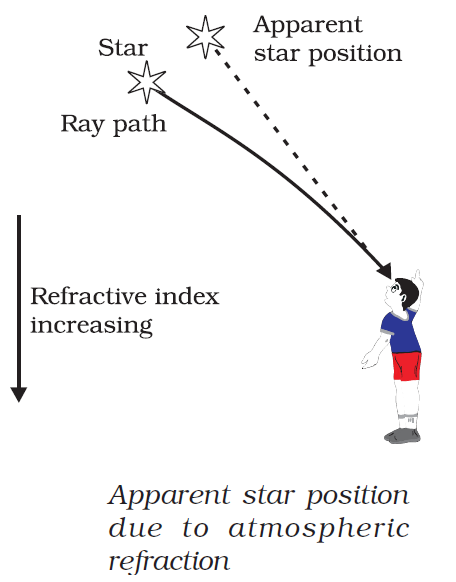
Is the position of a star as seen by us its true position? Justify your answer.
  • No. Light emitted by distant stars (act as point sources of light) passes through the atmosphere of the earth before reaching our eyes. The atmosphere of the earth is not uniform but consists of many layers of different densities. The layers close to the surface of the earth are optically denser. As we go higher and higher, the density of layers and refractive index decreases progressively. As the light from a star enters the upper­most layer of the atmosphere, it bends towards the normal as it enters the next layer. This process continues till the light enters our eyes. So due to refraction of light, the apparent position of the star is different from the actual position of the star (Figure).

Answer: A.

View full solution
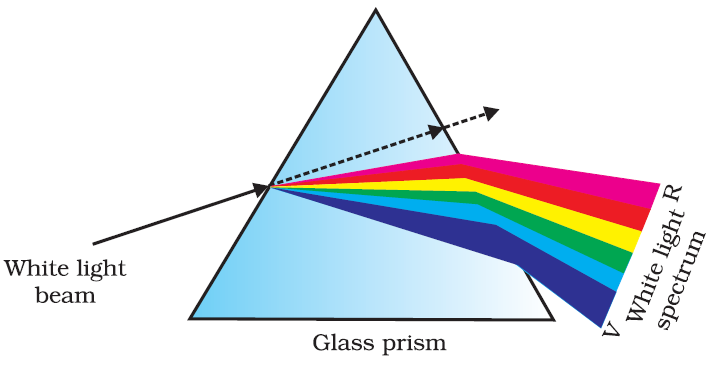
Draw a ray diagram showing the dispersion through a prism when a narrow beam of white light is incident on one of its refracting surfaces. Also indicate the order of the colours of the spectrum obtained.

Answer: A.

View full solution
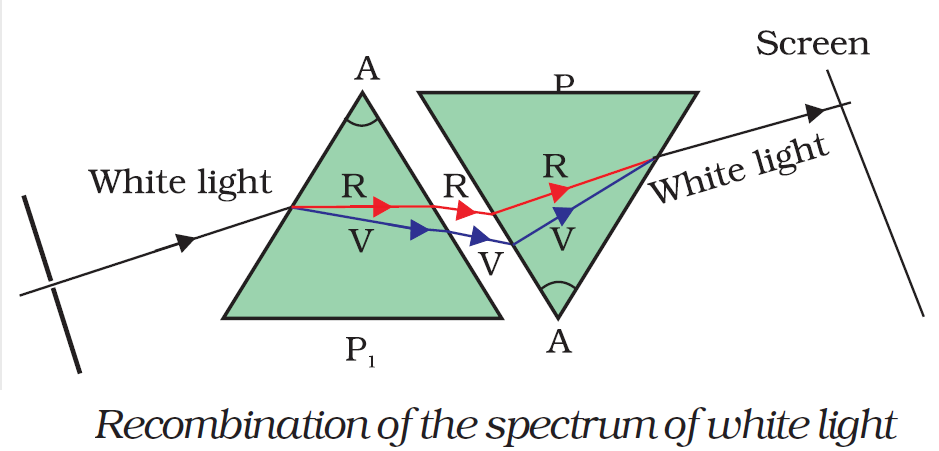
How will you use two identical prisms so that a narrow beam of white light incident on one prism emerges out of the second prism as white light? Draw the diagram.
  • For this, one prism is placed near another prism so that one prism is in erect position and another prism is in inverted position. When ray of white light enters the first prism, dispersion of light takes place. When lights of different colours pass through the second prism, they recombine to make a ray of white light.

Answer: A.

View full solution
How are we able to see nearby and also the distant objects clearly?
  • Human eyes have power of accommodation. When we have to see distant objects, the eye muscles relax and lens becomes thin. Due to this, the focal length of the lens increases and the eye is able to see distant objects. When we have to see nearby objects, the eye muscles contract and lens becomes thick. Due to this, the focal length of the lens decreases and the eye is able to see nearby objects.

Answer: A.

View full solution
When do we consider a person to be myopic or hypermetropic? Explain using diagrams how the defects associated with myopic and hypermetropic eye can be corrected?
View full solution

Generate a Human Eye and Colourful World paper free

Pick question groups from the list above, set marks and difficulty, and export a branded PDF with step-by-step answer keys. First 3 chapters free — no signup.

Download App