Questions

case /data -based (4 Marks)

Take a timed test

14 questions · self-marked practice — reveal the answer and mark yourself.

Question 14 Marks
Questions are based on the two table given below. Study these tables related to blood pressure level and answer the question that follow :

TABLE- A

BLOOD PRESSURE CATEGORYSYSTOLIC mm Hg (Upper number)DIASTOLIC mm Hg (Lower number)
Normal12080
Elevated120-129Less than 80
High Blood Pressure (Hypertension) Stage 1130-13980-90
High Blood Pressure (Hypertension) Stage 2140 or higher90 or higher
Hypertensive crisis (consult your doctor immediately)Higher than 180Higher than 120

TABLE-B

Time of MeasurementBlood Pressure
Patient-XPatient-Y
Morning75-11585-125
Afternoon79-12280-120
Evening82-13275-110

(i) In the table B, at which time patent-Y have ideal normal blood pressure?
(ii) Identify the patient, which have hypertension stage-1 blood pressure ?
(iii) Which Diet is the best for high blood pressure patient?
or
(iv) What is the ideal blood pressure measurement of a human?

Answer
(i) Afternoon (80-120)
(ii) Patient $\times(82-132)$ Evening
(iii) Grain and fruits
or
(iv) $80-120 mm Hg$
View full question & answer
Question 24 Marks
Read the following and answer any three questions from (i) to (iv).Heterotrophic nutrition is a mode of nutrition in which organisms obtain readymade organic food from outside sources. The organisms that depend upon outside sources for obtaining organic nutrients are called heterotrophs. Heterotrophic nutrition is of three types: saprophytic, parasitic and holozoic nutrition.
  1. In which groups of organisms food material is broken outside the body and absorbed?
     
  2. What is a heterotrophs?
     
  3. A) Give an example of saprotroph?
    B) Write three types of Heterotrophic nutrition?

    OR
  4. What Heterotrophic nutrition involves?
Answer
  1. (b) Yeast, mushroom, bread mould.
Explanation:

Yeast, mushroom and bread mould have a saprophytic mode of nutrition which is chemoheterotrophic in nature. They breakdown complex organic substances by secreting digestive enzyme outside their body and absorb simple molecules as nutrients.
  1. (b) Taenia
  2. (b) Mushroom
  3. (c) Utilisation of energy obtained by plants.
Explanation:

Heterotrophic nutrition is mode of nutrition in which an organism depends on other living organisms for food.
  1. (d) Cytostome.
Explanation:

Feeding apparatus in Paramecium consists of peristome, vestibule, buccal cavity, cytostome (cell mouth) and cytopharynx.
View full question & answer
Question 34 Marks

Read the following and answer any three questions from (i) to (iv).
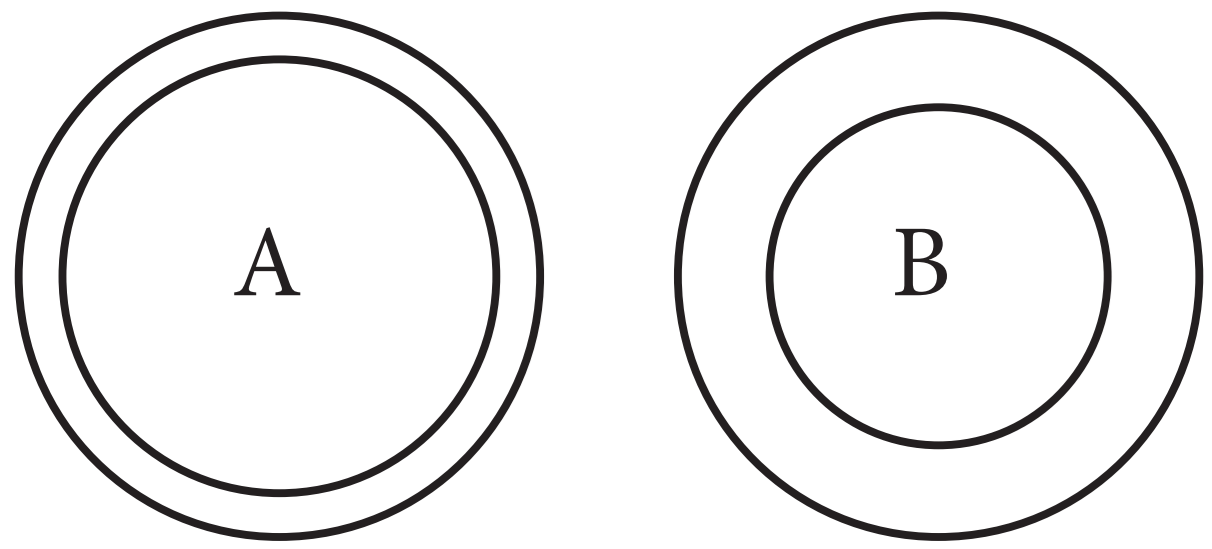
Given are the sections of two pipes, A and B. lf you need to represent blood vessels with these, which of the pipes would correspond to the artery and which one to a vein. Identify it and answer the following questions.
  1. B is best defined as the vessel of which?
     
  2. In A, valves are present to check backward flow of blood flowing at?
     
  3. Which of the pipes would correspond to the artery and which one to a vein?

    OR
  4. How Blood pressure in the pulmonary artery works?
Answer
  1. (b) Always carry blood away from the heart to different organs.
Explanation:
In the given figures, B represents artery that carry blood away from the heart to different organs.
  1. (c) Low pressure.
Explanation:
In the given figures, A represents vein. Veins bring blood from different body parts to the heart. The flow of blood in veins is not so fast because the blood in veins is under low pressure. Veins possess valves which prevent backward flow of blood.
  1. (a) Carries blood from an organ towards the heart.
Explanation:
Veins carry deoxygenated blood with single exception, i.e., pulmonary vein. Arteries carry blood from heart towards the organ.
  1. (d) None of these.
  2. (a) More than that of pulmonary vein.
View full question & answer
Question 44 Marks
Read the following and answer any three questions from (i) to (iv).All living cells need nutrients, O, and other essential substances. Also, the waste and harmful substances need to be removed continuously for healthy functioning of cells. So, a well developed transport system is mandatory for living organisms. Complex organisms have special fluids within their bodies to transport such materials. Blood is the most commonly used body fluid by most of the higher organisms. Lymph also helps in the transport of certain substances.
  1. Which activity does not exhibit phagocytic?
     
  2. Amount of blood corpusles in changed in dengue fever. One of the common symptoms observed in people infected with dengue fever?
     
  3. Why are WBCs called soldiers of the body?

    OR
  4. Write the feature of lymph?
Answer
  1. (c) Basophil
  2. (c) significant decrease in platelets count
  3. (c) They fight against disease causing germs.
  4. (d) Thrombocytes
  5. (a) It is similar to the plasma of blood, but is colourless and contains less proteins.
View full question & answer
Question 54 Marks
Read the following and answer any three questions from (i) to (iv).The food which is prepared by the process of photosynthesis in the leaves of a plant has to be transported to other parts like stem, roots, branches, etc. Therefore this food is transported to other parts of the plant through phloem.
i. A few drops of sap were collected by cutting across a plant stem by a suitable method.'Tile sap was tested chemically. Which test results indicate that it is phloem sap?

ii. What is the direction of movement of sugars in phloem?

iii. A girdled plant (Upto bast) may survive for some time but it will eventually die, because?

OR
  1. a) Phloem sap is mainly made of?
    b) How food is transported to phloem?
Answer
  1. (b) Alkaline.
  2. (a) Bi-directional.
Explanation:

Food is transported by vascular tissue phloem from source to sink. Source is a part that synthesise food and sink is a part that stores or needs the food. Since source and sink can be reversed depending on plant's need, therefore direction of movement of sugar in phloem can be bidirectional, i.e., both upwards or downwards.
  1. (b) 6 → 5 → 2 → 3
  2. (c) Sugars and other organic materials will not move downwards.
  3. (a) Water and sucrose.
Explanation:

Phloem sap consists primarily of water with sugars (sucrose) dissolved in it. It flows from the source or supply end (region of manufacture or storage) to the region of utilisation or sink.
View full question & answer
Question 64 Marks
Read the following and answer any three questions from (i) to (iv).ln fermentation, the incomplete oxidation of glucose achieved under anaerobic conditions by sets of reactions where pyruvic acid is converted to $CO _2$ and ethanol. The enzymes, pyruvic acid decarboxylase and alcohol dehydrogenase catalyse these reactions.
i. What is photosynthesis?
  1. Represent Fermentation by the equation?
  2. A test tube containing molasses solution and yeast is kept in a warm place over Night. The gas collected from that mixture will result in.

    OR
  3. a) How does Ethyl alcohol fermentation occur?
    b) what is pyruvic acid?
Answer
  1. (c) Anaerobic respiration.
Explanation:

ln the test tube full of mercury (figure A) there is no air and, therefore, the introduced soaked seeds do not get air for aerobic respiration. But they are capable of respiration in the absence of oxygen, as is indicated by the evolution of carbon dioxide (figure B). Therefore, anaerobic respiration takes place in the seeds in the absence of free oxygen. The experiment also shows that $CO _2$ is evolved in anaerobic respiration of seeds.
  1. (b) $6\text{H}_{2}\text{O}_6\rightarrow2\text{C}_2\text{H}_5\text{OH}+2\text{CO}_2+59\text{ Kcal}$
  2. (d) Both (a) and (c).
Explanation:

The given process is an example of alcoholic fermentation, thus the gas produced is $CO _2$
  1. (c) Yeast.
Explanation:

Ethyl alcohol fermentation occurs in fungi such as Rhizopus, yeast and bacteria.
  1. (a)
 
(i)
(ii)
(iii)
(a)
skeletal muscles
heavy exercise
glucose
Explanation:

Muscle fatigue is the reduction in force of contraction of a muscle after prolonged stimulation. ln the absence of oxygen, skeletal muscle of human beings can contract for a short time, but it gets fatigued soon. This is due to the fact that in the absence of oxygen, products of glycolysis mainly lactic acid is not disposed off and accumulates in the muscles. This leads to muscle fatigue and pain in the muscles. A muscle gets fatigued sooner after a strenuous exercise than after a mild exercise. Faster breathing for sometime after a strenuous exercise supplies extra oxygen, disposes off excess lactic acid and muscle fatigue disappears.
View full question & answer
Question 74 Marks
Read the following and answer any four questions from (i) to (v).
We need energy to perform various activities. This energy is derived from the catabolism of various components of food, e.g., proteins, carbohydrates, fats, etc. Oxygen is required for catabolic processes and carbon dioxide is released in the process. So, the body requires a continuous exchange of gases, oxygen from the atmosphere is taken inside, and carbon dioxide produced is given out. In human beings, respiratory pigment called hemoglobin present in RBCs has very high affinity for oxygen. In tissues, exchange of gases occurs between oxygenated blood and tissue cells.
  1. People living at sea level have around 5 million RBCs per cubic millimetre of their blood whereas those living at an altitude of 5400 metres have around 8 million. This is because at high altitude:
  1. People eat more nutritive food, therefore more RBCs are formed
  2. People get pollution-free air to breathe and more oxygen is available
  3. Atmospheri $CO _2$ level is less and hence more RBCs are needed to absorb the required amount of 02 to survive
  4. There is more UV radiation which enhances RBC production.
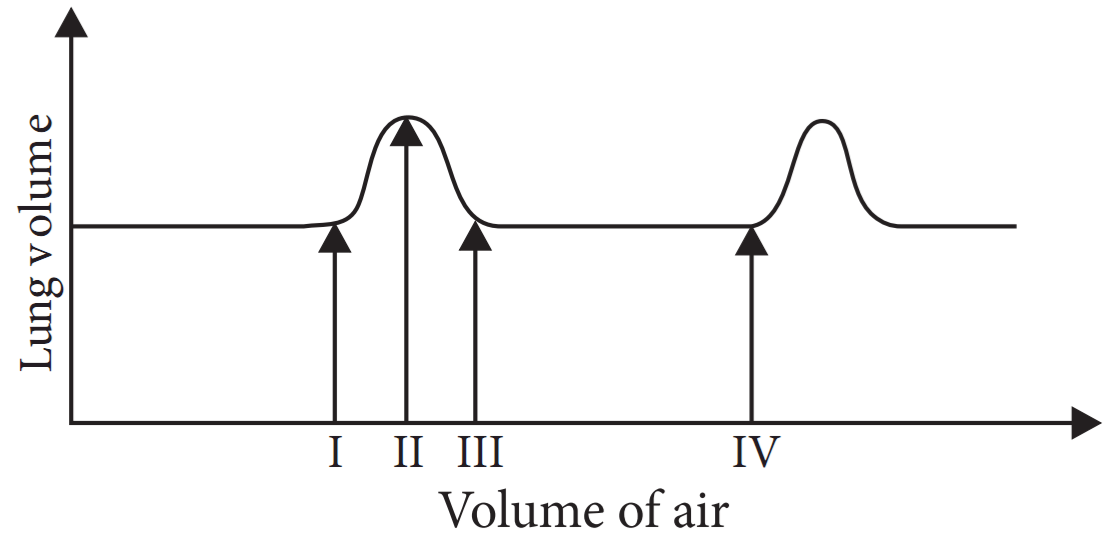
  1. The given graph illustrates the changes in lung volume during the process of breathing.


The change from II to III indicates the
  1. Movement of diaphragm away from the lungs.
  2. Expansion of the thoracic cavity.
  3. Movement of air out of the lungs.
  4. Expansion of ribs.
  1. Which one of the following is a possibility for most of us in regard to breathing, by making a conscious effort?
  1. One can breathe out air totally without oxygen.
  2. One can breathe out air through Eustachian tube by closing both nose and mouth.
  3. One can consciously breathe in and breathe out by moving the diaphragm alone, without moving the ribs at all.
  4. The lungs can be made fully empty by forcefully breathing out all air from them.
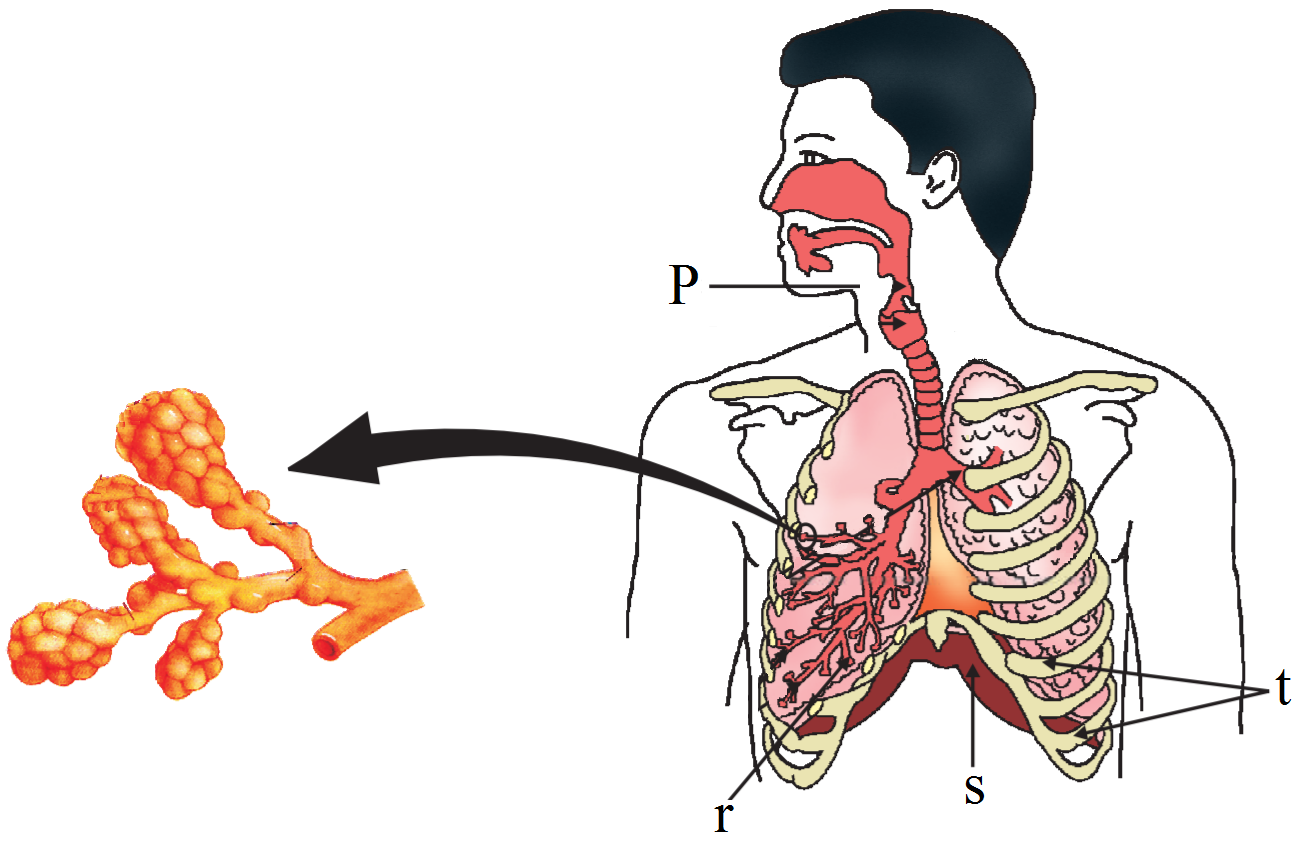
  1. Refer to the given figure and answer the following question.


Which of these parts
  1. Are the actual sites of respiratory gas exchange?
  2. Is the common passage for air and food?
  3. Is provided with incomplete cartilaginous rings?
  4. Relaxes and gets back to its original shape during expiration?
  5. Moves upwards and outwards during inspiration?
  1. (I) - s, (II) - p, (III) - q, (IV) - r, (V) - t
  2. (I) - r, (II) - p, (III) - q, (IV) - s, (V) - t
  3. (I) - t, (II) - q, (III) - r, (IV) - s, (V) - p
  4. (I) - p, (II) - q, (III) - r, (IV) - s, (V) - t
  1. Which of the following sequences is correct to initiate inspiration?
  1. The contraction of intercostal muscles raises the ribs and sternum.
  2. Volume of thorax increases.
  3. Intrathoracic pressure of the lungs decreases.
  4. Diaphragm contraction.
Air rushes into lungs.
  1. (I), (II), (IV), (V), (III)
  2. (I), (II), (III), (IV), (V)
  3. (I), (IV), (II), (III), (V)
  4. (V), (I), (II), (III), (IV)
Answer
  1. (c) Atmospheri $CO _2$ level is less and hence more RBCs are needed to absorb the required amount of $O _2$ to survive
Explanation:

Number of RBCs per cubic millimetre of blood is likely to be higher in people living at high altitudes. This is in response to the air being less dense at high altitude and thus more RBCs (and hence more Hb) are needed to absorb the required amount of $O _2$ from the air having low $PO _2$ (partial pressure of $O _2$).
  1. (c) Movement of air out of the lungs.
Explanation:

The change from II to III indicates decrease in the volume of lungs and thus, increase in the pressure of air inside the lungs. This results in movement of air out of the lungs.
  1. (c) One can consciously breathe in and breathe out by moving the diaphragm alone, without moving the ribs at all.
  2. (I) - r, (II) - p, (III) - q, (IV) - s, (V) - t
Explanation:

p-pharynx, q-trachea, r-alveoli, s-diaphragm, t-ribs
  1. (I), (IV), (II), (III), (V)
View full question & answer
Question 84 Marks
Read the following and answer any four questions from (i) to (v).
The green plants make their food, through photosynthesis and are therefore called autotrophs. All other organisms depend upon green plants for food and are referred to as heterotrophs. Green plants carry out photosynthesis by using light energy of sun. The first phase of reactions are directly light driven therefore called light reactions. The second phase of reactions are not directly light driven but are dependent on the products of light reactions and are called dark reactions.
  1. Which of the following is produced during the light phase of photosynthesis?
  1. ATP
  2. NADPH
  3. Carbohydrate
  4. Both (a) and (b)
  1. ln the overall process of photosynthesis, the number of sugar molecules produced is:
  1. 12
  2. 6
  3. 4
  4. 1
  1. A plant is provided with ideal conditions for photosynthesis and supplied with isotope ${ }^{14} CO _2$ When the products of the process are analysed carefully, what would be the nature of products?
  1. Both glucose and oxygen are normal.
  2. Both glucose and oxygen are labelled.
  3. Only glucose is labelled and oxygen is normal.
  4. Only oxygen is labelled and glucose is normal.
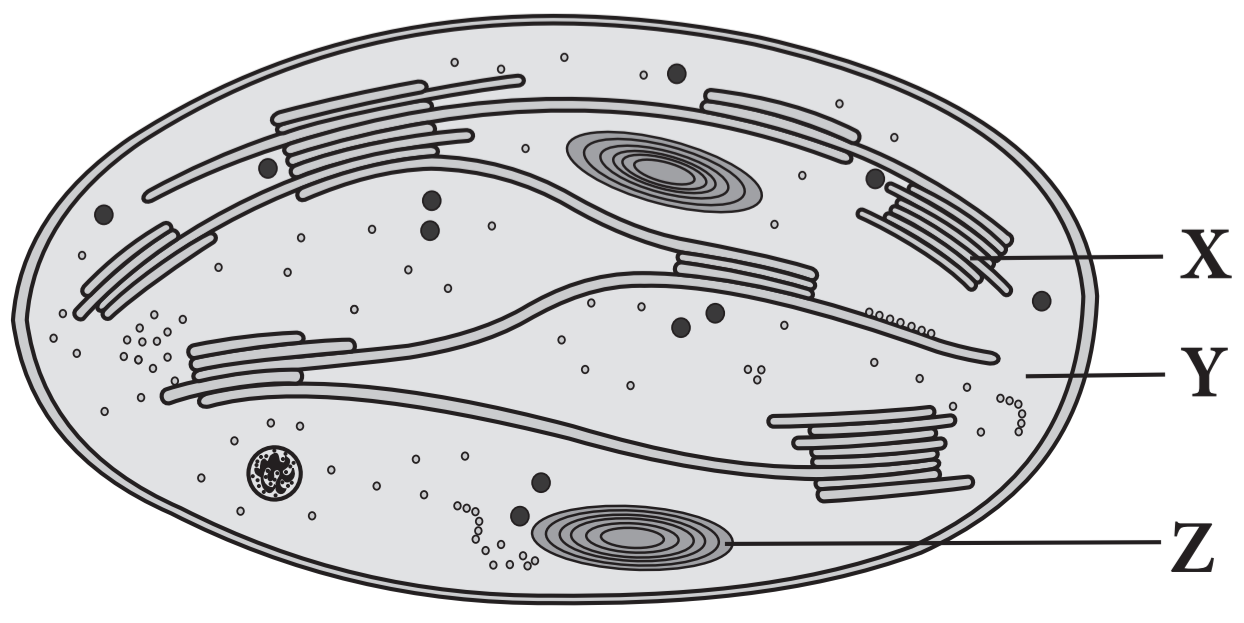
  1. Refer to the given diagrammatic representation of an electron micrograph of a section of chloroplast and answer the question.


Select the option which correctly depicts the functions of parts X, Y and Z.
 
X
Y
Z
(a)
Dark reaction
Light reaction
Carbohydrate synthesis
(b)
Light reaction
Carbohydrate synthesis
Carbohydrate storage
(c)
Light reaction
Carbohydrate storage
Carbohydrate synthesis
(d)
Carbohydrate synthesis
Carbohydrate storage
Cytoplasmic inheritance
  1. Following table summarises the differences between light and dark reactions.
 
Light reactions
Dark reactions
(I)
These are also called biosynthetic phase.
These are also called photochemical phase.
(II)
These reactions occur over thylakoids
These reactions occur in stroma of chloroplasts.
(III)
These produce assimilatory power i.e., NADPH and ATP.
These consume NADPH and ATP.
(IV)
These are directly dependent upon light.
'They depend upon the products synthesised during light reactions.
Which of the following is correct group of differences?
  1. (I), (II) and (III)
  2. (II), (III) and (IV)
  3. (II) and (III)
  4. (I) and (IV)
Answer
  1. (d) Both (a) and (b)
Explanation:

In light reaction of photosynthesis assimilatory power is produced, i.e., energy rich ATP molecules and reduced coenzyme NADPH.
  1. (d) 1
Explanation:

The equation of photosynthesis may be represented as $6 CO _2+12 H _2 \rightarrow C _6 H _{12} O _6+6 H _2 O +6 O _2$ No. of $C _6 H _{12} O _6$ (sugar) molecules produced = 1
  1. (c) Only glucose is labelled and oxygen is normal.
  2. (b)
 
X
Y
Z
(b) Light reaction Carbohydrate synthesis Carbohydrate storage
Explanation:

Light reactions (or photochemical phase) of photosynthesis mainly occur on the grana thylakoids. Dark reactions (or biosynthetic phase) which involve synthesis of carbohydrates by $CO _2$ fixation, occur in the stroma (or matrix) of chloroplasts. The chloroplast matrix of higher plants stores starch temporarily in the form of starch granules.
  1. (b) (II), (III) and (IV)
Explanation:

Light reactions are also called photochemical phase whereas dark reactions are also called biochemical phase.
View full question & answer
Question 94 Marks
Read the following and answer any four questions from (i) to (v).Our body needs to remove the wastes that build up from cell activities and from digestion. It these wastes are not removed, then our cells can stop working and we can get very sick. The organs of our excretory system help to release wastes from our body. The excretory system consists of a pair of kidney, a pair of ureters, a urinary bladder and a urethra. Each kidney is made up of nearly one million complex tubular structures called nephrons. The formation of urine involves various processes that takes place in the different parts of the nephron. Each nephron consists of a cup-shaped upper end called Bowman's capsule containing a bunch of capillaries called glomerulus. Bowman's capsule leads to tubular structure-proximal convoluted tubule, loop of Henle and distal convoluted tubule which ultimately joins the collecting tubule.
  1. The following substances are the excretory products in animals. Choose the least toxic form.
  1. Urea
  2. Uric acid
  3. Ammonia
  4. $CO^2$
  1. The outline of principal events of urination is given below in random manner.
  1. Stretch receptors on the wall of urinary bladder send signals to the CNS.
  2. The bladder fills with urine and becomes distended.
  3. Micturition.
  4. CNS passes on motor messages to initiate the contraction of smooth muscles of bladder and simultaneous relaxation of urethral sphincter.
The correct sequence of the events is:
  1. (I) → (II) → (Ill) → (IV)
  2. (IV) → (III) → (II) → (I)
  3. (II) → (I) → (IV) → (III)
  4. (Ill) →(II) → (I) → (IV).
  1. A person who is not taking food or beverages will have in urine.
  1. Little glucose.
  2. Less urea.
  3. Excess urea.
  4. Little fat.
  1. Glomerular filtrate is first collected by:
  1. Distal convoluted tubule.
  2. proximal convoluted tubule.
  3. Bowman's capsule.
  4. Loop of Henle.
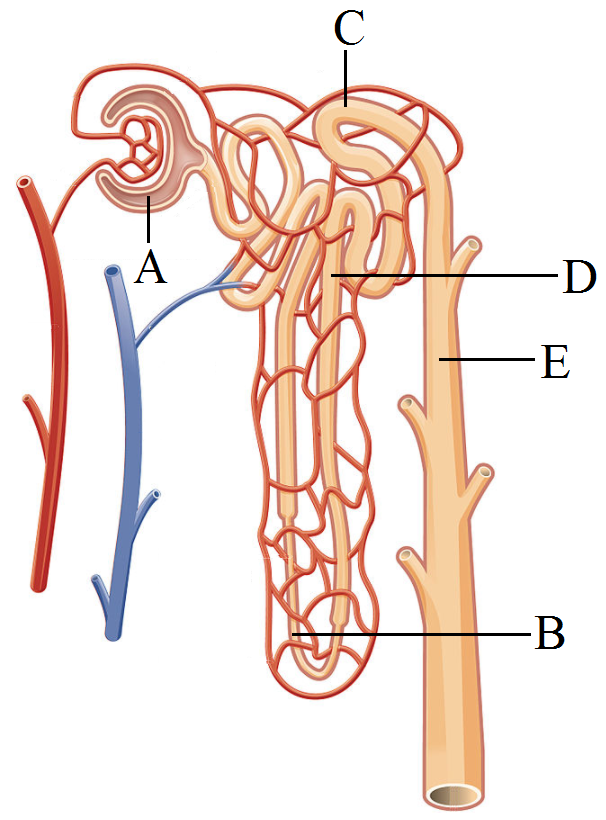
  1. The given figure represents a single nephron from a mammalian kidney. Identify the labelled parts, match them with the options (i-iv) and select the correct answer.
  1. The site of ultrafiltration
  2. Collect the urine and make it more concentrated
  3. The main site for the reabsorption of glucose and amino acids
  4. Largely responsible for the maintenance of blood $p_H$
  1. (I)-A, (II)-E, (III)-C, (IV)-D
  2. (I)-A, (II)-B, (III)-C, (IV)-D
  3. (I)-B, (II)-A, (III)-C, (IV)-E
  4. (I)-E, (II)-B, (III)-0, (IV)-A
Answer
  1. (B) Uric acid
Explanation:

Nitrogenous waste substances such as ammonia, urea or uric acid are produced during protein metabolism. Ammonia is the most toxic, followed by urea and uric acid. Uric acid is least toxic.
  1. (c) (II) → (I) → (IV) → (III)
  2. (b) Less urea.
Explanation:

Urea is a nitrogenous waste formed as a result of metabolism of various food/beverages in the body and is excreted in the urine. So, if a person is not taking food/beverages he will have less urea in his urine.
  1. (c) Bowman's capsule.
  2. (a) (I)-A, (II)-E, (III)-C, (IV)-D
Explanation:

Malpighian corpuscle (A) is the site of ultrafiltration. A considerable amount of water is reabsorbed in the collecting duct (E) under the influence of ADH. Proximal convoluted tubule (C) is the main site for the reabsorption of glucose and amino acids. In distal convoluted tubule (D), both hydrogen ions and ammonium ions are secreted, thus it maintains blood pH.
View full question & answer
Question 104 Marks
Small hair-like structures line the upper part of the human respiratory tract.
These structures trap the dust particles, germs and chemicals entering the human body during
breathing.
10. Smoking is likely to cause infections in the respiratory tract.
Which statement best explains the fact?
A. Smoking destroys the hair-like structures.
B. Smoking causes excessive growth of the hair-like structures.
C. Smoking stimulates the hair-like structures to release harmful chemicals.
D. Smoking makes the hair-like structures wet and they fail to trap dust particles.
Answer
10. A. Smoking destroys the hair-like structures.
View full question & answer
Question 114 Marks
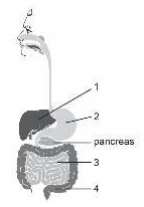
The diagram below shows the human alimentary canal.
1, 2, 3 and 4 are four different organs that are parts of the canal.

Image
8. Which of the labelled parts represents the liver?
A. 1
B. 2
C. 3
D. 4
9. Which of the following will be adversely affected in Mr. Ayub’s body?
Pancreas secretes lipase enzyme. Mr. Ayub is suffering from malfunctioning of the pancreas.
A. Digestion of carbohydrates
B. Digestion of proteins
C. Digestion of fats
D. Digestion of vitamins

Answer
8. A. 1
9. C. Digestion of fats
View full question & answer
Question 124 Marks
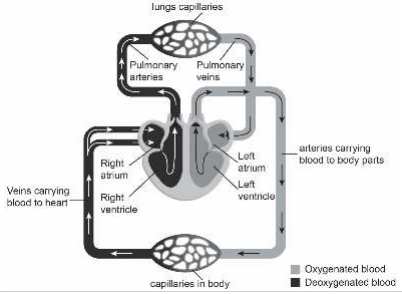
Blood transports oxygen and carbon dioxide to different parts of the human body.
The exchange of gases between blood and inhaled air takes place in the capillaries of lungs.
The diagram below shows how blood circulates in the human body.

Image
6. What statement is supported by the diagram?
A. All arteries carry oxygenated blood.
B. Capillaries are permeable to gases.
C. The wall between the left ventricle and the right ventricle is porous.
D. Blood can low back and forth between the right atrium and the right ventricle.
7. Which of these will be the immediate effect if gaseous exchange in the lung capillaries reduces?
A. Blood will low in the reverse direction.
B. Pulmonary veins will receive blood with less oxygen.
C. The space inside the left and the right atrium will increase.
D. The pressure of blood inside the capillaries will decrease.

Answer
6. B. Capillaries are permeable to gases.
7. B. Pulmonary veins will receive blood with less oxygen.
View full question & answer
Question 134 Marks
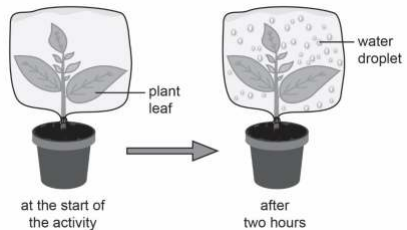
Sanjeev wanted to check whether plant leaves release water vapour.
He took a potted plant and covered the plant with a plastic bag.
The picture below shows what he observed after 2 hours.

Image
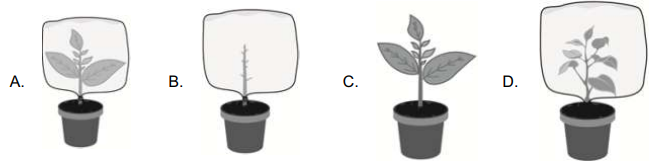
4. Sanjeev compared the results of the activity with a new pot to conirm his indings.
Which of the following best represents the new pot?

Image
5. How does the loss of water by plant leaves help the plant? Mention two points.

Answer
4. B. Image
5. Mentions that loss of water by plant leaves helps the plant in absorbing water and minerals from the soil and also in controlling the temperature.
For example:
● It helps the plant to absorb water and minerals from the soil.
● It helps the plant to control its temperature.
View full question & answer
Question 144 Marks
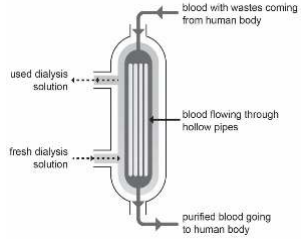
The process of iltering blood outside the human body to remove harmful wastes is called Dialysis.
Dialysis takes place in an enclosed chamber.
The given diagram shows how dialysis works.

Image
1. Which of the following must be true for a dialysis chamber?
Circle ‘Yes’ or ‘No’ to indicate your response.

Is this necessary for dialysis?

Yes or No

Used dialysis solution is recycled back to the chamber as fresh dialysis solution.

Yes/No

The hollow pipes should have semi-permeable walls.

Yes/No

The blood pressure inside the hollow pipes should be higher than that inside the human body

Yes/No

2. What type of blood vessel brings in the blood with wastes?
3. Which organ acts like a natural dialysis chamber in the human body?
A. Heart
B. Brain
C. Kidneys
D. Pancreas

Answer
1. No
Yes
Yes
2. Mentions that the blood with wastes is coming from a vein. For example:
● Blood with waste is coming from a vein.
3. C. Kidneys
View full question & answer
case /data -based (4 Marks) - Science STD 10 Questions - Vidyadip