Questions

[5 marks Questions]

🎯

Test yourself on this topic

44 questions · timed · auto-graded

Question 15 Marks
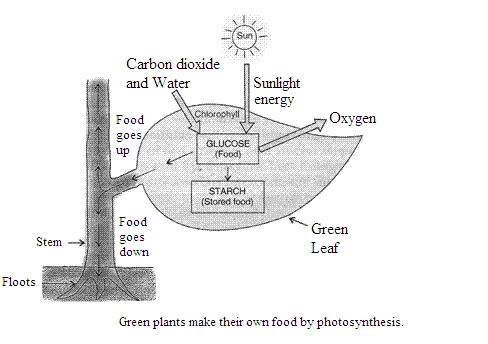
An organism A which cannot move from one place to another, makes a simple food B from the substances C and D available in the environment. This food is made in the presence of a green coloured substance E present in organs F in the presence of light energy in a process called G. Some of the simple food B also gets converted into a complex food H for storage purposes. The food H gives a blue-black colour with dilute iodine solution.
  1. What is (i) organism A, (ii) food B and (iii) food H?
  2. What are C and D?
  3. Name (i) green coloured substance E, and (ii) organ F.
  4. What is the process G?
Answer
  1. (i) Organism A is a green plant, (ii) Food B is glucose and (iii) Food H is starch.
  2. C is carbon-dioxide and D is water.
  3. (i) The green coloured substance E is chlorophy ll and (ii) Organ F is a leaf.
  4. The process G is photosynthesis.
View full question & answer
Question 25 Marks
During the respiration of an organism A, 1 molecule of glucose produces 2 ATP molecules whereas in the respiration of another organism B, 1 molecule of glucose produces 38 ATP molecules.
  1. Which organism is undergoing aerobic respiration?
  2. Which organism is undergoing anaerobic respiration?
  3. Which type of organism, A or B, can convert glucose into alcohol?
  4. Name one organism which behaves like A.
  5. Name two organisms which behave like B.
Answer
  1. Organism B is undergoing aerobic respiration.
  2. Organism A is undergoing anaerobic respiration.
  3. In anaerobic respiration, glucose breaks down to form alcohol and carbon dioxide with the release of small amount of energy. Hence, organism A can convert glucose into alcohol.
  4. Yeast behaves like organism A.
  5. Humans and dogs behave like organism B.
View full question & answer
Question 45 Marks
What are the methods used by plants to get rid of their waste products?
Answer
Thevarious methods used by the plants to get rid of their waste products are:
  1. The plants get rid of gaseous waste products through stomata in leaves and lenticels in stems.
  2. They get rid of solid and liquid waste by shedding off leaves, peeling of bark and falling of fruits.
  3. Secreting gums and resins.
  4. Plants excrete some waste substances into the soil around them.
View full question & answer
Question 55 Marks
Water and dissolved minerals get into the root hair of a plant by a process called A and enter the conducting tissue B. The process C helps the water and dissolved minerals to move up through the tissue B in roots and stem, and reach the leaves of a plant. In the leaves food is made by a process D. This food is then transported to all the parts of a plant through tissue E. The process of distributing food made in the leaves to all the parts of the plants is called F.
  1. What are (i) A, (ii) B, (iii) C, (iv) D, (v) E, and (vi) F?
  2. Which tissue is made up of living cells: B or E?
  3. Which tissue, B or E, contains sieve tubes?
  4. Which tissue, B or E, contains tracheids?
Answer
  1.  
  1. The process by which water and dissolved minerals get into the root hair of a plant is known as diffusion. Hence, A is diffusion.
  2. The water and dissolved minerals are absorbed by the cells of the root hair, which enter the conducting tissue known as xylem. Hence, B is xylem.
  3. Transpiration helps in transporting water and dissolved minerals to move up through the xylem tissue (B) in the roots and the stem, and reach the leaves of a plant. Hence, C is transpiration.
  4. In leaves, the food is prepared by a process known as photosynthesis. Hence, the process D is photosynthesis.
  5. The food synthesised by the leaves of a plant is transported to all the parts of a plant through tissue phloem (E). Hence, E is phloem.
  6. The process of distributing (or transporting) food made in the leaves to all the parts of the plant is called translocation. Hence, F is translocation.
  1. B represents xylem, while E represents phloem. Out of these, phloem (E) is made of living cells.
  2. E (phloem) contains sieve tubes.
  3. B (xylem) contains tracheids.
View full question & answer
Question 65 Marks
There are four organisms A, B, C and D. The organism A eats only the flesh of other animals as food. The organism B can eat grains, fruits and vegetables as well as meat and fish. The organism C can make the food itself from simple inorganic substances present in the environment by utilising sunlight energy. On the other hand, organism D eats only plants and their products as food.
  1. Which organism is
  1. Omnivore,
  2. Herbivore,
  3. Carnivore?
  1. Which organism is an autotroph?
  2. Which organism is/ are heterotroph (s)?
  3. Which organism can be a producer?
  4. Which organism is/ are consumer (s)?
Give one example each of organisms which could be like A, B, C and D.
Answer
  1. Organism B refers to an omnivore, Organism D refers to a herbivore and Organism A refers to a carnivore.
  2. Organism C is an autotroph.
  3. The organisms A, B and D are heterotrophs as they obtain food from other organisms and cannot synthesise their own food.
  4. Organism C can be a producer as it is an autotroph.
  5. The organisms A, B and D are consumers as they all are heterotrophs.
  6. The examples of organisms A, B, C and D are lion, crow, green plants (like mango) and cow, respectively.
View full question & answer
Question 75 Marks
What is the main difference between aerobic respiration and anaerobic respiration? Give one example of each.
Answer
Aerobic respiration:
  1. Aerobic respiration takes place in the presence of oxygen.
  2. Complete breakdown of food occurs in aerobic respiration.
  3. The end products in aerobic respiration are carbon-dioxide and water.
  4. Aerobic respiration produces a considerable amount of energy.
Example: Human Beings.
Anaerobic respiration:
  1. Anaerobic respiration takes place in the absence of oxygen.
  2. Partial breakdown of food occurs in anaerobic respiration.
  3. The end products in anaerobic respiration are ethanol and carbon-dioxide (in yeast) and lactic acid (in animal muscles).
  4. Much less energy is produced in anaerobic respiration.
Example: Yeast.
View full question & answer
Question 85 Marks
The organs A of a person have been damaged completely due to which too much of a poisonous waste material B has started accumulating in his blood, making it dirty. In order to save this person's life, the blood from an artery in the person's arm is made to flow into long tubes made of substance E which are kept in coiled form in a tank containing solution F. This solution contains three materials G, H and I in similar proportions to those in normal blood. As the person's blood passes through long tubes of substance E, most of the wastes present in it go into solution. The clean blood is then put back into a vein in the arm of the person for circulation.
  1. What are organs A?
  2. Name the waste substance B.
  3. What are (i) E and (ii) F? Name G, H and I.
  4. What is the process described above known as?
Answer
  1. Organ A is kidney. Complete damage of the kidney (organ A) can lead to the accumulation of waste material B, i.e. urea, in the blood.
  2. The waste substance B is urea.
  3. (i) In dialysis, the blood from a convenient artery is pumped into the dialyser of a dialysing machine. The dialyser contains a coiled cellophane tube made of substance E, called cellulose. It is surrounded by the dialysing solution (F). Hence, E represents cellulose. (ii) F represents the dialysing solution.
  4. The dialysing solution contains water (G), glucose (H) and salts (I), which is similar in concentration to those in normal blood.
  5. The process of removing waste substances like urea from the blood using a kidney machine is known as dialysis.
View full question & answer
Question 95 Marks
What are the different modes of nutrition? Explain with one example of each mode of nutrition.
Answer
There are mainly two modes of nutrition:
Autotrophic: Autotrophic nutrition is that mode of nutrition in which an organism makes its own food from the simple inorganic materials like carbon-dioxide and water present in the surroundings (with the help of sunlight energy).
Example: Green plants obtain food by autotrophic nutrition.
Heterotrophic: Heterotrophic nutrition is that mode of nutrition in which an organism cannot make its own food from simple inorganic materials like carbon-dioxide and water, and depends on other organisms for its food.
Example: All animals obtain food by heterotrophic nutrition.
View full question & answer
Question 105 Marks
The organisms A, B and C can obtain their food in three different ways. Organism A derives its food from the body of another living organism which is called its D, without killing it. The organism B takes in the solid food by the process of ingestion, digests a part of this food and throws out undigested food in the process called E. The organism C obtains its food from dead and decaying plants.
  1. What is the mode of nutrition of (i) organism A (ii) organism B, and (iii) organism C?
  2. What is the organism like D called?
  3. Name the process E.
  4. Give one example each of organisms like A, B and C.
  5. What is the general name of three modes of nutrition exhibited by organisms A, B and C?
Answer
  1.  
  1. Organism A has parasitic mode of nutrition.
  2. Organism B has holozoic mode of nutrition.
  3. Organism C has saprophytic mode of nutrition.
  1. The organisms like D are called hosts.
  2. The process E is egestion.
  3. The example of organisms like
  1. A is Cuscuta.
  2. B is cow.
  3. C is mushroom.
  1. The general name of the three modes of nutrition exhibited by organism A, B and C are parasitic nutrition, holozoic nutrition and saprophytic nutrition, respectively.
View full question & answer
Question 115 Marks
A liquid X of colour Y circulates in the human body only in one direction: from body tissues to the heart. Among other things, liquid X contains germs from cells and dead cells. The liquid X is cleaned of germs and dead cells by a special type of white blood cells called Z. This cleaned liquid is then put into blood circulatory system in subclavian veins.
  1. What is (i) liquid X and (ii) colour Y?
  2. What are Z.
  3. The liquid X is somewhat similar to a component of blood. Name this component.
  4. Why is liquid X not red?
Answer
  1. Lymph (X) is a light yellow colour (Y) liquid that circulates in the human body. It circulates from the body tissues to the heart. Hence, (i) the liquid X is lymph., (ii) The colour Y is light yellow.
  2. The liquid X (lymph) is cleaned of germs and dead cells by a special type of white blood cells called lymphocytes (Z). Lymphocyte helps in fighting infections and diseases. Thus, Z represents lymphocytes.
  3. The liquid X, i.e. lymph, is somewhat similar to plasma.
  4. The liquid X, i.e. lymph, is not red because it does not contain red blood cells that have red colour pigment called haemoglobin.
View full question & answer
Question 135 Marks
If the teeth are not cleaned regularly, they become covered with a sticky yellowish layer W of food particles and bacteria. Since layer W covers the teeth, the alkaline liquid X secreted by glands Y inside the mouth cannot reach the teeth surface to neutralise the acid formed by the action of organisms Z on sugary food, and hence tooth decay sets in.
  1. What is W known as?
  2. What is (i) X, and (ii) Y?
  3. What are organisms Z?
  4. State one way of removing layer W from the teeth.
Answer
  1. W is the dental plaque.
  2.  
  1. X refers to the saliva.
  2. Y refers to the salivary glands.
  1. Organisms Z are bacteria.
  2. Layer of W, i.e. dental plaque, can be removed by regular brushing of teeth.
View full question & answer
Question 145 Marks
What is lymphatic system? What are its functions?
Answer
Lymphatic system: A system of tiny tubes called lymph vessels (lymphatics) and lymph nodes (lymph glands) in the human body which transports the liquid called lymph from the body tissues to the blood circulatory system is called lymphatic system. Functions of lymphatic system:
  1. It takes part in the nutritive process of the body.
  2. It protects the body by killing the germs drained out of the body tissues with the help of lymphocytes contained in the lymph nodes, by making antibodies.
  3. It helps in removing the waste products like fragments of dead cells etc.
View full question & answer
Question 155 Marks
What are the various components of blood? State their functions.
Answer
The main components of blood are:
  1. Plasma: It carries all the dissolved substances such as proteins, digested food, common salt etc from one part to another part of the body.
  2. Red blood corpuscles (RBC): It carries oxygen from the lungs to all the cells of the body.
  3. White blood corpuscles (WBC): It fights infection and protects us from diseases.
  4. Platelets: It helps in the coagulation of blood in a cut or wound.
View full question & answer
Question 165 Marks
How are oxygen and carbon-dioxide exchanged in our body during respiration?
Answer
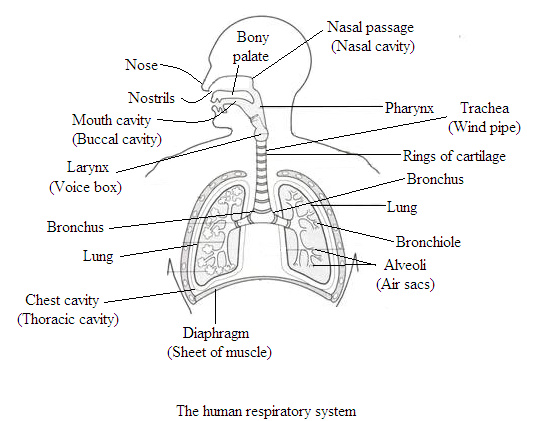
During the process of ‘breathing in’ the air sacs or alveoli of the lungs get filled with air containing oxygen. The alveoli are surrounded by capillaries carrying blood so the oxygen of air diffuses from the alveoli walls into the blood from where it is carried to all the parts of the body.As the blood passes through the tissues of the body, the oxygen present in it diffuses into the cells. This oxygen combines with the digested food to release energy. Carbon-dioxide gas is produced as a waste product during respiration in the cells of the body tissues which diffuses into the blood. Blood carries the carbon-dioxide back to the lungs where it diffuses into the alveoli.
View full question & answer
Question 175 Marks
What substances are contained in pancreatic juice? What are their functions?
Answer
Pancreatic juice contains digestive enzymes? Pancreatic Amylase, trypsin and lipase.Functions:
Pancreatic amylase: The enzyme amylase breaks down the starch. Trypsin: Trypsin digests the proteins. Lipase: Lipase breaks down the emulsified fats.
View full question & answer
Question 185 Marks
The transport system in plants consists of two kinds of tissues X and Y. The tissue X is made up of living cells and consists of two components A and B. The component A has tiny pores in its end walls and contains only cytoplasm but no nucleus. On the other hand, component B has cytoplasm as well as nucleus. The tissue Y is made up of dead cells and consists of two components C and D. The component C has open ends whereas component D does not have open ends. In flowering plants, either only C or both C and D transport water but D is the only water conducting tissue in non - flowering plants.
  1. What is (i) tissue X, (ii) component A and (iii) component B?
  2. What is (i) tissue Y, (ii) component C and (iii) component D?
View full question & answer
Question 195 Marks
Some sugar solution is taken in a test-tube and a little of substance X in powder form is added to it. The mouth of test - tube is closed with a cork and allowed to stand for sometime. On opening the cork, a characteristic smell of substance Y is obtained and a gas Z is also observed to be formed. The gas Z extinguishes a burning matchstick.
  1. What could be X, Y and Z?
  2. What is the process of converting sugar into substance Y by the action of X known as?
  3. What type of respiration is exhibited by X in the above process?
Answer
  1.  
  1. X is yeast.
  2. Y is ethanol.
  3. Z is carbon-dioxide.
  1. Fermentation is the process of converting sugar into substance Y by the action of X.
  2. Anaerobic respiration is exhibited by X in the above process.
View full question & answer
Question 205 Marks
X is a wild animal which eats only the flesh of other animals whereas Y is a domestic animal which feeds mainly on green grass.
  1. What are animals like X known as?
  2. What are animals Y known as?
  3. Which animal, X or Y, has a longer small intestine? Why?
  4. Name one animal which is like X.
  5. Name one animal which is like Y.
Answer
  1. Animals like X are known as carnivores.
  2. Animals like Y are known as herbivores.
  3. Animals like X have longer small intestine as they are grass eating animals and they need long intestine to digest the cellulose present in the grass.
  4. Lion is a carnivore.
  5. Cow is an herbivore.
View full question & answer
Question 215 Marks
When a person puts food in his mouth, then teeth cut it into small pieces, chew and grind it. The glands A in the mouth secrete a substance B which is mixed with the food by tongue. The substance B contains an enzyme C which starts the digestion of food in the mouth. The slightly digested food from the mouth goes down a tube D. The special type of movements E in the walls of tube D push the food into stomach for further digestion. The stomach wall secretes gastric juice containing three substance F, G and H. One of the functions of F is to kill bacteria which may enter the stomach with food. The substance G protects the inside layer of stomach from the damaging effect of substance F whereas substance H is and enzyme for digestion. The partially digested food then enters into small intestine for further digestion.
  1. What is Gland A, Substance B and Enzyme C?
  2. Name the tube D.
  3. What is the movement E known as?
  4. What are F, G and H?
Answer
  1.  
  1. Gland A is salivary gland.
  2. Substance B is saliva.
  3. Enzyme C is salivary amylase.
  1. Tube D is oesophagus.
  2. The movement E is known as peristaltic movement.
  3. (i) F is hydrochloric acid, G is mucus and H is pepsin.
View full question & answer
Question 225 Marks
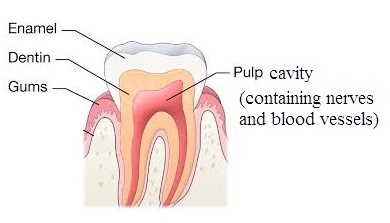
When a person eats sugary food, then organisms A present in his mouth act on sugar to produce a substance B. The substance B first dissolves the calcium salts from the top part C of the tooth and then from its middle part D forming holes E. These holes ultimately reach the part F in the lower part of tooth which contains nerves and blood vessels. The substance B irritates the nerve endings inside the tooth causing toothache.
  1. What are (i) organisms A, and (ii) substance B?
  2. What are (i) part C, and (ii) part D, of tooth known as?
  3. By what name are the holes E in the tooth known?
  4. Name the part F of the tooth.
  5. What will happen if organisms A reach part F of the tooth known?
Answer
  1.  
  1. Organism A is bacteria.
  2. Substance B is acid.
  1.  
  1. Part C is the tooth enamel.
  2. part D is the dentine of the tooth.
  1. The small holes, E, are known as cavities.
  2. F is the pulp of the tooth.
  3. When a bacterium (organism A) reaches the pulp (part F) of the tooth, it irritates the nerve endings and causes toothache.
View full question & answer
Question 235 Marks
Describe the parts of our tooth with the help of a labelled diagram.
Answer
The tooth has hard outer covering called enamel. The part of tooth below enamel is called dentine inside which is the pulp cavity. The pulp cavity contains nerves and blood vessels.
View full question & answer
Question 245 Marks
A unicellular animal P having no fixed shape ingests a food particle by forming temporary finger-like projections Q. The food particle is engulfed with a little surrounding water to form a temporary stomach R inside it. The chemicals S from surrounding cytoplasm enter into R and break down food into small and soluble molecules by chemical reactions. The digested food is absorbed directly into cytoplasm by the process T. The undigested food is thrown out of the body by the rupture of a cell organelle U in a process called V.
  1. Name the unicellular animal P.
  2. What are (i) Q, and (ii) R?
  3. Name (i) chemical S, and (ii) process T.
  4. Name (i) organelle U, and (ii) process V.
Answer
  1. The unicellular animal P is Amoeba.
  2. Q is pseudopodia and R is the food vacuole.
  3. Chemical S is the digestive enzyme and Process T is diffusion.
  4. Organelle U is cell membrane and Process V is egestion.
View full question & answer
Question 255 Marks
Name the raw materials required for photosynthesis. How do plants obtain these raw materials?
Answer
The raw materials for photosynthesis are carbon-dioxide and water. The green plants take carbon-dioxide from air for photosynthesis. The carbon-dioxide gas enters the leaves of the plants through the stomata present on their surface. The water required by the plants for photosynthesis is absorbed by the roots of the plants from the soil through the process of osmosis. The water absorbed by the roots is transported upwards through the xylem vessels to the leaves where it reaches the photosynthetic cells and utilized in photosynthesis.
View full question & answer
Question 265 Marks
Explain the principle of dialysis with the help of a labelled diagram.
Answer
Principle of Dialysis: The blood from an artery in the patients arm is made to flow into the dialyser of a dialysis machine made of long tubes of selective permeable membrane (like cellulose) which are coiled in a tank containing dialysing Solution. The dialysing Solution contains water, glucose and salts in similar concentrations to those in normal blood. As the patient’s blood passes through the dialysing Solution most of the waste like urea present in it pass through the selectively permeable cellulose tubes into the dialysing Solution. The clean blood is pumped back into a vein of the patients arm.
View full question & answer
Question 275 Marks
Explain the mechanism of photosynthesis.
Answer
The process of photosynthesis takes place in the green leaves of a plant. The carbon-dioxide gas required for making food is taken by the plant leaves from the air which enters the leaves through tiny pores called stomata. Water required for making food is taken from the soil which is transported to the leaves from the soil through the roots and the stem. The sunlight provides energy required to carry out the chemical reactions involved in the preparation of food. The green pigment called chlorophyll absorbs sunlight energy.
The photosynthesis takes place in three steps:
  1. Absorption of sunlight energy by chlorophyll.
  2. Conversion of light energy into chemical energy and splitting of water into hydrogen and oxygen by light energy.
  3. Reduction of carbon dioxide by hydrogen to form carbohydrates like glucose by utilising the chemical energy.
​​​​​​​
View full question & answer
Question 285 Marks
Classify the following into herbivores, carnivores and omnivores:
Lion, Man, Dog, Goat, Crow, Elephant, Snake, Hawk, Rabbit, Deer.
Answer
Lion Carnivore
Man Omnivore
Dog Omnivore
Goat Herbivore
Crow Omnivore
Elephant Herbivore
Snake Carnivore
Hawk Carnivore
Rabbit Herbivore
Deer Herbivore
View full question & answer
Question 295 Marks
The human body has an organ A which acts as a double pump. The oxygenated blood coming from the lungs through a blood vessel B enters the upper left chamber C of the double pump. When chamber C contracts, then blood goes into lower left chamber D. The contraction of chamber D forces the blood to go into a blood vessel E which supplies oxygenated blood to all the organs of the body (except the lungs). The deoxygenated blood coming out of the body organs is taken by a blood vessel F to the right upper chamber G of pumping organ. Contraction of chamber G forces the deoxygenated blood into right lower chamber H. And finally the contraction of chamber H sends the deoxygenated blood into lungs through a blood vessel I.
  1. What is organ A?
  2. Name the blood vessel (i) B (ii) E (iii) F, and (iv) I.
  3. What are chambers (i) C, and (ii) D?
  4. What are chambers (i) G and (ii) H?
Answer
  1. Heart is the organ in the human body that acts as a double pump. Hence, organ A represents the heart.
  2.  
  1. The oxygenated blood from the lungs enters the left atrium (chamber C) via the blood vessel called pulmonary vein (B). Hence, B is pulmonary vein.
  2. The contraction of left ventricle (chamber D) forces the blood into the blood vessel called aorta (E), which supplies the oxygenated blood to the organs of the body, except the lungs. Hence, E is aorta.
  3. From the body tissues, the deoxygenated blood is transported back to the heart into the right upper chamber called right atrium (G), by the vena cava (F). Hence, F is vena cava.
  4. Contraction of chamber G (right atrium) forces the deoxygenated blood into the lower right chamber called right ventricle (H). Finally, the contraction of H (right ventricle), sends the deoxygenated blood into the lungs through the blood vessel called pulmonary artery (I). Hence, I represent pulmonary artery.
  1.  
  1. The chamber C represents left atrium.
  2. The chamber D represents left ventricle.
  1.  
  1. The chamber G represents right atrium.
  2. The chamber H represents right ventricle.
View full question & answer
Question 305 Marks
The liquid connective tissue A circulates in our body continuously without stopping. This tissue contains a pigment B which imparts it a colour C. The tissue A consists of four components D, E, F and G. The component D fights infection and protects us from diseases. The component E helps in the clotting of tissue A if a person gets a cut. The component F is a liquid which consists mainly of water with many substances dissolved in it and component G carries oxygen from the lungs to all the parts of the body.
  1. What is (i) tissue A, (ii) pigment B and (iii) colour C?
  2. Name (i) D, (ii) E, (iii) F and (iv) G.
  3. Name one substance (other than oxygen) which is transported by tissue A in the human body.
  4. Which two components of tissue A are the cells without nucleus?
  5. Name any two organisms (animals) which do not have liquid like A in their body.
Answer
  1.  
  1. Blood is the liquid connective tissue that circulates in our body continuously without stopping. Hence, A is blood.
  2. Our blood contains a pigment called haemoglobin, which imparts it a red colour. Hence, pigment B is haemoglobin and colour C is red.
  3. Our blood contains a pigment called haemoglobin, which imparts it a red colour. Hence, pigment B is haemoglobin and colour C is red.
  1.  
  1. White blood cells, fight infection and protect us from diseases. Hence, D refers to white blood cells.
  2. Platelets are the component of blood, which help in the clotting of blood (A). Hence, E refers to platelets.
  3. Plasma is a liquid, which consists mainly of water with many substances dissolved in it. Hence, F refers to plasma.
  4. Red blood cells carry oxygen from the lungs to all the parts of the body. Hence, G refers to red blood cells.
  1. Blood also carries the digested food from the small intestine to all other parts of the body.
  2. E (platelets) and G (Red blood cells) are the cells without nucleus.
  3. Amoeba and grasshopper do not have blood (A) like liquid in their body.
View full question & answer
Question 315 Marks
Consider the following chemical reactions which take place in different organisms/ tissues under various conditions:
  1. Glucose → Respiration → Respiration Ethanol + Carbon-dioxide + Energy.
  2. Glucose → Respiration → Respiration Carbon-dioxide + Water + Energy.
  3. Glucose → Respiration → Respiration Lactic acid + Energy.
  1. Name one organism which respires according to equation (i) above.
  2. Name one organism which respires according to equation (ii) above.
  3. When and where does respiration represented by equation (iii) above take place?
  4. Which equation/ equations represent aerobic respiration?
  5. Which equation/ equations represent anaerobic respiration?
  6. Which of the above reactions produces the maximum amount of energy?
Answer
  1. Yeast shows anaerobic respiration.
  2. Humans show aerobic respiration.
  3. In humans beings, during high muscular activity, the respiration represented by equation (iii) occurs. It occurs in the muscle tissue.
  4. Equation (ii) represents aerobic respiration.
  5. Equation (i) represents anaerobic respiration.
  6. Aerobic respiration, i.e. the reaction represented by equation (ii), produces maximum amount of energy.
View full question & answer
Question 325 Marks
There is a pair of bean-shaped organs P in the human body towards the back, just above the waist. A waste product Q formed by the decomposition of unused proteins in the liver is brought into organ P through blood by an artery R. The numerous tiny filters S present in organ P clean the dirty blood by removing the waste product Q. The clean blood goes into circulation through a vein T. The waste substance Q, other waste salts, and excess water form a yellowish liquid U which goes from organ P into a bag-like structure V through two tubes W. This liquid is then thrown out of the body through a tube X.
  1. What is (i) organ P and (ii) waste substance Q?
  2. Name (i) artery R, and (ii) vein T.
  3. What are tiny filters S known as?
  4. Name (i) liquid U, (ii) structure V, (iii) tubes W and (iv) tube X.
Answer
  1.  
  1. Kidneys are bean shaped organs in the human body, towards the back of the body, just above the waist. Hence, organs P are kidneys.
  2. Urea is the waste product that is formed by the decomposition of unused proteins in the liver. Hence, the waste substance Q represents urea.
  1.  
  1. Urea (substance Q) is brought into kidney (organ P) through blood by an artery called renal artery. Hence, R represents renal artery.
  2. The numerous tiny filters called nephrons (S) present in the kidneys (organ P), clean the dirty blood by removing the waste product Q (urea). The clean blood then goes into circulation through T, i.e. renal vein. Hence, vein T represents the renal vein.
  3. The tiny filters S are known as nephrons.
  4. The waste substance Q (urea), other waste salts and excess water form yellowish liquid called urine (U). Urine goes from organ P (kidney) into a bag-like structure V, i.e. urinary bladder, through two tubes W, called ureters. This urine is then thrown out of the body through tube X, called urethra.
    Hence, (i) the liquid U is urine, (ii) structure V is urinary bladder, (iii) tubes W is ureters, and (iv) tube X is the urethra.
View full question & answer
Question 345 Marks
Describe the exchange of gases which takes place in the leaves of a plant:
  1. During daytime.
  2. At night.
Answer
  1. During daytime when photosynthesis occurs, oxygen is produced. The leaves use some of this oxygen for respiration and the rest of oxygen diffuses out into the air. Carbon-dioxide produced by respiration is all used up in photosynthesis by leaves during the daytime. Even more carbon-dioxide is taken in from air. Thus, the net gas exchange in leaves during daytime is: Oxygen diffuses out Carbon-dioxide diffuses in.
  2. At night time, when no photosynthesis occurs and hence no oxygen is produced, oxygen from air diffuses in leaves to carry out respiration. Carbon dioxide produced by respiration diffuses out into air. So, the net gas exchange in leaves at night is: Oxygen diffuses in Carbon-dioxide diffuses out.
View full question & answer
Question 355 Marks
The partially digested food coming from the stomach of a person enters a long and narrow organ A in his body. The organ A receives the secretion of two glands: liver and pancreas. Liver secretes a greenish - yellow liquid B which is normally stored in the organ C. Pancreas secretes pancreatic juice which contains three digestive enzymes D, E and F. The intestinal juice completes the process of digestion of food. The inner wall of organ A has millions of tiny finger - like projections G which help in the rapid absorption of digested food into blood stream. The undigested part of food then passes into wider tube H which absorbs most of the water from undigested food. The last part of tube H called I stores this undigested food (or waste) for some time. The undigested food is then passed out though opening J as faeces in the process known as K.
  1. Name the organ A.
  2. Name liquid B and organ C.
  3. What are the digestive enzymes D, E and F?
  4. Name the projections G present on the inner wall of organ A.
  5. Name Tube H, Part I, Opening J and Process K.
Answer
  1. The organ A is small intestine.
  2. Liquid B is bile and Organ C is gall bladder.
  3. The digestive enzymes D, E and F are Amylase, Trypsin and Lipase, respectively.
  4. The projections G are villi that are present on the inner wall of organ A.
  5. Tube H is the large intestine, Part I is the rectum, Opening J is the anus and The process K is egestion or defecation.
View full question & answer
Question 365 Marks
There are five animals P, Q, R, S and T. The animal P always lives in water and has gills for breathing. The animal Q can stay in water as well as on land and can breathe both, through moist skin and lungs. The animal R lives in soil and breathes only through its skin. The animal S lives on land and breathes through spiracles and tracheae. And animal T lives in water and breathes through its cell membrane.
  1. Which of the animals could be Amoeba?
  2. Which of the animals could be frog?
  3. Which animal could be fish?
  4. Which animal could be grasshopper?
  5. Which animal could be earthworm?
Answer
  1. T is Amoeba.
  2. Q is frog.
  3. P is fish.
  4. S is grasshopper.
  5. R is earthworm.
View full question & answer
Question 375 Marks
An organism X having breathing organs A lives on land. When organism X goes under water, it cannot survive for a long time unless carrying an oxygen cylinder. On the other hand, the organism Y having breathing organs B always lives in water and if taken out of water, it dies after a short while. A third organism Z having breathing organs C and D which lives on the banks of ponds, lakes and rivers can survive on land as well as in water equally well.
  1. What could organism X be? Name the breathing organs A.
  2. What could organism Y be? Name the breathing organs B.
  3. What could organism Z be? Name the breathing organs C and D.
  4. Out of X, Y and Z, which organism is.
  1. Amphibian,
  2. Aquatic,
  3. Terrestrial?
Answer
  1. Organism X could be a human being. The breathing organs A are lungs.
  2. Organism Y could be a fish. The breathing organs B are gills.
  3. Organism Z could be a frog. The breathing organ C is skin and D are lungs.
  4.  
  1. Z is an amphibian.
  2. Y is an aquatic organism.
  3. X is a terrestrial organism.
View full question & answer
Question 395 Marks
A, B and C are three living organisms. The organism A is a unicellullar fungus which can live without air. It is used in the commercial production of an organic compound P from molasses. The organism B is a unicellular animal which lives in water and feeds and moves by using pseudopodia. It breathes through an organelle Q. The organism C is a tiny animal which acts as a carrier of malarial parasite. It breathes and respires through a kind of tiny holes R and air - tubes S in its body.
  1. What are organisms A, B and C?
  2. Name P, Q, R and S.
  3. Which organism/ organisms undergo aerobic respiration?
  4. Which organism/ organisms undergo anaerobic respiration?
Answer
  1.  
  1. Organism A is yeast.
  2. AmoebaOrganism B is .
  3. C is mosquito.Organism.
  1.  
  1. P is alcohol.
  2. breathes through the cell membrane.Amoeba Q is the cell membrane because
  3. R is spiracle.
  4. S is tracheae.
  1.  
  1. Organisms B and C undergo aerobic respiration.
  2. Organism A, i.e. yeast, undergoes anaerobic respiration.
View full question & answer
Question 405 Marks
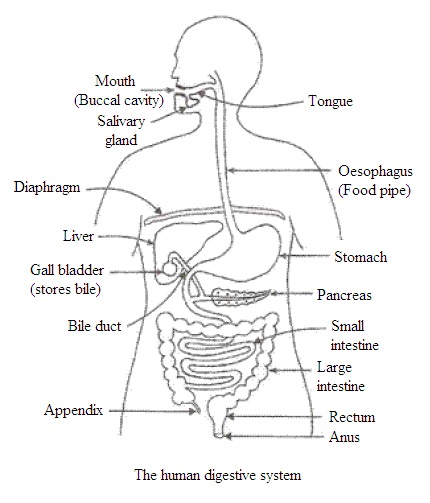
Draw a labelled diagram of the human digestive system. With the help of this diagram, describe the process of digestion of food in man (humans).
Answer
Digestion of food in human beings: Digestion of food begins in the mouth. The mouth cavity contains teeth, tongue and salivary glands. The teeth cut the food into small pieces, chew and grind it. This is called physical digestion. Salivary glands produce saliva which mixes with the food. This involves chemical digestion of food. The saliva contains an enzyme called salivary amylase which digests the starch and converts it into maltose sugar. Mouth opens into a small funnel shaped area called pharynx which leads to a long tube called oesophagus. It carries the food down into the stomach.
The wall of oesophagus is muscular. When the slightly digested food enters the food pipe, the walls of the oesophagus starts contraction and expansion movements called peristaltic movements which push the food into the stomach. Digestion does not take place in the oesophagus. The glands present on the walls of the stomach secrete gastric juice that contains hydrochloric acid, the enzyme pepsin and mucus. A small amount of gastric lipase is also present that breaks down the fats present in the food. Gastric juice is acidic due to the presence of HCl which is necessary for the pepsin to become active and converts the proteins into peptones.
The mucus protects the stomach walls from HCl. From the stomach, the partially digested food goes into the small intestine through sphincter muscle. Small intestine is divided into two parts: Duodenum and Ileum.
Duodenum receives the secretions of two glands, liver and pancreas through a common duct. Liver secretes bile which is alkaline and contains salts to emulsify the fats (or lipids). The bile secreted by the liver is stored in the gall bladder. Pancreas secretes pancreatic juice which contains trypsin, lipase and pancreatic amylase. Trypsin digests the proteins, lipase emulsifies the fats and pancreatic amylase breaks down the starch. Thus, small intestine is the site of complete digestion of carbohydrates, proteins and fats. The walls of ileum secrete succus entericus which completes the digestion process.
View full question & answer
Question 415 Marks
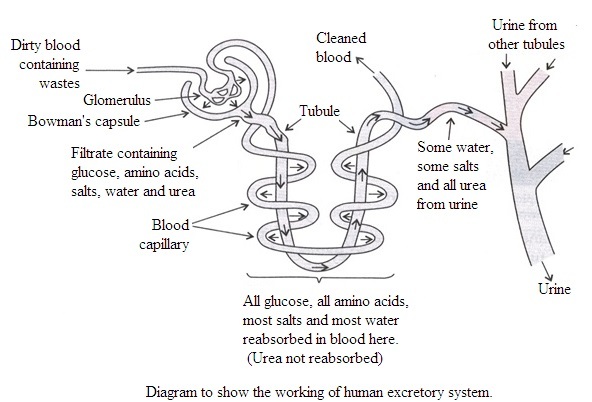
Describe the mechanism of urine formation in human excretory system. Draw a labelled diagram to illustrate your answer.
Answer
Urine formation: The dirty blood containing waste like urea enters the glomerulus which filters the blood. During filtration, the substance like glucose, amino acids, salts, water, urea etc present in the blood pass into Bowman’s capsule and then enter the tubule of nephron. When the filtrate containing useful substances as well as the waste substances passes through the tubule, the useful substances like glucose, amino acids, most salts and water are reabsorbed into the blood through blood capillaries surrounding the tubule. Only the waste substances like urea, some unwanted salts and excess water remains behind in the tubule. This yellowish liquid is called urine.
View full question & answer
Question 425 Marks
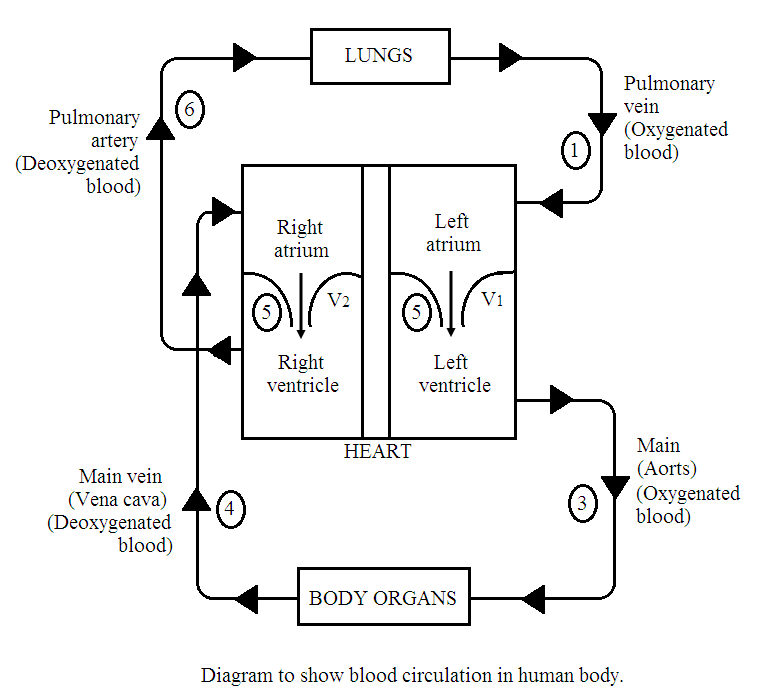
Describe the working of human blood circulatory system with the help of a suitable diagram which shows all the steps involved.
Answer
Working of Human blood circulatory system takes place in the steps below:
  1. When the muscles of all the four chambers are relaxed, the pulmonary vein brings the oxygenated blood from the lungs in the left atrium of the heart.
  2. When the left atrium contracts, the oxygenated blood is pushed into the left ventricle through valve V .
  3. When the left ventricle contracts, the oxygenated blood enters the main artery called aorta from which it goes to the different body organs through small branches called arterioles and capillaries.
  4. The main artery carries the blood to all the organs of the body head, arms etc except the lungs. The oxygenated blood gives off oxygen, digested food and dissolved materials to the body cells. The carbon-dioxide produced in the cells enters the blood. The deoxygenated blood enters main vein called vena cava which carried it to the right atrium of the heart.
  5. When the right atrium contracts, the deoxygenated blood enters right ventricle through valve V .
  6. When the right ventricle contracts, the deoxygenated blood enters the lungs through pulmonary artery and releases carbon-dioxide and absorbs fresh oxygen from air. The blood becomes oxygenated again and is sent to the left atrium of heart by pulmonary vein for circulation in the body. This whole process is repeated continuously.
​​​​​​​
View full question & answer
Question 435 Marks
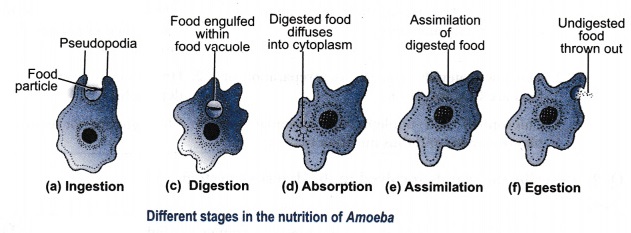
Describe the process of nutrition in Draw labelled diagrams to show the various steps in the nutrition in Amoeba.
Answer
Nutrition in amoeba: Nutrition in amoeba involves the following steps
  1. Ingestion? Amoeba has no mouth for ingestion of food. It ingests the food by using its pseudopodia. The food is engulfed with little water to form a food vacuole.
  2. Digestion? The food is digested by digestive enzymes present in the cytoplasm which breaks the food into small soluble molecules by chemical reactions.
  3. Absorption? The digested food is absorbed directly into the cytoplasm by diffusion. The digested food spreads out from the food vacuole into the whole cell and after absorption the food vacuole disappears.
  4. Assimilation? Food is used to obtain energy through respiration and the remaining part of the food is used for growth.
  5. Egestion? The undigested food collects inside the cell and the cell membrane ruptures. Through this, the undigested food is thrown out of the body.
View full question & answer
Question 445 Marks
How do carbohydrates, fats and proteins get digested in human beings?
Answer
  1. Carbohydrates: The digestion of carbohydrates begins in the mouth. The human saliva contains an enzyme called salivary amylase which digests the starch present in the food into maltose sugar. The slightly digested carbohydrates when reaches the small intestine, pancreatic amylase present in the pancreatic juice breaks down the starch. The intestinal juice of the small intestine completes the digestion of carbohydrates and finally coverts it into glucose.
  2. Fats: The process of digestion of fats begins in the stomach. The glands of stomach secrete a small amount of gastric lipase that breaks down the fats present in the food. From the stomach the partially digested food goes into small intestine where the pancreatic lipase breaks down the emulsified fats. The walls of small intestine secrete intestinal juice which converts the fats into fatty acids and glycerol.
  3. Proteins: The digestion of proteins begins in the stomach. The glands of the stomach secrete gastric juice which contains an enzyme called pepsin. Pepsin converts the proteins into peptones. Pancreatic juice contains trypsin which digests the proteins into peptides and the intestinal juice completes the process of digestion of proteins thus converting it into amino acids.
View full question & answer