Question
What are the various components of blood? State their functions.

Answer

The main components of blood are:
  1. Plasma: It carries all the dissolved substances such as proteins, digested food, common salt etc from one part to another part of the body.
  2. Red blood corpuscles (RBC): It carries oxygen from the lungs to all the cells of the body.
  3. White blood corpuscles (WBC): It fights infection and protects us from diseases.
  4. Platelets: It helps in the coagulation of blood in a cut or wound.

Need a full question paper?

Generate a complete, print-ready paper with questions like this in minutes — across 16+ boards, with answer keys.
Start Generating Free

Similar questions

A thickened underground stem X of a plant which is swollen with stored food has a number of points Y on its surface. When the old stem X is planted in the soil of a field in the next growing season, then each point Y present on its surface grows into a new plant.
  1. What is the general name of the underground stems like X?
  2. Give one example of X.
  3. What are points Y present on X known as?
  4. Is it necessary to plant the whole of stem X in the ground to obtain its new plants? Explain your answer.
  5. What is the name of this method of reproduction of plants?
  6. What is the advantage of growing new plants from the underground stems like X?
State the law of refraction of light that defines the refractive index of a medium with respect to the other. Express it mathematically. How is refractive index of any medium 'A' with respect to a medium 'B' related to the speed of propagation of light in two media A and B? State the name of this constant when one medium is vacuum or air.
The refractive indices of glass and water with respect to vacuum are $\frac{3}{2}$ and $\frac{4}{3}$ respectively. If the speed of light in glass is $2\times 10^{8} \text{ m/s}$ find the speed of light in,
  1. Vacuum.
  2. Water.
Write down the following activities in the correct order for a simple reflex arc:
  1. Impulse travels in the motor fibre.
  2. Impulse travels in the sensory fibre.
  3. Effector organ stimulated.
  4. Impulse crosses the synapse.
The organisms A, B and C can obtain their food in three different ways. Organism A derives its food from the body of another living organism which is called its D, without killing it. The organism B takes in the solid food by the process of ingestion, digests a part of this food and throws out undigested food in the process called E. The organism C obtains its food from dead and decaying plants.
  1. What is the mode of nutrition of (i) organism A (ii) organism B, and (iii) organism C?
  2. What is the organism like D called?
  3. Name the process E.
  4. Give one example each of organisms like A, B and C.
  5. What is the general name of three modes of nutrition exhibited by organisms A, B and C?
Suppose you have three concave mirrors A, B and C of focal lengths 10cm, 15cm and 20cm. For each concave mirror, you perform the experiment of image formation for three values of object distance of 10cm, 20cm and 30cm. Giving reason answer the following:
  1. For the three object distances, identify the mirror/mirrors which will form an image of magnification - 1.
  2. Out of the three mirrors identify the mirror which would be preferred to be used for shaving purposes/ makeup.
  3. For the mirror B draw, ray diagram for image formation for object distances 10 cm and 20 cm.
A liquid X of colour Y circulates in the human body only in one direction: from body tissues to the heart. Among other things, liquid X contains germs from cells and dead cells. The liquid X is cleaned of germs and dead cells by a special type of white blood cells called Z. This cleaned liquid is then put into blood circulatory system in subclavian veins.
  1. What is (i) liquid X and (ii) colour Y?
  2. What are Z.
  3. The liquid X is somewhat similar to a component of blood. Name this component.
  4. Why is liquid X not red?
Draw a labelled diagram of the human digestive system. With the help of this diagram, describe the process of digestion of food in man (humans).
Explain the mechanism of photosynthesis.
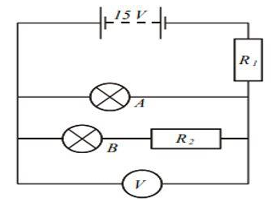
Image
As shown in the figure above $A$ and $B$ are two lamps. Lamp $A$ is rated at $12\  V, 24\ W.$ Lamp $B$ is rated at $6.0 \ V.$ When lamp $B$ operates at its rated voltage, the current in it is $3.0 \ A$. The values of $R_1$ and $R_2$ are chosen so that both lamps operate at their rated voltages.
Based on the information given, answer the following.
$(i)$ Calculate the current in Lamp $A$.
$(ii)$ State and give reason for the reading of the Voltmeter.
$(iii)$ Calculate the resistance of $R_2$.
$(iv)$ Find the value of the resistance $R_1$.
What is ten per cent law? Explain with an example.