Questions · Page 1 of 3

[1 Mark Questions]

Take a timed test

50 questions · self-marked practice — reveal the answer and mark yourself.
Question 11 Mark
What percentage of energy available at the producer level is transferred at successive trophic levels in a food chain?
Answer
10%.
View full question & answer
Question 21 Mark
From the list given below, choose an artificial ecosystem. Pond, crop field, lake, forest.
Answer
Crop fields are the artifical ecosystem among them.
View full question & answer
Question 31 Mark
Why do producers always occupy the first trophic level on every food chain?
Answer
Producers always occupy the first trophic level in any food chain because the main source of every food chain is the sun and only producers are capable of converting solar energy into chemical energy.
View full question & answer
Question 41 Mark
Write an aquatic food chain.
Answer
$\ \ \ \ \ \ \ \ \ \ \text{Algae}\ \ \ \ \ \rightarrow\ \ \ \ \ \text{protozoa}\ \ \ \ \ \rightarrow\ \ \ \ \ \text{small fish}\ \ \ \ \ \rightarrow\ \ \ \ \ \text{Big fish}\\\ \ \ \ ^{\text{(phytoplankton)}}\ \ \ \ \ \ \ \ \ \ ^{\text{(zoo plankton)}}\ \ \ \ \ \ \ \ \ \ \ \ \ \ \ \ ^{\text{(carnivore)}}\ \ \ \ \ \ \ \ \ \ \ \ \ ^{\text{(Large carnivore)}}\\\ \ \ \ \ \ \ ^{\text{(producer)}}\ \ \ \ \ \ \ \ \ \ \ \ \ \ \ \ ^{\text{(Harbivore)}}$
View full question & answer
Question 51 Mark
What type of substances are the major pollutants of the environment? Name two such substances.
Answer
The non- biodegradable wastes pollutes the environment like plastic and polythene bags.
View full question & answer
Question 61 Mark
We often use the word environment. What does it mean?
Answer
Environment means our surroundings in which we live. Not only human beings, but also animals, plants and all the living organism. It is actually the sum total of all surroundings of a living organism, including natural forces and other living things, which provide conditions for development and growth as well as of danger and damage.
View full question & answer
Question 71 Mark
What will happen if we kill all the organisms in one trophic level?
Answer
If we kill all the organisms of a trophic level, the number of organism in next trophic level will decrease drastically due to non-availability food. On the contrary, the number of individuals in lower trophic level will increase because no one will be there to feed upon them, resulting in imbalance ecosystem.
View full question & answer
Question 91 Mark
Which one of the following is not a terrestial ecosystem?
Forest, Grassland, Aquarium, Desert.
Answer
Aquarium.
View full question & answer
Question 101 Mark
How is energy introduced into the ecosystem?
Answer
The energy enters the living components of the ecosystem through the process of photosynthesis.
View full question & answer
Question 111 Mark
What is the function of ozone in the upper atmosphere?
Answer
Ozone layer provides protection from the harmful ULTRAVIOLET RAYS that are emitted by the sun. The UV rays causes greenhouse effect and many skin diseases.
View full question & answer
Question 121 Mark
Why is forest considered a natural ecosystem?
Answer
Forest considered as a natural ecosystem because forest provides us woods and foods and many animals also depend on forest for their food. Forest balance the food cycle and naturally gives oxygen and absorb carbon dioxide.
View full question & answer
Question 131 Mark
Which of the following materials are non-biodegradable?
Aluminium wire, Tea leaves, Synthetic fibre, Wool.
Answer
Aluminum wire and Synthetic fibre.
View full question & answer
Question 141 Mark
Write a common food chain of a pond ecosystem having four links.
Answer
$\text{Algae}\ \ \ \ \rightarrow\ \ \ \ \text{Protozoa}\ \ \ \ \rightarrow\ \ \ \ \text{Small fish}\ \ \ \ \rightarrow\ \ \ \ \text{Big fish}\\^\text{(Phytoplankton)}\ \ \ \ ^\text{(Zooplankton)}\ \ \ \ \ \ \ \ \ \ \ ^\text{(Carnivore)}\ \ \ \ \ \ \ \ \ \ \ ^\text{(Large carnivore)}\\^\text{(Producer)}\ \ \ \ \ \ \ \ \ \ \ \ ^\text{(Harbivore)}$
View full question & answer
Question 161 Mark
What will be the amount of energy available to the organisms of the $2^{\text {nd }}$ trophic level of a food chain, if the energy available at the first trophic level is 10,000 joules?
Answer
As we know that, only 10\% of the total energy is transferred from one trophic level to another. So, the amount of energy available to the organism of the $2^{\text {nd }}$ trophic level of a food chain will be $10 \%$ of 10,000 Joules which is 1000 Joules.
View full question & answer
Question 171 Mark
Why are green plants called producers?
Answer
Green plants are called producers because they are self sufficient and they make their own food by photosynthesis.
View full question & answer
Question 191 Mark
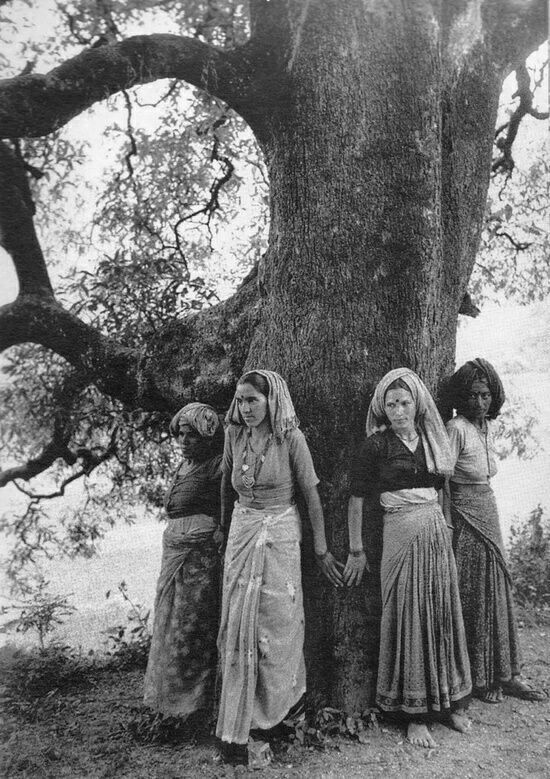
Mention the name of movement which arose due to conflict of interest between local people in forests and industrialists?
Answer

The Chipko Movement began from a small village; Reni in Garhwal district. The women of the village hugged the trees to prevent them from cutting by the contractors of an industry.
View full question & answer
Question 201 Mark
Why biodegradable and non-biodegradable wastes should be discarded in two separate dust bins?
Answer
Biodegradable wastes can be properly recycled for future use.
If biodegradable and non biodegradable wastes are discarded in the same dustbin, then the non-biodegradable waste will make the biodegradable waste unfit for recycling. It will also interfere in the process of recycling.
View full question & answer
Question 211 Mark
Which of the following belong to the same trophic level?
Goat; Spider ; Plants ; Hawk ; Rat.
Answer
Goat and Rat (Both are herbivores).
View full question & answer
Question 221 Mark
What is garbage? What does garbage consist of?
Answer
The household wastes are called garbage. It includes left -over food, fruit and vegetable peels, waste paper, unwanted plastic objects etc.
View full question & answer
Question 231 Mark
How many trophic levels does a food chain normally have?
Answer
Trophic Levels:
The feeding positions in a food chain or web are called trophic levels. The different trophic levels are defined in the Table below. Examples are also given in the table. All food chains and webs have at least two or three trophic levels. Generally, there are a maximum of four trophic levels.
Trophic Level Where It Gets Food Example
1st Trophic Level: Producer Makes its own food Plants make food.
2nd Trophic Level: Primary Consumer Consumes producers Mice eat plant seeds.
3rd Trophic Level: Secondary Consumer Consumes primary consumers Snakes eat mice.
4th Trophic Level: Tertiary Consumer Consumes secondary consumers Hawks eat snakes.
View full question & answer
Question 251 Mark
Which one term in the following includes the others?
air, flora, fauna, environment, water, sunlight, soil.
Answer
Environment.
View full question & answer
Question 261 Mark
List two biotic components of a biosphere.
Answer
Biotic components means all the living organisms living on earth two examples for biotic components are: human, animals. They are also sorted in groups like autotrophs or producers, heterotrophs, consumers and decomposers.
View full question & answer
Question 271 Mark
In the following food chain, 100 J of energy is available to the lion. How much energy was available to the producer?
Plants → Deer → Lion.
Answer
According to 10% law, in a food chain, only 10% of the total energy is transferred to the next tropic level.
Let the deer have x Joule of energy. Then:
10% of x = 100J
$\therefore$ x = 1000J
Thus the deer has received 1000J of energy from the plant.
Similarly you can calculate the energy available to the producer as 10000J.
View full question & answer
Question 281 Mark
Why should biodegradable and non-biodegradable wastes be discarded in two separate dustbins?
Answer
If the two wastes are collected in a single bin, they would mix and may form toxic compounds which can cause pollution. The biodegradable waste can be decomposed in a natural manner by the process of composting. Non-biodegradable wastes can be sent for recycling.
View full question & answer
Question 291 Mark
Does change in lifestyle add waste to the environment?
Answer
No, change in lifestyle does not add waste to the environment. It helps to reduce the amount of waste. The use of eco-friendly products and recyclable materials will lessen the waste produced.
View full question & answer
Question 301 Mark
Construct a food chain comprising the following:
Snakes, Hawk, Rats, Plants.
Answer
$\text{Plants}\ \ \ \ \rightarrow\ \ \ \ \text{Rats}\ \ \ \ \rightarrow\ \ \ \ \text{Snakes}\ \ \ \ \rightarrow\ \ \ \ \text{Hawk}$
View full question & answer
Question 311 Mark
Give an example of a four step food chain operating in grassland. Name the secondary consumer in this food chain.
Answer
Food chain in grass land:
$\text{Grass}\ \ \ \ \ \rightarrow\ \ \ \ \ \text{Insect}\ \ \ \ \ \rightarrow\ \ \ \ \ \text{Frog}\ \ \ \ \ \rightarrow\ \ \ \ \ \text{Bird}\\^\text{(producer)}\ \ \ \ \ \ \ \ \ \ ^\text{(Harbivore)}\ \ \ \ \ \ \ \ \ \ \ \ \ ^\text{(Carnivore)}\ \ \ \ \ \ \ \ ^\text{(Large carnivore)}$
The secondary consumer is frog.
View full question & answer
Question 321 Mark
State one advantage of using jute bags over plastic bags for shopping.
Answer
Jute bags should be used for shopping because these are biodegradable whereas plastic bags are non- biodegradable.
View full question & answer
Question 331 Mark
In a food chain consisting of grass, frog, bird and insects, where will the concentration of the harmful chemicals be maximum?
Answer
Bird.
View full question & answer
Question 341 Mark
What are the advantages of cloth bags over plastic bags during shopping?
Answer
Cloth bags have many advantages over plastic bags, some of them are:
Bags made of clothes can be used again and again by washing or modifying. One can modify these bags in home. Cloth bags are biodegradable and don’t causes pollution.
View full question & answer
Question 351 Mark
Write the common food chain of a pond ecosystem.
Answer
Phytoplankton (and other aquatic plants) → Zooplankton (and other small aquatic animals and larvae) → Fish → Bird (King Fisher).
View full question & answer
Question 371 Mark
Why are crop fields known as artificial ecosystems?
Answer
Ecosystems which are made by man are known as artificial ecosystem.
In case of crop fields abiotic and biotic components are selected by humans. The essential process such as sowing seeds, then irrigated and further progress is also kept under observation for getting good yield.
View full question & answer
Question 401 Mark
How much energy will be available to hawks in the food chain comprising hawk, snake, paddy, and mice if 10,000J of energy is available to paddy from the Sun?
Answer
$\begin{matrix}\text{ Sun } \rightarrow & \text{ Paddy } \ \rightarrow &\text{ Mice } \rightarrow &\text{ Snakes } \rightarrow &\text{ Hawks }\\10,000 \text{J} &1,000\text{J}& 100\text{J}& 10 \text{J} &1 \text{J} \end{matrix}$
View full question & answer
Question 411 Mark
What are the two main components of our environment?
Answer
The two main components of environment are:
  1. Abitoic components: They are the non-living components of any habitat.
  2. Biotic components: They are the living components of a habitat.
View full question & answer
Question 421 Mark
Name the organisms whose uncontrolled activities are damaging the environment.
Answer
Human beings are the only organisms which change the natural environment to fulfill their needs. The uncontrolled activities of human beings are damaging the balanced and healthy environment.
View full question & answer
Question 431 Mark
In a food chain of frog, grass, insect and snake, assign trophic level to frog.
Answer
Grass $\rightarrow$ insect $\rightarrow$ frog $\rightarrow$ snake/ $3^{\text {rd }}$ trophic level.
View full question & answer
Question 441 Mark
Which organisms belong to third and fourth trophic levels in the food chain comprising the following?
Rats, Plants, Hawk, Snakes.
Answer
Third Trophic level: Snakes.Fourth trophic level: Hawk.
View full question & answer
Question 451 Mark
Write down a food chain:
with five links in it.
Answer
$\text{Plants}\ \ \ \ \ \rightarrow\ \ \ \ \ \text{Grasshopper}\ \ \ \ \ \rightarrow\ \ \ \ \ \text{Frog}\ \ \ \ \ \rightarrow\ \ \ \ \ \text{Snake}\ \ \ \ \ \rightarrow\ \ \ \ \ \text{Hawk} $
View full question & answer
Question 461 Mark
Define trophic level. Draw the food chain with four trophic levels.
Answer
Trophic Levels – The various steps in a food chain at which the transfer of food takes place are called trophic levels. In a food chain, each step representing an organism forms a trophic level.
$\text{Grass}\ \ \ \ \ \rightarrow\ \ \ \ \ \text{Insect}\ \ \ \ \ \rightarrow\ \ \ \ \ \text{Frog}\ \ \ \ \ \rightarrow\ \ \ \ \ \text{Bird}\\^\text{(Producer)}\ \ \ \ \ \ \ \ \ \ \ \ ^\text{(Harbivore)}\ \ \ \ \ \ \ \ \ \ ^\text{(Carnivore)}\ \ \ \ \ \ ^\text{(Large carnivore)}$
View full question & answer
Question 471 Mark
List any two abiotic components of an ecosystem.
Answer
Air, Water, Minerals, Sunlight are the abiotic components of an ecosystem.
View full question & answer
Question 481 Mark
Why are there rarely more than five links (or five organisms) in a food chain?
Answer
Because after that the energy available for the next organism will be so small that it will be insufficient to sustain the life of that organism.
View full question & answer
Question 491 Mark
What is an ecosystem?
Answer
An ecosystem includes all of the living things (plants, animals and organisms) in a given area, interacting with each other, and also with their non-living environments (weather, earth, sun, soil, climate, atmosphere). Ecosystems are the foundations of the Biosphere and they determine the health of the entire earth system.
View full question & answer
Question 501 Mark
What percentage of solar radiation is absorbed by green plants for photosynthesis?
Answer
The percentage of solar radiation absorbs by all green plants for photosynthesis is 1%. Most solar energy occurs at wavelengths unsuitable forphotosynthesis.
View full question & answer