Question types

Our Environment question types

491 questions across 9 question groups — pick any mix to generate a Science paper with step-by-step answer keys.

491
Questions
9
Question groups
5
Question types
Sample Questions

Our Environment questions

One sample from each question group in this chapter. Select any group above to see the full set with answer keys.

Q 1M.C.Q1 Mark
Assertion: Biodegradable substances result in the formation of compost and natural replenishment.
Reason: It is due to breakdown of complex inorganic substances into simple organic substances.
  • A
    Both A and R are true, and R is the correct explanation of A.
  • B
    Both A and R are true, and R is not the correct explanation of A
  • A is true but R is false.
  • D
    A is false but R is true.

Answer: C.

View full solution
Q 2M.C.Q1 Mark
Which of the following features relates to biodegradable substances?
  • Broken down by biological processes
  • B
    Remain inert
  • C
    Persist in environment for long time
  • D
    May harm the ecosystem

Answer: A.

View full solution
Q 3M.C.Q1 Mark
In 1987, an agreement was formulated by the United Nations Environment Programme (UNEP) to freeze the production of " $X$ " to prevent depletion of " $Y$ ". " $X$ " and " $Y$ " respectively referred here are:
  • A
    Ozone; CFCs
  • B
    CFCs; rays UV
  • CFCs; Ozone
  • D
    UV rays; Diatomic oxygen

Answer: C.

View full solution
Q 4M.C.Q1 Mark
A decrease in the grass population will most immediately decrease the available energy for the :
  • Mouse
  • B
    Snake
  • C
    Hawk
  • D
    Frog

Answer: A.

View full solution
Q 5M.C.Q1 Mark
The use of one of the following will pollute the environment. This one is :
  • A
    Paper carry bags.
  • B
    Cotton cloth carry bags.
  • Nylon cloth carry bags.
  • D
    Jute carry bags.

Answer: C.

View full solution
For two statements are given $-$ one labelled Assertion $(A)$ and the other labelled Reason $(R).$ Select the correct answer to these questions from the codes $\ce{(a), (b), (c)}$ and $(d)$ as given below :
Assertion : A food chain can have a maximum of three trophic levels.
Reason : Energy available at each trophic level keeps on decreasing as we move higher up the food chain.
  • A
    Both $A$ and $R$ are true, and $R$ is correct explanation of the assertion.
  • B
    Both $A$ and $R$ are true, but $R$ is not the correct explanation of the assertion.
  • C
    $A$ is true, but $R$ is false.
  • $A$ is false, but $R$ is true.

Answer: D.

View full solution
For two statements are given $-$ one labelled Assertion $(A)$ and the other labelled Reason $(R).$ Select the correct answer to these questions from the codes $\ce{(a), (b), (c)}$ and $(d)$ as given below :
Assertion : Plastic, glass and metal wastes keep accumulating in our surrounding and their amount never reduces with time.
Reason : Plastic, glass and metal wastes are non $-$ biodegradable, and they cannot be decomposed by microorganisms.
  • Both $A$ and $R$ are true, and $R$ is correct explanation of the assertion.
  • B
    Both $A$ and $R$ are true, but $R$ is not the correct explanation of the assertion.
  • C
    $A$ is true, but $R$ is false.
  • D
    $A$ is false, but $R$ is true.

Answer: A.

View full solution
In the following questions, a statement of Assertion is given by the corresponding statement of Reason. Of the statements, mark the correct answer as
Assertion : Light is the primary source of energy in nearly all ecosystems.
Reason : Light is used by autotrophs to synthesise their food.
  • If both Assertion and Reason are true and Reason is the correct explanation of Assertion.
  • B
    If both Assertion and Reason are true, but Reason is not the correct explanation of Assertion.
  • C
    If Assertion is true, but Reason is false.
  • D
    If Assertion is false, but Reason is true.

Answer: A.

View full solution
For two statements are given $-$ one labelled Assertion $(A)$ and the other labelled Reason $(R).$ Select the correct answer to these questions from the codes $\ce{(a), (b), (c)}$ and $(d)$ as given below :
Assertion : $\text{DDT}$ can pass along food chain from crops to man or other animals and harm them.
Reason : $\text{DDT}$ is non $-$ biodegradable and cannot be metabolized within bodies of living organisms and accumulates in their bodies.
  • Both $A$ and $R$ are true, and $R$ is correct explanation of the assertion.
  • B
    Both $A$ and $R$ are true, but $R$ is not the correct explanation of the assertion.
  • C
    $A$ is true, but $R$ is false.
  • D
    $A$ is false, but $R$ is true.

Answer: A.

View full solution
For two statements are given $-$ one labelled Assertion $(A)$ and the other labelled Reason $(R).$ Select the correct answer to these questions from the codes $\ce{(a), (b), (c)}$ and $(d)$ as given below :
Assertion : Hospital wastes like used syringes, urine bags, etc. can be incinerated.
Reason : Incineration burns the waste at very high temperature and converts it to ashes.
  • Both $A$ and $R$ are true, and $R$ is correct explanation of the assertion.
  • B
    Both $A$ and $R$ are true, but $R$ is not the correct explanation of the assertion.
  • C
    $A$ is true, but $R$ is false.
  • D
    $A$ is false, but $R$ is true.

Answer: A.

View full solution
Q 20True-False1 Mark
State whether the following statement is true or false:
Only 10 per cent of the light energy given by the sun is available for transfer at each higher trophic level in a food chain.
View full solution
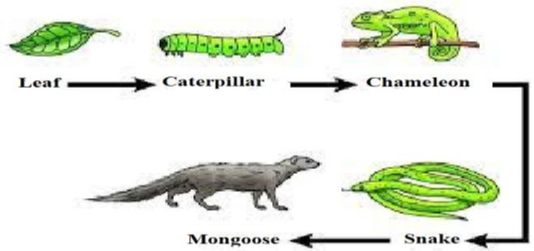
Study the food chain given below and answer the questions that follow :
Image
(a) If the amount of energy available at the third trophic level is 100 joules, then how much energy will be available at the producer level? Justify your answer.
(b) Is it possible to have 2 more trophic levels in this food chain just before the fourth trophic level? Justify your answer.
View full solution
Which of the following are biodegradable and which non-biodegradable?
Glass bottle, Paper, Ball point pen refill, Hay, DDT, Wheat, Cake, Wood, Polythene bag, Jute bag, Cotton cloth, Grass, Vegetable peels.
View full solution
Categorize some of the activities performed by you as an eco-friendly person. Suggest some more eco-friendly activities which we should adopt in day-to-day life.
View full solution
Consider the following food chains:
  1. Plants → Mice → Snakes → Hawks
  2. Plants → Mice → Hawks
If energy available at the producer level in both the food chains is 100J, in which case will hawks get more energy as food and by how much? Justify your answer.
View full solution
Students in a school listened to the news read in the morning assembly that the mountain of garbage in Delhi, suddenly exploded and various vehicles got buried under it. Several people were also injured and there was traffic jam all around. In the brain storming session the teacher also discussed this issue and asked the students to find out a solution to the problem of garbage. Finally they arrived at two main points – one is self management of the garbage we produce and the second is to generate less garbage at individual level.
  1. Suggest two measures to manage the garbage we produce.
  2. As an individual, what can we do to generate the least garbage? Give two points.
  3. List two values the teacher instilled in his students in this episode.
View full solution
Read the following and answer any three questions from: (i) to (iv).Ozone layer is present in the earth's atmosphere. It is in the form of a protective shield. It contains three oxygen atoms ($O_3$) which are formed as a consequence of photochemical reactions in the environment. Ozone absorbs harmful ultraviolet radiations of the sun. In this way, it protects all living beings on the earth. The thinning of ozone layer due to various human activities allows more UV radiations to pass through it which leads to harmful effects on man, animals and plants.
  1. Ozone layer is present in which layer of the atmosphere?
     
  2. Enhanced UV-radiations would affect humans and other animals, write cause of it.
     
  3. Give some name and example of depletion of ozone layer?

    OR
  4. what is photochemical reactions?
View full solution
Read the following and answer three questions from: (i) to (iii).In any given ecosystem, all living organisms are linked in a systematic chain with respect to their mode of manufacturing food/ feeding habits. This sequential interlinking of organisms involving transfer of food energy from producers through a series of organisms with repeated eating and being eaten is called the food chain. A food chain may have 3-4 trophic levels.
  1. What is food chain?
     
  2. how many trophic levels food chain have?
  1. a) Food chains are sustained by producers and ______.
    b) all living organisms are linked with which chain?
View full solution

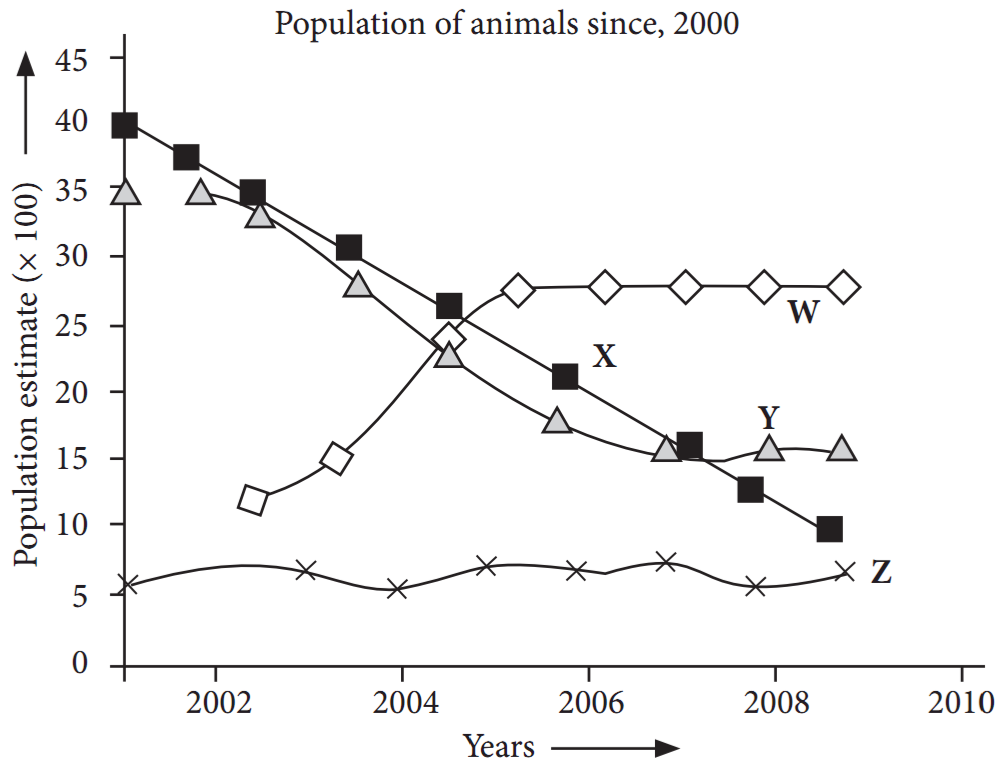
Read the following and answer any three questions from: (i) to (iv).
A group of ecologists studied and monitored the change in population of three animal species X, Y and Z over a period often years. During their research, they found that a new animal species W appeared in the area and its population was also monitored.
  1. Which animal species will unlikely to be alive in IO years without some intervention?
     
  2. Which species is most likely be the food source of W?
     
  3. What will be the likely consequence if population of X completely declines?

    OR
     
  4. A) What would be the most probable reason for the constant population of Z?
    B) What could be the reason for declining of X?
View full solution

Read the following and answer any three questions from: (i) to (iv).
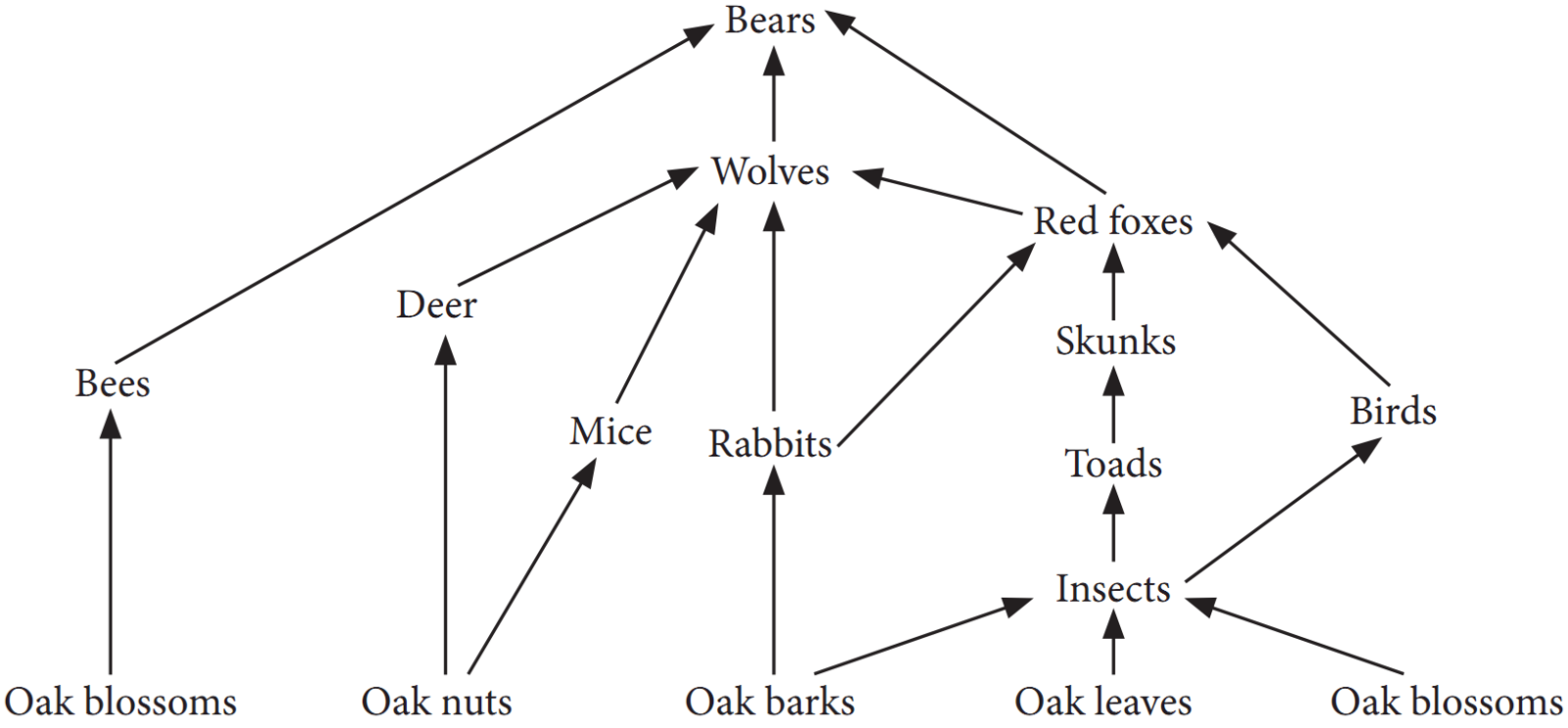
Food web is a network of food chains which become interconnected at various trophic levels so as to form a number of feeding connections amongst different organisms of a biotic community. Different food webs operate in different ecosystems. One such food web operating in an ecosystem is given ahead. Study it carefully and answer the following.
  1. What is the primary energy input in this food web?
     
  2. How many food chains are operating in the given food web?
     
  3. When a new species 'X' was introduced into the community, the population of toads rose and population of skunks fell over the subsequent two weeks. Species 'X' is most likely to be what?
    OR
     
  4. a) Which organisms in the food web passes most of its energy to the subsequent trophic levels?
    b) Which organisms would be most affected if the oak tree fails to flower?
View full solution

Generate a Our Environment paper free

Pick question groups from the list above, set marks and difficulty, and export a branded PDF with step-by-step answer keys. First 3 chapters free — no signup.

Download App