Question types

Periodic Classification of Elements question types

575 questions across 9 question groups — pick any mix to generate a Science paper with step-by-step answer keys.

575
Questions
9
Question groups
5
Question types
Sample Questions

Periodic Classification of Elements questions

One sample from each question group in this chapter. Select any group above to see the full set with answer keys.

Q 1M.C.Q1 Mark
An element ' $M$ ' has $50 \%$ of the electrons filled in the $3^{\text {nif }}$ shell as in the 2 nd shell. The atomic number of ' $M$ ' is:
  • A
    10
  • B
    12
  • 14
  • D
    18

Answer: C.

View full solution
Q 2M.C.Q1 Mark
An element with atomic number_____ will form a basic oxide.
  • A
    $7(2,5)$
  • B
    $17(2,8,7)$
  • C
    $14(2,8,4)$
  • $11(2,8,1)$

Answer: D.

View full solution
Q 3M.C.Q1 Mark
The element placed with nickel in the table formed by Newlands was :
  • A
    Iron
  • Cobalt
  • C
    Chromium
  • D
    Copper

Answer: B.

View full solution
Q 5M.C.Q1 Mark
According to Mendele′ ev's Periodic Law, the elements were arranged in the periodic table in the order of :
  • A
    Increasing atomic number.
  • B
    Decreasing atomic number.
  • Increasing atomic masses.
  • D
    Decreasing atomic masses.

Answer: C.

View full solution
For two statements are given $-$ one labelled Assertion $(A)$ and the other labelled Reason $(R).$ Select the correct answer to these questions from the codes $\ce{(a), (b), (c)}$ and $(d)$ as given below :
Assertion : Increasing order of non $-$ metallic character is $: \ce{Si < B < C < N < F}.$
Reason : Non $-$ metallic character increases along a period and decreases down the group.
  • Both $A$ and $R$ are true, and $R$ is correct explanation of the assertion.
  • B
    Both $A$ and $R$ are true, but $R$ is not the correct explanation of the assertion.
  • C
    $A$ is true, but $R$ is false.
  • D
    $A$ is false, but $R$ is true.

Answer: A.

View full solution
In each of the following questions, a statement of Assertion is given by the corresponding statement of Reason. Of the statements, mark the correct answer as. Sodium is an element of group $1$ of the modern periodic table.
All the elements of group $1$ of the modern periodic table contain two electrons in their outermost shell.
  • A
    Both Assertion and Reason are true and Reason is the correct explanation of Assertion.
  • B
    Both Assertion and Reason are true, but Reason is not the correct explanation of Assertion.
  • Assertion is true, but Reason is false.
  • D
    Assertion is false, but Reason is true.

Answer: C.

View full solution
For two statements are given $-$ one labelled Assertion $(A)$ and the other labelled Reason $(R)$. Select the correct answer to these questions from the codes $\ce{(a), (b), (c)}$ and $(d)$ as given below:
Assertion : Decreasing order of atomic radii is $: \ce{Cl > F > 0 > S}$.
Reason : Atomic radius increases as the number of energy level increases and decreases as nuclear charge increases.
  • A
    Both $A$ and $R$ are true, and $R$ is correct explanation of the assertion.
  • B
    Both $A$ and $R$ are true, but $R$ is not the correct explanation of the assertion.
  • C
    $A$ is true, but $R$ is false.
  • $A$ is false, but $R$ is true.

Answer: D.

View full solution
For two statements are given $-$ one labelled Assertion $(A)$ and the other labelled Reason $(R)$. Select the correct answer to these questions from the codes $\ce{(a), (b), (c)}$ and $(d)$ as given below :
Assertion : According to Mendeleev's periodic law, the properties of elements is the periodic function of their atomic numbers.
Reason : Mendeleev placed some elements with higher atomic mass before the elements with lower atomic mass.
  • A
    Both $A$ and $R$ are true, and $R$ is correct explanation of the assertion.
  • B
    Both $A$ and $R$ are true, but $R$ is not the correct explanation of the assertion.
  • C
    $A$ is true, but $R$ is false.
  • $A$ is false, but $R$ is true.

Answer: D.

View full solution
For two statements are given $-$ one labelled Assertion $(A)$ and the other labelled Reason $(R)$. Select the correct answer to these questions from the codes $\ce{(a), (b), (c)}$ and $(d)$ as given below :
Assertion : Atomic size of potassium is greater than that of sodium.
Reason : As we go down the group, atomic radius increases.
  • Both $A$ and $R $ are true, and $R$ is correct explanation of the assertion.
  • B
    Both $A$ and $R$ are true, but $R$ is not the correct explanation of the assertion.
  • C
    $A$ is true, but $R$ is false.
  • D
    $A$ is false, but $R$ is true.

Answer: A.

View full solution
Q 16True-False1 Mark
State whether the following statement is true or false:
On going down in a group of the periodic table, the number of valence electrons increases.
View full solution
Q 18True-False1 Mark
State whether the following statements are true or false:
Newlands divided the elements into horizontal rows of eight elements each.
View full solution
Q 19True-False1 Mark
The elements of the same group have similar chemical properties because of same number of valence electrons. [True/ False]
View full solution
The atomic numbers of three elements A, B and C are 12, 18 and 20 respectively. State, giving reason, which two elements will show similar properties.
View full solution
Choose from the following:$_6\text{C}, {_8\text{O}}, _{\text{ 10}}\text{Ne}, _{\text{ 11}}\text{Na}, _{\text{ 14}}\text{Si}$
  1. Elements that should be in the same period.
  2. Elements that should be in the same group.
State reason for your selection in each case.
View full solution
An element ' X ' belongs to $3^{\text {rd }}$ period and group 17 of the periodic table.State its,
i. Electronic configuration,
ii. Valency. Justify your answer with reasoning.
View full solution
Na, Mg and $\text{A} \ell$ are the elements having one, two and three valence electrons respectively. Which of these elements,
  1. Has the largest atomic radius.
  2. Is least reactive? Justify your answer stating reason for each.
View full solution
In the modem periodic table, the element Calcium (atomic number = 20) is surrounded by elements with atomic numbers 12, 19, 21 and 38. Which of these elements has physical and chemical properties resembling those of Calcium and why?
View full solution
Write the electronic configuration of two elements X and Y whose atomic numbers are 20 and 17 respectively. Write the molecular formula of the compound formed when element X reacts with element Y. Draw electron-dot structure of the product and also state the nature of the bond formed between both the elements.
View full solution
What is periodicity in properties of elements with reference to the Modern Periodic Table? Why do all the elements of the same group have similar properties? How does the tendency of elements to gain electrons change as we move from left to right in a period? State the reason of this change.
View full solution
An element ' $X$ ' belong to $3^{\text {rd }}$ period and group 13 of the Modern Periodic Table.
  1. Determine the valence electrons and the valency of ‘X’.
  2. Molecular formula of the compound formed when ‘X’ reacts with an element ‘Y’ (atomic number=8).
  3. Write the name and formula of the compound formed when ‘X’ combines with chlorine.
View full solution
The position of eight elements in the Modern Periodic Table is given below where atomic numbers of elements are given in the parenthesis.
Period No.    
2 Li (3) Be (4)
3 Na (11) Mg (12)
4 K (19) Ca (20)
5 Rb (37) Sr (38)
  1. Write the electronic configuration of Ga.
  2. Predict the number of valence electrons in Rb.
  3. What is the number of shells in Cr?
  4. Predict whether K is a metal or a non-metal.
  5. Which one of these elements has the largest atom in size?
  6. Arrange Be, Ga, Mg and Rb in the increasing order of the size of their respective atoms.
View full solution
Given below are some elements of the modern periodic table. Atomic number of the element is given in the parentheses: $A(4), B(9), C(14), D(19), E(20)$
a. Select the element that has one electron in the outermost shell. Also write the electronic configuration of this element.
b. Which two elements amongst these belong to the same group? Give reason for your answer.
c. Which two elements amongst these belong to the same period? Which one of the two has bigger atomic radius?
View full solution
Explain the trends in the Modern Periodic Table of various properties like valency, atomic size, metallic and non-mettalic properties of the atoms of elements.
View full solution
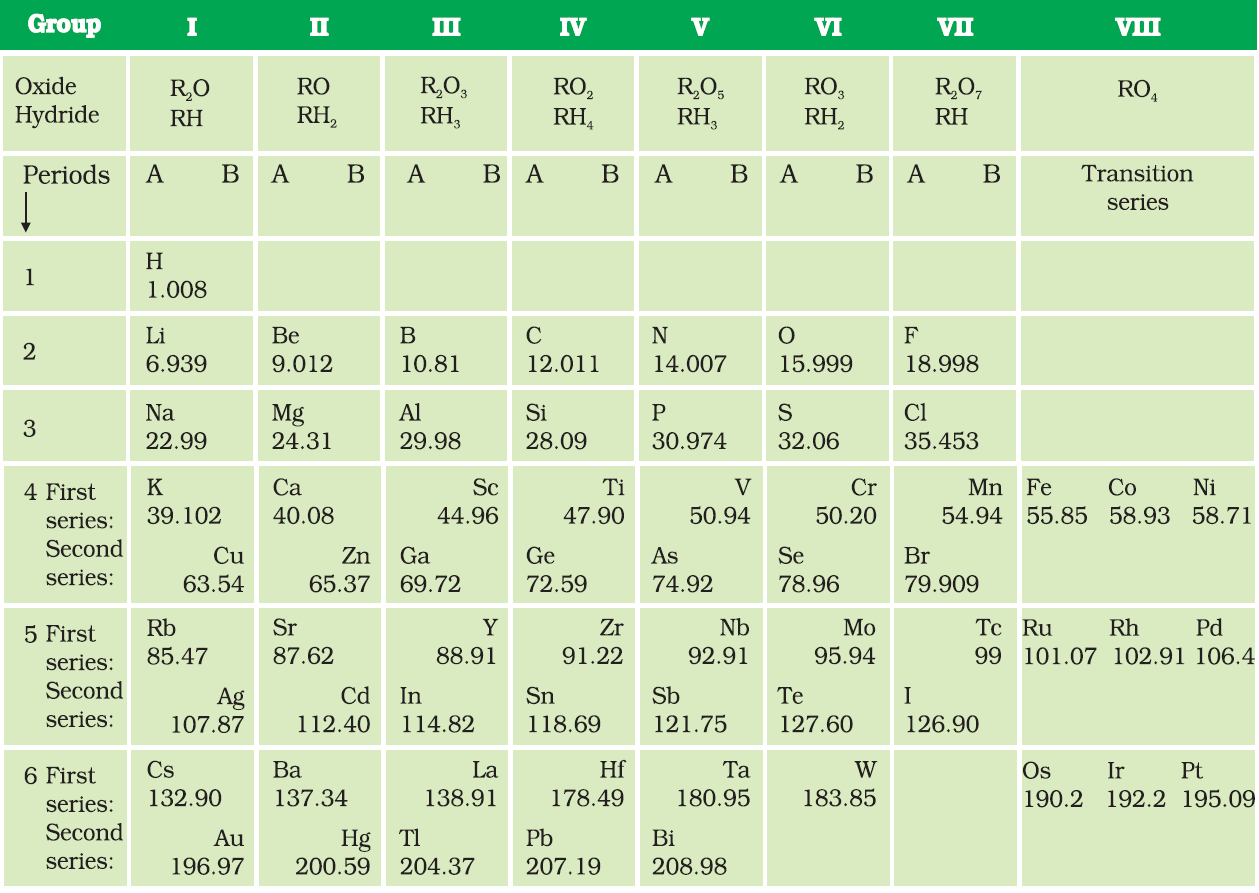
On the basis of Mendeleev’s Periodic Table given below, answer the questions that follow the table:
  1. Name the element which is in:
  1. i. $1^{\text {st }}$ group and $3^{\text {rd }}$ period.
    ii. $VII ^{\text {th }}$ group and 2nd period.
  1. Suggest the formula for the following:
  1. Oxide of nitrogen.
  2. Hydride of oxygen.
  1. In group VIII of the Periodic Table, why does cobalt with atomic mass 58.93 appear before nickel having atomic mass 58.71?
  2. Besides gallium, which two other elements have since been discovered for which Mendeleev had left gaps in his Periodic Table?
  3. Using atomic masses of Li, Na and K, find the average atomic mass of Li and K and compare it with the atomic mass of Na. State the conclusion drawn from this activity.
View full solution
  1. Why do we classify elements?
  2. What were the two criteria used by Mendeleev in creating his Periodic Table?
  3. Why did Mendeleev leave some gaps in his Periodic Table?
  4. In Mendeleev’s Periodic Table, why was there no mention of Noble gases like Helium, Neon and Argon?
  5. Would you place the two isotopes of chlorine Cl- 35 and Cl- 37 in different slots because of their different atomic masses or in the same slot because their chemical properties are the same? Justify your answer.
View full solution
Write the names and symbols of two most reactive metals belonging to group I of the periodic table. Explain by drawing electronic structure how either one of the two metals reacts with a halogen. With which name is the bond formed between these elements known and what is the class of the compound so formed known? State any four physical properties of such compounds.
View full solution
  1. Why did Mendeleev have gaps in his periodic table?
  2. State any three limitations of Mendeleev’s classification.
  3. How does electronic configurations of atoms change in a period with increase in atomic number?
View full solution

Read the following and answer any three questions from (i) to (iv).
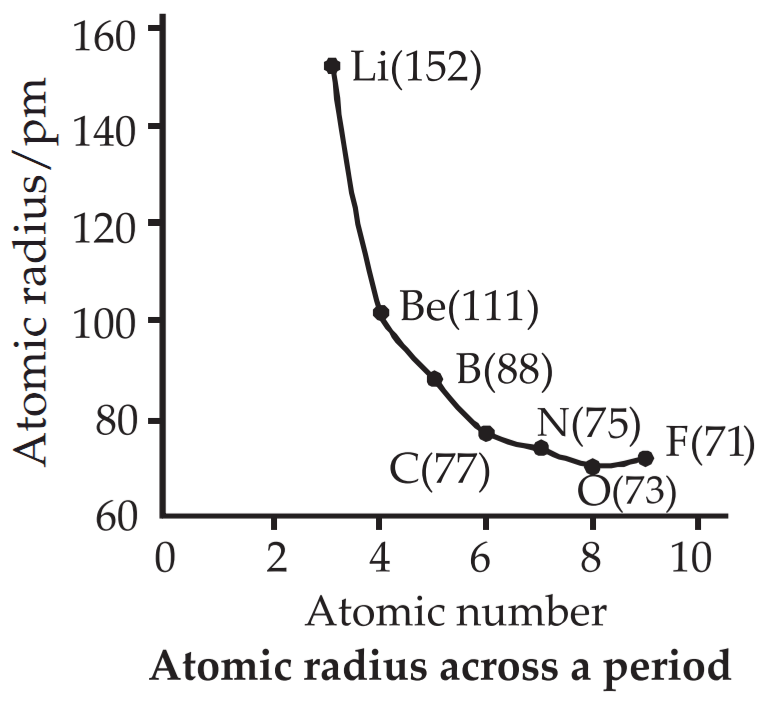
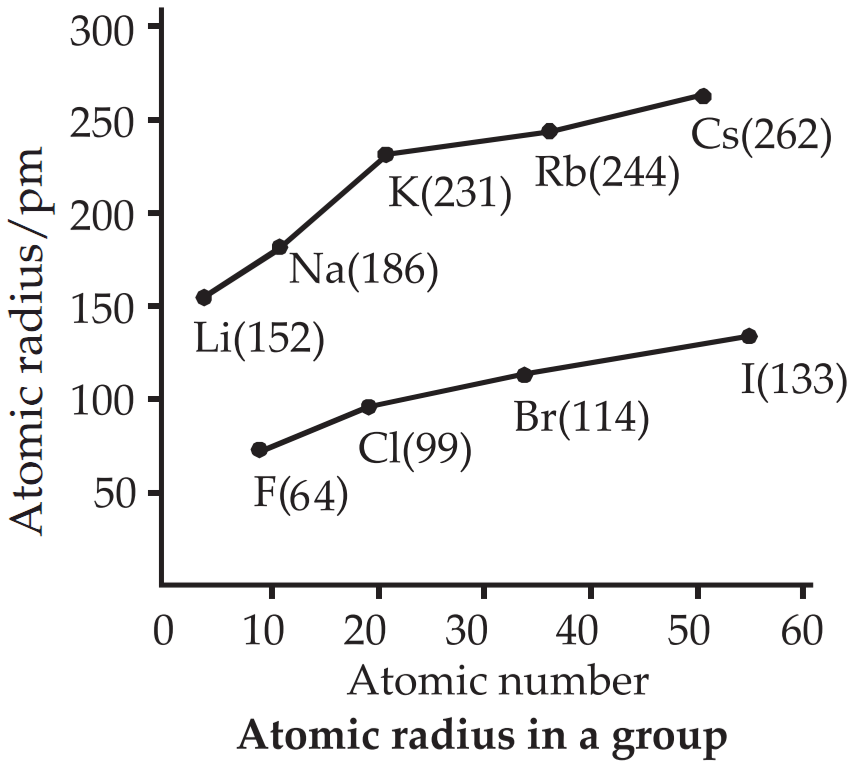
The distance between the centre of the nucleus and the outermost shell of electrons is known as atomic radius. On moving from left to right along a period, atomic radii decrease because effective nuclear charge increases. For example, the atomic size decreases regularly from Li to F in the second period and from Na to Cl in the third period. It may, however, be noted that in any period, the noble gas has the largest size. On moving down in a group, atomic radii increase.

  1. Write the maximum atomic radius?
     
  2. Which element is the smallest size in group 13?
     
  3. why the atomic radius decreases as we move across a period?

    OR
  4. A) ln the third period of the periodic table, Which element has the smallest size?
    b) define atomic radius?
View full solution
Read the following and answer any three questions from (i) to (iv).After the discovery of large number of elements it became necessary to classify them and arrange them in a regular manner in order of their periodic properties. ln 1817, Johann Wolfgang Dobereiner tried to arrange the elements with similar properties into groups. He identified some groups of three elements having similar physical and chemical properties, known as Dobereiner's triads.
ln 1865, John Newlands arranged all known elements in the order of increasing atomic masses and found that the properties of every eighth element are similar to the properties of the first element.
  1. If Cl, Br, I is a Dobereiner's triad and the atomic masses of Cl and I are 35.5 and 127 respectively, then what is the atomic mass of Br?
     
  2. give examples of Dobereiner's triad?
     
  3. a) A and B are two elements having similar properties which obey Newlands' law of octaves. How many elements are there in between A and B?

    b) According to the Newlands' law of octaves, the properties of magnesium are similar to whom?

    OR
  4. On what basis the elements are arranged in Dobereiner's triad explain in brief.
View full solution
Read the following and answer any three questions from (i) to (iv)."Properties of elements are the periodic function of their atomic numbers." This is known as modern periodic law. It means that the properties of elements depend on their atomic numbers, and the elements are given positions in the periodic table on the basis of their increasing atomic number. Atomic number determines the distribution of electrons in the orbit, and electrons of the outermost orbit determine the properties of an element. There are 18 groups (vertical columns) and 7 periods (horizontal lines) in modem form of the periodic table. The number of the period is equal to the number of shells in the atoms of the elements belonging to that period.
  1. What is the atomic number of elements of period 3 and group 17?
     
  2. What is modern periodic law?
     
  3. An element has a mass number of 40 and contains 20 neutrons in its atom. To which period and group of the periodic table does it belong?

    OR
  4. A) An element 'X' has an atomic number of 16. which of the elements will it show similarly?

    B) Write the characteristics of the modern periodic table.
View full solution
Read the following and answer any three questions from (i) to (iv).All the elements on the left side and in the middle of the periodic table (except hydrogen) are metallic elements or metals. Also, majority of elements in periodic table are metals. ln the modern periodic table, the metals are separated from non-metals by a zig-zag line. Some non-metals are gases, some are liquids and rest are solids at room temperature. They generally differ from metals in appearance and in other physical properties. Some elements, that lie along the zig-zag line that separates metals from non-metals, have properties that fall between those of metals and non-metals. These elements are regarded as semi-metals or metalloids.
  1. Define metals and non -metals?
     
  2. state the groups contains metals, non-metals and metalloids?
     
  3. what is a metalloids? give example.

    OR
  4. A) Why Silicon is a metalloids?

    B) Which is the lightest metal?
View full solution
Read the following and answer any three questions from (i) to (iv).ln 1913, Henry Moseley showed that the atomic number of an element is the more fundamental property than its atomic mass. Accordingly, Mendeleev's periodic law was modified and atomic number was adopted as the basis of modem periodic table.
ln this periodic table, the elements are arranged in increasing order of their atomic numbers.
There are 18 vertical columns in the periodic table which constitute 18 groups or families. The groups are numbered as 1, 2, 3, ... upto 18. All the members of a particular group have similar outer shell electronic configuration. There are seven horizontal rows of the periodic table, which are known as periods.
  1. According to modern periodic law, the properties of elements are the periodic function of their __________
     
  2. All the elements in a period in the periodic table have the same_____________.
     
  3. a) Write the combinations of elements that belong to the same group?
    b) The atoms of elements belonging to the same group of periodic table have same number of__________.

    OR
  4. ln the periodic table, the element with atomic numbers 16, 24, and 35 will be respectively placed in the which group.
View full solution

Generate a Periodic Classification of Elements paper free

Pick question groups from the list above, set marks and difficulty, and export a branded PDF with step-by-step answer keys. First 3 chapters free — no signup.

Download App