Question 14 Marks
Read the following and answer any three questions from (i) to (iv).
The distance between the centre of the nucleus and the outermost shell of electrons is known as atomic radius. On moving from left to right along a period, atomic radii decrease because effective nuclear charge increases. For example, the atomic size decreases regularly from Li to F in the second period and from Na to Cl in the third period. It may, however, be noted that in any period, the noble gas has the largest size. On moving down in a group, atomic radii increase.
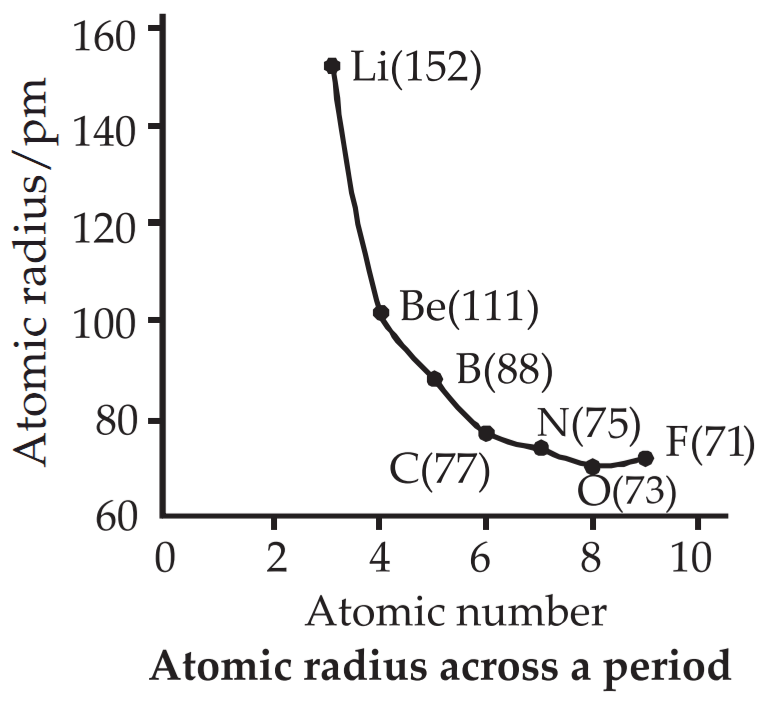
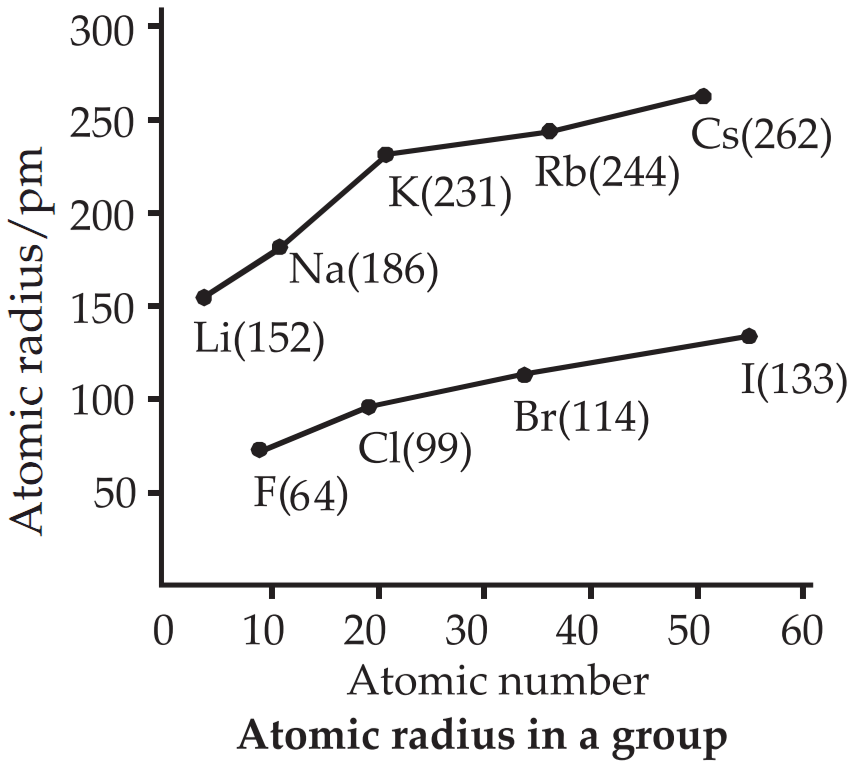
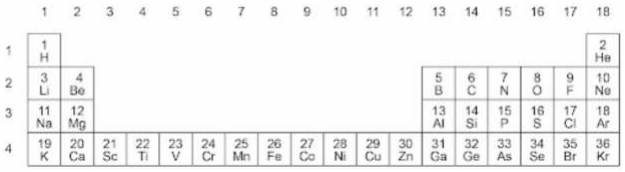
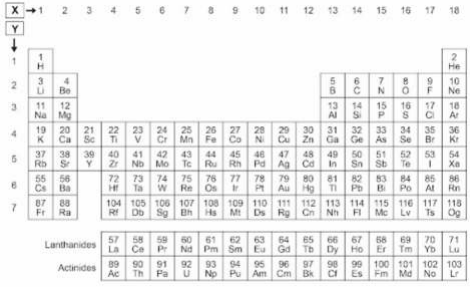
- Write the maximum atomic radius?
- Which element is the smallest size in group 13?
- why the atomic radius decreases as we move across a period?
OR - A) ln the third period of the periodic table, Which element has the smallest size?
b) define atomic radius?
Answer
ln general, the atomic radii decrease along a period and increase down a group
Thus, Mg has maximum atomic radius.
Boron is the first element of group 13, hence it is smallest in size.
Effective nuclear charge increases along a period and due to addition of electrons in the same shell it causes the incoming electron to experience more force of attraction by the nucleus. Therefore, the size of the atom decreases.
Atomic size decreases across the period. Cl has smaller size than Ar. Argon has larger atomic size as compared to Cl due to the inert nature (it has completely filled outer shell).
Atomic size decreases from left to right in a period and increases from top to bottom in a group. Thus, the order is F < 0 < C < Cl < Br
View full question & answer→- (d)
ln general, the atomic radii decrease along a period and increase down a group
|
Atom
|
12Mg
|
13AI
|
14Si
|
15P
|
|
Radius (pm)
|
160
|
143
|
118
|
110
|
- (d) Boron.
Boron is the first element of group 13, hence it is smallest in size.
- (c) Effective nuclear charge increases.
Effective nuclear charge increases along a period and due to addition of electrons in the same shell it causes the incoming electron to experience more force of attraction by the nucleus. Therefore, the size of the atom decreases.
- (c) Cl
Atomic size decreases across the period. Cl has smaller size than Ar. Argon has larger atomic size as compared to Cl due to the inert nature (it has completely filled outer shell).
- (a) F, O, C, Cl, Br
Atomic size decreases from left to right in a period and increases from top to bottom in a group. Thus, the order is F < 0 < C < Cl < Br