Question types

Periodic Classification of Elements question types

59 questions across 5 question groups — pick any mix to generate a Science paper with step-by-step answer keys.

59
Questions
5
Question groups
5
Question types
Sample Questions

Periodic Classification of Elements questions

One sample from each question group in this chapter. Select any group above to see the full set with answer keys.

Q 1M.C.Q1 Mark
According to Mendele′ ev's Periodic Law, the elements were arranged in the periodic table in the order of:
  • A
    Increasing atomic number.
  • B
    Decreasing atomic number.
  • Increasing atomic masses.
  • D
    Decreasing atomic masses.

Answer: C.

View full solution
Q 2M.C.Q1 Mark
In Mendele′ ev ’s Periodic Table, gaps were left for the elements to be discovered later. Which of the following elements found a place in the perioidc table later:
  • Germanium.
  • B
    Chlorine.
  • C
    Oxygen.
  • D
    Silicon.

Answer: A.

View full solution
Q 3M.C.Q1 Mark
The element with atomic number 14 is hard and forms acidic oxide and a covalent halide. To which of the following categories does the element belong?
  • A
    Metal.
  • Metalloid.
  • C
    Non-metal.
  • D
    Left-hand side element.

Answer: B.

View full solution
Q 4M.C.Q1 Mark
The elements A, B, C, D and E have atomic number 9, 11, 17, 12 and 13 respectively. Which pair of elements belong to the same group?
  • A
    A and B.
  • B
    B and D.
  • A and C.
  • D
    D and E.

Answer: C.

View full solution
Identify the element with the following property and arrange them in increasing order of their reactivity:The metal which is an important constituent of limestone.
View full solution
InMendele′ ev’s Periodic Table the elements were arranged in the increasing order of their atomic masses. However, cobalt with atomic mass of 58.93amu was placed before nickel having an atomic mass of 58.71amu. Give reason for the same.
View full solution
Can the following groups of elements be classified as Dobereiner's triad?
  1. Na, Si, Cl.
  2. Be, Mg, Ca.
Atomic mass of Be 9; Na 23; Mg 24; Si 28; Cl 35; Ca 40. Explain by giving reason.
View full solution
Three elements A, B and C have 3, 4 and 2 electrons respectively in their outermost shell. Give the group number to which they belong in the Modern Periodic Table. Also, give their valencies.
View full solution
Elements have been arranged in the following sequence on the basis of their increasing atomic masses.
F, Na, Mg, Al, Si, P, S, Cl, Ar, K.
  1. Pick two sets of elements which have similar properties.
  2. The given sequence represents which law of classification of elements?
View full solution
The three elements A, B and C with similar properties have atomic masses X, Y and Z respectively. The mass of Y is approximately equal to the average mass of X and Z. What is such an arrangement of elements called as? Give one example of such a set of elements.
View full solution
Write the formula of the product formed when the element A (atomic number 19) combines with the element B (atomic number 17). Draw its electronic dot structure. What is the nature of the bond formed?
View full solution
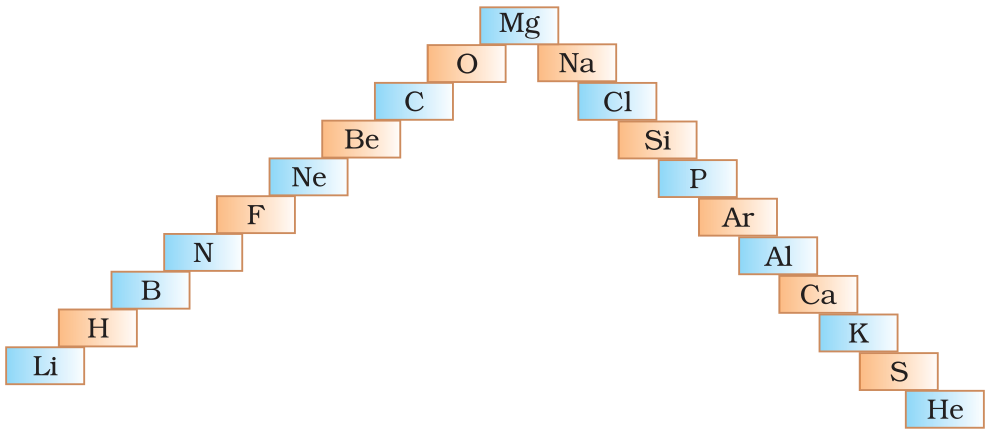
  1. In this ladder (Figure) symbols of elements are jumbled up. Rearrange these symbols of elements in the increasing order of their atomic number in the Periodic Table.
  1. Arrange them in the order of their group also.
View full solution
Mendeleev predicted the existence of certain elements not known at that time and named two of them as Eka-silicon and Eka-aluminium.
  1. Name the elements which have taken the place of these elements.
  2. Mention the group and the period of these elements in the Modern Periodic Table.
  3. Classify these elements as metals, non-metals or metalloids.
  4. How many valence electrons are present in each one of them?
View full solution
An element X (atomic number 17) reacts with an element Y (atomic number 20) to form a divalent halide.
  1. Where in the periodic table are elements X and Y placed?
  2. Classify X and Y as metal (s), non-metal (s) or metalloid (s)
  3. What will be the nature of oxide of element Y? Identify the nature of bonding in the compound formed.
  4. Draw the electron dot structure of the divalent halide.
View full solution
An element X of group 15 exists as diatomic molecule and combines with hydrogen at 773K in presence of the catalyst to form a compound, ammonia which has a characteristic pungent smell.
  1. Identify the element X. How many valence electrons does it have?
  2. Draw the electron dot structure of the diatomic molecule of X. What type of bond is formed in it?
  3. Draw the electron dot structure for ammonia and what type of bond is formed in it?
View full solution

Generate a Periodic Classification of Elements paper free

Pick question groups from the list above, set marks and difficulty, and export a branded PDF with step-by-step answer keys. First 3 chapters free — no signup.

Download App