Questions

3 Marks Question

Take a timed test

53 questions · self-marked practice — reveal the answer and mark yourself.

Question 13 Marks
Mention breifly about the circulatory system of earthworm.
Answer
Earthworm exhibits a closed type of blood vascular system. It consists of blood vessels, capillaries and heart. Due to a closed circulatory system, blood is confined to the heart and blood vessels. Contractions keep blood circulating in one direction. Smaller blood vessels supply the gut, nerve cord and body wall. Blood glands are present on the 4th, 5th and 6th segments. They produce blood cells and hemoglobin which is dissolved in blood plasma. Blood cells are phagocytic in nature.
View full question & answer
Question 23 Marks
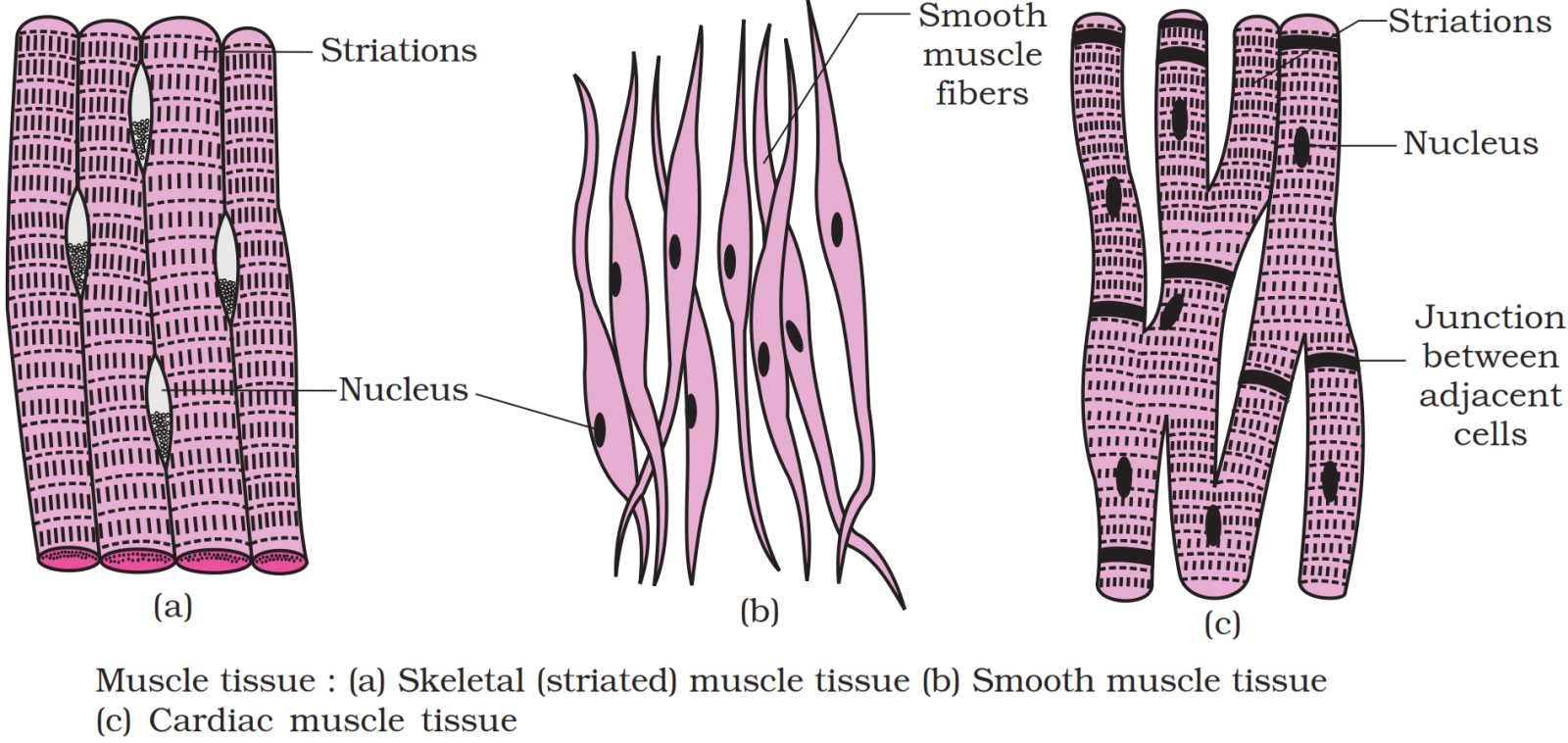
Distinguish between: Cardiac muscle and striated muscle.
Answer
 
Cardiac muscles
 
Striated muscles
1.
They are involuntary in function.
1.
They are voluntary in function.
2.
They are multi-nucleated and branched.
2.
They are multi-nucleated and un branched.
3.
They are found only in the heart.
3.
They are found in triceps, biceps, and limbs.
View full question & answer
Question 33 Marks
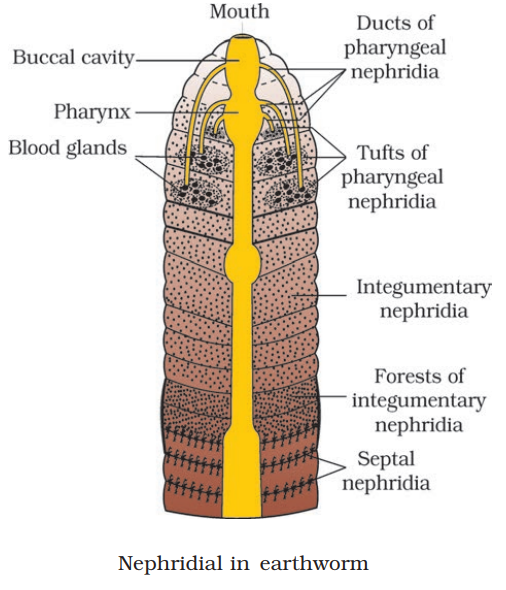
Answer the following: How many types of nephridia are found in earthworm based on their location?
Answer
On the basis of their location, three types of nephridia are found in earthworms. They are:
  1. Septal nephridia: These are present on both sides of the inter-segmental septa behind the $15^{\text {th}}$ segment and they open into the intestine.
  2. Integumentary nephridia: These lie attached to the body wall from the third segment to the last segment, which opens on the body surface.
  3. Pharyngeal nephridia: These are present as three paired tufts in fourth, fifth, and sixth segments.
View full question & answer
Question 43 Marks
Distinguish between: Simple epithelium and compound epithelium.
Answer
 
Simple epithelium
 
Compound epithelium
1.
It is composed of only one layer of cells.
1.
It is composed of many layers of cells.
2.
It is mainly involved in the function of absorption and secretion.
2.
It is mainly involved in the function of protection.
3.
It is present in the lining of the stomach, intestine.
3.
It is present in the lining of the pharynx and buccal cavity.
View full question & answer
Question 53 Marks
All the organ systems work in perfect harmony and thus all the life processes continue. This is similar to which of the following? How can taking care of the digestive system help us in maintaining a healthy body?
  1. All the musical instruments play in perfect harmony and thus the wonderful music is created.
  2. All the players in a team play to their ability and thus the team wins.
  3. You should be good at quantitative, linguistic and reasoning skills to excel in your studies.
Answer
  1. All the musical instruments play in perfect harmony and thus the wonderful music is created.
Every organ system is related to each other and malfunctioning of a particular system can affect another system. The digestive system is the system through which we get the fuel which is utilized by the whole body for energy. If the digestive system malfunctions, it results in reduced supply of fuel to other organ systems. In such a situation, other organ system may start malfunctioning and finally the whole body can become out of tune. So, taking care of the digestive system is important for maintaining a healthy body.
View full question & answer
Question 63 Marks
Explain the three types of cell junctions.
Answer
The three types of cell junctions are:
  1. Tight junctions.
  2. Gap junctions.
  3. Adhering junctions.
Functions of cell junctions are:
  1. Tight junctions prevent the leaking of substances across a tissue.
  2. Gap junctions facilitate the cells to communicate with each other by connecting their cytoplasm.
  3. Adhering junctions perform cementing of the adjacent cells to keep them together.
View full question & answer
Question 83 Marks
Differentiate between Blatta orientalis (oriental cockroach) and Periplanata americana (American cockroach).
Answer
Differences between Blatta orientalis and Periplanata americana are:
S. No.
Blatta orientalis
Periplanata americana
1.
Brownish-black to black coloured.
Shining brown-coloured.
2.
20-25 mm, smaller in size.
35-40 mm, larger in size.
3.
Less capable of flying.
Good capacity of flying.
4.
Forewings are vestigial. Hindwings are absent.
In both sexes, both pairs of wings are well-developed.
5.
Ootheca is black-coloured.
Ootheca is grey-coloured.
View full question & answer
Question 93 Marks
Differentiate between keratinised and non-keratinised stratified squamous epithelia.
Answer
Differences between keratinised and non-keratinised stratified squamous epithelia are:
S. No.
Keratinised Stratified Squamous Epithelium
Non-keratinised Stratified Squamous Epithelium
1.
It is found over the surfaces exposed to drying.
It occurs over the surfaces which are not subjected to drying.
2.
The outer cells are dead.
The outer cells are living.
3.
The outer cells are filled with keratin.
Keratin is absent.
4.
It has adhesive lipid layer.
Lipid layer is absent.
5.
The epithelium is impervious to water.
Impermeability to water is low.
View full question & answer
Question 103 Marks
Mention where the following cells are located?
  1. Neuroglial cells.
  2. Ependymal cells.
  3. Spindle cells.
Answer
  1. Neuroglial cells: These are supporting cells which form a packing around the neurons in the brain, spinal cord and ganglia.
  2. Ependymal cells: They forms the epithelium that lines the cavities in the brain and spinal cord.
  3. Spindle cells: These are biconvex nucleated cells found in the blood of vertebrates other than mammals.
View full question & answer
Question 113 Marks
Answer the following questions in respect of cockroach:
  1. What is meant by paurometabolous?
  2. What is the function of gizzard and malpighian tubules?
  3. Write the scientific name of cockroach.
Answer
  1. Development in cockroach is paurometabolous, since it involves nymphal stages.
  2.  
  • Gizzard helps in grinding the food materials.
  • Malpighian tubules help in removing the excretory products from the haemolymph.
  1. Periplaneta americana.
View full question & answer
Question 123 Marks
Explain in brief the nervous system of cockroach.
Answer
Nervous System of Cockroach:
  • The nervous system of cockroach consists of a series of fused, segmentally arranged ganglia joined by paired longitudinal connectives on the ventral side.
  • Three ganglia lie in the thorax, and six in the abdomen. The nervous system of cockroach is spread throughout the body.
  • The head holds a bit of a nervous system while the rest is situated along the ventral (belly-side) part of its body.
View full question & answer
Question 133 Marks
Write the functions in brief in Column B, appropriate to the structures given in Column A.
  1. Nictitating membrane __________.
  2. Tympanum __________.
  3. Copulatory pad __________.
Answer
  1. Nictitating membrane Protect the eyes while the frog is in water.
  2. Tympanum Receives sound signals.
  3. Copulatory pad Helps the male in grasping the female during amplexus.
View full question & answer
Question 143 Marks
Describe the structure of adipose tissue briefly with the help of diagram.
Answer
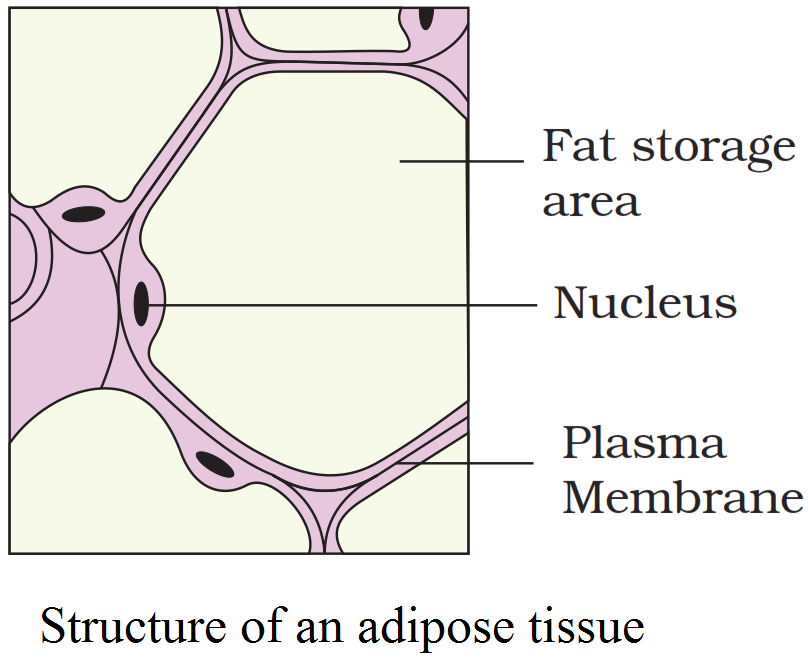
Adipose tissue is a fat storing connective tissue. Its matrix is packed with the large, spherical or oval fat cells or adipocytes. The fibres are few in number and form a loose network for supporting fat laden cells. This tissue is found in the subcutaneous parts, in the mesenteries, covering of the heart and around the blood vessels and kidneys. The adipose tissue mainly stores reserve food. It acts as shock absorbing cushions around the heart, kidneys, eyeball, etc.
View full question & answer
Question 153 Marks
Bring out the differences between striated and smooth muscles.
Answer
S.No.
Striated Muscles
Smooth Muscles
1
Cells are cylindrical and unbranched.
Cells are spindle-shaped with a broad centre.
2
Striations are prominent.
Striations are absent.
3
They are voluntary in function.
They are involuntary in function.
4
The cells are multinucleate.
The cells are uninucleate.
5
They are found in the walls of visceral organs.
They are attached to the skeletal system.
View full question & answer
Question 163 Marks
What do you understand by special junctions between cells? Which type of special junction are found in epithelial tissues?
Answer
All cells are held together with intercellular material. These materials form junctions between cells. There are three types of cell junctions found in epithelial tissue:
  1. Tight Junctions: These junctions help in stopping leakage of substances across a tissue.
  2. Adhering Junctions: These junctions keep neighbouring cells together.
  3. Gap Junctions: These junctions connect cytoplasm of adhering cells, and facilitate exchange of materials.
View full question & answer
Question 173 Marks
List out the important functions of connective tissue.
Answer
Functions of Connective Tissue The connective tissue performs following main functions:
  1. The connective tissue mainly joins one tissue to another in the organs.
  2. The adipose tissue stores fat.
  3. The cartilage and bones form a supporting framework for the body.
  4. Blood and lymph carry materials from one part to another in the body.
  5. The cells of connective tissues like macrophages, monocytes, neutrophils ingest bacteria, cell debris and foreign materials. Thus, they protect and clean the body.
  6. The adipose tissue acts as shock absorber around some organs, such as eyeballs and kidneys. It also acts as packing material in various organs.
  7. Bone marrow is the source of blood corpuscles.
  8. The collagen fibres help in the repair of injured tissues.
View full question & answer
Question 183 Marks
Differentiate between blood plasma and serum.
Answer
S. No.
Blood Plasma
Blood Serum
1.
It is the fluid minus blood corpuscles.
it is liquid minus clotting elements and corpuscles
2.
It is faint yellow in colour.
It is pale yellow in colour.
3.
It contains fibrinogen and other clotting factors.
It lacks fibrinogen and other clotting factors.
4.
It takes part in blood clotting.
It does not take part in blood clotting.
View full question & answer
Question 193 Marks
List out the functions of neural tissue.
Answer
Functions of Neural Tissue d be Neural tissue performs the following functions:
  1. The neural tissue coordinates and controls the functioning of different parts of the body.
  2. The sensation of smell, vision, taste, hearing, pain, pleasure, etc., are performed through the nervous tissue.
  3. The neural tissue helps in meditating conscious activities.
  4. The information about the changes in various internal structures is provided by nerves.
  5. It makes us aware about the environment around us.
  6. The nervous tissue brings about an appropriate response to each and every stimulus.
  7. The tissue is also a seat of experiences, memories, etc.
View full question & answer
Question 203 Marks
Describe the following as asked against each:
  1. Gizzard in cockroach: Function
  2. Open type of vascular system: One example
  3. Heart: Name of tissue.
Answer
  1. Grinding of food particles.
  2. Cockroach.
  3. Cardiac muscle.
View full question & answer
Question 213 Marks
Classify bones on the basis of texture.
Answer
On the basis of texture, bones may be compact or spongy.
  1. Compact bone: It has lamellae arranged in regular Haversian systems without gap between them. It is comparatively hard and compact. Compact bones are found in the shaft of long bone. Its cavity contains yellow bone marrow.
  2. Spongy bone: It has lamellae, called trabeculae that forms interlacing network with small spaces between them. These spaces contain red bone marrow. The spongy bones are without Haversian systems. This bone form expanded ends of long bones, vertebrae, ribs, skull bones.
View full question & answer
Question 223 Marks
Explain digestion in frogs.
Answer
Digestion in Frog:
  • In the stomach digestion of food takes place by the action of HCl and gastric juices secreted from the walls of the stomach.
  • Partially digested food called chyme is passed from stomach to the first part of the intestine, the duodenum. The duodenum receives bile from gall bladder and pancreatic juices from the pancreas through a common bile duct.
  • Bile emulsifies fat and pancreatic juices digest carbohydrates and proteins. Final digestion takes place in the intestine.
  • Digested food is absorbed by the numerous finger-like folds in the inner wall of intestine called villi and microvilli.
View full question & answer
Question 233 Marks
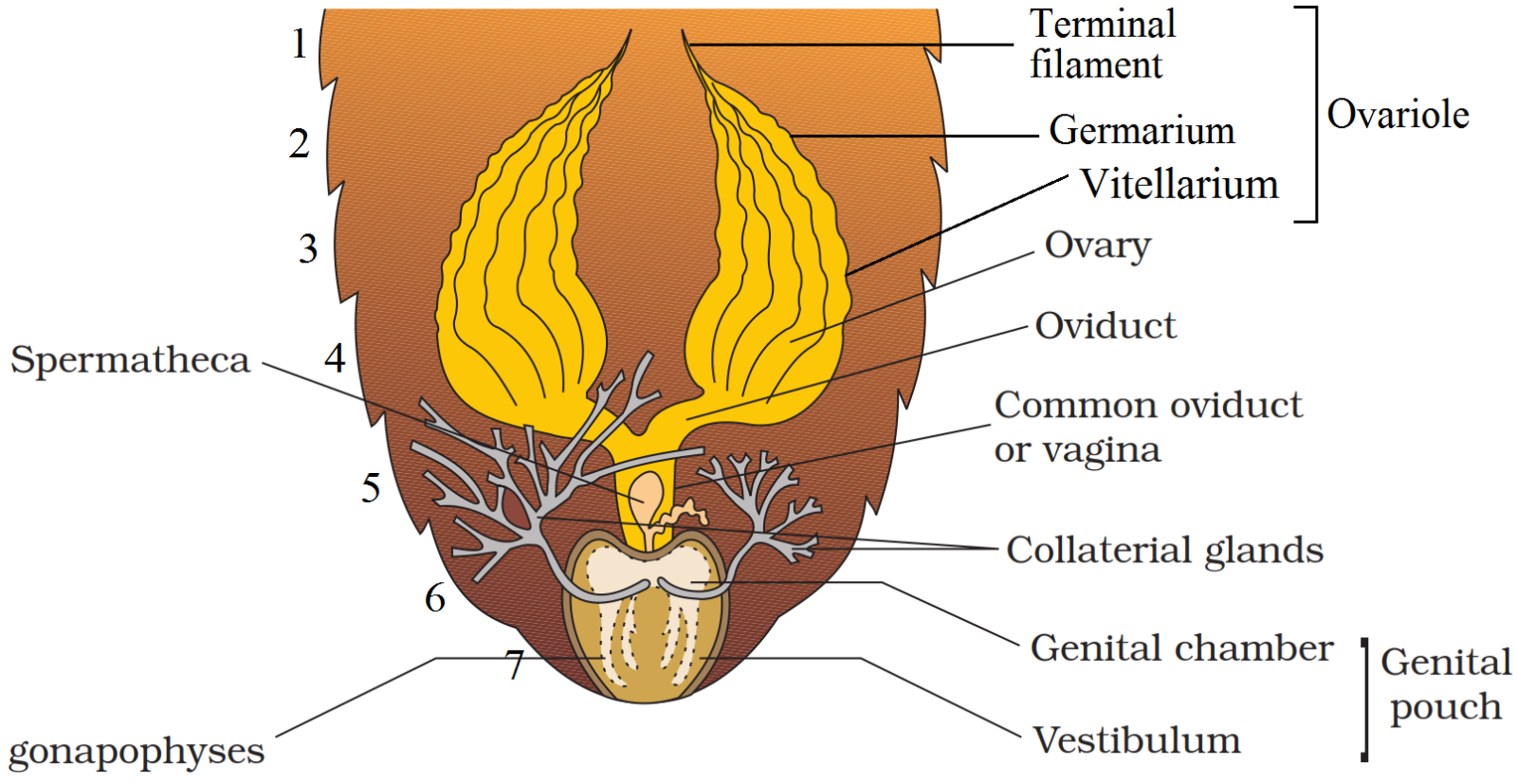
Draw the figure of female reproductive system of cockroach and label the following parts in it: Ovary, common oviduct, genital chamber, collaterial glands.
View full question & answer
Question 243 Marks
Mention the similarities between the:
  1. Cardiac and skeletal muscles.
  2. Cardiac and smooth muscles.
Answer
  1. Similarities between cardiac and skeletal muscles The cardiac and skeletal muscles both are made up of elongated fibres, which have numerous myofibrils. The myofibrils of the cardiac muscles have the same structure as those of skeletal muscle and are made up of actin and myosin filaments. The cardiac and skeletal muscles fibres have dark and light bands.
  2. Similarities between cardiac and smooth muscles Cardiac and smooth muscles both are uninucleate, contain nucleus at the centre and are involuntary in function.
View full question & answer
Question 253 Marks
Why earthworm is called the friend of farmer?
Answer
Earthworm is called the friend of farmer because it helps in making the soil loose and porous by burrowing, which in turn causes aeration and absorption of water by soil and thus, helps in respiration and penetration of the developing plant roots. Earthworms are also used in vermin composting as worm castings are used as manure and increases soil fertility. Nitrogenous wastes of earthworms are used as plant food and they help in creating optimum conditions for plant growth by reducing acidity and alkalinity of soil.
View full question & answer
Question 263 Marks
List the various types of nephridia in earthworm. Briefly describe the functioning of nephridia during excretion.
Answer
The excretory organs occur as segmentally arranged coiled tubules called nephridia (sing. nephridium). They are of following three types:
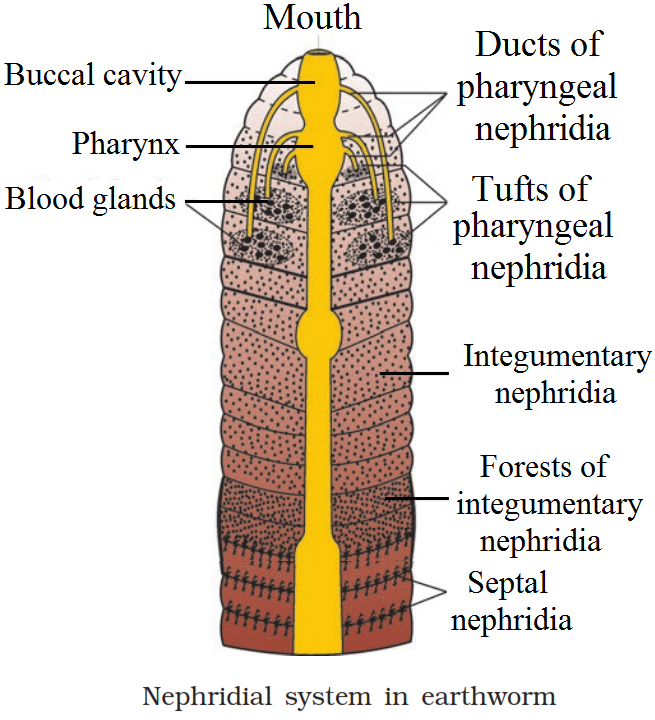
  1. Septal Nephridia: These are present on both the sides of inter segmental septa of segment 15 to the last that opens into intestine. They discharge the waste matter into the gut via septal excretory ducts and supraintestinal ducts.
  2. Integumentary Nephridia: These are attached to the lining of the body wall of segment 3 to the last that open on the body surface.
  3. Pharyngeal Nephridia: These are present as three paired tufts in the 4th, 5th and 6th segments. These different types of nephridia are basically similar in the structure.
Functions of Nephridia:
Nephridia regulates the volume and composition of the body fluids. A nephridium starts open up as a funnel that collects excess fluid from the coelomic chamber. The funnel connects with a tubular part of the nephridium, delivers the wastes through a pore to the surface in the body wall into the digestive tube.
View full question & answer
Question 273 Marks
Frogs are beneficial for mankind, justify the statement.
Answer
Frogs are beneficial for mankind in the following way:
  1. Frogs maintain the ecological balance as they occupy and serve an important link in the food chain.
  2. They eat insects and protect the crops.
  3. They are used as food in some countries. The muscular legs of the frog are used as food.
View full question & answer
Question 293 Marks
Give the location of hepatic caecae in a cockroach. What is their function?
Answer
Hepatic caecae are arise from the anterior end of midgut. They are present at junction of midgut and gizzard and are 6-8 in number. They are lined by the glandular cells which secrete digestive secretion containing amylolytic, proteolytic and lipolytic types of enzymes, which help in the digestion of carbohydrates, proteins and fats.
View full question & answer
Question 303 Marks
S. No.
column I
S. No.
column II
A.
Compound epithelium
1.
Alimentary canal
B.
Compound eye
2.
Cockroach
C.
Septal nephridia
3.
Skin
D.
Open circulatory system
4.
Mosaic vision
E.
Typhlosole
5.
Earthworm
F.
Osteocytes
6.
Phallomere
G.
Genitalia
7.
Bone
Answer
S. No.
column I
S. No.
column II
A.
Compound epithelium
3.
canal Skin
B.
Compound eye
4.
Mosaic vision
C.
Septal nephridia
5.
Earthworm
D.
Open circulatory system
2.
Cockroach
E.
Typhlosole
1.
Alimentary canal
F.
Osteocytes
7.
Bone
G.
Genitalia
6.
Phallomere
View full question & answer
Question 313 Marks
Explain in brief the central nervous system of frog.
Answer
Central Nervous System of Frog:
  • Brain is enclosed in a bony structure called brain box or skull (cranium).
  • The brain is divided into fore-brain, mid-brain and hind-brain.
  • Forebrain includes olfactory lobes, paired cerebral hemispheres and unpaired diencephalon.
  • The midbrain is characterised by a pair of optic lobes.
  • Hind-brain consists of cerebellum and medulla oblongata.
  • The medulla oblongata passes out through the foramen magnum and continues into spinal cord, which is enclosed in the vertebral column.
  • There are ten pairs of cranial nerves arising from the brain.
View full question & answer
Question 323 Marks
What are the main differences between smooth muscles, skeletal muscles and cardiac muscles?
Answer
S.No.
Smooth Muscle
Skeletal Muscle
Cardiac Muscle
1.
Spindle shaped cells.
Striated unbranched cells.
Striated branched cells.
2.
Found in muscles of internal organs.
Found in musculo-skeletal system.
Found in the heart.
3. Control involuntary actions. Control involuntary actions. Control heart's pumping which is involuntary.
View full question & answer
Question 333 Marks
Mention the layers of body wall of earthworm.
Answer
The body wall of earthworm has four layers, i.e., cuticle, epidermis, musculature and coelomic epithelium or parietal peritoneum.
  1. Cuticle: It is a thin, transparent, non-cellular outermost layer. The cuticle is secreted by the epidermis and is perforated by numerous minute pores.
  2. Epidermis: It is the next layer after cuticle, made up of a single layer of columnar epithelium which contain secretory gland cells, i.e., basal cells, sensor or receptor cells, setigerous cells (seta forming cells), etc.
  3. Muscle layers: It is composed of an outer thin layer of circular muscle fibres and an inner thick layer of longitudinal muscle fibres. Contraction of circular muscles makes the body long and thin whereas, the contraction of longitudinal muscle fibres makes the body thick and short.
  4. Coelomic epithelium: It is a thin, membrane-like coelomic epithelium consisting of flattened squamous cells.
View full question & answer
Question 343 Marks
Name the main excretory organs of cockroach. Write the structure of these organs.
Answer
Malphighian tubules are the main excretory organs of cockroach.
View full question & answer
Question 353 Marks
Give the location and function of the following:
  1. Adipose tissue.
  2. Intercalated disc.
  3. Malpighian tubules.
Answer
  1. Adipose tissue:
  • It is located beneath the skin.
  • The cells of this tissue store fats.
  1. Intercalated disc:
  • It is present in the cardiac muscle, at certain fusion points of the fibres.
  • It allows the cells to contract as a unit.
  1. Malpighian tubules:
  • They are present at the junction of midgut and hindgut of cockroaches (insects).
  • They absorb the nitrogenous excretory products from the haemolymph and convert them into uric acid and send into the hindgut.
View full question & answer
Question 363 Marks
Distinguish between male frog and female frog.
Answer
Differences between male and female frog:
S. No.
Male Frog
Female Frog
1.
Vocal cords are present on ventrolateral side of throat.
Vocal sacs are absent.
2.
Croaking is more louder.
Croaking is less louder.
3.
Forelimbs are stouter and more muscular.
Forelimbs are less muscular.
4.
Amplexusory pads are present on ventral side of index fingers.
Amplexusory pads are absent.
5.
During breeding season, abdomen does not change much.
Abdomen gets swollen during breeding season as it is full of ova released from mature ovaries.
View full question & answer
Question 373 Marks
Differentiate between eyes of cockroach and eyes of frog.
Answer
Differences between eyes of cockroach and eyes of frog:
S.No.
Eyes of Cockroach
Eyes of Frog
1.
Compound eyes made of multiple. units.
Simple eyes made of single unit.
2.
Ommatidia comprise eyes.
Lens comprise eyes.
3.
Project mosaic vision with less resolution.
Stereoscopic vision with high resolution.
View full question & answer
Question 383 Marks
List out the functions of muscular tissues.
Answer
Functions of Muscular Tissues:
  1. These are involved in the movement of body parts and locomotion of the organism to maintain the positions of the various parts of the body.
  2. Muscles are responsible for heart beat, production of sound and peristalsis in tubular viscera.
  3. The muscles support the bones and other structures.
  4. Muscles are essential during parturition.
View full question & answer
Question 393 Marks
While teaching in a classroom, teacher told students that cockroaches are omnipresent and they are useful as well as harmful for mankind. Ram found this interesting and asked many questions regarding the topic to his teacher.
  1. Which features enable the cockroaches to thrive in almost all places?
  2. How is it useful to humans?
  3. What are the negative impacts of its presence in our surroundings?
  4. What values does the Ram possess as a student?
Answer
  1. Cockroach has following important features which enable it to survive in variety of habitats:
  1. Flattened body to easily slip into narrow spaces.
  2. Shape of legs allows swift running possible in confined places.
  3. Nocturnal habit helps in protection from enemies.
  1. Cockroaches are eaten by the people of South American countries and Myanmar (Burma). These are part of food chain as many amphibian, birds, lizards and rodent feed on them.
  2. Negative impacts of presence of cockroach in our surroundings are:
  1. Cockroaches are pests which damage household materials including clothes, paper, shoes, etc.
  2. Contaminate our food by their excreta making it unpalatable.
  1. Ram is very attentive, curious, inquisitive, and is aware of is surroundings.
View full question & answer
Question 403 Marks
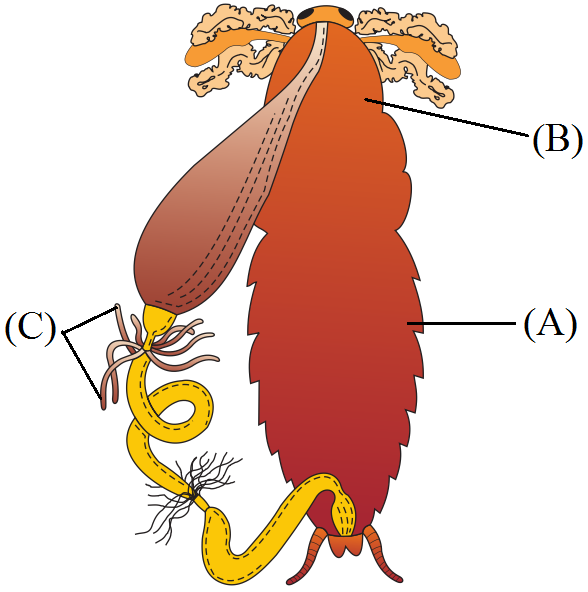
In the figure, some parts of alimentary canal of cockroach are shown. Name the organs A, B and C. State the function each of these organs.
Answer
  1. Crop: The food remains temporarily stored in this.
  2. Gizzard: It helps in grinding the food.
  3. Hepatic caecae: Secrete digestive enzymes, to digest all types of nutrients.
View full question & answer
Question 423 Marks
Why nephridia in earthworm that is basically similar in structure is classified into three types? Mention the names of each.
Answer
Nephridia are the main excretory organs in earthworms. They are associated with excretory and osmo regulatory functions. The nephridia occur in all segments of earthworm except the first two segments. The three types of nephridia are found in earthworm according to their location. They are distinguished on the basis of being enter one phric (nitrogen waste expelled input) and exonephric (nitrogen waste discharged outside directly). Septal Nephridia these are present on both sides of inter segmental septa of the segment starting from 15th to the last that open into intestine. They are enteronephric. Integumenatry Nephridia These is attached to lining of the body wall of segment 3 to the last that open on the body surface. They are exonephric. Pharyngeal Nephridia these are present as a three paired tufts in the 4th, 5th and 6thsegments. They are also enteronephric.
View full question & answer
Question 433 Marks
What is bone marrow? Briefly describe its types.
Answer
Bone marrow is the vascular pulpy connective tissue found in the marrow cavity of the bones. It is of two types:
  1. Yellow marrow: It is a yellow coloured tissue rich in fat cells called adipocytes. It is richly supplied with the blood vessels and nerve fibres. It is found in the shaft region of the bones.
  2. Red marrow: It is red coloured and blood cells are formed in it. It is found at the ends of long bones, ribs, sternum, vertebrae, etc. In a foetus, red marrow occurs in all bones. After birth, the red marrow becomes restricted to the above mentioned locations.
View full question & answer
Question 443 Marks
The function of the brain in our body is similar to which of these? Give reasons for your answer. Comment on the possible harms of artificial intelligence.
  1. The captain of the team.
  2. The coach of the team.
  3. Central Processing Unit of a computer.
Answer
  1. Central Processing Unit of a computer.
The way our brain controls all the functions in the body, the CPU controls all the functions in a computer. Artificial intelligence is still the stuff of science fiction, but many scientists are working overtime to develop machines which could be intelligent. It appears quite fascinating and promising to imagine a world full of intelligent robots. But imagine if those robots would actually overpower us and would start taking controls of the whole world. It may jeopardize the existence of human beings. Even other life forms can be in grave danger. Nature has its own way of making a balance among life forms and that ability of nature would be disturbed because of artificial intelligence.
View full question & answer
Question 453 Marks
Write the appropriate type of tissues in Column B according to the functions mentioned in Column A.
  1. Secretion and absorption __________.
  2. Protective covering ____________.
  3. Linking and supporting framework ____________.
Answer
  1. Secretion and absorption Simple epithelium.
  2. Protective covering Compound epithelium.
  3. Linking and supporting framework Connective tissue.
View full question & answer
Question 463 Marks
Ruchi's father was not well for last 8 days. He gave pale look in his eyes and skin all over the body, when she saw his father's degrading health became worried and took him to the doctor. The doctor did the medical check up and found that he was suffering from jaundice.
  1. How is Jaundice cause?
  2. Mention the functions of RBCs.
  3. What values are shown by Ruchi towards her father?
Answer
  1. The improper functioning of liver is not able to metabolise bilirubin and biliverdin completely so it start getting accurmulated in main bloodstream.
  2. The main function of RBCs is to carry red coloured oxygen carrying pigment haemoglobin.
  3. Ruchi is caring, attentive and responsible.
View full question & answer
Question 473 Marks
Differentiate between the abdomen of a male cockroach and that of a female cockroach.
Answer
S. No.
Male Cockroach
Female Cockroach
1
Genital pouch or chamber lies at the hind end of abdomen, bounded dorsally by 9th and 10th terga and ventrally by the 9th sternum.
7th sternum is boat shaped and along with the 8th and 9th sterna, it forms a brood/ genital pouch.
2
It contains dorsal anus, ventral male genital pore and gonapophyses.
Its anterior part contains female gono pore, spermathecal pores and collaterial glands.
3
There is a pair of anal styles arising from the 9th sternum.
Anal styles are absent.
4
The abdomen is narrow.
The abdomen is broad.
View full question & answer
Question 483 Marks
  1. Describe the main components of blood.
  2. Differentiate between adipose tissue and blood tissue.
Answer
  1. Blood is composed of mainly two components, i.e. fluid part called plasma and cells called formed elements. The formed elements are cellular components of the blood, i.e., red blood cells, white blood cells and blood platelets. The formed elements constitute 40-45% of the total blood volume and plasma SO occupies 55-60% of the blood volume.
View full question & answer
Question 493 Marks
How do different senses work in frog? Explain in brief.
Answer
Sense Organs in Frog: Frog has different types of sense organs which are as follows:
  1. Sensory papillae or organs of touch.
  2. Taste buds.
  3. Nasal epithelium for the sense of smell.
  4. Eyes for vision and us.
  5. Tympanum with internal ears for hearing.
Out of these, eyes and internal ears are well-organised structures and the rest are cellular aggregations around nerve endings. Eyes in a frog are a pair of spherical structures situated in the orbit in skull. These are simple eyes. External ear is absent in frogs and only tympanum can be seen externally. The ear is an organ of hearing as well as balancing.
View full question & answer
Question 513 Marks
Draw a diagram of alimentary canal of cockroach and label any six parts in it. (Description is not required)
View full question & answer
Question 523 Marks
How are glands classified on the basis of the mode of pouring out their secretions? Differentiate between them, with an example for each.
Answer
Glands are classified into exocrine glands and endocrine glands.
Exocrine Glands
Endocrine Glands
The glands which have a duct to pour out their secretion, are called exocrine glands.
The glands which do not have a duct and pour out their secretion directly into the blood, are called endocrine glands.
They secrete mucus, enzymes, sebum, tear, etc.
They secrete hormones.
Example: salivary glands, tear glands, etc.
Example: thyroid, pituitary, pineal glands, etc.
View full question & answer
Question 533 Marks
What is special about tissue present in the heart?
Answer
Cardiac muscle is specialized tissue that is found only in the heart. It has characteristics similar to both smooth and skeletal muscle tissue, as well as specialized properties that allow it to function with fast but sustained contractions, rapid conduction and coordinated movement. There are also differing types of cardiac muscle tissue that allow for both strong and coordinated contractions.
View full question & answer