Questions

Case study (4 Marks)

Take a timed test

10 questions · self-marked practice — reveal the answer and mark yourself.

Question 14 Marks
Read the following and answer any four questions from (i) to (v) given below:
Ginkgo tree has been saved from extinction by selective breeding followed by channeling into trade of nature lovers. This is an ex-situ conservation, where endangered species are protected from all adverse factors. Offspring produced in captive breeding are released in natural habitat for acclimatisation.
  1. What is the significance of offsite collections?
  1. Restock depleted populations.
  2. Protection of endangered species.
  3. Reintroduce species in wild.
  4. All of these.
  1. Which of the following is not an ex-situ conservation?
  1. Wetlands
  2. Orchards
  3. Aquaria
  4. Botanical gardens.
  1. Select the incorrect statements for ex-situ conservation.
  1. It is conservation of species outside their natural habitats.
  2. Endangered species are kept under human supervision and provided all the essentials.
  3. The species population recovers in natural environment.
  4. Both (b) and (c).
  1. Conditions maintained in seed banks for orthodox seeds are:
  1. Low moisture content.
  2. Anaerobic conditions.
  3. Low temperature.
  4. All of these.
  1. Assertion: Animal species which have become extinct in wild continue to be maintained in zoological parks.
Reason: Captive breeding is the conservation of those cases where these is no realistic chance of in-situ survival.
  1. Both assertion and reason are true and reason is the correct explanation of assertion.
  2. Both assertion and reason are true but reason is not the correct explanation of assertion.
  3. Assertion is true but reason is false.
  4. Both assertion and reason are false.
Answer
  1. (d) All of these.
  1. (a) Wetlands
Explanatio:

Wetlands are called Ramsar sites. They are low lying marshy areas which get filled up during rains due to run off and overflow from other water bodies.
  1. (c) The species population recovers in natural environment.
Explanatio:

ln case of in situ conservation procedure, species population recovers in natural environment. ln ex situ conservation, offspring produced in captive breeding are released in natural habitat for acclimatisation.
  1. (d) All of these.
  1. (a) Both assertion and reason are true and reason is the correct explanation of assertion.
View full question & answer
Question 24 Marks
Read the following and answer any four questions from (i) to (v) given below:
Non-native or alien species are often introduced in advertently for their economic and other uses. They often become invasive and drive away the local species. Exotic species have proved harmful to both aquatic and terrestrial ecosystems. For example, water hyacinth (Eichhornia crassipes) was introduced in Indian waters to reduce pollution. It was clogged water bodies including wetlands at many places resulting in death of several aquatic plants and animals.
  1. Island water ecosystem are the most vulnerable due to:
  1. Small size.
  2. Small number of species.
  3. Increases reproductive capacity.
  4. Both (a) and (b).
  1. Which of the following is not an alien species?
  1. Lantana camara.
  2. Periplaneta americana.
  3. Nile Perch.
  4. Yucca moth.
  1. Second major cause of species extinction is:
  1. Habitat loss and fragmentation.
  2. Over exploitation.
  3. Alien species invasion.
  4. Co-extinction.
  1. Assertion: Eichhomia crassipes drains off oxygen from water and can be seen growing in standing water.
Reason: Eichhornia crassipes is an indigenous species of India.
  1. Both assertion and reason are true and reason is the correct explanation of assertion.
  2. Both assertion and reason are true but reason is not the correct explanation of assertion.
  3. Assertion is true but reason is false.
  4. Both assertion and reason are false.
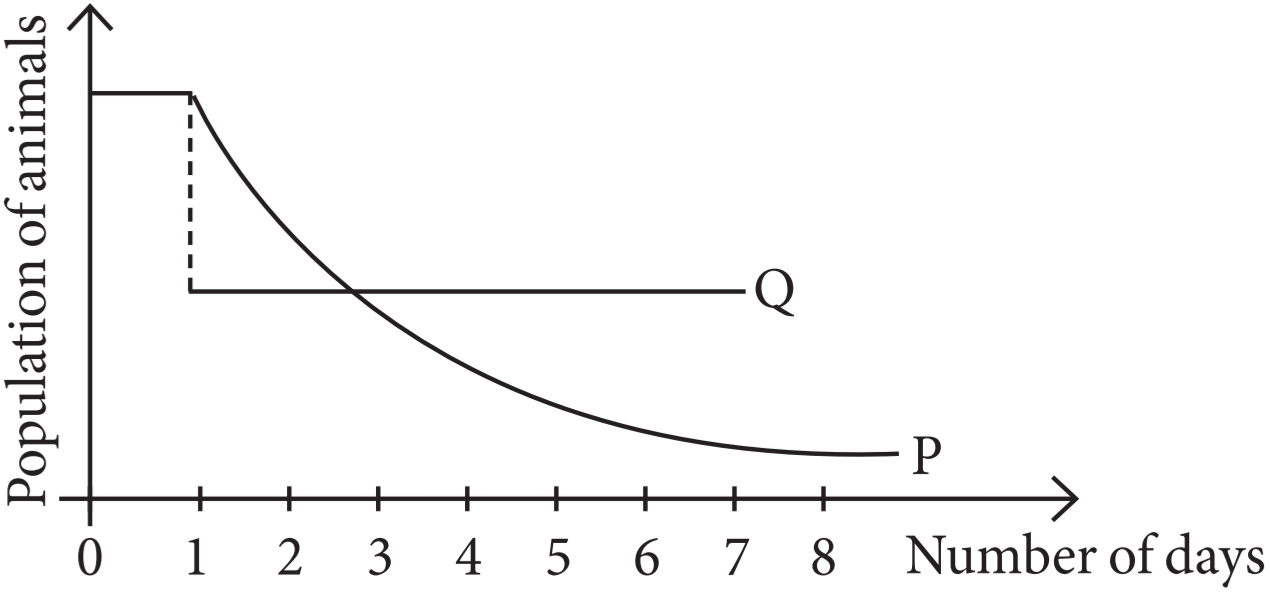
  1. The population of species Pin a certain conununity was constant until a population species Q from a distant land was subsequently introduced into that community. The interaction between the two populations is reflected in the graph below.


What could be the possible reason for the decrease in the population of species P over a number of days?
  1. Species Q is a predator of species P.
  2. Species Q is a prey species which wiped out the population of species P.
  3. Species P and Q compete for space but feeds on different food.
  4. None of these.
Answer
  1. (d) Both (a) and (b).
  1. (d) Yucca moth.
Explanation:

Pronuba yuccasella shows obligatory mutualisti c relationships with Yucca.
  1. (c) Alien species invasion.
Explanation:

Alien species invasion is considered to be second major cause of extinction of species.
  1. (c) Assertion is true but reason is false.
Explanation:

Eichhornia crassipes is an aquatic plant, native to Amazon basin. This plant was introduced into India for its beautiful ftowers and shape of leaves.
  1. (a) Species Q is a predator of species P.
View full question & answer
Question 34 Marks
Read the following and answer any four questions from (i) to (v) given below:
Wetlands are called Ramsar sites because the first international convention on their conservation was held in Ramsar in Iran in 1971. Wetlands or Ramsar sites are low lying marshy areas which get filled up during rains due to runoff and overflow from other water bodies. They are often considered to be waste lands which are used as dumping areas and filled up to recover land for various constructions activities. As a result, a large number of wetlands have disappeared.
  1. Select the incorrect match of wetland and its location.
 
Wetland
Location
(a)
Harike
Punjab
(b)
Chandra Tai
H.P.
(c)
Bhoj
M.P.
(d)
Ashtamudi
Odisha
  1. Migratory bird flamingo breeds in which of the following wetlands?
  1. Bhitarkanika Mangroves.
  2. Rann of Kutch.
  3. Harike.
  4. Chandra Tal.
  1. Which of the following is not an importance of wetlands?
  1. They are an important source of recharging groundwater.
  2. They provide protection from floods.
  3. They are good source of siltation and purification of water.
  4. None of these.
  1. Which of the following wetland ecosystem is highly acidic and has a accumulation of decomposed plants known as peat?
  1. Bog
  2. Mangrove
  3. Estuary
  4. Watershed
  1. The mangroves of Bhitarkanika are famous for:
  1. Rare migratory waterbirds.
  2. Nesting sites for endangered olive ridley turtles.
  3. Prawn cultivation.
  4. All of these.
Answer
  1. (d)
     
    Wetland
    Location
    (d)
    Ashtamudi
    Odisha
Explanation:

Ashtamudi is located in Kerala.
  1. (b) Rann of Kutch.
Explanation:

Migratory bird flamingo breeds in Rann of Kutch.
  1. (d) None of these.
  1. (a) Bog
Explanation:

The rate of peat formation is sufficiently high to create a bog in hydrosere. A bog is a permanently waterlogged raised site that receives all its water and nutrient inputs from rainfall or other precipitation.
  1. (b) Nesting sites for endangered olive ridley turtles.
View full question & answer
Question 44 Marks
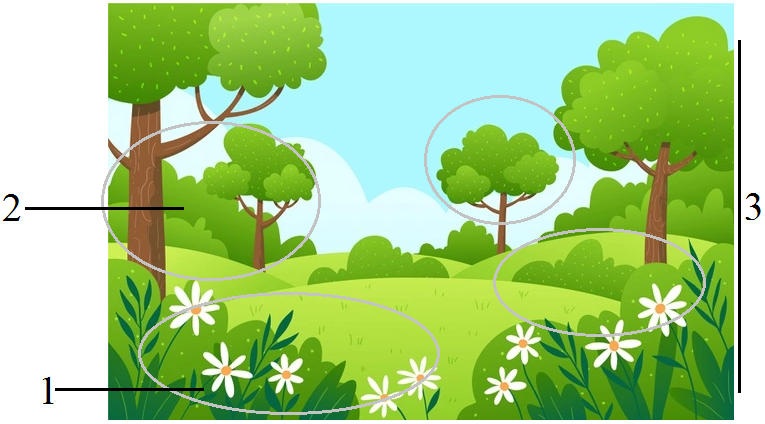
Read the following and answer any four questions from (i) to (v) given below: Ecosystem diversity is the variety of forms in the ecosystem due to diversity of niches, trophic levels and ecological processes like nutrient recycling, food webs, energy flow, etc. Study the given figure.
  1. Identify different types of diversity denoted by 1, 2 and 3 in the given figure.
 
1
2
3
(a)
Alpha diversity
Beta diversity
Gamma diversity
(b)
Gamma diversity
Alpha diversity
Beta diversity
(c)
Gamma diversity
Beta diversity
Alpha diversity
(d)
Beta diversity
Alpha diversity
Gamma diversity
  1. Alpha diversity is biodiversity present.
  1. Within conununity.
  2. Between conununities.
  3. In ranges of communities.
  4. None of these.
  1. Diversity represented by diversity of habitats over a total landscape area is:
  1. $\alpha-\text{diversity}$
  2. $\gamma-\text{diversity}$
  3. $\beta-\text{diversity}$
  4. $\delta-\text{diversity}$
  1. Concept of three types of ecological diversity was given by:
  1. Elton
  2. Odum
  3. Edward Wilson
  4. Whittaker
  1. The diversity of organisms sharing the same habitat or conununity is termed as:
  1. Alpha diversity.
  2. beta diversity.
  3. gamma diversity.
  4. delta diversity.
Answer
  1. (d)
     
    1
    2
    3
    (d)
    Beta diversity
    Alpha diversity
    Gamma diversity
Explanation:
Ecological diversity is of three types:
  1. Alpha diversity (Within community diversity)
  2. Beta diversity (Between community diversity)
  3. Gamma diversity is diversity of habitats/ ecosystems over a total landscape or geographical area.
  1. (a) Within conununity.
  1. (b) $\gamma-\text{diversity}$
Explanation:
$\gamma-\text{diversity}$ is diversity present in ranges of communities as represented by diversity of habitats over total landscape.
  1. (d) Whittaker
  1. (a) Alpha diversity.
View full question & answer
Question 54 Marks
​​​​Read the following and answer any four questions from (i) to (v) given below: Edward Wilson described diversity at all levels of biological organisation ranging from macromolecules inside the cells to biomes. It is of three inter-related hierarchial levels-genetic diversity, species diversity and conununity ecosystem diversity. Species diversity is the variety in the number and richness of the species of a region. For example, the Western ghats have a greater amphibian species diversity than the Eastern ghats.
  1. The number of species per unit area is called.
  1. Species evenness.
  2. Species richness.
  3. Species equitability.
  4. Both (a) and (c).
  1. The table below gives the population (in thousands) of ten species (A - J) in four areas (I - IV) consisting of the number of habitats given within brackets against each. Study the table and answer the question which follows:
Area and number of habitats
Species and their population (in thousands) in the area
A
B
C
D
E
F
G
H
I
J
I(11)
23
12
0.52
6.0
-
3.1
1.1
9.0
-
10.3
II(11)
10.2
-
0.62
-
1.5
3.0
-
8.2
1.1
11.2
III(13)
11.3
0.9
0.48
2.4
1.4
4.2
0.8
8.4
2.2
4.1
IV(12)
3.2
10.2
1.1
4.8
0.4
3.3
0.8
7.3
1.3
2.1
Which are out of I to IV shows maximum species diversity?
  1. II
  2. III
  3. IV
  4. I
  1. Study the given populations and choose the correct answer in relation to species diversity.
Population
Species
Species
Individuals
Population A
I
Mammals
3
II
Birds
2
III
Amphibians
2
Population B
I
Mammals
2
II
Mammals
2
III
Amphibians
1
Population C
I
Mammals
3
II
Mammals
2
III
Mammals
4
 
Maximum diversity
Minimum diversity
(a)
Population B
Population C
(b)
Population A
Population C
(c)
Population A
Population B
(d)
Population B
Population A
  1. The concept of species diversity has two components : evenness and richness. Evenness is based on the relative abundance of species. Richness is based on the total number of species present. Diversity indices combine a measure of richness and evenness. The Simpson index (D) is calculated from the following equations:
$\text{D}=\displaystyle\sum_{\text{i}=1}(\text{n}_\text{i}/\text{N})^2$
where, n = total number of organisms of particular species
N = total number of organisms of all species
Below are data collected in two terrestrial plant conununities that represent part of a successional chronosequence. ln this case the values were measured as percent cover.
Early Successional Community
Late Successional Community
Species
Percent Cover
Species
Percent Cover
A
83
F
24
B
5
G
20
C
9
H
18
D
2
I
23
E
1
J
15
The data indicate that, relative to the early successional community, the late successional community has which of the following characteristics?
 
Species Richness
Evenness
(a)
Higher
Higher
(b)
Higher
Lower
(c)
Same
Lower
(d)
Same
Higher
  1. Select the incorrect statement regarding species diversity.
  1. It results in polymorph formation and is useful in adaptation to changes in environmental conditions.
  2. Number of individuals of different species represent species evenness.
  3. It influences biotic interactions and stability of the community.
  4. It is a trait of the community.
Answer
  1. (b) Species richness.
Explanation:

The number of species per unit area is called species richness.
  1. (b) III
  1. (b)
     
    Maximum diversity
    Minimum diversity
    (b)
    Population A
    Population C
  1. (d)
     
    Species Richness
    Evenness
    (d)
    Same
    Higher
  1. (a) It results in polymorph formation and is useful in adaptation to changes in environmental conditions.
Explanation:

Genetic diversity results in polymorph formation and is useful in adaptation to changes in environmental conditions.
View full question & answer
Question 64 Marks
Read the following and answer any four questions from (i) to (v) given below:
The Kakapo is the world's largest and heaviest parrot, found only in New Zealand. It is unusual in that it is nocturnal, flightless and ground-dwelling. It is an excellent climber of trees, has strong legs that allow it to "jog" several kilometres in a single trip, and has mossy green plumage mottled with brown and yellow. The Kakapo is also critically endangered as of now, there were only few known living individuals left.
  1. Which could be the possible reason for Kakapo to be well-adapted to its environment prior to the arrival of humans in New Zealand?
  1. Kakapo was active only in the night when its potential predators would not be out for hunting.
  2. The Kakapo would likely be well-camouflaged among the forest foliage due to its greenish plumage.
  3. It was able to effectively hunt for food in the night.
  4. All of these.
  1. When humans started to settle in New Zealand, they took with them non-native animals, including mammals such as cats, dogs and stoats. By which of the following ways, human settlement likely contributed to a near decimation of Kakapo populations in New Zealand?
  1. Habitat destruction.
  2. Alien species invasion.
  3. Pollution.
  4. Both (a) and (b).
  1. All known survived Kakapo have been relocated by the New Zealand government to three predator-free islands, where they are monitored year round by staffs and volunteers to ensure that the birds are safe, healthy and well-fed. The extremely low population of Kakapo is a hurdle to the species becoming viable in the long term, despite such dedicated conservation efforts. This is because.
  1. The small population results in very small gene pool.
  2. There would be very Ii mited genetic diversity among the resulting offspring.
  3. Of reduced capacity of the species to adapt and survive changes in the environment.
  4. All of these.
  1. The reasons behind conserving biodiversity have been grouped into which of the following categories?
  1. Narrowly utilitarian.
  2. Broadly utilitarian.
  3. Ethical.
  4. All of these.
  1. One of the ex situ conservation methods for endangered species is:
  1. Wildlife sanctuaries.
  2. Biosphere reserves.
  3. Cryopreservation.
  4. National parks.
Answer
  1. (d) All of these.
Explanation:

Since the Kakapo is nocturnal, it was active only in the night when its potential predators would not be out for hunting. With its greenish plumage, the Kakapo could likely be well camouflaged among the forest foliage in the daytime when it is resting hence evading detection by its predators. It was able to effectively hunt for food in the night given its ability to climb trees and travel significant distances over land despite lacking the ability to fly.
  1. (d) Both (a) and (b).
Explanation:

As humans settled in NewZealand,they would have cleared the land to make way for their own needs, e.g., farmland, hence shrinking the natural habitats of the Kakapo. The new mammals that were introduced into the Kakapo's habitats might have out-competed the Kakapo for the limited food resources available. The new mammals that were introduced might also have easily preyed on the Kakapo (e.g., by using their sense of smell), as the Kakapo likely lacked the necessary adaptations to defend itself given that such predators were never present in the past. For instance, many mammals such as cats are nocturnal and hence would prey on Kakapo when the latter are also active at night.
  1. (d) All of these.
Explanation:

The small populations results in a very small gene pool, i.e., a very limited variety of alleles I traits among surviving individuals of the species. Even if the existing birds manage to breed and multiply significantly, there would be very limited genetic diversity among the resulting offspring. This would lead to reduce capacity of the species to adapt to and survive changes in the environment. There may also be reduced fitness in the offspring given increased likelihood of homozygosity of recessive harmful/ deleterious alleles, which would result in these alleles being expressed to bring about unfavourable phenotypes.
  1. (d) All of these.
Explanation:

We should conserve biodiversity. The reason for this can be broadly divided into three categories: (i) Narrowly utilitarian (Humans derive a major part of their requirement from organisms). (ii) Broadly utilitarian (Biodiversity is fundamental to ecosystem services of nature). (iii) Ethical (Every living species has an intrinsic value, it is our moral duty not to destroy them).
  1. (c) Cryopreservation.
Explanation:

Ex situ (off site) conservation is conservation of selected rare plants/ animals in places outside their natural homes. It is a desirable approach to save threatened or endangered plant or animal species from extinction. Ex situ conservation includes offsite collections, gene banks, in vitro fertilisation, cryopreservation techniques and tissue culture.
View full question & answer
Question 74 Marks
Read the following and answer any four questions from (i) to (v) given below:
Excessive exploitation of species, whether a plant or animal reduces the size of its population so it becomes vulnerable to extinction. Such as Dodo and passenger pigeon have become extinct due to over exploitation by humans. Thus the world is facing accelerated rates of species extinctions, largely due to human interference.
  1. Which of the following cause of biodiversity loss is not included in evil quartet?
  1. Coextinction.
  2. Pollution.
  3. Alien species invasion.
  4. Habitat loss and fragmentation.
  1. Identify the species that have become extinct due to over exploitation.
  1. Stellar sea cow.
  2. Yucca moth.
  3. Blatta orientalis.
  4. Nile Perch.
  1. Factors which make species susceptible to extinction are:
  1. Large population size.
  2. Lack of genetic variability.
  3. Ower status of trophic level.
  4. Ability to switch over to ahem ate foods.
  1. Assertion: Pollution reduces species biodiversity.
Reason: Spill over of oil in sea causes death of several marine animals.
  1. Both assertion and reason are true and reason is the correct explanation of assertion.
  2. Both assertion and reason are true but reason is not the correct explanation of assertion.
  3. Assertion is true but reason is false.
  4. Both assertion and reason are false.
  1. ________ is the first major cause of species extinction.
  1. Coextinction.
  2. Over exploitation.
  3. Habitat destruction.
  4. Alien species invasion.
Answer
  1. (b) Pollution
Explanation:

Evil quartet, i.e., four major causes of biodiversity loss are habitat loss and fragmentation, over exploitation, alien species invasion and co-extinction.
  1. (a) Stellar sea cow.
  1. (b) Lack of genetic variability.
Explanation:

Population traits which make species susceptible to extinction are: small population, higher status of trophic level and inability to switch over to alternate foods.
  1. (a) Both assertion and reason are true and reason is the correct explanation of assertion.
  1. (c) Habitat destruction.
View full question & answer
Question 84 Marks
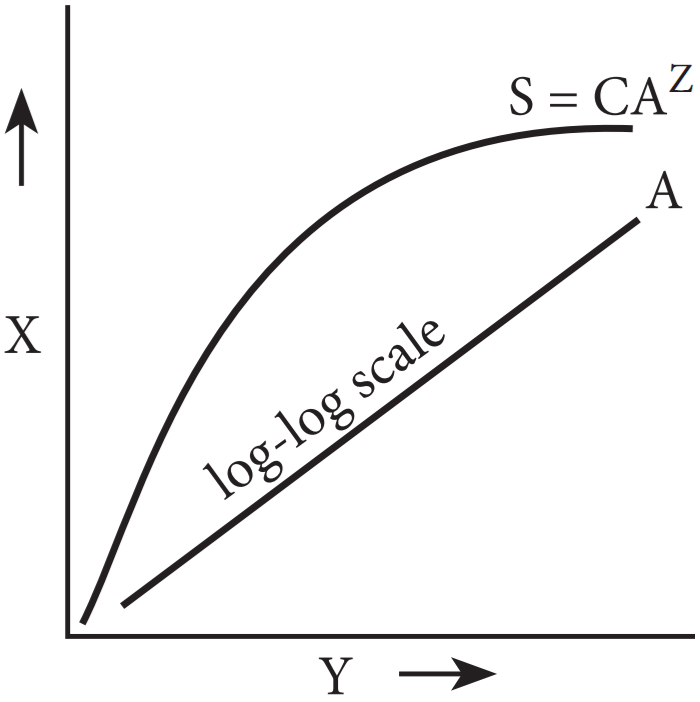
Read the following and answer any four questions from (i) to (v) given below: Within a region, species richness increases with increasing explored area, but only upto a limit. TI1e given graph explains this relationship.
  1. What does the given figure show?
  1. Rivet-popper hypothesis.
  2. Species-area relationship.
  3. Proportionate number of species of major taxa.
  4. $\alpha-\text{ecological diversity }$
  1. Equation for relationship (A) between species richness and area is:
  1. $\log\text{ S}=\log\text{ C}+\text{Z }\log\text{ A}$
  2. $\log\text{ C}=\log\text{ S}+\text{Z }\log\text{ A}$
  3. $\text{Z }\log\text{ A}=\log\text{ S}+\log\text{ C}$
  4. $\log\text{ S}=\log\text{ C}+\log\text{ A}$
  1. What is the value of slope of line or regression coefficient Z for frugivorous birds?
  1. 0.1 - 0.2
  2. 1.15
  3. 0.01 - 0.1
  4. 0.6 - 1.2
  1. The shape of curve for relationship between species richness and areas for wide variety of taxa is:
  1. Straight line.
  2. Parabola.
  3. Rectangular hyperbola.
  4. Bell shaped.
  1. Who gave this concept of increase in species richness with increasing offered area?
  1. Humboldt.
  2. Odum.
  3. Edward Wilson.
  4. Paul Ehrlich.
Answer
  1. (b) Species-area relationship.
  1. (a) $\log\text{ S}=\log\text{ C}+\text{Z }\log\text{ A}$
Explanation:
On a logarithmic scale, the relationship between species richness and area is a straight line.
  1. (b) 1.15
Explanation:
The regression coefficient Z have a value of 1.15 for frugivorous birds and mammals of tropical forests of different continents.
  1. (c) Rectangular hyperbola.
  1. (b) Odum.
Explanation:
While exploring the wilderness South American jungles, Alexander von Humboldt found that within a region, the species richness increased with increasing area but upto a certain limit.
View full question & answer
Question 94 Marks
Read the following and answer any four questions from (i) to (v) given below:
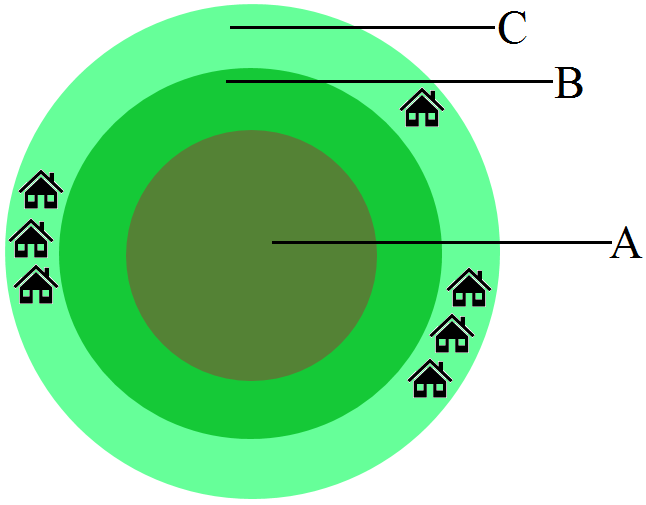
Biosphere reserves are multipurpose protected areas which are meant for preserving genetic diversity in representative ecosystems of various natural biomes and unique biological communities by protecting wild populations, traditional life style of tribals and domesticated plant/animal genetic resources. Each biosphere reserve has three zones-core, buffer and transition zone.
  1. Which of the following is similar to biosphere reserve in terms of conservation?
  1. Gene banks.
  2. Offsite collection.
  3. Orchards.
  4. Hotspots.
  1. Refer to the given figure representing different zones of a biosphere reserve and select the correct option regarding it.
  1. A-Limited human activity is allowed such as for research and education.
  2. B-An active co-operation occurs between reserve management and local people for activities like cropping, settlements, etc.
  3. C-No human activity is allowed.
  4. None of these.
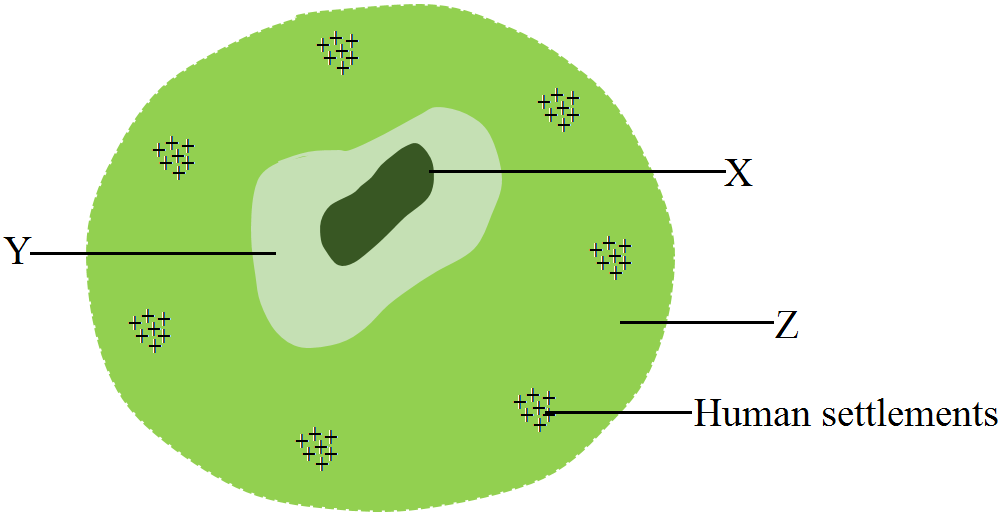
  1. Refer to the given diagrammatic representation of a biosphere reserve.


Select the incorrect statement regarding X, Y and Z.
  1. X is devoted to strict protection of wildlife and no human activity is allowed in this zone.
  2. In Y, only limited human activity (compatible with conservation) is allowed.
  3. In Z, commercial exploitation of natural resources is allowed.
  4. Tourism is allowed in Z zone only.
  5. Zone Y helps to maintain the lifestyle of the tribal people living in the area.
  1. (iii), (iv) and (v) only
  2. (ii), (iii) and (v) only
  3. (i), (iii) and (iv) only
  4. (ii), (iii) and (iv) only
  1. Biosphere reserves differ from national parks and wildlife sanctuaries because in the former.
  1. Human beings are not allowed to enter
  2. People are an integral part of the system
  3. Plants are paid greater attention than the animals
  4. Living organisms are brought from all over the world and preserved for posterity.
  1. MAB Programme means.
  1. Man and biosphere programme.
  2. Man and biodiversity conservation programme.
  3. Manually aided biosphere conservation programme.
  4. None of these.
Answer
  1. (d) Hotspots.
Explanation:

Biosphere reserves and hotspots are in-situ methods of conservation.
  1. (d) None of these.
  1. (a) (iii), (iv) and (v) only
Explanation:

ln the given figure, X, Y and Z represent core zone, buffer zone and transition zone of biosphere reserve respectively. No commercial exploitation of natural resources is allowed in core zone. Tourism is allowed up to buffer zone of biosphere reserve. Transition zone helps to maintain the lifestyle of the tribal people living in the area.
  1. (b) People are an integral part of the system
Explanation:

Biosphere reserves have a transition zone where participation of local people for activities like settlements, cropping, recreation, forestry, etc. take place.
  1. (a) Man and biosphere programme.
View full question & answer
Question 104 Marks
Read the following and answer any four questions from (i) to (v) given below:
IUCN maintains a Red Data Book or Red List which is a catalogue of taxa facing risk of extinction. The IUCN Red List (2004) documents the extinction of 784 species in the last 500 years. Some examples of recent extinctions include the dodo, quagga, thylacine and Steller's sea cow. The last twenty years alone have witnessed the disappearance of 27 species. Red List has eight categories of species.
  1. Dodo, an extinct taxon, belongs to which country?
  1. Mauritius
  2. Africa
  3. Australia
  4. Russia
  1. To which of the following categories of IUCN, Berberis nilghiriensis belongs?
  1. Extinct.
  2. Extinct in wild.
  3. Endangered.
  4. Critically endangered.
  1. Steller's sea cow and passenger pigeon became extinct due to:
  1. Alien species invasion.
  2. Over-exploitation.
  3. Coextinctions.
  4. Intensive agriculture.
  1. Bali, Javan and Caspian are:
  1. Species of tiger.
  2. Species of cheetah.
  3. Subspecies of cheetah.
  4. Subspecies of tiger.
  1. Select the correct term for the following definitions (i, ii, iii, iv).
  • The taxon is liable to become extinct if not allowed to realise its full biotic potential by providing protection from exotic species/ human exploitation/habitat deterioration/depletion of food.
  • The taxon has been completely eliminated or died out from earth, e.g., Dodo.
  • The taxon is facing a high risk of extinction in the wild in the near future due to decrease in its habitat, excessive predation or poaching.
  • They are species with naturally small populations, either localised or thinly scattered, which are always at risk from pests/ pathogens/ predators/ exotic species.
 
(i)
(ii)
(iii)
(iv)
(a)
Threatened
Extinct
Endangered
Rare
(b)
Endangered
Extinct
Threatened
Rare
(c)
Extinct
Rare
Threatened
Endangered
(d)
Threatened
Extinct
Rare
Endangered
Answer
  1. (a) Mauritius
Explanation:

An extinct taxon is the one which has been completely eliminated or died out from the earth, e.g., Dodo, native to Mauritius.
  1. (d) Critically endangered.
Explanation:

Berberis nilghiriensis is critically endangered animal. Critically endangered are those taxon which are facing very high risk of extinction in the wild and can becomes extinct any moment in the immediate future.
  1. (b) Over-exploitation.
Explanation:

Excessive exploitation of a species, whether a plant or animal reduces size of its population so that it becomes vulnerable to extinction. Dodo, passenger pigeon, three subspecies of tiger and Steller's sea cow have become extinct in the last 500 years due to over exploitation by humans.
  1. (d) Subspecies of tiger.
Explanation:

Bali, Javan and Caspian are the three subspecies of tiger.
  1. (a)
     
    (i)
    (ii)
    (iii)
    (iv)
    (a)
    Threatened
    Extinct
    Endangered
    Rare
View full question & answer