Questions

3 Marks Question

Take a timed test

72 questions · self-marked practice — reveal the answer and mark yourself.

Question 13 Marks
Write important features of a sedimentary cycle in an ecosystem.
Answer
Sedimentary cycles have their reservoirs in the Earth’s crust or rocks. Nutrient elements are found in the sediments of the Earth. Elements such as sulphur, phosphorus, potassium, and calcium have sedimentary cycles. Sedimentary cycles are very slow. They take a long time to complete their circulation and are considered as less perfect cycles. This is because during recycling, nutrient elements may get locked in the reservoir pool, thereby taking a very long time to come out and continue circulation. Thus, it usually goes out of circulation for a long time.
View full question & answer
Question 23 Marks
Outline salient features of carbon cycling in an ecosystem.
Answer
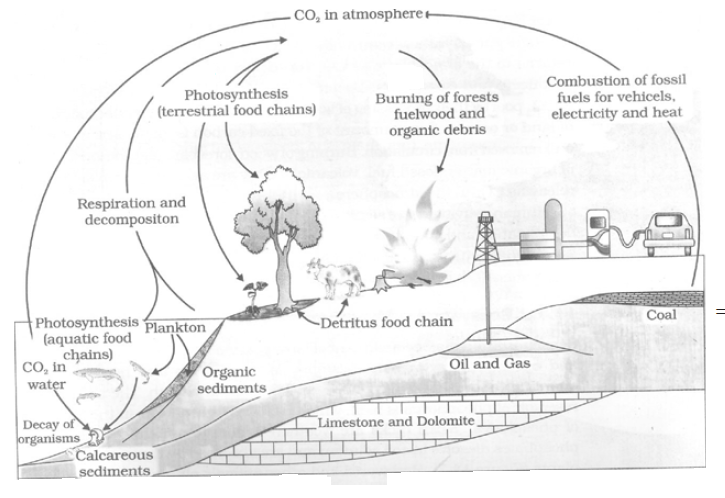
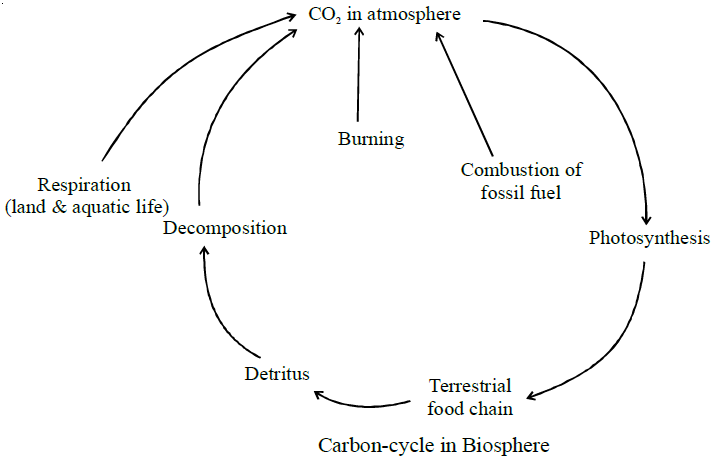
Carbon is an important constituent of living matter. Green plants take it in the form of $CO_2$ from atmosphere and fix it as carbohydrates. Carbon which is also present in proteins, fats etc. is transferred to the organisms of other trophic levels. Apart from being released in atmosphere as $CO_2$ during respiration, carbon is also released in atmosphere through burning of wood, fossil fuel and decomposition of organic matter by microbes.
View full question & answer
Question 33 Marks
Differentiate between primary and secondary succession. Provide one example of each.
Answer
S.No. Primary Succession Seconday Succession
1. It begins with areas where no living organisms ever existed. It begins in areas where natural biotic communities have been destroyed.
2. Establishment of a biotic community is very slow. Establishment of a biotic community is faster.
  Example
Newly cooled lava/bare rocks/newly created ponds or reservoir.
Example
Abandoned farm lands/burnt or cut forests/lands that have been flooded.
View full question & answer
Question 43 Marks
Describe the inter-relationship between productivity, gross primary productivity and net productivity.
Answer
Productivity is the rate of biomass production per unit area over a period of time, Gross primary productivity is the rate of production of organic matter during photosynthesis in an ecosystem.
Net productivity is the gross primary productivity minus respiration losses. (R)
View full question & answer
Question 53 Marks
State the function of a reservoir in a nutrient cycle. Explain the simplified model of carbon cycle in nature.
Answer
Function: To meet the deficit which occurs due to imbalance in the rate of influx & efflux.
View full question & answer
Question 63 Marks
Differentiate between two different types of pyramids of biomass with the help of one example of each.
Answer
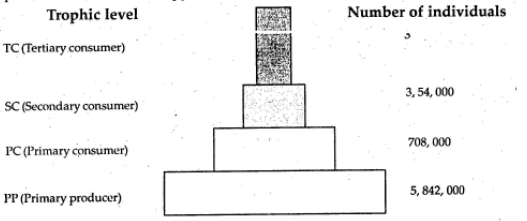
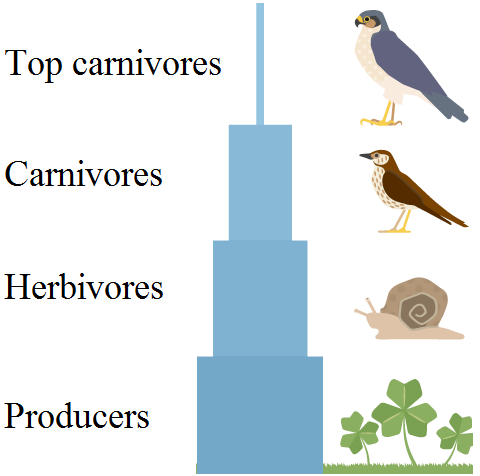
The relation between producers and consumerism an ecosystem can be graphically represented in the form of a pyramid called ecological pyramid. Types of ecological pyramid.
  1. Pyramid of number.
  2. Pyramid of biomass.
  3. Pyramid of energy.
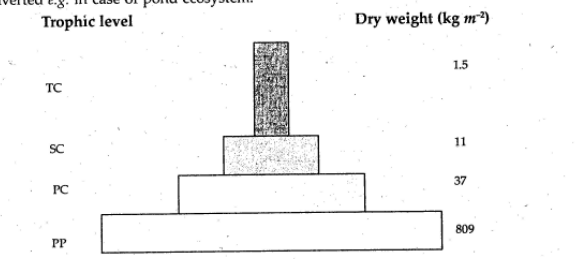
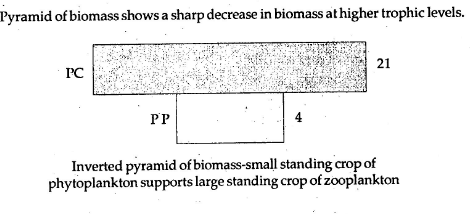
In grassland and forests, there is generally a gradual decrease in, biomass of organisms at successive levels from the producers to the top carnivores. The biomass of a single tree is naturally very high than the biomass of a number of birds feeding upon the tree. Similarly, the biomass of even a very large number of bird parasites is lesser than that of the birds. Therefore, in upright pyramid the biomass decreases with successive trophic levels. Thus, pyramids are upright.

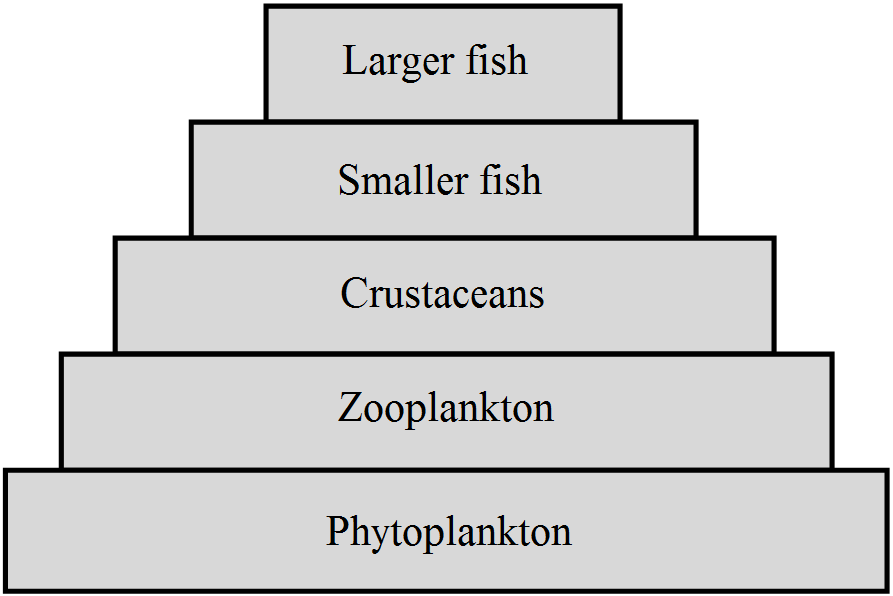
However, in a pond or lake ecosystem ,the pyramid of biomass is inverted in shape. In a pond or lake ecosystem, the biomass of diatoms and other phytoplankton is quite negligible as compared with that of the crustaceans and small herbivorous fish that feed on these producers. The biomass of large carnivorous fish living on small fishes is still greater.
  1.  
  1.  
View full question & answer
Question 73 Marks
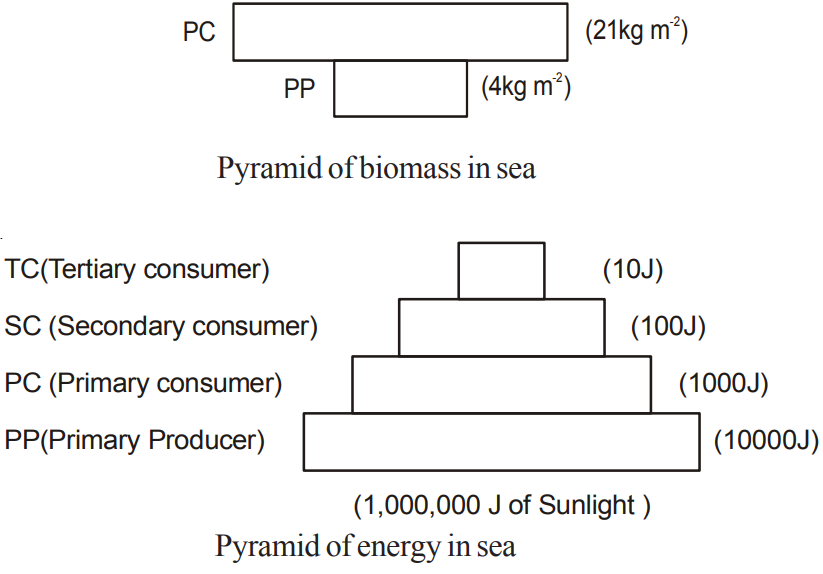
Draw a pyramid of biomass and pyramid of energy in sea. Give your comments on the type of pyramids drawn.
Answer

  • The pyramid of biomass in sea is inverted.
  • The pyramid of energy in sea is upright.
View full question & answer
Question 83 Marks
  1. Name any two places where it is essential to install electrostatic precipitators. Why it is required to do so?
  2. Mention one limitation of the electrostatic precipitator.
Answer
  1. Thermal power plants/smelters/other particulate matter releasing industries.
To remove particulate matter.
  1. Very very small particulate matter/less than 2.5 micrometres are not removed/velocity of air between plates must be low enough to allow the dust to fall/cannot work without electricity.
View full question & answer
Question 93 Marks
  1. What is primary productivity? Why does it vary in different types of eco - systems?
  2. State the relation between gross and net primary productivity.
Answer
  1. Production of biomass/energy per unit area in a given time (per year) by plants during photosynthesis.
Depends upon - plant species inhabiting a particular area, environmental factors availability of nutrients, photosynthetic capacity of plants.
  1. GPP – R = NPP.
View full question & answer
Question 103 Marks
“In a food-chain, a trophic level represents a functional level, not a species.” Explain.
Answer
Position of a species in any trophic level is determined by the function performed by that mode of nutrition of species in a particular food chain/A given species may occupy more than one trophic level in the same ecosystem (in different food chains) at the given time, If the function of the mode of nutrition of species changes its position shall change in the trophic levels, same species can be at primary consumer level in one food chain and at secondary consumer level in another food chain in the same ecosystem at the given time.
View full question & answer
Question 113 Marks
Name the pioneer species on a bare rock. How do they help in establishing the next type of vegetation? Mention the type of climax community that will ultimately get established.
Answer
Lichens, they secrete acids, to dissolve rocks, which result in weathering and soil forms, leads to growth of bryophytes, forests.
View full question & answer
Question 123 Marks
Construct an ideal pyramid of energy when 1,000,000 joules of sunlight is available. Label all its trophic levels.
View full question & answer
Question 133 Marks
What are exotic species? Explain with the help of two examples how the exotic species disturb the native species of an ecosystem?
Answer
Exotic species: A species which is not native to the region in which it occurs,
  1. Nile perch an exotic predatory fish introduced into Lake Victoria (South Africa) threatens the entire ecosystem of the lake by eliminating several native species of the small cichlid fish species.
  2. Introduction of water hyacinth has threatened the survival of many aquatic species in lakes and rivers, as this plant multiplies very fast and clogs the water bodies.
  3. Lantana camera has invaded forestlands in many parts of India, and it competes strongly with the native species.
View full question & answer
Question 143 Marks
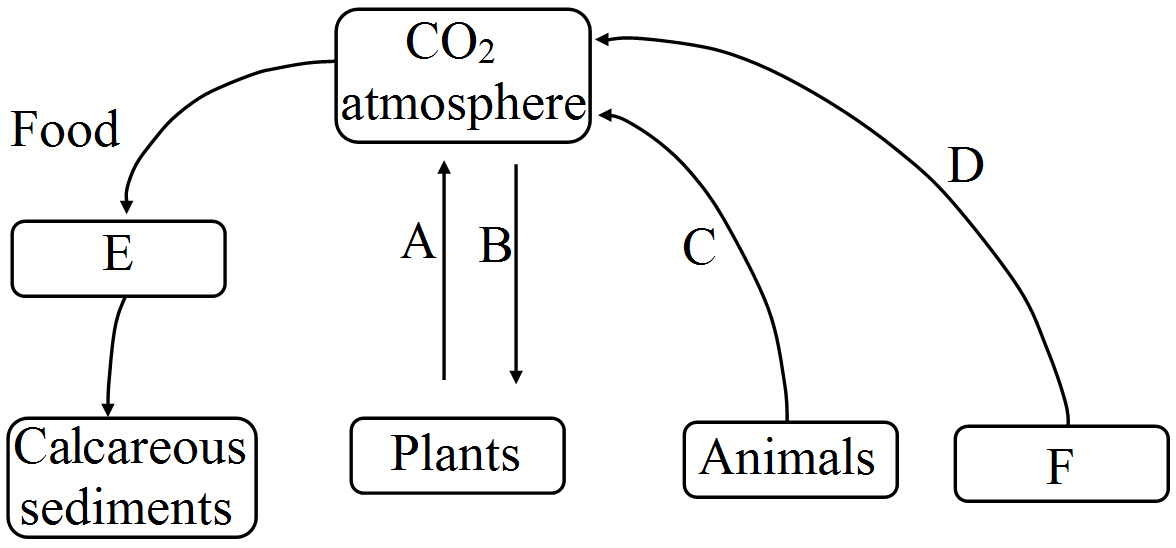
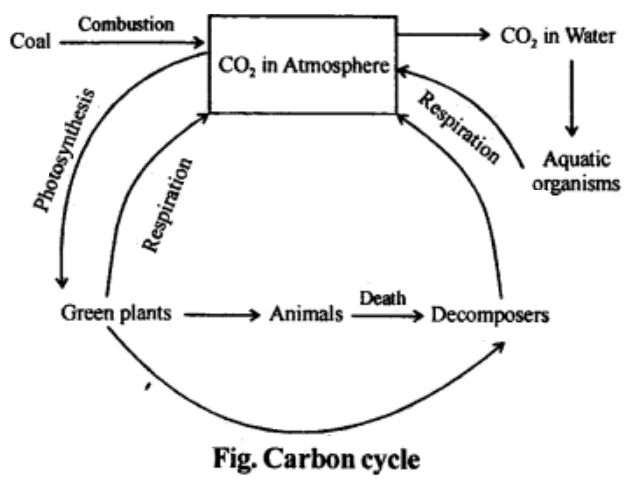
Complete the following model of carbon cycle by filling A, B, C, D, E and F.
Answer
A-Respiration, B-Photosynthesis, C-Respiration, D-Combustion of fossil fuels E-Aquatic food chain and F-Coal and oil.
View full question & answer
Question 153 Marks
Define a climax community. How does a sere differ from a seral community?
Answer
A climax community is the community that gets established at the terminal stage of succession and remains in equilibrium with the environment.Difference:
Sere Seral Community
A sere refers to the entire sequence of communities of communities that successively change in a given area. Each of the communities that gets establihsed between the pioneer and climax communities,is called a seral community.
View full question & answer
Question 163 Marks
What is the difference between gaseous and sedimentary cycles?
Answer
In gaseous cycle, the reservoir is located in atmosphere e.g., Nitrogen in atmosphere whereas in sedimentary cycle the reservoir is located in the soil. e.g., Phosphorus stored in lithosphere.
View full question & answer
Question 173 Marks
What is ecological succession? Where and why would the rate of succession be faster, in a newly created pond or a forest destroyed by a forest fire?
Answer
  1. Ecological succession is the phenomenon in which the structure and composition of communities change in an orderly and sequential manner leading ultimately to the establishment of a climax community.
  2. The ecological succession in a forest destroyed by a forest fire will be faster, because, there is already soil (substratum) and organic matter present; some vegetative propagules may also be present and it is secondary succession.
  3. In a newly created pond, it is primary succession as there is not much of organic matter or any propagules; hence it will take a very long time.
View full question & answer
Question 183 Marks
The biodiversity increases when one moves from the pioneer to the climax stage. What could be the explanation?
Answer
In the successive seral stages there is a change in the diversity of species of organisms, increase in the number of species and organisms as well as an increase in the total biomass. Description of ecological succession usually focuses on changes in vegetation. However, these vegetational changes in turn affect food and shelter for various types of animals. Thus, as succession proceeds, the numbers and types of animals and decomposers also change.
View full question & answer
Question 193 Marks
Flow of energy through various trophic levels in an ecosystem is unidirectional and non-cyclic. Explain.
Answer
The energy from the sun reaches the food chain through the primary producers (plants). This energy is passed on through successive trophic levels in the food chain. The energy transfer in the food chain follows the 10 percent law where in only 10% of the energy is transferred from one trophic level to the next successively. So, the movement of energy is only in one direction from lower to higher trophic level.
View full question & answer
Question 203 Marks
Differentiate between carnivores and consumers.
Answer
Carnivores and consumers:
S.No.
Carnivores
Consumers
1.
A carnivore meaning "meat eater" is an organism that derives its energy and nutrient requirements from a diet consisting mainly or exclusively of animal tissue, whether through predation or scavenging.
Consumers in a food chain are living creatures that eat organisms from a different population. First, it is necessary to understand these two classifications, heterotrophs and autotrophs, consumers and producers respectively.
2.
A carnivore at the top of the food chain, not preyed upon by other animals.
it can also only eat plants (producers) being located in the first level of the food chain above the producers. (primary, secoundary, tertiary).
View full question & answer
Question 213 Marks
Where and how does the primary succession occur? Explain.
Answer
Primary succession occurs on newly cooled lava or bare rocks or newly created pond or reservoir.
  1. Primary succession in water:
  • The pioneer species are phytoplanktons.
  • The phytoplanktons are replaced by free-floating angiosperms.
  • Then, rooted angiosperms invade sedges, grasses and finally the trees.
  • At last, a stable climax forest is formed.
  • An aquatic habitat is converted into mesic habitat.
  1. Primary succession on rocks:
  • Lichens are the pioneer species on a bare area.
  • The lichen secretes some acids to dissolve rock and help in weathering and soil formation.
  • Later, some small bryophytes invade and hold the small amount of soil.
  • The bryophytes are succeeded by herbs, shrubs and ultimately big trees.
  • At last, a stable climax forest is formed.
  • The xerophytic habitat gets converted into a mesophytic one.
View full question & answer
Question 223 Marks
  1. Define pioneer species.
  2. Among bryophytes, lichens and fern, which one is a pioneer species in a xeric succession? And why?
Answer
  1. The species that invade a bare area are called pioneer species.
  2. In a xeric succession the pioneer species are usually lichens then bryophytes, which are succeeded by ferns and some other bigger plants. Lichen produces organic acids which corrodes rock surface and release minerals required for growth. The corroded rock accumulates soil particles by wind and provides substrate for bryophytes and ferns.
View full question & answer
Question 233 Marks
Give two examples of each:
  1. Terrestrial ecosystem.
  2. Aquatic ecosystem.
  3. Man-made ecosystem.
Answer
  1. Terrestrial ecosystem: Forest, grassland, desert, etc.
  2. Aquatic ecosystem: Pond, lake, river, wetland, estuary, etc.
  3. Man-Made ecosystem: A manmade ecosystem is an artificial biological system that is managed and sustained by people.
View full question & answer
Question 243 Marks
Explain how oxygen and the chemical composition of detritus control decomposition.
Answer
  1. Chemical composition of detritus:
  • Decomposition is faster when detritus is rich in nitrogen and water-soluble substances like sugars.
  • Decomposition is slow when detritus is rich in lignin and chitin.
  1. Oxygen:
  • Decomposition is an oxygen-consuming process.
  • Anaerobic conditions inhibit decomposition.
View full question & answer
Question 253 Marks
What do you understand by climax community?
Answer
It is also called climatic climax community which is the stable, self perpetuating and final biotic community that develops at the end of biotic succession and is in perfect harmony with the physical environment.
View full question & answer
Question 263 Marks
  1. What is meant by ecological succession? Explain how it occurs.
  2. What properties distinguish a pioneer community from a climax community?
Answer
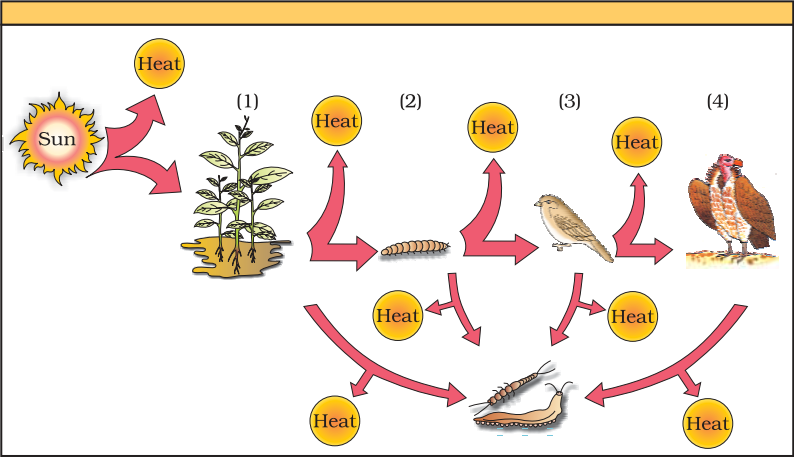
  1. The sequential, gradual and predictable changes in the species composition in an area are called succession or ecological succession.
Ecological succession is of two types:
  1. Primary succession: It begins in areas where no living organisms ever existed. Therefore, the establishment of a biotic community is very slow, e.g., newly cooled lava, bare rock, newly created pond or reservoir.
  2. Secondary succession: It begins in areas where natural biotic communities have been destroyed, e.g., abandoned farm lands, buried or cut forests. Since soil is available, it is a faster process.
  1.  
S. No.
Pioneer community
Climax community
(i)
The species which invade a bare area or land to initiate succession is called pioneer community.
The last or final stage in a succession constitute the climax community.
(ii)
The pioneer species have high reproductive rate.
The climax species have low reproductive rate.
(iii)
The pioneer species have short life span.
The climax species have long life span.
(iv)
They are replaceable.
They are stable and not replaced.
View full question & answer
Question 273 Marks
In ecosystem the movement of nutrients is called cycling while the term 'flow' used for energy. Why?
Answer
Nutrients are required by organisms to sustain their life, which are provided by earth and returned to earth after their death and decay. Thus, there is exchange of nutrients between living and non-living components of biosphere, whereas the energy flow in an ecosystem is always unidirectional, i.e., solar radiations → producers herbivores → carnivores. There is decrease in the content and flow of energy with the rise in trophic level. Thus, the terms cycling and flow are best suited for nutrients and energy respectively.
View full question & answer
Question 283 Marks
Questions 1-3 are based on the following diagram. Read the questions and fill the blank spaces:
  1. Each level of a pyramid represents a trophic level. With reference to the grazing food web, name an organism at the first trophic level. ______ (a) ______. Two organisms at the second trophic level ______(b)______ Two organisms at the third trophic level ______ (c) ______.
  2. With reference to a pyramid of energy, why is each trophic level reduced in size?
  3. Why is there a limited number of trophic levels?
Answer
  1.  
  1. Trees.
  2. Deer and rabbits.
  3. Snakes and hawks.
  1. As energy flows from one trophic level to the next, approximately 90% of it is lost.
  2. Eventually there is not enough energy to support another level.
View full question & answer
Question 293 Marks
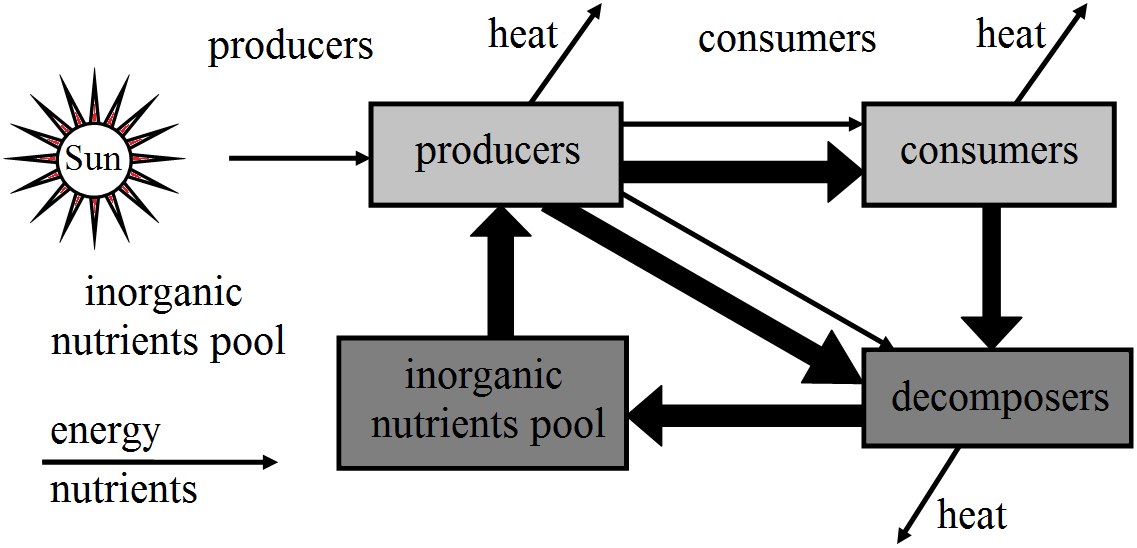
Study the following diagram, and answer these questions:
  1. Why does a wide arrow point from both producers and consumers to decomposers?
  2. Why does a wide arrow point only from inorganic nutrient pool to producers?
  3. Why don't the wavy arrows point from decomposers to producers?
Answer
  1. Both producers and consumers die and decompose.
  2. Only producers use inorganic nutrients to make organic molecules.
  3. Energy does not cycle.
View full question & answer
Question 303 Marks
Solar energy trapped by green plants finally returns to the environment. Comment.
Answer
Plants also convert sunlight into other forms of energy. In this case plants convert light energy.
  1. Into chemical energy, (in molecular bonds), through a process known as photosynthesis. Most of this energy is stored in compounds called carbohydrates. The plants convert a tiny amount of the light they receive into food energy. When animals eat green plants
  2. They consume and absorb some of this energy, which stored as chemical energy in compounds known as fats and protein. Milk from cows is a good source of solar energy
  3. (Also an excellent source of essential vitamins and minerals). When we drink milk our bodies convert the energy stored in the milk into energy for running, playing and important metabolic activities
  4. We have become “solar powered”!
View full question & answer
Question 323 Marks
Name the kind of organisms which constitute the pioneer community of xerarch and hydrarch succession, respectively.
Answer
Xerarch succession-Lichens.
Hydrarch succession-Phytoplanktons.
View full question & answer
Question 333 Marks
Mention the various seral stages of xero sere.
Answer
  1. Lichen stage.
  2. Moss stage.
  3. Annual grass stage.
  4. Perennial grass stage.
  5. Shrub stage.
  6. Climax community.
View full question & answer
Question 343 Marks
What are biogeochemical cycles? Mention their two kinds, giving instances of each.
Answer
Organisms need a constant supply of nutrients to grow reproduce and regulate various body functions and the .amount of nutrients, such as carbon, nutrients' phosphorus, calcium, etc., Present in the soil an any given time, is referred as the standing state. It varies with the kind of ecosystem and also on seasonal basis.The nutrients, which are present in the ecosystem never get lost, they are recycled again and again indefinitely. The movement of nutrient elements through the various components of an ecosystem is called as nutrient cycling, or also called biogeochemical cycles; (ro-living' geo-rocks, air, water).
Nutrient cycles are of two types based on their reservoir (i.e. storehouse): Gaseous cycle and sedimentary cycle' In both the gaseous and sedimentary cycle, environmental factors like temperature, pH' soil nature and moisture can regulate the rate of release of nutrients into the atmosphere. The function of the reservoir is to meet the deficit, which occurs due to imbalance in the rate of influx and efflux.
View full question & answer
Question 353 Marks
Given below is a list of autotrophs and heterotrophs. With your knowledge about food chain, establish various linkages between the organisms on the principle of ‘eating and being eaten’. What is this inter-linkage established known as?
Algae, hydrilla, grasshopper, rat, squirrel, crow, maize plant, deer, rabbit, lizard, wolf, snake, peacock, phytoplankton, crustaceans, whale, tiger, lion, sparrow, duck, crane, cockroach, spider, toad, fish, leopard, elephant, goat, Nymphaea, Spirogyra.
Answer
This interlinkage of different organisms is called food web. Following two food webs are possible with the given list of organisms.
Primary Producer’s (First trophic level): Algae, Hydrilla, maize plant, Phytoplankton, Nymphaea, Spirogyra.
Primary Consumer (Second trophic level): Crustaceans, grasshopper, deer, mouse, squirrel, rabbit, elephant, goat.
Secondly Consumer (Third trophic level): Spider, cockroach, lizard, wolf, snake, toad, fish, crane.
Top carnivore (Fourth trophic level): Lion, Tiger.
View full question & answer
Question 363 Marks
Discuss the factors which affect the rate of decomposition.
Answer
Factors Affecting Rate of Decomposition Decomposition is largely an aerobic process, i.e. requires oxygen for its processing.The rate of decomposition is controlled mainly by the following two factors:
  1. Chemical composition of detritus The rare of decomposition is slower, if detritus is rich in lignin and chitin while, it is quicker if it is composed of nitrogen and water-soluble substances like sugars.
  2. Climatic factors Temperature and soil moisture are the most important climatic factors that controls decomposition.
'Warm and moist environment favours decomposition while, low temperature and anaerobiosis, i.e. anaerobic conditions (unavailability of oxygen) inhibit decomposition resulting in build of organic materials.
View full question & answer
Question 373 Marks
What is humus? Mention its properties.
Answer
Humus is a dark-coloured, amorphous substance accumulated by the process of humification during decomposition of detritus.Properties:
  1. It is highly resistant to microbial action and undergoes decomposition at an extremely slow rate.
  2. Being colloidal in nature, it serves as a reservoir of nutrients.
  3. It improves the water-holding capacity of soil.
View full question & answer
Question 383 Marks
Define bioenergetics.
Answer
It is the process of transformation of solar energy into biological energy with the help of photosynthetic producers.
View full question & answer
Question 393 Marks
Why is earthworm considered a farmer's friend? Explain humification and mineralisation occurring in a decomposition cycle.
Answer
Earthworms are farmer's friend because these help in fragmentation of detritus and loosening of the soil. Both these processes are helpful for the decomposition of dead organic matter at a faster rate. Humification and mineralisation occurring during decomposition cycle are as follows Humification It is the process of accumulation of dark coloured amorphous substance called humus. It is highly resistant to microbial action and undergoes decomposition at very slow rate. Mineralisation It is the process by which humus is degraded by some microbes to release inorganic substances.
View full question & answer
Question 403 Marks
List the four important changes, taking place during biotic succession.
Answer
  1. Small short lived plants (r-selection) to large long lived plants (k-selection).
  2. Unstable biotic community to stable biotic community.
  3. Little diversity to high degree of diversity.
  4. Aquatic or dry conditions to mesic conditions.
View full question & answer
Question 413 Marks
Apart from plants and animals, microbes form a permanent biotic component in an ecosystem. While plants have been referred to as autotrophs and animals as heterotrophs, what are microbes referred to as? How do the microbes fulfil their energy requirements?
Answer
Productivity, decomposition, energy flow and nutrient cycling are integral features of any ecosystem. Plants and animals play important roles in productivity. While some microbes play the role in productivity; as some of them microbes are autotrophs, e.g. some algae and some chemosynthetic bacteria. Most of the microbes are heterotrophs. Parasitic microbes get nutrition from the host on which they depend. Many microbes are saprotrophs. They get nutrition from detritus, i.e. they are important part of detritus food chain.
View full question & answer
Question 423 Marks
Autotrophs convert inorganic materials into organic material with the help of solar energy.
  1. Name the process depicted by the given statement.
  2. Name the pigment which traps solar energy and convert light energy to chemical energy.
  3. What do you understand by a photosynthetic unit?
$6\text{CO}_2+12\text{H}_2\text{O}\xrightarrow{\text{Light}}\text{C}_6\text{H}_{12}\text{O}+6\text{H}_2\text{O}+6\text{O}_2$
Answer
  1. The process by which autotrophs convert inorganic materials into organic material with the help of solar energy is called photosynthesis.
  2. The green pigment which traps solar energy and converts light energy into chemical energy is chlorophyll.
  3. The three pigments, i.e. chlorophyll, carotenoids and xenthophylls together form a complex of pigments in the thylakoid membrane. These complexes work for the absorption of light and its transfer to a reaction centre,
These complexes are called photosynthetic unit or photosystem or pigment system.
View full question & answer
Question 433 Marks
A farmer harvests his crop and expresses his harvest in three different ways.
  1. I have harvested 10 quintals of wheat.
  2. I have harvested 10 quintals of wheat today in one acre of land.
  3. I have harvested 10 quintals of wheat in one acre of land, 6 months after sowing.
Do the above statements mean one and the same thing. If your answer is yes, give reasons. And if your answer is ‘no’ explain the meaning of each expression.
Answer
Different statements mean different things,
  1. The first statement shows only the quantity of biomass produced but it does not show the duration and area in which it was produced.
  2. The second statement shows quantity and area but it does not show the duration in which it was produced.
  3. The third statement is a complete as it shows the quantity, area and duration. Information from the third statement can be used to calculate primary productivity in the farm: in term of biomass produced.
View full question & answer
Question 443 Marks
What are the shortcomings of ecological pyramids in the study of ecosystem?
Answer
Following are the shortcomings of ecological pyramids:
  • It does not take into account the same species belonging to two or more trophic levels.
  • It is based on the assumption of simple food chain. However, simple food chain never exists in nature. It is the complex food web which exists in nature.
  • A food pyramid does not take into account the decomposers. But the fact is, decomposers play important role in nutrient cycle.
View full question & answer
Question 453 Marks
Define ecological succession. Give three differences between seral stages and climax community during succession.
Answer
The sequential, gradual and predictable changes in the species composition in an area are called succession or ecological succession.
S. No.
Seral stage
Climax community
(i)
It is the sequential replacement and establishment of species in the process of succession.
It is the community which gets established at the terminal stage of succession.
(ii)
The species composition changes from time to time.
The species are stable and species composition do not change.
(iii)
Simple food chains and food webs are found.
Complex food chains and food webs are found.
View full question & answer
Question 463 Marks
What will happen to an ecosystem if:
All producers are removed.
Answer
If all producers are removed from an ecosystem, then there will be no food for the primary consumers. All the primary consumers will be wiped out because of starvation. This will leave no food for secondary and tertiary consumers and they will also be finished in due course of time. This will be the end of the ecosystem.
View full question & answer
Question 483 Marks
Why is the length of a food chain in an ecosystem generally limited to 3-4 trophic levels? Explain with an example.
Answer
The amount of energy flow decreases with successive trophic levels as only 10% of energy is transferred from one trophic level to the next successive level. The energy is lost in the form of respiration and other vital activities to maintain life. If more trophic levels are present, the residual energy will be limited and decreased to such an extent that it cannot further support any trophic level by the flow of energy. So, the food chain is generally limited to 3-4 trophic levels only. For, e.g.,
$\text{Sun}\xrightarrow{1\%\text{ absorbed}\ \ }\text{Plants}\xrightarrow{10\%\text{ transferred}\ \ }\text{Deer}\xrightarrow{10\%\text{ transferred}}\text{Tiger}\\ (30,000\text{J})\ \ \ \ \ \ \ \ \ \ \ \ (300\text{J})\ \ \ \ \ \ \ \ \ \ \ \ \ \ \ \ \ \ \ \ \ \ (30\text{J})\ \ \ \ \ \ \ \ \ \ \ \ \ \ \ \ \ \ \ \ \ \ \ \ \ (3\text{J})\\ \xrightarrow{10\%\text{ transferred}\ \ }\text{IV Trophic Level}\xrightarrow{10\%\ \text{transferred}\ \ \ }\text{V Trophic Level}\\ (0.3\text{J})\ \ \ \ \ \ \ \ \ \ \ \ \ \ \ \ \ \ \ \ \ \ \ \ \ \ \ \ \ \ \ \ \ \ \ \ \ \ \ \ \ \ \ \ \ \ \ \ \ \ \ \ \ \ \ \ \ \ \ \ \ \ \ \ \ \ \ \ \ \ \ \ \ \ \ \ \ \ (0.03\text{J})$
View full question & answer
Question 493 Marks
Explain xerarch succession highlighting the xeral communities.
Answer
The series of development stages of biotic succession in an arid area is termed as xerosere while biological succession on an arid area is called xerarch.Primary succession on rocks:
  • Lichens are the pioneer species on a bare area.
  • The lichen secretes some acids to dissolve rock and help in weathering and soil formation.
  • Later, some small bryophytes invade and hold the small amount of soil.
  • The bryophytes are succeeded by herbs, shrubs and ultimately big trees.
  • At last, a stable climax forest is formed.
  • The xerophytic habitat gets converted into a mesophytic one.
View full question & answer
Question 503 Marks
Organisms at a higher trophic level have less energy available. Comment.
Answer
As per the law of 10% just 10% of the total energy consumed by an organism at a particular trophic level is available for the organism at next trophic level. So, whatever energy is converted into biomass by a producer; just 10% of it is available for the primary consumer. Similarly, just 10% of the energy consumed by the primary consumer is available for secondary consumer. Due to this, organisms at a higher trophic level less energy available.
View full question & answer
Question 513 Marks
What will happen to an ecosystem if:
All organisms of herbivore level are eliminated.
Answer
If all herbivores are eliminated from an ecosystem, there will be no food for the carnivores. Eventually, all the carnivores would be finished because of lack of food. Absence of herbivores will also result in exponential growth in plant population. But lack of other biotic factors will stop biogeochemical cycle. This will finally finish the ecosystem.
View full question & answer
Question 523 Marks
According to the 10% law given by Lindeman, only 10% of the energy is transferred to the next trophic level.
  1. Name the process by which an organism produces energy.
  2. What is the most common substrate used in this pathway?
  3. Which biomolecule is also known as energy currency of the cell?
Answer
  1. The process of harvesting chemical energy for metabolic activities by oxidising the food molecules is called respiration.
  2. The most common substrate used in the process is glucose.
  3. ATP or Adenosine Triphosphate is also known as energy currency of the cell.
View full question & answer
Question 543 Marks
What is eltonian pyramid?
Answer
Eltonian pyramid or ecological pyramid is graphic representation of an ecological parameter such as number of individuals, biomass or energy present in various trophic levels of a food chain with producers forming the base and carnivores the top.
View full question & answer
Question 553 Marks
Explain pyramid of numbers with the help of an example.
Answer

It is a graphic presentation of aquatic food chain in terms of numbers of producers and consumers at each level.
View full question & answer
Question 563 Marks
Name the kind of organisms which constitute the pioneer community of xerarch and hydrarch successions respectively.
Answer
The pioneer community of xerarch is usually lichens in the temperate regions and blue green algae in tropical region, whereas phytoplanktons (diatoms, green flagellates, green algae) followed by the zooplankton in the hydrarch succession.
View full question & answer
Question 573 Marks
How do you distinguish between humification and mineralisation?
Answer
Humification leads to accumulation of a dark coloured amorphous substance called humus that is highly resistant to microbial action and undergoes decomposition at an extremely slow rate. Being colloidal in nature it serves as a reservoir of nutrients. The humus is further degraded by some microbes and release of inorganic nutrients occurs by the process known as mineralisation.
View full question & answer
Question 583 Marks
The rate of decomposition of detritus is affected by the abiotic factors like availability of oxygen, pH of the soil substratum, temperature etc. Discuss.
Answer
The decomposition of detritus is due to activities of micro-organisms. The rate of growth of microbes is affected by temperature. The pH of substratum affects the composition of microbes (acidophiles/ basophiles) which degrade the dead organic matter. If oxygen is present, aerobic degradation occurs. In the absence of oxygen anaerobiosis sets in and there will be incomplete degradation. Also, the degradation is due to activity of exoenzymes secreted by the microbes and the activity of enzyme is affected by factors such as temperature etc.
View full question & answer
Question 593 Marks
In relation to energy transfer in ecosystem, explain the statement "10kg of deer's meat is equivalent to 1kg of lion's flesh".
Answer
We know that just 10% of energy consumed at a trophic level is available for the next trophic level. Here; 10kg of deer’s meat means 10kg of biomass at the level of primary consumer. Out of this, 90% is utilized by the deer for its own needs. Rest 10%, i.e. just 1kg is available for the lion. Hence, it is correct to say that 10kg of deer’s meat is equivalent to 1kg of lion’s flesh.
View full question & answer
Question 603 Marks
What are the limitations of ecological pyramids?
Answer
Limitations of ecological pyramids:
  1. It never takes into account the same species belonging to two or more trophic levels.
  2. It assumes a simple food chain, which never exists in nature.
  3. In spite of the vital role played by saprophytes/ decomposers, they are not given any position in ecological pyramids.
View full question & answer
Question 613 Marks
Is an aquarium a complete ecosystem?
Answer
Aquarium is man-made ecosystem and it has its own limitations. The confined space of aquarium cannot have endless supply of inorganic materials for producers. For supporting even a small number of consumers, there is a need for a large number of producers which is not possible in a small space of aquarium. One needs to provides food for the fish in the aquarium and regular cleaning of aquarium is also necessary. This shows that an aquarium is not a complete ecosystem because it is not self-sustainable.
View full question & answer
Question 623 Marks
Name the two forms of reservoir of carbon that regulate the ecosystem carbon cycle.
Answer
Oceans and atmosphere.
View full question & answer
Question 633 Marks
What are decomposers? What is their function in ecosystem?
Answer
Decomposers are saprophagous/ saprotrophs, which feed on dead bodies of organisms and organic wastes of living organisms.
They bring about decomposition and mineralisation of the dead matter to release them back for reuse by the autotrophs.
View full question & answer
Question 643 Marks
How does a detritivore differ from a decomposer? Explain with an example each.
Answer
Detritivore
Decomposer
Detritivore is an organism that breaks down the detritus into smaller particles in the process, called fragmentation, e.g. Earthworm.
Decomposer is an organism which by secreting enzymes degrades the detritus into simpler inorganic substances, e.g. Some bacteria and some fungi.
View full question & answer
Question 653 Marks
What is an incomplete ecosystem? Explain with the help of suitable example.
Answer
An ecosystem is a functional unit with biotic and abiotic factors interacting with one another resulting in a physical structure. Absence of any component will make an ecosystem incomplete as it will hinder the functioning of the ecosystem. Examples of such an ecosystem can be a fish tank or deep aphotic zone of the oceans where producers are absent.
View full question & answer
Question 663 Marks
Fill in the missing stages in the given primary hydrarch succession.
Phytoplankton → (a) → (b) → (c) → Submerged free-floating → (d) → Forest plant stage.
What is common between hydrarch and xerarch succession?
Answer
  1. Reed-swamp stage.
  2. Submerged plant stage.
  3. Marsh-meadow stage.
  4. Scrub stage.
Both the hydrarch and xerarch lead to mesic conditions of forest.
View full question & answer
Question 673 Marks
Distinguish between gross primary productivity and net primary productivity.
Answer
Gross primary productivity (GPP) is the rate of production of organic matter during photosynthesis.
GPP - Respiration losses (R) = Net primary productivity (NPP).
View full question & answer
Question 683 Marks
Construct an ideal pyramid of energy, where 1,000,000 joules of sunlight is available. Label all its trophic level.
View full question & answer
Question 693 Marks
What will happen to an ecosystem if:
  1. All producers are removed;
  2. All organisms of herbivore level are eliminated;
  3. All top carnivore population is removed.
Answer
  1. Reduction in primary productivity. No biomass available for consumption by higher trophic levels/ heterotrophs and hence heterotrophs also die of starvation.
  2. Increase in primary productivity and biomass of producers. Carnivore population will subsequently dwindle due to food shortage.
  3. Increase in number of herbivores which leads to over-grazing by herbivores, finally resulting in desertification.
View full question & answer
Question 703 Marks
What is sere? Which species can be named as dominant species?
Answer
The entire sequence of development stages of biotic succession from pioneer to a climax community is called sere.
Dominant species is that species which represent most numerous population in a seral or climax community.
View full question & answer
Question 713 Marks
Poaching of tiger is a burning issue in today's world. What implication would this activity have on the functioning of the ecosystem of which the tigers are an integral part?
Answer
Poaching (hunting) of tiger disturbs the ecological balance in ecosystem. Tigers are important predator of forest. Predator keeps prey population under control. Due to hunting of tiger its population decreases, hence the population of deer (prey) increases and interspecific competition occurs between them. Due to increase in prey population (that feeds on vegetation/ grass), vegetation destroyed rapidly which causes ecological disturbance.
View full question & answer
Question 723 Marks
Describe the different classes of consumers.
Answer
The consumers may be of following types:
  1. Primary consumers: The consumers that feed on plants direcdy, are called primary consumers or herbivores.
  2. Secondary consumers: Those animals, which ear other animals, who ear plants are called secondary consumers. These are also referred ro as primary carnivores.
  3. Tertiary consumers: These are animals who feeds on secondary consumers for their nutrition. These are also referred to as secondary carnivores.
Therefore, due to this interdependence of food/energy between organisms, the chains or webs are formed in the ecosystem.
View full question & answer