Questions

Case study (4 Marks)

Take a timed test

10 questions · self-marked practice — reveal the answer and mark yourself.

Question 14 Marks
Read the following and answer any four questions from (i) to (v) given below:
Ananya is a biologist, her research guide assigned project, i.e., to determine the effect ofin tra-specific competition on the growth of sapling of Eucalyptus. For this, she designed an experiment in which two sets of pots were used. ln the first set (set A) only I sapling was planted per pot and in the other set (set B) 16 saplings were planted per pot. To check for the effect of intra-specific competition on allocation of resources, a decreasing amount of water was added to each set. The results have been graphically indicated. Which of the following conclusions can indicated as follows:
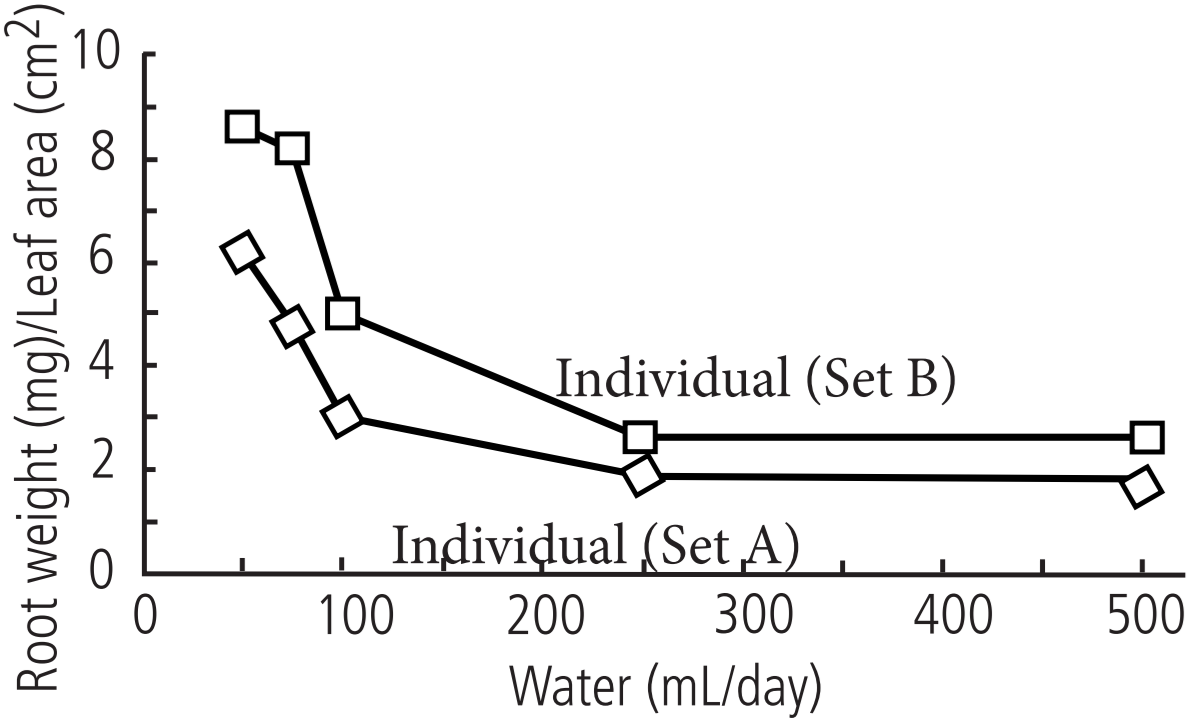
  1. Which of the following statements can be concluded from the given study?
  1. More resources are allocated to the root during low water conditions.
  2. Competition for water among individuals of a population causes more root growth as compared to individuals who are growing alone.
  3. Lesser leaves are formed under low water conditions.
  4. Root growth is higher in individual grown singly as compared to individuals in populations.
  1. Which of the following associations is an example of competitions?
  1. Cuscuta and hedge plant.
  2. Balanus and Cathamalus.
  3. Cactus and moth.
  4. Orchid and mango.
  1. If '+' sign is assigned to beneficial interaction, '-' sign to detrimental and O sign to neutral interaction, then the population interaction of competition refers to:
  1. +, +
  2. -, -
  3. +, -
  4. +, 0
  1. lntraspecific competition is more severe due to:
  1. similar needs.
  2. similar adaptations.
  3. common resources.
  4. all of these.
  1. Assertion: Two members of a competing species may co-exist.
Reason: Different individuals of a species have different resource requirements.
  1. Both assertion and reason are true and reason is the correct explanation of assertion.
  2. Both assertion and reason are true but reason is not the correct explanation of assertion.
  3. Assertion is true but reason is false.
  4. Both assertion and reason are false.
Answer
  1. (b) Competition for water among individuals of a population causes more root growth as compared to individuals who are growing alone.
Explanation:

Competition is a sort of rivalry among two or more organisms for obtaining the same resources. The competition among individuals of the same species is called intraspecific competition and among members of different species is called interspecific competition. lntraspecific competition is more severe than interspecific competition due to similar needs. Now, according to the given graph, competition for water in a population leads to more root weight (mg) per leaf area $(cm^2).$ This is because competition causes more root growth so that each sapling can derive more water from the pot.
  1. (b) Balanus and Cathamalus.
Explanation:

The association or interactions of Cuscuta and hedge plant is parasitism, cactus and moth is predation and orchid and mango is commensalism.
  1. (b) -, -
  1. (d) all of these.
Explanation:

lntraspecific competition is more severe because of common resource, similar needs and similar adaptations.
  1. (d) Both assertion and reason are false.
View full question & answer
Question 24 Marks
Read the following and answer any four questions from (i) to (v) given below:
Kangaroo rat seldom drinks water. It has thick coat to minimise evaporative desiccation. TI1e animal seldom comes out of its comparatively humid and cool burrow during the day time. 90% of its water requirement is met from metabolic water (water produced by respiratory breakdown of fats) while 10% is obtained from its food. Loss of water is minimised by producing nearly solid urine and faeces. As the animal faces acute water scarcity, it develops two types of adaptations : reducing water loss and ability to tolerate desert conditions.
  1. Kangaroo rat is a:
  1. Partial regulators
  2. Partial conformer
  3. Regulator
  4. Conformer
  1. Metabolic water refers to:
  1. Water required for metabolic activities.
  2. Water present in intercellular fluid.
  3. Water produced during oxidation of fat or carbohydrate.
  4. Water taken in, to promote metabolism.
  1. Desert animals minimise water loss by:
  1. Producing highly concentrated urine.
  2. Promoting maximum reabsorption of water in kidney tubules.
  3. Possessing one of the longest loop of Henle in kidney tubules.
  4. All of these.
  1. Assertion: Kangaroo rat can tolerate and thrive in wide temperature range and is known as stenothermal.
Reason: Kangaroo rats go into hibernation during winter to escape cold weather.
  1. Both assertion and reason are true and reason is the correct explanation of assertion.
  2. Both assertion and reason are true but reason is not the correct explanation of assertion.
  3. Assertion is true but reason is false.
  4. Both assertion and reason are false.
  1. The adaptations in an organism are meant for:
  1. Optimum primary production.
  2. Optimum life span.
  3. Optimum mobility.
  4. Optimum survival and reproduction.
Answer
  1. (c) Regulator
Explanation:

Kangaroo rat is a regulator that performs homeostasis through thermoregulation osmoregulation by physiological adjustments and behavioural changes.
  1. (c) Water produced during oxidation of fat or carbohydrate.
  1. (d) All of these.
  1. (d) Both assertion and reason are false.

Explanation:

Organisms that can tolerate and thrive in wide temperature range are known as eurythermal. Kangaroo rats do not go into hibernation rather, they stay in cool moist burrows during summer days..
  1. (d) Optimum survival and reproduction.
Explanation:

Adaptation is an attribute of an organism (morphological, physiological and behavioural) that enables it to survive and reproduce in its habitat. Adaptations lead to the formation of some specialised and peculiar features which have evolved over a long period of time through natural selection.
View full question & answer
Question 34 Marks
Read the following and answer any four questions from (i) to (v) given below:
A desert lizard (an ectotherm) and a mouse (an endotherm) are placed inside a chamber at 15ºC and their body temperature [T(L) for the lizard and T(M) for the mouse] and metabolic rates [M(L) for lizard and M(M) for the mouse] are monitored.
  1. Which of the following is correct regardingT(L), M(L), T(M) and M(M)?
  1. T(L) and M(L) will fall while T(M) and M(M) will increase.
  2. T(L) and M(L) will increase while T(M) and M(M) will fall.
  3. T(L) and M(L) will fall, T(M) will remain same and M(M) will increase.
  4. T(L) and M(L) will remain same, T(M) and M(M) will decrease.
  1. It can be said that some animals in their evolutionary development preferred to be ectotherms than endotherms. Which of the following can be the best suited reason for it?
  1. The metabolic reactions of these organisms can occur at a very wide range of temperature.
  2. Maintaining homeostasis is an energetically expensive process.
  3. The enzymes of these organisms are functional at high temperatures.
  4. Both (b) and (c).
  1. Organisms that can maintain a constant internal temperature are called.
  1. Homoeothermic
  2. Poikilothermic
  3. Oligothennic
  4. Heterothennic
  1. An animal that survives at temperature of 10ºC and 40ºC both can be placed under the category of:
  1. Ectotherm.
  2. Endotherm.
  3. Modifiers.
  4. Migratory organisms.
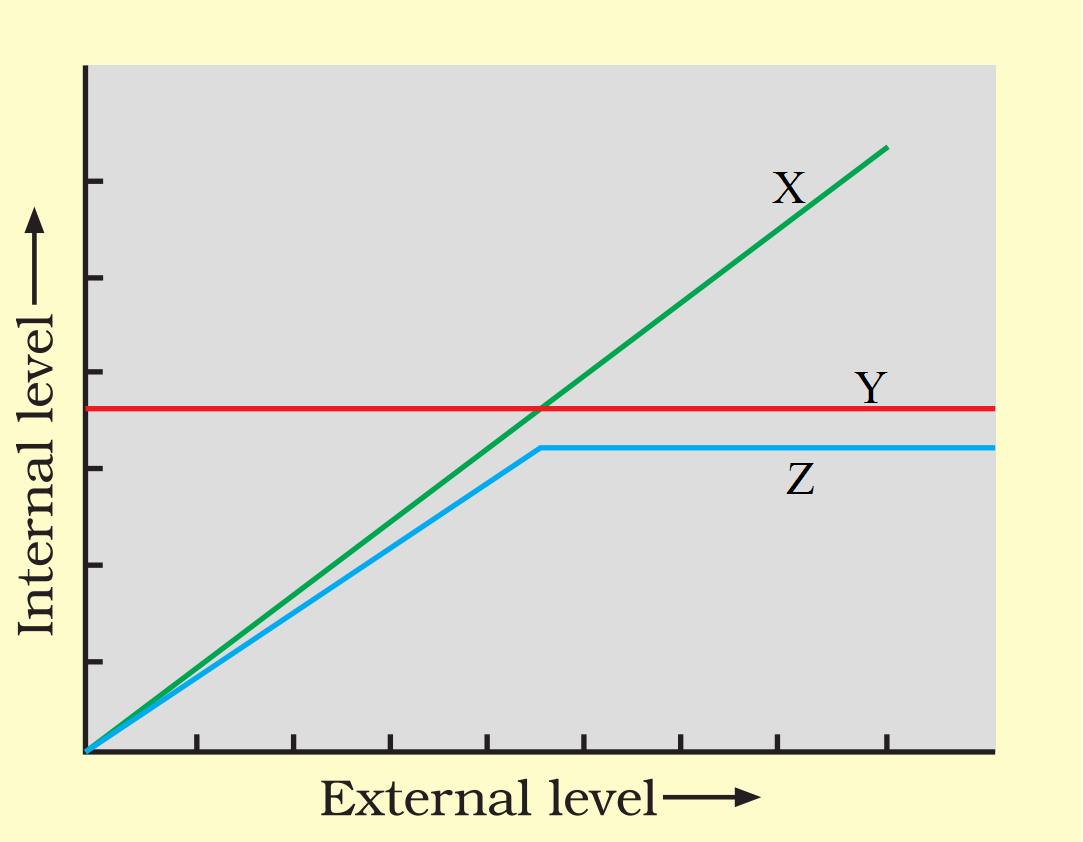
  1. Study the graph carefully and select the correct option.
  1. X could be desert lizard.
  2. Y could be mouse.
  3. Z could be desert lizard.
  4. Both (a) and (b).
Answer
  1. (c) T(L) and M(L) will fall, T(M) will remain same and M(M) will increase.
  1. (b) Maintaining homeostasis is an energetically expensive process.
Explanation:

Maintaining homeostasis, especially thermo regulation is energetically expensive for many organisms. During the course of evolution, the costs and benefits of maintaining a constant internal environment were taken into consideration and thus some species preferred to be ectotherms.
  1. (a) Homoeothermic
Explanation:

Animals with constant body temperature are called homoeotherms. They have insulating coat to check the loss of body heat. This coat consists of hair in most mammals, blubber (subcutaneous fat) in whales and seals and feathers in birds. Shivering warms up the body and perspiration cools down the body of these animals when required. These are also called endotherms as they regulate their body temperature by physiological means and maintain more or less constant internal temperature. Poikilotherms are cold-blooded animals which are unable to regulate their body temperature which changes with change in temperature of environment, e.g., fish, frog, lizards. They are also called ectotherms.
  1. (b) Endotherm.
  1. (d) Both (a) and (b).
Explanation:

ln the given graph X, Y and Z represent conformers, regulators and partial regulators respectively. Desert lizard and mouse are conformer and regulator respectively.
View full question & answer
Question 44 Marks
Read the following and answer any four questions from (i) to (v) given below:
Age sex structure of a population can be depicted in the form of a pyramid by plotting the percentage of population of each sex in each age class. Two age sex pyramids are as follows.
  1. Which of the following is correct regarding pyramid B?
  1. It represents stable population.
  2. It represents expanding population.
  3. It represents declining population.
  4. Both (a) and (b).
  1. Total number of individuals of a species per unit area per unit time is called.
  1. Population size.
  2. Population density.
  3. Demography.
  4. Population dynamics.
  1. Which of the following is correct regarding age sex pyramid A and B?
  1. A represents the age sex pyramid of developed country.
  2. B represents the age sex pyramid of developing country.
  3. A represents rapidly growing population.
  4. Both (a) and (b).
  1. A population with a large proportion of older individuals than younger ones will likely to:
  1. Grow larger first and then decline.
  2. Continue to grow indefinitely.
  3. Decline.
  4. None of these.
  1. Assertion: Bell shaped age pyramid represents a stable population.
Reason: ln a stable population, proportion of individuals in reproductive age group is higher than the individuals in pre reproductive age group.
  1. Both assertion and reason are true and reason is the correct explanation of assertion.
  2. Both assertion and reason are true but reason is not the correct explanation of assertion.
  3. Assertion is true but reason is false.
  4. Both assertion and reason are false.
Answer
  1. (b) It represents expanding population.
  1. (b) Population density
Explanation:

Population density is the number of individual present per unit area at a given time.
  1. (d) Both (a) and (b).
Explanation:

A represents nearly stable population whereas B represents rapidly growing population.
  1. (c) Decline.
Explanation:

A population with large number of older individuals than younger ones is likely to decline since older individuals do not take part in reproduction.
  1. (C) Assertion is true but reason is false.
Explanation:

In a bell-shaped age pyramid, die number of pre-reproductive and reproductive individuals is almost equal. Post-reproductive individuals are comparatively fewer. It represents a stable population.
View full question & answer
Question 54 Marks
Read the following and answer any four questions from (i) to (v) given below:
ln many species of fig trees, there is a tight one-to-one relationship with the pollinator species of wasp. It means that a given fig species can be pollinated only by its 'partner' wasp species and no other species. The wasp pollinates the fig inflorescence while looking for suitable egg-laying sites. ln return for the favour of pollination, the fig offers the wasp some of its developing seeds as food for the developing wasp larvae.
  1. The interaction between fig trees and wasp is an example of:
  1. Mutualism
  2. Commensalism
  3. Amensalism
  4. Parasitism
  1. AD the given interactions are similar to interaction between fig trees and wasp, except.
  1. Plant and animal relation for pollination.
  2. Association of algae and fungi in lichens.
  3. Association of cattle egret and grazing cattle.
  4. Association of fungi and roots of higher plants in mycorrhiza.
  1. In which of the following interactions both partners are adversely affected?
  1. Parasitism
  2. Mutualism
  3. Competition
  4. Predation
  1. ln relationship between fig and wasp:
  1. One benefitted other harmed.
  2. Both are benefitted.
  3. One benefitted other unaffected.
  4. One inhibited, other unaffected.
  1. Assertion: Fig and wasp cannot complete their life cycle without each other.
Reason: They show mutualistic relationship.
  1. Both assertion and reason are true and reason is the correct explanation of assertion.
  2. Both assertion and reason are true but reason is not the correct explanation of assertion.
  3. Assertion is true but reason is false.
  4. Both assertion and reason are false.
Answer
  1. (a) Mutualism
Explanation:

Mutualism is an interaction between two organisms of different species in which both the partners are benefitted, with none of the two capable of living separately. In many species offig trees thereis a relationship with the pollinator species of wasp. The female wasp uses the fruit not only as an oviposition site but also uses the developing seeds within the fruit for nourishing its larvae. The wasp pollinates the fig inflorescence, while searching for suitable egg-laying sites. The fig returns this favour of pollination by offering the wasp some of its developing seeds, as food for the developing wasp larvae.
  1. (c) Association of cattle egret and grazing cattle.
Explanation:

The relationship between fig trees and wasp is mutualism whereas relationship between cattle egret and grazing cattle is commensalism.
  1. (c) Competition
Explanation:

Competition is the rivalry between two or more organisms for obtaining the same resource such as food, light, water, space, shelter, mate, etc. Competitors adversely affect each other.
  1. (b) Both are benefitted.
  1. (a) Both assertion and reason are true and reason is the correct explanation of assertion.
Explanation:

Mutualism is an interaction between two organisms of different species in which both the partners are benefitted, with none of the two capable of living separately. In many species offig trees thereis a relationship with the pollinator species of wasp. The female wasp uses the fruit not only as an oviposition site but also uses the developing seeds within the fruit for nourishing its larvae. The wasp pollinates the fig inflorescence, while searching for suitable egg-laying sites. The fig returns this favour of pollination by offering the wasp some of its developing seeds, as food for the developing wasp larvae.
View full question & answer
Question 64 Marks
Read the following and answer any four questions from (i) to (v) given below: Unlike animals, plants cannot runaway for their defence, therefore, they have evolved an astonishing variety of morphological and chemical defences against herbivores. Thorns are the most common morphological means of defence. Many plants produce and store chemicals that make the herbivore sick when they are eaten, inhibit feeding or digestion, disrupt its reproduction or even kill it. Some plants produce highly poisonous chemicals and that is why no cattle or goats browse on those plants. A wide variety of chemical substances that we extract from plants on a conunercial scale are produced by them actually as defence against grazers and browsers.
  1. Why you never see cattle or goats browsing on weed Calotropisl?
  1. It produces highly poisonous tannins.
  2. It produces quinine which is bitter in taste.
  3. It produces poisonous cardiac glycosides.
  4. It bears prickles.
  1. What could be the possible reason for invasive growth of the prickly pear cactus introduced in Australia?
  1. Absence of predators.
  2. New mycorrhizal association.
  3. Abundant water availability.
  4. All of these.
  1. Which of the following is most likely to sick by consuming chemicals produced by plants?
  1. Frog
  2. Goat
  3. Human
  4. Pigeon
  1. Plant evolve variety of morphological and chemical defences against.
  1. Prey
  2. Predator
  3. Commenal
  4. Mutualist
  1. Assertion: Some plant functions as predator in nature.
Reason: Phytoph ago us insects feed on plant sap.
  1. Both assertion and reason are true and reason is the correct explanation of assertion.
  2. Both assertion and reason are true but reason is not the correct explanation of assertion.
  3. Assertion is true but reason is false.
  4. Both assertion and reason are false.
Answer
  1. (c) It produces poisonous cardiac glycosides.
Explanation:

Some plants produce highly poisonous cardiac glycosides and that is why no cattle or goats browse on these plants.
  1. (a) Absence of predators.
  1. (b) Goat
Explanation:

Many plants produce and store chemicals which make herbivores sick when they are eaten.
  1. (b) Predator
  1. (b) Both assertion and reason are true but reason is not the correct explanation of assertion.
Explanation:

Few plants are predator in nature, such as carnivorous or insectivorous plants e.g., Utricularia, Drosera, etc.
View full question & answer
Question 74 Marks
Read the following and answer any four questions from (i) to (v) given below:
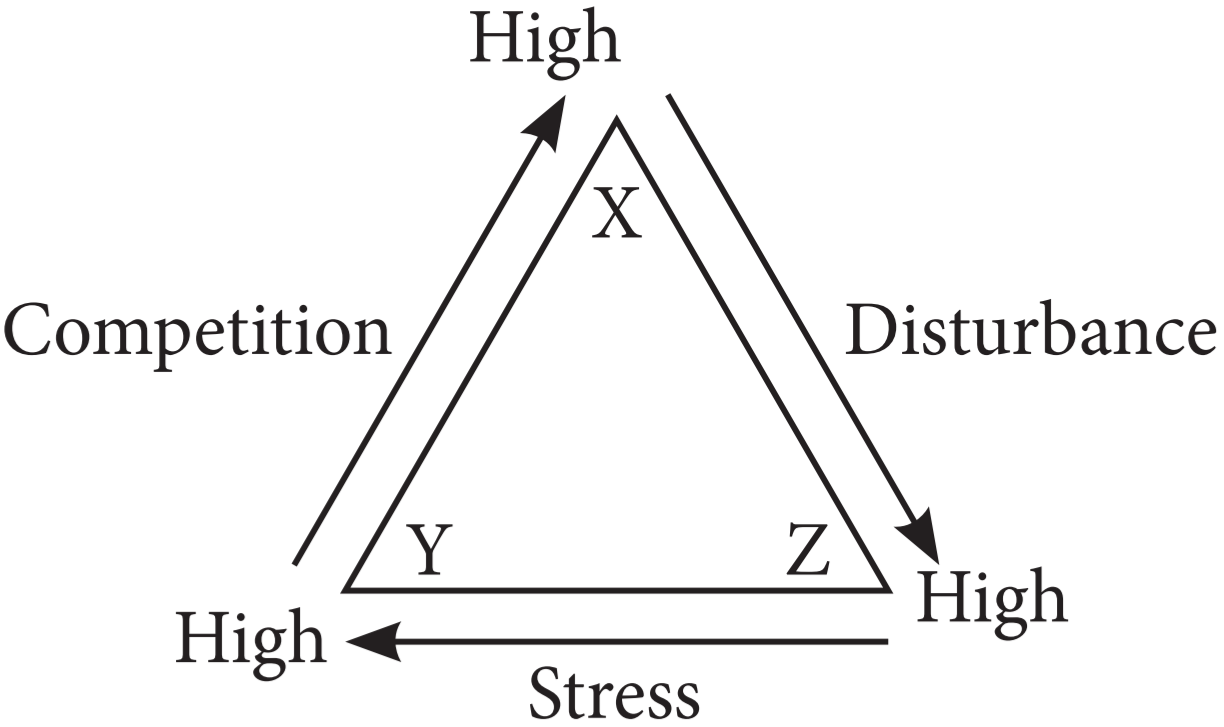
During teaching about various environmental factors, a teacher draw a figure that depicts like history strategies for three plant species (X, Y and Z) along 3 axes - strength of competition with other organisms, level of disturbance in the habitat and level of environmental stress in the habitat. Species X grows in habitats where competition among species is high but disturbance and stress are low. Species Y grows in habitats with high environmental stress but with low intraspecies competition. Species Z grows in highly disturbed habitats with low environmental stress.
  1. Which of the following is correct regarding plant type X?
  1. It has slow growth rate.
  2. It lives in area with high probability of severe environmental changes.
  3. It has good competitive ability at low population densities near the carrying capacity.
  4. None of these.
  1. Environmental stress occurs through.
  1. Very low temperature.
  2. Drought.
  3. Nutrient deficiency.
  4. All of these.
  1. Select the correct option regarding plant type X, Y and Z.
  1. X type of plants are likely to be trees.
  2. Y type of plants could be desert plants.
  3. Z type of plants could be herbaceous plant.
  4. All of these.
  1. Y type of plants grow under high stress and:
  1. Produce large number of seeds in a short time after rains.
  2. Have rapid growth.
  3. Produce less number of seed in a long time after rain.
  4. Both (a) and (b).
  1. Assertion: Plant growth rate is high in area of high stress and high disturbance.
Reason: High stress and high disturbance promote breeding capacity in plants.
  1. Both assertion and reason are true and reason is the correct explanation of assertion.
  2. Both assertion and reason are true but reason is not the correct explanation of assertion.
  3. Assertion is true but reason is false.
  4. Both assertion and reason are false.
Answer
  1. (a) It has slow growth rate.
Explanation:

'X type'of plants are competitors which live under condition of low stress and low disturbance and have good competitive ability at high population densities near the carrying capacity. Such plant have slow growth rate and prevail in non-seasonal tropics where there is low probability of severe environmental changes.
  1. (d) All of these.
Explanation:

Environmental stress occurs through external conditions such as shading, drought, nutrient deficiency or very low temperature that limit production.
  1. (d) All of these.
  1. (a) Produce large number of seeds in a short time after rains.
  1. (d) Both assertion and reason are false.
Explanation:

Plant growth rate is low in area of high stress and high disturbance. High stress and high disturbance cannot promote breeding capacity in plants
View full question & answer
Question 84 Marks
Read the following and answer any four questions from (i) to (v) given below:
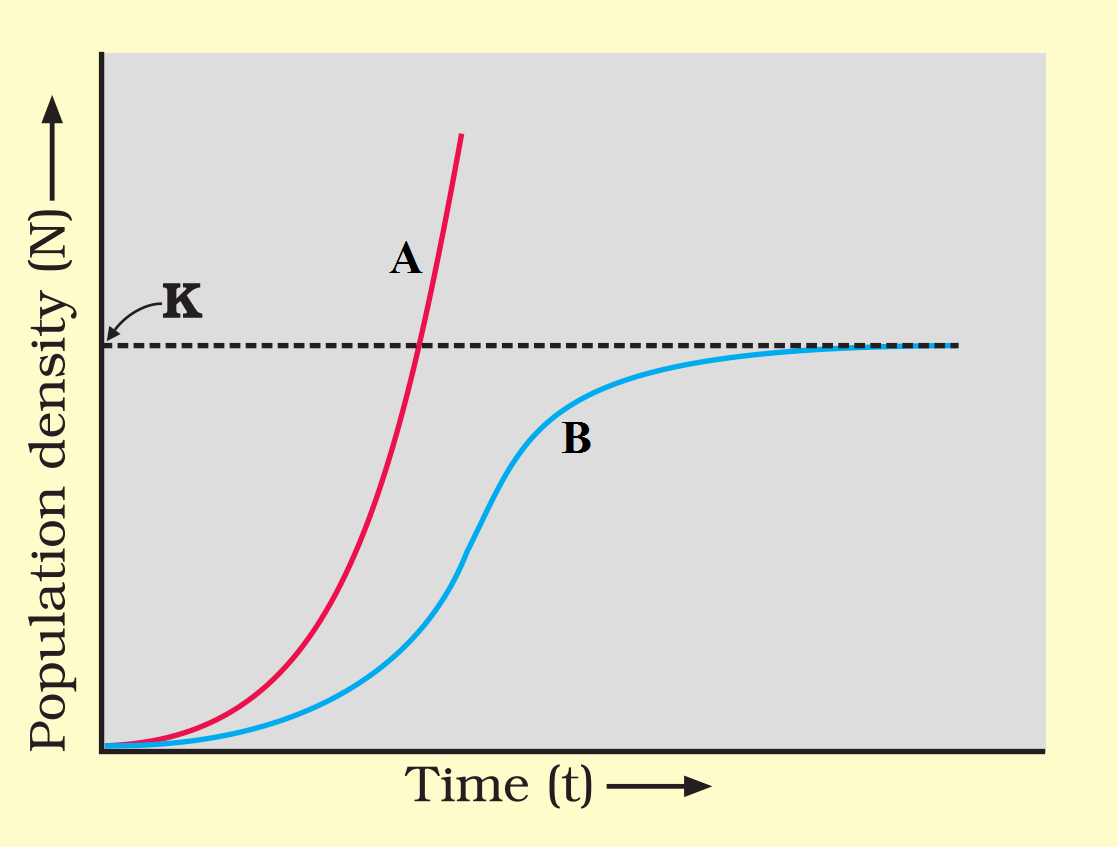
Growth of a population with time shows specific and predictable patterns. Two types of growth pattern of population are exponential and logistic growth. When resources in the habitat are unlimited each species has the ability to realise fully its innate potential to grow in number. Then the population grows in exponential fashion. When the resources are limited growth curve shows an initial slow rate and then it accelerates and finally slows giving the growth curve which is sigmoid.
  1. Which of the following statement is incorrect?
  1. Exponential growth occurs in organism such as lemmings.
  2. Logistic growth is more realistic.
  3. Exponential growth has two phases lag and log.
  4. ln logistic growth, population passes well beyond the carrying capacity of ecosystem.
  1. Which of the following equations correctly represents the exponential population growth curve?
  1. $\text{dN}/\text{dt}=\text{rN}$
  2. $\text{dN}/\text{dt}=\text{rN}\Big(\frac{\text{K-N}}{\text{K}}\Big)$
  3. $\text{N}_\text{t}=\text{N}_\text{o}\text{e}^\text{rt}$
  4. Both (a) and (c).
  1. Which of the following equations correctly represents Verhulst-Pearl logistic growth?
  1. $\text{dN}/\text{dt}=\text{rN}\Big(\frac{\text{K-N}}{\text{K}}\Big)$
  2. $\text{dN}/\text{dt}=\frac{\text{rN}}{\text{K}}$
  3. $\text{dN}/\text{dt}=\frac{\text{N}(\text{K}-\text{N})}{\text{K}}$
  4. $\text{dN}/\text{dt}=\frac{\text{r}(\text{K}-\text{N})}{\text{K}}$
  1. The population growth is generally described by the following equation:
$\frac{\text{dN}}{\text{dt}}=\text{rN}\Big(\frac{\text{K}-\text{N}}{\text{K}}\Big)$

What does 'r' represent in the given equation?
  1. Population density at time 't'.
  2. Intrinsic rate of natural increase.
  3. Carrying capacity.
  4. The base of natural logarithm.
  1. Study the population growth curves (A and B) in the given graph and select the incorrect option.
  1. Curve 'A: shows exponential growth, represented by equation $\frac{\text{dN}}{\text{dt}}=\text{rN}$.
  2. Curve 'B' shows logistic growth, represented by equation $\frac{\text{dN}}{\text{dt}}=\text{rN}\Big(\frac{\text{K}-\text{N}}{\text{K}}\Big)$
  3. Exponential growth curve is considered as more realistic than the logistic growth curve.
  4. Curve 'A' can also be represented by equation $\text{N}_\text{t}=\text{N}_\text{o}\text{e}^\text{rt}$.
Answer
  1. (d) ln logistic growth, population passes well beyond the carrying capacity of ecosystem.
Explanation:
ln logistic growth population seldom grows beyond the carrying capacity of ecosystem.
  1. (d) Both (a) and (c).
Explanation:
If any species is flourishing under unlimited resources, it would reach exponential growth which can be depicted by equation:
$\frac{\text{dN}}{\text{dt}}=\text{rN}$
Where, N = population density at time t; r = intrinsic rate of natural increase.
If we derive the integral form of the exponential growth equation, it can be written as
$\text{N}_\text{t}=\text{N}_\text{o}\text{e}^\text{rt}$
Where $N_t=$ population density after time t; $N_0=$ population density at time zero; r = intrinsic rate of natural increase; e is the base of natural logarithm.
  1. (a) $\text{dN}/\text{dt}=\text{rN}\Big(\frac{\text{K-N}}{\text{K}}\Big)$
  1. (b) Intrinsic rate of natural increase.
  1. (c) Exponential growth curve is considered as more realistic than the logistic growth curve.
Explanation:
Since resources of growth for most animal populations are finite and become limiting sooner or later, so the logistic growth model is considered as more realistic.
View full question & answer
Question 94 Marks
Read the following and answer any four questions from (i) to (v) given below:
Regular change in temperature that occurs at specific intervals of time is called thennoperiodicity. It is of two types-diurnal and seasonal thermoperiodicity. Diumal periodicity refers to temperatures of day and night. It determines periods ofannual activity. In season periodicity different temperature prevails in different seasons of the year. 'Tiley favour different aspects of plant and animal life termed as phenology. For example in wheat, leaf growth requires a temperature of 10º-25ºC. Apple requires temperature below 7ºC for a period of 800 hrs before flowering and fruiting can occur. Low temperature is required for germination of some seeds as well as flowering in some plants. It also determines growth, reproduction, colour and morphology of animals. Both low and high temperature cause stress in organisms which is overcome by particular adaptations.
  1. Some plants require low temperature treatment for flowering. This phenomenon is known as:
  1. Photoperiodism.
  2. Vemalisation.
  3. Thermoperiodism.
  4. None of these.
  1. Animals found in arctic zones are called.
  1. microtherms
  2. Megatherms
  3. Mesotherms
  4. Hekistotherms
  1. Which of the following parts of wheat plant grows maximum in temperature around 10º-25ºC?
  1. Root
  2. Seeds
  3. Leaf
  4. Stem
  1. "Different temperatures prevail in different seasons of the year." It represents:
  1. Diurnal thermoperiodicity.
  2. Seasonal periodicity.
  3. Homeostasis.
  4. Thermoregulation.
  1. Assertion: Low and high temperature causes stress in organisms.
Reasons: Organisms show specific adaptations to overcome stressful condition.
  1. Both assertion and reason are true and reason is the correct explanation of assertion
  2. Both assertion and reason are true but reason is not the correct explanation of assertion.
  3. Assertion is true but reason is false.
  4. Both assertion and reason are false.
Answer
  1. (b) Vemalisation.
  1. (d) Hekistotherms
Explanation:

Organisms living in tropical, subtropical, temperate and arctic zones are megathenns, mesotherms, microthenns and hekistotherms respectively.
  1. (c) Leaf
  1. (b) Seasonal periodicity.
Explanation:

Different temperatures prevail in different seasons of the year represent seasonal periodicity.
  1. (b) Both assertion and reason are true but reason is not the correct explanation of assertion.
View full question & answer
Question 104 Marks
Read the following and answer any four questions from (i) to (v) given below:
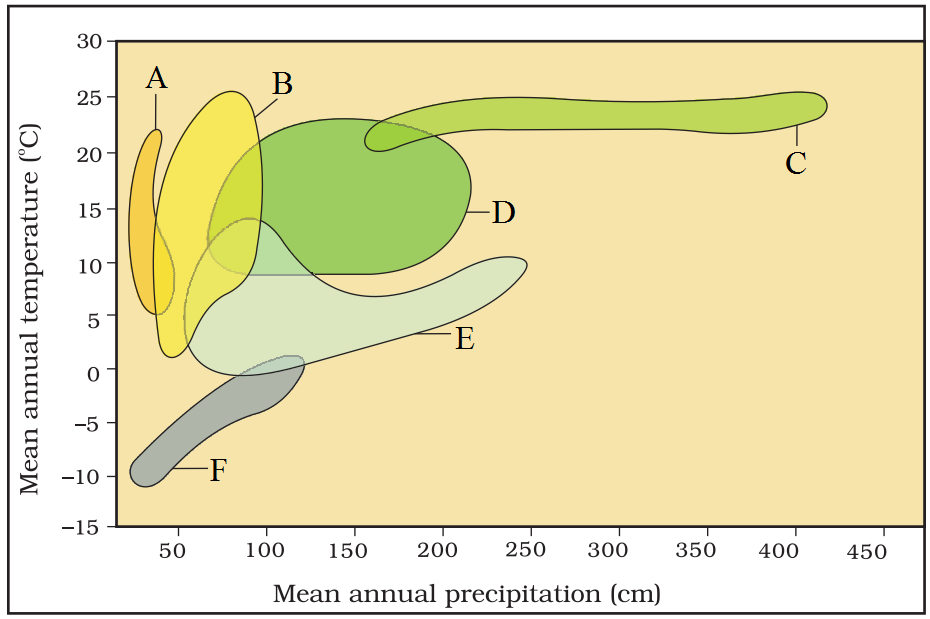
Organism P has thick lips and tongue so that it can easily feed on the commonly available spiny plants. Organism Q has thick layer of insulating fat under the skin. It was strong hooves to walk steadily on steep surfaces and lives in burrows during winters. Organism R has bright colours and sticky pads on its fingers and toes. It lives on trees.
  1. Which of the following is correct habitat for organisms P regarding its adaptation?
  1. Grassland biome.
  2. Desert biome.
  3. Tropical rainforest.
  4. Tropical deciduous forest.
  1. Which of the following is correct match regarding organism Q and its habitat?
  1. Tundra - Polar bear.
  2. Tropical rain forest - Deer.
  3. Grassland - Bighorn sheep.
  4. Desert - Camel.
  1. Which of the following is incorrect regarding organisms R's habitat?
  1. The vegetation shows stratification.
  2. Epiphytic growth is rich.
  3. Standing crop is highest.
  4. Deep rooted shrubs are common due to abundant sunlight.
  1. The dominant plants in habitat where P lives could be:
  1. Opuntia
  2. Nymphaea
  3. Deodar
  4. both (a) and (c).
  1. Organisms P, Q and R respectively most likely occur in:
  1. F, B and A.
  2. C, A, E.
  3. A, F and C.
  4. B, D and A.
Answer
  1. (b) Desert biome.
Explanation:

P is camel adapted to desert conditions as it has thick lips and tongue so that it can easily feed on the commonly available spiny plants.
  1. (a) Tundra - Polar bear.
Explanation:

Q is polar bear as it has thick insulating fat layer under the skin.
  1. (d) Deep rooted shrubs are common due to abundant sunlight.
Explanation:

R could be poison dart frog as it has bright colours and sticky pads on its fingers and toes and its habitat is tropical rainforest. Deep rooted shrubs are not found in tropical rainforest. These are found in deserts.
  1. (a) Opuntia
Explanation:

Habitat of P is desert, so, the dominant plant is Opuntia.
  1. (c) A, F and C.
View full question & answer