MCQ 11 Mark
In these questions, a statement of assertion followed by a statement of reason is given. Choose the correct answer out of the following choices.
Assertion: With $\ce{Br_2-H_2O},$ phenol gives $2, 4, 6-$tribromophenol but with $\ce{Br_2-CS_2},$ it gives $4-$bromophenol as the major product.
Reason: In water, ionisation of phenol is enhanced but in $CS_2,$ it is greatly suppressed.
- ✓
Assertion and reason both are correct statements and reason is correct explanation for assertion.
- B
Assertion and reason both are correct statements but reason is not correct explanation for assertion.
- C
Assertion is correct statement but reason is wrong statement.
- D
Assertion is wrong statement but reason is correct statement.
AnswerCorrect option: A. Assertion and reason both are correct statements and reason is correct explanation for assertion.
View full question & answer→MCQ 21 Mark
Note: In the following questions a statement of assertion followed by a statement of reason is given. Choose the correct answer out of the following choices.
Assertion: Addition reaction of water to but$-1-$ene in acidic medium yields butan$-1-ol.$
Reason: Addition of water in acidic medium proceeds through the formation of primary carbocation.
- A
Assertion and reason both are correct and reason is correct explanation of assertion.
- ✓
Assertion and reason both are wrong statements.
- C
Assertion is correct statement but reason is wrong statement.
- D
Assertion is wrong statement but reason is correct statement.
AnswerCorrect option: B. Assertion and reason both are wrong statements.
Correct assertion: Addition reaction of water to but$-1-$ene in acidic medium yields butan$-2-01.$
Correct reason: Addition of water in acidic medium proceeds through the formation of secondary carbocation.
View full question & answer→MCQ 31 Mark
Note: In the following questions a statement of assertion followed by a statement of reason is given. Choose the correct answer out of the following choices.
Assertion: $\text{IUPAC}$ name of the compound $\text{CH}_3-\text{CH}-\text{O}-\text{CH}_2-\text{CH}_2-\text{CH}_3 \\ \ \ \ \ \ \ \ \ \ \ \ \ \ \ | \\ \ \ \ \ \ \ \ \ \ \ \ \ \ \text{CH}_3$is $2-$Ethoxy$-2-$methylethane.
Reason: In $\text{IUPAC}$ nomenclature, ether is regarded as hydrocarbon derivative in which a hydrogen atom is replaced by $—OR$ or $—OAr$ group $[$where $R =$ alkyl group and $Ar =$ aryl group$]$
- A
Assertion and reason both are correct and reason is correct explanation of assertion.
- B
Assertion and reason both are wrong statements.
- C
Assertion is correct statement but reason is wrong statement.
- ✓
Assertion is wrong statement but reason is correct statement.
AnswerCorrect option: D. Assertion is wrong statement but reason is correct statement.
Correct assertion is the $\text{IUPAC}$ name of the compound is $1-(2-$propoxy$)$ propane.
View full question & answer→MCQ 41 Mark
In these questions, a statement of assertion followed by a statement of reason is given. Choose the correct answer out of the following choices.
Assertion: $P-$Nitrophenol gives more electrophilic substituted compound than $m-$methoxy phenol.
Reason: Methoxy group shows both $+R$ and $-I -$effect.
- A
Assertion and reason both are correct statements and reason is correct explanation for assertion.
- B
Assertion and reason both are correct statements but reason is not correct explanation for assertion.
- C
Assertion is correct statement but reason is wrong statement.
- ✓
Assertion is wrong statement but reason is correct statement.
AnswerCorrect option: D. Assertion is wrong statement but reason is correct statement.
ln $p-$nitrophenol, $-NO_2$ group has $-I$ effect, as a result of which electron density decreases on the benzene ring, hence reactivity towards electrcphihc substitution decreases. Methoxy group shows both $+R\ ($due to lone pair of electrons on $O)$ and $-I$ effect $($due to greater electronegativity of $O). -OCH_3 $ at meta$-$position shows only $-I$ effect but lesser than $-I$ effect of $-NO_2$ group.
View full question & answer→MCQ 51 Mark
In these questions, a statement of assertion followed by a statement of reason is given. Choose the correct answer out of the following choices.
Assertion: Boiling points of alcohols are lower than hydrocarbons.
Reason: Among isomeric alcohols, boiling point decreases in the order$: 1^\circ > 2^\circ > 3^\circ .$
- A
Assertion and reason both are correct statements and reason is correct explanation for assertion.
- B
Assertion and reason both are correct statements but reason is not correct explanation for assertion.
- C
Assertion is correct statement but reason is wrong statement.
- ✓
Assertion is wrong statement but reason is correct statement.
AnswerCorrect option: D. Assertion is wrong statement but reason is correct statement.
Alcohols undergo intermolecular H-bonding and hence, their boiling points are higher than those of hydrocarbons.
Among isomeric alcohols, boiling point decreases in the order$:\ 1^\circ > 2^\circ > 3^\circ .$
View full question & answer→MCQ 61 Mark
Note: In the following questions a statement of assertion followed by a statement of reason is given. Choose the correct answer out of the following choices.
Assertion: Like bromination of benzene, bromination of phenol is also carried out in the presence of Lewis acid.
Reason: Lewis acid polarises the bromine molecule.
- A
Assertion and reason both are correct and reason is correct explanation of assertion.
- B
Assertion and reason both are wrong statements.
- C
Assertion is correct statement but reason is wrong statement.
- ✓
Assertion is wrong statement but reason is correct statement.
AnswerCorrect option: D. Assertion is wrong statement but reason is correct statement.
Bromination of phenol can be carried out in absence of Lewis acid.
View full question & answer→MCQ 71 Mark
In these questions, a statement of assertion followed by a statement of reason is given. Choose the correct answer out of the following choices.
Assertion: Phenol is more acidic than ethanol.
Reason: Phenoxide ion is resonance stabilised.
- ✓
Assertion and reason both are correct statements and reason is correct explanation for assertion.
- B
Assertion and reason both are correct statements but reason is not correct explanation for assertion.
- C
Assertion is correct statement but reason is wrong statement.
- D
Assertion is wrong statement but reason is correct statement.
AnswerCorrect option: A. Assertion and reason both are correct statements and reason is correct explanation for assertion.
View full question & answer→MCQ 81 Mark
In these questions, a statement of assertion followed by a statement of reason is given. Choose the correct answer out of the following choices.
Assertion: $O-$Nitrophenol is more volatile than $p-$nitrophenol.
Reason: Intramolecular hydrogen bonding is present in $o-$nitrophenol while intermolecular $H-$bonding is in $p-$nitrophenol.
- ✓
Assertion and reason both are correct statements and reason is correct explanation for assertion.
- B
Assertion and reason both are correct statements but reason is not correct explanation for assertion.
- C
Assertion is correct statement but reason is wrong statement.
- D
Assertion is wrong statement but reason is correct statement.
AnswerCorrect option: A. Assertion and reason both are correct statements and reason is correct explanation for assertion.
View full question & answer→MCQ 91 Mark
Note: In the following questions a statement of assertion followed by a statement of reason is given. Choose the correct answer out of the following choices.
Assertion: $p-$nitrophenol is more acidic than phenol.
Reason: Nitro group helps in the stabilisation of the phenoxide ion by dispersal of negative charge due to resonance.
- ✓
Assertion and reason both are correct and reason is correct explanation of assertion.
- B
Assertion and reason both are wrong statements.
- C
Assertion is correct statement but reason is wrong statement.
- D
Assertion is wrong statement but reason is correct statement.
AnswerCorrect option: A. Assertion and reason both are correct and reason is correct explanation of assertion.
$p-$Nitrophenol is more acidic than phenol because nitro group stabilizes phenoxide ion by dispersal of negative charge.
View full question & answer→MCQ 101 Mark
In these questions, a statement of assertion followed by a statement of reason is given. Choose the correct answer out of the following choices.
Assertion: Phenol is less acidic than $p-$nitrophenol.
Reason: Phenolate ion is more stable than $p-$nitrophenolate ion.
- A
Assertion and reason both are correct statements and reason is correct explanation for assertion.
- B
Assertion and reason both are correct statements but reason is not correct explanation for assertion.
- ✓
Assertion is correct statement but reason is wrong statement.
- D
Assertion is wrong statement but reason is correct statement.
AnswerCorrect option: C. Assertion is correct statement but reason is wrong statement.
Phenol is less acidic than $p-$nitrophenol because $-NO_2$ is strongly electron$-$withdrawing$. p-$Nitrophenolate ion is more stable than phenolate ion.
View full question & answer→MCQ 111 Mark
Note: In the following questions a statement of assertion followed by a statement of reason is given. Choose the correct answer out of the following choices.
Assertion: Ethanol is a weaker acid than phenol.
Reason: Sodium ethoxide may be prepared by the reaction of ethanol with aqueous $\text{NaOH}.$
- A
Assertion and reason both are correct and reason is correct explanation of assertion.
- B
Assertion and reason both are wrong statements.
- ✓
Assertion is correct statement but reason is wrong statement.
- D
Assertion is wrong statement but reason is correct statement.
AnswerCorrect option: C. Assertion is correct statement but reason is wrong statement.
Phenol is stronger acid than ethanol as phenoxide ion is stabilized by resonance whereas no such stabilization occurs in ethoxide ion. Sodium ethoxide can be prepared by reaction of ethanol with sodium.
View full question & answer→MCQ 121 Mark
In these questions, a statement of assertion followed by a statement of reason is given. Choose the correct answer out of the following choices.
Assertion: 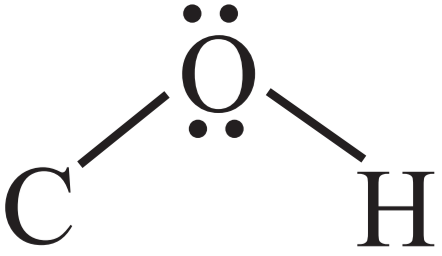 Bond angle is less than the normal tetrahedral bond angle.
Reason: Lone pair$-$lone pair repulsion decreases bond angle. - ✓
Assertion and reason both are correct statements and reason is correct explanation for assertion.
- B
Assertion and reason both are correct statements but reason is not correct explanation for assertion.
- C
Assertion is correct statement but reason is wrong statement.
- D
Assertion is wrong statement but reason is correct statement.
AnswerCorrect option: A. Assertion and reason both are correct statements and reason is correct explanation for assertion.
View full question & answer→MCQ 131 Mark
In these questions, a statement of assertion followed by a statement of reason is given. Choose the correct answer out of the following choices.
Assertion: Reimer$-$Tiemann reaction of phenol with $\ce{CHCl_3}$ in $\text{NaOH}$ at $340K$ gives salicylic acid as the major product.
Reason: The reaction occurs through intermediate formation of $\ce{^+CHCl_2}.$
- A
Assertion and reason both are correct statements and reason is correct explanation for assertion.
- B
Assertion and reason both are correct statements but reason is not correct explanation for assertion.
- ✓
Assertion is correct statement but reason is wrong statement.
- D
Assertion is wrong statement but reason is correct statement.
AnswerCorrect option: C. Assertion is correct statement but reason is wrong statement.
Intermediate formed is dichlorocarbene.
View full question & answer→MCQ 141 Mark
In these questions, a statement of assertion followed by a statement of reason is given. Choose the correct answer out of the following choices.
Assertion: Phenol decomposes $\ce{NaHCO_3}$ solution to evolve $\ce{CO_2}$ gas.
Reason: Picric acid is $2, 4, 6-$trinitrophenol.
- A
Assertion and reason both are correct statements and reason is correct explanation for assertion.
- B
Assertion and reason both are correct statements but reason is not correct explanation for assertion.
- C
Assertion is correct statement but reason is wrong statement.
- ✓
Assertion is wrong statement but reason is correct statement.
AnswerCorrect option: D. Assertion is wrong statement but reason is correct statement.
Phenol is a weaker acid than carbonic acid and hence, does not decompose $\ce{NaHCO_3}$ solution to evolve $\ce{CO_2}$ gas. Picric acid is $2, 4, 6-$trinitrophenol.
View full question & answer→MCQ 151 Mark
In these questions, a statement of assertion followed by a statement of reason is given. Choose the correct answer out of the following choices.
Assertion: Solubility of alcohols decreases with increase in size of alkyl/ aryl groups.
Reason: Alcohols form $H-$bonding with water to show soluble nature.
- A
Assertion and reason both are correct statements and reason is correct explanation for assertion.
- ✓
Assertion and reason both are correct statements but reason is not correct explanation for assertion.
- C
Assertion is correct statement but reason is wrong statement.
- D
Assertion is wrong statement but reason is correct statement.
AnswerCorrect option: B. Assertion and reason both are correct statements but reason is not correct explanation for assertion.
The tendency to show $H-$bonding decreases with increasing hydrophobic character of carbon chain.
View full question & answer→MCQ 161 Mark
Note: In the following questions a statement of assertion followed by a statement of reason is given. Choose the correct answer out of the following choices.
Assertion: Boiling points of alcohols and ethers are high.
Reason: They can form intermolecular hydrogen$-$bonding.
- A
Assertion and reason both are correct and reason is correct explanation of assertion.
- ✓
Assertion and reason both are wrong statements.
- C
Assertion is correct statement but reason is wrong statement.
- D
Assertion is wrong statement but reason is correct statement.
AnswerCorrect option: B. Assertion and reason both are wrong statements.
Correct assertion: Boiling points of alcohols are higher than that of ethers of comparable molecular mass. Correct reason: Alcohols can form intermolecular hydrogen bonding while ethers cannot.
View full question & answer→MCQ 171 Mark
Note: In the following questions a statement of assertion followed by a statement of reason is given. Choose the correct answer out of the following choices.
Assertion: $o-$Nitrophenol is less soluble in water than the $m-$ and $p-$isomers.
Reason: $m-$ and $p-$Nitrophenols exist as associated molecules.
- A
Assertion and reason both are correct and reason is correct explanation of assertion.
- B
Assertion and reason both are wrong statements.
- C
Assertion is correct statement but reason is wrong statement.
- ✓
Both assertion and reason are correct statements but reason is not correct explanation of assertion.
AnswerCorrect option: D. Both assertion and reason are correct statements but reason is not correct explanation of assertion.
Due to intramolecular hydrogen bonding $o-$Nitrophenol does not form hydrogen bond with water.
View full question & answer→MCQ 181 Mark
In these questions, a statement of assertion followed by a statement of reason is given. Choose the correct answer out of the following choices.
Assertion: The ease of dehydration of alcohols follows the order: Primary $>$ Secondary $>$ Tertiary.
Reason: Dehydration proceeds through the formation of carbocations.
- A
Assertion and reason both are correct statements and reason is correct explanation for assertion.
- B
Assertion and reason both are correct statements but reason is not correct explanation for assertion.
- C
Assertion is correct statement but reason is wrong statement.
- ✓
Assertion is wrong statement but reason is correct statement.
AnswerCorrect option: D. Assertion is wrong statement but reason is correct statement.
The ease of dehydration of alcohols can be explained on the basis of stability of the intermediate carbocation.
Greater the stability of the carbonation formed, greater will be the rate of reaction. The order of stability of carbocation formed is:
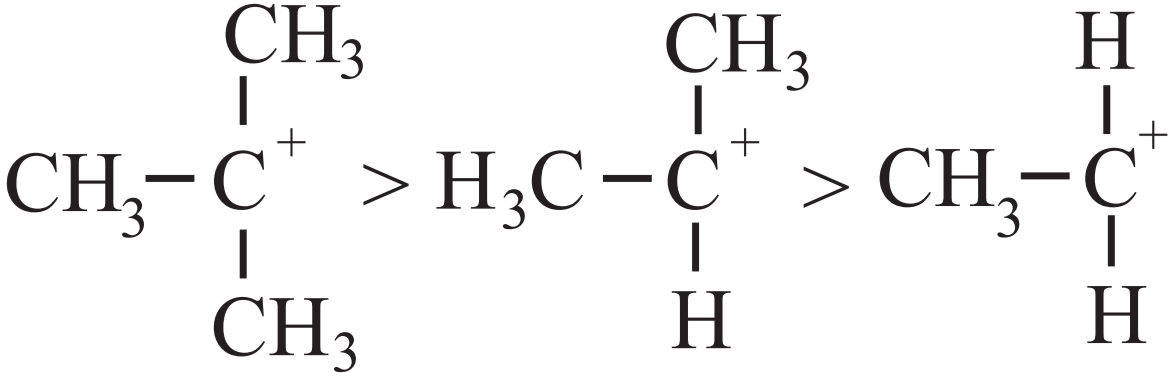
This is due to the electron releasing $(+I)$ effect of the alkyl groups. Therefore, the ease of dehydration of alcohols follows the order: Tertiary $>$ Secondary $>$ Primary Dehydration of alcohols proceed through carbocation formation. View full question & answer→MCQ 191 Mark
Note: In the following questions a statement of assertion followed by a statement of reason is given. Choose the correct answer out of the following choices.
Assertion: Bond angle in ethers is slightly less than the tetrahedral angle.
Reason: There is a repulsion between the two bulky $(-R)$ groups.
- A
Assertion and reason both are correct and reason is correct explanation of assertion.
- B
Assertion and reason both are wrong statements.
- C
Assertion is correct statement but reason is wrong statement.
- ✓
Assertion is wrong statement but reason is correct statement.
AnswerCorrect option: D. Assertion is wrong statement but reason is correct statement.
Bond angle in ethers is slightly more than the tetrahedral angle due to repulsion between two bulky alkyl groups.
View full question & answer→MCQ 201 Mark
In these questions, a statement of assertion followed by a statement of reason is given. Choose the correct answer out of the following choices.
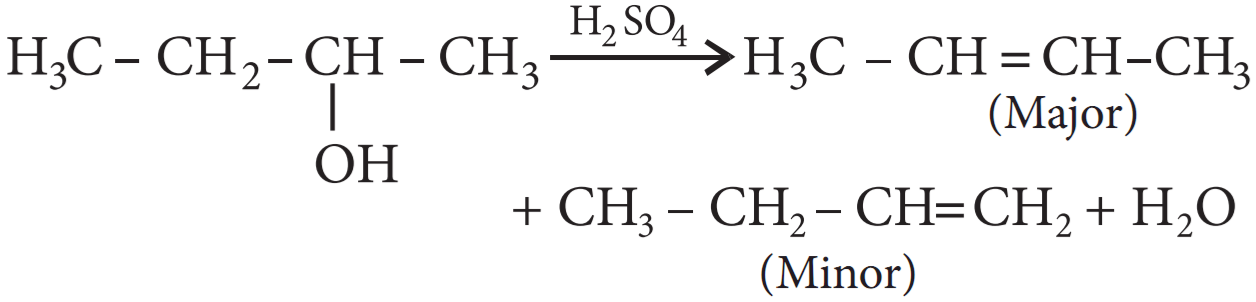
Assertion: $2-$Butanol on heating with $\ce{H_2SO_4}$ gives $1-$butene and $2-$butene.
Reason: Dehydration of $2-$butanol follows Saytzeff's rule.
- ✓
Assertion and reason both are correct statements and reason is correct explanation for assertion.
- B
Assertion and reason both are correct statements but reason is not correct explanation for assertion.
- C
Assertion is correct statement but reason is wrong statement.
- D
Assertion is wrong statement but reason is correct statement.
AnswerCorrect option: A. Assertion and reason both are correct statements and reason is correct explanation for assertion.
Saytzeff's rule: The alkene formed in greatest amount is the one that corresponds to removal of the hydrogen from the $\beta-$carbon having the fewest hydrogen substituent.
In case of $2^\circ$ and $3^\circ$ alcohols, Saytzeff's rule is followed.
View full question & answer→MCQ 211 Mark
In these questions, a statement of assertion followed by a statement of reason is given. Choose the correct answer out of the following choices.
Assertion: Tert $4$ Butyl alcohol undergoes acid catalysed dehydration readily than propanol.
Reason: $3º$ Alcohols do not give Victor$-$Meyer's test.
- A
Assertion and reason both are correct statements and reason is correct explanation for assertion.
- ✓
Assertion and reason both are correct statements but reason is not correct explanation for assertion.
- C
Assertion is correct statement but reason is wrong statement.
- D
Assertion is wrong statement but reason is correct statement.
AnswerCorrect option: B. Assertion and reason both are correct statements but reason is not correct explanation for assertion.
Alcohol which forms the more stable carbocation undergoes dehydration more readily. Since tert$-$butyl alcohol forms more stable tert$-$butyl cation, therefore, it undergoes dehydration more readily than propanol.
View full question & answer→MCQ 221 Mark
In these questions, a statement of assertion followed by a statement of reason is given. Choose the correct answer out of the following choices.
Assertion: Primary and secondary alcohols can be distinguished by Victor$-$Meyer's test.
Reason: Primary alcohols form nitrolic acid which dissolves in $\text{NaOH}$ to form blood red colouration but secondary alcohols form pseudonitrols which give blue colouration with $\text{NaOH}.$
- ✓
Assertion and reason both are correct statements and reason is correct explanation for assertion.
- B
Assertion and reason both are correct statements but reason is not correct explanation for assertion.
- C
Assertion is correct statement but reason is wrong statement.
- D
Assertion is wrong statement but reason is correct statement.
AnswerCorrect option: A. Assertion and reason both are correct statements and reason is correct explanation for assertion.
View full question & answer→MCQ 231 Mark
Note: In the following questions a statement of assertion followed by a statement of reason is given. Choose the correct answer out of the following choices.
Assertion: Phenols give $o-$ and $p-$nitrophenol on nitration with conc$. \ce{HNO_3}$ and $\ce{H_2SO_4}$ mixture.
Reason: $-OH$ group in phenol is $o-, p-$directing.
- A
Assertion and reason both are correct and reason is correct explanation of assertion.
- B
Assertion and reason both are wrong statements.
- C
Assertion is correct statement but reason is wrong statement.
- ✓
Assertion is wrong statement but reason is correct statement.
AnswerCorrect option: D. Assertion is wrong statement but reason is correct statement.
Phenol on treatment with dil$. \ce{HNO_3}$ form $o-$nitrophenol and $p-$nitrophenol.
View full question & answer→MCQ 241 Mark
In these questions, a statement of assertion followed by a statement of reason is given. Choose the correct answer out of the following choices.
Assertion: $\ce{CH_3OCH_3}$ and $\ce{C_2H_5OH}$ has comparable molecular weight but boiling point of $\ce{C_2H_5OH}$ is more than dimethyl ether.
Reason: $\ce{C_2H_5OH}$ forms intermolecular $H-$bonding while $\ce{CH_3OCH_3}$ forms intramolecular $H-$bonding.
- A
Assertion and reason both are correct statements and reason is correct explanation for assertion.
- B
Assertion and reason both are correct statements but reason is not correct explanation for assertion.
- ✓
Assertion is correct statement but reason is wrong statement.
- D
Assertion is wrong statement but reason is correct statement.
AnswerCorrect option: C. Assertion is correct statement but reason is wrong statement.
Due to the presence of hydroxyl group $(-OH),$ there is extensive hydrogen bonding between the ethanol molecules $\ce{(C_2H_5OH)}$. But there is no such hydrogen bonding in dimethyl ether $($due to absence of $-OH$ group$)$. So, boiling point of dimethyl ether is much lower than ethanol.
View full question & answer→MCQ 251 Mark
Note: In the following questions a statement of assertion followed by a statement of reason is given. Choose the correct answer out of the following choices.
Assertion: Phenol forms $2, 4, 6–$tribromophenol on treatment with $Br_2$ in carbon disulphide at $273K.$
Reason: Bromine polarises in carbon disulphide.
- A
Assertion and reason both are correct and reason is correct explanation of assertion.
- ✓
Assertion and reason both are wrong statements.
- C
Assertion is correct statement but reason is wrong statement.
- D
Assertion is wrong statement but reason is correct statement.
AnswerCorrect option: B. Assertion and reason both are wrong statements.
Correct assertion: Phenol on treatment with bromine water can form $2, 4, 6-$ tribromophenol.
Correct reason: In water, phenol gives phenoxide ions which activate the ring towards electrophilic substitution reaction.
View full question & answer→