Question types

Alcohols, Phenols, and Ethers question types

387 questions across 7 question groups — pick any mix to generate a Chemistry paper with step-by-step answer keys.

387
Questions
7
Question groups
5
Question types
Sample Questions

Alcohols, Phenols, and Ethers questions

One sample from each question group in this chapter. Select any group above to see the full set with answer keys.

Electrophilic substitution reaction in phenol takes place at:
  • A
    Para position
  • B
    Meta position
  • C
    Ortho position
  • Ortho and para position

Answer: D.

View full solution
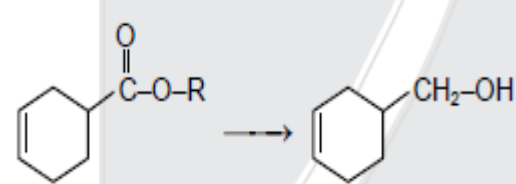
Which reagent is suitable for this conversion?
  • A
    $\text{Zn−Hg/HCl}$
  • $\mathrm{LiAlH}_4$
  • C
    $\mathrm{NH}_2-\mathrm{NH}_2 / \mathrm{OH}^{-}$
  • D
    Red $\text{P + HI}$

Answer: B.

View full solution
Mark the correct statement:
  • Water gas is used in the manufacture of methyl alcohol.
  • B
    Water gas has the highest calorific value.
  • C
    Water gas burns with luminuous flame.
  • D
    The production of water gas is exothermic process.

Answer: A.

View full solution
In these questions, a statement of assertion followed by a statement of reason is given. Choose the correct answer out of the following choices.
Assertion: With $\ce{Br_2-H_2O},$ phenol gives $2, 4, 6-$tribromophenol but with $\ce{Br_2-CS_2},$ it gives $4-$bromophenol as the major product.
Reason: In water, ionisation of phenol is enhanced but in $CS_2,$ it is greatly suppressed.
  • Assertion and reason both are correct statements and reason is correct explanation for assertion.
  • B
    Assertion and reason both are correct statements but reason is not correct explanation for assertion.
  • C
    Assertion is correct statement but reason is wrong statement.
  • D
    Assertion is wrong statement but reason is correct statement.

Answer: A.

View full solution
Note: In the following questions a statement of assertion followed by a statement of reason is given. Choose the correct answer out of the following choices.
Assertion: Addition reaction of water to but$-1-$ene in acidic medium yields butan$-1-ol.$
Reason: Addition of water in acidic medium proceeds through the formation of primary carbocation.
  • A
    Assertion and reason both are correct and reason is correct explanation of assertion.
  • Assertion and reason both are wrong statements.
  • C
    Assertion is correct statement but reason is wrong statement.
  • D
    Assertion is wrong statement but reason is correct statement.

Answer: B.

View full solution
Note: In the following questions a statement of assertion followed by a statement of reason is given. Choose the correct answer out of the following choices.
Assertion: $\text{IUPAC}$ name of the compound $\text{CH}_3-\text{CH}-\text{O}-\text{CH}_2-\text{CH}_2-\text{CH}_3 \\ \ \ \ \ \ \ \ \ \ \ \ \ \ \ | \\ \ \ \ \ \ \ \ \ \ \ \ \ \ \text{CH}_3$is $2-$Ethoxy$-2-$methylethane.
Reason: In $\text{IUPAC}$ nomenclature, ether is regarded as hydrocarbon derivative in which a hydrogen atom is replaced by $—OR$ or $—OAr$ group $[$where $R =$ alkyl group and $Ar =$ aryl group$]$
  • A
    Assertion and reason both are correct and reason is correct explanation of assertion.
  • B
    Assertion and reason both are wrong statements.
  • C
    Assertion is correct statement but reason is wrong statement.
  • Assertion is wrong statement but reason is correct statement.

Answer: D.

View full solution
In these questions, a statement of assertion followed by a statement of reason is given. Choose the correct answer out of the following choices.
Assertion: $P-$Nitrophenol gives more electrophilic substituted compound than $m-$methoxy phenol.
Reason: Methoxy group shows both $+R$ and $-I -$effect.
  • A
    Assertion and reason both are correct statements and reason is correct explanation for assertion.
  • B
    Assertion and reason both are correct statements but reason is not correct explanation for assertion.
  • C
    Assertion is correct statement but reason is wrong statement.
  • Assertion is wrong statement but reason is correct statement.

Answer: D.

View full solution
In these questions, a statement of assertion followed by a statement of reason is given. Choose the correct answer out of the following choices.
Assertion: Boiling points of alcohols are lower than hydrocarbons.
Reason: Among isomeric alcohols, boiling point decreases in the order$: 1^\circ > 2^\circ > 3^\circ .$
  • A
    Assertion and reason both are correct statements and reason is correct explanation for assertion.
  • B
    Assertion and reason both are correct statements but reason is not correct explanation for assertion.
  • C
    Assertion is correct statement but reason is wrong statement.
  • Assertion is wrong statement but reason is correct statement.

Answer: D.

View full solution
Write IUPAC names of the following compound:$\ \ \ \ \ \ \ \ \ \ \ \ \ \ \ \ \ \ \ \ \ \ \ \ \ \ \ \ \ \ \ \ \ \ \text{CH}_3\\\ \ \ \ \ \ \ \ \ \ \ \ \ \ \ \ \ \ \ \ \ \ \ \ \ \ \ \ \ \ \ \ \ \ \ |\\\text{CH}_3-\text{CH}-\text{CH}-\text{C}-\text{CH}_3\\\ \ \ \ \ \ \ \ \ \ \ \ \ \ |\ \ \ \ \ \ \ \ \ \ |\ \ \ \ \ \ \ \ \ |\\\ \ \ \ \ \ \ \ \ \ \ \ \ \text{CH}_3\ \ \ \ \text{OH}\ \ \ \ \text{CH}_3$
View full solution
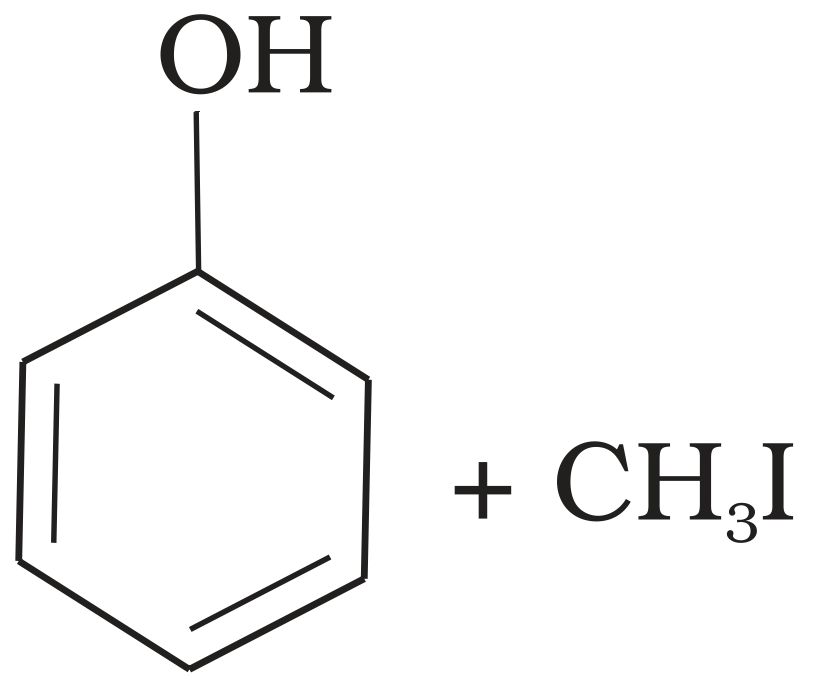
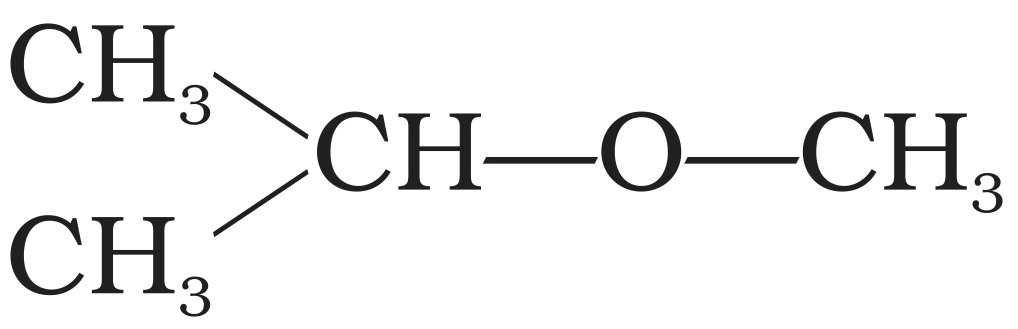
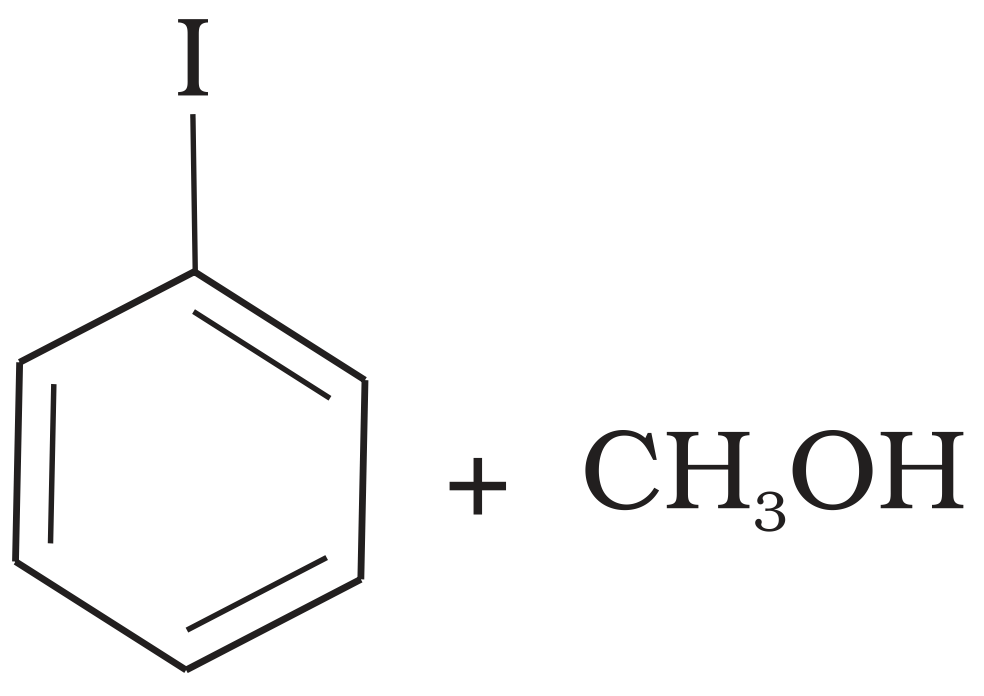
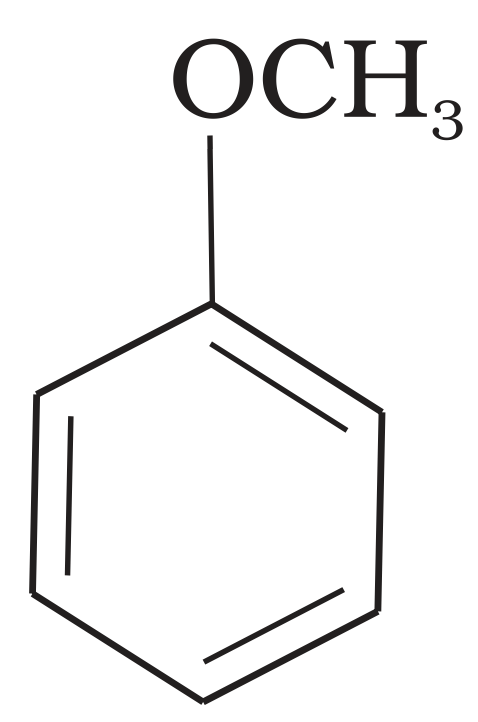
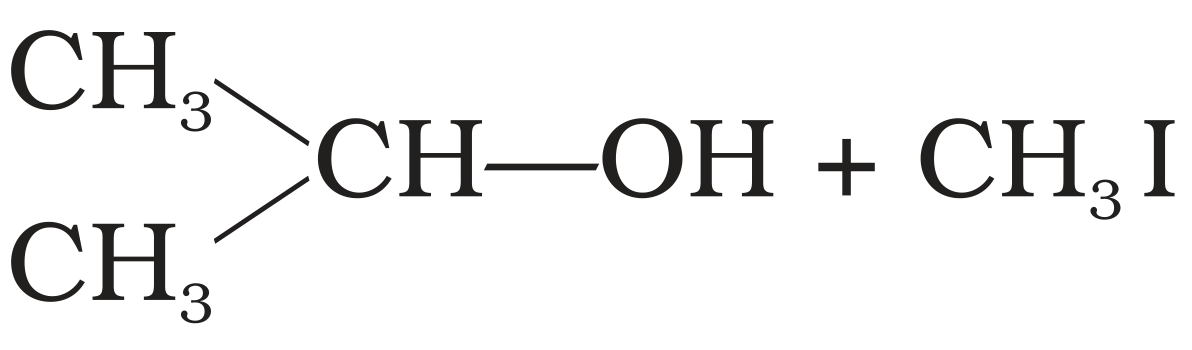
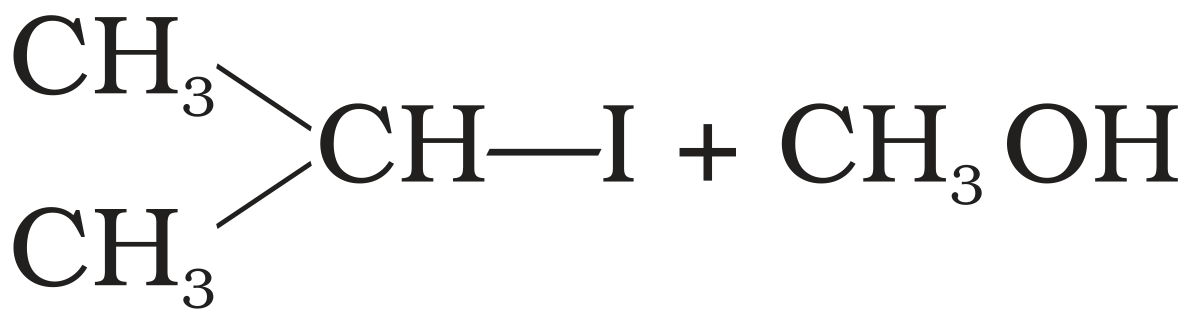
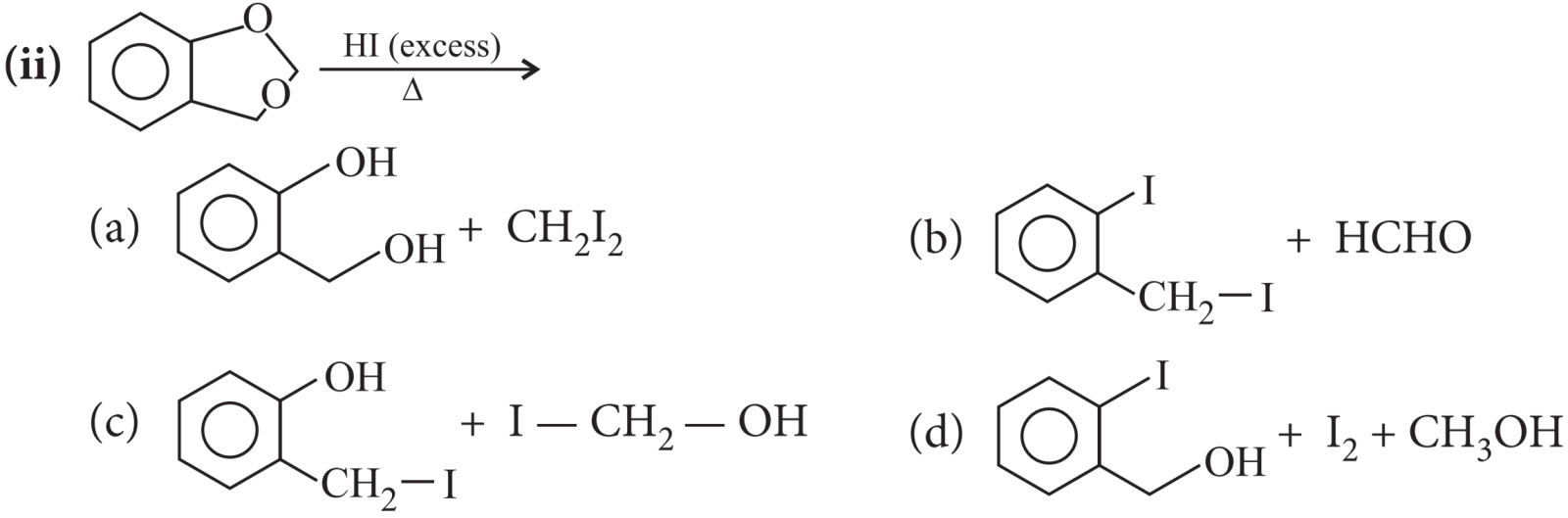
Match the starting materials given in Column I with the products formed by these (Column II) in the reaction with II.
 
Column I
 
Column II
(i)
$CH_3-o-CH_3$
(a)
(ii)
(b)
$\ \ \ \ \ \ \ \ \ \ \ \ \ \text{CH}_3 \\ \ \ \ \ \ \ \ \ \ \ \ \ \ \ | \\ \text{CH}_3-\text{C}-\text{I}+\text{CH}_3\text{OH} \\ \ \ \ \ \ \ \ \ \ \ \ \ \ \ | \\ \ \ \ \ \ \ \ \ \ \ \ \ \ \text{CH}_3$
(iii)
$\ \ \ \ \ \ \ \ \ \ \ \ \ \text{CH}_3 \\ \ \ \ \ \ \ \ \ \ \ \ \ \ \ | \\ \text{H}_3\text{C}-\text{C}-\text{O}-\text{CH}_3 \\ \ \ \ \ \ \ \ \ \ \ \ \ \ \ | \\ \ \ \ \ \ \ \ \ \ \ \ \ \ \text{CH}_3$
(c)
(iv)
(d)
$CH_3-OH + CH_3-I$
 
 
(e)
 
 
(f)
 
 
(g)
$\ \ \ \ \ \ \ \ \ \ \ \ \ \text{CH}_3 \\ \ \ \ \ \ \ \ \ \ \ \ \ \ \ | \\ \text{CH}_3-\text{C}-\text{OH}+\text{CH}_3\text{I} \\ \ \ \ \ \ \ \ \ \ \ \ \ \ \ | \\ \ \ \ \ \ \ \ \ \ \ \ \ \ \text{CH}_3$
View full solution
Q 213 Marks Question3 Marks
  1. Draw the structures of all isomeric alcohols of molecular formula $C_5H_{12}O$ and give their IUPAC names.
  2. Classify the isomers of alcohols in question $11.3\ (i)$ as primary, secondary and tertiary alcohols.
View full solution
Q 233 Marks Question3 Marks
Match the items of column I with items of column II.
 
Column I
 
Column II
(i)
Methanol
(a)
Conversion of phenol to o-hydroxysalicylic acid
(ii)
Kolbe’s reaction
(b)
Ethyl alcohol
(iii)
Williamson’s synthesis
(c)
Conversion of phenol to salicylaldehyde
(iv)
Conversion of $2°$ alcohol to ketone
(d)
Wood spirit
(v)
Reimer-Tiemann reaction
(e)
Heated copper at $573K$
(vi)
Fermentation
(f)
Reaction of alkyl halide with sodium alkoxide
View full solution
Q 253 Marks Question3 Marks
Identify the product of the following reaction:$ \ \ \ \ \ \ \ \ \ \text{CH}_3\\ \ \ \ \ \ \ \ \ \ \ \ \ \ \text{|}\\\text{CH}_3-\text{C}-\text{CH}_2-\text{Br}\xrightarrow{\stackrel{{}}{\hbox{Na}}\stackrel{{}}{\hbox{OH}}}\\ \ \ \ \ \ \ \ \ \ \ \ \ \ \text{|} \ \ \ \ \ \ \ \ \ \ \ \ \ \ \ \ \ \ \ \ \ \ \ \ \ \ \ \ \ \Delta\\ \ \ \ \ \ \ \ \ \ \text{CH}_3$
View full solution
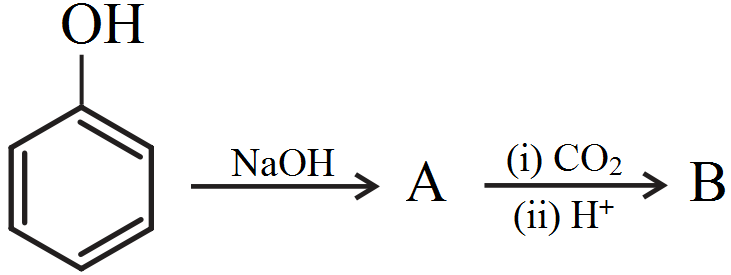
Read the passage given below and answer the following questions: An organic compound (A) having molecular formula $C_6H_6O$ gives a characteristic colour with aqueous $FeCl_3$ solution. (A) on treatment with $CO_2$ and $NaOH$ at $400K$ under pressure gives (B), which on acidification gives a compound (C). The compound (C) reacts with acetyl chloride to give (D) which is a popular pain killer. The following questions are multiple choice questions. Choose the most appropriate answer:
  1. Compound (A) is:
  1. 2-Hexanol.
  2. Dimethyl ether.
  3. Phenol.
  4. 2-Methyl pentanol.
  1. Compound (C) is:
  1. Salicylic acid.
  2. Salicyladehyde.
  3. Benzoic acid.
  4. Benzaldehyde.
  1. Number of carbon atoms in compound (D) is:
  1. 7
  2. 6
  3. 8
  4. 9
  1. The conversion of compound (A) to (C) is known as:
  1. Reimer-Tiemann reaction.
  2. Kolbe's reaction.
  3. Schimdt reaction.
  4. Swarts reaction.
  1. Compound (A) on heating with compound (C) in presence of $POCl_3$​​​​​​​ gives a compound (D) which is used:
  1. In perfumery as a ftavouring agent
  2. As an antipyretic
  3. As an analgesic
  4. As an intestinal antiseptic.
View full solution
Read the passage given below and answer the following questions:
Ethers are readily cleaved by HI or HBr at 373K to form an alcohol and an alkyl halide.
$\text{R}-\text{O}-\text{R}+\text{HX}\xrightarrow{373\text{K}}\text{R}-\text{X}+\text{R}-\text{OH}$
$\text{R}-\text{OH}+\text{HX}\xrightarrow{373\text{K}}\text{R}-\text{X}+\text{H}_2\text{O}$
Mixed ether, containing primary or secondary alkyl group, when heated with hydrogen halide, the lower alkyl group forms halide and higher will form an alcohol. Tertiary alkyl ether when heated with hydrogen halide gives tertiary alkyl halide.
The following questions are multiple choice questions. Choose the most appropriate answer:
  1. Among the following ethers, which one will produce methyl alcohol on treatment with hot concentrated HI?
  1. $\ \ \ \ \ \ \ \ \ \ \ \ \text{CH}_3\\\ \ \ \ \ \ \ \ \ \ \ \ \ \ |\\\text{CH}_3-\text{C}-\text{O}- \text{CH}_3\\\ \ \ \ \ \ \ \ \ \ \ \ \ \ |\\\ \ \ \ \ \ \ \ \ \ \ \ \ \text{CH}_3 $
  2. $\text{CH}_3-\text{CH}-\text{CH}_2-\text{O}-\text{CH}_3\\\ \ \ \ \ \ \ \ \ \ \ \ \ |\\\ \ \ \ \ \ \ \ \ \ \ \text{CH}_3$
  3. $\text{CH}_3-\text{CH}_2-\text{CH}_2-\text{CH}_2-\text{O}-\text{CH}_3$
  4. $\text{CH}_3-\text{CH}_2-\text{CH}-\text{O}-\text{CH}_3\\\ \ \ \ \ \ \ \ \ \ \ \ \ \ \ \ \ \ \ \ \ \ \ \ \ \ |\\\ \ \ \ \ \ \ \ \ \ \ \ \ \ \ \ \ \ \ \ \ \ \ \ \ \text{CH}_3$
  1. When $CH_2 = CH - O - CH_2 - CH_3$ reacts with one mole of HI, one of the products formed is:
  1. Ethane.
  2. Ethanol.
  3. Iodoethene.
  4. Ethanal.
  1. $(CH_3)_3COCH_3$ and $CH_3OC_2H_5$​​​​​​​ are treated with hydroiodic acid. The fragments obtained after reactions are respectively:
  1. $(CH_3)_3CI + CH_3OH; CH_3I + C_2H_5OH$
  2. $(CH_3)_3CI + CH_3OH; CH_3OH + C_2H_5I$
  3. $(CH_3)_3COH + CH_3I; CH_3OH + C_2H_5I$
  4. $CH_3I + (CH_3)_3COH; CH_3I + C_2H_5OH$
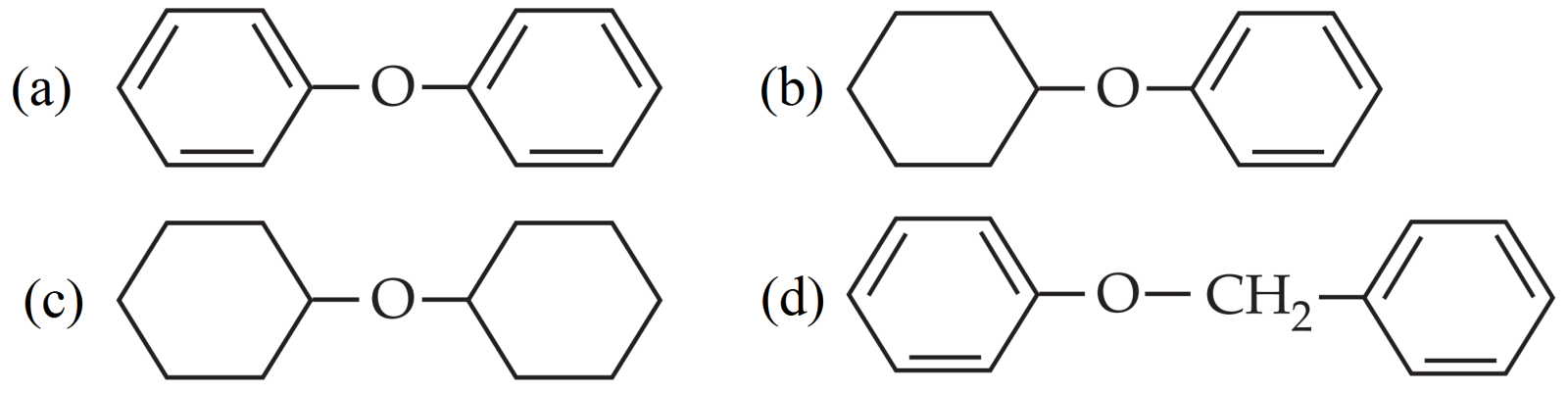
  1. Which of the following ether is unlikely to be cleaved by hot cone. HBr?
View full solution
Read the passage given below and answer the following questions:
Although chlorobenzene is inert to nucleophilic substitution, however it gives quantitative yield of phenol when heated with aq. $Na OH$ at high temperature and under high pressure. As far as electrophilic substitution in phenol is concemed the — OH group is an activating group, hence, its presence enhances the electrophilic substitution at o - and p - positions.
The following questions are multiple choice questions. Choose the most appropriate answer:
  1. Conversion of chlorobenzene into phenol involves:
  1. Modified $S_N1$ mechanism.
  2. Modified $S_N2$ mechanism.
  3. Both (a) and (b).
  4. Elimination-addition mechanism.
  1. Phenol undergoes electrophilic substitution more readily than benzene because:
  1. The intermediate carbocation is a resonance hybrid of more resonating structures than that from benzene.
  2. The intermediate is more stable as it has positive charge on oxygen, which can be better accommodated than on carbon.
  3. In one of the canonical structures, every atom (except hydrogen) has complete octet.
  4. The — OH group is o, p-directing which like all other o, p - directing group, is activating.
  1. Phenol on treatment with excess of cone. $HNO_3$ gives:
  1. O - nitrophenol.
  2. P - nitrophenol.
  3. O - and p - nitrophenol.
  4. 2, 4, 6 - trinitrophenol.
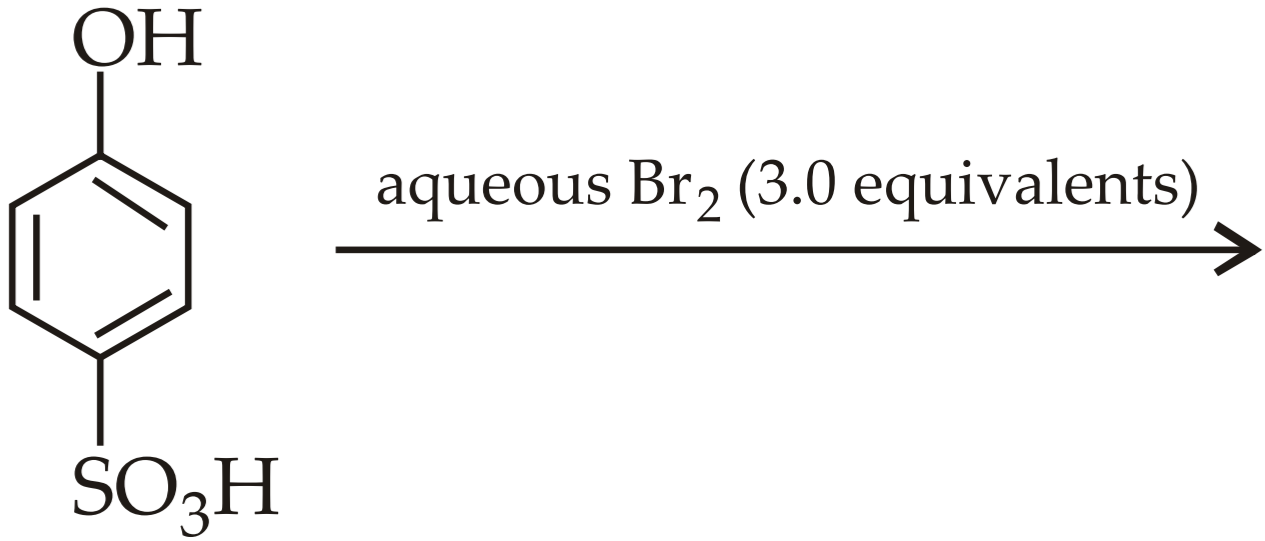
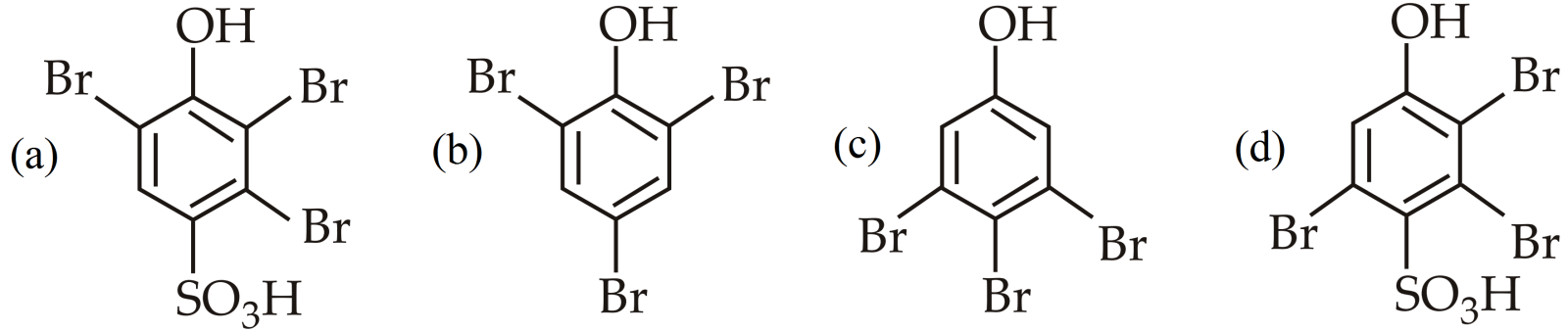
  1. Phenol is heated with a solution of mixture of $KBr$ and $KBrO_3$. The major product obtained in the above reaction is:
  1. 2 - bromophenol.
  2. 3 - bromophenol.
  3. 4 - bromophenol.
  4. 2, 4, 6 - tribromophenol.
  1. The major product of the following reaction is:

View full solution
Read the passage given below and answer the following questions: A compound (X) containing C, H and O is unreactive towards sodium. It also does not react with Schiff s reagent. On refluxing with an excess of hydroiodic acid, (X) yields only one organic product ( Y). On hydrolysis, (Y) yields a new compound (Z) which can be converted into (Y) by reaction with red phosphorus and iodine. The compound (Z) on oxidation with potassium permanganate gives a carboxylic acid. The equivalent weight of this acid is 60. The following questions are multiple choice questions. Choose the most appropriate answer:
  1. The compound (X) is an:
  1. Acid.
  2. Aldehyde.
  3. Alcohol.
  4. Ether.
  1. The IUPAC name of the acid formed is:
  1. Methanoic acid.
  2. Ethanoic acid.
  3. Propanoic acid.
  4. Butanoic acid.
  1. Compound (Y) is:
  1. Ethyl iodide.
  2. Methyl iodide.
  3. Propyl iodide.
  4. Mixture of (a) and (b).
  1. Compound (Z) is:
  1. Methanol.
  2. Ethanol.
  3. Propanol.
  4. Butanol.
  1. Compound (X) on treatment with excess of $Cl_2$ in presence of tight gives:
  1. $\propto-$ Chlorodiethyl ether.
  2. $\propto,\propto'-$ Dichlorodiethyl ether.
  3. Perchlorodiethyl ether.
  4. None of these.
View full solution
Read the passage given below and answer the following questions: Williamson's synthesis is used for the preparation of symmetrical as well as unsymmerical ether. It is $S_N2$ reaction mechanism. In Williamson's synthesis, $1º$ alkyl halide are used for preparation of ethers because $2º$ and $3º$ alkyl halide give alkene. Ethers are cleaved by hydrogen halides to alcohol and alkyl halide where alkyl halide is corresponding to that alkyl which has less number of carbon atom (it is because of less steric hindrance). In polar media unsymmetrical ether like tertiary butyl ethyl ether gives ethyl alcohol and tertiary butyl halide as reaction proceeds via carbocation. In these questions (Q. No. i-iv), a statement of assertion followed by a statement of reason is given. Choose the correct answer out of the following choices.
  1. Assertion and reason both are correct statements and reason is correct explanation for assertion.
  2. Assertion and reason both are correct statements but reason is not correct explanation for assertion.
  3. Assertion is correct statement but reason is wrong statement.
  4. Assertion is wrong statement but reason is correct statement.
  1. Assertion: Rate of reaction of alkyl halide in Williamson's synthesis reaction is 1ºRX > 2ºRX > 3ºRX.
Reason: It is a type of bimolecular substitution reaction $(S_N2)$.
  1. Assertion: T-Butyl methyl ether is not prepared by the reaction of t-butyl bromide with sodium methoxide.
Reason: Sodium methoxide is a weak nucleophile.
  1. Assertion: Williamson's synthesis method cannot be used for preparing diphenyl ether.
Reason: Aryl halides do not undergo nucleophilic substitution easily.
  1. Assertion: When isopropyl bromide is treated with sodium isopropoxide, di-isopropyl ether is obtained as a major product.
Reason: With secondary alkyl halides, both substitution and elimination occur.
  1. Assertion: Both symmetrical and unsymmetrical ethers can be prepared by Williamson's synthesis.
Reason: Williamson's synthesis is an example of nucleophilic substitution reaction.
View full solution

Identify A and B in the following reactions:
  1.  
  1. $\text{C}_2\text{H}_5\text{OH}\xrightarrow{\text{Cu},573\text{k}}\text{A}\xrightarrow{\text{CH}_3\text{MgBr}}\text{B}\\ \ \ \ \ \ \ \ \ \ \ \ \ \ \ \ \ \ \ \ \ \ \ \ \ \ \ \ \ \ \ \ \ \ \ \text{H}_2\text{O}/\text{H}^{+}$
View full solution
An aromatic compound ‘A’ on treatment with $CHCl_3 / KOH$ gives two compounds ‘B’ and ‘C’. Both B and C give the same product ‘D’ when distilled with zinc dust. Oxidation of D gives E having molecular formula $C_7H_6O_2$. The sodium salt of E on heating with sodalime gives F which may also be obtained by distilling A with zinc dust. Identify A to F.
View full solution

Generate a Alcohols, Phenols, and Ethers paper free

Pick question groups from the list above, set marks and difficulty, and export a branded PDF with step-by-step answer keys. First 3 chapters free — no signup.

Download App