Questions

5 Marks Questions

Take a timed test

12 questions · self-marked practice — reveal the answer and mark yourself.

Question 15 Marks
Match the terms given in Column I with the units given in Column II.
 
Column I   Column II
i. $\text{K}$ a. $\text{I}\times\text{t}$
ii. $\wedge_{\text{m}}$ b. $\frac{\wedge_{\text{m}}}{\wedge^\circ_\text{m}}$
iii. $\alpha$ c. $\frac{\text{k}}{\text{c}}$
iv. $\text{Q}$ d. $\frac{\text{G}^*}{\text{R}}$
Answer
 
Column I   Column II
i. $\text{K}$ d. $\frac{\text{G}^*}{\text{R}}$
ii. $\wedge_{\text{m}}$ c. $\frac{\text{k}}{\text{c}}$
iii. $\alpha$ b. $\frac{\wedge_{\text{m}}}{\wedge^\circ_\text{m}}$
iv. $\text{Q}$ a. $\text{I}\times\text{t}$
View full question & answer
Question 25 Marks
Match the terms given in Column I with the units given in Column II.
 
Column I   Column II
i. $\wedge_{\text{m}}$ a. Intensive property.
ii. $\text{E}^{\ominus}_{\text{Cell}}$ b. Depends on number of ions/volume.
iii. $\text{K}$ c. Extensive property.
iv. $\Delta_{\text{r}}\text{G}_{\text{Cell}}$ d. Increases with dilution.
Answer
 
Column I   Column II
i. $\wedge_{\text{m}}$ d. Increases with dilution.
ii. $\text{E}^{\ominus}_{\text{Cell}}$ a. Intensive property.
iii. $\text{K}$ b. Depends on number of ions/volume.
iv. $\Delta_{\text{r}}\text{G}_{\text{Cell}}$ c. Extensive property.
View full question & answer
Question 35 Marks

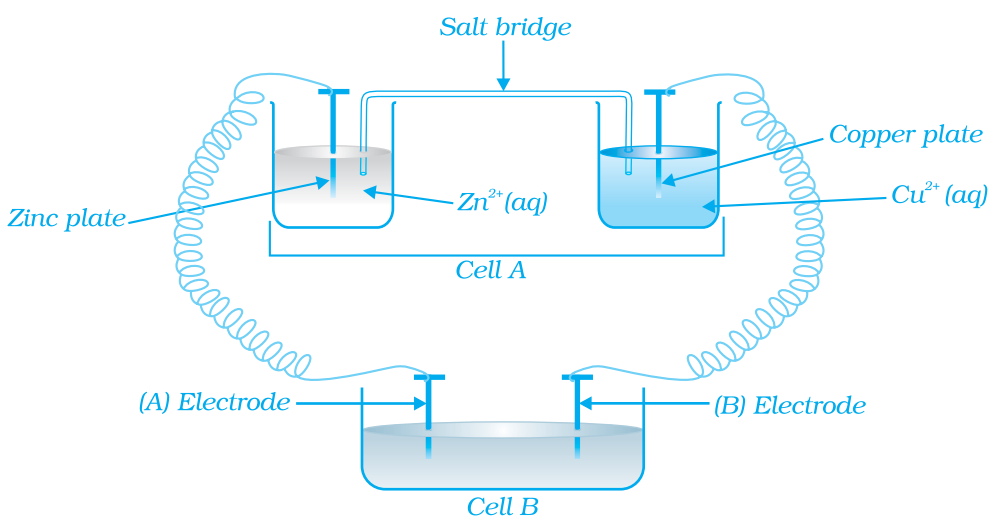
Consider the and answer the following questions.

i. Cell 'A' has $E_{\text {Cell }}=2 \mathrm{~V}$ and Cell 'B' has $E_{\text {Cell }}=1.1 \mathrm{~V}$ which of the two cells ' $A$ ' or ' $B$ ' will act as an electrolytic cell. Which electrode reactions will occur in this cell?
ii. If cell 'A' has $E_{C e l l}=0.5 \mathrm{~V}$ and cell 'B' has $E_{C e l l}=1.1 \mathrm{~V}$ then what will be the reactions at anode and cathode?
Answer
  1. Cell ‘B’ will act as electrolytic cell as it has lower emf
$\therefore$ The electrode reactions will be:
$\text{zn}^{2+}+2\text{e}^{-}\xrightarrow{\ \ \ \ \ \ \ \ \ \ \ }\text{zn}\ \ \text{ at cathode}$
$\text{Cu}\xrightarrow{\ \ \ \ \ \ \ \ \ \ \ }\text{Cu}^{2+}+2\text{e}^-\ \ \text{ at anode}$
  1. Now cell ‘B’ acts as galvanic cell as it has higher emf and will push electrons into cell ‘A’.
The electrode reaction will be:
$\text{at cathode}\ \ \text{ zn}\xrightarrow{\ \ \ \ \ \ \ \ \ \ \ }\text{zn}^{2+}+2\text{e}^{-}$
$\text{ at anode}\ \ \ \text{Cu}^{2+}+2\text{e}^-\xrightarrow{\ \ \ \ \ \ \ \ \ \ \ }\text{Cu}$
View full question & answer
Question 45 Marks
Match the items of Column I and Column II.
 
Column I
 
Column II
i.
Lechlanche cell
a.
Cell reaction $2H_2 + O_2 ⎯→ 2H_2O$
ii.
Ni–Cd cell
b.
Does not involve any ion in solution and is used in hearing aids.
iii.
Fuel cell
c.
Rechargeable.
iv.
Mercury cell
d.
Reaction at anode, $Zn ⎯→ Zn^{2+} + 2e^-$
 
 
e.
Converts energy of combustion into electrical energy.
Answer
 
Column I
 
Column II
i.
Lechlanche cell
d.
Reaction at anode, $Zn ⎯→ Zn^{2+} + 2e^-$
ii.
Ni–Cd cell
c.
Rechargeable.
iii.
Fuel cell
e.
Converts energy of combustion into electrical energy.
iv.
Mercury cell
b.
Does not involve any ion in solution and is used in hearing aids.
 
 
e.
Converts energy of combustion into electrical energy.
View full question & answer
Question 55 Marks
Match the items of Column I and Column II.
 
Column I
 
Column II
i.
Lead storage battery
a.
Maximum efficiency.
ii.
Mercury cell
b.
Prevented by galvanisation.
iii.
Fuel cell
c.
Gives steady potential.
iv.
Rusting
d.
Pb is anode, $PbO_2$ is cathode.
Answer
 
Column I
 
Column II
i.
Lead storage battery
d.
Pb is anode, $PbO_2$ is cathode.
ii.
Mercury cell
c.
Gives steady potential.
iii.
Fuel cell
a.
Maximum efficiency.
iv.
Rusting
b.
Prevented by galvanisation.
View full question & answer
Question 65 Marks
Match the terms given in Column I with the units given in Column II.
 
Column I
 
Column II
i.
$∧_m$
a.
$S cm^{-1}$
ii.
$E_{Cell}$
b.
$m^-$
iii.
$K$
c.
$S cm^2 mol^{-1}$
iv.
$G^*$
d.
$V$
Answer
 
Column I
 
Column II
i.
$∧_m$
c.
$S cm^2 mol^{-1}$
ii.
$E_{Cell}$
d.
$V$
iii.
$K$
a.
$S cm^{-1}$
iv.
$G^*$
b.
$m^-$
View full question & answer
Question 75 Marks
What is the relationship between Gibbs free energy of the cell reaction in a galvanic cell and the emf of the cell? When will the maximum work be obtained from a galvanic cell?
Answer
In general,
$\Delta_\text{r}\text{G}=\text{nFE}$
Where $\Delta_{\text{r}}\text{G}=$ Gibbs energy of the cell reaction.
$\text{n}=$ Number of moles of electrons transferred in the redox reaction taking place in a cell.
$\text{F}=$ Faraday constant.
$\text{E}=$ Cell emf.
Using standard Conditions, the reaction is,
$\Delta_{\text{r}}\text{G}^0=\text{nFE}$
Where $\Delta_{\text{r}}\text{G}^0=$ standard Gibbs energy of the cell reaction.
$\text{E}^0=$ Standard Cell emf.
If we want to obtain maximum work from a galvanic cell then charge has to be passed reversibly.
View full question & answer
Question 85 Marks
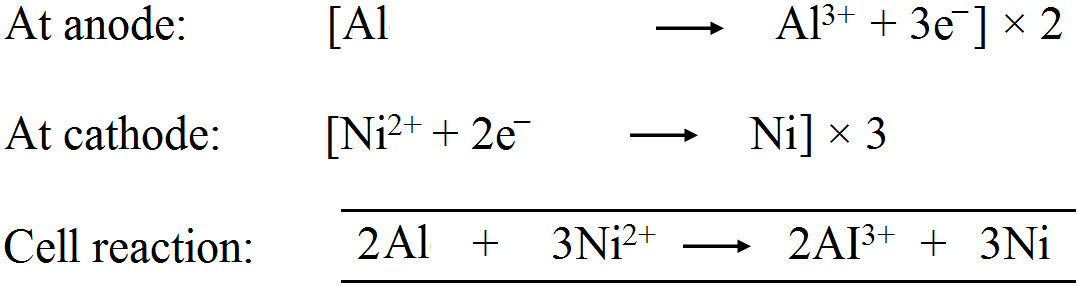
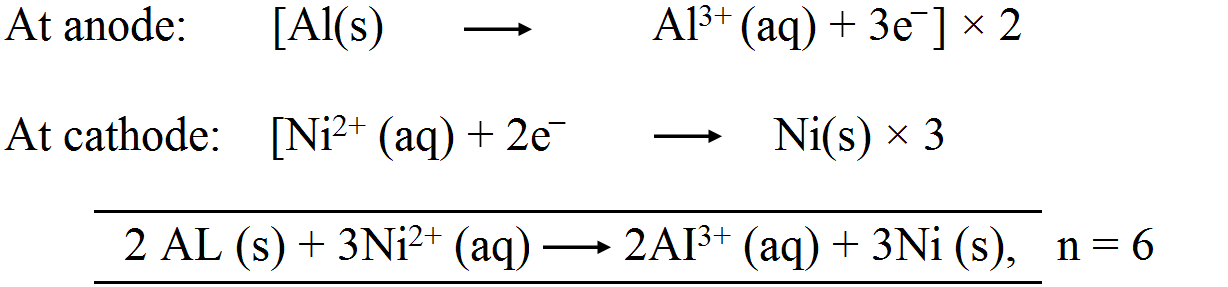
A voltaic cell is set up at $25°C$ with the following half-cells $Al^{3+} (0.001M)$ and $Ni^{2+} (0.50M)$. Write an equation for the reaction that occurs when the cell generates an electric current and determine the cell potential. $(\text{Given:}\text{ E}^{\circ}_{\text{Ni}^{2+}/\text{Ni}}=-0.25\text{V,E}^{\circ}_{\text{Al}^{3+}/\text{Al}}=-1.66\text{V})$
Answer


$\text{E}^{\circ}_{\text{cell}}=\text{E}^{\circ}_{\text{cathode}}-\text{E}^{\circ}_{\text{anode}}=\text{E}^{\circ}_{\text{Ni}^{2+}/\text{Ni}}-\text{E}^{\circ}_{\text{Al}^{3+}/\text{Al}}$
$=-0.25\text{V}-(-1.66\text{V})=1.41\text{V}$
$[\text{Al}^{3+}]=1\times10^{-3}\text{M};[\text{Ni}^{2+}]=0.5\text{ M};\text{n}=6$
Substituting the values in the Nernst equation,
$\text{E}_{\text{cell}}=\text{E}^{\circ}_{\text{Ni}^{2+}/\text{Ni}}-\text{E}^{\circ}_{\text{Al}^{3+}/\text{Al}}$
$\text{E}_{\text{cell}}=1.41\text{V}-\frac{0.059}{6}\log\frac{(10^{-3})^2}{(0.5)^3}$
$=1.41\text{V}-\frac{0.059}{6}\log(8\times10^{-6})$
$=1.41\text{V}-\frac{0.059}{6}(-0.54)$
$\text{E}_{\text{cell}}=1.41\text{V}+0.0053\text{V}=1.4153\text{V}$
View full question & answer
Question 95 Marks
A voltaic cell is set up at $25°C$ with the followinng half-cell: $Al | Al^{3+} (0.001M)$ and $Ni | Ni^{2+} (0.50M)$ Calculate the cell voltage $\text{E}^{\circ}_{\text{Ni}^{2+}/\text{Ni}}\Big[=-0.25\text{V,E}^{\circ}_{\text{Al}^{3+}/\text{Al}}=-1.66\text{V}\Big]$
Answer


$\text{E}_{\text{cell}}=\text{E}^{\circ}_{\text{cell}}-\frac{0.0591}{\text{n}}\log\frac{[\text{Al}^{3+}]^2}{[\text{Ni}^{2+}]^3}$
Here, $\text{n}=6,[\text{Al}^{3+}]=0.001\text{M}$
$=1\times10^{-3}\text{M},[\text{Ni}^{2+}]=0.5\text{M}$
$\text{E}^{\circ}_{\text{cell}}=\text{E}^{\circ}_{\text{Ni}^{2+}/\text{Ni}}-\text{E}^{\circ}_{\text{Al}^{3+}/\text{Al}}$
$=-0.25\text{V}-(-1.66\text{V})=1.41\text{V}$
$\text{E}_{\text{cell}}=1.41-\frac{0.0591}{6}\log\frac{(10^{-3})^2}{(0.5)^3}$
$=1.41-\frac{0.0591}{6}\log\frac{10^{-6}}{0.125}$
$=1.41\frac{0.0591}{6}-\log(10^{-6}\times8)$
$=1.41-\frac{0.0591}{6}\log(10^{-6}+\log2^3)$
$=1.41-\frac{0.0591}{6}\log(-6\log10+3\log2)$
$=1.41-\frac{0.0591}{6}\log(-6+3\times0.3010)$
$=1.41-\frac{0.0591}{6}(-5.097)$
$=1.41+\frac{0.3012}{6}=1.41+0.0502=1.4602\text{V}$
$\text{E}_{\text{cell}}=1.46\text{V}$
View full question & answer
Question 105 Marks

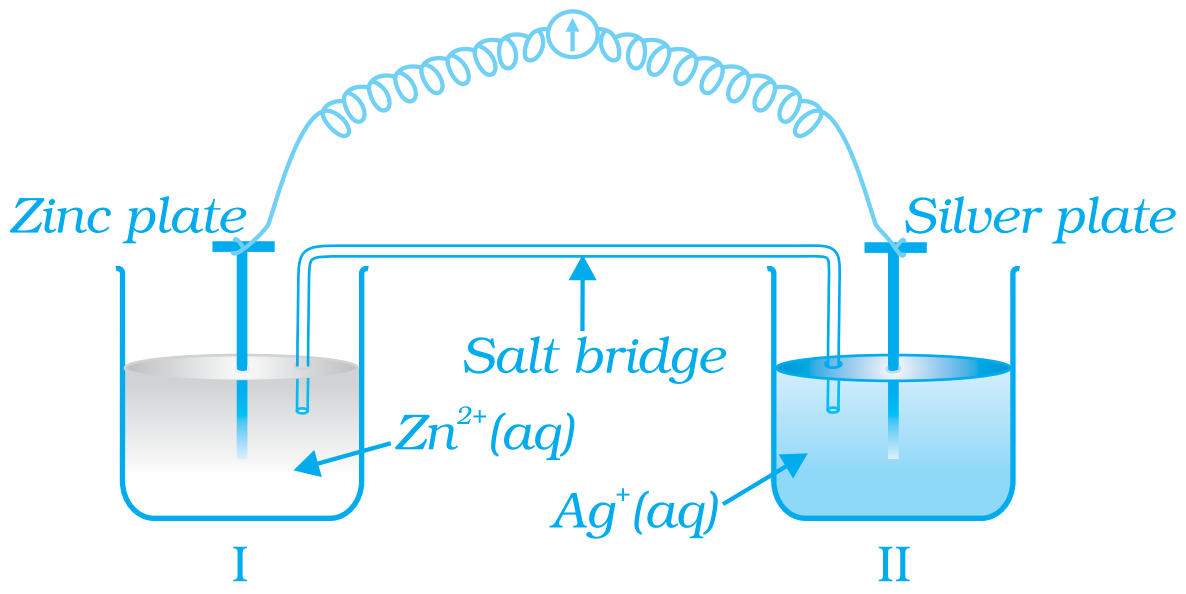
Consider and answer the questions (i) to (vi) given below.
  1. Redraw the diagram to show the direction of electron flow.
  2. Is silver plate the anode or cathode?
  3. What will happen if salt bridge is removed?
  4. When will the cell stop functioning?
  5. How will concentration of $Zn^{2+}$^ ions and $Ag^+$^ ions be affected when the cell functions?
  6. How will the concentration of$ Zn^{2+}$^ ions and $Ag^+$^ ions be affected after the cell becomes ‘dead’?
Answer
  1. The cell is,
$Zn(s) |Zn^{+2}||Ag^+| Ag$
  1. Electron will flow from zinc anode to silver cathode in external circuit. Silver will act as cathode, since its standard reduction potential is greater than that of zinc.
  2. Potential will drop to zero if salt bridge is suddenly removed.
  3. Cell will stop functioning when it is discharged i.e., when cell potential is zero.
  4. Nemst equation for the cell is 0.059,
$\text{E}=\text{E}^\circ-\frac{0.059}{2}\log\frac{\big[\text{zn}^{2+}\big]}{\big[\text{Ag}^{+}\big]^2}$
Cell potential will decrease with increase in concentration of $[Zn^{+2}]$ while it will increase with the concentration of$ [Ag^+].$​​​​​​​​​​​​​​
  1. When cell is dead or discharged, E will be zero and the cell will be at equilibrium. Then, concentration of $Zn^{+2} $and $Ag^+$^ will not change.
View full question & answer
Question 115 Marks
At 291 K , the molar conductivities at infinite dilution of $\mathrm{NH}_4 \mathrm{Cl}, \mathrm{NaOH}$ and NaCl are $129.8,217.4$ and $108.9 \mathrm{S~cm}^2 \mathrm{~mol}^{-1}$ respectively. If the molar conductivity of a centinormal solution of $\mathrm{NH}_4 \mathrm{OH}$ is $9.33 \mathrm{S~cm}^2 \mathrm{~mol}^{-1}$, what is the percentage dissociation of $\mathrm{NH}_4 \mathrm{OH}$ at this dilution? Also calculate the dissociation constant of $\mathrm{NH}_4 \mathrm{OH}$.
Answer
Here, we are given:
$\Lambda^{0}_{\text{m}}\text{ for }\text{NH}_4\text{Cl}=129.8\text{ S}\text{ cm}^2\text{mol}^{-1}$
$\Lambda^{0}_{\text{m}}\text{ for }\text{NaOH}=217.4\text{ S}\text{ cm}^2\text{mol}^{-1}$
$\Lambda^{0}_{\text{m}}\text{ for }\text{NaCl}=108.9\text{ S}\text{ cm}^2\text{mol}^{-1}$
By Kohlrausch's law,
$\Lambda^{0}_{\text{m}}\text{ for }\text{NH}_4\text{OH}=\lambda^{0}_{\text{NH}^+_4}+\lambda^{0}_{\text{OH}^-}$
$=\Lambda^0_{\text{m}}(\text{NH}_4\text{Cl})+\Lambda^0_{\text{m}}(\text{NaOH})-\Lambda^0_{\text{m}}(\text{NaCl})$
$=[129.8+217.4-108.9]\text{ S cm}^2\text{mol}^{-1}$
$=238.3\text{ S cm}^2\text{mol}^{-1}$
$\Lambda^{\text{c}}_{\text{m}}=9.33\text{ S cm}^2\text{mol}^{-1}$ (Given)
$\therefore$ Degree of dissociation $(\alpha)=\frac{\Lambda^{\text{c}}_{\text{m}}}{\Lambda^{\text{o}}_{\text{m}}}=\frac{9.33}{238.3}=0.0392$
or percentage dissociation = 0.0392 × 100 = 3.92%
Calculation of dissociation constant
$\text{NH}_4\text{OH}\rightleftharpoons\text{NH}^+_4+\text{OH}^-$
Initial Concentration $\text{c}$ $0 $ $0 $
Equilibrium Concentration $\text{c}-\text{c}\alpha$ $\text{c}\alpha$ $\text{c}\alpha$
$=\text{c}(1-\alpha)$
$\text{K}=\frac{\text{c}\alpha\times\text{c}\alpha}{\text{c}(1-\alpha)}=\frac{\text{c}\alpha^2}{1-\alpha}$
Substituting, c = 0.01, N = 0.01M, and $\alpha=0.0392$
We get, $\text{K}=\frac{(0.01)(0.0392)^2}{1-0.0392}$
$=\frac{10^{-2}\times(3.92\times10^{-2})^2}{0-9608}$
$=1.599\times10^{-5}$
View full question & answer
Question 125 Marks
Match the items of Column I and Column II on the basis of data given below:
$\text{E}^{\ominus}_{\text{F}_2/\text{F}^-}=2.87\text{V},\text{ E}^{\ominus}_{\text{Li}^+/\text{Li}}=-3.5\text{V},\text {E}^{\ominus}_{\text{Au}^{3+}/\text{Au}}=1.4\text{V},\text{ E}^{\ominus}_{ \text{Br}_2/\text{Br}^-}=1.09\text{V}$
 
Column I
 
Column II
i.
$F_2$
a.
Metal is the strongest reducing agent.
ii.
$Li$
b.
Metal ion which is the weakest oxidising agent.
iii.
$Au^{3+}$​​​​​​​
c.
Non metal which is the best oxidising agent.
iv.
$Br^-$​​​​​​​
d.
Unreactive metal.
v.
$Au$
e.
Anion that can be oxidised by $Au^{3+}​​​​​​​$​​​​​​​
vi.
$Li^+$
f.
Anion which is the weakest reducing agent.
vii.
$F^-$
g.
Metal ion which is an oxidising agent.
Answer
 
Column I
 
Column II
i.
$F_2$
c.
Non metal which is the best oxidising agent.
ii.
$Li$
a.
Metal is the strongest reducing agent.
iii.
$Au^{3+}$
g.
Metal ion which is an oxidising agent.
iv.
$Br^-$
e.
Anion that can be oxidised by $Au^{3+}​​​​​​​$​​​​​​​
v.
$Au$
d.
Unreactive metal.
vi.
$Li^+$
b.
Anion which is the weakest reducing agent.
vii.
$F^-$
f.
Metal ion which is the weakest oxidising agent.
View full question & answer