Questions

Case study (4 Marks)

Take a timed test

11 questions · self-marked practice — reveal the answer and mark yourself.

Question 14 Marks
Read the passage given below and answer the following questions:
At the freezing point of a solvent, the solid and the liquid are in equilibrium. Therefore, a solution will freeze when its vapour pressure becomes equal to the vapour pressure of the pure solid solvent. It has been observed that when a non-volatile solute is added to a solvent, the freezing point of the solution is always lower than that of the pure solvent. Depression in freezing point can be given as, $\Delta\text{T}_\text{f}=\text{K}_\text{f}\text{m}$ Where, $K_f =$ Molal freezing point depression constant or we can write, $\Delta\text{T}_\text{f}=\frac{\text{K}_\text{f}\times\text{W}_\text{B}\times1000}{\text{W}_A\times\text{M}_\text{B}}$
a statement of assertion followed by a statement of reason is given. Choose the correct answer out of the following choices.
  1. Assertion and reason both are correct statements and reason is correct explanation for assertion.
  2. Assertion and reason both are correct statements but reason is not correct explanation for assertion.
  3. Assertion is correct statement but reason is wrong statement.
  4. Assertion is wrong statement but reason is correct statement.
  1. Assertion: $0.1M$ solution of glucose has same depression in the freezing point as $0.1M$ solution of urea.
Reason: $K_f $ for both has same value.
  1. Assertion: Increasing pressure on pure water decreases its freezing point.
Reason: Density of water is maximum at $273K.$
  1. Assertion: Larger the value of cryoscopic constant of the solvent, lesser will be the freezing point of the solution.
Reason: Extent of depression in the freezing point depends on the nature of the solvent.
  1. Assertion: The water pouch of instant cold pack for treating athletic injuries breaks when squeezed and NH4N03 dissolves thus lowering the temperature.
Reason: Addition of non-volatile solute into solvent results into depression of freezing point of solvent.
  1. Assertion: If a non-volatile solute is mixed in a solution then elevation in boiling point and depression in freezing point both wiII be same.
Reason: Elevation in boiling point and depression in freezing point both depend on number of particles of solute.
Answer
  1. (b) Assertion and reason both are correct statements but reason is not correct explanation for assertion.
Explanation:

Depression in freezing point is a colligative property which depends on the number of particles present in the solution. As both 0.1M solution of glucose and $0.1M$ solution of urea contain same number of moles (number of particles) therefore, both will have same depression in freezing point.
  1. (c) Assertion is correct statement but reason is wrong statement.
Explanation:

Density of water is maximum at $4^\circ C$ i.e., $277K.$
  1. (a) Assertion and reason both are correct statements and reason is correct explanation for assertion.
  1. (a) Assertion and reason both are correct statements and reason is correct explanation for assertion.
Explanation:

Freezing point of a substance is defined as the temperature at which the vapour pressure of its liquid is equal to the vapour pressure of the corresponding solid. Since the addition of a non-volatile solute always lowers the vapour pressure of solvent, therefore it will be in equilibrium with solid phase at a lower pressure and hence at a lower temperature.
  1. (d) Assertion is wrong statement but reason is correct statement.
Explanation:

Elevation in boiling point $(\Delta\text{T}_\text{b})=\text{K}_\text{b}\times\text{m}$ Depression in freezing point $(\Delta\text{T}_\text{f})=\text{K}_\text{f}\times\text{m}$ Elevation in boiling point and depression in freezing point are colligative properties i.e., they depend only on the number of particles of the solute. Value of $K_b$ and $K_f $ are different, so $\Delta\text{T}_\text{b}$ and $\Delta\text{T}_\text{f}$ are also different.
View full question & answer
Question 24 Marks
Read the passage given below and answer the following questions:
According to Raoult's law, the partial pressure of two components of the solution maybe given as:
$\text{P}_\text{A}=\stackrel{{0}}{\hbox{PA }}\text{x}_\text{A}$ and $\text{P}_\text{B}=\stackrel{{0}}{\hbox{PB }}\text{x}_\text{B}$
For an ideal solution (obeys Raoult's law always)
$\Delta\text{H}_\text{mix}=0,\Delta\text{mix}=0$
All solutions do not obey Raoults law over entire range of concentration. These are known as non-ideal solutions.
For non-ideal solutions, $\text{P}_\text{A}\not=\stackrel{{0}}{\hbox{PA }}\text{x}_\text{A}$ or $\text{P}_\text{B}\not=\stackrel{{0}}{\hbox{PB }}\text{x}_\text{B}$
Positive deviation $\Rightarrow\text{P}_\text{A}>\stackrel{{0}}{\hbox{PA }}\text{x}_\text{A}$ and $\text{P}_\text{B}>\stackrel{{0}}{\hbox{PB }}\text{x}_\text{B}$
Negative deviation $\text{P}_\text{A}<\stackrel{{0}}{\hbox{PA }}\text{x}_\text{A}$ and $\text{P}_\text{B}\stackrel{{0}}{\hbox{PB }}\text{x}_\text{B}$
A statement of assertion followed by a statement ofreason is given. Choose the correct answer out of the following choices.
  1. Assertion and reason both are correct statements and reason is correct explanation for assertion.
  2. Assertion and reason both are correct statements but reason is not correct explanation for assertion.
  3. Assertion is correct statement but reason is wrong statement.
  4. Assertion is wrong statement but reason is correct statement.
  1. Assertion: An ideal solution obeys Raoult's law.
Reason: In an ideal solution, solute-solute as well as solvent-solvent interactions are similar to solute-solvent interactions.
  1. Assertion: Acetone and aniline show negative deviations.
Reason: H-bonding between acetone and aniline is stronger than that between acetone-acetone and aniline-aniline.
  1. Assertion: Azeotropic mixtures are formed only by non-ideal solutions and they may have boiling points either greater than both the components or lesser than both the components.
Reason: The composition of the vapour phase is same as that of the liquid phase of an azeotropic mixture.
  1. Assertion: The solutions which show negative deviations from Raoult's law are called maximum boiling azeotropes.
Reason: 68% nitric acid and 32% water by mass fonn maximum boiling azeotrope.
  1. Assertion: $\Delta\text{H}_{\text{mix}}$ mix and $\Delta\text{V}_{\text{mix}}$ are positive for an ideal solution.
Reason: The interactions between the particles of the components of an ideal solution are almost identical as between particles in the liquids.
Answer
  1. (a) Assertion and reason both are correct statements and reason is correct explanation for assertion.
  1. (a) Assertion and reason both are correct statements and reason is correct explanation for assertion.
  1. (b) Assertion and reason both are correct statements but reason is not correct explanation for assertion.
Explanation:

Non-ideal solutions with positive deviation i.e., having more vapour pressure than expected, boil at lower temperature while those with negative deviation boil at higher temperature than those of the components.
  1. (b) Assertion and reason both are correct statements but reason is not correct explanation for assertion.
  1. (d) Assertion is wrong statement but reason is correct statement.
Explanation:

For ideal solution, $\Delta\text{H}_\text{mix}=0,\Delta\text{V}_\text{mix}=0$
View full question & answer
Question 34 Marks
Read the passage given below and answer the following questions:
The solubility of gases increases with increase of pressure. William Henry made a systematic investigation of the solubility of a gas in a liquid. According to Henry's law "the mass of a gas dissolved per unit volume of the solvent at constant temperature is directly proportional to the pressure of the gas in equilibrium with the solution". Dalton during the same period also concluded independently that the solubility of a gas in a ti quid solution depends upon the partial pressure of the gas. If we use the mole fraction of gas in the solution as a measure of its solubility, then Henry's law can be modified as "the partial pressure of the gas in the vapour phase is directly proportional to the mole fraction of the gas in the solution"
The following questions are multiple choice questions. Choose the most appropriate answer:
  1. Henry's law constant for the solubility of methane in benzene at $298K$ is $4.27 x 10^5$mm Hg. The solubility of methane in benzene at $298K$ under $760$mm Hg is:
  1. $4.27 \times 10^{-5}$
  2. $1.78 \times 10^{-3}$
  3. $4.27 \times 10^{-3}$
  4. $1.78 \times 10^{-5}$
  1. The partial pressure of ethane over a saturated solution containing $6.56 \times 10^{-2}g$ of ethane is I bar. If the solution contains $5.00 \times 10^{-2}g$ of ethane then what will be the partial pressure (in bar) of the gas?
  1. 0.762
  2. 1.312
  3. 3.81
  4. 5.0
  1. $K_H (K$ bar$)$ values for $Ar_{(g),} CO_{2(g),} HCHO_{(g)}$ and $CH_{4(g)}$ are $40.39, 1.67, 1.83 \times 10^{-5}$ and $0.413$ respectively. Arrange these gases in the order of their increasing solubility. Arrange these gases in the order of their increasing solubility.
  1. $HCHO < CH_4 < CO_2 < Ar$
  2. $HCHO < CO_2 < CH_4 < Ar$
  3. $Ar < CO_2 < CH_4 < HCHO$
  4. $Ar < CH_4 < CO_2 < HCHO$
  1. When a gas is bubbled through water at $298K$, a very dilute solution of the gas is obtained. Henry's law constant for the gas at 298K is 150 kbar. If the gas exerts a partial pressure of $2$ bar, the number of millimoles of the gas dissolved in IL of water is:
  1. $0.55$
  2. $0.87$
  3. $0.37$
  4. $0.66$
  1. Which of the following statements is correct?
  1. $K_H$ increases with increase of temperature.
  2. $K_H$ decreases with increase of temperature.
  3. $K_H$ remains constant with increase of temperature.
  4. $K_H$ first increases then decreases, with increase of temperature.
Answer
  1. (b) $1.78 \times 10^{-3}$
Explanation:
$\text{K}_\text{H}=4.17\times10^5\text{mm HG}$
$\text{p}=760\text{mm Hg}$
According to Henry's law, $\text{P}=\text{K}_\text{H}\times\text{X}_{\text{CH}_4}$
$\text{X}_{\text{CH}_4}=\frac{\text{P}}{\text{K}_\text{H}}=\frac{760}{4.27\times10^5}=1.78\times10^{-3}$
  1. (a) $0.762$
Explanation:
According to Henry's law, $m = K_H \times p$
$6.56 \times 10^{-2} = K_H \times 1$
For another case, $5 \times 10^{-2} = 6.56 \times 10^{-2} \times p$
$\text{p}=\frac{5\times10^{-2}}{6.56\times10^{-2}}=0.762\text{ bar}$
  1. (c) $Ar < CO_2 < CH_4 < HCHO$
Explanation:
Higher the value of $K_H$ at a given pressure, the lower is the solubility of the gas.
  1. (c) $0.37$
Explanation:
The mole fraction of the gas in solution,
$\text{x}=\frac{\text{p}}{\text{K}_\text{H}}=\frac{1}{150\times10^3}$
If n is the number of moles of gas in a solution of I L of water containing 55.5 mol then,
$\text{x}=\frac{\text{n}}{\text{n+55.5}}\text{ or,}\frac{\text{n}}{55.5}=\frac{1}{150\times10^3}$
$[\text{n} + 55.5\approx55.5,\text{as n is very small}]$
$\text{n}=\frac{55.5}{150}\times10^{-3}=0.37\text{ millimoles}$
  1. (a) $K_H$ increases with increase of temperature.
View full question & answer
Question 44 Marks
Read the passage given below and answer the following questions:
If some solute is added to a solvent, the boiling point of solution increases. This is known as elevation in baiting point.
$\Delta\text{T}_\text{b}=\text{K}_\text{b}\text{m}$ where, $K_b =$ Molal elevation constant,
$\Delta\text{T}_\text{b}\propto\text{m}$
Hence, it is a colligative property,
Also, $\text{K}_\text{b}=\frac{\text{MRT}^2_\text{b}}{\Delta\text{Vap}\text{H}\times1000}$
where, $M =$ Molar mass of solvent,
$\Delta\text{vap}$ $H = $Enthalpy of vaporisation,
Molar mass can also be calculated using elevation in boiling point.
$\text{M}_\text{B}=\frac{\text{K}_\text{B}\times\text{W}_\text{B}\times1000}{\Delta\text{T}_\text{b}\times\text{W}_\text{A}}$
A statement of assertion followed by a statement of reason is given. Choose the correct answer out of the following choices.
  1. Assertion and reason both are correct statements and reason is correct explanation for assertion.
  2. Assertion and reason both are correct statements but reason is not correct explanation for assertion.
  3. Assertion is correct statement but reason is wrong statement.
  4. Assertion is wrong statement but reason is correct statement.
  1. Assertion: In a pressure cooker, the water is brought to boil. The cooker is then removed from the stove. Now on removing the lid of pressure cooker, the water starts boiling again.
Reason: The impurities in water bring down its boiling point.
  1. Assertion: On dissolving $3.24g$ of sulphur in $40g$ of benzene, boiling point of solution get higher than that of benzene by $0.081K$, then the formula of sulphur is $S_8. (K_b$ for benzene $= 2.53K\ kg\ mol^{-1})$
Reason: Molecular mass of sulphur comes out to be $253.$
  1. Assertion: When sugar is added to water, boiling point of water increases.
Reason: When a non-volatile solute is added to a solvent, elevation in boiling point is observed.
  1. Assertion: Cooking time in pressure cookers is reduced.
Reason: Boiling point inside the pressure cooker in raised.
  1. Assertion: Elevation in boiling point of two isotonic solutions is same.
Reason: Boiling point depends upon the concentration of the solute.
Answer
  1. (c) Assertion is correct statement but reason is wrong statement.
Explanation:

In pressure cooker, water boils above 100º. When the lid of cooker is opened, pressure is lowered so that boiling point decreases and water boils again.
  1. (a) Assertion and reason both are correct statements and reason is correct explanation for assertion.
Explanation:

$\text{M}_\text{B}=\frac{\text{K}_\text{b}\times1000\times\text{W}_\text{B}}{\Delta\text{T}_\text{b}\times\text{W}_\text{A}}$

$\text{K}_\text{b}=2.53\text{K kg mol}^{-1},\text{W}_\text{B}=3.24\text{g},$

$\Delta\text{T}_\text{b}=0.81\text{K},\ \text{W}_\text{A}=40\text{g}$

$\text{M}_\text{B}=\frac{2.53\times1000\times3.24}{0.81\times40}=253$

Let molecular formula of sulphur $= S_x$

$\text{x}\times32=253$ or $\text{x}=7.91\approx8$
  1. (a) Assertion and reason both are correct statements and reason is correct explanation for assertion.
  1. (a) Assertion and reason both are correct statements and reason is correct explanation for assertion.
  1. (c) Assertion is correct statement but reason is wrong statement.
Explanation:

Elevation in boiling point of two isotonic solutions is the same and elevation in boiling point depends upon the concentration of solute not on the boiling point.
View full question & answer
Question 54 Marks
Read the passage given below and answer the following questions:
The properties of the solutions which depend only on the number of solute particles but not on the nature of the solute are called colligative properties. Relative lowering in vapour pressure is also an example of colligative properties. For an experiment, sugar solution is prepared, for which lowering in vapour pressure was found to be 0.061 mm of Hg. (Vapour pressure of water at 20° C is 17.5 mm of Hg)
The following questions are multiple choice questions. Choose the most appropriate answer:
  1. Relative lowering of vapour pressure for the given solution is.
  1. 0.00348
  2. 0.061
  3. 0.122
  4. 1.75
  1. The vapour pressure (mm of Hg) of solution will be.
  1. 17.5
  2. 0.61
  3. 17.439
  4. 0.00348
  1. Mole fraction of sugar in the solution is.
  1. 0.00348
  2. 0.9965
  3. 0.061
  4. 1.75
  1. If weight of sugar taken is 5g in 108g of water, then molar mass of sugar will be.
  1. 358
  2. 120
  3. 240
  4. 400
  1. The vapour pressure (mm of Hg) of water at 293K when 25g of glucose is dissolved in 450g of water is.
  1. 17.2
  2. 17.4
  3. 17.120
  4. 17.02
Answer
  1. (a) 0.00348
Explanation:

Vapour pressure of water $\big(\text{P}\mathring{\text{A}}\big)=17.5\text{mm}\ \text{of}\ \text{Hg}$

Lowering of vapour pressure $\big(\text{P}\mathring{\text{A}}-\text{P}_{\text{A}}\big)=0.061$

Relative lowering of vapour pressure $=\frac{\text{p}\mathring{\text{A}}-\text{PA}}{\text{p}\mathring{\text{A}}}=\frac{0.061}{17.5}=0.00348$
  1. (c) 17.439
Explanation:

p = Vapour pressure of solvent - lowering in vapour pressure = 17.5 - 0.061 = 17.439 mm of Hg
  1. (a) 0.00348
Explanation:

$=\frac{\text{p}\mathring{\text{A}}-\text{PA}}{\text{p}\mathring{\text{A}}}=\text{x}_\text{B}=0.00348$

Hence, mole fraction of sugar = 0.00348
  1. (c) 240
Explanation:

$\text{M}_\text{B}=\frac{\text{W}_\text{B}\text{M}_\text{A}}{\text{W}_\text{A}\Bigg(\frac{\text{p}\mathring{\text{A}}-\text{PA}}{\text{p}\mathring{\text{A}}}\Bigg)}$

$\text{W}_\text{B}=5\text{g},\text{M}_\text{A}=18\text{g},\text{W}_\text{A}=108\text{g}$

$\text{M}_\text{B}=\frac{5\times18}{108\times0.00348}=240$
  1. (b) 17.4
Explanation:

$=\frac{\text{p}\mathring{\text{A}}-\text{PA}}{\text{p}\mathring{\text{A}}}=\text{x}_\text{B}=\frac{\text{W}_\text{B}\times\text{M}_\text{A}}{\text{M}_\text{B}\times\text{W}_\text{A}}$

$\frac{17.5-\text{P}_\text{A}}{17.5}=\frac{25\times18}{450\times180}=5.56\times10^{-3}$

$17.5-\text{P}_\text{A}=17.5\times5.56\times10^{-3}$

$17.5-\text{P}_\text{A}=0.0973$

$\text{P}=17.40\text{mm}\ \text{Hg}$
View full question & answer
Question 64 Marks
Read the passage given below and answer the following questions: Boiling point or freezing point of liquid solution would be affected by the dissolved solids in the liquid phase. A soluble solid in solution has the effect of raising its boiling point and depressing its freezing point. The addition of non-volatile substances to a solvent decreases the vapor pressure and the added solute particles affect the formation of pure solvent crystals. According to many researches the decrease in freezing point directly correlated to the concentration of solutes dissolved in the solvent. This phenomenon is expressed as freezing point depression and it is useful for several applications such as freeze concentration of liquid food and to find the molar mass of an unknown solute in the solution. Freeze concentration is a high quality liquid food concentration method where water is removed by forming ice crystals. This is done by cooling the liquid food below the freezing point of the solution. The freezing point depression is referred as a colligative property and it is proportional to the molar concentration of the solution (m), along with vapor pressure lowering, boiling point elevation, and osmotic pressure. These are physical characteristics of solutions that depend only on the identity of the solvent and the concentration of the solute. The characters are not depending on the solute’s identity.
  1. When a non volatile solid is added to pure water it will:
  1. boil above 100°C and freeze above 0°C
  2. boil below 100°C and freeze above 0°C
  3. boil above 100°C and freeze below 0°C
  4. boil below 100°C and freeze below 0°C
  1. Colligative properties are:
  1. dependent only on the concentration of the solute and independent of the solvent’s and solute’s identity.
  2. dependent only on the identity of the solute and the concentration of the solute and independent of the solvent's identity.
  3. dependent on the identity of the solvent and solute and thus on the concentration of the solute.
  4. dependent only on the identity of the solvent and the concentration of the solute and independent of the solute’s identity.
  1. Assume three samples of juices A, B and C have glucose as the only sugar present in them. The concentration of sample A, B and C are 0.1M, 5M and 0.2 M respectively. Freezing point will be highest for the fruit juice:
  1. A
  2. B
  3. C
  4. All have same freezing point
  1. Identify which of the following is a colligative property:
  1. freezing point
  2. boiling point
  3. osmotic pressure
  4. all of the above
Answer
  1. (b) boil below 100°C and freeze above 0°C
  2. (d) dependent only on the identity of the solvent and the concentration of the solute and independent of the solute’s identity.
  3. (a) A
  4. (c) osmotic pressure
View full question & answer
Question 74 Marks
Read the passage given below and answer the following questions:
The concentration of a solute is very important in studying chemical reactions because it determines how often molecules collide in solution and thus indirectly determine the rate of reactions and the conditions at equilibrium. There are several ways to express the amount of solute present in a solution. The concentration of a solution is a measure of the amount of solute that has been dissolved in a given amount of solvent or solution. Concentration can be expressed in terms of molarity, molality, parts per million, mass percentage, volume percentage, etc.
The following questions are multiple choice questions. Choose the most appropriate answer:
  1. A solution is prepared using aqueous Kl which is turned out to be $20\%$ w/w Density of Kl is $1.202$ g/mL the molality of the given solution and mole fraction of solute are respectively.
  1. $1.95m, 0.120$
  2. $1.5m, 0.0263$
  3. $2.5m, 0.0569$
  4. $3.0m, 0.0352$
  1. The molarity $($in $mol\ L^{-1})$ of the given solution will be.
  1. $1.56$
  2. $1.89$
  3. $0.263$
  4. $1.44$
  1. Which of the following is correct relationship between mole fraction and molality?
  1. $\text{x}_2=\frac{\text{mM}_1}{1+\text{mM}_1}$
  2. $\text{x}_2=\frac{\text{mM}_1}{1-\text{mM}_1}$
  3. $\text{x}_2=\frac{1+\text{mM}_1}{\text{mM}_1}$
  4. $\text{x}_2=\frac{1-\text{mM}_1}{\text{mM}_1}$
  1. Which of the following is temperature dependent?
  1. Molarity
  2. Molality
  3. Mole fraction
  4. Mass percentage
  1. Which of the following is true for an aqueous solution of the solute in terms of concentration?
  1. $1M = 1m$
  2. $1M > 1m$
  3. $1M < 1m$
  4. Cannot be predicted
Answer
  1. (b) $1.5m, 0.0263$
Explanation:

Molar mass of $Kl = 166$ g/mol

$\text{n}_\text{Kl}=\frac{20}{166}=0.12\text{mol}$

$\text{Molality}=\frac{\text{n}_{\text{Kl}}}{\text{w}_{\text{H}_2\text{O}}}\times1000=\frac{0.12}{80}\times1000=1.5\text{m}$

$\text{n}_\text{kl}=0.12\ \text{and}\ \text{n}_\text{water}=\frac{80}{18}=4.44$

$\text{x}_\text{kl}=\frac{\text{n}_\text{Kl}}{\text{n}_\text{Kl}+\text{n}_{\text{H}_2\text{O}}}=\frac{0.12}{0.12+4.44}=0.0263$
  1. (d)$1.44$
Explanation:

Density of solution $= 1.202$ g/mL

Volume of solution $=\frac{100\text{g}}{1.202\text{g/mL}}=83.2\text{mL}$

$\text{Molarity}=\frac{\text{n}_\text{Kl}}{\text{Volume of solution in L}}$

$=\frac{0.120\text{mol}}{0.0832\text{L}}=1.4423\ \text{moL}^{-1}$
  1. (a) $\text{x}_2=\frac{\text{mM}_1}{1+\text{mM}_1}$
Explanation:

$\text{x}_2=\frac{\text{n}_2}{\text{n}_1+\text{n}_2};\text{x}_1=\frac{n_1}{\text{n}_1+\text{n}_2};\frac{\text{x}_2}{\text{x}_1}=\frac{\text{n}_2}{\text{n}_1}$

$\frac{\text{x}_2}{\text{x}_1}=\frac{\text{m}/\text{M}_2}{\text{m}_1/\text{M}_1}=\frac{\text{m}_2}{\text{m}_1}\times\frac{\text{M}_1}{\text{M}_2}$

$\text{Molality}=\frac{\text{n}_2}{\text{m}_2}=\frac{\text{m}_2}{\text{M}_2\times\text{m}_1}$

$\text{From (i) and (ii)}\ \text{m}=\frac{\text{x}_2}{\text{x}_1}\times\frac{1}{\text{M}_1};\text{x}_1=1-\text{x}_2$

$\text{Hence,}\ \text{x}_2=\frac{\text{mM}_1}{1+\text{mM}_1}$
  1. (a) Molarity
Explanation:

Mass does not depend on temperature, while volume does. Hence, molarity depends on temperature.
  1. (b) $1M > 1m$
Explanation:

$1M$ solution contains $1$ mole of solute in less than $1000g$ of the solvent, whereas $1$m solution has $1$ mole of the solute in 1000 g of the solvent.
View full question & answer
Question 84 Marks
Read the passage given below and answer the following questions:
The phenomenon of the flow of solvent through a semipermeable membrane from pure solvent to the solution is called osmosis.
Sometimes a pressure is applied to stop the process of osmosis, this is known as osmotic pressure. It is denoted by $\pi.$ Osmotic pressure is expressed as : $\pi=\text{CRT}$
Since, osmotic pressure depends upon the molar concentration of solution, therefore it is a colligative property.
A statement of assertion followed by a statement of reason is given. Choose the correct answer out of the following choices.
  1. Assertion and reason both are correct statements and reason is correct explanation for assertion.
  2. Assertion and reason both are correct statements but reason is not correct explanation for assertion.
  3. Assertion is correct statement but reason is wrong statement.
  4. Assertion is wrong statement but reason is correct statement.
  1. Assertion: If red blood cells were removed from the body and placed in pure water, pressure inside the cells increases.
Reason: The concentration of salt content in the cells increases.
  1. Assertion: The osmotic pressure of a solution obtained by mixing 100mL of 3.4% solution of urea and 100mL of 1.6% solution of cane sugar at 293K is 7.46 bar.
Reason: The total osmotic pressure will be equal to the sum of partial osmotic pressures.
  1. Assertion: When a solution is separated from the pure solvent by a semipermeable membrane, the solvent molecules pass through it from pure solvent side to the solution side.
Reason: Diffusion of solvent occurs from a region of high concentration to a region of low concentration solution.
  1. Assertion: Two solutions having same osmotic pressure at a given temperature are called isotonic solutions.
Reason: Osmotic pressure is not a colligative property.
  1. Assertion: The preservation of meat by salting and fruits by adding sugar protects against bacterial action.
Reason: A bacterium on salted meat or candid fruit loses water due to osmosis shrivels and ultimately dies.
Answer
  1. (c) Assertion is correct statement but reason is wrong statement.
Explanation:

If the red blood cells are placed in pure water, pressure inside the cells increases as the water is drawn in and the cell swells.
  1. (a) Assertion and reason both are correct statements and reason is correct explanation for assertion.
Explanation:
  1. Osmotic pressure of urea,
$\text{W}_\text{B}=3.4,\text{V}=200\text{mL}=0.2,\text{T}=293\text{K}$

$\text{M}_\text{B}=60,\text{R}=0.083\text{L }\text{bar mol}^{-1}\text{K}^{-1}$

$\pi=\frac{\text{W}_\text{B}\text{RT}}{\text{M}_\text{B}\text{V}}=\frac{3.4\times0.083\times293}{60\times0.2}=6.89\text{ bar}$
  1. Osmotic pressure of cane sugar,
$\pi=\frac{\text{W}_\text{B}\text{RT}}{\text{M}_\text{B}\text{V}}=\frac{1.6\times0.083\times293}{342\times0.2}=0.57\text{ bar}$

$\pi=6.89+0.57=7.46\text{ bar}$
  1. (b) Assertion and reason both are correct statements but reason is not correct explanation for assertion.
  1. (c) Assertion is correct statement but reason is wrong statement.
Explanation:

Osmotic pressure is a colligative property.
  1. (a) Assertion and reason both are correct statements and reason is correct explanation for assertion.
View full question & answer
Question 94 Marks
Read the passage given below and answer the following questions:
At $298\ K$, the vapour pressure of pure benzene, $C_6, H_6$ is $0.256$ bar and the vapour pressure of pure toluene $C_6 H_5 CH_3$ is $0.0925$ bar. Two mixtures were prepared as follows:
  1. $7.8g of C_6 H_6 + 9.2g$ of toluene
  2. $3.9g of C_6 H_6 + 13.8g$ of toluene
The following questions are multiple choice questions. Choose the most appropriate answer:
  1. The total vapour pressure (bar) of solution I is.
  1. $0.128$
  2. $0.174$
  3. $0.198$
  4. $0.258$
  1. Which of the given solutions have higher vapour pressure?
  1. $I$
  2. $II$
  3. Both have equal vapour pressure
  4. Cannot be predicted
  1. Mole fraction of benzene in vapour phase in solution I is.
  1. $0.128$
  2. $0.174$
  3. $0.734$
  4. $0.266$
  1. Which of the following statements is/are correct?
  1. Mole fraction of toluene in vapour phase is more in solution I.
  2. Mole fraction of toluene in vapour phase is less in solution I.
  3. Mole fraction of benzene in vapour phase is less in solution I.
  1. Only II
  2. Only I
  3. I and III
  4. II and III
  1. Solution I is an example of a/an.
  1. Ideal solution.
  2. Non-ideal solution with positive deviation.
  3. Non-ideal solution with negative deviation.
  4. Can't be predicted.
Answer
  1. (b) 0.174
Explanation:

Moles of $C_6 H_6 =\frac{7.8}{78}=0.1$

Moleso $C_6 H_5 CH_3 =\frac{9.2}{92}=0.1$

Mole fraction of $C_6 H_6 =\frac{0.1}{0.1+0.1}=0.5$

$\Rightarrow$ Mole fraction of $C_6 H_5 CH_3 = 0.5$

Vapour pressure of toluene = Vapour pressure of pure toluene $\times$ mole fraction of toluene $= 0.0925 \times 0.5 = 0.04625$

Vapour pressure of benzene $= 0.256 \times 0.5 = 0.128$

Total vapour pressure of solution $= 0.17425$
  1. (a) I
Explanation:

Moles of benzene in solution-II $=\frac{3.9}{78}=0.05$

Moles of toluene in solution-II $=\frac{13.8}{92}=0.15$

Vapour pressure of solution $= 0.256 \times 0.05 + 0.0925 \times 0.15$

$= 0.0128 + 0.013875 = 0.026675$
  1. (c) $0.734$
Explanation:

Mole fraction of benzene in vapour phase

$\text{y}_{\text{benzene}}=\frac{\text{p}_{\text{benzwne}}}{\text{P}_{\text{total}}}=\frac{0.128}{0.17425}=0.734$
  1. (a) Only II
Explanation:

Mole fraction of toluene in vapour phase in Solution-I $=\frac{0.04625}{0.17425}=0.2654$

Mole fraction of toluene in vapour phase in Solution-II $=\frac{0.013875}{0.026675}=0.520$

Mole fraction of toluene in vapour phase in Solution-II is greater than in Solution-I.

Hence, statement II is correct

Mole fraction of benzene in vapour phase in Solution-$I = 0.734$ Mole fraction of benzene in vapour phase in Soution-Il

$=\frac{0.0128}{0.026675}=0.479$

Thus, mole fraction of benzene in vapour phase is less in Solution-II.
  1. (a) Ideal Solution.
Explanation:

Benzene and toluene form an ideal Solution.
View full question & answer
Question 104 Marks
Read the passage given below and answer the following questions: An ideal solution may be defined as the solution which obeys Raoult's law exactly over the entire range of concentration. The solutions for which vapour pressure is either higher or lower than that predicted by Raoult's law are called non-ideal solutions.Non-ideal solutions can show either positive or negative deviations from Raoult's law depending on whether the A-B interactions in solution are stronger or weaker than A - A and B - B interactions. The following questions are multiple choice questions. Choose the most appropriate answer:
  1. Which of the following solutions is/are ideal solution(s)?
  1. Bromoethane and iodoethane.
  2. Acetone and chloroform
  3. Benzene and acetone
  4. n-heptane and n-hexane
  1. Only I
  2. I and II
  3. II and III
  4. I and Iv
  1. For which of the following solutions $\Delta\text{H}_{\text{mix}}$ and $\Delta\text{V}_{\text{mix}}$ is negative?
  1. Acetone and aniline
  2. Ethyl alcohol and cyclohexane
  3. Acetone and CS2
  4. Benzene and toluene
  1. Which of the following is not true for positive deviations?
  1. The A-B interactions in solution are weaker than the A - A and B - B interactions.
  2. $\text{P}_\text{A}<\text{P}\mathring{\text{A}}\ \text{x}_\text{A}$ and $\text{P}_\text{B}<\text{P}\mathring{\text{B}}\ \text{x}_\text{B}$
  3. Carbon tetrachloride and chloroform mixture is an example of positive deviations.
  4. All of these.
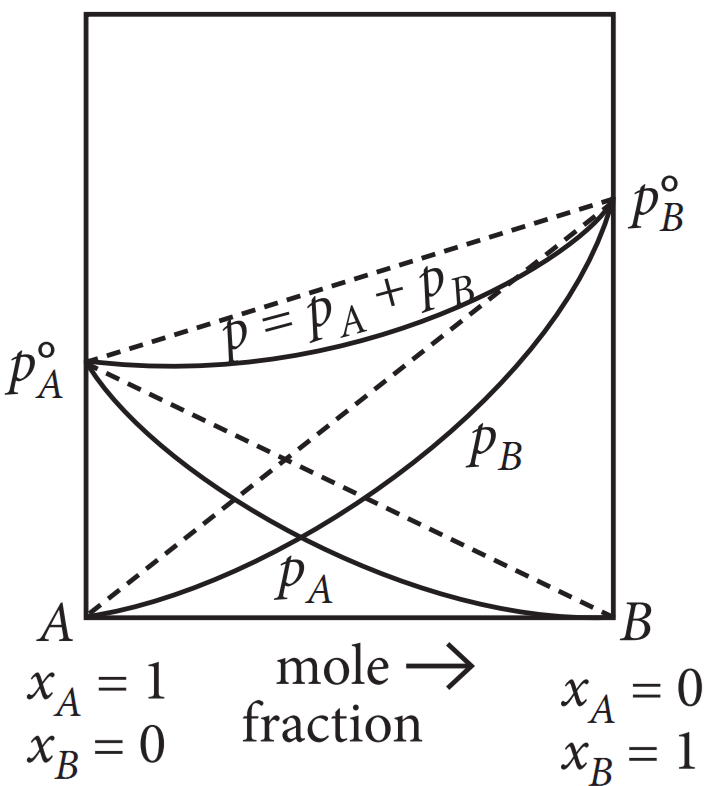
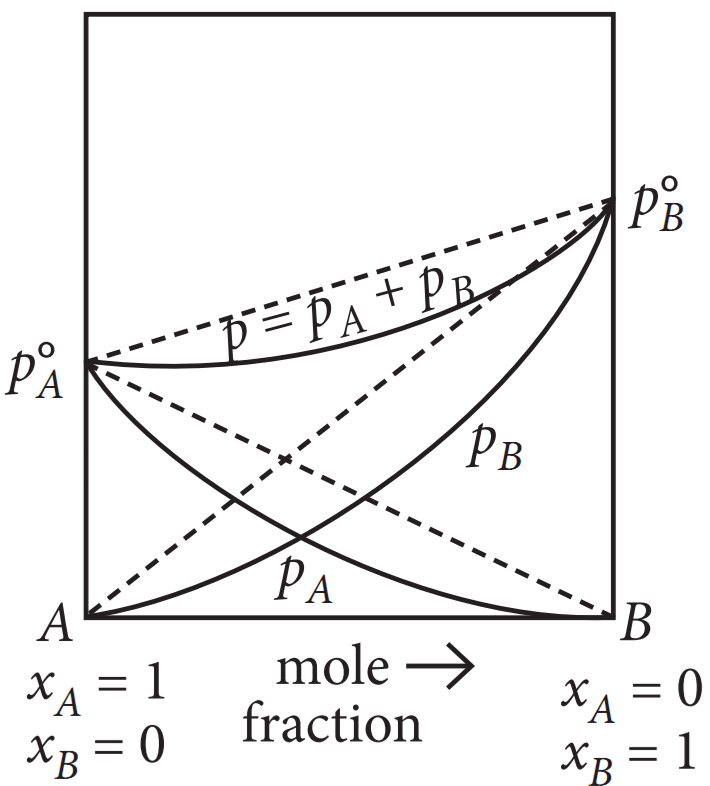
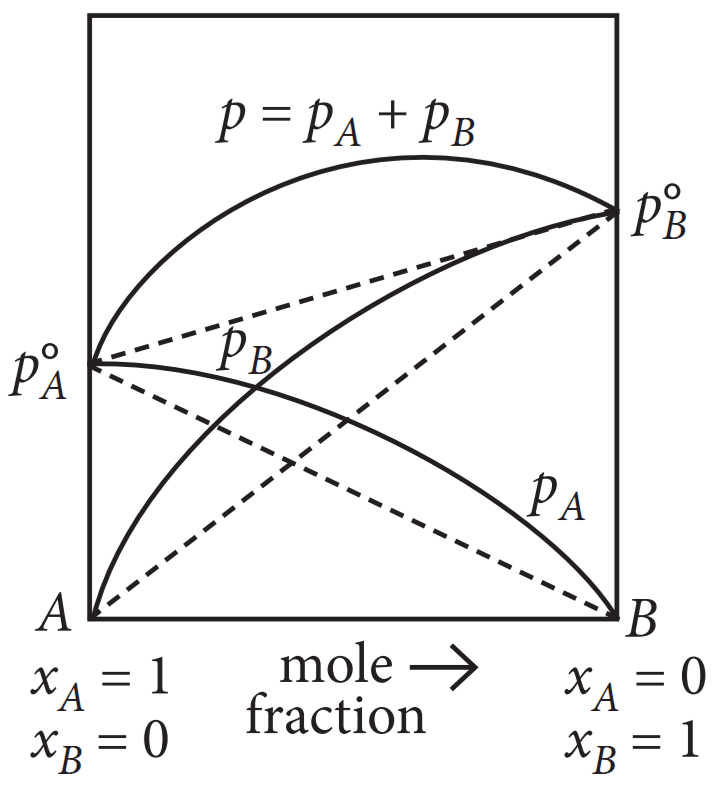
  1. For water and nitric acid mixture, which of the given graph is correct?
  1.  
  1.  
  1. Both of these
  2. None of these
  1. Water-HCI mixture.
  1. Shows positive deviations.
  2. Forms minimum boiling azeotrope.
  3. Shows negative deviations.
  4. Forms maximum boiling azeotrope.
  1. I and II
  2. I and III
  3. I and IV
  4. III and IV
Answer
  1. (d) I and Iv
Explanation:

II represents negative deviations and III represents positive deviations.
  1. (a) Acetone and aniline
Explanation:

Acetone and aniline mixture represents negative deviations from Raoult's law, hence for this mixture,

$\Delta\text{H}_{\text{mix}}$ and $\Delta\text{V}_{\text{mix}}$ is negative.
  1. (b) $\text{P}_\text{A}<\text{P}\mathring{\text{A}}\ \text{x}_\text{A}$ and $\text{P}_\text{B}<\text{P}\mathring{\text{B}}\ \text{x}_\text{B}$
Explanation:

For positive deviations $\text{P}_\text{A}<\text{P}\mathring{\text{A}}\ \text{x}_\text{A}$ and $\text{P}_\text{B}<\text{P}\mathring{\text{B}}\ \text{x}_\text{B}$
  1. (b)
Explanation:

Water and nitric acid mixture shows negative deviations from Raoult's law, hence

$\text{P}_\text{A}<\text{P}\mathring{\text{A}}\ \text{x}_\text{A}$ and $\text{P}_\text{B}<\text{P}\mathring{\text{B}}\ \text{x}_\text{B}$
  1. (d) III and IV
Explanation:

Water-HCI mixture shows negative deviations from Raoult's law and solutions showing negative deviations from ideal behaviour form maximum boiling azeotrope.
View full question & answer
Question 114 Marks
Read the passage given below and answer the following questions
Few colligative properties are:
  1. Relative lowering of vapour pressure: depends only on molar concentration of solute (mole fraction) and independent of its nature.
  2. Depression in freezing point: it is proportional to the molal concentration of solution.
  3. Elevation of boiling point: it is proportional to the molal concentration of solute.
  4. Osmotic pressure: it is proportional to the molar concentration of solute
A solution of glucose is prepared with $0.052$ g at glucose in $80.2$ g of water. $\left(\mathrm{KJ}=1.86 \mathrm{~K} \mathrm{~kg} \mathrm{~mol}^{-1}\right.$ and $\left.\mathrm{K}_{\mathrm{b}}=5.2 \mathrm{~K} \mathrm{~kg} \mathrm{~mol}^{-1}\right)$ The following questions are multiple choice questions. Choose the most appropriate answer:
  1. Molality of the given solution is.
  1. $0.0052m$
  2. $0.0036m$
  3. $0.0006m$
  4. $1.29m$
  1. Boiling point for the solution will be.
  1. $373.05K$
  2. $373.15K$
  3. $373.02K$
  4. $373.02K$
  1. The depression in freezing point of solution will be.
  1. $0.0187K$
  2. $0.035K$
  3. $0.082K$
  4. $0.067K$
  1. Mole fraction of glucose in the given solution is.
  1. $6.28 \times 10^{-5}$
  2. $6.28 \times 10^{-4}$
  3. $0.00625$
  4. $0.00028$
  1. If same amount of sucrose $(C_{12} H_{22} O_{11})$ is taken instead of glucose, then.
  1. Elevation in boiling point will be higher.
  2. Depression in freezing point will be higher.
  3. Depression in freezing point will be lower.
  4. Both $(a)$ and $(b).$
Answer
  1. (b) $0.0036m$
Explanation:

$\text{m}=\frac{0.052}{180}\times\frac{1000}{80.2}=0.0036$
  1. (c) $373.02K$
Explanation:

$\Delta\text{T}_\text{b}=\text{k}_\text{b}\times\text{m}=5.2\times0.0036=0.0187\ \text{K}$

$T_b = 373 + 0.0187 = 373.0187 K  \approx  373.02 K$
  1. (d) $0.067 K$
Explanation:

$\Delta\text{T}_\text{f}=\text{k}_\text{f}\times\text{m}=1.86\times0.0036=0.067\ \text{K}$
  1. (a) $6.28 \times 10^{-5}$​​​​​​​
Explanation:

Moles of water $\frac{80.2}{18}=4.455$

Mole fraction of glucose $=\frac{0.00028}{4.45+0.00028}=6.28\times10^{-5}$'
  1. (c) Depression in freezing point will be lower.
Explanation:

Depression in freezing point or elevation in boiling point is proportional to molarity, which is proportional to number of moles. For same amount, higher the molar mass of solute, lower will be number of moles. Hence, lower will be the colligative property.
View full question & answer