Questions

2 Marks Questions

Take a timed test

62 questions · 5 auto-graded MCQ + 57 self-marked written.

Question 12 Marks
Describe the following:
  1. Tyndall effect.
  2. Shape-selective catalysis.
Answer
Tyndall Effect:- The scattering of light by the colloidal particles present in a colloidal sol is called Tyndall effect.
Shape Selective Catalysis:- The catalytic reaction that depends upon the pore structure of the catalyst and the size of the reactant and product molecules is called shape-selective catalysis.
View full question & answer
Question 22 Marks
What is meant by coagulation of a colloidal solution? Name any method by which coagulation of lyophobic sols can be carried out.
Answer
Coagulation is a process of aggregating together the colloidal particles so as to change them into large particles which ultimately settle as a precipitate. By electrophoresis, coagulation of lyophobic Sols can be carried out.
View full question & answer
Question 32 Marks
What are colligative properties? Write the colligative property which is used to find the molecular mass of macromolecules.
Answer
Properties that depend on the number of solute particles irrespective of their nature relative to the total number of particles present in the solution.
Osmotic Pressure.
View full question & answer
Question 42 Marks
Write the principles of the following methods:
  1. Froth floatation method.
  2. Electrolyticrefining.
Answer
  1. Froth floatation method: This is based upon the preferential wetting of mineral/ore particles by oil while the gangue particles by water.
  2. Electrolytic refining: Is based on the principle of deposition of pure metal on cathode.
View full question & answer
Question 52 Marks
Write the dispersed phase and dispersion medium of the following colloidal systems:
  1. Smoke.
  2. Milk.
Answer
  Dispersed phase Dispersion Medium
  1. Smoke
Solid Gas
  1. Milk
Liquid Liquid
View full question & answer
Question 62 Marks
What are lyophilic and lyophobic colloids? Which of these sols can be easily coagulated on the addition of small amounts of electrolytes?
Answer
Lyophilic sols are solvent attracting sols whereas Lyophobic sols are Solvent repelling sols Lyophobic sols can be easily coagulated.
View full question & answer
Question 72 Marks
  1. which solution is used for the leaching of silver metal in the presence of air in the metallurgy of silver?
  2. Out of C and CO, which is a better reducing agent at the lower temperature range in the blast furnace to extract iron from the oxide ore?
Answer
  1. NaCN solution.
  2. CO.
View full question & answer
Question 82 Marks
Write the differences between physisorption and chemisorption with respect to the following:
  1. Specificity.
  2. Temperature dependence.
  3. Reversibility and.
  4. Enthalpy change.
Answer
Physisorption Chemisorption
It is not very specific. It is highly specific.
It is usually takes place at low temperature and decreases with increasing temperature. It takes place at high temperature.
It is reversible. It is irreversible.
Low enthalpy of adsorption. High enthalpy of adsorption.
View full question & answer
Question 92 Marks
Name the two groups into which phenomenon of catalysis can be divided. Give an example of each group with the chemical equation involved.
Answer
The phenomenon of catalysis can be divided into two groups.
  1. Homogeneous catalysis: The process in which reactant and catalyst are in same phase.
e.g. $ \text{2SO}_{2(\text{g})}+\text{O}_{2(\text{g})}\xrightarrow{\text{NO}_{(\text{g})}}\text{2SO}_{3(\text{g})}$
  1. Heterogeneous catalysis: The process in which reactant and product are in different phase.
e.g. $ \text{N}_{2(\text{g})}+\text{3H}_{2(\text{g})}\xrightarrow{\text{Fe}_{(\text{s})}}\text{2NH}_{3(\text{g})}$
View full question & answer
Question 102 Marks
What is meant by coagulation of a colloidal solution? Describe briefly any three methods by which coagulation of lyophobic sols can be carried out.
Answer
The process of settling of colloidal particles is called coagulation or precipitation of the sol.
  1. By Electrophoresis/ The collidal particles move towards oppositely charged electrodes.
  2. By mixing two oppositely charged sols.
  3. By addition of electrolytes/ When excess of an electrolyte is added the colloidal particles are precipitated.
View full question & answer
Question 112 Marks
Explain the cleansing action of soaps.
Answer
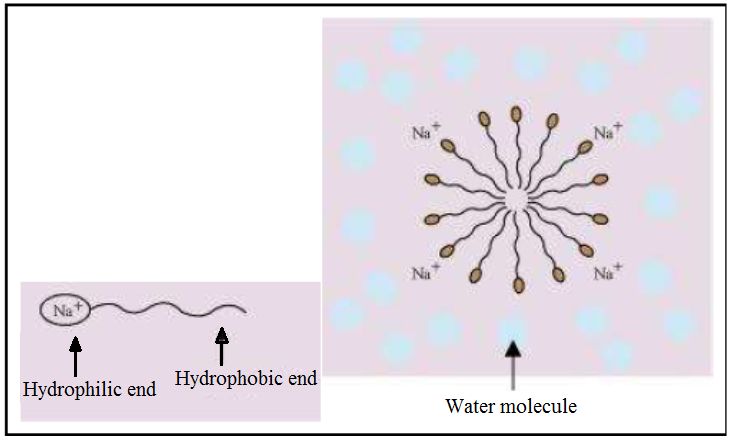
Soap molecules form micelle around the oil droplet or dirt in such a way that hydrophobic part interacts with the oil droplet and hydrophilic part projects out. Micelles can be washed away on rinsing with water. Thus soap helps in emulsification and washing away of oil and fats.
View full question & answer
Question 122 Marks
On the basis of Hardy-Schulze rule explain why the coagulating power of phosphate is higher than chloride.
Answer
Minimum quantity of an electrolyte required to cause precipitation of a sol is called its coagulating value. Greater the charge on flocculating ion and smaller is the amount of electrolyte required for precipitation, higher is the coagulating power of coagulating ion (Hardy-Schulze rule).
View full question & answer
Question 132 Marks
Explain the observations:
Cottrell’s smoke precipitator is fitted at the mouth of the chimney used in factories.
Answer
Cottrell’s smoke precipitator, neutralises the charge on unburnt carbon particles, coming out of chimney and they get precipitated and settle down at the floor of the chamber.
View full question & answer
Question 142 Marks
How does a delta form at the meeting place of sea and river water?
Answer
River water is a colloidal solution of clay and sea water contains lot of electrolytes. The point at which river and sea meet is the site for coagulation. Deposition of coagulated clay results in delta formation.
View full question & answer
Question 152 Marks
What are micelles? Give an example of a micellers system.
Answer
Micelle formation is done by substances such as soaps and detergents when dissolved in water. The molecules of such substances contain a hydrophobic and a hydrophilic part. When present in water, these substances arrange themselves in spherical structures in such a manner that their hydrophobic parts are present towards the centre, while the hydrophilic parts are pointing towards the outside (as shown in the given figure). This is known as micelle formation.
View full question & answer
Question 162 Marks
What do you understand by activation of adsorbent? How is it achieved?
Answer
Activation of adsorbent implies increasing its adsorbing power. It is achieved by the following ways:
  1. Activation of the adsorbent is carried out by mechanical rubbing or by subjecting it to some chemical reaction.
  2. Some adsorbents are activated by strong heating in contact with super heated steam. For example, charcoal which is commonly employed in adsorption of gases, is activated by subjecting it to the action of superheated steam. This will remove the molecules of gases like $CH_4,$ $C_2H_6$ (hydrocarbons) that are occupying these pores.
  3. To increase the adsorbing power, the adsorbent is sub divided into small fine pieces. By doing so, the surface area increases and so is the adsorbing power.
View full question & answer
Question 172 Marks
Explain what is observed when:
Silver nitrate solution is added to potassium iodide solution.
Answer
If silver nitrate solution is added to potassium iodide solution, the precipitated silver iodide adsorbs iodide ions from the dispersion medium and negatively charged colloidal solution results.
$\text{AgI}\ \ \ \ \ \ \ \ + \ \ \ \ \ \ \text{I}^-\ \ \ \ \ \ \ \ \ \xrightarrow {\ \ \ \ \ \ \ \ \\ }\ \ \ \ \ \ \text{AgI}/\text{I}\\\ \ \ \ \ \ \ \ \ \ \ \ {(\text{From dispersion }}\ \ \ \ \ \ \ \ {\text{Negatively charged }}\\ \ \ \ \ \ \ \ \ \ \ \ \ \ \ \ \ \ \ \text{medium)}\ \ \ \ \ \ \ \ \ \ \ \ \ \ \ \ \ \ \ \ \ \ \ \ \ \ \ \ \text{sol}$
View full question & answer
Question 182 Marks
Why is it important to have clean surface in surface studies?
Answer
Clean surface of adsorbent is suitable for adsorption because if surface is covered with gases of air, it will not be available for adsorption.
View full question & answer
Question 192 Marks
Why do physisorption and chemisorption behave differently with rise in temperature?
Answer
Physisorption involves weak van der Waals forces which become weaker with rise of temperature. The chemisorption involves formation of chemical bonds involving activation energy. With increase of temperature, we reach the activated complex faster. Therefore, chemisorption process becomes faster.
View full question & answer
Question 202 Marks
What happens when electric field is applied to colloidal solution?
Answer
When electric field is applied to colloidal solution then charged colloidal particles move towards oppositely charged electrodes. This phenomenon is called electrophoresis.
View full question & answer
Question 212 Marks
A colloid is formed by adding $FeCl_3$ in excess of hot water. What will happen if excess sodium chloride is added to this colloid?
Answer
A positively charged colloidal solution of hydrated ferric oxide is formed. On adding sodium chloride, negatively charged chloride ions neutralise the positive charge of the colloidal solution. Coagulation of the sol takes place.
View full question & answer
MCQ 222 Marks
Note: In the following questions a statement of assertion followed by a statement of reason is given. Choose the correct answer out of the following choices.
Assertion: Colloidal solutions show colligative properties.
Reason: Colloidal particles are large in size.
  • A
    Assertion and reason both are correct and the reason is correct explanation of assertion.
  • Assertion and reason both are correct but reason does not explain assertion.
  • C
    Assertion is correct but reason is incorrect.
  • D
    Both assertion and reason are incorrect.
Answer
Correct option: B.
Assertion and reason both are correct but reason does not explain assertion.
Colloidal particles are large in size and hence the number of particle is lesser than the true solution. The lesser number of particles causes lower colligative properties.
View full question & answer
Question 232 Marks
Why is desorption important for a substance to act as good catalyst?
Answer
After the reaction is over between adsorbed reactants, the process of desorption is important to remove products and further create space for the other reactant molecules to approach the surface and react.
View full question & answer
Question 242 Marks
What form Freundlich adsorption equation will take at high pressure?
Answer
Freundlich Adsorption Isotherm, $\frac{\text{x}}{\text{m}}=\text{kp}^\frac{1}{\text{n}}$At high pressure (beyond saturation pressure), $\frac{1}{\text{n}}=0\ \text{and}\ \frac{\text{x}}{\text{m}}=$constant i.e., the adsorption is independent of pressure. So,
$\frac{\text{x}}{\text{m}}=\text{kp}^0\ \ \text{or}\ \ \frac{\text{x}}{\text{m}}=\text{k}.$
View full question & answer
Question 252 Marks
What is demulsification? Name two demulsifiers.
Answer
The process of decomposition of an emulsion into its constituent liquids is called demulsification. Examples of demulsifiers are surfactants, ethylene oxide, etc.
View full question & answer
Question 262 Marks
Explain what is observed when:
The size of the finest gold sol particles increases in the gold sol.
Answer
The colour of the colloidal solution depends on the wavelength of the light scattered by the colloidal particles which in turn depends on size and nature of the colloidal particle. Finest gold sol is red in colour, as the size of the particle increases, it appears purple, then blue and finally golden.
View full question & answer
Question 272 Marks
What happens when a freshly precipitated $Fe(OH)_3$ is shaken with a little amount of dilute solution of $FeCl_3?$
Answer
It is converted into colloidal state by preferential adsorption of $Fe^{3+}$ ions.$\text{Fe}(\text{OH})_3+\text{FeCl}_3\rightarrow[\text{Fe}(\text{OH})_3]\ \ \text{Fe}^{3-}+3\text{Cl}\\ \ \ \ \ \ \ \ \ \ \ \ \ \ \ \ \ \ \ \ \ \ \ \ \ \ \ \ \ \ \ \ \ \ \ ^\text{Reddish brown}\\ \ \ \ \ \ \ \ \ \ \ \ \ \ \ \ \ \ \ \ \ \ \ \ \ \ \ \ \ \ \ \ \ \ \ ^\text{coloured colloid}$
View full question & answer
Question 282 Marks
How does the precipitation of colloidal smoke take place in Cottrell precipitator?
Answer
In Cottrell precipitator, charged smoke particles are passed through a chamber containing plates with charge opposite to the smoke particles. Smoke particles lose their charge on the plates and get precipitated.
View full question & answer
Question 292 Marks
Give reasons:
Physisorption decrease with increase of temperature.
Answer
As physisorption is an exothermic process:
$\text{Solid}\ \ \ \ +\ \ \ \ \text{Gas}\ \ \ \ \ \rightarrow\ \ \ \ \text{Gas }/\text{Solid}\ \ \ \ +\ \ \ \ \text{Heat}\\^\text{(Adsorbent)}\ \ \ \ \ ^\text{(Absorbate)}\ \ \ \ \ ^\text{(Gas absorbed on solid)}$
According to Le Chatelier’s principle, if we increase the temperature, equilibrium will shift in the backward direction, i.e., gas is released from the adsorbed surface.
View full question & answer
Question 302 Marks
Why does leather get hardened after tanning?
Answer
Animal skin is colloidal, in nature and carries positive charge. Tannin is a negatively charged colloidal solution. When leather is soaked in tannin, mutual coagulation of the two takes place and leather gets hardened.
View full question & answer
MCQ 312 Marks
Note: In the following questions a statement of assertion followed by a statement of reason is given. Choose the correct answer out of the following choices.
Assertion: An ordinary filter paper impregnated with collodion solution stops the flow of colloidal particles.
Reason: Pore size of the filter paper becomes more than the size of colloidal particle.
  • A
    Assertion and reason both are correct and the reason is correct explanation of assertion.
  • B
    Assertion and reason both are correct but reason does not explain assertion.
  • Assertion is correct but reason is incorrect.
  • D
    Both assertion and reason are incorrect.
Answer
Correct option: C.
Assertion is correct but reason is incorrect.
Colloidal particles can pass through ordinary filter paper because the pores are too large. However, the pores of filter paper can be reduced in size by impregnating with collodion solution to stop the flow of colloidal particles.
View full question & answer
Question 322 Marks
What is the role of diffusion in heterogenous catalysis?
Answer
The gas molecules diffuse onto the surface of the catalyst and get adsorbed. After the chemical change, the products formed diffuse away from the surface of the catalyst setting the surface free for other reactant molecules to adsorb on the surface and give the product.
View full question & answer
Question 332 Marks
What are the factors which influence the adsorption of a gas on a solid?
Answer
The factors which influence the adsorption of a gas on a solid are:
  1. The nature of a gas adsorbate and nature of solid adsorbent.
  2. Surface area of adsorbent.
  3. Pressure of gas.
  4. Temperature.
  5. Activation of adsorbent.
View full question & answer
Question 342 Marks
Explain the observations:
Sun looks red at the time of setting.
Answer
At the time of setting, the sun is at horizon. The light emitted by the sun has to travel a relatively longer distance through the atmosphere. As a result, blue part of light is scattered away by the particulate in the atmosphere causing red part to be visible.
View full question & answer
Question 352 Marks
Based on type of particles of dispersed phase, give one example each of associated colloid and multimolecular colloid.
Answer
S.No.
Type of Colloid
Example
(i)
Associated colloid
Surface active agents such as soap (CMC is 10–4 to 10–3 mol L–1) and synthetic detergents.
(ii)
Multimolecular colloid
Sulphur sol, gold sol.
View full question & answer
Question 362 Marks
Explain what is observed when:
Two oppositely charged sols are mixed in almost equal proportions.
Answer
Two oppositely charged sols when mixed in almost equal proportions, neutralise their charges and get partially or completely precipitated. Such type of coagulation is called mutual coagulation.
View full question & answer
Question 372 Marks

Physical and chemical adsorption respond differently with a rise in temperature. What is this difference and why is it so?
Answer
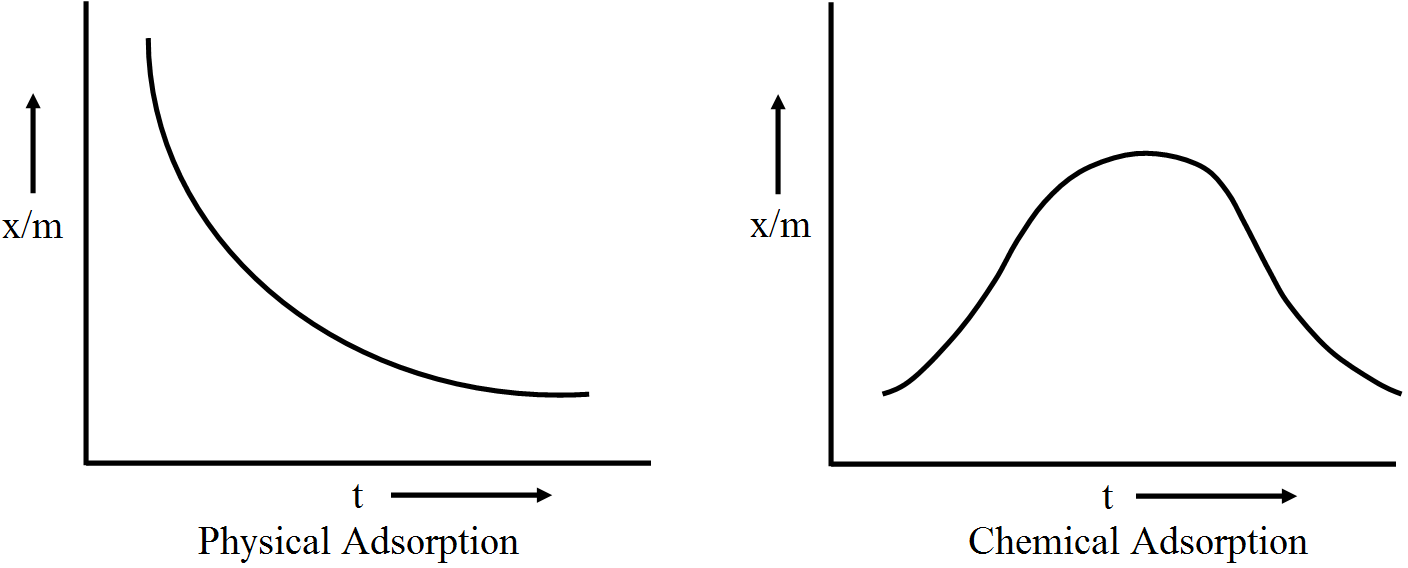
Adsorption isobar for physical adsorption shows that the extent of adsorption decreases with the increase in temperature. The adsorption isobar of chemical adsorption shows that the extent of adsorption first increases and then decreases with the increase in temperature. The initial unexpected increase in the extent of adsorption with temperature is due to the fact that the heat supplied acts as activation energy required for chemical adsorption which is much more than that of physical adsorption.
View full question & answer
Question 382 Marks
Write an important characteristic of lyophilic sols.
Answer
Important characteristics of lyophilic sols:
  1. They are reversible in nature, i.e., once the dispersed phase is separated from dispersion medium the sol can be made again by simply remixing with dispersion medium.
  2. They are quite stable and are not easily coagulated.
View full question & answer
Question 392 Marks
Why do we add alum to purify water?
Answer
River water carries negatively charged colloidal particles of clay and sand; alum $(K_2SO_4Al_2(SO_4)_324H_2O)$ is added to river water to coagulate the colloidal particles of clay and sand. Thus, alum helps to purify water.
View full question & answer
Question 402 Marks
How do emulsifying agents stabilise the emulsion?
Answer
The emulsifying agent forms an interfacial layer between suspended particles and the dispersion medium thereby stabilising the emulsion.
View full question & answer
Question 412 Marks
Give four uses of emulsions.
Answer
Four uses of emulsions:
  1. Cleansing action of soaps is based on the formation of emulsions.
  2. Digestion of fats in intestines takes place by the process of emulsification.
  3. Antiseptics and disinfectants when added to water form emulsions.
  4. The process of emulsification is used to make medicines.
View full question & answer
Question 422 Marks
What modification can you suggest in the Hardy Schulze law?
Answer
Hardy-Schulze law states that 'the greater the valence of the flocculating ion added, the greater is its power to cause precipitation.'
This law takes into consideration only the charge carried by an ion, not its size. The smaller the size of an ion, the more will be its polarising power. Thus, Hardy-Schulze law can be modified in terms of the polarising power of the flocculating ion. Thus, the modified Hardy Schulze law can be stated as 'the greater the polarizing power of the flocculating ion added, the greater is its power to cause precipitation.'
View full question & answer
Question 432 Marks
Why is chemisorption referred to as activated adsorption?
Answer
Chemisorption involves formation of bond between gaseous molecules/ atoms and the solid surface for which high activation energy is required. Thus it is referred to as activated adsorption.
View full question & answer
Question 442 Marks
What causes brownian motion in colloidal dispersion?
Answer
Unbalanced bombardment of the particles of dispersed phase by molecules of dispersion medium causes brownian motion. This stabilises the sol.
View full question & answer
MCQ 452 Marks
Note: In the following questions a statement of assertion followed by a statement of reason is given. Choose the correct answer out of the following choices.
Assertion: Coagulation power of $Al^{3+}$ is more than $Na^+.$
Reason: Greater the valency of the flocculating ion added, greater is its power to cause precipitation $($Hardy Schulze rule$).$
  • Assertion and reason both are correct and the reason is correct explanation of assertion.
     
  • B
    Assertion and reason both are correct but reason does not explain assertion.
     
  • C
    Assertion is correct but reason is incorrect.
     
  • D
    Both assertion and reason are incorrect.
Answer
Correct option: A.
Assertion and reason both are correct and the reason is correct explanation of assertion.
 
According to Hardy$-$Schulze law, the greater is the valency of the coagulating ion, the more is the power to coagulate the colloidal solution. Thus, coagulation power of $Al^{3+}$ is greater than that of $Na^+.$
View full question & answer
Question 462 Marks
Give an example where physisorption changes to chemisorption with rise in temperature. Explain the reason for change.
Answer
The process of physisorption, for example that of $H_2$ on finely divided nickel, involves weak van der Waal's forces. With increase in temperature, hydrogen molecules dissociate into hydrogen atoms which are held on the surface by chemisorption.
View full question & answer
Question 472 Marks
What happens when dialysis is prolonged?
Answer
Due to excessive dialysis, traces of electrolyte which stabilises the colloids is removed completely, making the colloid unstable. As a result, coagulation takes place.
View full question & answer
Question 482 Marks
In which of the following does adsorption take place and why?
  1. Silica gel placed in the atmosphere saturated with water.
  2. Anhydrous $CaCl_2$ placed in the atmosphere saturated with water.
Answer
  1. In silica gel, adsorption takes place due to attraction and retention of water molecules on the surface.
  2. Anhydrous $CaCl_2$ undergoes absorption because it combines with water molecules to form hydrated calcium chloride,$ CaCl_2.2H_2O.$
View full question & answer
Question 492 Marks
State Hardy–Schulze rule.
Answer
Hardy and Schulze rules:
  1. The ions carrying charge opposite to that of sol particles are effective in bringing about the coagulation of sol.
  2. Coagulating power of the electrolyte is directly proportional to the fourth power of the valency of the ions causing coagulation.
View full question & answer
Question 502 Marks
Why are lyophilic colloidal sols more stable than lyophobic colloidal sols?
Answer
This is because the stability of lyophobic sol is only due to the presence of charge on the colloidal particles. On the other hand, the stability of lyophilic sol is due to charge on the colloidal particles as well as solvation of colloidal particles.
View full question & answer
Question 512 Marks
Which one of the following electrolytes is the most effective for the coagulation of $Fe(OH)_3$ sol and why$?NaCl,\ Na_2SO_4,\ Na_3PO_4$
Answer
$Fe(OH)_3$ is a positively charged sol. According to Hardy–Schulze rule, greater the charge on the oppositely charged ion of the electrolyte added, more effective it is in bringing about the coagulation. Hence, $Na_3PO_4$ $($containing $PO4^{3–}$ ions$)$ is the most effective.
View full question & answer
Question 522 Marks
What are enzymes? Write in brief the mechanism of enzyme catalysis.
Answer


Enzymes are basically protein molecules of high molecular masses. These form colloidal solutions when dissolved in water. These are complex, nitrogenous organic compounds produced by living plants and animals. Enzymes are also called 'biochemical catalysts'.
Mechanism of enzyme catalysis:
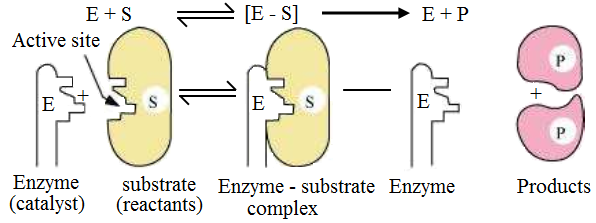
On the surface of the enzymes, various cavities are present with characteristic shapes. These cavities possess active groups such as -NH2, -COOH etc. The reactant molecules having a complementary shape fit into the cavities just like a key fits into a lock. This leads to the formation of an activated complex. This complex then decomposes to give the product.
Hence,
Step 1: E + S → ES+
(Activated complex)
Step 2: ES → E + P
View full question & answer
Question 532 Marks
Explain the observations:
Physical adsorption is multilayered while chemical adsorption is monolayered.
Answer
Physical adsorption involves van der Waals’ forces, so any number of layers may be formed one over the other on the surface of the adsorbent. Chemical adsorption takes place as a result of the reaction between adsorbent and adsorbate. When the surface of adsorbent is covered with one layer, no further reaction can take place.
View full question & answer
Question 542 Marks
Action of soap is due to emulsification and micelle formation. Comment
Answer
The cleansing action of soap is due to emulsification and micelle formation. Soaps are basically sodium and potassium salts of long chain fatty acids, $R -COO^-Na+ .$ The end of the molecule to which the sodium is attached is polar in nature, while the alkyl-end is non-polar. Thus, a soap molecule contains a hydrophilic (polar) and a hydrophobic (non-polar) part. When soap is added to water containing dirt, the soap molecules surround the dirt particles in such a manner that their hydrophobic parts get attached to the dirt molecule and the hydrophilic parts point away from the dirt molecule. This is known as micelle formation.b Thus, we can say that the polar group dissolves in water while the non-polar group dissolves in the dirt particle. Now, as these micelles are negatively charged, they do not coalesce and a stable emulsion is formed.
View full question & answer
Question 552 Marks
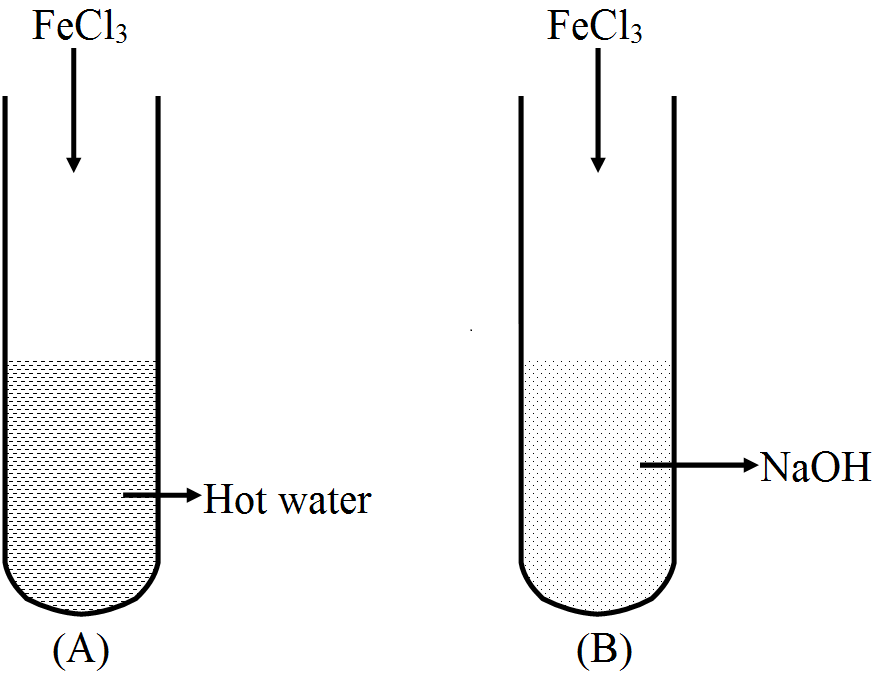
A colloidal solution of ferric oxide is prepared by two different methods as shown below.
  1. What is the charge on colloidal particles in two test tubes $(A)$ and $(B)?$
  2. Give reasons for the origin of charge.
Answer
  1. Colloidal particles of test tube $(A)$ are positively charged whereas colloidal particles of test tube $(B)$ are negatively charged.
  2. In test tube $(A),$ $Fe^{3+}$ is adsorbed on the precipitate $Fe_2O_3.xH_2O [$or $Fe_2O_3.xH_2O/ Fe^{3+}$ is formed$].$
In test tube $(B),\ OH^–$ ion is adsorbed on the precipitate $Fe_2O3 .\ xH_2O [$or $Fe_2O_3.xH_2O/ OH^–$ is formed$].$
View full question & answer
Question 562 Marks
What is the role of activated charcoal in gas mask used in coal mines?
Answer
Role of activated charcoal can be explained on the basis of adsorption. In gas mask, charcoal adsorbs the pollutant gases like $SO_2,\ NO_2,\ CH_4,\ CO_2$ etc. present in atmosphere due to heavy traffic.
View full question & answer
Question 572 Marks
What do you mean by activity and selectivity of catalysts?
Answer
  1. Activity of a catalyst:
The activity of a catalyst is its ability to increase the rate of a particular reaction. Chemisorption is the main factor in deciding the activity of a catalyst. The adsorption of reactants on the catalyst surface should be neither too strong nor too weak. It should just be strong enough to make the catalyst active.
  1. Selectivity of the catalyst:
The ability of the catalyst to direct a reaction to yield a particular product is referred to as the selectivity of the catalyst. For example, by using different catalysts, we can get different products for the reaction between $H_2$ and $CO.$​​​​​​​
  1. $\text{CO}_{(\text{g})}+3\text{H}_{2(\text{g})}\xrightarrow{\ \ \ \ \ \ \ \ \ \ \text{Ni}\ \ \ \ \ \ \ \ }\text{CH}_{4 \text{g}}+\text{H}_2\text{O}_{(\text{g})}$
  2. $\text{CO}_{(\text{g})}+2\text{H}_{2(\text{g})}\xrightarrow{\ \ \ \ \ \ \ \ \ \ \text{Cu/Zno}-\text{Cro}_3\ \ \ \ \ \ \ \ }\text{CH}_{3 }\text{OH}{(\text{g})}$
  3. $\text{CO}_{(\text{g})}+\text{H}_{2(\text{g})}\xrightarrow{\ \ \ \ \ \ \ \ \ \ \text{Cu}\ \ \ \ \ \ \ \ }\text{HCHO}_{(\text{g})}$
View full question & answer
Question 582 Marks
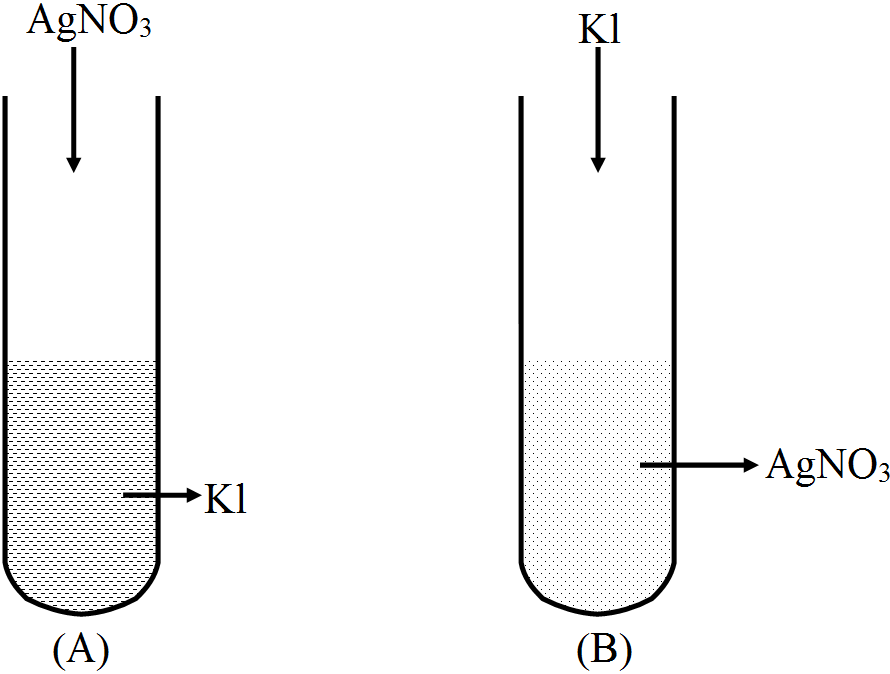
A colloidal solution of AgI is prepared by two different methods as shown in figure below.
  1. What is the charge of AgI colloidal particles in the two test tubes $(A)$ and $(B)?$
  2. Give reasons for the origin of charge.
Answer
  1. Test tube $(A)$ has negative charge whereas test tube $(B)$ has positive charge on the colloidal particles.
  2. In test tube $(A), I^–$ is adsorbed on precipitate $AgI$ $[$or $AgI/I^–$ is formed] and in test tube $(B), Ag^+$ is adsorbed on precipitate $AgI$ $[$or $AgI/ Ag^+$ is formed$].$
View full question & answer
Question 592 Marks
What is the role of adsorption in froth floatation process used especially for concentration of sulphide ores?
Answer
Sulphide ores are preferentially wetted by oils while the gangue is preferentially wetted by water .The ore particles get adsorbed on oil droplets and come to the surface where they can be collected as froth gangue is wetted by water and gets settled down. Eg. It is done for Pbs (Phosphate-buffered saline) ores.
Here, in this froth floatation process, low grade sulphide ores are concentrated by separating them from earthly and silicious (containing silicon) matter. Here, pine oil is used as the frothing agent. The sulphide ore is shaken with pine oil and water, the ore particles are adsorbed on froth that floats and the gangue particles settle down as discussed earlier.
Thus, role of adsorption in froth floatation process can be understood as following processes.
  1. Adsorption of pine oil on sulphide ore particles.
  2. Formation of emulsion takes place.
  3. Froth is formed along with ore particles.
  4. As sulphide are extracted using froth floatation method therefore, only sulphide ore particles will show these type of adsorbing tendency. It is showing shape selective catalysis.
View full question & answer
Question 602 Marks
What type of solutions are formed on dissolving different concentrations of soap in water?
Answer
At lower concentration soap forms a normal electrolytic solution with water. After a certain concentration called critical micelle concentration, colloidal solution is formed.
View full question & answer
MCQ 612 Marks
Note: In the following questions a statement of assertion followed by a statement of reason is given. Choose the correct answer out of the following choices.
Assertion: Detergents with low $\text{CMC}$ are more economical to use.
Reason: Cleansing action of detergents involves the formation of micelles. These are formed when the concentration of detergents becomes equal to $\text{CMC}.$
  • Assertion and reason both are correct and the reason is correct explanation of assertion.
  • B
    Assertion and reason both are correct but reason does not explain assertion.
  • C
    Assertion is correct but reason is incorrect.
  • D
    Both assertion and reason are incorrect.
Answer
Correct option: A.
Assertion and reason both are correct and the reason is correct explanation of assertion.
Detergents with low $\text{CMC}$ are more economical to use as they involves the formation of micelle which is used for cleaning of oil and dirt from our cloth. Micelle formation takes place when the concentration of detergent becomes equal to $\text{CMC}.$
View full question & answer
MCQ 622 Marks
Note: In the following questions a statement of assertion followed by a statement of reason is given. Choose the correct answer out of the following choices.
Assertion: Colloidal solutions do not show brownian motion.
Reason: Brownian motion is responsible for stability of sols.
  • A
    Assertion and reason both are correct and the reason is correct explanation of assertion.
  • B
    Assertion and reason both are correct but reason does not explain assertion.
  • C
    Assertion is correct but reason is incorrect.
  • Assertion is incorrect but reason is correct.
Answer
Correct option: D.
Assertion is incorrect but reason is correct.
Colloidal particle shows Brownian movement. The Brownian movement has a stirring effect which does not permit the particles to settle and thus, is responsible for the stability of sols.
View full question & answer