Questions

Assertion (A) & Reason (B) MCQ

Take a timed test

15 questions · 3 auto-graded MCQ + 12 self-marked written.

Question 11 Mark
For two statements are given-one labelled Assertion (A) and the other labelled Reason (R). Select the correct answer to these questions from the codes (a), (b), (c) and (d) as given below.
  1. Both A and R are true and R is the correct explanation of A.
  2. Both A and R are true but R is not the correct explanation of A.
  3. A is true but R is false.
  4. A is false and R is also false.
Assertion: An alternating current shows magnetic effect.
Reason: Magnitude of alternating current varies with time.
Answer
  1. Both A and R are true but R is not the correct explanation of A.
Explanation:

Like direct current, an alternating current also produces magnetic field. But the magnitude and direction of the field goes on changing continuously with lime.
View full question & answer
MCQ 21 Mark
For two statements are given-one labelled Assertion $(A)$ and the other labelled Reason $(R)$. Select the correct answer to these questions from the codes $(a), (b), (c)$ and $(d)$ as given below.
Assertion: A bulb connected in series with a solenoid is connected to $A.C.$ source. If a soft iron core is introduced in the solenoid, the bulb will glow brighter.
Reason: On introducing soft iron core in the solenoid, the inductance decreases.
  • A
    Both $A$ and $R$ are true and $R$ is the correct explanation of $A$.
  • B
    Both $A$ and $R$ are true but $R$ is not the correct explanation of $A.$
  • C
    $A$ is true but $R$ is false.
  • $A $ is false and $R$ is also false.
Answer
Correct option: D.
$A $ is false and $R$ is also false.
On introducing soft iron core, the bulb will glow dimmer.
This is because on introducing soft iron core in the solenoid, its inductance $L$ increases, the inductive reactance, $X_L= W_L$ increases and hence the current through the bulb decreases.
View full question & answer
Question 31 Mark
For two statements are given-one labelled Assertion (A) and the other labelled Reason (R). Select the correct answer to these questions from the codes (a), (b), (c) and (d) as given below.
  1. Both A and R are true and R is the correct explanation of A.
  2. Both A and R are true but R is not the correct explanation of A.
  3. A is true but R is false.
  4. A is false and R is also false.
Assertion: The alternating current lags behind the e.m.f. by a phase angle of $\frac{\pi}{2}$ when A.C. flows through an inductor.
Reason: The inductive reactance increases as the frequency of A. C. source decreases.
Answer
  1. A is true but R is false.
Explanation:

When pure inductor is connected to source of an alternating emf, then instantaneous value of alternating emf is given by $\text{E}=\text{E}_0\sin\omega\text{t},$ and corresponding alternating current is given by $\text{I}=\text{I}_0\sin(\omega\text{t}-\frac{\pi}{2}).$ From these two equations, it follows that alternating current lags behind e.m.f. by a phase angle of $\frac{\pi}{2}.$ The inductive reactance, so when frequency increases correspondingly inductive reactance also increases.
View full question & answer
Question 41 Mark
For two statements are given-one labelled Assertion (A) and the other labelled Reason (R). Select the correct answer to these questions from the codes (a), (b), (c) and (d) as given below.
  1. Both A and R are true and R is the correct explanation of A.
  2. Both A and R are true but R is not the correct explanation of A.
  3. A is true but R is false.
  4. A is false and R is also false.
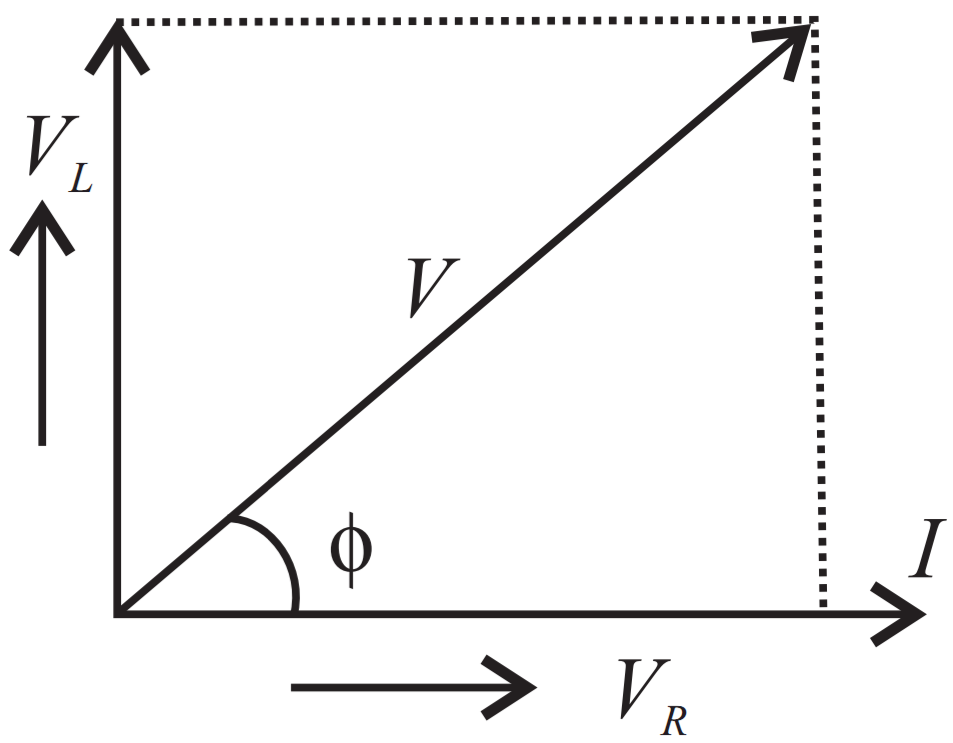
Assertion: An inductance and a resistance are connected in series with an A.C. circuit. ln this circuit the current and the potential difference across the resistance lags behind potential difference across the inductance by an angle $\frac{\pi}{2}.$
Reason: In L-R circuit voltage leads the current by phase angle which depends on the value ofinductance and resistance both.
Answer
  1. Both A and R are true but R is not the correct explanation of A.
Explanation:


As both the inductance and resistance are joined in series, hence current through both will be same. But in case of resistance, both the current and potential vary simultaneously, hence they are in same phase. While in case of an inductance when current is zero, potential difference across it is maximum and when current reaches maximum $\big($at $\omega\text{t}=\frac{\pi}{2}\big),$ potential difference across it becomes zero i.e., potential difference leads the current by $\frac{\pi}{2}$ or current lags behind the potential difference by $\frac{\pi}{2}.$ Phase angle in case of LR circuit is given as $\phi=\tan^{-1}\Big(\frac{\omega\text{L}}{\text{R}}\Big).$
View full question & answer
Question 51 Mark
For two statements are given-one labelled Assertion (A) and the other labelled Reason (R). Select the correct answer to these questions from the codes (a), (b), (c) and (d) as given below.
  1. Both A and R are true and R is the correct explanation of A.
  2. Both A and R are true but R is not the correct explanation of A.
  3. A is true but R is false.
  4. A is false and R is also false.
Assertion: Long distance transmission of A.C. is carried out at extremely high voltage.
Reason: For large distance, voltage has to be large.
Answer
  1. A is true but R is false.
Explanation:

The transmission is done at high voltage due to which current through the wire is reduced. By reduction in current corresponding dissipation of energy is also reduced $\big($as $\text{H}\propto\text{I}^2\text{R}\big).$ If transmission is done at low voltage then we have to use thick wire in order to reduce the dissipation of energy. This increase the cost of transmission lines wires. In order to reduce both energy dissipation and cost of transmission wire, transmission is done at high voltage by using step-up transformers.
View full question & answer
MCQ 61 Mark
For two statements are given$-$one labelled Assertion $(A)$ and the other labelled Reason $(R)$. Select the correct answer to these questions from the codes $(a), (b), (c)$ and $(d)$ as given below.
Assertion: When capacitive reactance is smaller than the inductive reactance in $\text{LCR}$ series circuit, e.m.f. leads the current.
Reason: The phase angle is the angle between the alternating e.m.f. and alternating current of the circuit.
  • A
    Both $A$ and $R$ are true and $R$ is the correct explanation of $A.$
  • Both $A$ and $R$ are true but $R$ is not the correct explanation of $A.$
  • C
    $A$ is true but $R$ is false.
  • D
    $A$ is false and $R$ is also false.
Answer
Correct option: B.
Both $A$ and $R$ are true but $R$ is not the correct explanation of $A.$
The phase angle for the $\text{LCR}$ series circuit is given by $\tan\theta=\frac{\text{X}_\text{L}-\text{X}_\text{C}}{\text{R}}=\frac{\frac{\omega\text{L-1}}{\omega\text{C}}}{\text{R}}.$
Where $X_L, X_C$ are inductive reactance and capacitive reactance respectively.
When $X_L > X_C$ then $\tan\theta$ is positive
i.e. $\theta$ is positive $\big($between $0$ and $\frac{\pi}{2}\big).$ Hence emf leads the current.
View full question & answer
Question 71 Mark
For two statements are given-one labelled Assertion (A) and the other labelled Reason (R). Select the correct answer to these questions from the codes (a), (b), (c) and (d) as given below.
  1. Both A and R are true and R is the correct explanation of A.
  2. Both A and R are true but R is not the correct explanation of A.
  3. A is true but R is false.
  4. A is false and R is also false.
Assertion: We use a thick wire in the secondary coil ofa step down transformer to reduce the production of heat.
Reason: When the plane of the armature is parallel to the line of force of magnetic field, the magnitude of induced e.m.f. is maximum.
Answer
  1. Both A and R are true but R is not the correct explanation of A.
Explanation:

A step-down transformer converts electrical energy from a high voltage to one at a low voltage. Accordingly the current in the secondary will be larger than that in the primary. ln order to produce less heat in the secondary, we use a wire oflesser resistance i.e. thick wire. We also know that when the plane of the armature is parallel to the lines of force of magnetic field, the rate of change of magnetic flux linked with it is maximum. Therefore the e.m.f. induced in the armature in this orientation is maximum.
View full question & answer
Question 81 Mark
For two statements are given-one labelled Assertion (A) and the other labelled Reason (R). Select the correct answer to these questions from the codes (a), (b), (c) and (d) as given below.
  1. Both A and R are true and R is the correct explanation of A.
  2. Both A and R are true but R is not the correct explanation of A.
  3. A is true but R is false.
  4. A is false and R is also false.
Assertion: Soft iron is used as a core of transformer.
Reason: Area of hysteresis loop for soft iron is small.
Answer
  1. Both A and R are true and R is the correct explanation of A.
Explanation:

The alternating current flowing through the coils, magnetises and demagnetises the iron core again and again over complete cycles. During each cycle of magnetisation, some energy is lost due to hysteresis, the energy lost during a cycle of magnetisation being equal to area of hysteresis loop (in magnitude). Energy loss can be reduce by selecting the material core, which has narrow hysteresis loop, that is why soft iron core is used.
View full question & answer
Question 91 Mark
For two statements are given-one labelled Assertion (A) and the other labelled Reason (R). Select the correct answer to these questions from the codes (a), (b), (c) and (d) as given below.
  1. Both A and R are true and R is the correct explanation of A.
  2. Both A and R are true but R is not the correct explanation of A.
  3. A is true but R is false.
  4. A is false and R is also false.
Assertion: A transformer cannot work on D.C. supply.
Reason: D.C. changes neither in magnitude nor in direction.
Answer
  1. Both A and R are true and R is the correct explanation of A.
Explanation:

Transformer works on the principle of mutual induction i.e., if two coils are inductively coupled and when current or magnetic flux is changed through one of the two coils, then induced e.m.f. is produced in the other coil. So whenever there is change in current or magnetic flux, only then e.m.f. is induced. But in case of D.C. current or voltage, e.m.f. is not induced because it remain constant throughout and never changes its direction and magnitude. Therefore transformer cannot work when D.C. is applied.
View full question & answer
MCQ 101 Mark
For two statements are given-one labelled Assertion $(A)$ and the other labelled Reason $(R).$ Select the correct answer to these questions from the codes $(a), (b), (c)$ and $(d)$ as given below.
Assertion: At resonance, $\text{LCR}$ series circuit have a maximum current.
Reason: At resonance, in $\text{LCR}$ series circuit, the current and e.m.f are in phase with each other.
  • A
    Both $A$ and $R$ are true and $R$ is the correct explanation of $A.$
  • Both $A$ and $R$ are true but $R$ is not the correct explanation of $A$.
  • C
    $A$ is true but $R$ is false.
  • D
    $A$ is false and $R$ is also false.
Answer
Correct option: B.
Both $A$ and $R$ are true but $R$ is not the correct explanation of $A$.
At resonance $X_L = X_C$ or $\omega\text{L}=\frac{1}{\omega\text{C}}.$
Because of this impedance of $\text{LCR}$ series circuit become equal to resistance of circuit $\Big(\text{Z}=\sqrt{\text{R}^2+(\text{X}_\text{L}-\text{X}_\text{C})^2}\Big).$
Therefore from $\text{I}=\frac{\text{E}}{\text{Z}}=\frac{\text{E}}{\text{R}},$ at resonance, current in $\text{LCR}$ series circuit is maximum.
Correspondingly phase angle is also equal to zero.
Therefore emf and current are in phase in $\text{LCR}$ series circuit.
View full question & answer
Question 111 Mark
For two statements are given-one labelled Assertion (A) and the other labelled Reason (R). Select the correct answer to these questions from the codes (a), (b), (c) and (d) as given below.
  1. Both A and R are true and R is the correct explanation of A.
  2. Both A and R are true but R is not the correct explanation of A.
  3. A is true but R is false.
  4. A is false and R is also false.
Assertion: Capacitor serves as a block for D.C. and offers an easy path to A.
Reason: Capacitive reactance is inversely proportional to frequency.
Answer
  1. Both A and R are true and R is the correct explanation of A.
Explanation:

The capacitive reactance of capacitor is given by,

$\text{X}_\text{C}=\frac{1}{\omega\text{C}}=\frac{1}{2\pi\text{fC}}.$

So this is infinite for D.C. (f = 0) and has a finite value for A.C. Therefore a capacitor blocks D.C. and offers an easy path for A. C.
View full question & answer
Question 121 Mark
For two statements are given-one labelled Assertion (A) and the other labelled Reason (R). Select the correct answer to these questions from the codes (a), (b), (c) and (d) as given below.
  1. Both A and R are true and R is the correct explanation of A.
  2. Both A and R are true but R is not the correct explanation of A.
  3. A is true but R is false.
  4. A is false and R is also false.
Assertion: An electric lamp connected in series with a variable capacitor and A.C. source, its brightness increases with increase in capacitance.
Reason: Capacitive reactance decreases with increase in capacitance of capacitor.
Answer
  1. Both A and R are true and R is the correct explanation of A.
Explanation:

Capacitive reactance $\text{X}_\text{C}=\frac{1}{\omega\text{C}}.$ When roe capacitance C increases, the capacitive reactance decreases. Due to decrease in its values, the current in the circuit will increase $\Bigg(\text{I}=\frac{\text{E}}{\sqrt{\text{R}^2+\text{X}^2_\text{C}}}\Bigg)$ and hence brightness of source (or electric lamp) will also increases.
View full question & answer
Question 131 Mark
For two statements are given-one labelled Assertion (A) and the other labelled Reason (R). Select the correct answer to these questions from the codes (a), (b), (c) and (d) as given below.
  1. Both A and R are true and R is the correct explanation of A.
  2. Both A and R are true but R is not the correct explanation of A.
  3. A is true but R is false.
  4. A is false and R is also false.
Assertion: Step-down transformer increases the current.
Reason: Transformer obeys the law of conservation of energy.
Answer
  1. Both A and R are true but R is not the correct explanation of A.
Explanation:

If there is no loss of energy in transformer, then instantaneous output power is equal to instantaneous input power. From this we get $\frac{\text{e}_\text{s}}{\text{e}_\text{p}}=\frac{\text{I}_\text{p}}{\text{I}_\text{s}}.$

So in step up transformer voltage increases by decreasing the current. Similarly, step-down transformer decreases the voltage by increasing current. Therefore transformer simply transforms the voltage and current, obeying the law of conservation of energy.
View full question & answer
Question 141 Mark
For two statements are given-one labelled Assertion (A) and the other labelled Reason (R). Select the correct answer to these questions from the codes (a), (b), (c) and (d) as given below.
  1. Both A and R are true and R is the correct explanation of A.
  2. Both A and R are true but R is not the correct explanation of A.
  3. A is true but R is false.
  4. A is false and R is also false.
Assertion: The core of transformer is made laminated in order to increase the eddy currents.
Reason: The sensitivity of transformer increases with increase in the eddy currents.
Answer
  1. A is false and R is also false.
Explanation:

Eddy current is produced in the iron core due to induced e.m.f. Since resistance of the iron core is quite small, the magnitude of eddy currents is quite large. As a result, large amount of heat is produced. To avoid it, a laminated core is used in a transformer. ln laminated core iron stripes are quite thin and each strip possesses very large resistance, the magnitude of eddy currents produced is quite small and hence only a small amount of heat is produced.
View full question & answer
Question 151 Mark
For two statements are given-one labelled Assertion (A) and the other labelled Reason (R). Select the correct answer to these questions from the codes (a), (b), (c) and (d) as given below.
  1. Both A and R are true and R is the correct explanation of A.
  2. Both A and R are true but R is not the correct explanation of A.
  3. A is true but R is false.
  4. A is false and R is also false.
Assertion: An electric heater is heated first by direct and then by alternating currents. For both the currents, the potential difference across the ends of the heater is the same. The rate of production of heat will be different in two cases.
Reason: The resistance of a coil in altemating current will be more than the resistance of a coil in direct current, hence heat produced in case of direct current will be low.
Answer
  1. Both A and R are true and R is the correct explanation of A.
Explanation:

The element of the heater is in the form of a coil so that it has inductance L also besides the resistance R. So, for the alternating current, the effective resistance of the heater would be $\sqrt{\text{R}^2+(\omega\text{L})^2}$ which is larger than the resistance R for the direct current. Hence on healing by alternating current, heat produced per second would be less.

$\big(\text{H}=\frac{\text{V}^2}{\text{R}}$ and V is same in both the cases$\big).$
View full question & answer