Questions

Assertion (A) & Reason (B) MCQ

Take a timed test

18 questions · 3 auto-graded MCQ + 15 self-marked written.

Question 11 Mark
For question two statements are given-one labelled Assertion (A) and the other labelled Reason (R). Select the correct answer to these questions from the codes (a), (b), (c) and (d) as given below.
  1. Both A and R are true, and R is the correct explanation of A.
  2. Both A and R are true, but R is NOT the correct explanation of A.
  3. A is true, but R is false.
  4. A is false and R is also false.
Assertion (A): Fraunhofer lines are observed in the spectrum of the sun.
Reason (R): The different elements have different spectra.
Answer
  1. Both A and R are true, but R is NOT the correct explanation of A.
Explanation:

When white light from the photosphere (central portion of the sun) passes through vapours of various elements present in the outer chromosphere, then these elements absorb those wavelengths which they themselves emit to bring incandescent. Hence, dark lines (absence of light) appear in the continuous solar spectrum, due to absorption of these lines. Absorption is possible in the sun, not only from the ground state but also in higher states because of the high temperature of the sun.
View full question & answer
Question 21 Mark
For question two statements are given-one labelled Assertion (A) and the other labelled Reason (R). Select the correct answer to these questions from the codes (a), (b), (c) and (d) as given below.
  1. Both A and R are true, and R is the correct explanation of A.
  2. Both A and R are true, but R is NOT the correct explanation of A.
  3. A is true, but R is false.
  4. A is false and R is also false.
Assertion (A): For the scattering of $\alpha$-partides at a large angles, only the nucleus of the atom is responsible.
Reason (R): Nucleus is very heavy in comparison to electrons.
Answer
  1. Both A and R are true, and R is the correct explanation of A.
Explanation:

We know that an electron is very light particle as compared to an $\alpha$-particle. Hence, electron cannot scatter the $\alpha$-particle at large angles, according to law of conservation of momentum. On the other hand, mass of nucleus is comparable with the mass of $\alpha$-particle, hence only the nucleus of atom is responsible for scattering of $\alpha$-particles.
View full question & answer
Question 31 Mark
For question two statements are given-one labelled Assertion (A) and the other labelled Reason (R). Select the correct answer to these questions from the codes (a), (b), (c) and (d) as given below.
  1. Both A and R are true, and R is the correct explanation of A.
  2. Both A and R are true, but R is NOT the correct explanation of A.
  3. A is true, but R is false.
  4. A is false and R is also false.
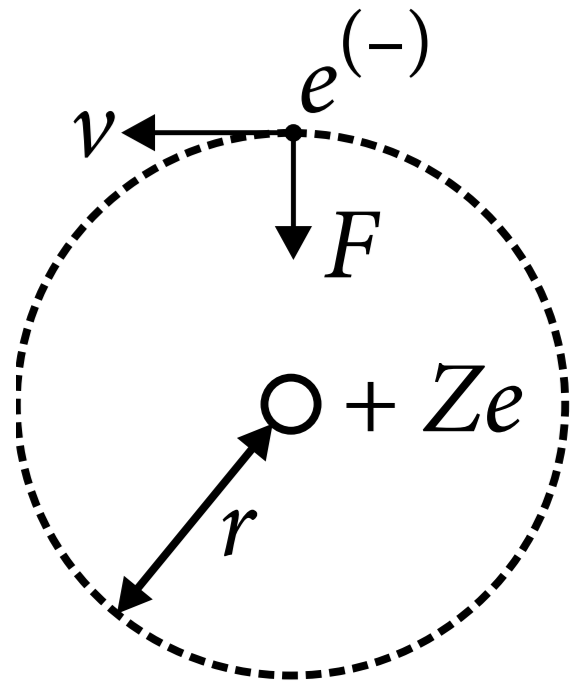
Assertion (A): According to classical theory, the proposed path of an electron in Rutherford atom model will be circular.
Reason (R): According to electromagnetic theory an accelerated particle continuously emits radiation
Answer
  1. Both A and R are true, but R is NOT the correct explanation of A.
Explanation:

According to classical electromagnetic theory, an accelerated charge continuously emits radiation. As electrons revolving in circular paths are constantly experiencing centripetal acceleration, hence they will be losing their energy continuously and the orbital radius will go on decreasing and form spiral and finally the electron will fall into the nucleus.
View full question & answer
MCQ 41 Mark
For question two statements are given-one labelled Assertion $(A)$ and the other labelled Reason $(R).$ Select the correct answer to these questions from the codes $(a), (b), (c)$ and $(d)$ as given below.
Assertion $(A):$ The positively charged nucleus of an atom has a radius of almost $10^{-15}m.$
Reason $(R):$ In $\alpha$-particle scattering experiment, the distance of closest approach for $\alpha-$particles is $10^{-15}m.$
  • Both $A$ and $R$ are true and $R$ is the correct explanation of $A.$
  • B
    Both $A$ and $R$ are true but $R$ is not the correct explanation of $A.$
  • C
    $A$ is true but $R$ is false.
  • D
    $A$ is false and $R$ is also false.
Answer
Correct option: A.
Both $A$ and $R$ are true and $R$ is the correct explanation of $A.$
In $\alpha$-particle scattering experiment, Rutherford found a small number of $\alpha-$particles which were scattered back through an angle approaching to $180^\circ.$ This is possible only if the positive charges are concentrated at the centre or nucleus of the atom.
View full question & answer
Question 51 Mark
For question two statements are given-one labelled Assertion (A) and the other labelled Reason (R). Select the correct answer to these questions from the codes (a), (b), (c) and (d) as given below.
  1. Both A and R are true, and R is the correct explanation of A.
  2. Both A and R are true, but R is NOT the correct explanation of A.
  3. A is true, but R is false.
  4. A is false and R is also false.
Assertion (A): Smoky flame of Bunsen burner gives continuous spectrum whereas its blue flame gives band spectrum.
Reason (R): The band spectrum consists of coloured bands of light on a dark background.
Answer
  1. Both A and R are true, but R is NOT the correct explanation of A.
Explanation:

When the flame of Bunsen burner is smoky, the carbon particles in it are in the incandescent state. Hence, the flame gives a continuous spectrum. But when the Burner gives a blue flame, then it has carbon, cynogen etc., in the molecular state. Hence, it gives band spectrum.
View full question & answer
MCQ 61 Mark
For question two statements are given$-$one labelled Assertion $(A)$ and the other labelled Reason $(R).$ Select the correct answer to these questions from the codes $(a), (b), (c)$ and $(d)$ as given below.
Assertion $(A):$ A tube light emits white light
Reason $(R):$ Emission of light in a tube takes place at a very high temperature.
  • A
    Both $A$ and $R$ are true and $R$ is the correct explanation of $A.$
  • B
    Both $A$ and $R$ are true but $R$ is not the correct explanation of $A.$
  • C
    $A$ is true but $R$ is false.
  • $A$ is false and $R$ is also false.
Answer
Correct option: D.
$A$ is false and $R$ is also false.
The tube light is nothing but a gas discharge tube, which can emit light of different colours.
This colour depends mainly upon the nature of the gas inside the tube and the nature of the glass.
For neon gas the colour is bright red and for $CO_2$ it is bluish.
Again, the fluorescent glow looks yellowish green for soda glass.
So it is the nature of the glass and the gas inside the tube which determines the colour of the fluorescent glow.
As argon is filled inside a tube tight, the colour of the light is white.
View full question & answer
Question 71 Mark
For question two statements are given-one labelled Assertion (A) and the other labelled Reason (R). Select the correct answer to these questions from the codes (a), (b), (c) and (d) as given below.
  1. Both A and R are true, and R is the correct explanation of A.
  2. Both A and R are true, but R is NOT the correct explanation of A.
  3. A is true, but R is false.
  4. A is false and R is also false.
Assertion (A): Total energy of revolving electron in any stationary orbit is negative.
Reason (R): Energy is a scalar quantity. It can have positive or negative value.
Answer
  1. Both A and R are true, but R is NOT the correct explanation of A.
Explanation:

The reason is correct, but does not explain the assertion properly. Negative energy of revolving electron indicates that it is bound to the nucleus. The electron is not free to leave the nucleus.
View full question & answer
Question 81 Mark
For question two statements are given-one labelled Assertion (A) and the other labelled Reason (R). Select the correct answer to these questions from the codes (a), (b), (c) and (d) as given below.
  1. Both A and R are true, and R is the correct explanation of A.
  2. Both A and R are true, but R is NOT the correct explanation of A.
  3. A is true, but R is false.
  4. A is false and R is also false.
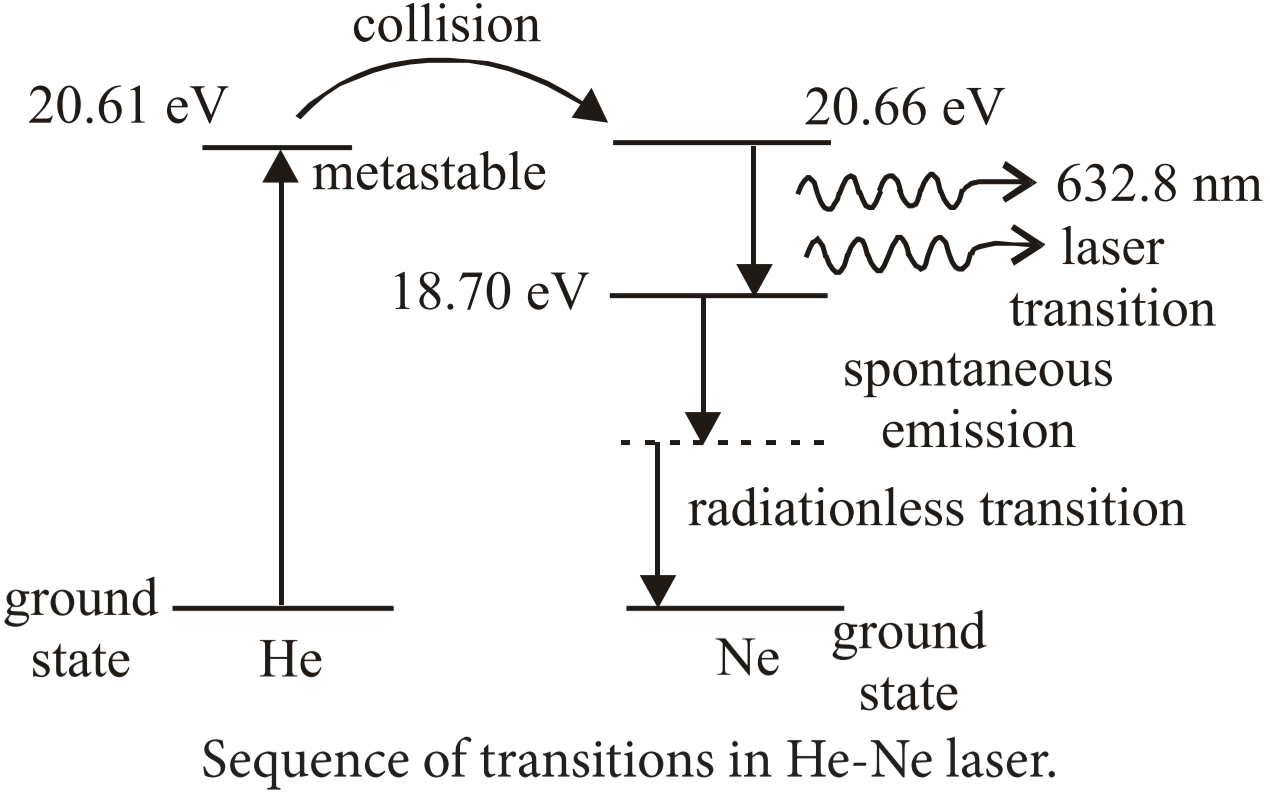
Assertion (A): In He-Ne laser, population inversion takes place between energy levels of neon atoms. Reason (R): Helium atoms have a meta-stable energy level.
Answer
  1. Both A and R are true, and R is the correct explanation of A.
Explanation:
Helium-neon laser uses a gaseous mixture of helium and neon. An electric discharge in the gas pumps the helium atoms to higher energy level, (which is meta stable energy level).

Then these helium atom excite the neon atoms to higher level by collision and produce an inverted population of neon atom which emit radiation when they are stimutated to fall to lower level.
View full question & answer
Question 91 Mark
For question two statements are given-one labelled Assertion (A) and the other labelled Reason (R). Select the correct answer to these questions from the codes (a), (b), (c) and (d) as given below.
  1. Both A and R are true, and R is the correct explanation of A.
  2. Both A and R are true, but R is NOT the correct explanation of A.
  3. A is true, but R is false.
  4. A is false and R is also false.
Assertion (A): The force of repulsion between atomic nucleus and $\alpha$-particle varies with distance according to inverse square law.
Reason (R): Rutherford did $\alpha$-particle scattering experiment.
Answer
  1. Both A and R are true, but R is NOT the correct explanation of A.
Explanation:

In Rutherford'$\alpha$-particle scattering experiment, some of $\alpha$-particles were found to be scattered at very large angles inspite of having very high kinetic energy. This shows that there are $\alpha$-particles which will be passing very close to nucleus. Rutherford confirmed the repulsive force on $\alpha$-particles due to nucleus varies with distance according to inverse square law and that the positive charges are concentrated at the centre and not distributed throughout the atom. This is the nuclear model of Rutherford.
View full question & answer
Question 101 Mark
For question two statements are given-one labelled Assertion (A) and the other labelled Reason (R). Select the correct answer to these questions from the codes (a), (b), (c) and (d) as given below.
  1. Both A and R are true, and R is the correct explanation of A.
  2. Both A and R are true, but R is NOT the correct explanation of A.
  3. A is true, but R is false.
  4. A is false and R is also false.
Assertion (A): Electrons in the atom are held due to coulomb forces.
Reason (R): The atom is stable only because the centripetal force due to Coulomb's law is balanced by the centrifugal force.
Answer
  1. A is true, but R is false.


Explanation:

According to postulates of Bohr's atom model, the electron revolve around the nucleus in fixed orbit of definite radii. As long as the electron is In a certain orbits it does not radiate any energy. Not only the centripetal force has to be the centrifugal force, even the stable orbits are fixed by Bohr's theory.
View full question & answer
Question 111 Mark
For question two statements are given-one labelled Assertion (A) and the other labelled Reason (R). Select the correct answer to these questions from the codes (a), (b), (c) and (d) as given below.
  1. Both A and R are true, and R is the correct explanation of A.
  2. Both A and R are true, but R is NOT the correct explanation of A.
  3. A is true, but R is false.
  4. A is false and R is also false.
Assertion (A): It is essential that all the lines available in the emission spectrum will not be available in the absorption spectrum.
Reason (R): The spectrum of hydrogen atom is only absorption spectrum
Answer
  1. A is true, but R is false.
Explanation:

Emission transitions can take place between any higher energy level and any energy level below it, while absorption transitions start from the lowest energy level only and may end at any higher energy level. Hence, number of absorptions transitions between two given energy levels is always less than the number of emission transitions between same two levels.
View full question & answer
Question 121 Mark
For question two statements are given-one labelled Assertion (A) and the other labelled Reason (R). Select the correct answer to these questions from the codes (a), (b), (c) and (d) as given below.
  1. Both A and R are true, and R is the correct explanation of A.
  2. Both A and R are true, but R is NOT the correct explanation of A.
  3. A is true, but R is false.
  4. A is false and R is also false.
Assertion (A): Between any two given energy levels, the number of absorption transitions is always less than the number of emission transitions.
Reason (R): Absorption transitions start from the lowest energy level only and may end at any higher energy level. But emission transitions may start from any higher energy level and end at any energy level below it.
Answer
  1. Both A and R are true, and R is the correct explanation of A.
Explanation:

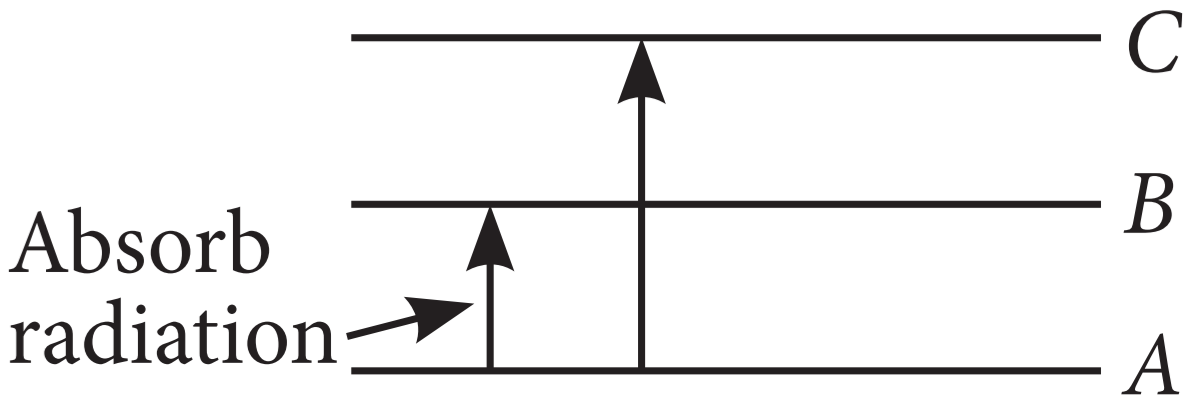
Absorption transition


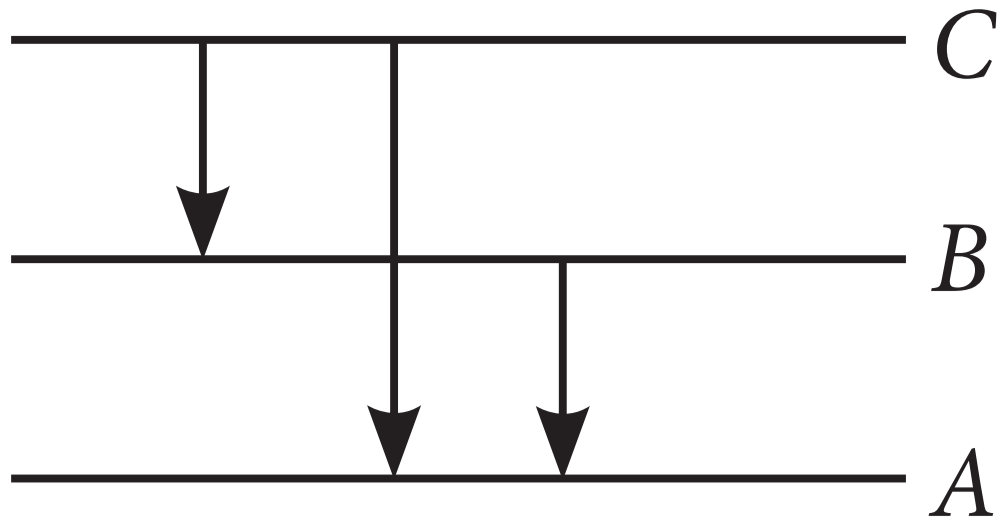
Two possibilities in absorption transition. Emission transition


Three possibilities in emission transition. Therefore, number of absorption transition < number of emission transition. For any two states A and B such that $E_A < E_8$ we have absorption spectrum for A → B transition and emission B → A. But most of the time atoms are in ground state, absorption is only from the ground state.
View full question & answer
Question 131 Mark
For question two statements are given-one labelled Assertion (A) and the other labelled Reason (R). Select the correct answer to these questions from the codes (a), (b), (c) and (d) as given below.
  1. Both A and R are true, and R is the correct explanation of A.
  2. Both A and R are true, but R is NOT the correct explanation of A.
  3. A is true, but R is false.
  4. A is false and R is also false.
Assertion (A): Total energy of electron in an hydrogen atom is negative.
Reason (R): It is bounded to the nucleus.
Answer
  1. Both A and R are true, and R is the correct explanation of A.
Explanation:

We know that $\text{E}=-\frac{13.6}{\text{n}^2}\text{eV}$

It shows that total energy of electron in a stationary orbit in a hydrogen atom is negative, which means the electron is bound to the nucleus and is not free to leave it.
View full question & answer
Question 141 Mark
For question two statements are given-one labelled Assertion (A) and the other labelled Reason (R). Select the correct answer to these questions from the codes (a), (b), (c) and (d) as given below.
  1. Both A and R are true, and R is the correct explanation of A.
  2. Both A and R are true, but R is NOT the correct explanation of A.
  3. A is true, but R is false.
  4. A is false and R is also false.
Assertion (A): Bohr had postulated that the electrons in stationary orbits around the nucleus do not radiate.
Reason (R): According to classical physics, all moving electrons radiate.
Answer
  1. Both A and R are true, but R is NOT the correct explanation of A.
Explanation:

According to classical physics, all moving charged particle radiate electromagnetic radiation. So moving electrons will also radiate energy. If we see the atomic structure, we find that electrons revolve around the nucleus in some particular orbits. Bohr termed these orbits as the stationary orbits as the electrons do not radiate energy as long as they are moving in these orbits. This is one of Bohr's postulates. This postulate is based on the fact that if the moving electrons radiate thereby losing energy, they have got a chance to finally fall back onto the nucleus and the atom will be collapsed.
View full question & answer
Question 151 Mark
For question two statements are given-one labelled Assertion (A) and the other labelled Reason (R). Select the correct answer to these questions from the codes (a), (b), (c) and (d) as given below.
  1. Both A and R are true, and R is the correct explanation of A.
  2. Both A and R are true, but R is NOT the correct explanation of A.
  3. A is true, but R is false.
  4. A is false and R is also false.
Assertion (A): Hydrogen atom consists of only one electron but its emission spectrum has many lines
Reason (R): Only Lyman series is found in the absorption spectrum of hydrogen atom whereas in the emission spectrum, all the series are found.
Answer
  1. Both A and R are true, but R is NOT the correct explanation of A.
Explanation:

Every atom has certain definite energy level. In the normal state, the electron in the hydrogen atom stays in lowest energy level. When the atom gets appropriate energy from outside, then this electron rises to some higher energy level i.e., atom is excited. Within nearly $10^{-8}$ sec, the electron leaves the higher energy level. Now, it can return either directly to the lowest energy level (or the ground state) or come to the ground state after passing through other lower energy levels. Since there are a large number of atoms in a light - source (hydrogen lamp), hence all possible transitions take place in the source and many lines are seen in the spectrum. The slit gives the shape of the spectrum and the large number of lines are obtained because a large number of atoms are getting excited and de-excited to different energy levels.
View full question & answer
Question 161 Mark
For question two statements are given-one labelled Assertion (A) and the other labelled Reason (R). Select the correct answer to these questions from the codes (a), (b), (c) and (d) as given below.
  1. Both A and R are true, and R is the correct explanation of A.
  2. Both A and R are true, but R is NOT the correct explanation of A.
  3. A is true, but R is false.
  4. A is false and R is also false.
Assertion (A): Laser is used to measure distant object like moon.
Reason (R): They are highly coherent source of light.
Answer
  1. Both A and R are true, and R is the correct explanation of A.
Explanation:

As laser is highly monochromatic and highly coherent, we can send as a laser beam to the moon, from where it comes back reflected without much loss of intensity. That's why the large distances can be measured accurately with the help of laser.
View full question & answer
MCQ 171 Mark
For question two statements are given$-$one labelled Assertion $(A)$ and the other labelled Reason $(R).$ Select the correct answer to these questions from the codes $(a), (b), (c)$ and $(d)$ as given below.
Assertion $(A):$ Balmer series lies in the visible region of electromagnetic spectrum.
Reason $(R): \frac{1}{\lambda}=\text{R}\Big(\frac{1}{2^2}-\frac{1}{\text{K}^2}\Big)$, where $K = 3, 4, 5, ...$
  • A
    Both $A$ and $R$ are true and $R$ is the correct explanation of $A.$
  • Both $A$ and $R$ are true but $R$ is not the correct explanation of $A.$
  • C
    $A$ is true but $R$ is false.
  • D
    $A$ is false and $R$ is also false.
Answer
Correct option: B.
Both $A$ and $R$ are true but $R$ is not the correct explanation of $A.$
When we put $R = 10^7m^{-1}$ and $K = 3, 4 5,$ in the given formula, values of $\lambda$ calculated lie between $4000A$ and $8000A,$ which is the visible region. The reason is true, but does not explain the assertion properly.
View full question & answer
Question 181 Mark
For question two statements are given-one labelled Assertion (A) and the other labelled Reason (R). Select the correct answer to these questions from the codes (a), (b), (c) and (d) as given below.
  1. Both A and R are true, and R is the correct explanation of A.
  2. Both A and R are true, but R is NOT the correct explanation of A.
  3. A is true, but R is false.
  4. A is false and R is also false.
Assertion (A): An electron in hydrogen atom passes from n = 4 to n = 1 level. The maximum number of photons that can be emitted is 4.
Reason (R): Maximum number of photons emitted can only be 4
Answer
  1. A is false and R is also false
Explanation:

The maximum number of photons emitted = 6 corresponding to the transitions 4 → 3 ; 3 → 2, 2 → 1, 4 → 2, 4 → 1 and 3 → 1
View full question & answer
Assertion (A) & Reason (B) MCQ - Physics STD 12 Science Questions - Vidyadip