Question
For question two statements are given-one labelled Assertion (A) and the other labelled Reason (R). Select the correct answer to these questions from the codes (a), (b), (c) and (d) as given below.
  1. Both A and R are true, and R is the correct explanation of A.
  2. Both A and R are true, but R is NOT the correct explanation of A.
  3. A is true, but R is false.
  4. A is false and R is also false.
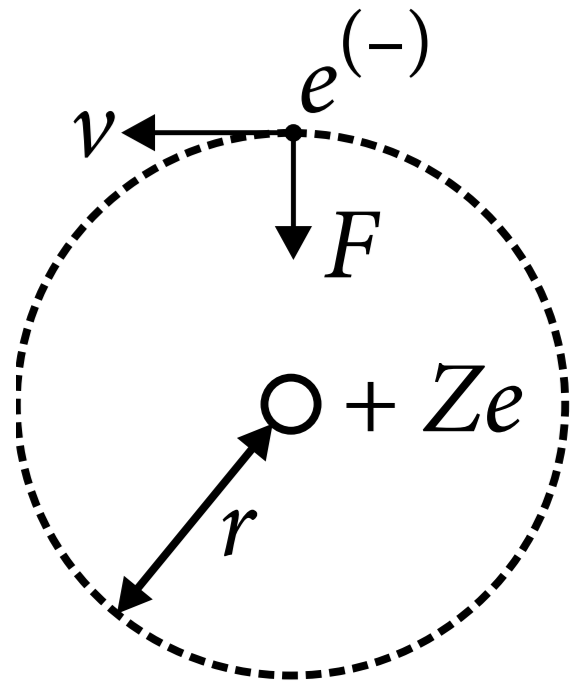
Assertion (A): Electrons in the atom are held due to coulomb forces.
Reason (R): The atom is stable only because the centripetal force due to Coulomb's law is balanced by the centrifugal force.
Answer

  1. A is true, but R is false.


Explanation:

According to postulates of Bohr's atom model, the electron revolve around the nucleus in fixed orbit of definite radii. As long as the electron is In a certain orbits it does not radiate any energy. Not only the centripetal force has to be the centrifugal force, even the stable orbits are fixed by Bohr's theory.

Need a full question paper?

Generate a complete, print-ready paper with questions like this in minutes — across 16+ boards, with answer keys.

Start Generating Free

Similar questions

For two statements are given-one labelled Assertion (A) and the other labelled Reason (R). Select the correct answer to these questions from the codes (a), (b), (c) and (d) as given below.
Assertion (A): The electric flux emanating out and entering a closed surface are $8 \times 10^3$ and $2 \times 10^3 \mathrm{Vm}$ respectively. The charge enclosed by the surface is $0.053\mu\text{C}.$
Reason (R): Gauss's theorem in electrostatics may be applied to verify.
Assertion: A parallel plate capacitor is connected across battery through a key. A dielectric slab of dielectric constant K is introduced between the plates. The energy which is stored becomes K times.
Reason(R): The surface density of charge on the plate remains constant or unchanged.
For question, statements are given-one labelled Assertion (A) and the other labelled Reason (R). Select the correct answer to these questions from the codes (a) (b) (c) and (d) as given below.
  1. Both A and R are true, and R is the correct explanation of A.
  2. Both A and R are true, but R is NOT the correct explanation of A.
  3. A is true, but R is false.
  4. A is false and R is also false.
Assertion (A): There is a chain reaction when uranium is bombarded with slow neutrons. Reason (R): When uranium is bombarded with slow neutrons, more neutrons are produced.
For two statements are given-one labelled Assertion (A) and the other labelled Reason (R). Select the correct answer to these questions from the codes (a), (b), (c) and (d) as given below.
  1. Both A and R are true, and R is the correct explanation of A.
  2. Both A and R are true, but R is not the correct explanation of A.
  3. A is true, but R is false.
  4. A is false, and R is also false.
Assertion (A): An electric field is preferred in comparison to magnetic field for detecting the electron beam in a television picture tube.
Reason (R): Electric field requires low voltage.
Two statements are given-one labelled Assertion (A) and the other labelled Reason (R). Select the correct answer to these questions from the codes (a), (b ), (c) and (d) as given below.
  1. Both A and R are true and R is the correct explanation of A.
  2. Both A and Rare true but R is NOT the correct explanation of A.
  3. A is true but R is false.
  4. A is false and R is also false.
Assertion (A): An induced current is developed when the number of magnetic lines of force associated with conductor is changed.
Reason (R): An induced current develop in a conductor moved in a direction parallel to the magnetic field.
For two statements are given-one labelled Assertion (A) and the other labelled Reason (R). Select the correct answer to these questions from the codes (a), (b), (c) and (d) as given below.
  1. Both A and R are true, and R is the correct explanation of A.
  2. Both A and R are true, but R is not the correct explanation of A.
  3. A is true, but R is false.
  4. A is false, and R is also false.
Assertion (A): The dielectric constant for metals is infinity.
Reason (R): When a charged capacitor is filled completely with a metallic slab, its capacity becomes very large.
Assertion (A): When ultraviolet light is incident on a photocell, its stopping potential is $V _0$ and the maximum kinetic energy of the photoelectrons is $K _{\max }$. When the ultraviolet light is replaced by X-rays, both $V _0$ and $K _{\max }$. increase.
Reason (R): Photoelectrons are emitted with speeds ranging from zero to a maximum value because of the range of frequencies present in the incident light.
For question two statements are given-one labelled Assertion (A) and the other labelled Reason (R). Select the correct answer to these questions from the codes (a), (b), (c) and (d) as given below.
  1. Both A and R are true and R is the correct explanation of A.
  2. Both A and R are true but R is NOT the correct explanation of A.
  3. A is true but R is false.
  4. A is false and R is also false.
Assertion (A): Interference obeys the law of conservation of energy.
Reason (R): The energy is redistributed in case of interference.
For two statements are given-one labelled Assertion (A) and the other labelled Reason (R). Select the correct answer to these questions from the codes (a), (b), (c) and (d) as given below.
  1. Both A and R are true, and R is the correct explanation of A.
  2. Both A and R are true, but R is not the correct explanation of A.
  3. A is true, but R is false.
  4. A is false, and R is also false.
Assertion (A): The surface of a conductor is an equipotential surface.
Reason (R): Conductor allows the flow of charge.
For two statements are given-one labelled Assertion (A) and the other labelled Reason (R). Select the correct answer to these questions from the codes (a), (b), (c) and (d) as given below.
  1. Both A and R are true, and R is the correct explanation of A.
  2. Both A and R are true, but R is not the correct explanation of A.
  3. A is true, but R is false.
  4. A is false, and R is also false.
Assertion (A): No work is done in taking a positive charge from one point to other inside a positively charged metallic sphere while outside the sphere work is done in taking the charge toward the sphere.
Reason (R): Inside the sphere electric potential is same at each potential, but outside it is different for different points.