Questions

Case study (4 Marks)

Take a timed test

10 questions · self-marked practice — reveal the answer and mark yourself.

Question 14 Marks
Sunita and her friends visited an exhibition. The policeman asked them to pass through a metal detector. Sunita’s friends were initially scared of it. Sunita, however, explained to them the purpose and working of the metal detector.
Answer the following questions:
  1. On what principle does a metal detector work?
  2. Why does the detector emit sound when a person carrying any metallic object walks through it?
  3. State any two qualities which Sunita displayed while explaining the purpose of walking through the detector.
Answer
  1. Metal detector works on the principle of resonance in ac circuits.
  2. When a person walks through the gate of a metal detector, the impedance of the circuit changes, resulting in significant change in current in the circuit that causes sound to be emitted as an alarm.
  3. Two qualities:
  1. Following the rules/regulations.
  2. Responsible citizen.
  3. Scientific temperament.
  4. Knowledgable.
View full question & answer
Question 24 Marks
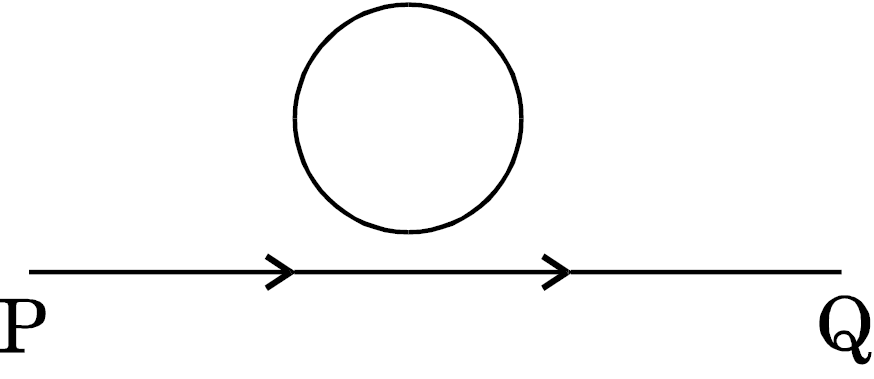
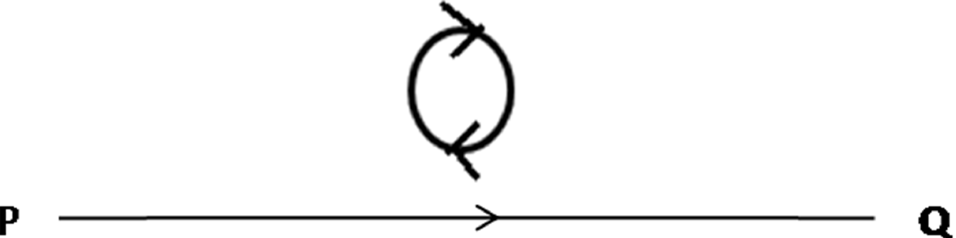
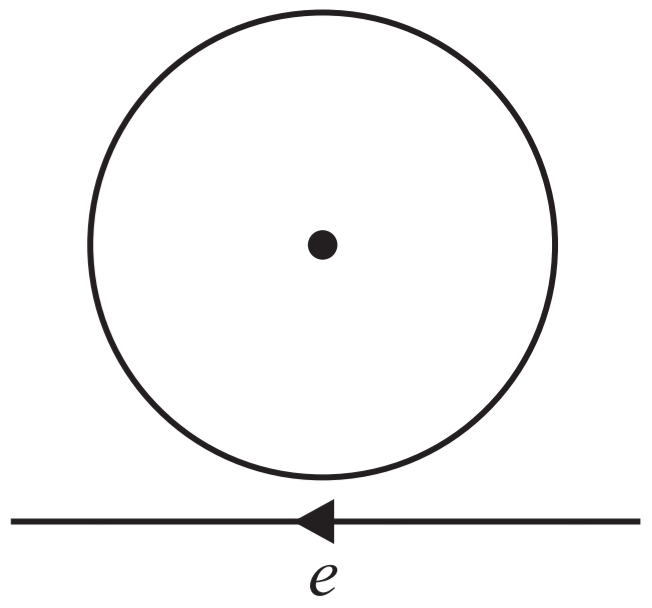
A conducting loop is held above a current carrying wire ‘PQ’ as shown in the figure. Depict the direction of the current induced in the loop when the current in the wire PQ is constantly increasing.
Answer
Clockwise.
View full question & answer
Question 34 Marks
Ram is a student of class X in a village school. His uncle gifted him a bicycle with a dynamo fitted in it. He was very excited to get it. While cycling during night, he could light the bulb and see the objects on the road. He however, did not know this device works. He asked this question to his teacher. the teacher considered it an opportunity to explain the working to the whole class.
Answer the following question:
  1. State the principle and working of a dynamo.
  2. Write two values each displayed by Ram and his school teacher.
Answer
  1. Principle: Whenever a coil is rotated in a magnetic field, an emf is induced in it due to the change in magnetic flux linked with it.
Working - As the coil rotates, its inclination$(\theta ) $ with respect to the field changes.

Hence sinusoidal/varying emf$( = \text{e}_{o}\sin \omega\text{t}) $ is obtained./May also be explained graphically.
  1. Values Ram - Scientific aptitude, curiosity, keenness to learn, positive approach, etc.
Teacher - Dedication, concern for students, depth of knowledge, generous, positive attitude towards queries, motivational approach.
View full question & answer
Question 44 Marks
A metallic loop is placed in a nonuniform magnetic field. Will an emf be induced in the loop?
Answer
As the magnetic field is non uniform thus it will induce only small electric field in different directions so there would be no net current in the loop.
View full question & answer
Question 54 Marks
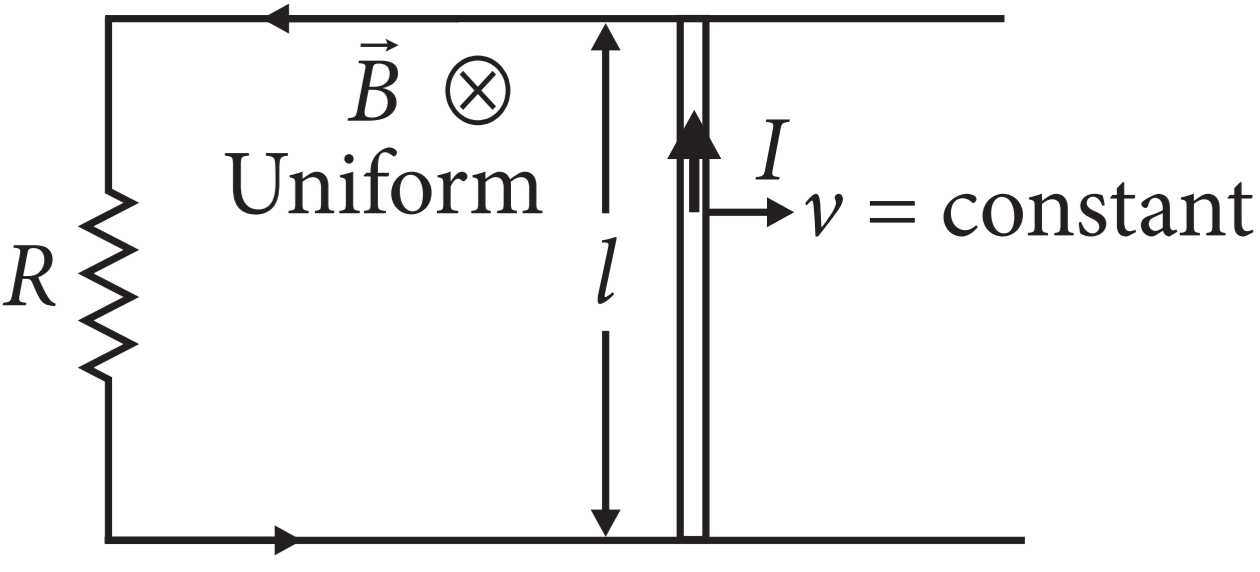
The emf induced across the ends of a conductor due to its motion in a magnetic field is called motional emf. It is produced due to the magnetic Lorentz force acting on the free electrons of the conductor. For a circuit shown in figure, if a conductor of length l moves with velocity v in a magnetic field B perpendicular to both its length and the direction of the magnetic field, then all the induced parametres are possible in the circuit.
  1. Direction of current induced in a wire moving in a magnetic field is found using
  1. Fleming's left hand rule.
  2. Fleming's right hand rule.
  3. Ampere's rule.
  4. Right hand clasp rule.
  1. A conducting rod of length l is moving in a transverse magnetic field of strength B with velocity v. The resistance of the rod is R. The current in the rod is:
  1. $\frac{\text{Blv}}{R}$
  2. $\frac{\text{B}^2\text{v}^2\text{l}^2}{\text{R}}$
  3. Blv
  4. Zero
  1. A 0.1m long conductor carrying a current of SO A is held perpendicular to a magnetic field of 1.25mT. The mechanical power required to move the conductor with a speed of I m $s^{-1}$​​​​​​​ is:
  1. 62.5 mW
  2. 625 mW
  3. 6.25 mW
  4. 12.5 mW
  1. A bicycle generator creates 1.5 Vat 15km/ hr. The EMF generated at 10km/ hr is:
  1. 1.5 volts
  2. 2 volts
  3. 0.5 volts
  4. 1 volt
  1. The dimensional formula for emf E in MKS system will be:
  1. $[ML^2T^{-3}A^{-1}]$
  2. $[ML^2T^{-1}A]$
  3. $[ML^2A]$
  4. $[MLT^-^3A^{-1}]$
Answer
  1. (b) Fleming's right hand rule.
Explanation:
Direction of current induced in a wire moving in a magnetic field is found by using Fleming's right hand rule.
  1. (a) $\frac{\text{Blv}}{R}$
Explanation:
Induced e.m.f $\varepsilon=\text{Blv}$
Current in the rod, $\text{l}=\frac{\varepsilon}{\text{R}}=\frac{\text{Blv}}{\text{R}}$
  1. (c) 6.25 mW
Explanation:
Here, $\text{l}=0.1\text{m,}\text{v}=1\text{ms}^{-1}$
$\text{I}=50\text{A, B}=1.25\text{mT}=1.25\times10^{-3}\text{T}$
The induced emf is, $\varepsilon=\text{Blv}$
The mechanical power is,
$\text{P}=\varepsilon\text{I}=\text{BlvI}=1.25\times10^{-3}\times0.1\times1\times50$
$=6.25\times10^{-3}\text{W}=6.25\text{mW}$
  1. (d) 1 volt
Explanation:
Emf induced, $\varepsilon=\text{Blv}$
Here, $\vec{\text{B}},\vec{\text{l}}$ and $\vec{\text{v}}$ are mutually perpendicular For given B and $\text{l},\varepsilon\propto\text{v}.$
$\therefore\frac{\varepsilon_1}{\varepsilon_2}=\frac{\text{v}_1}{\text{v}_2}$
Here, $\varepsilon_1=1.5\text{V},\text{v}_1=15\text{km/ hr}=15\times\frac{5}{18}\text{ms}^{-1}$
$\text{v}_210\text{km/ hr}=10\times\frac{5}{18}\text{m s}^{-1},\varepsilon_2=?$
$\frac{1.5}{\varepsilon_2}=\frac{15\frac{5}{18}}{10\times\frac{5}{18}}=\frac{3}{2};\varepsilon_2=1\text{V}$
  1. (a) $[ML^2T^{-3}A^{-1}]$
Explanation:
$\varepsilon=\frac{[\text{W}]}{[\text{q}]}=\frac{\text{ML}^2\text{T}^{-2}}{\text{AT}}=\text{ML}^2\text{T}^{-3}\text{A}^{-1}$
View full question & answer
Question 64 Marks
Currents can be induced not only in conducting coils, but also in conducting sheets or blocks. Current is induced in solid metallic masses when the magnetic flux threading through them changes. Such currents flow in the from of irregularly shaped loops throughout the body of the metal. These currents look like eddies or whirlpools in water so they are known as eddy currents. Eddy currents have both undesirable effects and practically useful applications. For example it causes unnecessary heating and wastage of power in electric motors, dynamos and in the cores of transformers.
  1. The working of speedometers of trains is based on:
  1. Wattless currents.
  2. Eddy currents.
  3. alternating currents.
  4. pulsating currents.
  1. Identify the wrong statement.
  1. Eddy currents are produced in a steady magnetic field.
  2. Induction furnace uses eddy currents to produce heat.
  3. Eddy currents can be used to produce braking force in moving trains.
  4. Power meters work on the principle of eddy currents.
  1. Which of the following is the best method to reduce eddy currents?
  1. Laminating core.
  2. Using thick wires.
  3. By reducing hysteresis loss.
  4. None of these.
  1. The direction of eddy currents is given by:
  1. Fleming's left hand rule.
  2. Biot-Savart law.
  3. Lenz's law
  4. Ampere-circuital law.
  1. Eddy currents can be used to heat localised tissues of the human body. This branch of medical therapy is called:
  1. Hyperthermia.
  2. Diathermy.
  3. Inductothermy.
  4. None of these.
Answer
  1. (b) Eddy currents.
Explanation:

The working of speedometers is based on eddy currents.
  1. (a) Eddy currents are produced in a steady magnetic field.
  1. (a) Laminating core.
Explanation:

To reduce the eddy currents in the metal armature of motors, wire is wrapped around a number of thin metal sheets called lamination.
  1. (c) Increase.
Explanation:

Eddy currents also oppose the change in magnetic flux, so their direction is given by Lenz's law.
  1. (c) Henry.
View full question & answer
Question 74 Marks
Mutual inductance is the phenomenon of inducing emfina coil, due to a change of current in the neighbouring coil. The amount of mutual inductance that links one coil to another depends very much on the relative positioning of the two coils, their geometry and relative separation between them. Mutual inductance between the two coils increases ft, times if the coils are wound over an iron core of relative permeability.
  1. A short solenoid of radius a, number of turns per unit length $n_1$, and length L is kept coaxially inside a very long solenoid of radius b, number of turns per unit length $n_2$. What is the mutual inductance of the system?
  1. $\mu_0\pi\text{b}^2\text{n}_1\text{n}_2\text{L}$
  2. $\mu_0\pi\text{a}^2\text{n}_1\text{n}_2\text{L}^2$
  3. $\mu_0\pi\text{a}^2\text{n}_1\text{n}_2\text{L}$
  4. $\mu_0\pi\text{b}^2\text{n}_1\text{n}_2\text{L}^2$
  1. If a change in current of 0.01A in one coil produces a change in magnetic flux of $2 \times 10^{-2}$ weber in another coil, then the mutual inductance between coils is:
  1. 0
  2. 0.5H
  3. 2H
  4. 3H
  1. Mutual inductance of two coils can be increased by:
  1. Decreasing the number of turns in the coils.
  2. Increasing the number of turns in the coils.
  3. Winding the coils on wooden cores.
  4. None of these.
  1. When a sheet of iron is placed in between the two co-axial coils, then the mutual inductance between the coils will:
  1. Increase.
  2. Decrease.
  3. Remains same.
  4. Cannot be predicted.
  1. The SJ unit of mutual inductance is:
  1. Ohm.
  2. Mho.
  3. Henry.
  4. None of these.
Answer
  1. (c) $\mu_0\pi\text{a}^2\text{n}_1\text{n}_2\text{L}$
  1. Explanation:
    We know that the mutual inductance depends (directly proportional) on the permeability of the medium surrounding the coils. When the permeability of the medium is increased by inserting a sheet of iron, then the mutual inductance between the coils also increases.
  2. (c) Henry.
  3. Explanation:
    Mutual inductance of coils, $\text{m}=\frac{\mu_0.\text{u}_\text{r}\text{N}_1\text{N}_2\text{A}}{\text{l}}$
    It is clear that mutual inductance of coils can be increased by increasing the number of turns in the coils.
  4. (a) Increase.
  5. Explanation:
    Here, $\phi_{\text{B}}=2\times10^{-2}\text{Wb},\ \text{l}=0.01\text{A}$
    As, $\phi_\text{B}=\text{MI}$
    $\therefore$ Mutual inductance between two coils is $\text{M}=\frac{\phi_\text{B}}{\text{l}}=\frac{2\times10^{-2}\text{Wb}}{0.01\text{A}}=2\text{H}$
  6. (b) Increasing the number of turns in the coils.
  7. Explanation:
    The mutual inductance of the system is $=\mu_0\text{n}_1\text{n}_2\pi\text{a}^2\text{L}$
  8. (c) 2H
View full question & answer
Question 84 Marks
Lenz's law states that the direction of induced current in a circuit is such that it opposes the change which produces it. Tims, if the magnetic flux linked with a closed circuit increases, the induced current flows in such a direction that a magnetic flux is created in the opposite direction of the original magnetic flux. If the magnetic flux linked with the closed circuit decreases, the induced current flows in such a direction so as to create a magnetic flux in the direction of the original flux.
  1. Which of the following statements is correct?
  1. The induced e.m.f is not in the direction opposing the change in magnetic flux so as to oppose the cause which produces it.
  2. The relative motion between the coil and magnet produces change in magnetic flux.
  3. Emf is induced only if the magnet is moved towards coil.
  4. Emf is induced only if the coil is moved towards magnet.
  1. The polarity of induced emf is given by:
  1. Ampere's circuital law.
  2. Biot-Savart law.
  3. Lenz's law.
  4. Fleming's right hand rule.
  1. Lenz's law is a consequence of the law of conservation of:
  1. Charge.
  2. Mass.
  3. Momentum.
  4. Energy.
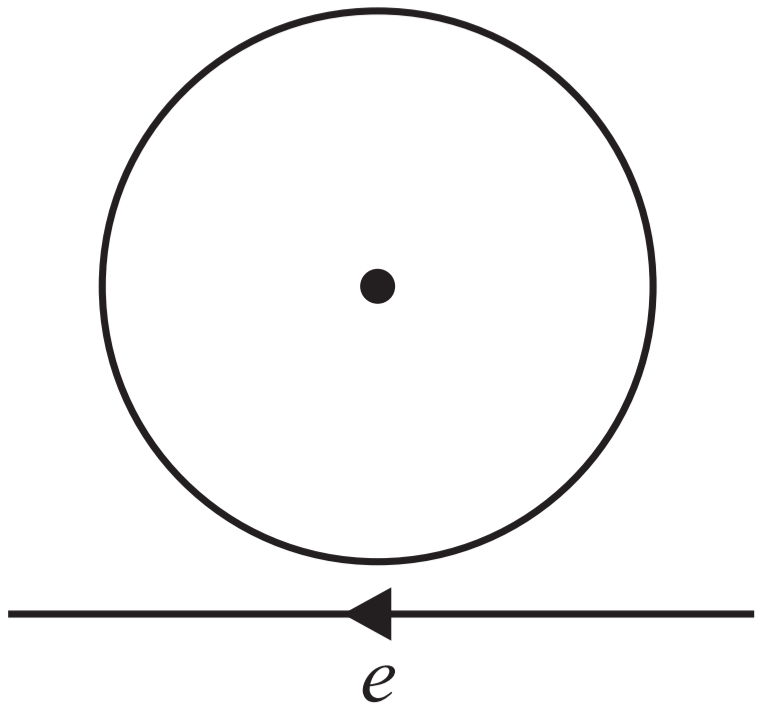
  1. Near a circular loop of conducting wire as shown in the figure, an electron moves along a straight line. The direction of the induced current if any in the loop is:
  1. Variable.
  2. Clockwise.
  3. Anticlockwise.
  4. Zero.
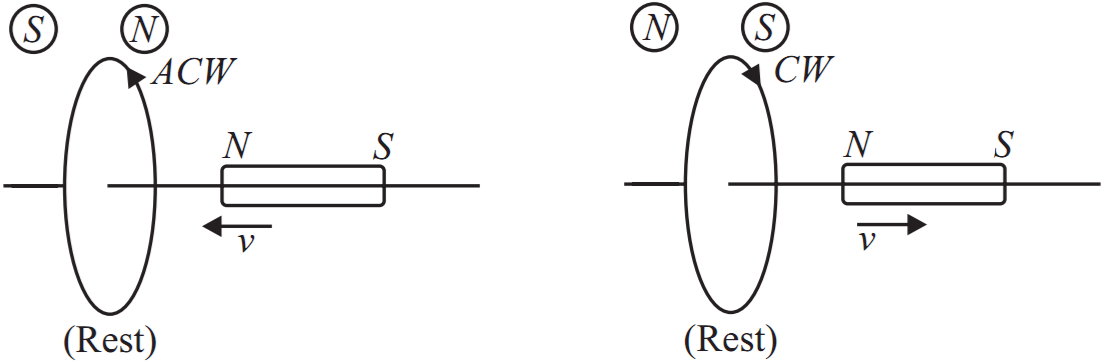
  1. Two identical circular coils A and Bare kept in a horizontal tube side by side without touching each other. If the current in the coil A increases with time, in response, the coil B:
  1. Is attracted by A.
  2. Remains stationary.
  3. Is repelled.
  4. Rotates.
Answer
  1. (b) The relative motion between the coil and magnet produces change in magnetic flux.
Explanation:
The relative motion between the coil and the magnet produces change in the magnetic flux in the coil. The induced emf is always in such a direction that it opposes the change in the flux.
  1. (c) Lenz's law.
  1. (d) Energy.
  1. (a) Variable.
Explanation:
When an electron is moving from right 10 left, the flux linked with loop (which is going into the page) will first increase and then decrease as the electron passes by. So the induced current $I_i$ in the loop will be first clockwise and will change direction (i.e. will become anticlockwise) as the electron passes by.
  1. (c) Is repelled.
Explanation:
When current in coil A increases with time, there will be a change of flux in coil B which will induce a current in B. Now, according to Lenz's law, the direction of induced current in B will be opposite to the direction of current in A. Thus, if two loops carry current in opposite direction they will repel each other.
View full question & answer
Question 94 Marks
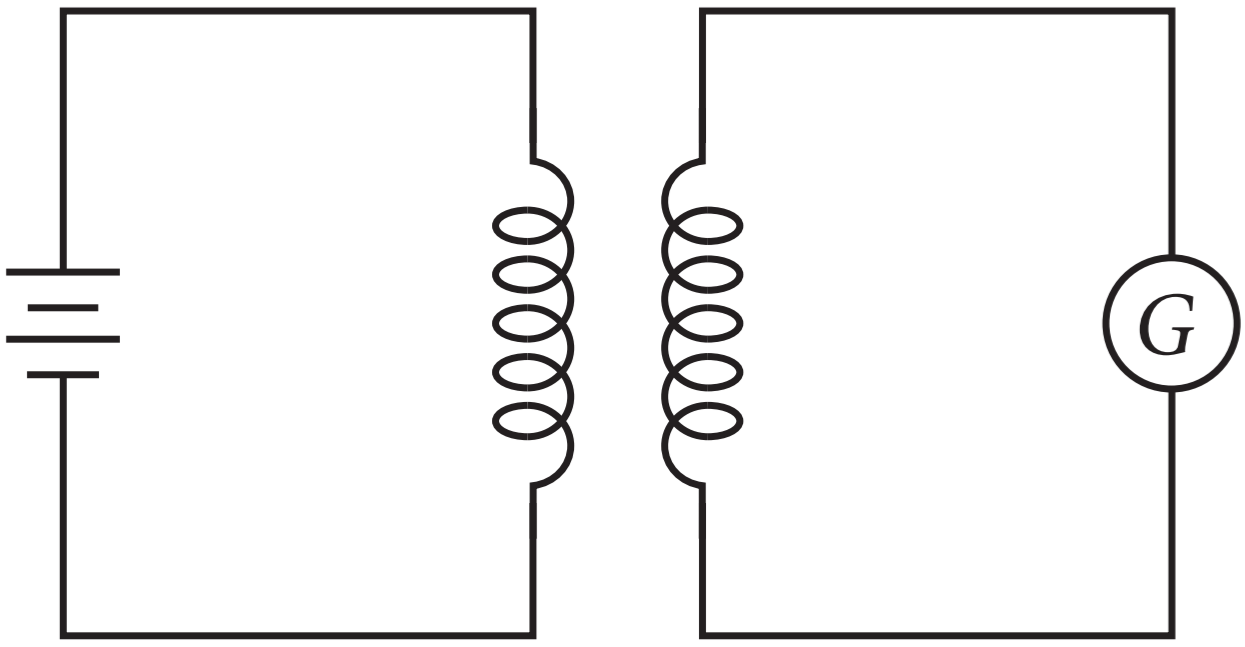
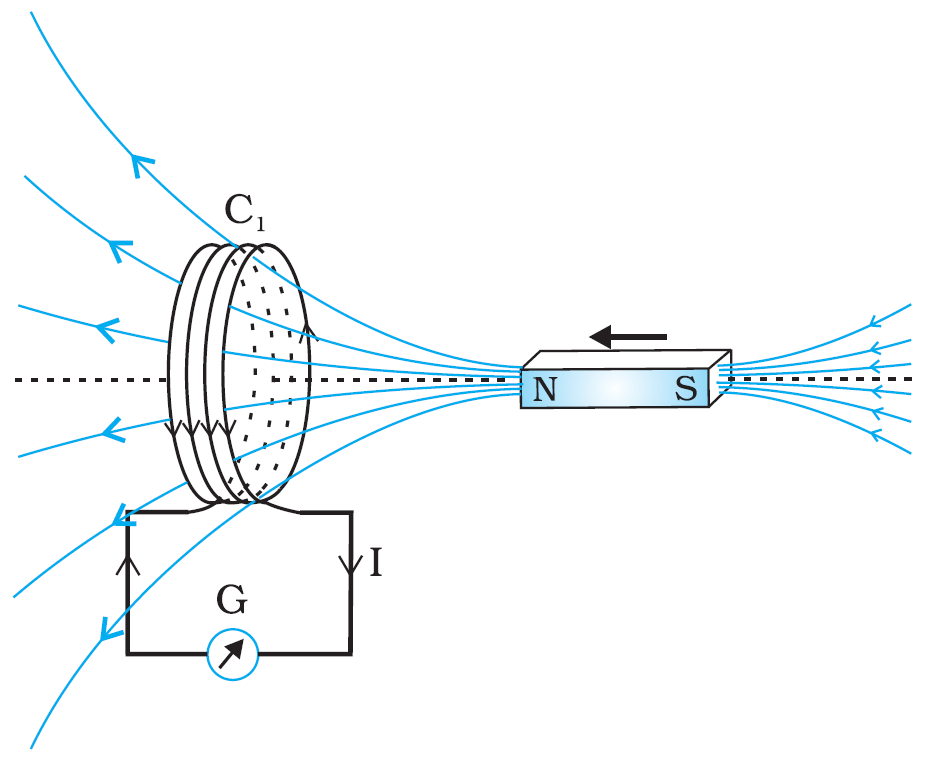
In year 1820 Oersted discovered the magnetic effect of current. Faraday gave the thought that reverse of this phenomenon is also possible i.e., current can also be produced by magnetic field. Faraday showed that when we move a magnet towards the coil which is connected by a sensitive galvanometer. The galvanometer gives instantaneous deflection showing that there is an electric current in the loop. Whenever relative motion between coil and magnet takes place an emf induced in coil. If coil is in closed circuit then current is also induced in the circuit. This phenomenon is called electromagnetic induction.
  1. The north pole of a long bar magnet was pushed slowly into a short solenoid connected to a galvanometer. The magnet was held stationary for a few seconds with the north pole in the middle of the solenoid and then withdrawn rapidly. The maximum deflection of the galvanometer was observed when the magnet was:
  1. Moving towards the solenoid.
  2. Moving into the solenoid.
  3. At rest inside the solenoid.
  4. Moving out of the solenoid.
  1. Two similar circular loops carry equal currents in the same direction. On moving the coils further apart, the electric current will.
  1. Remain unaltered.
  2. Increases in one and decreases in the second.
  3. Increase in both.
  4. Decrease in both.
  1. A closed iron ring is held horizontally and a bar magnet is dropped through the ring with its length along the axis of the ring. The acceleration of the falling magnet is.
  1. Equal to g.
  2. Less than g.
  3. More than g.
  4. Depends on the diameter of the ring and length of magnet.
  1. Whenever there is a relative motion between a coil and a magnet, the magnitude of induced emf set up in the coil does not depend upon the:
  1. Relative speed between the coil and magnet.
  2. Magnetic moment of the coil.
  3. Resistance of the coil.
  4. Number of turns in the coil.
  1. A coil of metal wire is kept stationary in a non-uniform magnetic field:
  1. A n emf and current both are induced in the coil.
  2. A current but no emf is induced in the coil.
  3. An emf but no current is induced in the coil.
  4. Neither emf nor current is induced in the coil.
Answer
  1. (d) Moving out of the solenoid.
Explanation:

More rapid is the movement of bar magnet, more is the deflection observed in the galvanometer.
  1. (c) Increase in both.
Explanation:

Two circular loops carrying current in the same direction will attract each other. If they are now separated, induced currents will try to keep status quo, by increasing the current in both the coils.
  1. (b) Less than g.
Explanation:

Acceleration of the magnet will not be equal tog. It will be less than g. This is because, as the magnet falls, amount of magnetic flux linked with the ring changes.

An induced emf is developed in the ring which opposes the downward motion of the magnet.
  1. (c) Resistance of the coil.
Explanation:

The magnitude of induced emf set up in the coil does not depend upon the resistance of the coil whereas induced current set up in the coil depend upon the resistance of the coil.
  1. (d) Neither emf nor current is induced in the coil.
Explanation:

As long as a coil of metal is kept stationary in a magnetic field, even if it is non-uniform, unless it is changing with respect to time, there will be no induced emfor current in the coil.
View full question & answer
Question 104 Marks
When a current/ flows through a coil, flux linked with it is $\phi=\text{LI},$ where L is a constant known as self inductance of the coil. Any change in current sets up an induced emf in the coil. Tims, self inductance of a coil is the induced emf set up in it when the current passing through it changes at the unit rate. It is a measure of the opposition to the growth or the decay of current flowing through the coil. Also, value of self inductance depends on the number of turns in the solenoid, its area of cross-section and the relative permeability of its core material.
  1. The inductance in a coil plays the same role as:
  1. Inertia in mechanics.
  2. Energy in mechanics.
  3. Momentum in mechanics.
  4. Force in mechanics.
  1. A current of 2.5A flows through a coil of inductance 5H. The magnetic flux linked with the coil is:
  1. 0.5Wb
  2. 12.5Wb
  3. Zero
  4. 2Wb
  1. The inductance L of a solenoid depends upon its radius R as:
  1. $\text{L}\propto\text{R}$
  2. $\text{L}\propto\frac{1}{\text{R}}$
  3. $\text{L}\propto\text{R}^2$
  4. $\text{L}\propto\text{R}^3$
  1. The unit of self-inductance is:
  1. Weber ampere
  2. Weber$^{-1}$ ampere
  3. Ohm second
  4. Farad
  1. The induced e.m.f. in a coil of 10 henry inductance in which current varies from 9A to 4A in 0.2 second is:
  1. 200V
  2. 250V
  3. 300V
  4. 500V
Answer
  1. (a) Inertia in mechanics.
Explanation:
The inductance in a coil plays the same role as inertia in mechanics.
  1. (b) 12.5Wb
Explanation:
Here, $\text{I}=2.5\text{A},\ \text{L}=5\text{H}$
Magnetic flux linked with the coil is,
$\phi_\text{B}=\text{LI}=(5\text{H})(2.5\text{A})=12.5\text{Wb}$
  1. (b) $\text{L}\propto\frac{1}{\text{R}}$
Explanation:
The inductance of a solenoid is $\text{L}=\mu_0{\text{n}}^2\text{Al}$ where A is the area of cross-section of the solenoid, l its length and n is the number of turns per unit length.
As, $\text{A}=\pi\text{R}^2$ where R is the radius of the solenoid.
$\therefore\text{L}=\mu_0\text{n}^2\pi\text{R}^2\text{l}\Rightarrow\text{L}\propto\text{R}^2$
  1. (c) Ohm second
Explanation:
The magnitude of induced emf is $|\varepsilon|=\text{L}\frac{\text{dl}}{\text{dt}}\Rightarrow\text{L}=\frac{|\varepsilon|\text{dt}}{\text{dl}}$
or, $\text{L}=\frac{\text{volt}\times\text{ second}}{\text{ampere}}=\text{ohm second}$
  1. (b) 250V
Explanation:
Here L = 10 henry $I_1 = 9A, I_2 = 4A$ and $\triangle\text{t}=0.2$ second
Then induced e.m.f
$\varepsilon_1=-\text{L}\frac{\text{dl}}{\text{dt}}=-\text{L}\frac{\text{l}_2-\text{l}_1}{\triangle\text{t}}=\frac{-10\times(4-9)}{0.2}=\frac{50}{0.2}=250\text{V}$
View full question & answer