Questions

M.C.Q (1 Marks)

Take a timed test

21 questions · auto-graded multiple-choice test.

MCQ 11 Mark
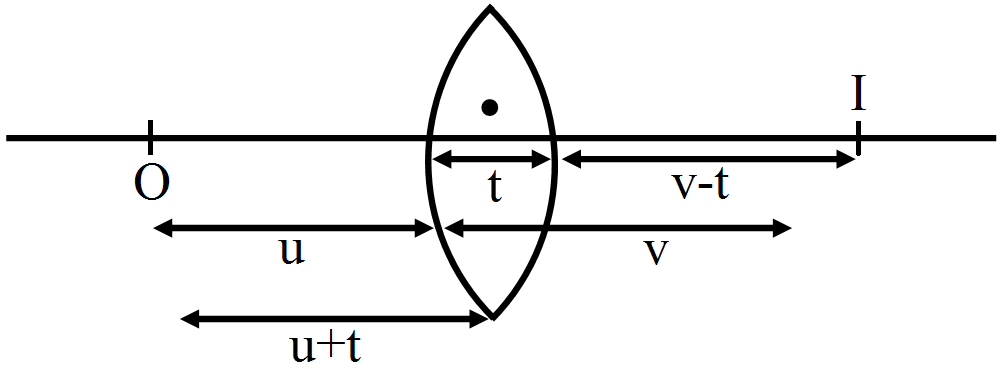
Four modifications are suggested in the lens formula to include the effect of the thickness t of the lens. Which one is likely to be correct?
  • A
    $\frac{1}{\text{v}}-\frac{1}{\text{u}}=\frac{1}{\text{uf}}$
  • B
    $\frac{1}{\text{v}^2}-\frac{1}{\text{u}}=\frac{1}{\text{f}}$
  • $\frac{1}{\text{v}-\text{t}}-\frac{1}{\text{u}+\text{t}}=\frac{1}{\text{f}}$
  • D
    $\frac{1}{\text{v}}-\frac{1}{\text{u}}+\frac{\text{t}}{\text{uv}}=\frac{\text{t}}{\text{f}}$
Answer
Correct option: C.
$\frac{1}{\text{v}-\text{t}}-\frac{1}{\text{u}+\text{t}}=\frac{1}{\text{f}}$
Explanation:
View full question & answer
MCQ 21 Mark
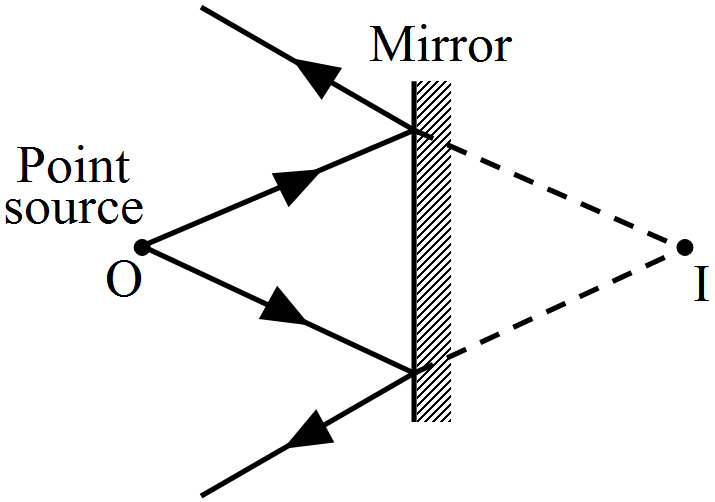
A point source of light is placed in front of a plane mirror:
  • All the reflected rays meet at a point when produced backward.
  • B
    Only the reflected rays close to the normal meet at a point when produced backward.
  • C
    Only the reflected rays making a small angle with the mirror, meet at a point when produced backward.
  • D
    Light of different colours make different images.
Answer
Correct option: A.
All the reflected rays meet at a point when produced backward.
Explanation:

View full question & answer
MCQ 31 Mark
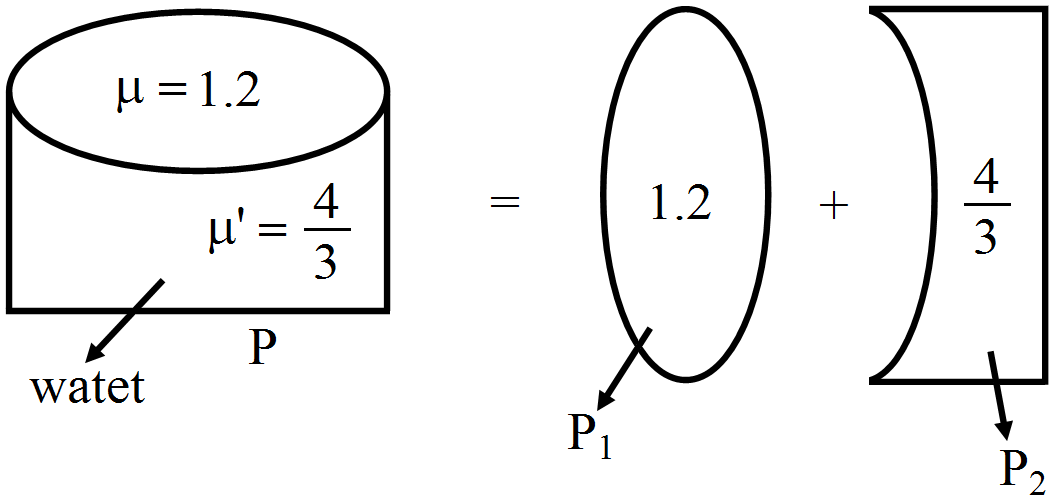
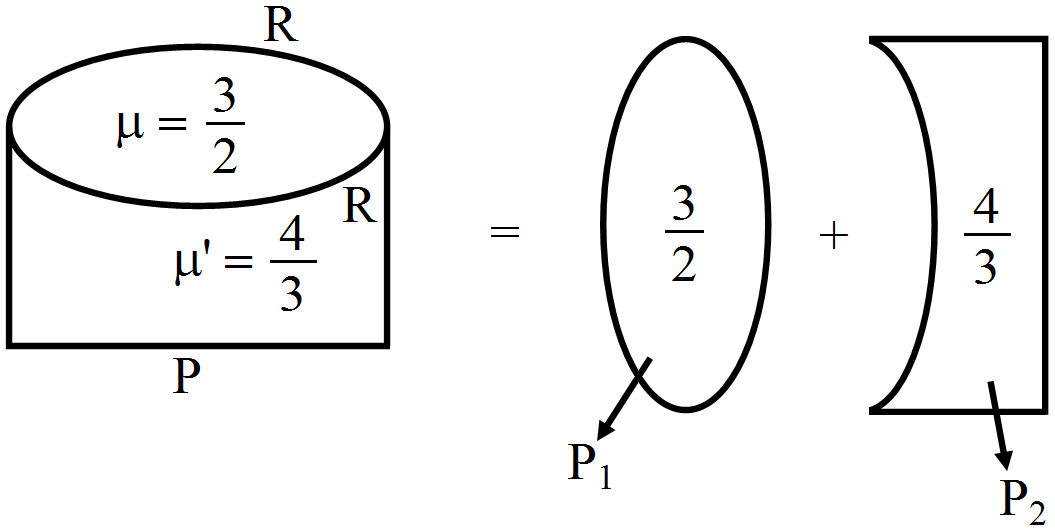
A convex lens is made of a material having refractive index $1.2.$ Both the surfaces of the lens are convex. If it is dipped into water $(\mu=1.33),$ it will behave like:
  • A
    A convergent lens.
  • A divergent lens.
  • C
    A rectangular slab.
  • D
    A prism.
Answer
Correct option: B.
A divergent lens.

$\text { Here P, } P_1\ \&\ P_2$ are the Power of Lenses.
$P=P_1+P_2$
$\frac{1}{\text{f}}=\frac{1}{\text{f}_1}=\frac{1}{\text{f}_2}$
$(\mu-1)\Big(\frac{2}{\text{R}}\Big)+(\mu'-1)\Big(\frac{-1}{\text{R}}\Big)$
$(1.2-1)\Big(\frac{2}{\text{R}}\Big)-\Big(\frac{4}{3}-1\Big)\Big(\frac{1}{\text{R}}\Big)$
$\frac{1}{\text{f}}=\frac{2}{5\text{R}}-\frac{1}{3\text{R}}$
$\frac{1}{\text{f}}=\frac{6-5}{15\text{R}}$
$\text{f}=15\text{R}$
Focal lenght of combined is positive, but it's magnitude in capair to $f_1\ \&\ f_2$ is High.
So it will be hare like a divergent lens.
View full question & answer
MCQ 41 Mark
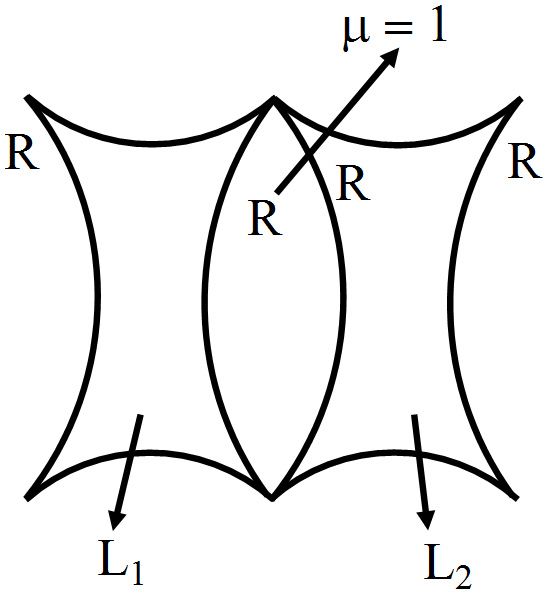
Two concave lenses $L_1$ and $L_2$ are kept in contact with each other. If the space between the two lenses is filled with a material of refractive index $\mu\approx1,$ the magnitude of the focal length of the combination:
  • A
    Becomes undefined.
  • B
    Remains unchanged.
  • C
    Increases.
  • Decreases.
Answer
Correct option: D.
Decreases.


$\frac{1}{\text{f}}=\frac{1}{\text{f}_{\text{L}_1}}+\frac{1}{\text{f}_{\text{L}_2}}$
$\frac{1}{\text{f}_{\text{L}_1}}=(\mu-1)\Big(\frac{-2}{\text{R}}\Big)=\frac{1}{\text{f}_{\text{L}_2}}$
Local length of the combination.
$\frac{1}{\text{f}}=(\mu-1)\Big(\frac{-2}{\text{R}}\Big)+(\mu-1)\Big(\frac{-2}{\text{R}}\Big)$
$\frac{1}{\text{f}}=-4(\mu-1)\Big(\frac{1}{\text{R}}\Big)$
$\text{f}=\frac{\text{R}}{4(\mu-1)}$
Where $\text{f}_{\text{L}_1}=\text{f}_{\text{L}_2}=\frac{\text{R}}{2(\mu-1)}$
$(\text{f}_{\text{L}_1}=\text{f}_{\text{L}_2})>\text{f}$
View full question & answer
MCQ 51 Mark
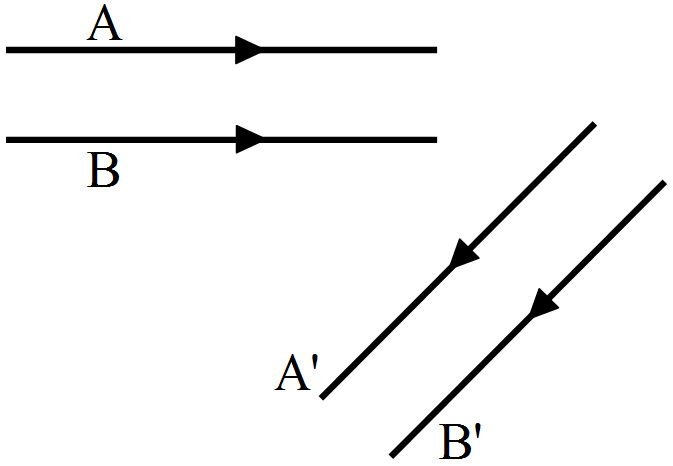
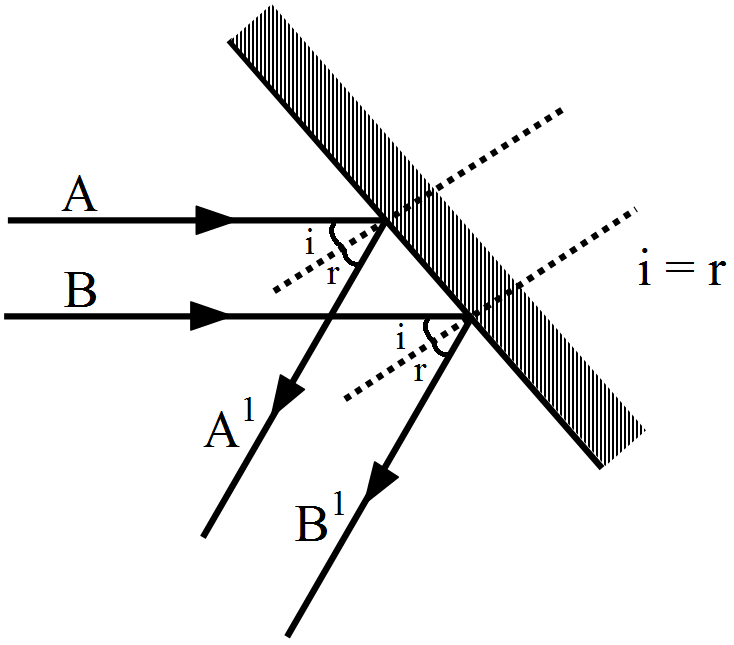
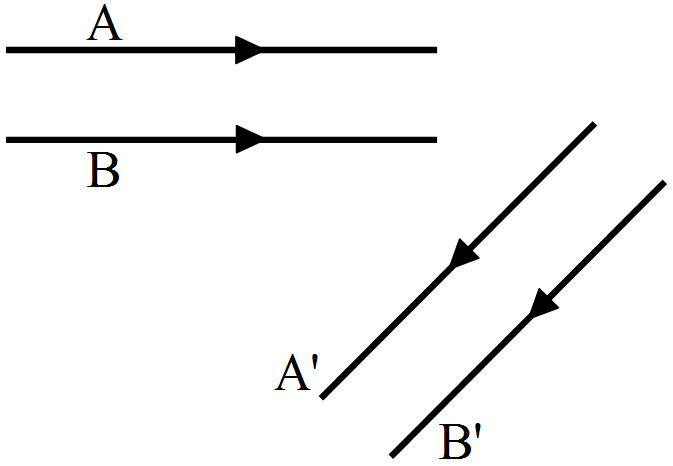
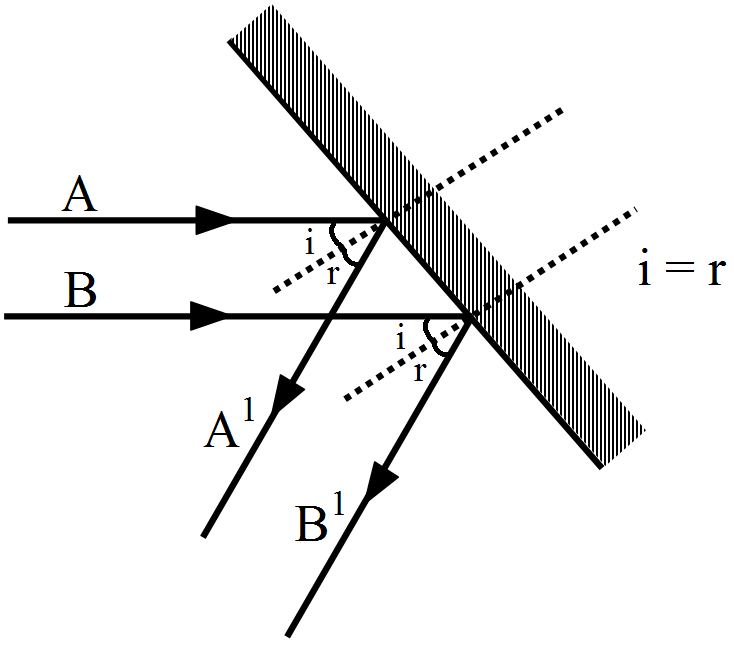
Two rays A and B being reflected by a mirror and going as A' and B'. The mirror:
  • Is plane.
  • B
    Is convex.
  • C
    Is concave.
  • D
    May be any spherical mirror.
Answer
Correct option: A.
Is plane.
Explanation:


Here initially A & B is parallel to each other after reflection by teh plane mirror A' & B' goes Parallel to each other.
View full question & answer
MCQ 61 Mark
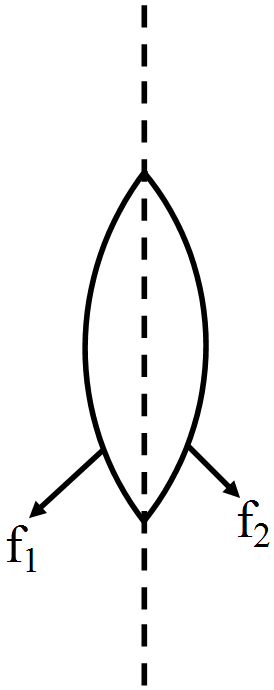
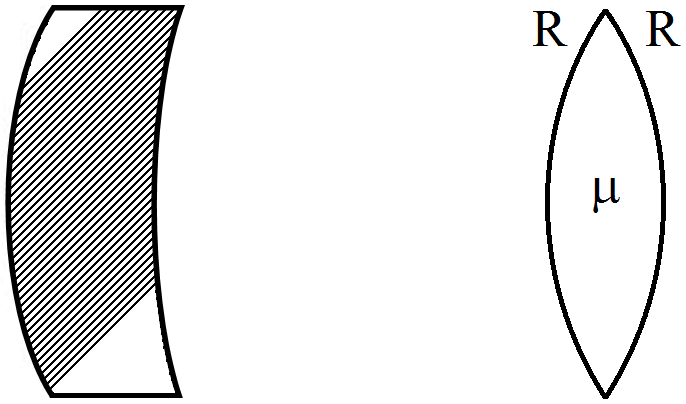
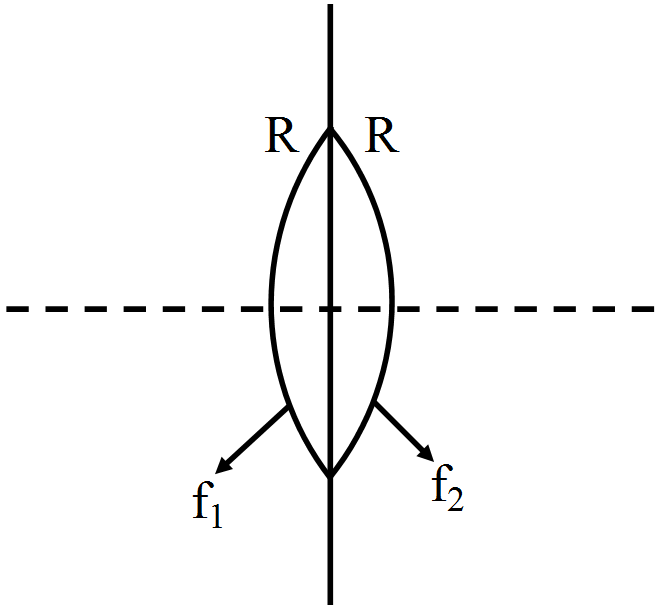
A symmetric double convex lens is cut in two equal parts by a plane containing the principal axis. If the power of the original lens was $4D,$ the power of a divided lens will be:
  • $2D$
  • B
    $3D$
  • C
    $4D$
  • D
    $5D.$
Answer
Correct option: A.
$2D$


Before cut
$\frac{1}{\text{f}}=(\mu-1)\Big(\frac{2}{\text{R}}\Big)=4\text{D}$
After cut
$\frac{1}{\text{f}_1}=(\mu-1)\Big(\frac{1}{\text{R}}\Big)=\text{P}_1$
$\ \frac{1}{\text{f}_2}=(\mu-1)\Big(\frac{1}{\text{R}}\Big)=\text{P}_2$
Power of a divided lens will be $= P_1+ P_2$
$=(\mu-1)\Big(\frac{2}{\text{R}}\Big)$
$=4\text{D}$
View full question & answer
MCQ 71 Mark
A screen is placed a distance 40cm away from an illuminated object. A converging lens is placed between the source and the screen and it is attempted to form the image of the source on the screen. If no position could be found, the focal length of the lens:
  • A
    Must be less than 10cm.
  • Must be greater than 20cm.
  • C
    Must not be greater than 20cm.
  • D
    Must not be less than 10cm.
Answer
Correct option: B.
Must be greater than 20cm.
Explanation:
$\text{v}=(40-4)$
$\frac{1}{\text{f}}=\frac{1}{40-4}-\frac{1}{(-\text{u})}$
$\frac{\text{df}}{\text{du}}=0$ for f minimum.
$\frac{\text{df}}{\text{du}}=1-\frac{\text{u}}{20}=0$
$\text{u}=20$
$\text{f}_{\text{min}}=10\text{cm}$
View full question & answer
MCQ 81 Mark
Mark the correct options:
  • A
    If the incident rays are converging, we have a real object.
  • If the final rays are converging, we have a real image.
  • C
    The image of a virtual object is called a virtual image.
  • D
    If the image is virtual, the corresponding object is called a virtual object.
Answer
Correct option: B.
If the final rays are converging, we have a real image.
Explanation:
This is because a real image is formed by converging reflected/ refracted rays from a mirror/ lens.
View full question & answer
MCQ 91 Mark
Two rays A and B being reflected by a mirror and going as A' and B'. The mirror:
  • Is plane.
  • B
    Is convex.
  • C
    Is concave.
  • D
    May be any spherical mirror.
Answer
Correct option: A.
Is plane.
Explanation:


Here initially A & B is parallel to each other after reflection by teh plane mirror A' & B' goes Parallel to each other.
View full question & answer
MCQ 101 Mark
The rays of different colours fail to converge at a point after going through a converging lens. This defect is called:
  • A
    Spherical aberration.
  • B
    Distortion.
  • C
    Coma.
  • Chromatic aberration.
Answer
Correct option: D.
Chromatic aberration.
Explanation:
The rays of different colours fail to converge at a Point after going through a converging Lens. This defect is called chromatic oberration.
View full question & answer
MCQ 111 Mark
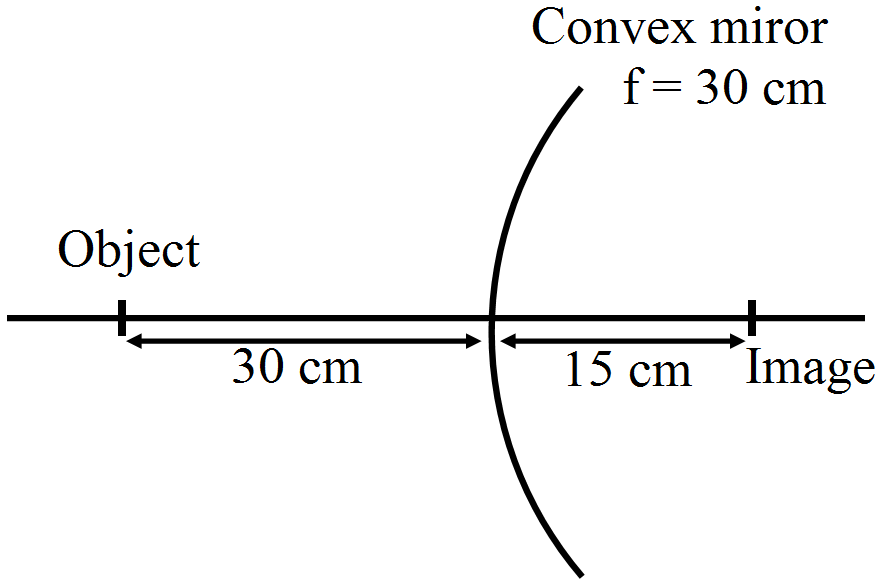
A point object is placed at a distance of 30cm from a convex mirror of focal length 30cm. The image will form at:
  • Infinity.
  • B
    Pole.
  • C
    Focus.
  • D
    15cm behind the mirror.
Answer
Correct option: A.
Infinity.
Explanation:
By mirror formula:
$\frac{1}{\text{V}}+\frac{1}{\text{u}}=\frac{1}{\text{f}}$
Here u = -30cm
f = +30cm
So, $\frac{1}{\text{V}}-\frac{1}{30}=\frac{1}{30}$
Þ v= 15cm behind the mirror.
View full question & answer
MCQ 121 Mark
A thin lens is made with a material having refractive index $\mu=1.5.$ Both the sides are convex. It is dipped in water $(\mu=1.33).$ It will behave like:
  • A convergent lens.
     
  • B
    A divergent lens.
     
  • C
    A rectangular slab.
     
  • D
    A prism
Answer
Correct option: A.
A convergent lens.


$\text { Here } P, P_1\ \& \ P_2 \text { are the power of Lenses. }$
$P=P_1+P_2$
$\frac{1}{\text{f}}=\frac{1}{\text{f}_1}+\frac{1}{\text{f}_2}$
$=(\mu-1)\Big(\frac{2}{\text{R}}\Big)+(\mu'-1)\Big(\frac{-1}{\text{R}}\Big)$
$=\Big(\frac{3}{2}-1\Big)\Big(\frac{2}{\text{R}}\Big)-\Big(\frac{4}{3}-1\Big)\Big(\frac{1}{\text{R}}\Big)$
$\frac{1}{\text{f}}=\frac{1}{\text{R}}-\frac{1}{3\text{R}}$
$\frac{1}{\text{f}}=\frac{3-1}{3\text{R}}$
$\text{f}=\frac{3\text{R}}{2}$
focal length of combined is positive means it will behave like a canvergent lens.
View full question & answer
MCQ 131 Mark
In image formation from spherical mirrors, only paraxial rays are considered because they:
  • A
    Are easy to handle geometrically.
  • B
    Contain most of the intensity of the incident light.
  • Form nearly a point image of a point source.
  • D
    Show minimum dispersion effect.
Answer
Correct option: C.
Form nearly a point image of a point source.
Explanation:
In Image formation from spherical mirrors, only paraxial rays are considered because they form nearly a point Image of a point source. Angle of Incidence of Paraxial rays is very small.
View full question & answer
MCQ 141 Mark
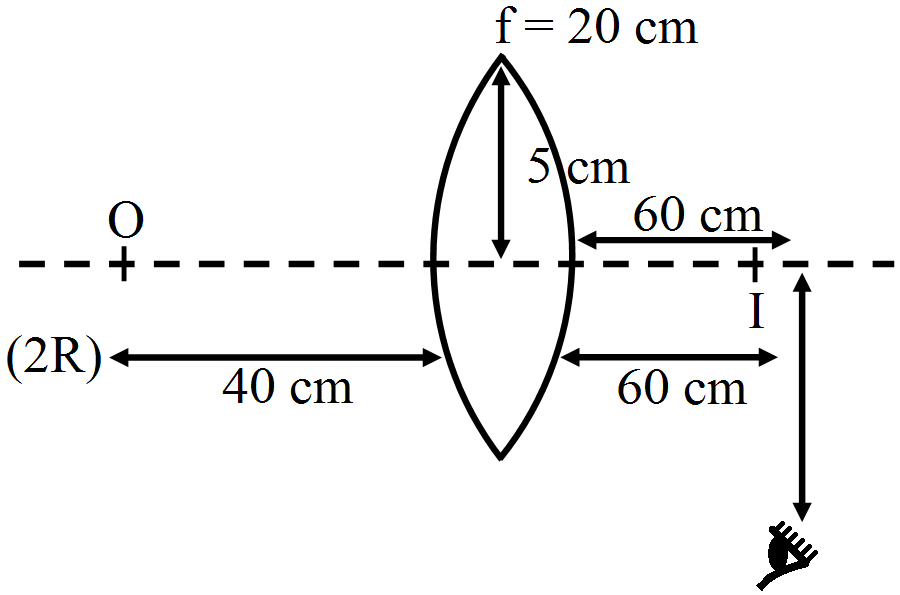
A point object O is placed on the principal axis of a convex lens of focal length f = 20cm at a distance of 40cm to the left of it. The diameter of the lens is 10cm. An eye is placed 60cm to right of the lens and a distance h below the principal axis. The maximum value of h to see the image is:
  • A
    0
  • 2.5cm
  • C
    5cm
  • D
    10cm.
Answer
Correct option: B.
2.5cm
Explanation:


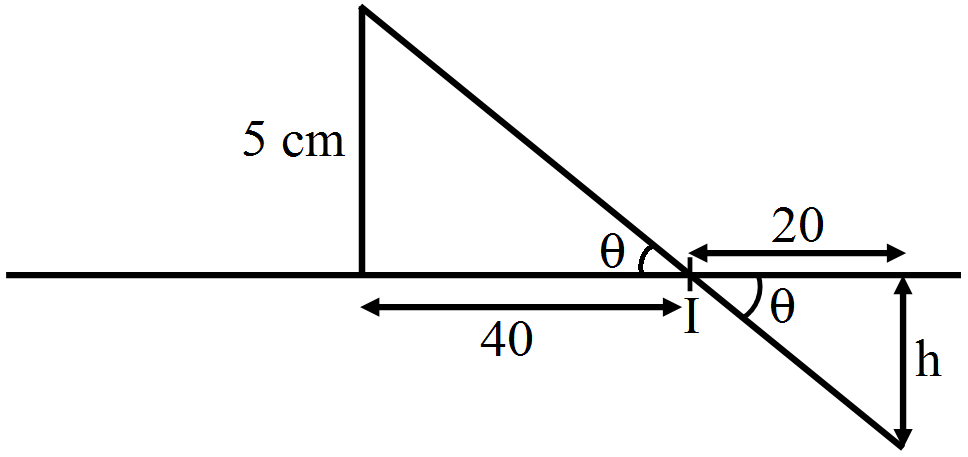
$\tan\theta=\frac{5}{40}=\frac{\text{h}}{20}$
$\text{h}=\frac{5}{2}=\frac{\text{h}}{20}$
$\text{h}=\frac{5}{2}=2.5\text{cm}$
The maximum value of "h =2.5cm" to see the Image of the object.
View full question & answer
MCQ 151 Mark
A double convex lens has two surfaces of equal radii R and refractive index $\mu=1.5$ We have,
  • A
    $\text{f}=\frac{\text{R}}{2}$
  • $\text{f}=\text{R}$
  • C
    $\text{f}=-\text{R}$
  • D
    $\text{f}=2\text{R}$
Answer
Correct option: B.
$\text{f}=\text{R}$
Explanation:

$\Rightarrow\frac{1}{\text{f}}=(\mu-1)\Big(\frac{1}{\text{R}_1}-\frac{1}{\text{R}_2}\Big)$
$\Rightarrow\frac{1}{\text{f}}=\Big(\frac{3}{2}-1\Big)\Big(\frac{1}{\text{R}}-\Big(-\frac{1}{\text{R}}\Big)\Big)$
$\frac{1}{\text{f}}=\frac{1}{\text{R}}$
$\text{f}=\text{R}$
View full question & answer
MCQ 161 Mark
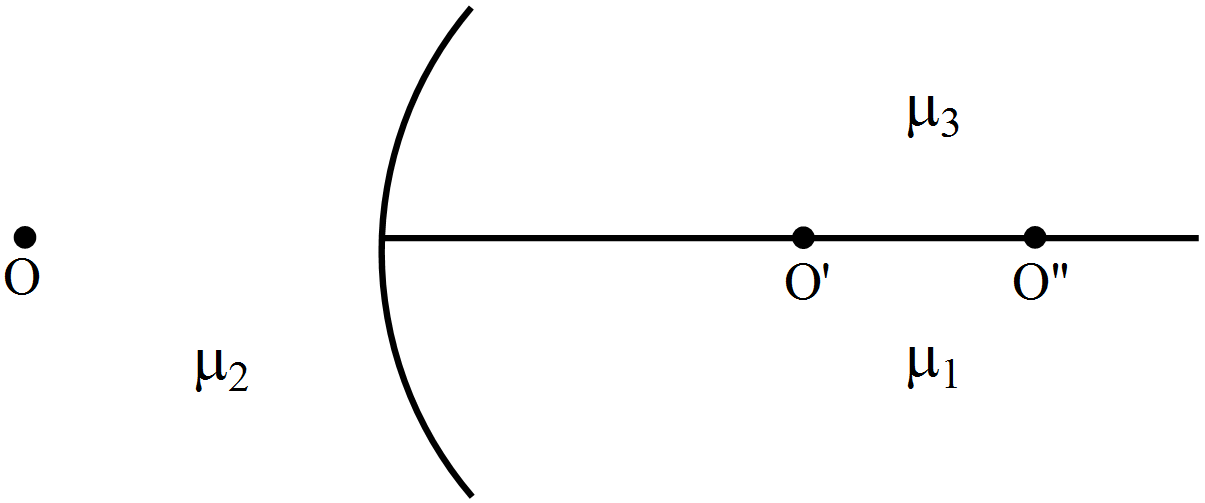
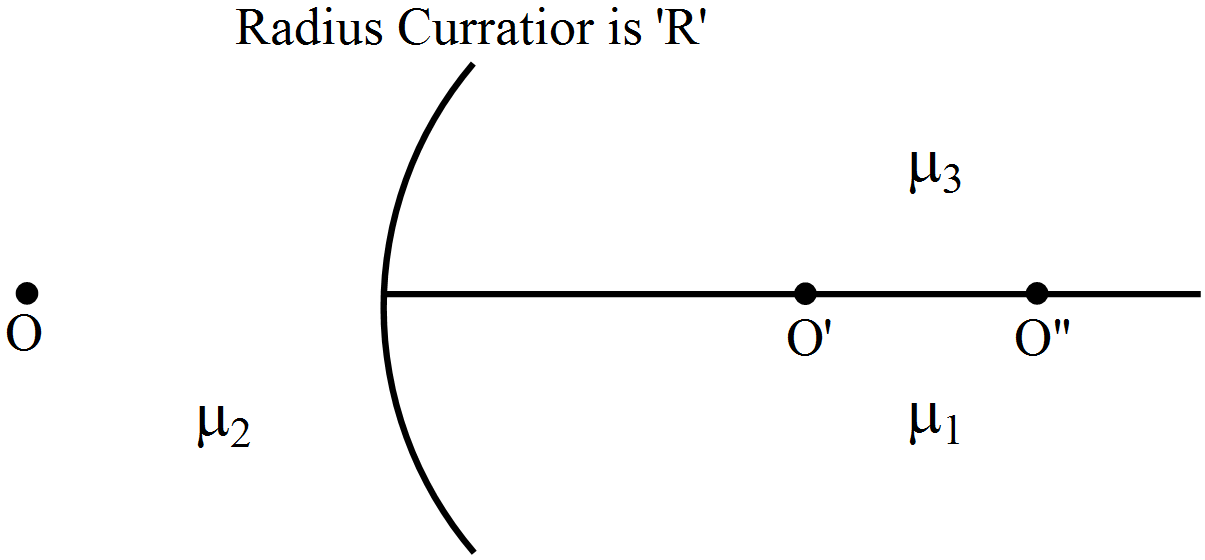
Three transparent media of refractive indices $\mu_1,\mu_2$ and $\mu_3.$ A point object $O$ is placed in the medium $\mu_2.$ If the entire medium on the right of the spherical surface has refractive index $\mu_1,$ the image forms at $O'$. If this entire medium has refractive index $\mu_3,$ the image forms at $O"$. In the situation shown:

  • A
    The image forms between $O'$ and $O"$
  • B
    The image forms to the left of $O'$
  • C
    The image forms to the right of $O"$
  • Two images form, one at $O'$ and the other at $O".$
Answer
Correct option: D.
Two images form, one at $O'$ and the other at $O".$
$\mathrm{m}_1$, Image is $\mathrm{O}^1$
$\mathrm{m}_3$, Image is $\mathrm{O}^{11}$
Spherical Surface formula
$\frac{\mu^{11}}{\text{v}}-\frac{\mu_1}{\mu}=\frac{\mu^{11}-\mu^1}{\text{R}}$
If ray goes to $\mathrm{m}^2$ to $\mathrm{m}^1$ than Image is formed at $\mathrm{O}^1$ and if ray goes to $\mathrm{m}_2$ to $\mathrm{m}_3$ than Image is formed at $\mathrm{O}^{11}$.

View full question & answer
MCQ 171 Mark
The image formed by a concave mirror:
  • A
    Is always real.
  • B
    Is always virtual.
  • Is certainly real if the object is virtual.
  • D
    Is certainly virtual if the object is real.
Answer
Correct option: C.
Is certainly real if the object is virtual.
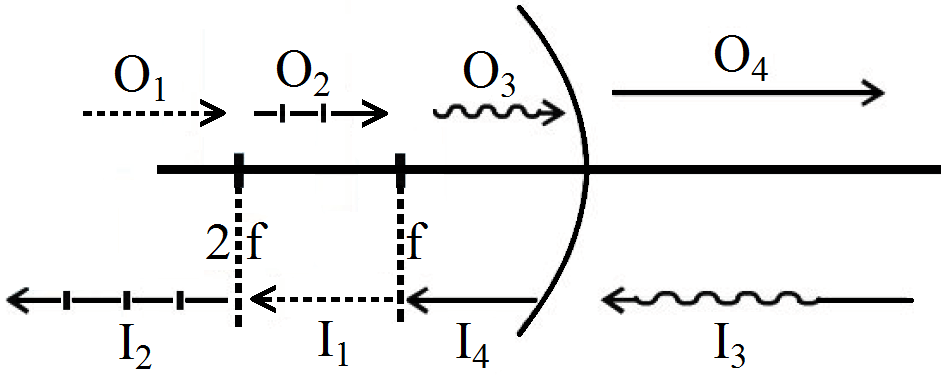
Object
Image
$O_1$
$I_1$
$O_2$
$I_2$
$O_3$
$I_3$
$O_4$
$I_4$
Here $O_4$ is virtual oblect $\&\ I_4$ is real image.
View full question & answer
MCQ 181 Mark
Total internal reflection can take place only if:
  • A
    Light goes from optically rarer medium (smaller refractive index) to optically denser medium.
  • Light goes from optically denser medium to rarer medium.
  • C
    The refractive indices of the two media are close to each other.
  • D
    The refractive indices of the two media are widely different.
Answer
Correct option: B.
Light goes from optically denser medium to rarer medium.
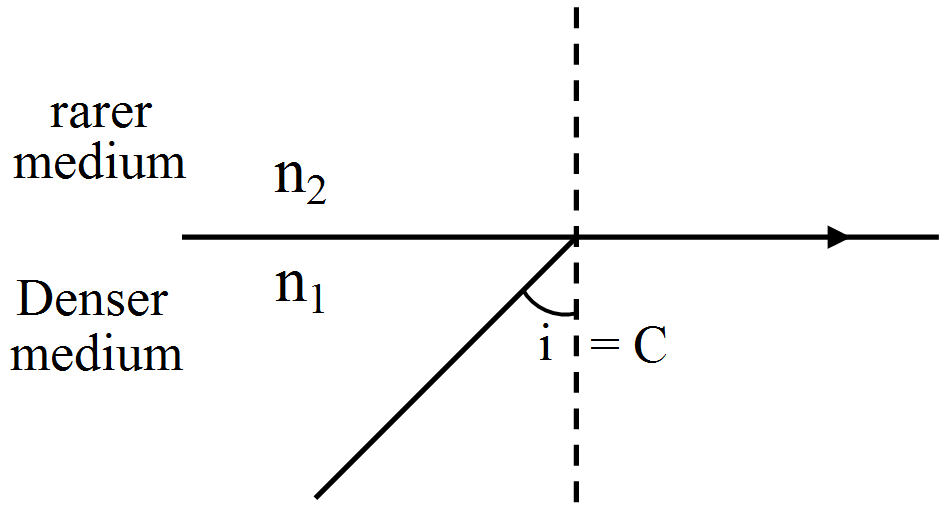
$\text{T.I.R.} ($Total Internal reflection$)$
$i < C ($condition for $\text{T.I.R.})$
By Snell's Law
$\text{n}_1\sin\text{i}=\text{n}_2\sin90^{\circ}$
$\sin\text{i}=\frac{\text{n}_2}{\text{n}_1}=\sin\text{C}$
$\text{þ} \ \text{C}=\sin^{-1}$
$\because \ -1\leq\sin\text{i}\leq1$
$n_1 > n_2 ($so we can conclude that light goes from optically denser medium to rarer medium $\&$ incident angle is greater than the critical angle.$)$
View full question & answer
MCQ 191 Mark
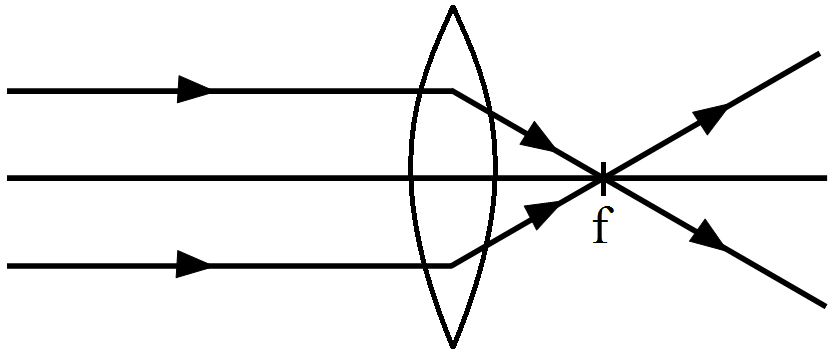
A parallel beam of light is incident on a converging lens parallel to its principal axis. As one moves away from the lens on the other side on its principal axis, the intensity of light:
  • A
    Remains, constant.
  • B
    Continuously increases.
  • C
    Continuously decreases.
  • First increases then decreases.
Answer
Correct option: D.
First increases then decreases.
Explanation:

The intensity o light is first increases then decreases.
View full question & answer
MCQ 201 Mark
A symmetric double convex lens is cut in two equal parts by a plane perpendicular to the principal axis. If the power of the original lens was $4D,$ the power of a cutlens will be :
  • $2D$
     
  • B
    $3D$
     
  • C
    $4D$
     
  • D
    $5D.$
Answer
Correct option: A.
$2D$
 

Before cut
$\frac{1}{\text{f}}=(\mu-1)\Big(\frac{2}{\text{R}}\Big)=4\text{D} \ ...(1)$
After cut
$\frac{1}{\text{f}_1}=(\mu-1)\Big(\frac{1}{\text{R}}\Big)+\frac{1}{\text{f}_2}=(\mu-1)\Big(\frac{1}{2}\Big) \ ...(2)$
From eq. $(1)$ we get Power of $f_1= $power of $f_2$
$\text{P}=\frac{1}{\text{f}_1}=\frac{1}{\text{f}_2}=2\text{D}$
View full question & answer
MCQ 211 Mark
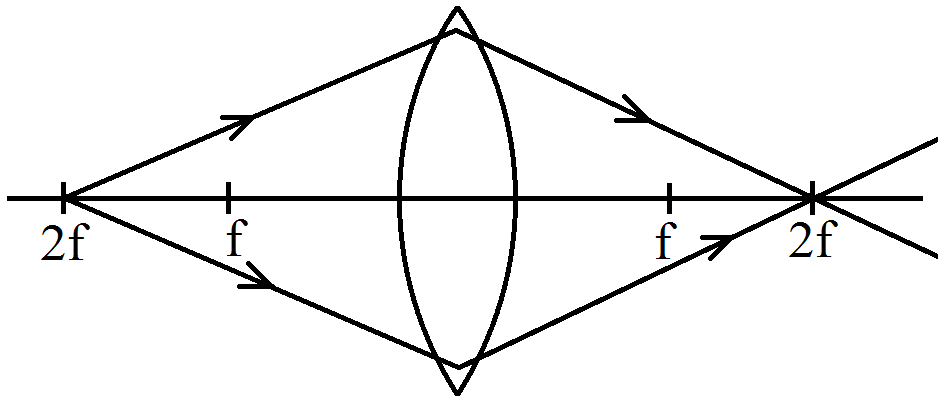
A point source of light is placed at a distance, of 2f from a converging lens of focal length f. The intensity on the other side of the lens is maximum at a distance:
  • A
    f
  • B
    between f and 2
  • 2f
  • D
    more than 2f.
Answer
Correct option: C.
2f
Explanation:

The Intensity on the other side of the lans is maximum at a distance 2f.
View full question & answer