Questions

3 Marks Question

Take a timed test

8 questions · self-marked practice — reveal the answer and mark yourself.

Question 13 Marks
Is the colour of 620nm light and 780nm light same? Is the colour of 620nm light and 621nm light same? How many colours are there in white light?
Answer
White light is a composition of seven colours. These are violet, indigo, blue, green, yellow, orange and red, collectively known as VIBGYOR. Spectrum of white light consists of sever colour bands. Each band consists of some range of wavelengths or frequencies.
For orange colour: (590nm to 620nm)
For red colour: (620nm to 780nm)
So, the colour of 620nm and 780nm lights may be different. But the colour of 620nm light and 621nm light is same.
View full question & answer
Question 23 Marks
Find the range of frequency of light that is visible to an average human being $(400\text{nm} < \lambda < 700\text{nm}).$
Answer
Given that, $400\text{nm} < \lambda < 700\text{nm}.$
$\frac{1}{700\text{nm}} < \frac{1}{\lambda} < \frac{1}{400\text{nm}}$
$\Rightarrow\frac{1}{7\times10^{-7}} < \frac{1}{\lambda} < \frac{1}{4\times10^{-7}}$
$\Rightarrow\frac{3\times10^8}{7\times10^{-7}} < \frac{\text{c}}{\lambda} < \frac{3\times10^8}{4\times10^{-7}}$
$($Where, $c =$ speed of light $= 3 \times 10^8m/s)$
$\Rightarrow4.3\times10^{14} < \frac{\text{c}}{\lambda} < 7.5\times10^{14}$
$\Rightarrow4.3\times10^{14}\text{Hz} < \text{f} < 7 .5\times10^{14}\text{Hz}.$
View full question & answer
Question 33 Marks
Suppose white light falls on a double slit but one slit is covered by a violet filter (allowing $\lambda=400\text{nm}$). Describe the nature of the fringe pattern observed.
Answer
The violet filter will allow only violet light to pass through it. Now, if the double slit experiment is performed with the white light and violet light, the fringe pattern will not be the same as obtained by just using white light as the source. To have interference pattern, the light waves entering from the slits should be monochromatic. So, in this case, the violet light will superimpose with only violet light (of wavelength 400nm) in such a way that the bright bands will be of violet colour and the minima will be completely dark.
View full question & answer
Question 43 Marks
If the separation between the slits in a Young's double slit experiment is increased, what happens to the fringe-width? If the separation is increased too much, will the fringe pattern remain detectable?
Answer
The fringe width in Young's double slit experiment depends on the separation of the slits.$\text{x}=\frac{\lambda\text{D}}{\text{d}},$
where$\lambda$ = wavelength
x = fringe width D = distance between slits and screen d = separation between slits On increasing d, fringe width decreases. If the separation is increased too much, the fringes will merge with each other and the fringe pattern won't be detectable.
View full question & answer
Question 53 Marks
The index of refraction of fused quartz is 1.472 for light of wavelength 400nm and is 1.452 for light of wavelength 760nm. Find the speeds of light of these wavelengths in fused quartz.
Answer
We know that, $\frac{\mu_2}{\mu_1}=\frac{\text{v}_1}{\text{v}_2}$So, $\frac{1472}{1}=\frac{3\times10^8}{\text{v}_{400}}\Rightarrow\text{v}_{400}=2.04\times10^8\text{m/sec}.$
[because, for air, $\mu=1\ \text{and v}=3\times10^8\text{m/s}]$
Again, $\frac{1452}{1}=\frac{3\times10^8}{\text{v}_{760}}\Rightarrow\text{v}_{760}=2.07\times10^8\text{m/sec}.$
View full question & answer
Question 63 Marks
Can we perform Young's double slit experiment with sound waves? To get a reasonable "fringe pattern", what should be the order of separation between the slits? How can the bright fringes and the dark fringes be detected in this case?
Answer
Young's double slit experiment can be performed with sound waves, as the sound waves also show interference pattern. To get a reasonable 'fringe pattern", the separation of the slits should be of the order of the wavelength of the sound waves used.
In this experiment, the bright and dark fringes can be detected by measuring the intensity of sound using a microphone or any other detector.
View full question & answer
Question 73 Marks
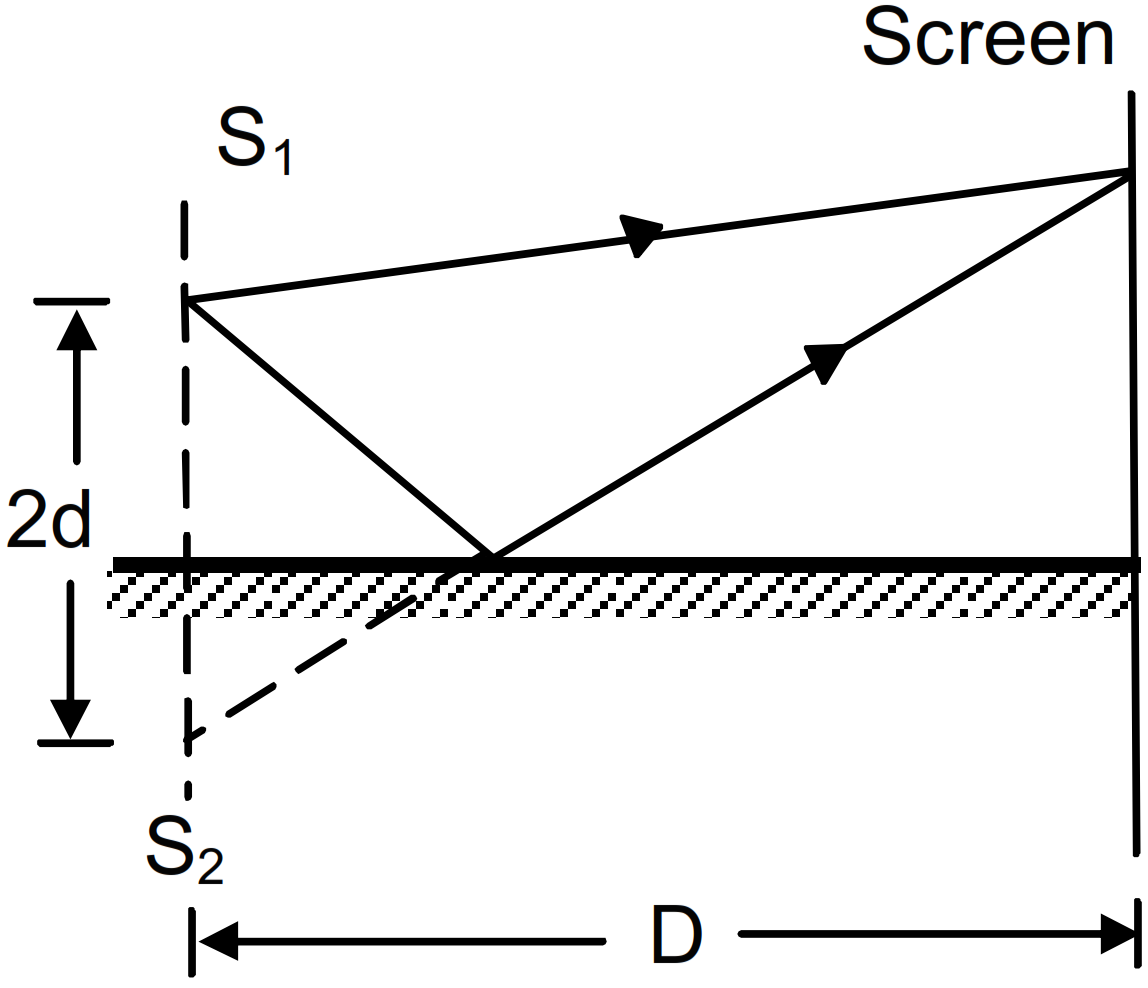
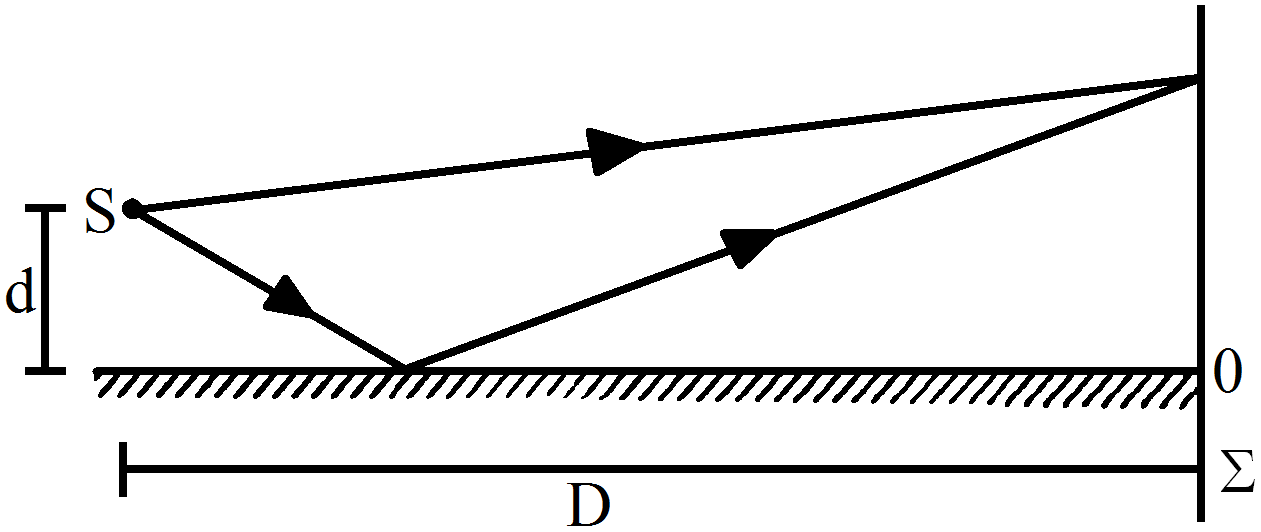
A narrow slit S transmitting light of wavelength $\lambda$ is placed a distance d above a large plane mirror as shown in figure (17-E1). The light coming directly from the slit and that coming after the reflection interfere at a screen $\sum$ placed at a distance D from the slit.
  1. What will be the intensity at a point just above the mirror, i.e., just above O?
  2. At what distance from 0 does the first maximum occur?
Answer
  1. Since, there is a phase difference of $\pi$ between direct light and reflecting light, the intensity just above the mirror will be zero.
  2. Here, 2d = equivalent slit separation


D = Distance between slit and screen.

We know for bright fringe, $\Delta\text{x}=\frac{\text{y}\times2\text{d}}{\text{D}}=\text{n}\lambda$

But as there is a phase reversal of $\frac{\lambda}{2}.$

$\Rightarrow\frac{\text{y}\times2\text{d}}{\text{D}}+\frac{\lambda}{2}=\text{n}\lambda$

$\Rightarrow\frac{\text{y}\times2\text{d}}{\text{D}}=\text{n}\lambda-\frac{\lambda}{2}\Rightarrow\text{y}=\frac{\lambda\text{D}}{4\text{d}}$
View full question & answer
Question 83 Marks
Two narrow slits emitting iight in phase are separated by a distance of 1.0cm. The wavelength of the light is $5.0 \times 10^{-7}m$. The interference pattern is observed on a screen placed at a distance of 1.0m.
  1. Find the separation between the consecutive maxima. Can you expect to distinguish between these maxima?
  2. Find the separation between the sources which will give a separation of 1.0mm between the consecutive maxima.
Answer
Given that, $d = 1cm = 10^{-2}m, \lambda=5\times10^{-7}\text{m}$ and D = 1m
  1. Separation between two consecutive maxima is equal to fringe width.
So, $\beta=\frac{\lambda\text{D}}{\text{d}}=\frac{5\times10^{-7}\times1}{10^{-2}}\text{m}=5\times10^{-5}\text{m}=0.05\text{mm}.$
  1. When, $\lambda=1\text{mm}=10^{-3}\text{m}$
$10^{-3}\text{m}=\frac{5\times10^{-7}\times1}{\text{D}}\Rightarrow\text{D}=5\times10^{-4}\text{m}=0.50\text{mm}.$
View full question & answer