Questions

3 Marks Question

Take a timed test

10 questions · self-marked practice — reveal the answer and mark yourself.

Question 13 Marks
Why are the magnification properties of microscopes and telescopes defined in terms of the ratio of angles and not in terms of the ratio of sizes of objects and images?
Answer
Instruments like telescopes and microscopes deal with objects placed at different distances. Due to some physical factors, there is a relative change in heights not in the angle which the light emerging from them subtends on the lens. So, the magnification properties of instruments are defined in terms of the ratio of angles.
View full question & answer
Question 23 Marks
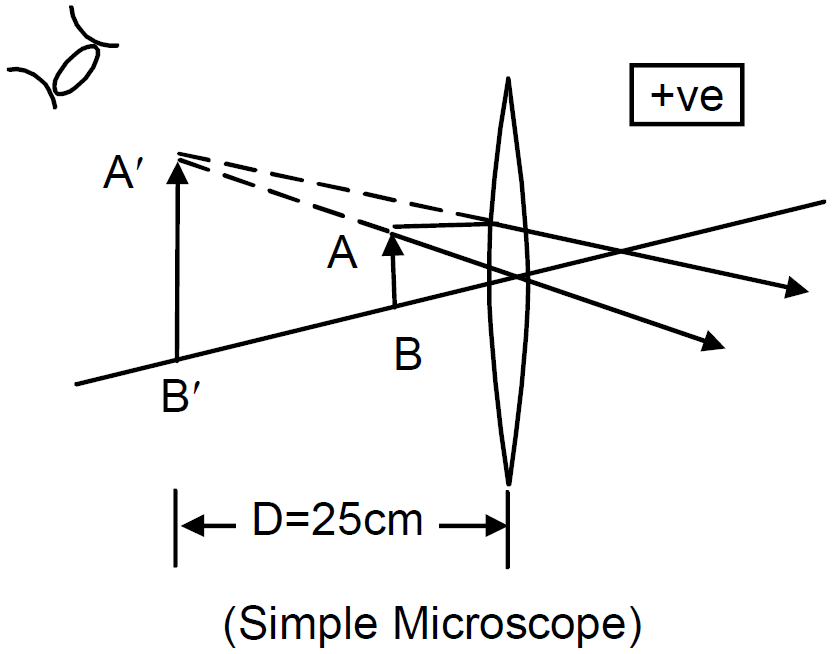
The magnifying power of a simple microscope is given by $1+\frac{\text{D}}{\text{f}},$ where D is the least distance for clear vision. For farsighted persons, D is greater than the usual. Does it mean that the magnifying power of a simple microscope is greater for a farsighted person as compared to a normal person? Does it mean that a farsighted person can see an insect more clearly under a microscope than a normal person?
Answer
The magnifying power of a simple microscope depends on the ratio $\frac{\text{D}}{\text{f}}$ for a farsighted person. Here, D for a farsighted person is greater than that for a normal person, but the value of f remains the same. Therefore, the magnifying power of a simple microscope is greater for a farsighted person compared to that for a person with normal vision. Also, a farsighted person can see the insect more clearly under the microscope than a person with normal vision.
View full question & answer
Question 33 Marks
A person looks at different trees in an open space with the following details. Arrange the trees in decreasing order of their apparent sizes.
Tree Height(m) Distance form the eye(m)
A 2.8 50
B 2.5 80
C 1.8 70
D 2.8 100
Answer
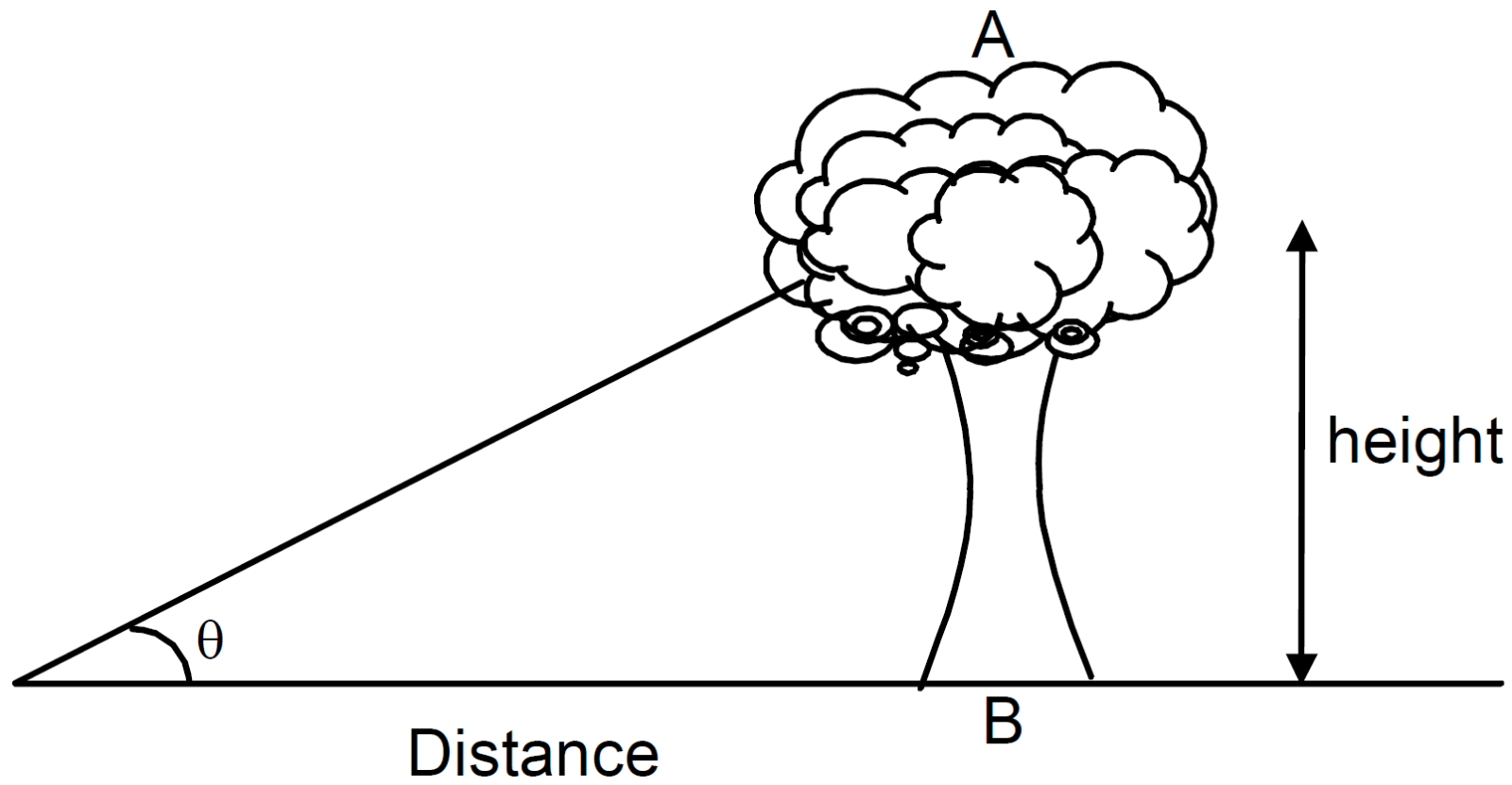
The visual angles made by the tree with the eyes can be calculated be below.$\theta=\frac{\text{Height of the tree}}{\text{Distance from the eye}}=\frac{\text{AB}}{\text{OB}}$
$\Rightarrow\theta_\text{A}=\frac{2}{50}=0.04$
Similarly, $\theta_\text{B}=\frac{2.5}{80}=0.03125$$\theta_\text{c}=\frac{2.8} {70}=0.02571$
$\theta_\text{D}=\frac{2.8}{100}=0.028$
Since, $\theta_\text{A}>\theta_\text{B}>\theta_\text{D}>\theta_\text{C}$ the arrangement in decreasing order is given by A, B, D and C.
View full question & answer
Question 43 Marks
The magnifying power of a converging lens used as a simple microscope is $\Big(1+\frac{\text{D}}{\text{f}}\Big).$ A compound microscope is a combination of two such converging lenses. Why don't we have magnifying power $\Big(1+\frac{\text{D}}{\text{f}_\text{o}}\Big) \Big(1+\frac{\text{D}}{\text{f}_\text{o}}\Big)?$ In other words, why can the objective not be treated as a simple microscope but the eyepiece can?
Answer
In a simple microscope, the converging lens is used to magnify the object. It is done by the eyepiece in a compound microscope. But the purpose of the objective lens is the same, i.e., to form an enlarged, real and inverted image of the object at a distance less than the focal length of the eyepiece. So, its magnification power cannot be expressed in a way it is expressed for a simple microscope.
View full question & answer
Question 53 Marks
A nearsighted person cannot see beyond 25cm. Assuming that the separation of them glass from the eye is 1cm, find the power of lens needed to see distant objects.
Answer
For the near sighted person,
v = distance of image from glass
= distance of image from eye - separation between glass and eye
= 25cm - 1cm = 24cm = 0.24m
So, for the glass, $\text{u}=\infty$ and v = -24cm = -0.24m
So, $\frac{1}{\text{f}}=\frac{1}{\text{v}}-\frac{1}{\text{u}}=\frac{1}{-0.24}-\frac{1}{\infty}=-4.2\text{D}$
View full question & answer
Question 63 Marks
A person has near point at 100cm. What power of lens is needed to read at 20cm if he/ she uses.
  1. Contact lens,
  2. Spectacles having glasses 2.0cm separated from the eyes?
Answer
The person has near point 100cm. It is needed to read at a distance of 20cm.
  1. When contact lens is used,
u = -20cm = -0.2m,

v = -100cm = -1m

So, $\frac{1}{\text{f}}=\frac{1}{\text{v}}-\frac{1}{\text{u}}=\frac{1}{-1}-\frac{1}{-0.2}=-1+5=+4\text{D}$
  1. When spectacles are used,
u = -(20 - 2) = -18cm = -0.18m

v = -100cm = -1m

So, $\frac{1}{\text{f}}=\frac{1}{\text{v}}-\frac{1}{\text{u}}=\frac{1}{-1}-\frac{1}{-0.18}=-1+5.55=+4.5\text{D}$
View full question & answer
Question 73 Marks
A magnifying glass is a converging lens placed close to the eye. A farsighted person uses spectacles having converging lenses. Compare the functions of a converging lens used as a magnifying glass and as spectacles.
Answer
A converging lens in a magnifying glass is of small focal length which is used to magnify an object which is placed close to the lens. On the other hand, converging lens used as spectacles is of varying focal length which depends upon the actual near point of the long-sighted person. It forms image at the near point of the defected eye which is further focussed by the eye lens.
View full question & answer
Question 83 Marks
An object is to be seen through a simple microscope of focal length 12cm. Where should the object be placed so as to produce maximum angular magnification? The least distance for clear vision is 25cm.
Answer
For the given simple microscope, f = 12cm and D = 25cm For maximum angular magnification, the image should be produced at least distance of clear vision. So, v = -D = -25cm Now, $\frac{1}{\text{v}}-\frac{1}{\text{u}}=\frac{1}{\text{f}}$$\Rightarrow \frac{1}{\text{u}}=\frac{1}{\text{v}}-\frac{1}{\text{f}}=\frac{1}{-25}-\frac{1}{12}=-\frac{37}{300}$
$\Rightarrow \text{u}=-8.1\text{cm}$
So, the object should be placed 8.1cm away from the lens.
View full question & answer
Question 93 Marks
A simple microscope has a magnifying power of 3.0 when the image is formed at the near point (25cm) of a normal eye.
  1. What is its focal length?
  2. What will be its magnifying power if the image is formed at infinity?
Answer
The simple microscope has, m = 3, when image is formed at D = 25cm
  1. $\text{m}=1+\frac{\text{D}}{\text{f}}\Rightarrow3=1+\frac{25}{\text{f}}$
$\Rightarrow\text{f}=\frac{25}{2}=12.5\text{cm}$
  1. When the image is formed at infinity (normal adjustment)
Magnifying power $=\frac{\text{D}}{\text{f}}=\frac{25}{12.5}= 2.0$
View full question & answer
Question 103 Marks
The near point and the far point of a child are at 10cm and 100cm. If the retina is 2.0cm behind the eye-lens, what is the range of the power of the eye-lens?
Answer
The child has near point and far point 10cm and 100cm respectively.Since, the retina is 2cm behind the eye-lens, v = 2cm
For near point u = -10cm = -0.1m, v = 2cm = 0.02m
So, $\frac{1}{\text{f}_\text{near}}=\frac{1}{\text{v}}-\frac{1}{\text{u}}=\frac{1}{0.02}-\frac{1}{-1}=50+10=60\text{D}$
For far point, u = -100cm = = -1m,
v = 2cm = 0.02m
So, $\frac{1}{\text{f}_\text{far}}=\frac{1}{\text{v}}-\frac{1}{\text{u}}=\frac{1}{-1}=50+1=51\text{D}$
So, the rage of power of the eye-lens is +60D to +51D.
View full question & answer