Questions

3 Marks Question

Take a timed test

11 questions · self-marked practice — reveal the answer and mark yourself.

Question 13 Marks
A free atom of iron emits $\text{K}_\alpha$ X-rays of energy 6.4keV. Calculate the recoil kinetic energy of the atom. Mass of an iron atom $= 9.3 \times 10^{-26}kg.$
Answer
Here energy of photon $= E$
$E = 6.4$KeV $= 6.4 × 10³$ev
Momentum of Photon $=\frac{\text{E}}{\text{C}}=\frac{6.4\times10^3}{3\times10^8}=3.41\times10^{-24\text{m/sec}}$
According to collision theory of momentum of photon = momentum of atom
$\therefore$ Momentum of Atom $= P = 3.41 \times 10^{-24}$m/sec
$\therefore$ Recoil K.E. of atom $=\frac{\text{P}^2}{2\text{m}}$
$\Rightarrow\frac{(3.41\times10^{-24})^2\text{eV}}{(2)(9.3\times10^{-26}\times1.6\times10^{-19})}=3.9\text{eV}$
View full question & answer
Question 23 Marks
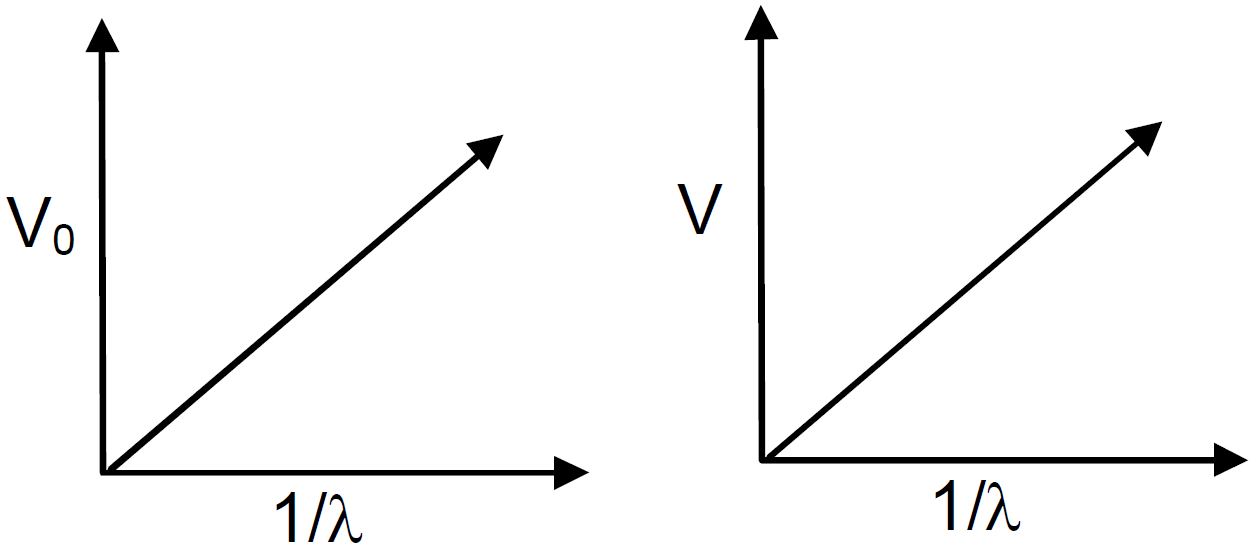
The stopping potential in a photoelectric experiment is linearly related to the inverse of the wavelength $\Big(\frac{1}{\lambda}\Big)$ of the light falling on the cathode. The potential difference applied across an X-ray tube is linearly related to the inverse of the cutoff wavelength$\Big(\frac{1}{\lambda}\Big)$ of the X-ray emitted. Show that the slopes of the lines in the two cases are equal and find its value.
Answer


$V_0→$ Stopping Potential,
$\lambda\rightarrow$ Wavelength, $eV_0 = hv - hv$
$\text{eV}_0=\frac{\text{hc}}{\lambda}$
$\Rightarrow\text{V}_0\lambda=\frac{\text{hc}}{\text{e}}$
V → Potential difference across X-ray tube
$\lambda\rightarrow$ Cut of wavelength
$\lambda=\frac{\text{hc}}{\text{ev}}\ \text{or}\ \text{V}\lambda=\frac{\text{hc}}{\text{e}}$
Slopes are same i.e $\text{V}_0\lambda=\text{V}\lambda$
$\frac{\text{hc}}{\text{e}}=\frac{6.63\times10^{-34}\times3\times10^8}{1.6\times10^{-19}}$
$1.242\times10^{-6}\text{Vm}$
View full question & answer
Question 33 Marks
Suppose a monochromatic X-ray beam of wavelength 100pm is sent through a Young's double slit and the interference pattern is observed on a photographic plate placed 40cm away from the slit. What should be the separation between the slits so that the successive maxima on the screen are separated by a distance of 0.1mm?
Answer
$\lambda=10\text{pm}=100\times10^{-12}\text{m}$
$\text{D}=40\text{cm}=40\times10^{-2}\text{m}$
$\beta=0.1\text{nm}=0.1\times10^{-3}\text{m}$
$\beta=\frac{\lambda\text{D}}{\text{d}}$
$\Rightarrow\text{d}=\frac{\lambda\text{D}}{\beta}$
$=\frac{100\times10^{-12}\times40\times10^{-2}}{10^{-3}\times0.1}=4\times10^{-7}\text{m}$
View full question & answer
Question 43 Marks
If the operating potential in an X-ray tube is increased by 1%, by what percentage does the cutoff wavelength decrease?
Answer
We know $\lambda=\frac{\text{hc}}{\text{V}}$
Now $\lambda=\frac{\text{hc}}{1.01\text{V}}=\frac{\lambda}{1.01}$
$\lambda=\lambda'=\frac{0.01}{1.01}\lambda.$
% change of wave length $=\frac{0.01\times\lambda}{1.01\times\lambda}\times100=\frac{1}{1.01}$
$=0.9900=1\%.$
View full question & answer
Question 53 Marks
Characteristic X-rays may be used to identify the element from which they are being emitted. Can continuous X-rays be used for this purpose?
Answer
Characteristic X-rays are emitted due to the transitions of electrons among different shells. The wavelength of the X-rays emitted in these transitions have definite value for a particular element. But continuous X-rays are emitted due to the conversion of kinetic energy of an electron into photon, which varies from collision to collision and is independent of material. Hence, continuous X-rays provide no information about the element from which they are being emitted.
View full question & answer
Question 63 Marks
Iron emits $\text{K}_\alpha$ X-ray of energy 6.4keV and calcium emits $\text{K}_\alpha$ X-rays of energy 3.69 keV. Calculate the times taken by an iron $\text{K}_\alpha$ photon to cross through a distance of 3km.
Answer
Distance $= 3km = 3 \times 10^3m$
$C = 3 \times 10^8m/s$
$\text{t}=\frac{\text{Dist}}{\text{Speed}}=\frac{3\times10^3}{3\times10^8}$
$=10^{-5}\text{sec}$
$\Rightarrow10\times10^{-8}\text{sec}=10\mu\text{s}$ in both case.
View full question & answer
Question 73 Marks
What potential difference should be applied across an X-ray tube to get X-ray of wavelength not less than 0.10nm? What is the maximum energy of a photon of this X-ray in joule?
Answer
$\lambda=0.10\text{nm}=10^{-10}\text{m}$
$\text{h}=6.63\times10^{-34}\text{J-s}$
$\text{C}=3\times10^8\text{m/s}$
$\text{e}=1.6\times10^{-19}\text{C}$
$\lambda_\text{min}=\frac{\text{hc}}{\text{eV}}$
Or $\text{V}=\frac{\text{hc}}{\text{e}\lambda}$
$=\frac{6.63\times10^{-34}\times3\times10^8}{1.6\times10^{-19}\times10^{-10}}$
$=12.43\times10^3\text{V}=12.4\text{KV}$
Max. Energy $=\frac{\text{hc}}{\lambda}=\frac{6.63\times10^{-34}\times3\times10^8}{10^{-10}}$
$=19.89\times10^{-18}=1.989\times10^{-15}$
$=2\times10^{-15}\text{J}$
View full question & answer
Question 83 Marks
In a Coolidge tube, electrons strike the target and stop inside it. Does the target get more and more negatively charged as time passes?
Answer
An electron emitted from the filament undergoes a number of collisions inside the material and loses its kinetic energy before coming to rest. This energy is utilised to give out photons or reject electrons from the atoms of the target. These electrons move to the battery connected to the circuit. Thus, the target does not get more and more negatively charged as time passes.
View full question & answer
Question 93 Marks
Can X-rays be used for photoelectric effect?
Answer
Yes, X-rays can be use for photoelectric effect. Photoelectric effect is the emission of electrons from a metal surface when the frequency of radiation is greater than the threshold frequency of the metal. For photoelectric effect using X-rays, the energy of the incoming X-ray photon should be greater than the work-function of the metal used.
View full question & answer
Question 103 Marks
The electric current in an X-ray tube (from the target to the filament) operating at 40kV is 10mA. Assume that on an average, 1% of the total kinetic energy of the electron hitting hte target are converted into X-rays.
  1. What is the total power emitted as X-rays
  2. How much heat is produced in the target every second?
Answer
$V = 40KV,$
$i = 10mA$
$1%$ of $T_{KE}($Total Kinetic Energy$) = X$ ray
$i = ne$
Or, $\text{n}=\frac{10^{-2}}{1.6\times10^{-19}}=0.625\times10^{17}$ no. of electrons.
KE of one electron $= eV = 1.6 \times 1019 \times 40103 = 6.4 \times 10^{-15}J$
$T_{KE}= 0.625 \times 6.4 \times 10^{17} \times 10^{-15}= 4 \times 10^2J.$
  1. Power emitted in X-ray $=4\times10^2\times(\frac{-1}{100})=4\text{w}$
  2. Heat produced in target per second $= 400 - 4 = 396J.$
View full question & answer
Question 113 Marks
Find the energy, the frequency and the momentum of an X-ray photon of wavelength 0.10nm.
Answer
$\lambda=0.1\text{nm}$
  1. Energy $=\frac{\text{hc}}{\lambda}=\frac{1242\text{evnm}}{0.1\text{nm}}$
$=12420\text{ev}=12.42\text{Kev}=12.4\text{Kev}$
  1. Frequency $=\frac{\text{C}}{\lambda}=\frac{3\times10^8}{0.1\times10^{- 9}}$
$=\frac{3\times10^8}{10^{-10}}=3\times10^{18}\text{Hz}$
  1. Momentum $=\frac{\text{E}}{\text{C}}=\frac{12.4\times10^3\times1.6\times10^{-19}}{3\times10^8}$
$=6.613\times10^{-24}\text{Kg-m/s}=6.62\times10^{-24}\text{Kg-m/s}$
View full question & answer