Question 13 Marks
How many square slabs each with side $90\ cm$ are needed to cover a floor of area 81sqm.
AnswerGiven, side of square slab $= 90 \ cm$
$\therefore$ Area of square slab = Side $\times $ Side $= 90 \times 90 = 8100sq-cm$
But according to the question, area $= 81sq-m$
$\because$ $1m = 100\ cm$
$1sq-m = 100 \times 100\ cm = 10000\ cm$
and $81sq-m = 810000sq-cm$
Now, number of slabs $=\frac{\text{Area of floor}}{\text{Area of one square slab}}$
$=\frac{810000}{8100}=100$
View full question & answer→Question 23 Marks
Anmol has a chart paper of measure $90\ cm \times 40\ cm,$ whereas Abhishek has one which measures $50\ cm \times 70\ cm.$ Which will cover more area on the table and by how much?
AnswerGiven, Anmol’s chart paper size $= 90\ cm \times 40\ cm$
Here, let $90\ cm = $ length and $40\ cm =$ breadth
$\therefore$ Area of rectangle = Length $\times $ Breadth $= 90 \times 40 = 3600sq-cm$
Similarly, Abhishek’s chart paper size $= 50\ cm \times 70\ cm$
Here, let $50\ cm$ = length and $70\ cm =$ breadth
$\therefore$ Area of rectangle = Length $\times $ Breadth $= 50 \times 70 = 3500sq-cm$
Hence, Anmol’s chart paper will cover more area as the table. More area $= 3600 - 3500 = 100sq-cm$
View full question & answer→Question 33 Marks
Four regular hexagons are drawn so as to form the design as shown in Fig. If the perimeter of the design is $28\ cm$, find the length of each side of the hexagon.
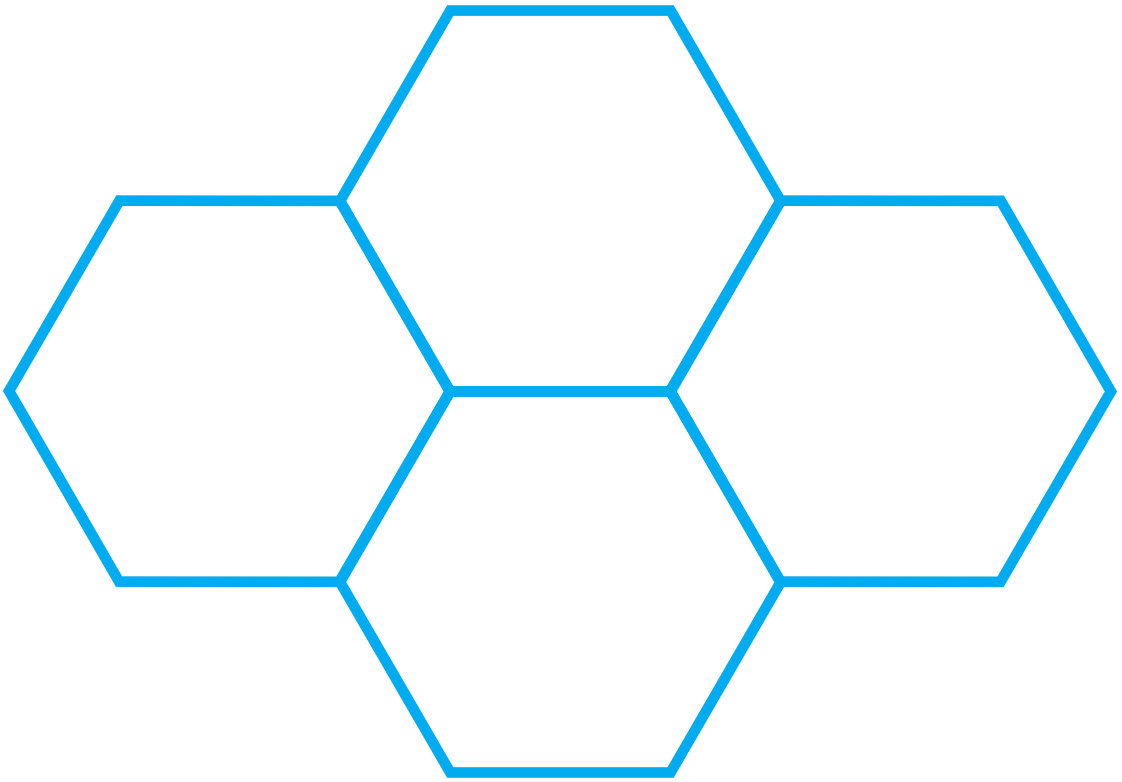
AnswerGiven, four regular hexagons as shown below:
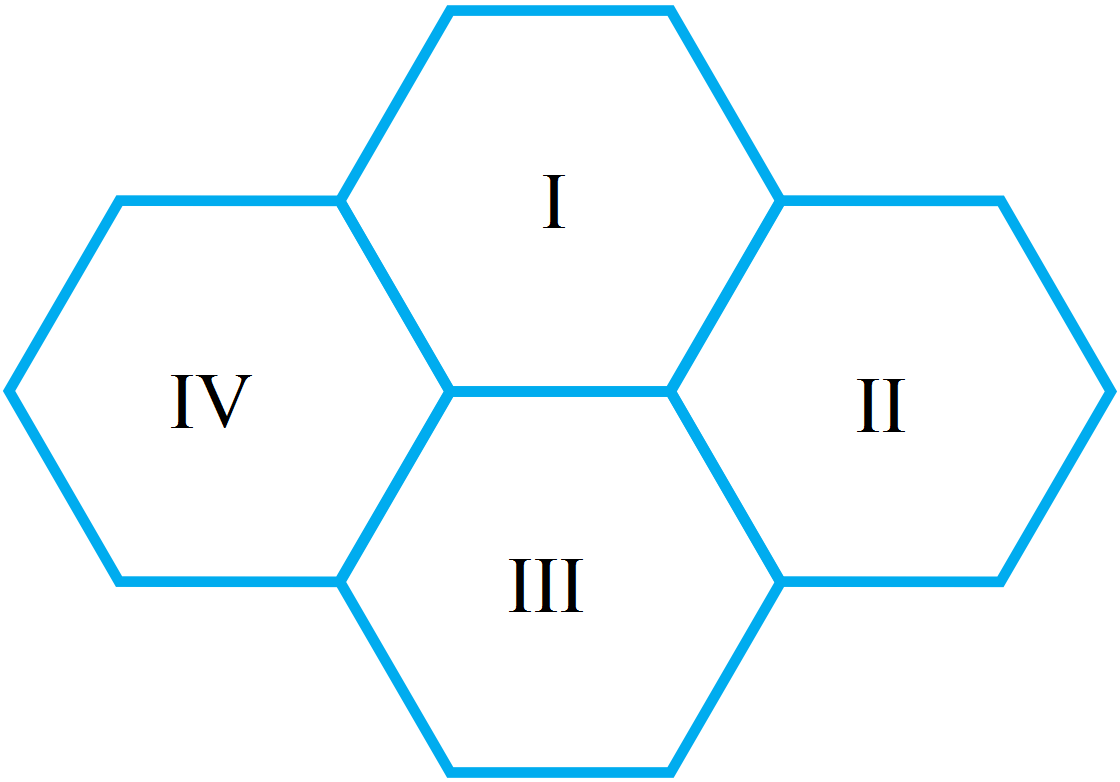
Perimeter of the given design = Sum of all outer sides of the four hexagon Here, this figure has $14$ outer equal sides.
Perimeter of the design $= 14 \times $ Length of one side of hexagon
$\Rightarrow 28 = 14 \times $ Length of one side of hexagon Length of one side of hexagon
$=\frac{28}{14}=2\text{cm}$
Hence, the length of each side of the hexagon is $2\ cm.$ View full question & answer→Question 43 Marks
Rectangular wall $MNOP$ of a kitchen is covered with square tiles of $15\ cm$ length Fig. Find the area of the wall.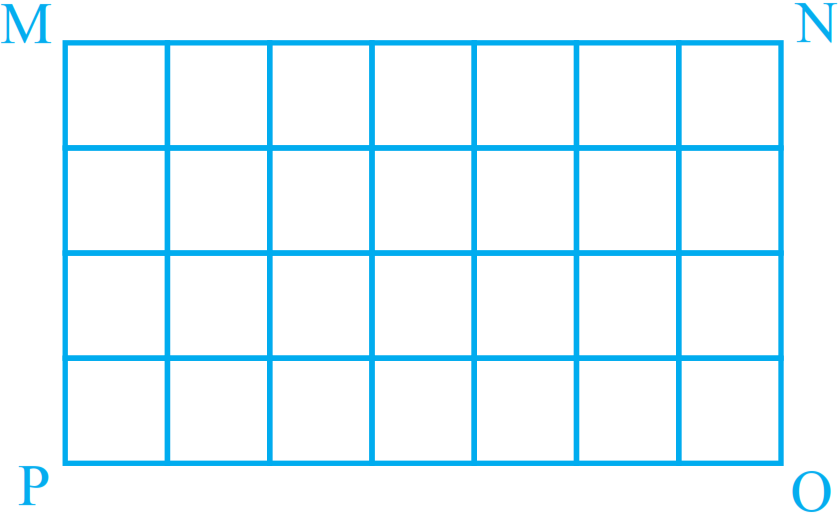
AnswerIn rectangular wall $MNOP$, Number of square tiles $= 28$
Length of one square tile $= 15cm$ In square, all sides are equal
$\therefore$ Area of one square tile = Side $\times $ Side
$= 15 \times 15 = 225\ cm^2$
Area of $28$ tiles $= 225 \times 28 = 6300sq-cm$
Hence, total area of wall $MNOP$ is $6300sq-cm.$
View full question & answer→Question 53 Marks
The length of a rectangular field is twice its breadth. Jamal jogged around it four times and covered a distance of $6\ km$. What is the length of the field?
AnswerLet breadth of rectangular field $= xm$
Then, length of rectangular field $= 2x$ $m$
$\because$ Distance covered in one round = Perimeter
$\therefore$ Distance covered in four rounds $ = 4 \times$ Perimeter
$\Rightarrow 4 \times 2(l + b) = 6\ km$ [$\because$ perimeter $= 2$ (length + breadth)]
$\Rightarrow 8 \times (l + b) = 6000m$ [$\because$ $1\ km = 1000m$]
$\Rightarrow 8(2x + x) = 6000m = 8 \times 3x = 6000m$
$\Rightarrow 24x = 6000m$
$\Rightarrow\frac{24\text{x}}{24}=\frac{6000}{24}$ [dividing both sides by $24$]
$\Rightarrow x = 250m$
$\therefore$ Length of the field $= 2x = 2 \times 250 = 500m$
View full question & answer→Question 63 Marks
Parmindar walks around a square park once and covers $800m$. What will be the area of this park?
AnswerGiven, distance covered in one around $= 800m$
$\because$ Distance covered in one round = Perimeter of square park
$\Rightarrow 800 = 4 \times $ side [$\because$ perimeter $= 4 \times $ side]
$\Rightarrow\frac{800}{4}=\frac{4\times\text{Side}}{4}$ [dividing both sides by $4$]
Side $= 200m$
Now, area of square = Side $\times $ Side
$= 200 \times 200$
$= 40000sq-m$
View full question & answer→Question 73 Marks
The lawn in front of Molly’s house is $12m \times 8m,$ whereas the lawn in front of Dolly’s house is $15m \times 5m$. A bamboo fencing is built around both the lawns. How much fencing is required for both?
AnswerIn order to find the total length of fencing around both the gardens, we will calculate the perimeter of both the gardens and then add them.
Given, size of lawn in front of Molly’s house $= 12m \times 8m$
Perimeter $= 2$(Length + Breadth)
$= 2(12 + 8)m = 40m ...(i)$
Now, size of lawn in front of Dolly’s house $= 15m \times 5m$ Perimeter
$= 2(15 + 5)m = 40m ...(ii)$
From Eqs. $(i)$ and $(ii)$, we get total length $= 40 + 40 = 80m$
Hence, total length of bamboo fencing is $80m.$
View full question & answer→Question 83 Marks
Three squares are joined together as shown in Fig. Their sides are $4\ cm, 10\ cm$ and $3\ cm.$ Find the perimeter of the figure.
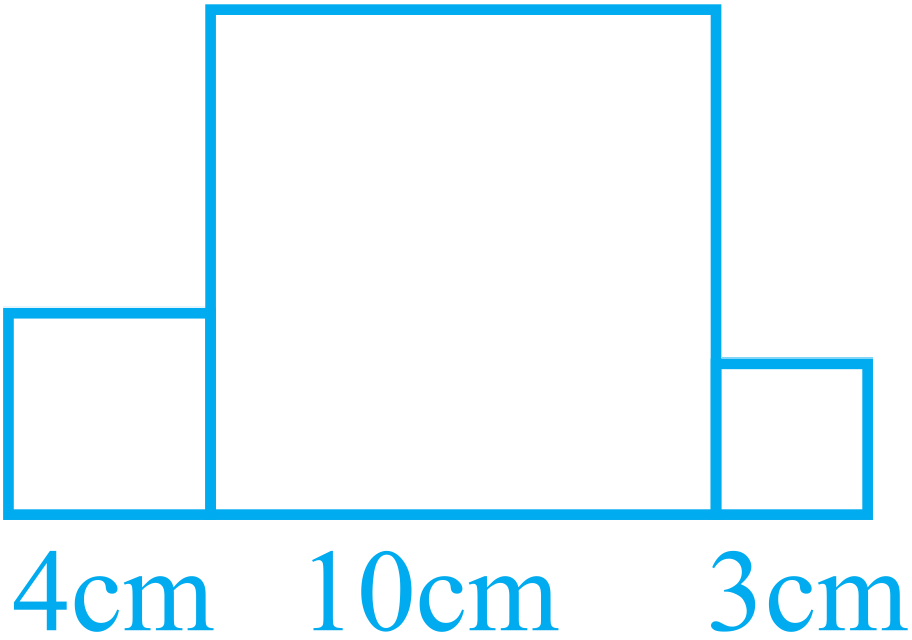
AnswerGiven sides of three squares are $4\ cm, 10\ cm$ and $3\ cm$, respectively.
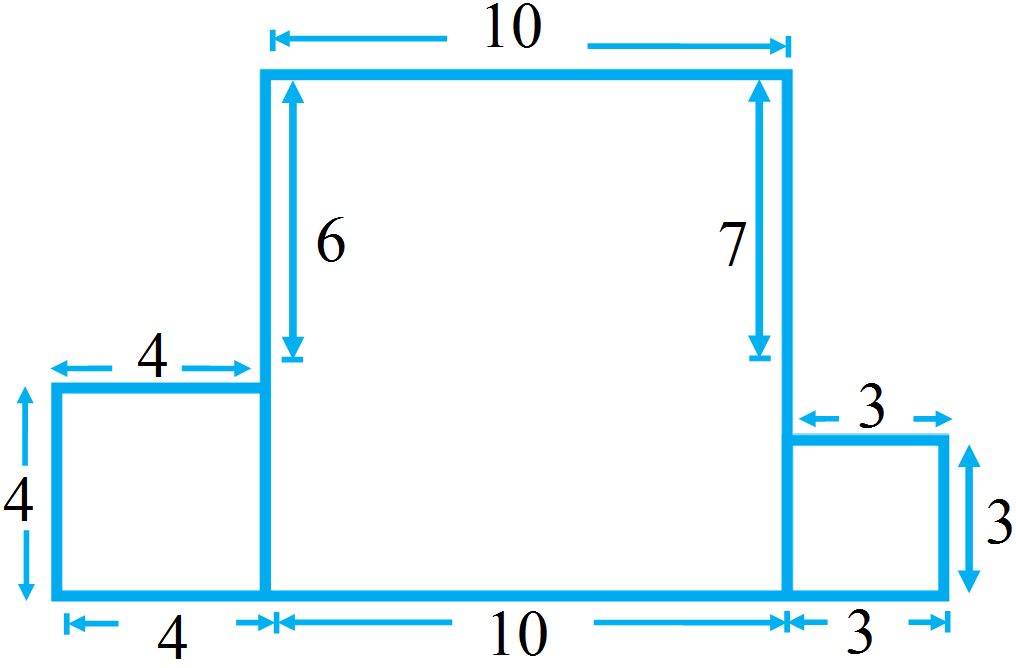
Total perimeter of given squares
= Sum of all outer sides of the figure
$= 4 + 4 + 4 + 6 + 10 + 7 + 3 + 3 + 3 + 10 = 54\ cm$ View full question & answer→Question 93 Marks
The length of an aluminium strip is 40cm. If the lengths in cm are measured in natural numbers, write the measurement of all the possible rectangular frames which can be made out of it. (For example, a rectangular frame with $15\ cm$ length and $5\ cm$ breadth can be made from this strip.)
AnswerGiven, length of an aluminium strip $= 40\ cm$
If this aluminium strip is used to make rectangular frame, then Perimeter of rectangular frame $= 40cm$
$\Rightarrow 2(x + y) = 40cm$ (assuming $x$ and $y$ as the length and breadth of rectangular frame, respectively) $2(x + y)$
$\Rightarrow\frac{2(\text{x + y})}{2}=\frac{40}{2}$ [dividing both sides by $2$]
$\Rightarrow x + y = 20cm$
Now, if the value of both length and breadth are natural numbers, then possible dimensions are as follows
Dimensions (in cm): $1 \times 19, 2 \times 18, 3 \times 17, 4 \times 16, 5 \times 15, 6 \times 14, 7 \times 13, 8 \times 12, 9 \times 11, 10 \times 10$
View full question & answer→Question 103 Marks
Length of a rectangular field is $6$ times its breadth. If the length of the field is $120\ cm$, find the breadth and perimeter of the field.
AnswerGiven, length of rectangular field $(l) = 120\ cm$
Let breadth of rectangular field $= b$
According to question, length is $6$ times its breadth.
$\therefore$ $l = 6b$
$\Rightarrow 120 = 6b$
$\Rightarrow\frac{120}{6}=\frac{6\text{b}}{6}$ [dividing both sides by $6$]
$b = 20\ cm$
We know that,
Perimeter of the field $= 2 \times $ (Length + Breadth)
$= 2(120 + 20)$
$= 2 \times (140)$
$= 280\ cm$
View full question & answer→Question 113 Marks
There is a rectangular lawn $10m$ long and $4m$ wide in front of Meena’s house (Fig.) It is fenced along the two smaller sides and one longer side leaving a gap of $1m$ for the entrance. Find the length of fencing.
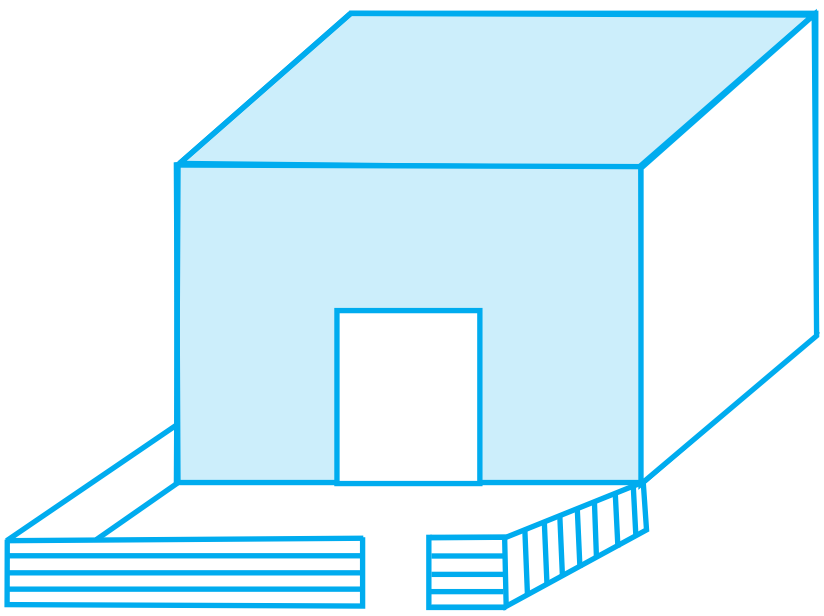
AnswerGiven, width of the lawn, $AB = EF = 4m$ and length of the lawn, $BE = 10m$
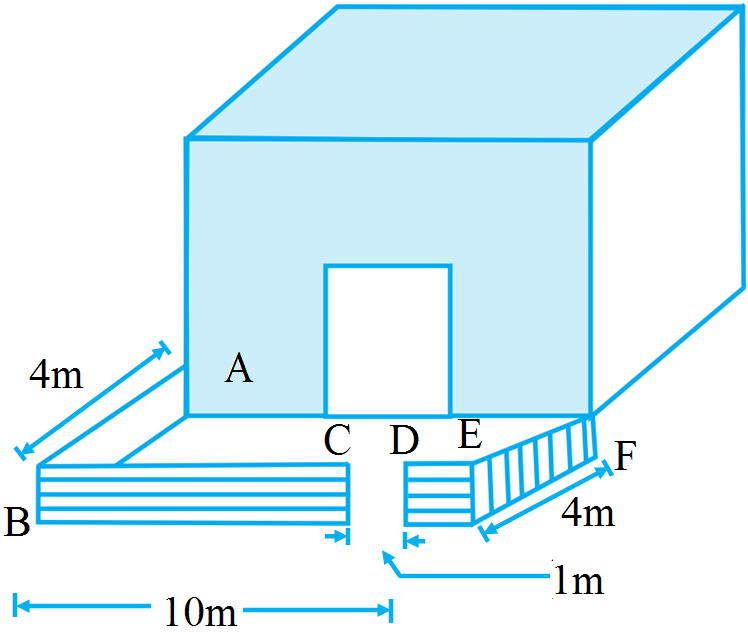
Also, given length of gap, $CD = 1m$
Total length of fencing $= AB + (BC + DE) + EF$
$= AB + (BE - CD) + EF = 4m + (10 - 1)m + 4m = (4 + 9 + 4)m = 17m$
Hence, the length of fencing of the lawn is $17m.$ View full question & answer→Question 123 Marks
What is the length of outer boundary of the park shown in Fig.? What will be the total cost of fencing it at the rate of $Rs\ 20$ per metre? There is a rectangular flower bed in the center of the park. Find the cost of manuring the flower bed at the rate of $Rs\ 50$ per square metre.
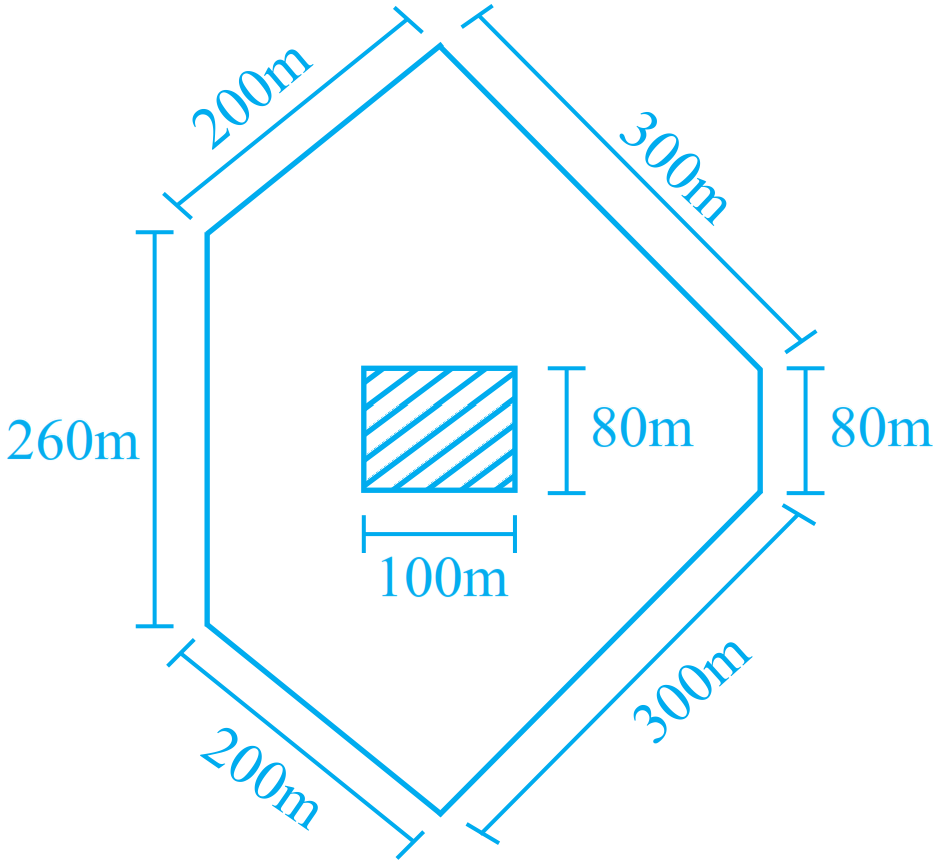
AnswerLength of outer boundary = Perimeter of park = Sum of all sides length $= (200 + 300 + 80 + 300 + 200 + 260)m = 1340m$
Also, rate of fencing per metre $= Rs. 20$ Then, rate of fencing $1340$ metre $= 20 \times 1340 = Rs. 26800$
Now, length of rectangular flower bed $= 100m$ and breadth of rectangular flower bed $= 80m$
$\therefore$ Area of rectangular flower bed = Length $\times $ Breadth $= 100 \times 80 = 8000sq-m$
Also, rate of manuring the flower bed per square metre $= Rs. 50$
Then, rate of manuring the flower bed of area $8000sq-m = 50 \times 8000 = Rs. 400000$
View full question & answer→Question 133 Marks
The perimeter of a regular pentagon is $1540\ cm$. How long is its each side?
AnswerGiven that, perimeter of regular pentagon $= 1540\ cm$
$\therefore$ Perimeter of regular pentagon $= 5 \times $ Length of its side [$\therefore$ pentagon has $5$ sides of equal length]
$\Rightarrow 5 \times $ Length of side $= 1540$
Length of side $=\frac{1540}{5}$ $= 308\ cm$
Hence, the length of each side is $308\ cm.$
View full question & answer→Question 143 Marks
The perimeter of a square garden is $48m$. A small flower bed covers $18$sq-m area inside this garden. What is the area of the garden that is not covered by the flower bed? What fractional part of the garden is covered by flower bed? Find the ratio of the area covered by the flower bed and the remaining area.
AnswerGiven, side of square $= 5\ cm$
$\therefore$ Area of square = Side $\times $ Side $= 5 \times 5$
$= 25sq-cm$
Now, according to question,
New side $= 2 \times $ Old side
$= 2 \times 5= 10\ cm$
$\therefore$ Area of new square = Side $\times $ Side $= 10 \times 10$
$= 100sq-cm$
$\therefore\frac{\text{Area of new square}}{\text{Area of old square}}$
$=\frac{100}{25}=4$
Hence, the area of new square is $4$ times increase.
View full question & answer→Question 153 Marks
The area of a rectangular field is $1600sq-m$. If the length of the field is $80m$, find the perimeter of the field.
AnswerGiven, area of the rectangular field $= 1600sq-m$
and length of the rectangular field $= 80m$
We know that, area of rectangle = Length $\times $ Breadth
Let breadth of the rectangular field = $b$
Then, Area $= 80 \times b$
$\Rightarrow\frac{1600}{80}=\frac{80\times\text{b}}{80}$ [dividing both sides by $80$]
$b = 20m$
Now, perimeter of the rectangular field $= 2 ×$ (Length + Breadth)
$= 2 \times (80 + 20)$
$= 2 \times 100$
$= 200m$
View full question & answer→Question 163 Marks
Match the shapes $($each sides measures $2\ cm)$ in column $I$ with the corresponding perimeters in column $II$:
| |
Column $I$ |
|
Column $II$ |
| $(A)$ |
 |
$(i)$ |
$16\ cm$ |
| $(B)$ |
 |
$(ii)$ |
$20\ cm$ |
| $(C)$ |
 |
$(iii)$ |
$24\ cm$ |
| $(D)$ |
 |
$(iv)$ |
$28\ cm$ |
| |
|
$(v)$ |
$32\ cm$ |
Answer
| |
Column $I$ |
|
Column $II$ |
| $(A)$ |
 |
$(iv)$ |
$28\ cm$ |
| $(B)$ |
 |
$(i)$ |
$16\ cm$ |
| $(C)$ |
 |
$(ii)$ |
$20\ cm$ |
| $(D)$ |
 |
$(iii)$ |
$24\ cm$ |
Solution:
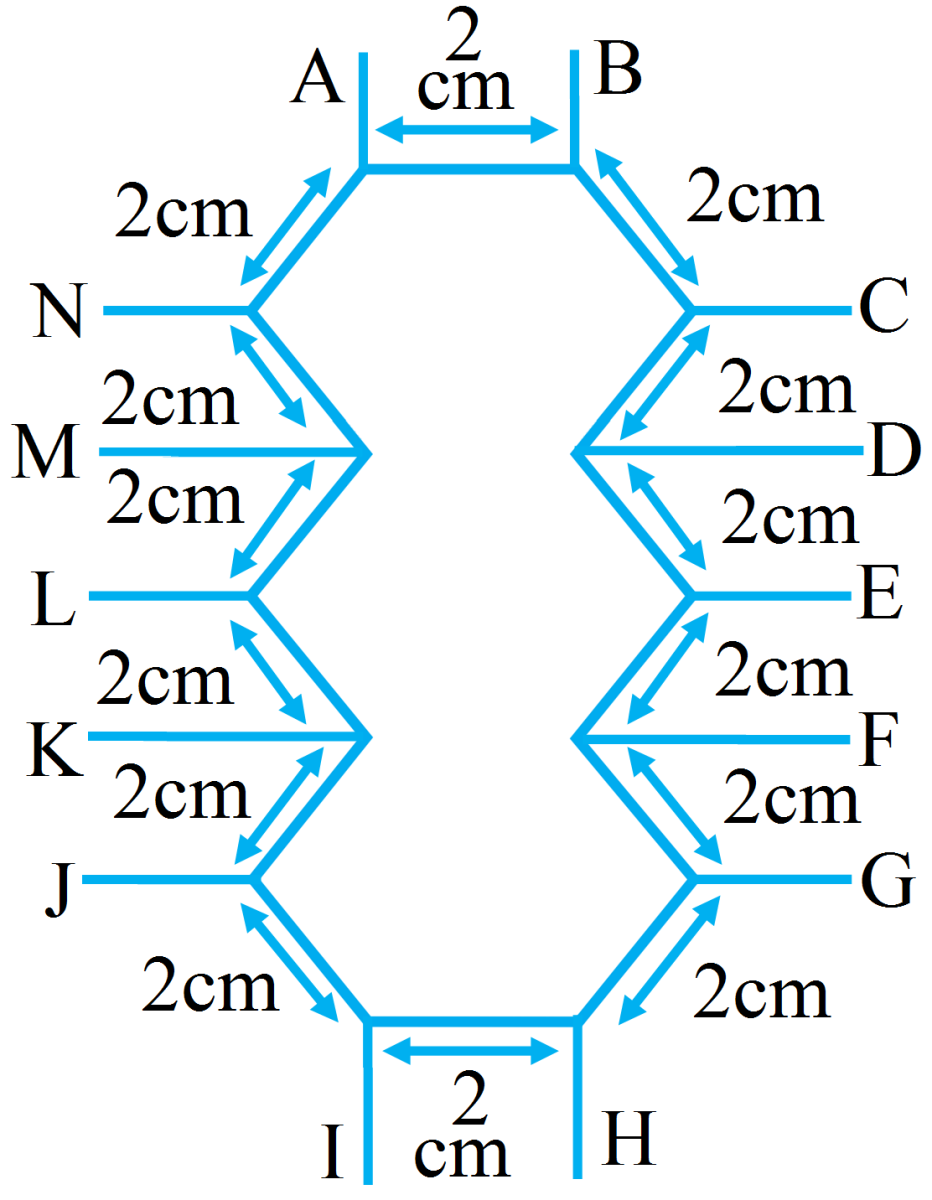
$a.\ $Perimeter of figure $=$ Sum of all sides
$= \text{AB + BC + CD + DE + EF + FG + GH + HI + IJ + JK + KL + LM + MN + NA}$
$= 2 + 2 + 2 + 2 + 2 + 2 + 2 + 2 + 2 + 2 + 2 + 2 + 2 + 2 = 28\ cm$
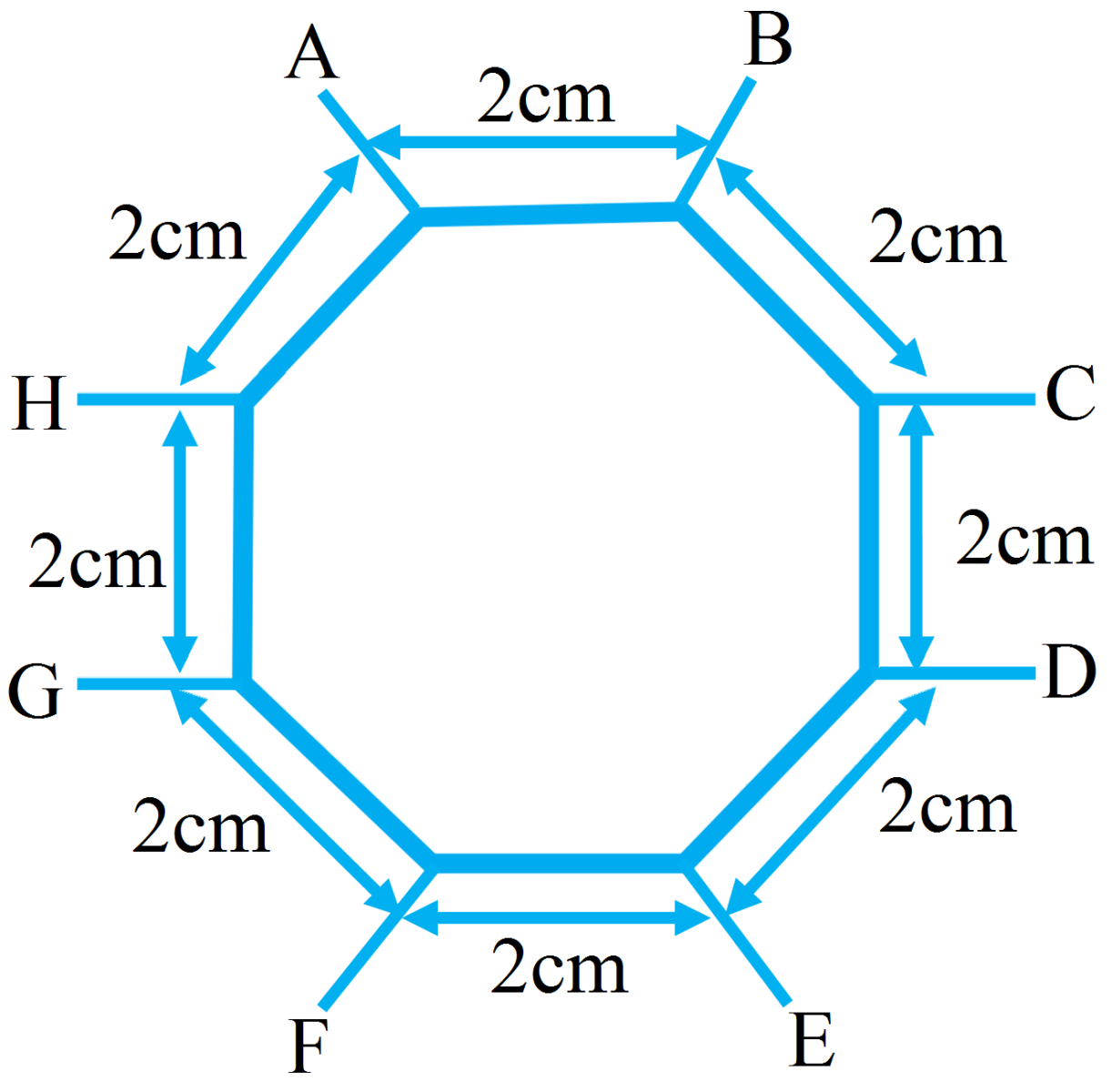
$b.\ $Perimeter of figure $=$ Sum of all sides
$= \text{AB + BC + CD + DE + EF + FG + GH + HA}$
$= 2 + 2 + 2 + 2 + 2 + 2 + 2 + 2 = 16\ cm$
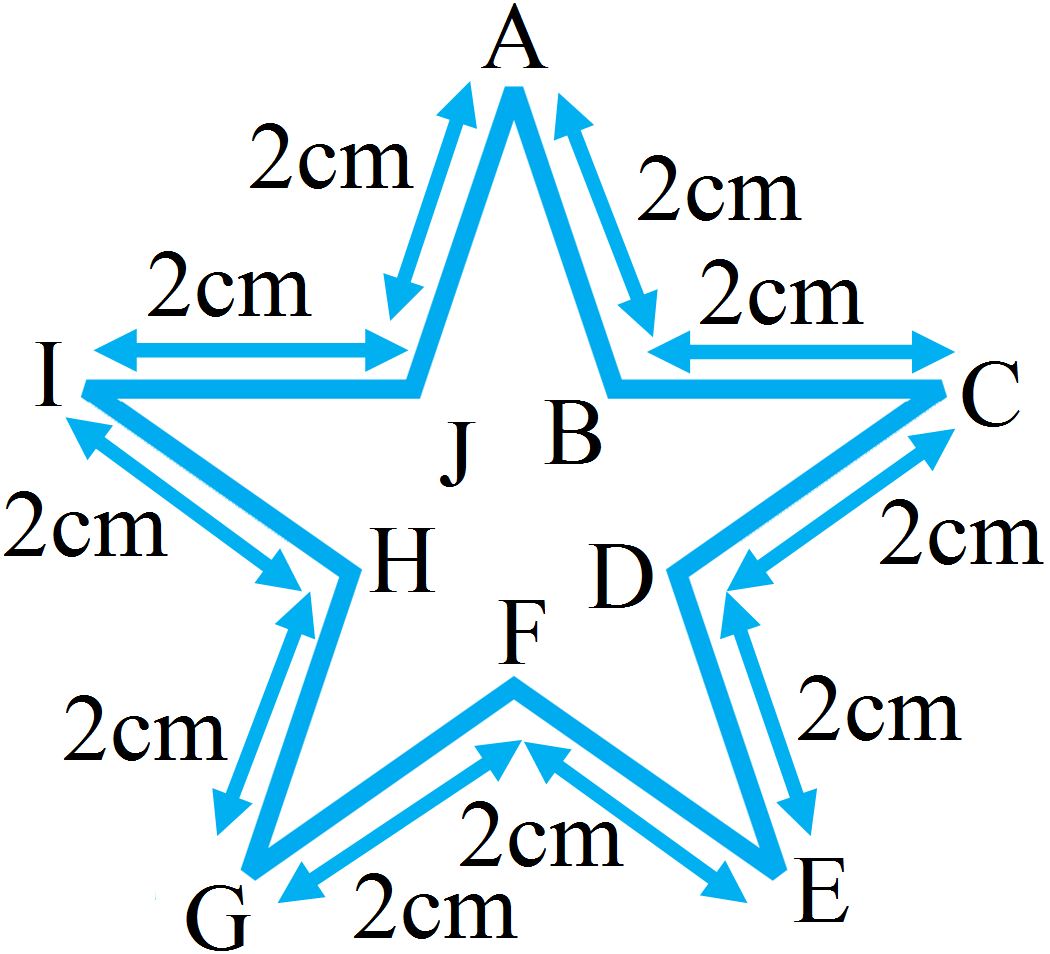
$c.\ $Perimeter of figure $=$ Sum of all sides
$= \text{AB + BC + CD + DE + EF + FG + GH + HI + IJ + JA}$
$= 2 + 2 + 2 + 2 + 2 + 2 + 2 + 2 + 2 + 2 = 20\ cm$
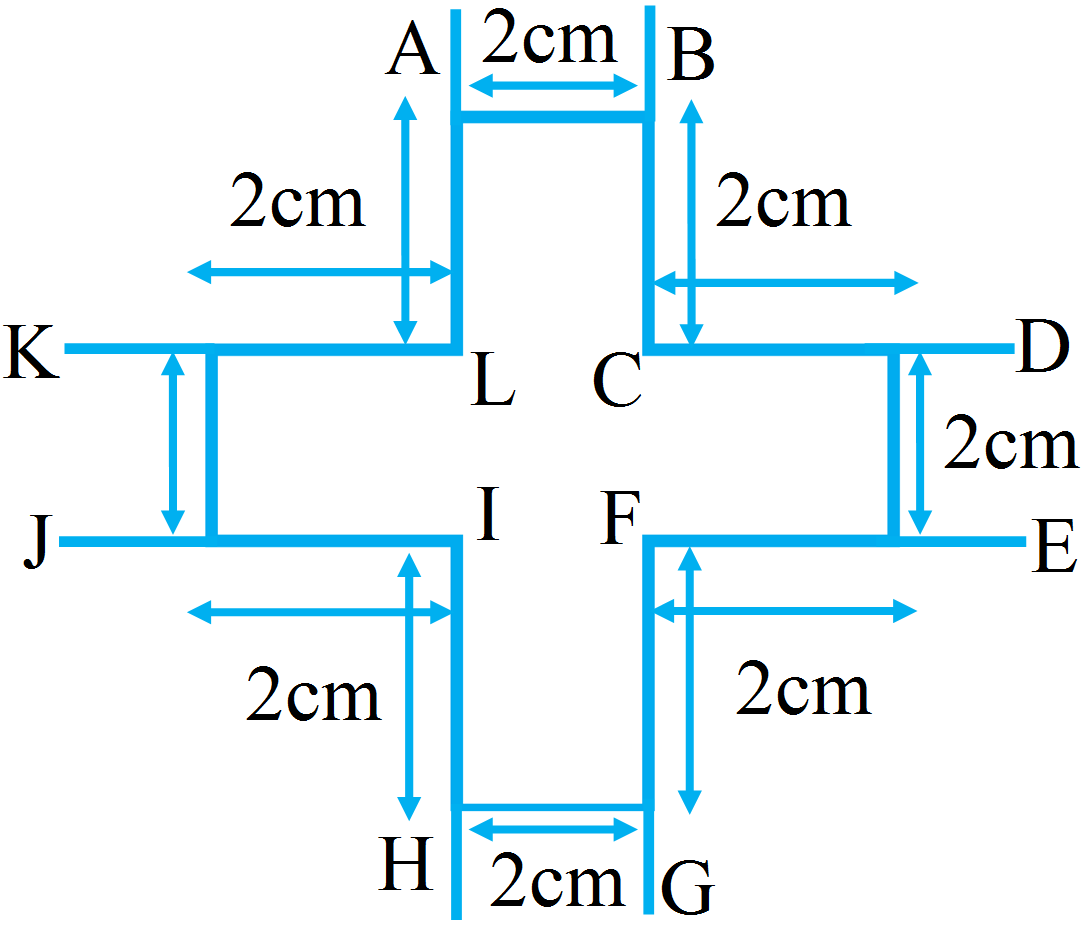
$d.\ $Perimeter of figure $=$ Sum of all sides
$= \text{AB + BC + CD + DE + EF + FG + GH + HI + IJ + JK + KL + LA}$
$= 2 + 2 + 2 + 2 + 2 + 2 + 2 + 2 + 2 + 2 = 24\ cm$
View full question & answer→Question 173 Marks
Length of a rectangular field is $250m$ and width is $150m$. Anuradha runs around this field $3$ times. How far did she run? How many times she should run around the field to cover a distance of $4\ km$?
AnswerGiven, length of rectangular field $(l) = 250m$
and width of rectangular field $(b) = 150m$
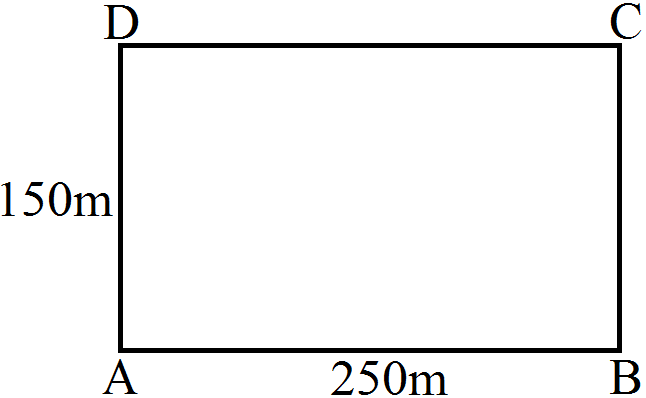
Perimeter of the field $= 2(l + b) = 2(250 + 150)m = 2 \times 400m= 800m$
$\because$ Distance covered in one round = Perimeter $= 800m$
$\therefore$ Distance covered in three rounds $= 3 \times 800 = 2400m$
Now, number of rounds to cover $4\ km,$ i.e. $4000m$
$=\frac{4000}{800}=5$ [$\because$ $1\ km = 1000m]$
Hence, she should run $5$ times around the field to cover the distance of $4\ km.$ View full question & answer→Question 183 Marks
The area of each square on a chess board is $4sq\ cm$. Find the area of the board.
$a.\ $At the beginning of game when all the chess men are put on the board, write area of the squares left unoccupied.
$b.\ $Find the area of the squares occupied by chess men.
AnswerGiven, area of each square on a chess board $= 4\ sq-cm$ We know that, there are $64$ squares on a chess board. Area of the chess board = Area of $64$ squares on a chess board $= 64 \times $ Area of $1$ square on a chess board $= 64 \times 4sq-cm = 256sq-cm$
$a.\ $We know that, there are $32$ chess men at the beginning of game.
Number of squares occupies by $32$ chess men $= 32$
and number of squares left unoccupied $=$ Total number of squares $- 32$
$= 64 - 32 = 32$
So, area of squares left unoccupied
$= 32 \times $ Area of a square
$= 32 \times 4 = 128sq-cm$
$b.\ $Area of squares occupied by $32$ chess men
$= 32 \times $ Area of a square
$= 32 \times 4 = 128sq-cm$
View full question & answer→Question 193 Marks
Amita wants to make rectangular cards measuring 8cm × 5cm. She has a square chart paper of side 60cm. How many complete cards can she make from this chart? What area of the chart paper will be left?
AnswerLet ABCD be a square chart of side 60cm. We have to cut out rectangular cards measuring 8cm × 5cm out of this chart.
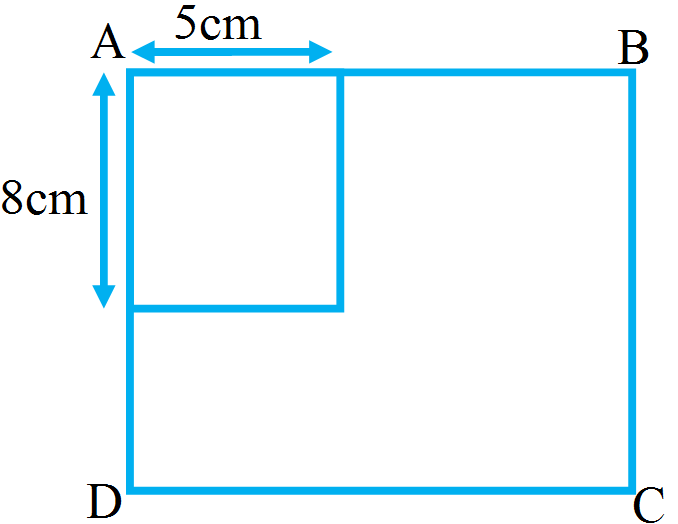
Now, if we cut chart along AB as shown in the figure, then we can cut 12 rectangular cards from one row.
Similarly, we can cut 7 rows with 12 rectangular cards in each.
Area of cut outs of the rectangular cards $= 7 × 12 × (8 × 5)cm^2$
$= 3360cm^2$
The left part of square chart is of dimensions 4cm × 60cm.
Now, area of the left part = 4 × 60
$= 240cm^2$ View full question & answer→Question 203 Marks
Total cost of fencing the park shown in Fig. is $Rs\ 55000.$ Find the cost of fencing per metre.
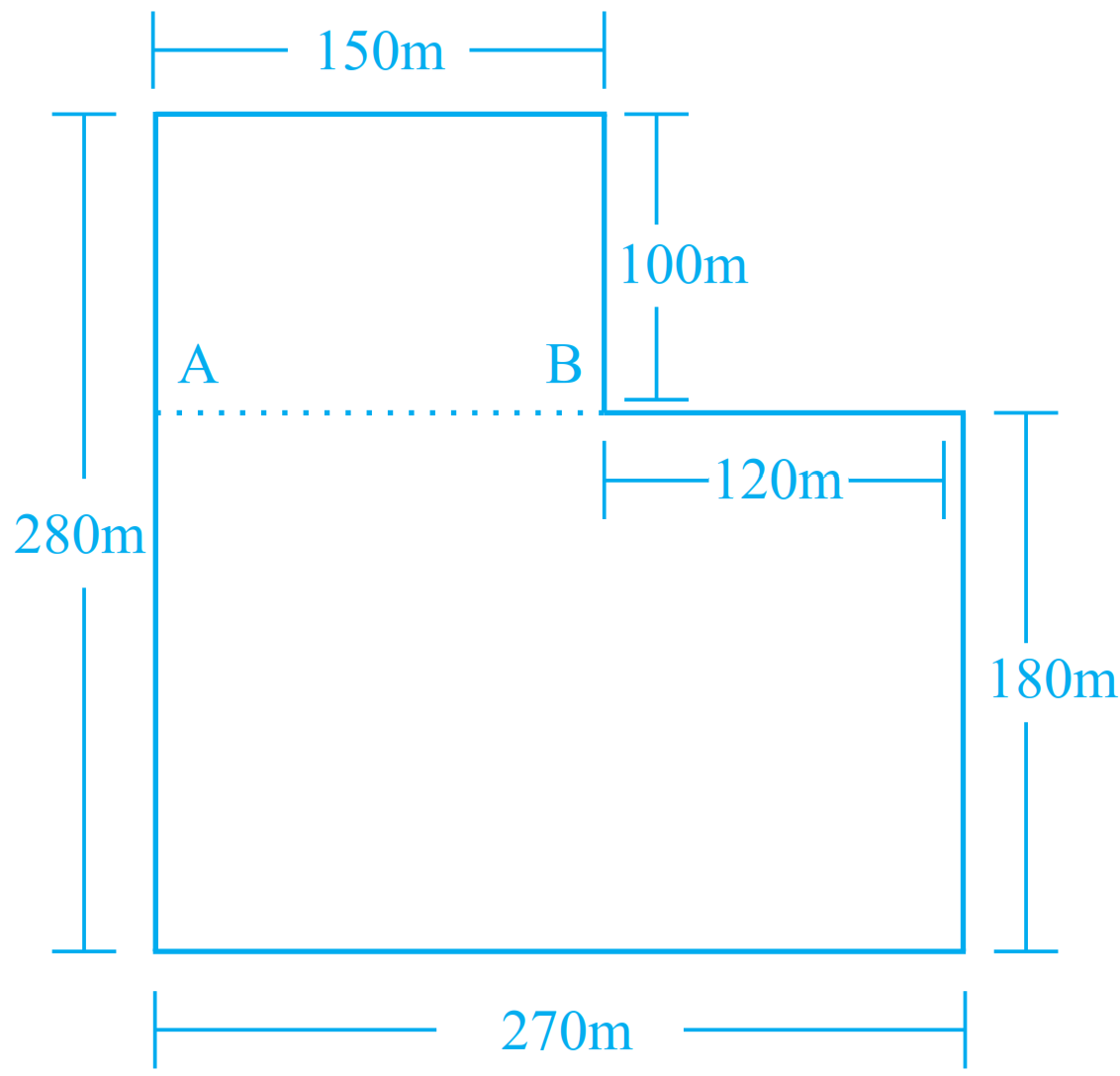
AnswerPerimeter of $ABCDEFA$ = Sum of all sides
$= AB + BC + CD + DE + EF + FA$
$= (150 + 100 + 120 + 180 + 270 + 280)m = 1100m$
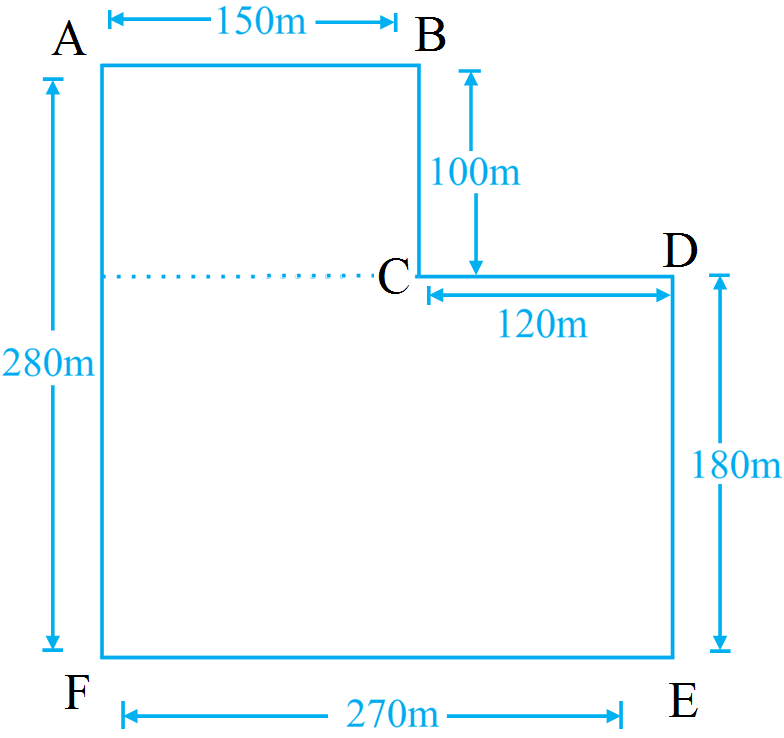
Total cost $= 55000$ [given]
Now, cost of fencing per metre $=\frac{\text{Total cost}}{\text{perimeter}}=\frac{55000}{1100}=\text{Rs} \ 50$ View full question & answer→Question 213 Marks
Find all the possible dimensions (in natural numbers) of a rectangle with an area of $36sq-cm$, and find their perimeters.
AnswerLet x and y be the length and breadth of the given rectangle whose area is $36sq-cm.$
$\therefore$ Area of rectangle = Length $\times $ Breadth $= x \times y$
$\Rightarrow x \times y = 36sq-cm$
If the value of both length and breadth are natural numbers, then possible dimensions and their perimeters are as follows:
| Dimension (in cm) |
Perimeter (in cm) |
| $36 \times 1$ |
$74$ |
| $18 \times 2$ |
$40$ |
| $9 \times 4$ |
$26$ |
| $12 \times 3$ |
$30$ |
| $6 \times 6$ |
$24$ |
View full question & answer→Question 223 Marks
Match the following:
| |
Shapes |
|
Perimeter |
| $(A)$ |
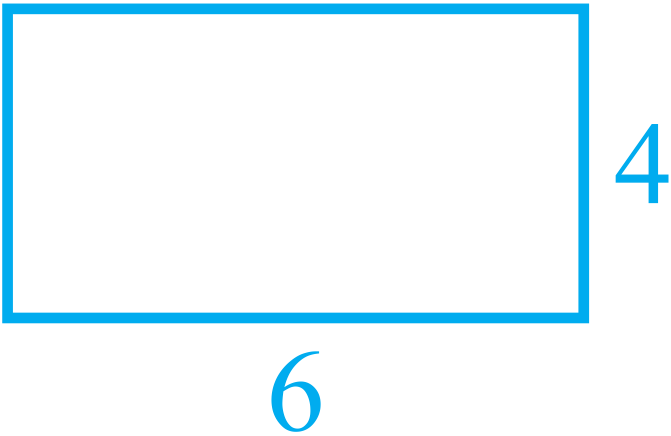 |
$(i)$ |
$10$ |
| $(B)$ |
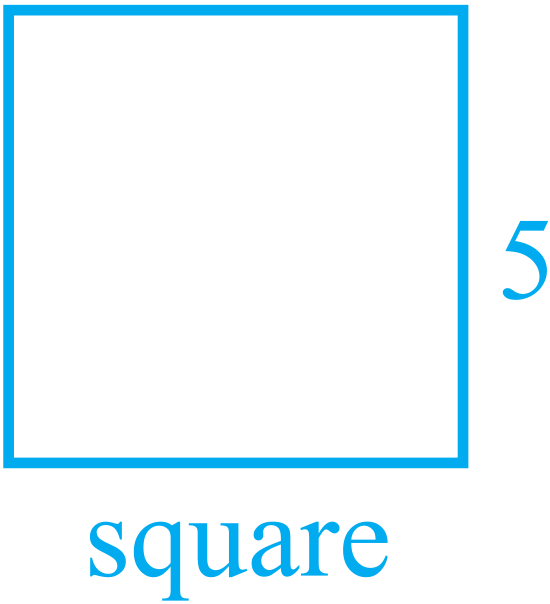 |
$(ii)$ |
$18$ |
| $(C)$ |
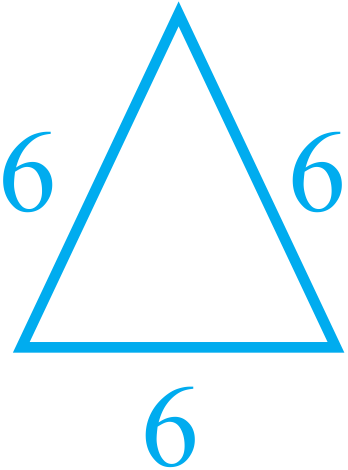 |
$(iii)$ |
$20$ |
| $(D)$ |
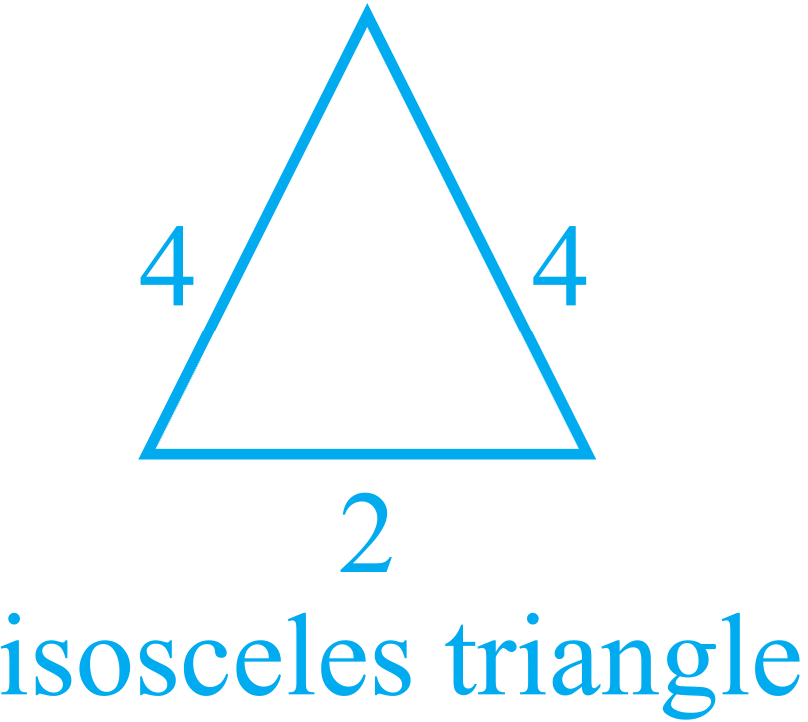 |
$(iv)$ |
$25$ |
Answer
| |
Shapes |
|
Perimeter |
| $(A)$ |
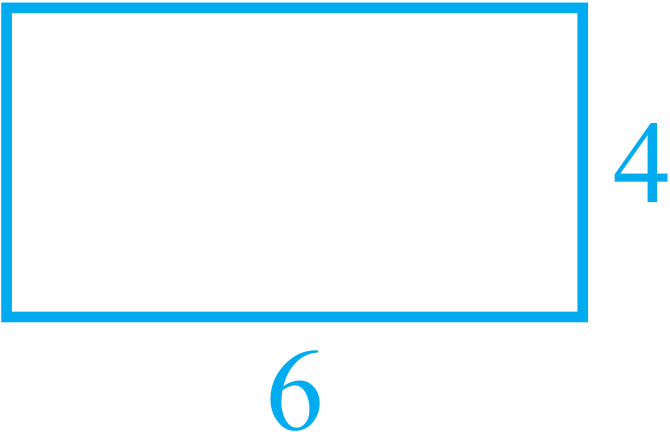 |
$(iii)$ |
$20$ |
| $(B)$ |
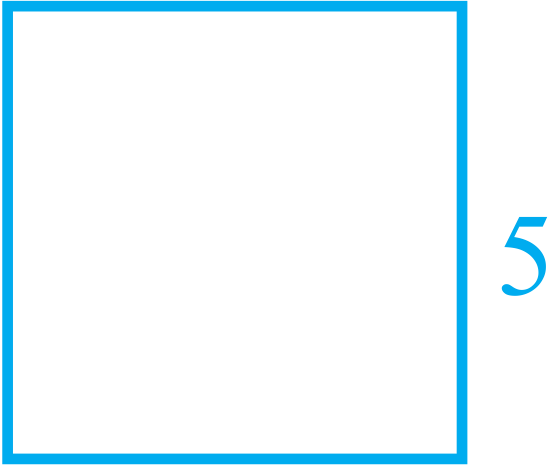 |
$(iii)$ |
$20$ |
| $(C)$ |
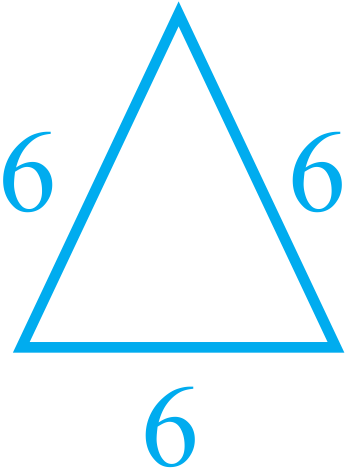 |
$(ii)$ |
$18$ |
| $(D)$ |
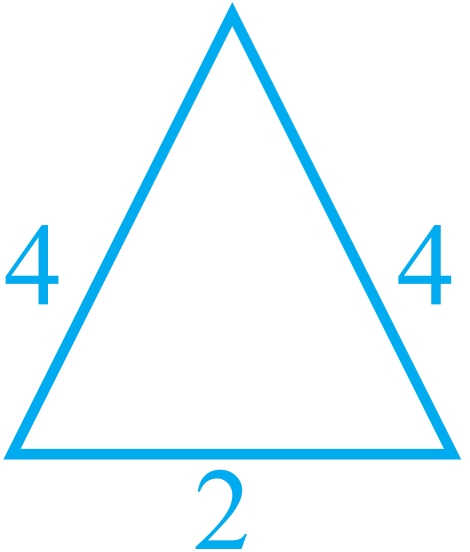 |
$(i)$ |
$10$ |
Solution:
$a.\ (iii)$ We know that,
Perimeter of a rectangle
$= 2 \times ($Length $+$ Breadth$)$
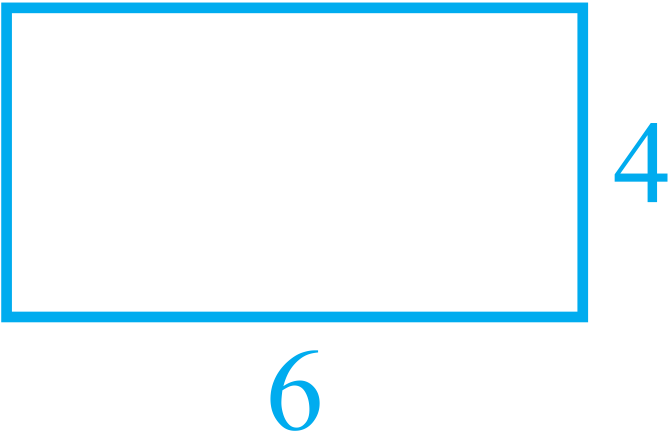
Here, length $= 6$ and breadth $= 4$
$\therefore$ Perimeter of a rectangle $= 2 \times (6 + 4) = 2 \times 10 = 20$
$b.\ (iii)$ Here, side $= 5$
$\therefore$ Perimeter of a square $= 4 \times $ Side $= 4 \times 5 = 20$
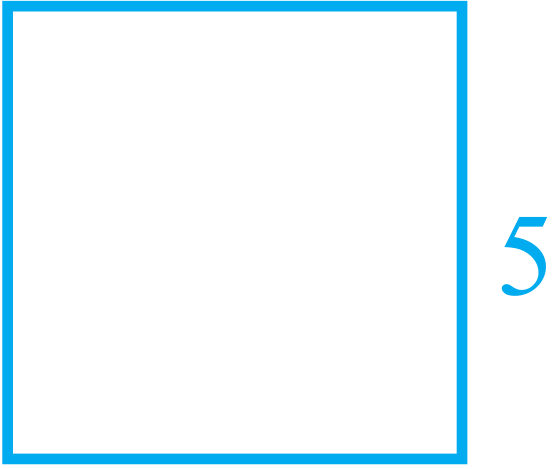
$[$in square all sides are equal$]$
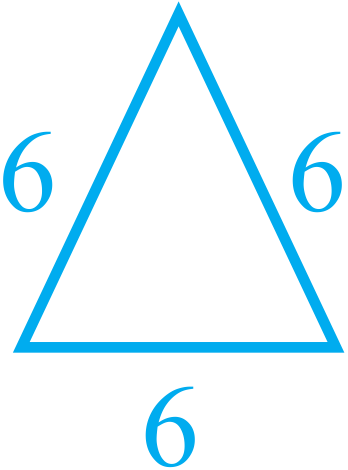
$c.\ (ii)$ Here, side $= 6$
$\therefore$ Perimeter of an equilateral triangle $= 3 \times $ Length of a side $= 3 \times 6 = 18$
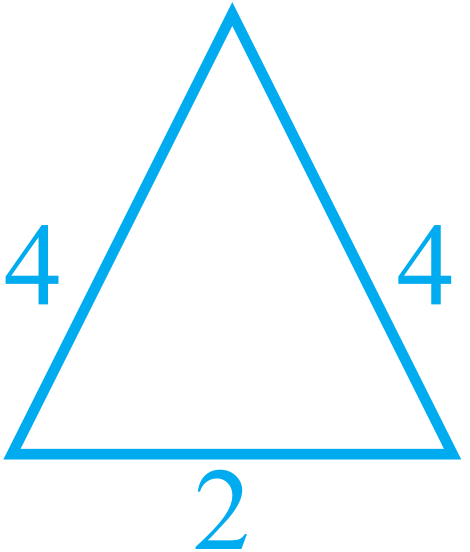
$d.\ (i)$ Given sides are $4, 4$ and $2.$
$\therefore$ Perimeter of an isosceles triangle $=$ Sum of all sides $= 4 + 4 + 2 = 10$
View full question & answer→Question 233 Marks
A rectangular path of $60m$ length and $3m$ width is covered by square tiles of side $25\ cm$. How many tiles will there be in one row along its width? How many such rows will be there? Find the number of tiles used to make this path?
AnswerGiven, length of path $= 60m$
and width of path $= 30m$
Side of square tile $=25\text{cm}=\frac{25}{100}\text{m}=0.25\text{m}$
Diagram of path is shown below
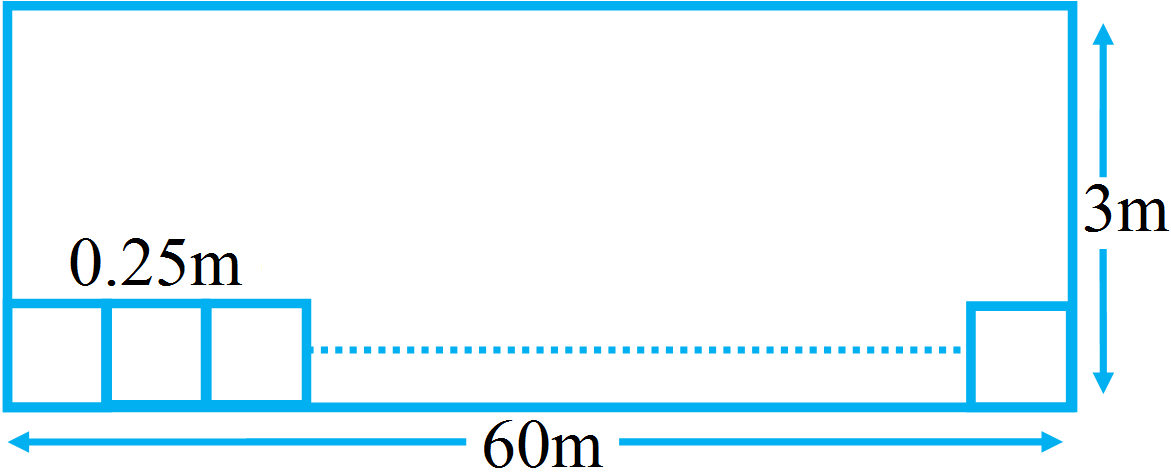
Number of tiles in one row along width $=\frac{\text{Width}}{\text{Side of one file}}$
$=\frac{3}{0.25}=\frac{3\times100}{25}=12$
Number of rows $=\frac{\text{Length}}{\text{Side of one tile}}$
$=\frac{60}{0.25}=\frac{60}{25}\times100=240$
Also, number of tiles = Number of tiles in one row $\times $ Number of rows $= 12 \times 240 = 2880$ View full question & answer→Question 243 Marks
Find the area and Perimeter of each of the following figures, if area of each small square is $1sq-cm.$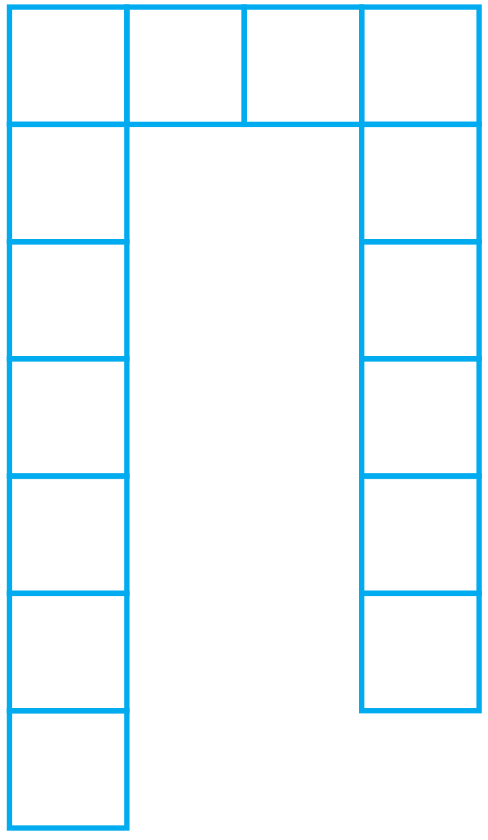
AnswerIn the given figure, there are $13$ small squares.
Given, area so $1$ small square $= 1sq-cm$
$\therefore$ Area of 4 small squares $= 13 \times $ Area of a small square
$= 13 \times 1sq-cm$
$= 13sq-cm$
Also, side of a small square $= 1\ cm$
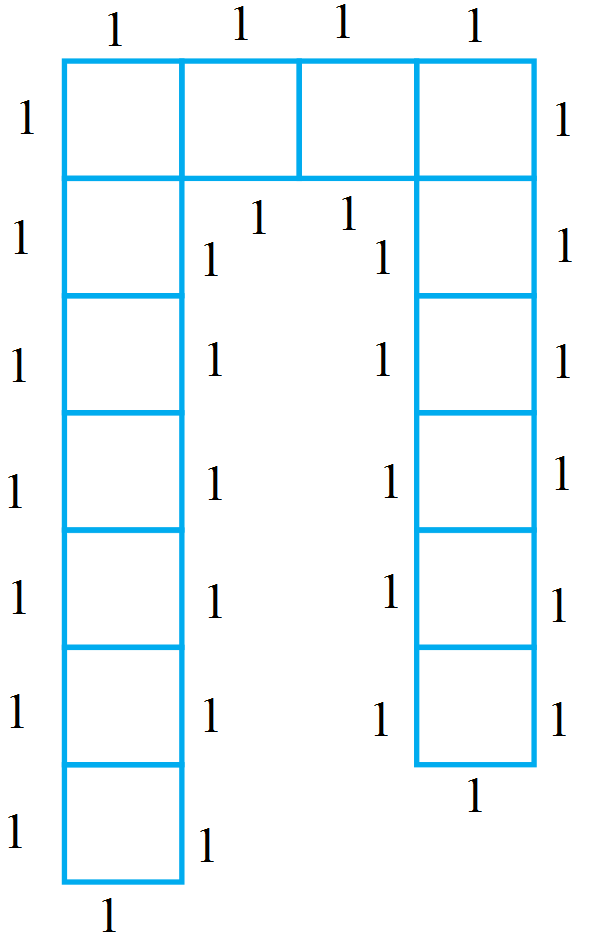
Now, perimeter of the given figure = Sum of all its sides
$=(1 + 1 + 1 + 1 + 1 + 1 + 1 + 1 + 1 + 1 + 1 + 1 + 1 + 1 + 1 + 1 + 1 + 1 + 1 + 1 + 1 + 1 + 1 + 1 + 1 + 1 + 1 + 1)$
$= 28\ cm$
View full question & answer→Question 253 Marks
Find all the possible dimensions (in natural numbers) of a rectangle with a perimeter $36\ cm$ and find their areas.
AnswerLet $x$ and $y$ be the length and breadth of the given rectangle whose perimeter is $36\ cm.$
$\therefore$ Perimeter of rectangle $= 2$(Length + Breadth) $= 2(x + y)$
$\Rightarrow 2(x + y) = 36$
$\Rightarrow\frac{2\text{x + y}}{2}=\frac{36}{2}$ [dividing both sides by $2$]
$\Rightarrow x + y = 18$
Now, if the value of both length and breadth are natural numbers, then possible dimensions and their areas are as follows:
| Dimensions (in cm) |
Area (in cm) |
| $17 \times 1$ |
$17$ |
| $16 \times 2$ |
$32$ |
| $15 \times 3$ |
$45$ |
| $14 \times 4$ |
$56$ |
| $13 \times 5$ |
$65$ |
| $12 \times 6$ |
$72$ |
| $11 \times 7$ |
$77$ |
| $10 \times 8$ |
$80$ |
| $9 \times 9$ |
$81$ |
View full question & answer→Question 263 Marks
Tahir measured the distance around a square field as $200$ rods (lathi). Later he found that the length of this rod was $140\ cm$. Find the side of this field in metres.
AnswerGiven, total distance around a square field $= 200$ rods
and $1$ rod $= 140\ cm$
Total distance around a square field = Perimeter of square field
$\Rightarrow 200 = 4 \times$ side
$\Rightarrow\frac{200}{4}=\frac{4\times\text{side}}{4}$ [dividing both sides by $4$]
$\Rightarrow$ Side $= 50$ rods
$\because$ $1$ rod $= 140\ cm$
$\therefore$ $50$ rods $= 50 \times 140 = 7000\ cm$
$=\frac{7000}{100}\text{m}$ $[$$\because$ $1m = 100\ cm]$
$= 70m$
Hence, the side of the field is $70m.$
View full question & answer→Question 273 Marks
The length of a rectangular field is $8m$ and breadth is $2m$. If a square field has the same perimeter as this rectangular field, find which field has the greater area.
AnswerGiven, length of a rectangular field $= 8m$
Breadth of a rectangular field $= 2m$
Now, perimeter of rectangle $= 2 \times $ (Length + Breadth)
$= 2 \times (8 + 2) = 2 \times 10$
$= 20m$
$\therefore$ Area of rectangle = Length $\times $ Breadth $= 8 \times 2 = 16m^2$
According to the question,
Perimeter of square = Perimeter of rectangle
$4 \times $ Side $= 20$
$\Rightarrow\frac{4\times\text{Side}}{4}=\frac{20}{4}$ [dividing both sides by $4$]
$\Rightarrow Side = 5m$
Now, area of square = Side $\times $ Side $= 5 \times 5 = 25m^2$
Hence, the area of square field is greater than the area of rectangular field.
View full question & answer→Question 283 Marks
Find the area and Perimeter of each of the following figures, if area of each small square is $1sq-cm.$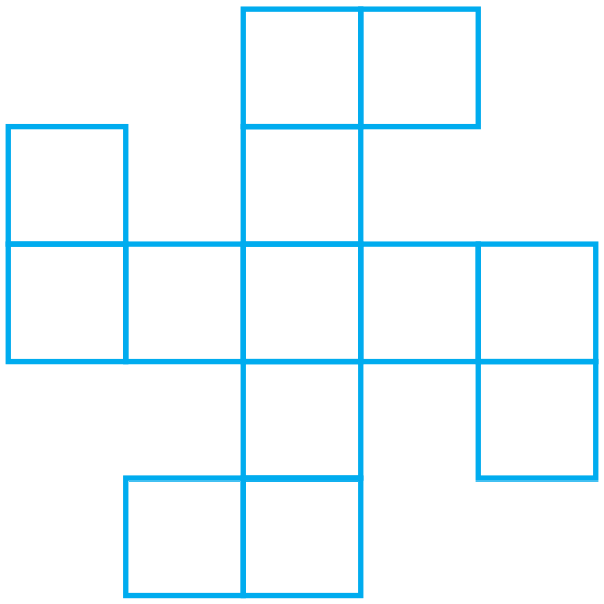
AnswerIn the given figure, there are $13$ small squares
Given, area of $1$ small square $= 1sq-cm$
$\therefore$ Area of $13$ small squares $= 13 \times $ Area of a small square
$= 13 \times 1sq-cm$
$= 13sq-cm$
Also, side of a small square $= 1\ cm$
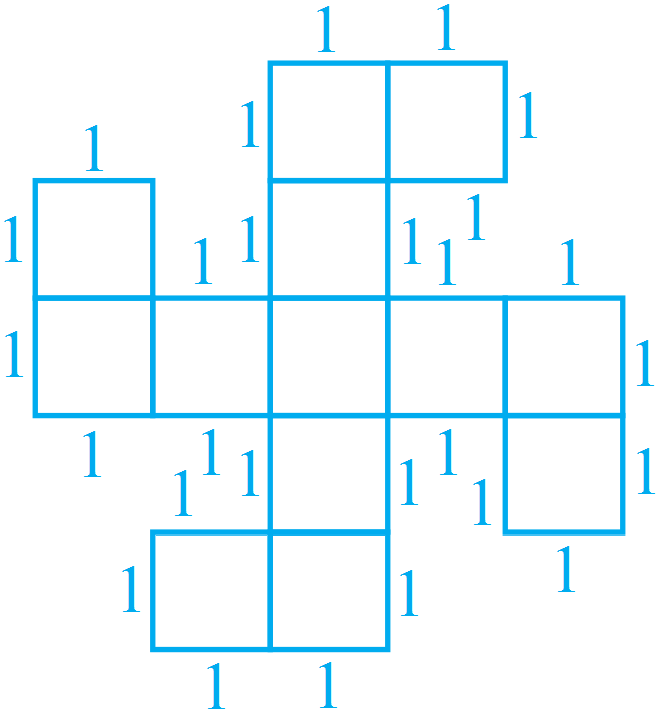
Now, perimeter of the given figure = Sum of all its sides
$= (1 + 1 + 1 + 1 + 1 + 1 + 1 + 1 + 1 + 1 + 1 + 1 + 1 + 1 + 1 + 1 + 1 + 1 + 1 + 1 + 1 + 1 + 1 + 1 + 1 + 1 + 1)cm$
$= 27\ cm$ View full question & answer→Question 293 Marks
Find the area and Perimeter of each of the following figures, if area of each small square is $1sq-cm.$ 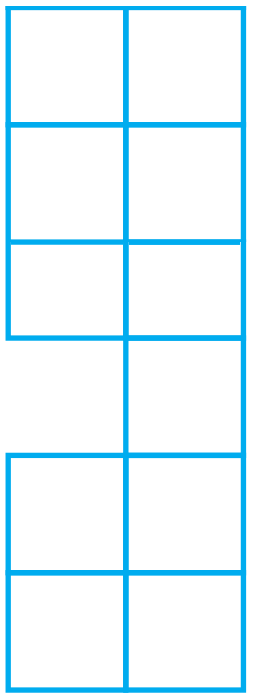
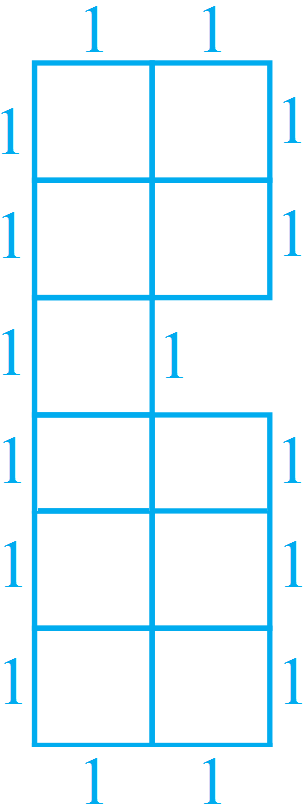
AnswerIn the given figure, there are $11$ small squares.
Given, area of $1$ small square = 1sq-cm [$\because$ area of square = side $\times $ side]
$\therefore$ Area of $11$ small squares $= 11 \times $ Area of a small square
$= 11 \times 1sq-cm$
$= 11sq-cm$
Also, side of a small square $= 1\ cm$
Now, perimeter of the given figure = Sum of all its sides
$= (1 + 1 + 1 + 1 + 1 + 1 + 1 + 1 + 1 + 1 + 1+ 1 + 1 + 1 + 1 + 1)cm = 16\ cm$
View full question & answer→Question 303 Marks
The perimeter of a square garden is $48m$. A small flower bed covers $18sq-m$ area inside this garden. What is the area of the garden that is not covered by the flower bed? What fractional part of the garden is covered by flower bed? Find the ratio of the area covered by the flower bed and the remaining area.
AnswerGiven, perimeter of triangle $= 28\ cm$ and one side $= 8\ cm$ Let other sides be $a$ and $b$.
[$\therefore$ in isosceles triangle, two sides are equal]
Then, $a = b$ According to the question, Perimeter of triangle = Sum of its all sides [transposing $8$ to $LHS$]
[dividing both sides by $2$]
Hence, sides are $8\ cm, 10\ cm$ and $10\ cm$.
Again, let two equal sides be $8\ cm$ and $8\ cm$ and third side $= a$
Now, according to the question, Perimeter of triangle = Sum of its all sides
$\Rightarrow 28 = 8 + 8 + a $
$\Rightarrow 28 = 16 + a $
$\Rightarrow 28 - 16 = a$ [transposing $16$ to $LHS$]
$\Rightarrow 12 = a$
Hence, sides are $8\ cm, 8\ cm$ and $12\ cm.$
View full question & answer→