Question 11 Mark
What is the HCF of two consecutive odd numbers$?$
Answer$HCF$ of two consecutive odd numbers$ = 1$
View full question & answer→Question 21 Mark
What is the $HCF$ of two consecutive even numbers$?$
Answer$HCF$ of two consecutive even numbers $= 2$
View full question & answer→Question 31 Mark
What is the $HCF$ of two consecutive numbers$?$
Answer$HCF$ of consecutive numbers $= 1$
View full question & answer→Question 41 Mark
In the given expression, prime factorisation has been done or not$?\ 54 = 2 \times 3 \times 9$
AnswerGiven: $54 = 2 \times 3 \times 9$
As we can see in this factorization 9 is a composite number, and it can be further factorized, so prime factorization has not been done.
View full question & answer→Question 51 Mark
In the given expression, prime factorisation has been done or not$?\ 70 = 2 \times 5 \times 7$
AnswerGiven: $70 = 2 \times 5 \times 7$
Since all the factors are prime numbers, so, prime factorization has been done.
View full question & answer→Question 61 Mark
In the given expression, prime factorisation has been done or not? $56 = 7 \times 2 \times 2 \times 2$
AnswerGiven: $56 = 7 \times 2 \times 2 \times 2$
Since all the factors are prime, so, prime factorization has been done.
View full question & answer→Question 71 Mark
In the given expressions, prime factorisation has been done or not? $24 = 2 \times 3 \times 4$
AnswerGiven that, $24 = 2 \times 3 \times 4$
As we can see in this factorization $4$ is a composite number, which can be further factorized, so prime factorization has not been done.
View full question & answer→Question 81 Mark
Which factors are not included in the prime factorisation of a composite number?
Answer$1$ and the number itself are not included in the prime factorisation of a composite number.
View full question & answer→Question 91 Mark
I am the smallest number, having four different prime factors. Can you find me$?$
AnswerLet us take the smallest four different prime numbers i.e $2, 3, 5$ and $7.$
$\therefore$ The smallest number, having four different prime factors is
$2 \times 3 \times 5 \times 7 = 210$
View full question & answer→Question 101 Mark
A number is divisible by $12.$ By what other numbers will that number be divisible?
AnswerFactors of $12$ are $1, 2, 3, 4, 6$ and $12.$
Therefore the number will be divisible by $1, 2, 3, 4$ and $6.$
View full question & answer→Question 111 Mark
A number is divisible by both $5$ and $12.$ By which other number will that number be always divisible?
AnswerThe number will always be divisible by $5 \times 12 = 60.$
View full question & answer→Question 121 Mark
Write the smallest digit and the largest digit in the blank space of number so that the number is divisible by $3 :\_\_\ 6724$
Answer$i.$ Smallest digit
Sum of the given digits $= 6 + 7 + 2 + 4 = 19$
$\because 19$ is not divisible by $3.$ The no. after $19$ which is divisible by $3$ is $21.$ So we will add $2$ to make it divisible by $3.$
$\therefore$ Smallest digit (non-zero) is $2.$
$ii.$ Largest digit
Sum of the given digits is $19.$ Largest no. which we can add is $9,$ so $19+9=28$ which is not divisible by $3$ hence $8$ should be added because $19+8=27$ which is divisible by $3.$
The largest digit is $8.$
View full question & answer→Question 131 Mark
Using divisibility test, determine if $901153$ is divisible by $11.$
AnswerSum of the digits (at odd places) from the right $= 3 + 1 + 0 = 4$
Sum of the digits (at even places) from the right $= 5 + 1 + 9 = 15$
Difference of these sums $= 15 – 4 = 11$
$\because 11$ is divisible by $11.$
$\therefore 901153$ is divisible by $11$ because a no. is divisible by $11$ if difference of the sum of digits at odd places and even places from the right is either $0$ or divisible by $11.$
View full question & answer→Question 141 Mark
Using divisibility test, determine if $10000001$ is divisible by $11.$
AnswerSum of the digits (at odd places) from the right $= 1 + 0 + 0 + 0 = 1$
Sum of the digits (at even places) from the right $= 0 + 0 + 0 + 1 = 1$
Difference of these sums $= 1 – 1 = 0$
$\because 0$ is divisible by $11.$
$\therefore 10000001$ is divisible by $11$ because a no. is divisible by $11$ if difference of the sum of the digits at the odd places and even places from the right is $0$ or divisible by $11.$
View full question & answer→Question 151 Mark
Using divisibility tests, determine if $70169308$ is divisible by $11.$
AnswerSum of the digits (at odd places) from the right $= 8 + 3 + 6 + 0 = 17$
Sum of the digits (at even places) from the right $= 0 + 9 + 1 + 7 = 17$
Difference of these sums $= 17 – 17 = 0$
$\therefore 70169308$ is divisible by $11$ because a no. is divisible by $11$ if difference of the sum of the digits at odd places and even places from the right is either $0$ or divisible by $11$
View full question & answer→Question 161 Mark
Using divisibility test, determine if $7138965$ is divisible by $11.$
AnswerSum of the digits (at odd places) from the right $= 5 + 9 + 3 + 7 = 24$
Sum of the digits (at even places) from the right $= 6 + 8 + 1 = 15$
Difference of these sums $= 24 – 15 = 9$
$\because 9$ is not divisible by $11$
$\therefore 7138965$ is not divisible by $11$ because a no. is divisible by $11$ if difference of the sum of digits at odd places and even places from the right is either $0$ or divisible by $11.$
View full question & answer→Question 171 Mark
Using divisibility test, determine if $10824$ is divisible by $11.$
AnswerSum of the digits (at odd places) from the right $= 4 + 8 + 1 = 13$
Sum of the digits (at even places) from the right $= 2 + 0 = 2.$
Difference of these sums $= 13 – 2 = 11$
$\because 11$ is divisible by $11$
$\therefore 10824$ is divisible by $11$ because a no. is divisible by $11$ if difference of the sum of the digits at odd places and even places from the right is either $0$ or divisible by $11.$
View full question & answer→Question 181 Mark
Using divisibility tests, determine if $5445$ is divisible by $11.$
AnswerSum of the digits (at odd places) from the right $= 5 + 4 = 9$
Sum of the digits (at even places) from the right $= 4 + 5 = 9$
Difference of these sums $= 9 – 9 = 0$
$\therefore 5445$ is divisible by $11$ because a no. is divisible by $11$ if difference of sums of digits at odd places and even places ( from right) is either 0 or divisible by $11$
View full question & answer→Question 191 Mark
Using divisibility test, determine if $12583$ is divisible by $6.$
AnswerA number is divisible by $6,$ if it is divisible by $2\ \& \ 3$ both
$i.$ Divisibility by $2$
$\because$ Unit's digit $= 3,$ which is not from the digits $0, 2, 4, 6$ or $8.$
$\therefore 12583$ is not divisible by $2.$
$\therefore12583$ is not divisible by $6.$
View full question & answer→Question 201 Mark
Using divisibility tests, determine if number $61233$ is divisible by $6.$
AnswerA number is divisible by $6,$ if it is divisible by $2\ \&\ 3$ both.
Divisibility by $2$
$\because$ Unit's digit $= 3,$ which is not any of the digits from $0, 2, 4, 6$ or $8.$
$\therefore 61233$ is not divisible by $2.$
$\therefore 61233$ is not divisible by $6$ because a no . is divisible by $6$ only if it is divisible by $2$ and $3$ both.
View full question & answer→Question 211 Mark
Using divisibility tests, determine $17852$ is divisible by $6.$
AnswerSum of digits $= 1+7+8+5+2=23$
Which is not a multiple of $3.$
Therefore, $17852$ is not divisible by $3.$
Hence, it is not divisible by $6.$
View full question & answer→Question 221 Mark
Write seven consecutive composite numbers less than $100$ so that there is no prime number between them.
AnswerSeven consecutive composite numbers less than $100$ are $90, 91, 92, 93, 94, 95, 96$
View full question & answer→Question 231 Mark
Give three pairs of prime numbers whose difference is $2.$
$($Remark: Two prime numbers whose difference is $2$ are called twin primes$).$
AnswerThe three pairs of prime numbers, whose difference is $2,$ are as follows:
$3, 5; 5, 7; 11, 13.$
View full question & answer→Question 241 Mark
Express the sum of two odd primes of $18$
AnswerThe number can be expressed as: $18 = 13 + 5$
View full question & answer→Question 251 Mark
Express $24$ as the sum of two odd primes.
AnswerThe number can be expressed as: $24 = 17 + 7$
View full question & answer→Question 261 Mark
Express the sum of two odd primes of $36.$
AnswerThe given number can be written as the sum of two odd primes as: $36 = 29 + 7$
View full question & answer→Question 271 Mark
Express the sum of two odd primes of $44.$
AnswerThe given number can be expressed as $44 = 39 + 5$
View full question & answer→Question 281 Mark
What is the greatest prime number between $1$ and $10?$
AnswerThe greatest prime number between $1$ and $10$ is $7.$
View full question & answer→Question 291 Mark
Write down separately the prime and composite numbers less than $20.$
AnswerPrime no. $= 2,3,5,7,11,13,17,19$
Composite no. $= 4,6,8,9,10,12,14,15,16,18$
View full question & answer→Question 301 Mark
The numbers $13$ and $31$ are prime numbers. Both these numbers have same digits $1$ and $3.$ Find such pairs of prime numbers upto $100.$
AnswerAll other such pairs of prime numbers upto $100$ are as follows.
$17$ and $71; 37$ and $73; 79$ and $97.$
View full question & answer→Question 311 Mark
A number which has more than two factors is called a ________.
Question 321 Mark
A number having only two factors is called a ________.
Question 331 Mark
What is the sum of any two even numbers?
AnswerThe sum of two even numbers is even.
View full question & answer→Question 341 Mark
Write five pairs of prime numbers below $20$ whose sum is divisible by $5.$Hint: $3 + 7 = 10$
Answer$2, 3 ; 3, 7 ; 2, 13 ; 3, 17; 7, 13.$
View full question & answer→Question 351 Mark
What is the sum of any two odd numbers?
AnswerThe sum of two odd numbers is even.
Example: $3 + 5 = 8$
View full question & answer→Question 361 Mark
Express $61$ as the sum of three odd prime.
AnswerHere,
$61 = 13 + 17 + 31$
Where, $13, 17,$ and $31$ are prime numbers.
View full question & answer→Question 371 Mark
Express $53$ as the sum of three odd prime.
AnswerHere,
$53 = 5 + 17 + 31$
Where, $5, 17,$ and $31$ are prime numbers.
View full question & answer→Question 381 Mark
Express $31$ as the sum of three odd prime.
AnswerHere,
$31 = 5 + 7 + 19$
Where, $3, 7,$ and $19$ are prime numbers.
View full question & answer→Question 391 Mark
Express $21$ as the sum of three odd prime.
Answer$21$ can be written as,
$21 = 5 + 5 + 11$
where, $5$ and $11$ are prime numbers.
View full question & answer→Question 401 Mark
Write first five multiples of $5$
AnswerThe first five multiplies of $5$ can be obtained as follows;
$1 \times 5 = 5$
$2 \times 5 = 10$
$3 \times 5 = 15$
$4 \times 5 = 20$
$5 \times 5 = 25$
So, the first five multiplies are $5, 10, 15, 20$ and $25.$
View full question & answer→Question 411 Mark
Write all the factors of $36$
Answer$36 = 1 \times 36$
$36 = 2 \times 18$
$36 = 3 \times 12$
$36 = 4 \times 9$
$36 = 6 \times 6$
Thus, all the factors of $36$ are $1, 2, 3, 4, 6, 9, 12, 18 $ and $36.$
View full question & answer→Question 421 Mark
Write all the factors of $23$
Answer$23 = 1 \times 23$
As $23$ is a prime number so its factors are $1$ and $23$ only.
View full question & answer→Question 431 Mark
Write all the factors of $18$
Answer$18 = 1 \times 18$
$18 = 2 \times 9$
$18 = 3 \times 6$
Thus, all the factors of $18$ are $1, 2, 3, 6, 9$ and $18.$
View full question & answer→Question 441 Mark
Write all the factors of $20$
Answer$20 = 1 \times 20$
$20 = 2 \times 10$
$20 = 4 \times 5$
Thus, all the factors of $20$ are $1, 2, 4, 5, 10$ and $20.$
View full question & answer→Question 451 Mark
Write all the factors of $12$
Answer
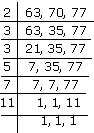
$\therefore L.C.M. $ of $63, 70$ and $77 = 2 \times 3 \times 3 \times 5 \times 7 \times 11$
$= 6930$
Hence, the minimum distance each should cover so that all cover the distance in complete steps is $6930\ cm.$ View full question & answer→Question 461 Mark
Write all the factors of $27$
Answer$27 = 1 \times 27$
$27 = 3 \times 9$
Thus, all the factors of $27$ are $1, 3, 9 $ and $27.$
View full question & answer→Question 471 Mark
Write all the factors of $21$
Answer$21 = 1 \times 21$
$21 = 3 \times 7$
Thus, all the factors of $21$ are $1, 3, 7$ and $21.$
View full question & answer→Question 481 Mark
Write all the factors of $15$
Answer$15 = 1 \times 15$
$15 = 3 \times 5$
Thus, all the factors of $15$ are $1, 3, 5$ and $15.$
View full question & answer→Question 491 Mark
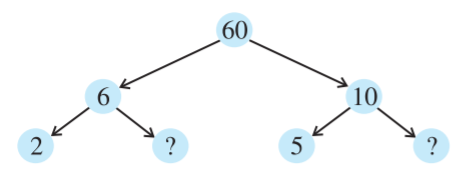
Here are two different factor trees for $60.$ Write the missing numbers.
AnswerThe given number is: $24$
$1 \times 24 = 24$
$2 \times 12 = 24$
$3 \times 8 = 24$
$4 \times 6 = 24$
So, $1, 2, 3, 4, 6, 8, 12$ and $24$ are the factors of $24.$
View full question & answer→