Question 13 Marks
Samira sells newspapers at Janpath crossing daily. On a particular day, she had $312$ newspapers out of which $216$ are in English and remaining in Hindi. Find the ratio of:
$i.\ $The number of English newspapers to the number of Hindi newspapers.
$ii.\ $The number of Hindi newspapers to the total number of newspapers.
AnswerGiven, total newspapers $= 312$ English newspapers $= 216$ Hindi newspapers $=$ Total number of newspapers $–$ Newspapers in English $= 312 – 216 = 96$
$i.\ $Ratio of number of English newspapers to number of Hindi newspapers $=\frac{ 216}{96}=\frac{9}{4} = 9 : 4 [$On dividing numerator and denominator by $24]$
$ii.\ $Ratio of number of Hindi newspapers to the total number of newspapers $=\frac{ 96}{312}=\frac{4}{13} = 4 : 13$
View full question & answer→Question 23 Marks
In an election, the votes cast for two of the candidates were in the ratio $5 : 7$. If the successful candidate received $20734$ votes, how many votes did his opponent receive?
AnswerGiven, ratio of votes for two candidates $= 5 : 7$ Let the votes are $5x$ and $7x.$
For successful candidates votes are greater.
Hence, $7x = 20734 \Rightarrow x = 2962$ Number of votes of his opponent $= 5x = 5 \times 2962 = 14810$
View full question & answer→Question 33 Marks
A train takes $2$ hours to travel from Ajmer to Jaipur, which are $130\ km$ apart. How much time will it take to travel from Delhi to Bhopal which are $780\ km$ apart, if the train is travelling at the uniform speed?
AnswerTime taken by train to travel from Ajmer to Jaipur $= 2h$
Distance between Ajmer to Jaipur $= 130\ km$
Distance between Delhi to Bhopal $= 780\ km$
The train is travelling at the uniform speed.
Therefore, distance : time : :: : distance : time
$\Rightarrow$ $130 : 2 :: 780 : x$ (let)
$\Rightarrow \frac{130}{2}=\frac{780}{\text{x}}$
$\Rightarrow130\times\text{x}=2\times780$
$\Rightarrow\text{x}= \frac{2\times780}{130}=12$
Hence. the train will take $12h$ fromDelhi to Bhopal.
View full question & answer→Question 43 Marks
Length and breadth of the floor of a room are $5m$ and $3m$, respectively. forty tiles, each with area $\frac{1}{16}\text{m}^2$ are used to cover the floor partially. Find the ratio of the tiled and the non tiled portion of the floor.
AnswerGiven, length of the floor of a room $= 5m$
Breadth of the floor of a room $= 3m$
Area of the room = Length $\times $ Breadth
$= 5 \times 3 = 15m^2$
$\because$ Area of 1 tiles $=\frac{1}{16}\text{m}^2$
$\because $ Area of 40 tiles $=\frac{1}{16}\times40$
$= 2.5m^2$
Area covered by tiles $= 2.5m^2$
Area not covered by tiles $= (15 - 2.5)$
$= 12.5m^2$
Ratio of the tiled to non-tiled portion $=\frac{2.5\text{m}^2}{12.5\text{m}^2}=\frac{25}{125}=\frac{1}{5}=1:5$
View full question & answer→Question 53 Marks
The marked price of a table is $Rs. 625$ and its sale price is $Rs 500$. What is the ratio of the sale price to the marked price?
AnswerGiven, marked price of table $= Rs. 625$ Sale price of a table $= Rs. 500$
Ratio of sale price to marked price = $\frac{\text{Rs. 500}}{\text{Rs. 625}}=\frac{500}{625}$
$=\frac{20}{25}$ [On dividing numerator and denominator by $25$]
$=\frac{4}{5}$ [On dividing numerator and denominator by $25$]
$\therefore$ Required ratio $= 4 : 5$
View full question & answer→Question 63 Marks
Ramesh earns $Rs. 28000$ per month. His wife Rama earns $Rs. 36000$ per month. Find the ratio of:
$a.\ $Ramesh’s earnings to their total earnings
$b.\ $Rama’s earnings to their total earnings.
AnswerGiven, Ramesh earns $= Rs. 28000$ per month
His wife Rama's earns $= Rs. 36000$ per month
Total earning $= Rs. (28000 + 36000) = Rs. 64000$ per month
$a.\ $Ratio of Ramesh's earning to their total earning $=\frac{\text{Rs. 28000}}{\text{Rs. 64000}}=\frac{7}{16}=7:16 [$On dividing numerator and denominator by $4000]$
$b.\ $Ratio of Rama's earning to their total earning $=\frac{\text{Rs. 36000}}{\text{Rs. 64000}}=\frac{9}{16}=9:16[$On dividing numerator and denominator by $4000]$
View full question & answer→Question 73 Marks
Shivangi is suffering from anaemia as haemoglobin level in her blood is lower than the normal range. Doctor advised her to take one iron tablet two times a day. If the cost of $10$ tablets is $Rs. 17$, then what amount will she be required to pay for her medical bill for $15$ days?
AnswerShivangi has to take iron tablets two times in a day.
Number of iron tablets she has to take in one day $= 2$
Total iron tablets for $15$ days $= 15 \times 2 = 30$ tablets
$\therefore$ Cost of $10$ tablets $= Rs. 17$
$\therefore$ Cost of $1$ tablet $= \text{Rs.} \frac{17}{10}$
$\therefore$ Cost of $30$ tablets $= \text{Rs.}\frac{17}{10}\times30=\text{Rs.}51$
Hence, she has to pay $Rs. 51$ for her medical bill.
View full question & answer→Question 83 Marks
An office opens at $9 a.m$. and closes at $5.30 p.m$. with a lunch break of $30$ minutes. What is the ratio of lunch break to the total period in the office?
AnswerOffice opens at $= 9 A.M$.Office close at $= 5 : 30\ P.M.$
Total hours of office $= 5 : 30\ P.M. - 9\ A.M. = 17 : 30 - 9 = 8 : 30h = 8h\ 30$min
Lunch break $= 30$min
Ratio of lunch break to the period = $\frac{30\text{min}}{8\text{h}\ 30\text{min}}$
$=\frac{30\text{min}}{(8\times60+ 30)\text{min}}$
$=\frac{30\text{min}}{510\text{min}}$ [$\because$ $1h = 60$min]
$=\frac{1}{17}$ [On dividing numerator and denominator by $30$]
$=1:17$
View full question & answer→Question 93 Marks
The quarterly school fee in Kendriya Vidyalaya for Class $VI$ is $Rs. 540$. What will be the fee for seven months?
AnswerQuarterly means $= 3$ months
The fee for $3$ months $= Rs. 540$
The fee for $1$ month $ = \text{Rs.}\frac{540}{3}$
The fee for $7$ months $ = \text{Rs.}\frac{540}{3}\times7$$= \text{Rs.} 1260$
Hence, fee for seven months is $Rs. 1260.$
View full question & answer→Question 103 Marks
In Fig. the comparative areas of the continents are given. What is the ratio of the areas of:
$a.\ $Africa to Europe
$b.\ $Australia to Asia
$c.\ $Antarctica to Combined area of North America and South America.
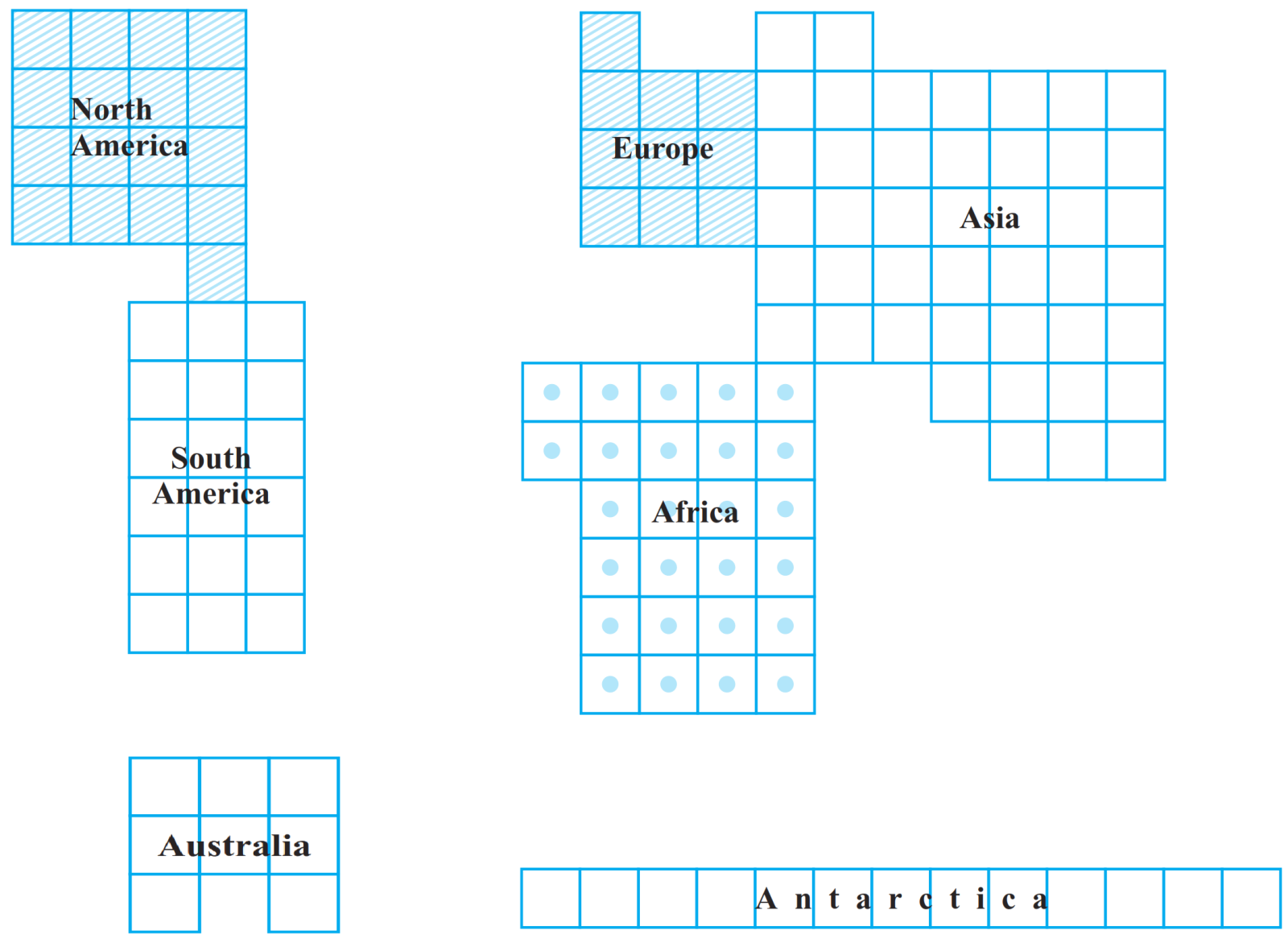
AnswerArea of North America $= 17sq$ units
Area of Europe $= 10sq$ units
Area of South America $= 18sq$ units
Area of Africa $= 26sq$ units
Area of Asia $= 44sq$ units
Area of Australia $= 8sq$ units
Area of Antarctica $= 13sq$ units
$a.\ $Ratio of area of Africa to Europe $=\frac{26}{10}=\frac{13}{5}=13:5$ [On dividing numerator and denominator by $2$]
$b.\ $Ratio of area of Australia to Asia $=\frac{8}{44}=\frac{2}{11}=2:11$ [On dividing numerator and denominator by $4$]
$c.\ $Ratio of area of Antartica to combined area of North America and South America $=\frac{13}{17+18}=\frac{13}{35}=13:35$
View full question & answer→Question 113 Marks
The length and breadth of a school ground are $150m$ and $90m$ respectively, while the length and breadth of a mela ground are $210m$ and $126m$, respectively. Are these measurements in proportion?
AnswerGiven, length of school ground = 150m
Breadth of school ground = 90m
Length of mela ground = 210m
Breadth of melal ground = 126m
If measurements are in proportion, then $\frac{\text{Length of school ground}}{\text{Breadth of school ground}}=\frac{\text{Length of mela ground}}{\text{Breadth of mela ground}}$
$\Rightarrow \frac{150}{90}=\frac{210}{126}$
$\frac{5}{3}=\frac{5}{3}$
Hence, the measurements are in proportion.
View full question & answer→Question 123 Marks
Bachhu Manjhi earns $Rs. 24000$ in $8$ months. At this rate,
$a.\ $How much does he earn in one year?
$b.\ $In how many months does he earn $Rs. 42000$?
AnswerGiven,
$a.\ $Earning of Bachhu Manjhi in $8$ months $= Rs. 24000$
Earning of Bachhu Manjhi in $1$ month $= Rs. 3000$
He will earn in $1$ year $(12$ months$) = Rs. 3000 \times 12 = Rs. 36000$
$b.\ $Bachhu Manjhi earns $Rs. 3000 = 1$ month
He earn $Rs. 1 =\frac{1}{3000}\text{month} $
He will earn $Rs. 42000 =\frac{1}{3000}\times42000$
$=14\text{months}$
View full question & answer→Question 133 Marks
In a year, Ravi earns $Rs. 360000$ and paid $Rs. 24000$ as income tax. Find the ratio of his:
$a.\ $Income to income tax.
$b.\ $Income tax to income after paying income tax.
AnswerGiven, Ravi earns $ = Rs. 360000$ Paid income tax $= Rs. 24000$
$a.\ $Ratio of income to income tax $=\frac{\text{Rs. 360000}}{\text{Rs. 24000}}=\frac{15}{1}=15:1$
$b.\ $Income of Ravi after paying income tax $ = Rs. (360000 - 24000) = Rs. 336000$
Ratio of income tax to income after paying income tax $=\text{Rs.}\frac{24000}{336000}$
$=\frac{1}{14} [$On dividing numerator and denominator by $24000]$
$= 1 : 14$
View full question & answer→Question 143 Marks
The students of a school belong to different religious backgrounds. The number of Hindu students is $288$, the number of Muslim students is $252$, the number of Sikh students is $144$ and the number of Christian students is $72$. Find the ratio of:
$a.\ $The number of Hindu students to the number of Christian students.
$b.\ $The number of Muslim students to the total number of students.
AnswerGiven, number of Hindu students $= 288$ Number of Muslim students $= 252$ Number of Sikh students $= 144$ Number of Christian students $= 72$ Total number of students $= 288 + 252 + 144 + 72 = 756$
$a.\ $Ratio of number of Hindu students to the number of Christian students $=\frac{288}{72} = \frac{4}{1} = 4:1 [$on dividing numerator and denominator by $72]$
$b.\ $Ratio of number of Muslim students to the total number of students $=\frac{252}{756} = \frac{1}{3} = 1:3 [$on dividing numerator and denominator by $252]$
View full question & answer→Question 153 Marks
The shadow of a $3m$ long stick is $4m$ long. At the same time of the day, if the shadow of a flagstaff is $24m$ long, how tall is the flagstaff?
AnswerLet the length of flagstaff is $x$.
Shadow : Length :: Shadow : Length $4m: 3m : 24m :: x$
$\frac{4}{3}=\frac{24}{\text{x}}$ $\Big[$if $a, b, c$ and $d$ are in proportion $\frac{\text{a}}{\text{b}}=\frac{\text{c}}{\text{d}}$$\Big]$
$4\times\text{x} = 3\times 24$ [By cross multiplication]
$\text{x}=\frac{3\times24}{4}$ $\text{x} = 18$
Hence, the flagstaff is $18m$ tall.
View full question & answer→Question 163 Marks
A recipe for raspberry jelly calls for $5$ cups of raspberry juice and $2\frac{1}{2}$ cups of sugar. Find the amount of sugar needed for 6 cups of the juice?
AnswerFor a recipe of raspberry jelly.
If $5$ cups of raspberry juice, then sugar needed $=2\frac{1}{2}\text{ cups} =\frac{5}{2}\text{ cups}$
If $1$ cup of raspberry juice, then sugar needed $=\frac{5}{2}\times{1}{5}\text{ cups}$
If $6$ cups of raspberry, then sugar needed $=\frac{5}{2}\times{1}{2}\times6=3\text{ cups}$
Hence, $3$ cups of sugar needed for 6 cups of the juice.
View full question & answer→Question 173 Marks
A tea merchant blends two varieties of tea costing her $Rs. 234$ and $Rs. 130$ per $kg$ in the ratio of their costs. If the weight of the mixture is $84\ kg$, then find the weight of each variety of tea.
AnswerGiven, cost of two varities of tea $= Rs. 234$ and $Rs. 130$
Ratio of their costs $=\frac{234}{130} = \frac{9}{5} = 9:5$ [On dividing numerator and denominator by $26$]
Total weight of mixture $= 84\ kg$ Total ratio $= 9 + 5 = 14$
Weight of first variety tea $=\frac{9}{14} \times84=54\text{kg}$
Weight of second variety tea $=\frac{5}{14} \times84=30\text{kg}$
View full question & answer→Question 183 Marks
A metal pipe $3$ metre long was found to weigh $7.6kg$. What would be the weight of the same kind of $7.8m$ long pipe?
AnswerWeight of $3m$ long pipe $= 7.6kg$ Weight of $1m$ long pipe $=\frac{7.6}{3 }\text{kg}$
$\therefore$ Weight of $7.8m$ long pipe $=\frac{7.6}{3}\times{7.8}=19.76\text{kg}$
Hence, the weight of $7.8m$ long pipe is $19.76kg.$
View full question & answer→Question 193 Marks
A farmer planted $1890$ tomato plants in a field in rows each having $63$ plants. A certain type of worm destroyed $18$ plants in each row. How many plants did the worm destroy in the whole field?
AnswerFarmer planted total plants $= 1890$ Plants in each row $= 63$
Number of rows $=\frac{1890}{63}= 30$ Worm destroys plants in $1$ row $= 18$
$\therefore$ Worm destroys plants in $30$ rows $= 18 \times 30 = 540$
Hence, the worm destroyed $540$ plants in the whole field.
View full question & answer→Question 203 Marks
Of the $288$ persons working in a company, $112$ are men and the remaining are women. Find the ratio of the number of:
$a.\ $Men to that of women.
$b.\ $Men to the total number of persons.
$c.\ $Women to the total number of persons.
AnswerTotal person working in company, $m = 288$
Number of men $= 112$
$\therefore$ Number of women $=$ Total person $-$ Number of men $= 288 - 112 = 176$
$a.\ $Ratio of men to women $=\frac{112}{176}=\frac{7}{11}=7:11$ [On dividing numerator and denominatot by $16$]
$b.\ $Ratio of men to the total number of persons $=\frac{112}{288}=\frac{7}{18}=7:18$ $[$On dividing numerator and denominatot by $16]$
$c.\ $Ratio of women to the total number of persons $=\frac{176}{288}=\frac{11}{18}=11:18$ $[$On dividing numerator and denominatot by $16]$
View full question & answer→Question 213 Marks
A recipe calls for $1$ cup of milk for every $2\frac{1}{2}$ cups of flour to make a cake that would feed $6$ persons. How many cups of both flour and milk will be needed to make a similar cake for $8$ people?
AnswerGiven, milk needed for making cake = $1$ cup and flour needed for making cake = $2\frac{1}{2}\ \text{cups}$
$=\frac{5}{2}\ \text{cups}$ Then, total amount needed = Milk + Flour $=\Big(1+\frac{5}{2}\Big)$
$=\frac{7}{2}\ \text{cups}$ So, $\frac{7}{2}$ cups of milk and flour are needed to make cake for $6$ persons.
Let the needed amount of cups of milk and flour to make cake for $8$ persons $= x$ (where, $x$ is the multiple of cups)
So, Cups : Persons : :: Cups : Persons $\frac{7}{2}:6::\text{x}:8$
$\frac{\big(\frac{7}{2}\big)}{6}=\frac{\text{x}}{8}$ $6\times\text{x}=\frac{7}{2}\times8$ [By cross multiplication]
$\text{x}=\frac{7}{2}\times8\times\frac{1}{6}$ $\text{x}=\frac{14}{3}=4\frac{2}{3}$
Hence, the cups needed for $8$ persons is $4\frac{2}{3}$.
View full question & answer→Question 223 Marks
A carpenter had a board which measured $3m \times 2m$. She cut out a rectangular piece of $250cm \times 90cm$. What is the ratio of the area of cut out piece and the remaining piece?
AnswerGiven, board measure $= 3m \times 2m$
Area of board = Length $\times $ Breadth
$= 3 \times 2 = 6m^2$
She cut out a rectangular piece $= 250\ cm \times 90\ cm$
Area of the piece $= 250 \times 90\ cm^2$
$= 22500cm^2$ [$\because$ $1m^2$$= 10000\ cm^2$]
$=\frac{22500}{10000}\text{m}^2$
$=2.25\text{m}^2$
Remaining area of board $= (6 - 2.25)m^2$
$= 3.75m^2$
Ratio of the area of cut out piece to the remaining piece$=\frac{2.25\text{m}^2}{3.75\text{m}^2}$
$=\frac{225}{375}$
$=\frac{3}{5}$
$=3:5$
View full question & answer→