Questions

[5 Marks Each] QUE-ANS

Take a timed test

7 questions · self-marked practice — reveal the answer and mark yourself.

Question 15 Marks
What is the difference between image and shadow?
Answer
Image Shadow
$1.$ Image is formed due to reflection or refraction of light $1.$ Shadow is formed when light falls on the opaque body.
$2.$ Image is seen when light coming from the object after reflection or refraction enters the observes’s eye. $2.$ No light enters the eye from the shadow of the object.
$3.$ Image gives more information such as colour, structure, etc., about the object $3.$ Shadow does not provide any detail about the object, it gives an idea about the shape of the object.
View full question & answer
Question 25 Marks
What is a shadow? How is it formed? How does the colour of an opaque object affect the colour of the shadow?
Answer
A shadow is a dark outline or image cast by an opaque object that blocks light coming from a source of light. It is formed when light hits the opaque object which does not let the light pass through. Everywhere else around the opaque object, the light continues in a straight path until it bounces off the ground or wall behind the object. The wall or ground behind the opaque object is the screen. On this screen is a dark patch, or shadow, with the same outline as the object surrounded by light. The colour of the opaque object does not affect the colour of the shadow that is formed.
View full question & answer
Question 35 Marks
What are the different types of object based on their ability to pass the light? Give suitable examples of each objects.
Answer
On the basis of ability to pass light through an object, objects are classified into three main groups, i.e., $(a)$ transparent $(b)$ translucent and $(c)$ opaque. $(a)$ Transparent objects: Objects through which light can pass easily are called transparent objects, e.g., clean glass, clean water, clean air, etc. $(b)$ Translucent objects: Objects through which light can pass partially and through which we cannot see clearly are called translucent objects, e.g., greased paper, wax paper, butter paper, etc. $(c)$ Opaque objects: Objects through which light cannot pass at all and through which we cannot see are called opaque objects. Only opaque objects can make shadows, e.g., wall, blackboard, stone, etc.
View full question & answer
Question 45 Marks
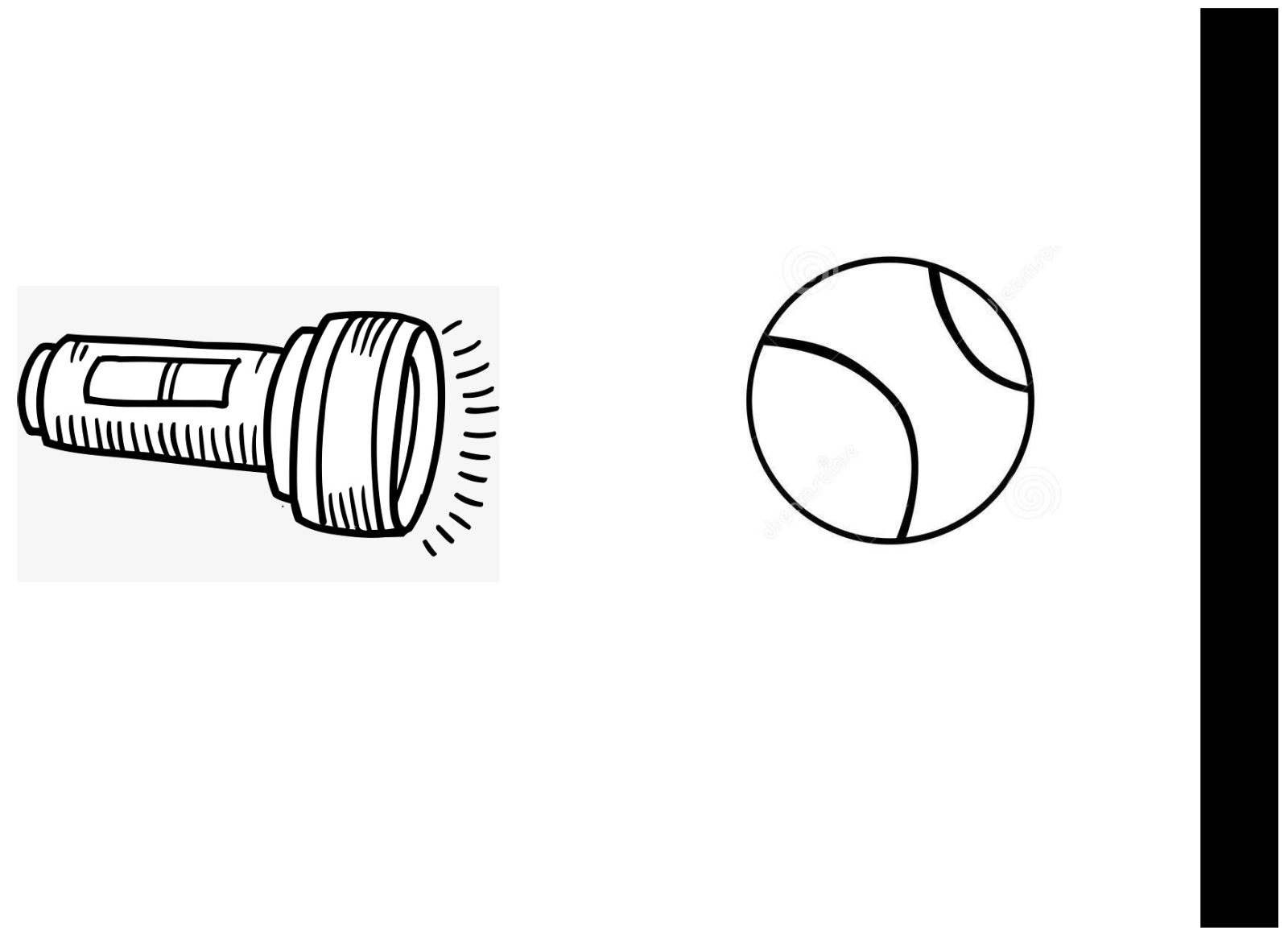
A student had a ball, a screen and a torch in working condition. He tried to form a shadow of the ball on the screen by placing them at different positions. Sometimes the shadow was not obtained. Explain.
Answer
Sometimes, the shadow of the object (ball) may not be formed because of improper arrangement of source of light (torch), object and screen. It may be due to the following reasons-
  1. The screen from the ball.
  2. The direction of beam of light from the torch falling on the ball, is parallel to the screen.
  3. The torch is kept away from the ball.
An accurate shadow of ball will be formed only if screen, torch and ball are in the same straight line (as shown in figure).
View full question & answer
Question 55 Marks
Activity.Place a chair in the school ground on a sunny day. What do you observe from the shadow of the chair?
  1. Does the shadow give an accurate picture of the shape of the chair? If the chair is turned around a little, how does the shape of the shadow change?
  2. Take a thin notebook and look at its shadow. Then, take a rectangular box and look at its shadow. Do the two shadows seem to have a similar shape?
  3. Take flowers or other objects of different colours and look at their shadows. A red rose and a yellow rose, for instance. Do the shadows look different in colour, when the colours of the objects are different?
  4. Take a long box and look at its shadow on the ground. When you move the box around, you may see that the size of the shadow changes. When is the shadow of the box the shortest, when the long side of the box is pointed towards the Sun or when the short side is pointing towards the Sun?
Answer
  1. No, accurate shape of chair is not shown by the shadow. When turned around a little, the shape of the shadow will change because now different portions of the chair will obstruct light and make shadow.
  2. Yes, the two shadows seem to have a similar shape.
  3. No, the shadows of the different coloured objects are not different.
  4. Shadow of the box is the shortest when the short side is pinting towards the Sun.
View full question & answer
Question 75 Marks
Classify the objects or materials given below as opaque, transparent or translucent and luminous or non-luminous:
Air, water, a piece of rock, a sheet of aluminium, a mirror, a wooden board, a sheet of polythene, a $CD$, smoke, a sheet of plane glass, fog, a piece of red hot iron, an umbrella, a lighted fluorescent tube, a wall, a sheet of carbon paper, the flame of a gas burner, a sheet of cardboard, a lighted torch, a sheet of cellophane, a wire mesh, kerosene stove, sun, firefly, moon.
Answer
Object
Object is Transparent/Translucent/Opaque
Object is Luminous/Nonluminous
Air
Transparent
Non-luminous
Water
Transparent
Non-luminous
Piece of rock
Opaque
Non-luminous
Sheet of aluminium
Opaque
Non-luminous
Mirror
Opaque
Non-luminous
Wooden board
Opaque
Non-luminous
Sheet of polythene
Translucent
Non-luminous
$CD$
Translucent
Non-luminous
Smoke
Translucent
Non-luminous
Sheet of plane glass
Transparent
Non-luminous
Fog
Translucent
Non-luminous
Piece of red hot iron
Opaque
Luminous
Umbrella
Opaque
Non-luminous
Lighted fluorescent tube
Opaque
Luminous
Wall
Opaque
Non-luminous
Sheet of carbon paper
Opaque
Non-luminous
Flame of a gas burner
Translucent
Luminous
Sheet of cardboard
Opaque
Non-luminous
Lighted torch
Opaque
Luminous
Sheet of cellophane
Translucent
Non-luminous
Wire mesh
Translucent
Non-luminous
Kerosene stove
Opaque
Luminous
Sun
Opaque
Luminous
Firefly
Opaque
Luminous
Moon
Opaque
Non-luminous
View full question & answer