Questions

[5 Marks Each] QUE-ANS

Take a timed test

9 questions · self-marked practice — reveal the answer and mark yourself.

Question 15 Marks
List five each opaque and transparent materials.
Answer
  1. Opaque materials:
  • Wood.
  • Iron.
  • Cardboard.
  • Brick.
  • Gold.
  1. Transparent materials:
  • Water.
  • Glass.
  • Air.
  • Cellophine plastic.
  • Fibre glass.
View full question & answer
Question 25 Marks
Match the objects given in Column $I$ with the materials given in Column $II.$
 
$COLUMN\ I$
 
$COLUMN\ II$
$a$
Surgical Instruments
$i$
Plastic
$b$
Newspaper
$ii$
Animal product
$c$
Electrical switches
$iii$
Steel
$d$
Wool
$iv$
Plant product
Answer
 
$COLUMN\ I$
 
$COLUMN\ II$
$a$
Surgical Instruments
$iii$
Steel
$b$
Newspaper
$iv$
Plant product
$c$
Electrical switches
$i$
Plastic
$d$
Wool
$ii$
Animal product
Explanation:
  1. Surgical instruments are made up of steel.
  2. Newspaper is made up of paper and paper is obtained from plants.
  3. Electrical switches are made up of plastic.
  4. Wool is obtained from wool yielding animals so wool is animal product.
View full question & answer
Question 35 Marks
Activity.Lists some common materials. You can also add more materials in Column $1$ that are known to you. Now, try and think of everyday objects you know, that are made mainly of these materials, and list them in Column $2.$
Answer
Different types of objects that are made from the same material:
S.No.
Material
Objects made of these materials
$(i)$
Wood
Chair, table, plough, bullock cart and its wheels, etc.
$(ii)$
Papier
Books, notebooks, newspapers, toys, calendars,etc.
$(iii)$
Leather
Shoes, belt, purse, bag, jacket,etc.
$(iv)$
Plastics
Mug, bottle, bucket, toy,etc.
$(v)$
Cotton
Clothes, curtains, bed sheets, sari,etc.
View full question & answer
Question 45 Marks
During summer holidays, a group of children collected a lump of salt, green grass, broken glass piece, a small thermocol box, pen, iron nail, glass marbles, hair, naphthalene ball, a piece of sugar candy (mishri) and tried to group them on the basis of properties given in Table below. Help them in filling the Table.
Name of the material Appearance (Hard/ Soft) Transparency (Transparent/ Transucent/ Opaque) Floats/ Sinks in water Soluble/ Insouble in water
- - - - -
Answer
Name of the material
Appearance (Hard/ Soft)
Transparency (Transparent/ Transucent/ Opaque)
Floats/ Sinks in water
Soluble/ Insouble in water
Lump of salt
Hard
Opaque
Sinks
Soluble
Green grass
Soft
Opaque
Floats
Insoluble
Broken glass piece
Hard
Transparent
Sinks
Insoluble
A small thermocol box
Soft
Opaque
Floats
Insoluble
Pen
Hard
Opaque
Sinks
Insoluble
Iron nail
Hard
Opaque
Sinks
Insoluble
Glass marbles
Hard
Transparent
Sinks
Insoluble
Hair
Soft
Opaque
Floats
Insoluble
Naphthalene ball
Hard
Opaque
Sinks
Insoluble
A piece of sugar candy (mishri)
Hard
Translucent
Sinks
Soluble
View full question & answer
Question 55 Marks
How can materials be grouped together? In what ways do we classify materials?
Answer
Different materials have different properties. Materials with similar properties can be grouped together.
Different types of materials can be grouped based on any of the following properties:
  • Appearance.
  • Solubility.
  • Transparency.
  • Conductivity.
  • Combustibility—Easily burn or not.
  • Attraction towards magnet.
View full question & answer
Question 65 Marks
Activity.
Collect samples of some solid substances such as sugar, salt, chalk powder, sand and ; sawdust. Take five glasses or beakers. Fill each one of them about two-thirds with water. Add a small amount (spoonful) of sugar to the first glass, salt to the second and similarly, add small amounts of the other susbtances into the other glasses. Stir the contents of each of them with a spoon. Wait for a few minutes. Observe what happens to the substances added to water. Note your observations as shown in Table.
Answer

Mixing different solid materials in water
S.No.
Substance
Substance
$1.$
Salt
Disappears completely in water.
$2.$
Sugar
Disappears completely in water.
$3.$
Sand
Does not disappear.
$4.$
Chalk powder
Does not disappear.
$5.$
Sawdust
Does not disappear.
View full question & answer
Question 75 Marks
List all items known to you that float on water. Check and see if they will float on an oil or kerosene.
Answer
  1. List of some items that float on water:
  1. Paper.
  2. Wood.
  3. Thin plastic sheets.
  4. Wax.
  5. Ice.
  6. Thermocol.
  7. Oil.
  1. List of items that float on an oil:
  1. Paper.
  2. Plastic sheet.
  3. Wax.
  4. Thermocol.
  5. Wood.
  1. List of items that float on kerosene:
  1. Paper.
  2. Thermocol.
  3. Thin plastic sheet.
View full question & answer
Question 85 Marks
Activity.
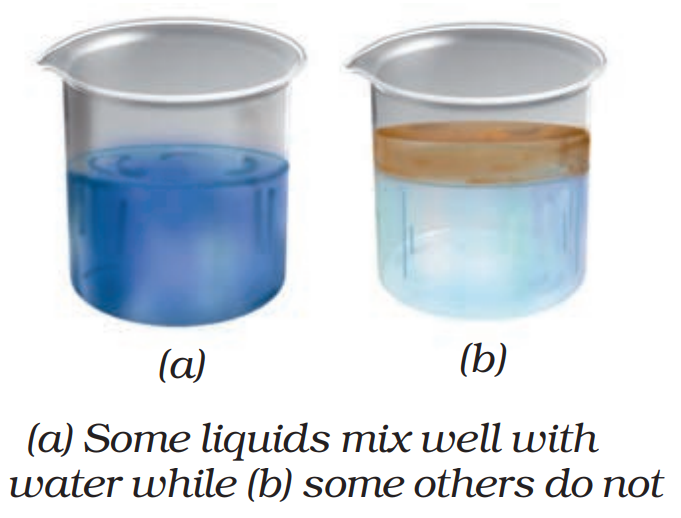
Collect samples of vinegar, lemon juice, mustard oil or coconut oil, kerosene or any other liquid. Take a glass tumbler. Fill it up to half with water. Add a few spoonfuls of one liquid to this and stir it well. Let it stand for five minutes. Observe whether the liquid mixes with water (see figure). Repeat the same with other liquids, as many different liquids as are available to you. Write your observations in Table.
Answer
Table: Solubility of some common liquids in water.
S.No.
Liquid
Mixes well/Does not mix
$1.$
Vinegar.
Mixes well.
$2.$
Lemon juice.
Mixes well.
$3.$
Mustard oil.
Does not mix.
$4.$
Coconut oil.
Does not mix.
$5.$
Kerosene.
Does not mix.
View full question & answer
Question 95 Marks
Match the objects given below with the materials from which they could be made. Remember, an object could be made from more than one material and a given material could be used for making many objects.
S.N.
Objects
 
Materials
$1.$
Book
$A$
Glass
$2.$
Tumblar
$B$
Wood
$3.$
Chair
$C$
Paper
$4.$
Toy
$D$
Leather
$5.$
Shoes
$E$
Plastic
Answer
S.N.
Objects
 
Materials
$1.$
Book
$C$
PaperGlass
$2.$
Tumblar
$A$
Glass and plastic
$3.$
Chair
$B$
Wood and plastic
$4.$
Toy
$E$
PlasticLeather
$5.$
Shoes
$D$
Leather
View full question & answer