MCQ 11 Mark
Mark $(\checkmark)$ against the correct answer in the following: $\frac{55}{-66}$ in standard form is:
- ✓
$\frac{5}{-6}$
- B
$\frac{-5}{6}$
- C
$\frac{-55}{66}$
- D
AnswerCorrect option: A. $\frac{5}{-6}$
$=\frac{55}{-66}=\frac{55\times(-1)}{-66\times(-1)}=\frac{-55}{66}$
$H.C.F.$ of $55$ and $66$ is $11$
$=\frac{55\div11}{66\div11}=\frac{-5}{6}$
$=\frac{-5}{6}$ is the standard from.
View full question & answer→MCQ 21 Mark
Sum of the numbers $0.3, 0.03$ and $0.003$ is:
- A
$0.999$
- B
$0.393$
- C
$0.636$
- ✓
Answer Given, $0.3, 0.03, 0.003$ We need to find sum of all these.
$\therefore$ sum of $0.3 + 0.03 + 0.003 = 0.333$
View full question & answer→MCQ 31 Mark
Mark $(\checkmark)$ against the correct answer in the following: What should be added to $\frac{-5}{9}$ to get $1?$
- A
$\frac{4}{9}$
- B
$\frac{-4}{9}$
- ✓
$\frac{14}{9}$
- D
$\frac{-14}{9}$
AnswerCorrect option: C. $\frac{14}{9}$
The correct option is $(c).$
$\frac{14}{9}$ should be added to $\frac{-4}{9}$ to get $1.$
$\text{x}+\Big(\frac{-5}{9}\Big)=1\text{x}$
$=1-\frac{(-5)}{9}=\frac{9+5}{9}=\frac{14}{9}$
Let the required number be $x.$
View full question & answer→MCQ 41 Mark
Which of the following rational numbers is in the standard form?
- A
$\frac{8}{-36}$
- B
$\frac{-7}{56}$
- C
$\frac{3}{-4}$
- ✓
View full question & answer→MCQ 51 Mark
If a is reciprocal of $b,$ then the reciprocal of $b$ is:
Answer If $a$ is reciprocal of $b,$ then the reciprocal of $b$ is $a$
If $a$ is reciprocal of $b,$ then
$⇒ a × b = 1 [$Commutative property is true for multiplication$]$
$⇒ b × a = 1$
Thus reciprocal of $b$ is $a$
View full question & answer→MCQ 61 Mark
Mark $(\checkmark)$ against the correct answer in the following: $0\div\frac{-7}{5}=?$
- A
- B
$\frac{-5}{7}$
- ✓
$0$
- D
$\frac{5}{7}$
Answer$0\div\frac{-7}{5}=?$
View full question & answer→MCQ 71 Mark
Out of the following numbers, which cannot be represented on a number line$? 0, \frac56, 1, \frac24$
Answer Given numbers are $0, \frac56, 1, \frac24$ are integers and $\frac56, \frac24$ are rational numbers. As, rationals and integers are subset of reals. Thus, all the above numbers are real. we can represent all above numbers on a number line.
View full question & answer→MCQ 81 Mark
$\frac{-3}{0}$ is a:
- A
- B
- C
Either positive or negative rational number
- ✓
Answer$\frac{-3}{0}$ is undefined. Which means that it is neither a negative rational number nor a positive rational number.
View full question & answer→MCQ 91 Mark
$\sqrt{9}$ is a rational number. It is equal to:
Answer $\sqrt{9}$ we can simplify the square root to $3$ which is a natural number, an integer and also can be written as $\frac{3}{1}$ so a rational number.
View full question & answer→MCQ 101 Mark
What is the additive identity element in the set of whole numbers$?$
Answer If a is a whole number then $a + 0 = a = 0 + a.$
Therefore, $0$ is the additive identity element for addition of whole number because it does not change the identity or value of the whole number during the operation of addition.
Hence, the correct answer is option $(a).$
View full question & answer→MCQ 111 Mark
$\frac{44}{-77}$ is standard form is:
- A
$\frac{4}{-7}$
- ✓
$-\frac{4}{7}$
- C
$-\frac{44}{77}$
- D
AnswerCorrect option: B. $-\frac{4}{7}$
The denominator of $\frac{44}{-77}$ is nagative.
Hence, the correct answer is option $(b).$
View full question & answer→MCQ 121 Mark
The value of $X$ such that $\frac{3}{8}$ and $\frac{\text{X}}{-24}$ are equivalent rational numbers is .......
Answer $\frac{-3}{8} = \frac{\text{x}}{24 } \text{ X} =\frac {-3\times-24}{8}\text{ X} = {9}$
View full question & answer→MCQ 131 Mark
If $\frac{27}{-45}$ is expressed as a rational number with denominator $5,$ then the numerator is:
Answer In order to express $\frac{27}{-45}$ as a rational number with denominator $5,$ firstly find a number which gives $5$ when $-45$ is divided by it.
This number is $-45\div5=-9$
Dividing the numerator and denominator of $\frac{27}{-45}$ by $-9,$
We have:
$\frac{27}{-45}=\frac{27\div(-9)}{-45\div(-9)}=\frac{-3}{5}$
Thus, the numerator is $-3.$
Hence, the correct answer is option $(b).$
View full question & answer→MCQ 141 Mark
Division of $9.826$ by $10$ gives:
- A
$98.26$
- B
$982.6$
- C
$0.09826$
- ✓
Answer$\frac{9.826}{10} = \frac{9826}{10000} = {0.9826}$
View full question & answer→MCQ 151 Mark
$\frac{-7}{13}-\Big(\frac{-8}{15}\Big)=$
- A
$-\frac{239}{195}$
- B
$\frac{29}{195}$
- C
$\frac{-29}{195}$
- ✓
Answer $\frac{-7}{13}-\Big(\frac{-8}{15}\Big)$
$=\frac{-7}{13}+\frac{8}{15}$ $\Big[-\Big(\frac{-8}{15}\Big)=\frac{8}{15}\Big]$
$=\frac{-7\times15+8\times13}{195} (LCM$ of $13$ and $15 = 195)$
$=\frac{-105+104}{195}$
$=\frac{-1}{195}$
Hence, the correct answer is option $(d).$
View full question & answer→MCQ 161 Mark
Mark $(\checkmark)$ against the correct answer in the following: Multiplicative inverse of $\frac{-2}{3}$ is:
- A
$\frac{2}{3}$
- ✓
$\frac{-2}{3}$
- C
$\frac{3}{2}$
- D
AnswerCorrect option: B. $\frac{-2}{3}$
The correct option is $(b).$
Multiplicative inverse of $\frac{-2}{3}\text{ is }\frac{-3}{2}$
View full question & answer→MCQ 171 Mark
Find a rational number between $-1$ and $1:$
- ✓
$0$
- B
$\frac{1}{\sqrt{-2}}$
- C
$\frac { -8 }{ 5 }$
- D
Answerhe rational numbers between the $2$ numbers $a, b$ is given by $\frac{\text{a+b}}{2}$ Here $a = -1, b = 1$ So the rational number between them is $\frac{-1+1}{2} = {0}$
View full question & answer→MCQ 181 Mark
If the rational numbers $\frac{-2}{3}\text{ and }\frac{4}{\text{x}}$ represent a pair of equivalent rational numbers, then $x:$
AnswerIt is given that the rational numbers $\frac{-2}{3}\text{ and }\frac{4}{\text{x}}$ represent a pair of equivalent rational numbers.
We know that the values of two equivalent rational numbers is equal.
$\therefore\frac{-2}{3}=\frac{4}{\text{x}}$
$\Rightarrow-2\times\text{x}=4\times3$ $\Big(\frac{\text{a}}{\text{b}}=\frac{\text{c}}{\text{d}}\Rightarrow\text{ad}=\text{bc}\Big)$
$\Rightarrow-2\text{x}=12$
$\Rightarrow\frac{-2\text{x}}{-2}=\frac{12}{-2} ($Dividing both sides by $-2)$
$\Rightarrow\text{x}=-6$
Hence, the correct answer is option $(b).$
View full question & answer→MCQ 191 Mark
What per cent is the least rational number of the greatest rational number if $\frac{1}{2},\frac{2}{5},\frac{1}{3}$ and $\frac{5}{9}$ are arranged in ascending order$?$
AnswerCorrect option: A. $60\%$
$60\%$
View full question & answer→MCQ 201 Mark
Which of the following statement is false?
- A
Every fraction is a rational number
- ✓
Every rational number is a fraction
- C
Every integer is a rational number
- D
AnswerCorrect option: B. Every rational number is a fraction
Every rational number is not a fraction. Since in rational numbers, we use integers and in fractions, we use only natural numbers.
View full question & answer→MCQ 211 Mark
Difference of the numbers $32$ and $27.091$ is:
- A
$30.791$
- B
$5.909$
- ✓
$4.909$
- D
AnswerCorrect option: C. $4.909$
View full question & answer→MCQ 221 Mark
If $-\frac{3}{8}\text{ and }\frac{\text{x}}{-24}$ are equivalent rational numbers, then $x =?$
AnswerIt is given that the rational numbers $-\frac{3}{8}\text{ and }\frac{\text{x}}{-24}$ are equivalent rational numbers.
We know that the values of two equivalent rational numbers is equal.
$\therefore\frac{\text{x}}{-24}=-\frac{3}{8}$
$\Rightarrow\text{x}\times8=-3\times(-24)$ $\Big(\frac{\text{a}}{\text{b}}=\frac{\text{c}}{\text{d}}\Rightarrow\text{ad}=\text{bc}\Big)$
$\Rightarrow8\text{x}=72$
$\Rightarrow\frac{8\text{x}}{8}=\frac{72}{8}$
$($Dividing both sides by $8)$
$\Rightarrow\text{x}=9 $
Hence, the correct answer is option $(c)$.
View full question & answer→MCQ 231 Mark
Which of the following rational numbers is positive$?$
- A
$\frac{-8}{7}$
- B
$\frac{19}{-13}$
- ✓
$\frac{-3}{-4}$
- D
$\frac{-21}{13}$
AnswerCorrect option: C. $\frac{-3}{-4}$
$(c)$ We know that, when numerator and denominator of a rational number, both are negative,
it is a positive rational number.
Hence, among the given rational numbers $\frac{-3}{-4}$ is positive.
View full question & answer→MCQ 241 Mark
$\frac{-5}{0}$ is $a .......$
- A
Positive rational number.
- B
Negative rational number.
- C
Either positive or negative rational number.
- ✓
Neither positive nor negative rational number.
AnswerCorrect option: D. Neither positive nor negative rational number.
$\because$ Denominator is $0$, it is not a rational number.
View full question & answer→MCQ 251 Mark
Mark $(\checkmark)$ against the correct answer in the following: The multiplicative inverse of $\frac{-3}{4}$ is:
- A
$\frac{3}{4}$
- B
$\frac{4}{3}$
- ✓
$\frac{-4}{3}$
- D
AnswerCorrect option: C. $\frac{-4}{3}$
Multiplicative inverse of $\frac{-3}{4}$ is $\frac{-4}{3}$
View full question & answer→MCQ 261 Mark
The rational number that does not have a reciprocal is:
AnswerThe rational number that does not have a reciprocal $0$ because reciprocal of $0$ is undefined.
View full question & answer→MCQ 271 Mark
In the standard form of a rational number, the common factor of numerator and denominator is always:
MCQ 281 Mark
Which of the following is not a rational number?
- ✓
$\sqrt{2}$
- B
$\sqrt{4}$
- C
$\sqrt{9}$
- D
AnswerCorrect option: A. $\sqrt{2}$
$\sqrt{2} = 1.4142135623730951 ...$
$\sqrt{4} = \sqrt{{2}\times{2}} = {2}$
$\sqrt{9} = \sqrt{{3}\times{3}} = {3}$
$\sqrt{16} = \sqrt{{4}\times{4}} = {4}$
As we can see the decimal representation of $\sqrt{2}$ is non$−$terminating non$−$repeating. $\sqrt{2}$ is irrational number.
View full question & answer→MCQ 291 Mark
The number of rational numbers between two given rational numbers is:
AnswerA rational number between two rational numbers $a$ and $b= \frac {(\text{a + b})}{2}$ Like this, using this rational number $= \frac {(\text{a + b})}{2}$ and $b,$ we can find another rational number. if we continue this, we get infinite rational numbers between two given rational numbers.
View full question & answer→MCQ 301 Mark
State which of the following statements is$/$ are true?
$I.$ Numerator and denominator of a positive rational number need not to have like signs.
$II.$ Numerator and denominator of a negative rational number should have like signs.
- A
Only $I$
- B
Only $II$
- C
Both $I$ and $II$
- ✓
Neither $I$ nor $II$
AnswerCorrect option: D. Neither $I$ nor $II$
If both the numerator and denominator has same sign, then the fraction is a positive rational number.
If the numerator and denominator have different signs, then the fraction is a negative rational number.
View full question & answer→MCQ 311 Mark
If $p:$ All integers are rational numbers and $q:$ Every rational number is an integer, then which of the following statement is correct?
- A
$p$ is False and $q$ is True
- ✓
$p$ is True and $q$ is False
- C
Both $p$ and $q$ are True
- D
Both $p$ and $q$ are False
AnswerCorrect option: B. $p$ is True and $q$ is False
All integers are rational number but all rational number are not integer because rational number can be integer, fraction, decimals so $p$ is true and $q$ is false.
View full question & answer→MCQ 321 Mark
If $\frac{-3}{7}=\frac{\text{x}}{35}\text{ then }\text{x}=?$
AnswerFirstly, write $\frac{-3}{7}$ as a rational number with denominator $35.$
Multiplying the numerator and denominator of $\frac{-3}{7}$ by $5,$
We have:
$\frac{-3}{7}=\frac{-3\times5}{7\times5}=\frac{-15}{35}$
$\therefore\frac{-3}{7}=\frac{\text{x}}{35}$
$\Rightarrow\frac{-15}{35}=\frac{\text{x}}{35}$
$\Rightarrow\text{x}=-15$
Hence, the correct answer is option $(c).$
View full question & answer→MCQ 331 Mark
A rational number between $-3$ and $3$ is:
AnswerA rational number is a number that can be represented $\frac{\text{a}}{\text{b}}$ where $a$ and $b$ are integers and b is not equal to $0.$ A rational number can also be represented in decimal form and the resulting decimal is a repeating decimal. Also any decimal number that is repeating can be written in the form $\frac{\text{a}}{\text{b}}$ with $b$ not equal to zero so it is a rational number. In the given options, option $D$ is irrational number. option $B$ and $C$ are not lying between $-3$ and $3.$ Only option A lies $-3$ and $3$ and is a rational number.
View full question & answer→MCQ 341 Mark
In the standard form of a rational number, the denominator is always a:
Answer$ (c)$ By definition, a rational number is said to be in the standard form, if its denominator is a positive integer.
View full question & answer→MCQ 351 Mark
Mark $(\checkmark)$ against the correct answer in the following: Which is greater between $\frac{-4}{9}$ and $\frac{-5}{12}?$
- A
$\frac{-4}{9}$
- ✓
$\frac{-5}{12}$
- C
AnswerCorrect option: B. $\frac{-5}{12}$
The correct option is $(b).$
$\frac{-5}{12}$ is greater than $\frac{-4}{9}$
$LCM$ of $9$ and $12$ is $36$
$\frac{-5\times3}{12\times3}=\frac{-15}{36}$
$\frac{-4\times4}{12\times4}=\frac{-16}{36}$
$(-15)>(-16)$
$\frac{-5}{12}>\frac{-4}{9}$
View full question & answer→MCQ 361 Mark
In the standard form of a rational number, the common factor of numerator and denominator is always:
Answer$(b)$ By definition, in the standard form of a rational number, the common factor of numerator and denominator is always $1$.
Note: Common factor means, a number which divides both the given two numbers.
View full question & answer→MCQ 371 Mark
$1\div\frac{1}{3}=$
- A
$\frac{1}{3}$
- ✓
$3$
- C
$1\frac{1}{3}$
- D
$3\frac{1}{3}$
Answer$1\div\frac{1}{3}$
$=1\times3$ $\Big(\text{x}\div\text{y}=\text{x}\times\frac{1}{\text{y}}\Big)$
$=3$
Hence, the correct answer is option $(b).$
View full question & answer→MCQ 381 Mark
Mark $(\checkmark)$ against the correct answer in the following: $1\div\frac{1}{2}=?$
- A
$\frac{1}{2}$
- ✓
$2$
- C
$2\frac{1}{2}$
- D
$1\frac{1}{2}$
Answer$1\div\frac{1}{2}$
$=1\times\frac{2}{1}$
$=2$
View full question & answer→MCQ 391 Mark
A rational number equal to $\frac{-2}{3}$ is:
- A
$\frac{-10}{25}$
- ✓
$\frac{10}{-15}$
- C
$\frac{-9}{6}$
- D
AnswerCorrect option: B. $\frac{10}{-15}$
We know that two rational numbers are equal if they have the same standard form.
The rational number $\frac{-2}{3}$ is in its standard form.
Consider the rational number $\frac{10}{-15}$
This rational numbner can be expressed in standerd form as follows:
$\frac{10}{-15}=\frac{10\times(-1)}{-15\times(-1)}=\frac{-10}{15}$ (Multiplying numerator and denominator by $-1$ to make denominator positive)
$HCF$ of $10$ and $15 = 5$
Dividing the numeator and denominator of $\frac{-10}{15}$ by $5,$
We have:
$\frac{-10}{15}=\frac{-10\div5}{15\div5}=\frac{-2}{3}$
Thus, the standard form of $\frac{-10}{15}$ is $\frac{-2}{3},$ which is same as the given rational number.
So, the rational number equal to $\frac{-2}{3}$ is $\frac{-10}{15}$
Let us check why options $(a)$ and $(c)$ are not correct.
The standard form of $\frac{-10}{25}\text{ is }\frac{-2}{5}$
$HCF$ of $10$ and $25 = 5$
Dividing the numerator and denominator of $=\frac{-10}{25}$ by $5,$
We have:
$\frac{-10}{25}=\frac{-10\div5}{25\div5}=\frac{-2}{5}$
The standard form of $\frac{-9}{6}\text{ is }\frac{-3}{2}$
$HCF$ of $6$ and $9 = 3$
Dividing the numerator and denominator of $\frac{-9}{3}$by $3,$
We have:
$\frac{-9}{6}=\frac{-9\div3}{6\div2}=\frac{-3}{2}$
Hence, the correct answer is option $(b)$
View full question & answer→MCQ 401 Mark
Mark $(\checkmark)$ against the correct answer in the following: Reciprocal of $-6$ is:
- A
$6$
- B
$\frac{1}{6}$
- ✓
$\frac{-1}{6}$
- D
AnswerCorrect option: C. $\frac{-1}{6}$
The correct option is $(c).$
Reciprocal of $-6\text{ is }\frac{-1}{6}$
View full question & answer→MCQ 411 Mark
Find the rational number which is not equal to $\frac{ 2}{3}$
- A
$ \frac{ -2}{-3}$
- ✓
$ \frac{ -4}{+6}$
- C
$\frac{ 8}{12}$
- D
AnswerCorrect option: B. $ \frac{ -4}{+6}$
$ \frac{ -4}{+6}$
View full question & answer→MCQ 421 Mark
Mark $(\checkmark)$ against the correct answer in the following: $\frac{-3}{14}\times?=\frac{5}{12}$
- ✓
$\frac{-35}{18}$
- B
$\frac{35}{18}$
- C
$\frac{7}{3}$
- D
$\frac{-7}{3}$
AnswerCorrect option: A. $\frac{-35}{18}$
$?=\frac{5}{12}\div\frac{(-3)}{14}$
$=\frac{5}{12}\times\frac{14}{(-3)}$
$=\frac{70}{-36}$
$=\frac{35\times-1}{-18\times-1}$
$?=\frac{-35}{18}$
View full question & answer→MCQ 431 Mark
If $p$ and $q$ both are perfect squares, then $\sqrt{\frac{\text{p}}{\text{q}}}$ is always a rational number. Is the statement true$?$
Answerif $p$ and $q$ are perfect squares, then we can writep $= x^2$ and $q = y^2$
$\sqrt{\frac{\text{p}}{\text{q}}} = \sqrt{\frac{\text{x}^{2}}{\text{y}^{2}}} $
$ = \frac{\text{x}}{\text{y}} = {\text{a}}$ rational number. So, the given statement is true
View full question & answer→MCQ 441 Mark
What should be added to $\frac{-7}{9}$ to get$?$
- A
$\frac{11}{9}$
- B
$\frac{-11}{9}$
- ✓
$\frac{25}{9}$
- D
$\frac{-25}{9}$
AnswerCorrect option: C. $\frac{25}{9}$
$\frac{25}{9}$
Sum of the given number and the required number $= 2$
Given number $=\frac{-7}{9}$
$\therefore$ Required number $=$ Sum of the numbers $-$ Given number
$=2-\Big(\frac{-7}{9}\Big)$
$=\frac{2}{1}+\frac{7}{9}$
$=\frac{2\times9+7\times1}{9}$
$=\frac{18+7}{9}$
$=\frac{25}{9}$
Hence, the correct answer is option $(d).$
View full question & answer→MCQ 451 Mark
Between two rational numbers, there exists:
- A
- B
- ✓
Infinite numbers of rational numbers
- D
AnswerCorrect option: C. Infinite numbers of rational numbers
Between two rational numbers there are infinitely many rational number for example.
between $4$ and $5$ there are $4.1, 4.2, .4.22, 4.223.$
View full question & answer→MCQ 461 Mark
Which among the following is a rational number?
AnswerCorrect option: D. $\sqrt { \frac { 64 }{ 49 } }$
$\sqrt{\frac{64}{49}} = {\frac{\sqrt{64}}{\sqrt{49}}} = \frac{8}{7}$ Option $D$ is a rational number. Rest all are irrational numbers.
View full question & answer→MCQ 471 Mark
The product of two rational numbers is always a ......... number:
AnswerProduct of two rational number is always a rational number Let $a$ and $b$ are two rational number then $a \times b$ will be a rational number.
View full question & answer→MCQ 481 Mark
The expression of the division $\frac { \frac { 1 }{ 3 } }{ \frac { 3 }{ 4 } }$ equals $......$
- ✓
$ \frac { 4 }{ 9 }$
- B
$\frac {4}{5}$
- C
$\frac {1}{3}$
- D
AnswerCorrect option: A. $ \frac { 4 }{ 9 }$
$=\frac { \frac { 1 }{ 3 } }{ \frac { 3 }{ 4 } } $
$= \frac{1}{3} \div \frac{3}{4} $
$= \frac{1}{3}\times\frac{4}{3} $
$= \frac{4}{9}$
View full question & answer→MCQ 491 Mark
$\frac{-2}{-19}$ is a:
- A
- ✓
- C
neither positive nor negative rational number
- D
AnswerBoth the negative signs of the numerator and denominator will cancel each other out. So the given fraction is a positive rational number.
View full question & answer→MCQ 501 Mark
Choose the rational number which does not liebetween rational numbers $-\frac{2}{5}$ and $-\frac{1}{5}$
- A
$-\frac{1}{4}$
- B
$-\frac{3}{10}$
- ✓
$\frac{3}{10}$
- D
AnswerCorrect option: C. $\frac{3}{10}$
Consider given the rational numbers $-\frac{2}{5}$ and $-\frac{1}{5}$ Now, given both rational numbers are negative numbers so the number which lies between them will be negative. so $\frac{3}{10}$ will not lie between them,
View full question & answer→MCQ 511 Mark
Which of the following is a negative rational number:
- ✓
$\frac { -15 }{ 25 }$
- B
$0$
- C
$\frac { 3 }{ 5 }$
- D
AnswerCorrect option: A. $\frac { -15 }{ 25 }$
Among the following negative rational numbers are $ \frac{-15}{25}$ and $\frac{-3}{5}$
View full question & answer→MCQ 521 Mark
If $\frac{\text{x}}{3}+\frac{1}{3}=1,$ then $x = ?$
- A
$\frac{3}{4}$
- ✓
$\frac{4}{3}$
- C
$-\frac{3}{4}$
- D
$\frac{-4}{3}$
AnswerCorrect option: B. $\frac{4}{3}$
$\frac{\text{x}}{2}+\frac{1}{3}=1$
$\Rightarrow\frac{\text{x}}{2}=1-\frac{1}{3}$
$\Rightarrow\frac{\text{x}}{2}=\frac{3\times1-1}{3}$
$\Rightarrow\frac{\text{x}}{2}=\frac{3-1}{3}$
$\Rightarrow\frac{\text{x}}{2}=\frac{2}{3}$
$\Rightarrow\frac{2\text{x}}{2}=\frac{2\times2}{3}( $Multiplying both sides by $2)$
$\Rightarrow\text{x}=\frac{4}{3}$
Hence, the correct answer is option $(b).$
View full question & answer→MCQ 531 Mark
Arational number $\frac{-2}{3}$
AnswerCorrect option: A. Lies to the left side of $0$ on the number line
Since $\frac{-2}{3} < {0}$ it lies on left side of $0$ on the number line.
View full question & answer→MCQ 541 Mark
Mark $(\checkmark)$ against the correct answer in the following: $-2\frac{1}{3}+4\frac{3}{5}=?$
- A
$-2\frac{4}{15}$
- ✓
$2\frac{4}{15}$
- C
$-2\frac{1}{5}$
- D
$2\frac{2}{15}$
AnswerCorrect option: B. $2\frac{4}{15}$
The correct option is $(b).$
$-2\frac{1}{3}+4\frac{3}{5}$
$=\frac{-7}{3}+\frac{23}{5}$
$LCM$ of $5$ and $5$ is $15$
$=\frac{-35+69}{15}$
$=\frac{34}{15}$
$=2\frac{4}{15}$
View full question & answer→MCQ 551 Mark
Mark $(\checkmark)$ against the correct answer in the following: $78\frac{3}{4}\div2\frac{1}{2}=?$
- ✓
$31\frac{1}{2}$
- B
$39\frac{3}{8}$
- C
$40\frac{1}{3}$
- D
AnswerCorrect option: A. $31\frac{1}{2}$
$78\frac{3}{4}\div2\frac{1}{2}$
$=\frac{315}{4}\div\frac{5}{2}$
$=\frac{315}{4}\times\frac{2}{5}$
$=\frac{63}{2}$
$=31\frac{1}{2}$
View full question & answer→MCQ 561 Mark
Which one of the following is a rational number:
- ✓
$(\sqrt{2})^{2}$
- B
$2\sqrt{2}$
- C
$2 + \sqrt{2}$
- D
AnswerCorrect option: A. $(\sqrt{2})^{2}$
Observe that, $ (2^{\frac{1}{2}})^{2}=2$
$\therefore$ it is a rational number.
All other numbers are irrational.
View full question & answer→MCQ 571 Mark
Which of the following pairs of rational numbers are on the opposite side of the zero on the number line?
- A
$\frac{3}{7}\text{ and }\frac{5}{12}$
- B
$-\frac{3}{7}\text{ and }\frac{-5}{12}$
- ✓
$\frac{3}{7}\text{ and }\frac{-5}{12}$
- D
AnswerCorrect option: C. $\frac{3}{7}\text{ and }\frac{-5}{12}$
The rational numbers $\frac{3}{7}\text{ and }\frac{5}{12}$ are positive rational numbers. We know that every positive rational number is greater than $0,$ so both the rational numbers $\frac{3}{7}\text{ and }\frac{5}{12}$ are represented by points on the right of the zero on the number line.
The rational numbers $-\frac{3}{7}\text{ and }\frac{-5}{12}$ are negative rational numbers. We know that every negative rational number is less than $0,$ so both the rational numbers $\frac{3}{7}\text{ and }\frac{5}{12}$ are represented by points on the left of the zero on the number line.
The rational numbers $\frac{3}{7}$ is a positive rational number whereas the rational number $\frac{-5}{12}$ is a negative rational numbers. We know that every negative rational number is less than $0$ and every positive rational number is greater than $0,$ so the rational number $\frac{3}{7}$ is represented by point on the right of the zero and $\frac{-5}{12}$ is represented by point on the left of the zero on the number line.
Thus, the rational numbers $-\frac{3}{7}\text{ and }\frac{-5}{12}$ are on the opposite side of the zero on the number line.
Hence, the correct answer is option $(c).$
View full question & answer→MCQ 581 Mark
If $\frac{\text{p}}{\text{q}}$ and $\frac{\text{R}}{\text{S}}$are equivalent fraction, then we have:
- A
$P + s = q + r$
- B
$P ÷ s = q ÷ s$
- C
$Pq = rs$
- ✓
$Ps = rq$
AnswerCorrect option: D. $Ps = rq$
$Ps = rq$
View full question & answer→MCQ 591 Mark
The standard from of $\frac{55}{-99}$ is:
- A
$\frac{5}{9}$
- ✓
$\frac{-5}{9}$
- C
$\frac{-55}{99}$
- D
$\frac{-99}{55}$
AnswerCorrect option: B. $\frac{-5}{9}$
$\frac{-5}{9}$
View full question & answer→MCQ 601 Mark
Which of the following rational numbers is equal to its reciprocal$?$
- ✓
$1$
- B
$2$
- C
$\frac{1}{2}$
- D
$0$
Answer$1.$ Reciparocal of $1=\frac{1}{1}=1$
$2.$ Reciparocal of $2\frac{1}{2}$
$3.$ Reciparocal of $\frac{1}{2}=\frac{1}{\frac{1}{2}}=2$
$4.$ Reciparocal of $0=\frac{1}{0}$
Note: $1$ is the only number, which is equal its recprocal.
View full question & answer→MCQ 611 Mark
The product $3\times\frac{1}{7}\times1\frac{5}{6}\times1\frac{2}{5}\times1\frac{1}{11}$is equal to:
- A
$5\frac{5}{8}$
- B
$5\frac{4}{5}$
- ✓
$8\frac{4}{5}$
- D
$7\frac{4}{5}$
AnswerCorrect option: C. $8\frac{4}{5}$
$3\frac{1}{7}\times1\frac{5}{6}\times1\frac{2}{5}\times1\frac{1}{11}$
$=\frac{22}{7}\times\frac{11}{6}\times\frac{7}5{}\times\frac{12}{11}$
$=\frac{22\times11\times7\times2}{7\times6\times5\times11}$ $\Big(\frac{\text{a}}{\text{b}}\times\frac{\text{c}}{\text{d}}=\frac{\text{a}\times\text{c}}{\text{b}\times\text{d}}\Big)$
$=\frac{44}{5}$
$=\frac{8\times5+4}{5}$
$=8\frac{4}{5}$
Hence, the correct answer is option $(c).$
View full question & answer→MCQ 621 Mark
Which of the following is equivalent to $\frac{4}{5}?$
- A
$\frac{4}{5}$
- B
$\frac{16}{25}$
- ✓
$\frac{16}{20}$
- D
$\frac{15}{25}$
AnswerCorrect option: C. $\frac{16}{20}$
Given rational number is $\frac{4}{5},$
So, equivalent rational number $=\frac{4\times4}{5\times4}$
$=\frac{16}{20}[ $Multipying numerator and denominator by $4]$
Note: If the numerator and denominator of a rational number is multiplied/divided by a non-zero integer, then the result we get, is equivalent rational number.
View full question & answer→MCQ 631 Mark
A rational number can be expressed asa terminating decimal if thedenominator has factors:
- ✓
$2$ or $5$
- B
$2, 3$ or $5$
- C
$3$ or $5$
- D
AnswerCorrect option: A. $2$ or $5$
$2$ or $5$
View full question & answer→MCQ 641 Mark
The product of $\frac{2}{9}$ and $\frac{27}{8}$ is$.....$
- A
$\frac{4}{3}$
- ✓
$\frac{3}{4}$
- C
$3$
- D
$4$
AnswerCorrect option: B. $\frac{3}{4}$
$\frac{3}{4}$
View full question & answer→MCQ 651 Mark
Classify the result as rational or irrationals. $(3+\sqrt{23})-\sqrt{23}$
Answer $(3+\sqrt{23})-\sqrt{23}$
$3+\sqrt{23} - \sqrt{23} = {3}$
Here, $3$ is a rational number.
View full question & answer→MCQ 661 Mark
If $P:$ every fraction is a rational number and $Q:$ every rational number is a fraction, then which of the following options hold$?$
- ✓
$P$ is true and $Q$ is false
- B
$P$ is false and $Q$ is true
- C
Both $p$ and $q$ are true
- D
Both $p$ and $q$ are false
AnswerCorrect option: A. $P$ is true and $Q$ is false
$ P:$ Every fraction is a rational number: True
$Q:$ Every rational number is a fraction: False
View full question & answer→MCQ 671 Mark
Mark $(\checkmark)$ against the correct answer in the following: What should be subtracted from $\frac{-2}{7}$ to get $\frac{3}{4}?$
- ✓
$\frac{-17}{12}$
- B
$\frac{17}{12}$
- C
$\frac{-12}{17}$
- D
$\frac{-12}{17}$
AnswerCorrect option: A. $\frac{-17}{12}$
Let the number to be subtracted be $x$
$\Rightarrow\text{x}=\frac{-2}{3}-\frac{3}{4}$
$LCM$ of $3$ and $4$ is $12$
$=\frac{-8-9}{12}$
$\frac{-17}{12}$
View full question & answer→MCQ 681 Mark
Mark $(\checkmark)$ against the correct answer in the following: $-2\frac{1}{9}-6=?$
- ✓
$-8\frac{1}{9}$
- B
$8\frac{1}{9}$
- C
$4\frac{1}{9}$
- D
$-4\frac{1}{9}$
AnswerCorrect option: A. $-8\frac{1}{9}$
The correct option is $(a).$
$=\frac{-73}{9}=-8\frac{1}{9}$
View full question & answer→MCQ 691 Mark
If $\frac{4}{3}=\frac{\text{x}}{12}$ Than $x =$
View full question & answer→MCQ 701 Mark
A rational number $\frac{-2}{3}$
AnswerCorrect option: A. Lies to the left side of $0$ on the number line
$\frac{-2}{3} = -0.667 - 0.667 < 0$ it will lie to the left side of $0$ on the number line.
View full question & answer→MCQ 711 Mark
$1\div\frac{-5}{7}=$
- A
$\frac{2}{7}$
- B
$\frac{5}{7}$
- C
$-\frac{2}{7}$
- ✓
$\frac{-7}{5}$
AnswerCorrect option: D. $\frac{-7}{5}$
$1\div\frac{-5}{7}$
$=1\times\frac{7}{-5}$ $\Big(\text{x}\div\text{y}=\text{x}\times\frac{1}{\text{y}}\Big)$
$=\frac{7}{-5}$
$=\frac{7\times(-1)}{-5\times(-1)}$
$=\frac{-7}{5}$
Hence, the correct answer is option $(d).$
View full question & answer→MCQ 721 Mark
$\frac{-3}{0}$is a:
- A
- B
- C
Either positive or negative rational number
- ✓
Answer$\frac{-3}{0}$ is undefined. Which means that it is neither a negative rational number nor a positive rational number.
View full question & answer→MCQ 731 Mark
A fraction is a rational number, and a rational number:
- A
- ✓
May or may not be a fraction.
- C
- D
Can always be reduced to a fraction.
AnswerCorrect option: B. May or may not be a fraction.
May or may not be a fraction.
View full question & answer→MCQ 741 Mark
The reciprocal of a positive rational number is positive:
MCQ 751 Mark
The value of the fraction $\displaystyle \frac{5}{\sqrt{0.0025}}$ is
- A
$\frac{1}{5}$
- B
$5$
- ✓
$100$
- D
$50$
Answer We need to find value of $\frac {5}{\sqrt {0.0025}}$
$\therefore \displaystyle \frac{5}{\sqrt{0.0025}} = \frac{5}{0.05} = 100$
View full question & answer→MCQ 761 Mark
If the product of two non-zero rational numbers is $1,$ Then they are:
- A
Additve inverse of each other.
- B
Multiplicative inverse of each other.
- C
Reciprocal of each other.
- ✓
Both $(b)$ and $(c)$
AnswerCorrect option: D. Both $(b)$ and $(c)$
For every non-zero rational number $\frac{\text{a}}{\text{b}}$ there exists a rational number $\frac{\text{b}}{\text{a}}$ such that:
$\frac{\text{a}}{\text{b}}\times\frac{\text{b}}{\text{a}}=1$
Here, the rational number $\frac{\text{b}}{\text{a}}$ is called the multiplicative inverse or reciprocal of $\frac{\text{a}}{\text{b}}$
Thus, if the product of two non-zero rational numbers is $1,$ then they are multiplicative inverse or reciprocal of each other.
Hence, the correct answer is option $(d).$
View full question & answer→MCQ 771 Mark
The division of $\frac { 18 }{ 6 }$ is:
Answer The value of $ \frac{18}{6}= 18 \div 6$ as $18$ is divisible by $6 = 3$
View full question & answer→MCQ 781 Mark
The sum of $\frac{8}{15}$ and $\frac{7}{15}$ is:
- ✓
$1$
- B
$\frac{1}{15}$
- C
$\frac{1}{30}$
- D
Answer$\frac{8}{15}+\frac{7}{15}=\frac{8+7}{15}=1$
View full question & answer→MCQ 791 Mark
The rational number equal to $\frac{2}{-3}$ is:
- A
$\frac{14}{-18}$
- ✓
$\frac{-6}{9}$
- C
$\frac{-8}{-12}$
- D
$\frac{3}{-2}$
AnswerCorrect option: B. $\frac{-6}{9}$
We know that two rational numbers are equal if they have the same standard form.
$\frac{2}{-3}=\frac{2\times(-1)}{-3\times(-1)}=\frac{-2}{3}$
The standard form of $\frac{2}{-3}\text{ is }\frac{-2}{3}$
Consider the rational number $\frac{-6}{9}$
$HCF$ of $6$ and $9 = 3$
Dividing the numerator and denominator of $\frac{-6}{9}$ by $3,$
We have:
$\frac{-6}{9}=\frac{-6\div3}{9\div3}=\frac{-2}{3}$
So, the rational number $\frac{-6}{9}$ is equal to $\frac{2}{-3}$
It can be checked that:
Standard form of $\frac{14}{-18}=\frac{-7}{9}$
Standard form of $\frac{3}{-2}=\frac{-3}{2}$
Hence, the correct answer is option $(b).$
View full question & answer→MCQ 801 Mark
Which of the following is correct$?$
- ✓
$\frac{5}{9}>\frac{-3}{8}$
- B
$\frac{5}{9}<\frac{-3}{-8}$
- C
$\frac{2}{-3}<\frac{-8}{7}$
- D
$\frac{4}{-3}>\frac{-8}{7}$
AnswerCorrect option: A. $\frac{5}{9}>\frac{-3}{8}$
Consider the rational numbers $\frac{5}{9}\text{ and } \frac{-3}{-8}$
We write the rational number $\frac{-3}{-8}$ with positive denominator.
$\frac{-3}{-8}=\frac{-3\times(-1)}{-8\times(-1)}=\frac{3}{8}$
Now, we write the rational numbers so that they have a common denominator.
$LCM$ of $8$ and $9 = 72$
So, $\frac{5}{9}=\frac{5\times8}{9\times8}=\frac{40}{72}$ and $\frac{3}{8}=\frac{3\times9}{8\times9}=\frac{27}{72}$
Now,
$40>27$
$\Rightarrow\frac{40}{72}>\frac{27}{72}$
$\Rightarrow\frac{5}{9}>\frac{3}{8}$
$\Rightarrow\frac{5}{9}>\frac{-3}{-8}$
Hence the correct option is $(a).$
View full question & answer→MCQ 811 Mark
How many rational numbers are there between two rational numbers$?$
Answer$ (c)$ There are unlimited numbers between two rational numbers.
View full question & answer→MCQ 821 Mark
Mark $(\checkmark)$ against the correct answer in the following: $\frac{-102}{119}$ in standard form is:
- A
$\frac{-4}{7}$
- ✓
$\frac{-6}{7}$
- C
$\frac{-6}{17}$
- D
AnswerCorrect option: B. $\frac{-6}{7}$
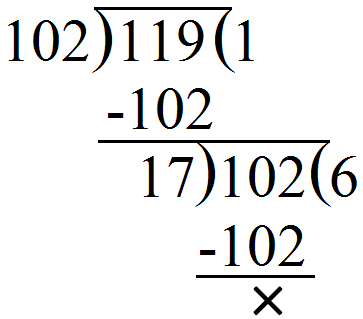
$H.C.F$ of $102$ and $119$ is $17$
$=\frac{-102\div11}{119\div17}=\frac{-6}{7}$
The standard from of $\frac{-102}{119}\text{ is }\frac{-6}{7}$
View full question & answer→MCQ 831 Mark
Mark $(\checkmark)$ against the correct answer in the following:The product of two numbers is$\frac{-1}{6}$ If one of them is $\frac{-5}{8}$ the other number is:
- A
$\frac{-4}{15}$
- ✓
$\frac{4}{15}$
- C
$\frac{15}{4}$
- D
$\frac{-15}{4}$
AnswerCorrect option: B. $\frac{4}{15}$
Let the other number to be $x$
$\frac{-5}{8}\times\text{x}=\frac{-1}{6}$
$\Rightarrow\text{x}=\frac{-1}{6}\div\Big(\frac{-5}{8}\Big)$
$=\frac{-1}{6}\times\Big(\frac{8}{-5}\Big)$
$=\frac{-4}{-15}$
$=\frac{4}{15}$
View full question & answer→MCQ 841 Mark
$-2\frac{3}{7}+4=?$
- A
$\frac{-11}{7}$
- ✓
$\frac{11}{7}$
- C
$\frac{-45}{7}$
- D
$\frac{45}{7}$
AnswerCorrect option: B. $\frac{11}{7}$
$?=-2\frac{3}{7}+4$
$\Rightarrow?=-\frac{17}{7}+\frac{4}{1}$
$\Rightarrow?=\frac{-17\times1+4\times7}{7}$
$\Rightarrow=\frac{-17+28}{7}$
$\Rightarrow?=\frac{11}{7}$
Hence, the correct answer is option $(b).$
View full question & answer→MCQ 851 Mark
The standard form of $\frac{-48}{60}$ is:
- A
$\frac{48}{60}$
- B
$\frac{-601}{48}$
- ✓
$\frac{-4}{5}$
- D
$\frac{-4}{-5}$
AnswerCorrect option: C. $\frac{-4}{5}$
Given rational number is $\frac{-48}{60}.$
For standrad/ simplest form, divide numerator and denomin by their $HCF$
i.e. $\frac{-48+12}{60+12}=\frac{-4}{5}$
Hence, the standard form of $\frac{-48}{60}$ is $\frac{-4}{5}.$
View full question & answer→MCQ 861 Mark
The rational number equivalent to the rational number $\frac{7}{19}$ is:
- A
$\frac{17}{119}$
- B
$\frac{14}{57}$
- C
$\frac{21}{38}$
- ✓
$\frac{21}{57}$
AnswerCorrect option: D. $\frac{21}{57}$
$\frac{7}{19}$ can be written as $\frac{{7\times}\text{n}}{{19\times}\text{n}}$ where $n$ is integer.The only equation which satisfies this equation is option $D$ as $\frac{21}{57} = \frac{7\times{3}}{19\times{3}}$ where $n = 3$
View full question & answer→MCQ 871 Mark
Write five rational numbers which are smaller than $2:$
- ✓
$1,\frac{1}{2},\,0,\,-1,\,-\frac{1}{2}$
- B
$0, 1 , 1.414, \sqrt3, -1$
- C
$0, 1 , \sqrt2, \sqrt3, -1$
- D
$0, 1 , 1.732, \sqrt2, -1$
AnswerCorrect option: A. $1,\frac{1}{2},\,0,\,-1,\,-\frac{1}{2}$
Five rational numbers less than $2$ may be taken $1,\frac{1}{2},\,0,\,-1,\,-\frac{1}{2}$(There can be many more such rational numbers).
View full question & answer→MCQ 881 Mark
Decimal representation of a rational number cannot be:
- A
- B
Non$-$Terminating
- C
Non$-$Terminating, Repeating
- ✓
Non$-$Terminating, Non$-$Repeating
AnswerCorrect option: D. Non$-$Terminating, Non$-$Repeating
View full question & answer→MCQ 891 Mark
The value of the root $ \sqrt{\frac{16}{36}+\frac{1}{4}}$ is:
- A
$ \frac{2}{5}$
- B
$ \frac{1}{3}$
- ✓
$\frac{5}{6}$
- D
$ \frac{7}{6}$
AnswerCorrect option: C. $\frac{5}{6}$
$\therefore\sqrt{\frac{16}{36}+\frac{1}{4}}$
$=\sqrt{\frac{16+9}{36}} $
$= \sqrt{\frac{25}{36}} $
$= \frac{5}{6}$
View full question & answer→MCQ 901 Mark
The reciprocal of $\frac{1}{2}$ is:
Answer$ (b)$ Reciprocal of $\frac{1}{2}=\frac{1}{\frac{1}{2}}=2$
View full question & answer→MCQ 911 Mark
The rational number $ {\frac{0}{7}}$
- A
- B
- C
Has either a positive numerator or a negative numerator
- ✓
Has neither a positive numerator nor a negative numerator
AnswerCorrect option: D. Has neither a positive numerator nor a negative numerator
In the given question numerator is $0$ and $0$ is neither positive nor negative.
View full question & answer→MCQ 921 Mark
Evaluate: $ \frac {1}{(-5)^2}$
- A
$\frac {-1}{25}$
- ✓
$\frac {1}{25}$
- C
$25$
- D
$-25$
AnswerCorrect option: B. $\frac {1}{25}$
The value of $\frac {1}{(-5)^2}=\dfrac {1}{(-5)(-5)} = \frac{1}{25}$
View full question & answer→MCQ 931 Mark
Match the correct product to the given expression $3 \times 5 \times 2 \times 5 = ..........$
Answer$ 3 \times 5 \times 2 \times 5 = 150$ The given expression has more than $2$ factors. So, it is a composite number.
View full question & answer→MCQ 941 Mark
The whole number nearest to $457$ and divisible by $11$ is:
AnswerThe numbers $450$ and $460$ are not divisible by $11.$
Now, both the numbers $451$ and $462$ are divisible by $11.$
Distance between $457$ and $451$ on the number line $= 457 - 451 = 6$
Distance between $457$ and $462$ on the number line $= 462 - 457 = 5$
Thus, the whole number nearest to $457$ and divisible by $11$ is $462.$
Hence, the correct answer is option $(d).$
View full question & answer→MCQ 951 Mark
If $-\frac{3}{4}=\frac{6}{\text{x}},$ then $x =$
Answer $-\frac{3}{4}=\frac{6}{\text{x}}$
$\Rightarrow-3\times\text{x}=6\times4$ $\Big(\frac{\text{a}}{\text{b}}=\frac{\text{c}}{\text{d}}\Rightarrow\text{ad}=\text{bc}\Big)$
$\Rightarrow-3\text{x}=24$
$\Rightarrow\frac{-3\text{x}}{-3}=\frac{24}{-3} ($Dividing both sides by $-3)$
$\Rightarrow\text{x}=-8$
Hence, the correct answer is option $(a).$
View full question & answer→MCQ 961 Mark
Which one of the following is not true?
- A
Every natural number is a rational number
- ✓
Every real number is a rational number
- C
Every whole number is a rational number
- D
Every integer is a rational number
AnswerCorrect option: B. Every real number is a rational number
Every real number is a rational number
View full question & answer→MCQ 971 Mark
Find the unknown value $ x: \frac{5}{13} +\text{ x} = \frac{5}{13}$
- ✓
$0$
- B
$1$
- C
$ \frac{5}{13}$
- D
$ \frac{2}{13}$
Answer Given, $\frac {5}{13}+ \text{x}= \frac {5}{13}$
$\therefore \text{x}= \frac{5}{13}-\frac{5}{13}$
$\therefore \text{x}= 0$
View full question & answer→MCQ 981 Mark
$\frac{-2}{-19}$ is a:
- ✓
Positive rational number.
- B
Negative rational number.
- C
Either positive or negative number.
- D
Has neither a positive numerator nor a negative number
AnswerCorrect option: A. Positive rational number.
$\because$ Both numerator and denominator are negative $(i.e.,$ same sign$)$
View full question & answer→MCQ 991 Mark
Mark $(\checkmark)$ against the correct answer in the following: $\frac{-9}{14}+?=-1$
- A
$\frac{5}{14}$
- ✓
$\frac{-5}{14}$
- C
$\frac{1}{7}$
- D
$\frac{-1}{7}$
AnswerCorrect option: B. $\frac{-5}{14}$
Missing number $=(-1)+\frac{9}{14}$
$=\frac{-14+9}{14}$
$=\frac{-5}{14}$
View full question & answer→MCQ 1001 Mark
All repeating decimals are:
MCQ 1011 Mark
Product of the numbers $78.12$ and $1.5$ is:
- A
$117.81$
- ✓
$117.18$
- C
$117.32$
- D
$117.80$
AnswerCorrect option: B. $117.18$
$78.12\times1.5 = \frac{7812}{100}\times\frac{15}{10}$
$ = \frac{117180}{1000}$
$= 117.180$
$= 117.18$
View full question & answer→MCQ 1021 Mark
A rational number is defined as a number that can be expressed in the form $\frac{\text{p}}{\text{q}},$ where $p$ and $q$ are integers and
- A
$\text{q}=0$
- B
$\text{q}=1$
- C
$\text{q}\neq1$
- ✓
$\text{q}\neq0$
AnswerCorrect option: D. $\text{q}\neq0$
A number that can be expressed in the form of $\frac{\text{p}}{\text{q}},$ where $p$ and $q$ are integers and $\text{q}\neq0,$ is called a rational number.
View full question & answer→MCQ 1031 Mark
Which one of the following is a rational number?
- ✓
$(\sqrt{2})^{2}$
- B
$2\sqrt{2}$
- C
$2+\sqrt{2}$
- D
$\frac{\sqrt{2}}{2}$
AnswerCorrect option: A. $(\sqrt{2})^{2}$
$(\sqrt{2})^{2} = \sqrt{2}\times\sqrt{2} = {2}$ So $(\sqrt{2})^{2}$ is a rational number.
View full question & answer→MCQ 1041 Mark
Mark $(\checkmark)$ against the correct answer in the following: Which is smaller between $\frac{-5}{6}$ and $\frac{-7}{12}?$
- ✓
$\frac{-5}{6}$
- B
$\frac{-7}{12}$
- C
$\frac{6}{5}$
- D
AnswerCorrect option: A. $\frac{-5}{6}$
Since $LCM$ of $6$ and $12$ is $12$
$\frac{-5\times2}{6\times}=\frac{-10}{12}$
$\frac{-7\times1}{12\times1}=\frac{-7}{12}$
$\frac{-5}{6}<\frac{-7}{12}$
View full question & answer→MCQ 1051 Mark
Express $ \frac{126}{-196}$ as simplest rational number with numerator equal to:
Answer Given $ \frac{126}{-196} =\frac{ {-9}\times{14}}{14\times14} = \frac{-9}{14}$
View full question & answer→MCQ 1061 Mark
$(-2)\div\Big(-\frac{5}{3}\Big)=$
- A
$\frac{5}{6}$
- B
$-\frac{5}{6}$
- ✓
$\frac{6}{5}$
- D
$\frac{-6}{5}$
AnswerCorrect option: C. $\frac{6}{5}$
$(-2)\div\Big(-\frac{5}{3}\Big)$
$=-2\times\Big(-\frac{3}{5}\Big)$ $\text{x}\div\text{y}=\text{x}\times\frac{1}{\text{y}}$
$=\frac{-2}{1}\times\frac{(-3)}{5}$
$=\frac{-2\times(-3)}{1\times5}$ $\Big(\frac{\text{a}}{\text{b}}\times\frac{\text{c}}{\text{d}}=\frac{\text{a}\times\text{c}}{\text{b}\times\text{d}}\Big)$
$=\frac{6}{5}$
Hence, the correct answer is option $(c).$
View full question & answer→MCQ 1071 Mark
A rational number is defined as a number that can be expressed in the form $\frac{\text{p}}{\text{q}}$ where $p$ and $q$ are integers and:
- A
$q = 0$
- B
$q = 1$
- C
${\text{q}}\neq{1}$
- ✓
${\text{q}}\neq{0}$
AnswerCorrect option: D. ${\text{q}}\neq{0}$
According to the definition of a rational number, it can be expressed in the form of $\frac{\text{p}}{\text{q}}$ where $p$ and $q$ are an integer and ${\text{q}}\neq{0}$
View full question & answer→MCQ 1081 Mark
Mark $(\checkmark)$ against the correct answer in the following: $\text{if }\frac{\text{x}}{6}=\frac{7}{-3}$ then the value of $x$ is:
Answer The correct option is $(a).$
The value of $x$ is $-14$
$\Big[\text{x}=\frac{7\times6}{-3}=\frac{42^{14}}{-3_1}=-14\Big]$
View full question & answer→MCQ 1091 Mark
Which one of the following is a rational number?
- ✓
$( \sqrt{7} )^{2}$
- B
$ 211\sqrt{7}$
- C
$8+\sqrt{7}$
- D
$\frac{\sqrt{7}}{9}$
AnswerCorrect option: A. $( \sqrt{7} )^{2}$
$( \sqrt{7} )^{2}$
View full question & answer→MCQ 1101 Mark
Mark $(\checkmark)$ against the correct answer in the following: $\frac{-6}{13}-\Big(\frac{-7}{15}\Big)=?$
- A
$\frac{-181}{195}$
- B
$\frac{181}{195}$
- ✓
$\frac{1}{195}$
- D
$\frac{-1}{195}$
AnswerCorrect option: C. $\frac{1}{195}$
The correct option is $(c).$
$\frac{-6}{13}-\frac{[-7]}{15}$
$LCM$ of $13$ and $15$ is $195$
$\frac{-6}{13}-\frac{[-7]}{15}$
$=\frac{-90+91}{195}$
$=\frac{1}{195}$
View full question & answer→MCQ 1111 Mark
Every rational number is:
Answer Real number is a value that represents a quantity along the number line. Real number includes all rational and irrational numbers. Rational numbers are numbers which can be represented in the form $\dfrac {\text{ p} }{\text{ q} }$ where, ${\text{q}} \neq 0\ p, q $ are integers. rational number is a subset of real number.
View full question & answer→MCQ 1121 Mark
For any two rational numbers $x$ and $y$ which of the following is $/$are correct, if $x$ is positive and $y$ is negative$?$
$x < y , x = y , x > y$
- A
Both $1$ and $2$
- B
Both $2$ and $3$
- ✓
Only $3$
- D
$1, 2$ and $3$
AnswerCorrect option: C. Only $3$
Given that, $x$ is positive and $y$ is negative
$\Rightarrow x > 0$ and $y < 0$
$\therefore x > y$ is the only true statement amongst the given ones.
View full question & answer→MCQ 1131 Mark
If $x, y, z$ be rational numbers such that $x > y$ and $z < y$ then:
- A
$Z > x$
- ✓
$Z < x$
- C
$Y < z$
- D
$Y > x$
AnswerCorrect option: B. $Z < x$
$x > y$ and $y > z$
$\therefore x > y > z$
$\Rightarrow x > z$
View full question & answer→MCQ 1141 Mark
Calculate the remainder when $30$ is divided by $7.$
- A
$0$
- B
$0.2857140$
- ✓
$2$
- D
$2.2857142$
Answer The remainder is the integer amount left over after a number is divided by another. The number $7$ goes into $30$ four times, with $2$ left over i.e. $7 \times 4 + 2 = 30,$ so the remainder is $2.$
View full question & answer→MCQ 1151 Mark
Divide $\frac{7}{12}\div\Big(\frac{-7}{12}\Big),$ the result is:
View full question & answer→MCQ 1161 Mark
$\frac{-5}{13}+?=-1$
- A
$\frac{8}{13}$
- ✓
$\frac{-8}{13}$
- C
$\frac{-18}{13}$
- D
$\frac{18}{13}$
AnswerCorrect option: B. $\frac{-8}{13}$
$\frac{-5}{13}+?=-1$
$\Rightarrow?=-1-\Big(\frac{-5}{13}\Big)$
$\Rightarrow?=-1+\frac{5}{13}$ $\Big[-\Big(\frac{-5}{13}=\frac{5}{13}\Big)\Big]$
$\Rightarrow?=\frac{-1\times13+5}{13}$
$\Rightarrow\frac{-13+5}{13}$
$\Rightarrow=\frac{-8}{13}$
Hence, the correct answer is option $(b).$
View full question & answer→MCQ 1171 Mark
Which of the following statement is true about a rational number $\frac{-2}{3}?$
AnswerCorrect option: A. It lies to the left side of $′0′$ on the number line.
It lies to the left side of $′0′$ on the number line.
View full question & answer→MCQ 1181 Mark
What should be subtracted from $\frac{-2}{3}$ to get$\frac{4}{5}?$
- A
$\frac{22}{15}$
- ✓
$\frac{-22}{15}$
- C
$\frac{15}{22}$
- D
$\frac{-15}{22}$
AnswerCorrect option: B. $\frac{-22}{15}$
Difference of the given number and required number $=\frac{4}{5}$
Given number $=\frac{-2}{3}$
$\therefore$ Required number = Given number - Difference of the numbers
$=\frac{-2}{3}-\frac{4}{5}$
$=\frac{-2}{3}+\Big(\frac{-4}{5}\Big)$
$=\frac{-2\times5+(-4)\times3}{15}$
$=\frac{-10+(-12)}{15}$
$=\frac{-22}{15}$
Hence, the correct answer is option $(b).$
View full question & answer→MCQ 1191 Mark
Which of the following is not zero$?$
- A
$0\times0$
- B
$\frac{0}{3}$
- C
$\frac{7-7}{3}$
- ✓
$9\div0$
AnswerCorrect option: D. $9\div0$
AIf any number is multiplied by $0,$ the product is $0.$
$\therefore0\times0=0$
If $0$ is divided by any number $(\neq0),$ the quotient is always $0.$
$\therefore\frac{0}{3}\text{ and }\frac{7-7}{3}=\frac{0}{3}=0$
Division of any number by $0$ is meaningless and is not defined.
$\therefore9\div0$ is not defined.
Hence, the correct answer is option $(d).$
View full question & answer→MCQ 1201 Mark
Which of the following rational numbers is not to equivalent to $\frac{3}{5}?$
- A
$\frac{6}{10}$
- B
$\frac{-3}{-5}$
- C
$\frac{9}{15}$
- ✓
$\frac{12}{24}$
AnswerCorrect option: D. $\frac{12}{24}$
$\frac{12}{24}$
View full question & answer→MCQ 1211 Mark
Assertion: $2$ is a rational number. Reason: The square roots of all positive integers are irrationals:
- A
Both Assertion and Reason are correct and Reason is the correct explanation for Assertion
- B
Both Assertion and Reason are correct but Reason is not the correct explanation for Assertion
- ✓
Assertion is correct but Reason is incorrect
- D
Assertion is incorrect but Reason is correct
AnswerCorrect option: C. Assertion is correct but Reason is incorrect
An integer is a rational number, so the assertion is true. Whereas root of any integer cant be termed as irrational as $4$ is an integer and a perfect square at the same time, so the root will be rational only.
View full question & answer→MCQ 1221 Mark
The rational number between the pair of number $\frac{1}{2}$ and $\sqrt{1}$ is:
- A
$\frac{9}{4}$
- ✓
$\frac{3}{4}$
- C
$\frac{5}{4}$
- D
$\frac{7}{4}$
AnswerCorrect option: B. $\frac{3}{4}$
$\frac{3}{4}$
View full question & answer→MCQ 1231 Mark
Between any two rational numbers:
- A
There is no rational number
- B
There is exactly one rational number
- ✓
There are infinitely many rational numbers
- D
There are only rational numbers and no irrational numbers
AnswerCorrect option: C. There are infinitely many rational numbers
There are infinitely many rational numbers
View full question & answer→MCQ 1241 Mark
If $S > 0$ and $\sqrt { \frac { \text{r} }{\text{ s} } } =\text{s}$ what is $r$ in terms of $s?$
Answer given that
$\sqrt { \frac { \text{r} }{\text{ s} } } =\text{s}$ where $S > 0$
squaring both sides
$\Rightarrow \frac{\text{r}}{\text{s}} = \text{s}^{2}$
$⇒ r = s^2× s$
$⇒ r =s^3$
View full question & answer→MCQ 1251 Mark
Mark $(\checkmark)$ against the correct answer in the following: $\frac{2}{3}-1\frac{5}{7}=?$
- A
$1\frac{1}{21}$
- ✓
$-1\frac{1}{21}$
- C
$\frac{5}{21}$
- D
$\frac{-5}{21}$
AnswerCorrect option: B. $-1\frac{1}{21}$
$-1\frac{1}{21}$
View full question & answer→MCQ 1261 Mark
The multiplicative inverse of $\frac{4}{-5}$ of:
- A
$-\frac{4}{5}$
- B
$\frac{5}{4}$
- ✓
$\frac{5}{-4}$
- D
$\frac{-5}{-4}$
AnswerCorrect option: C. $\frac{5}{-4}$
We know that the multiplicative inverse of the rational number $\frac{\text{a}}{\text{b}}\text{ is }\frac{\text{b}}{\text{a}}$
$\therefore$ Multiplicative inverse of $\frac{4}{-5}=\frac{-5}{4}=\frac{5}{-4}$
Hence, the correct answer is option $(c).$
View full question & answer→MCQ 1271 Mark
Compare $\frac{19}{20} $ and $\frac{14}{20}$
- A
$\frac{19}{20} = \frac{14}{20}$
- ✓
$\frac{19}{20} > \frac{14}{20}$
- C
$ \frac{19}{20} \geq \frac{14}{20}$
- D
$ \frac{19}{20} \leq \ \frac{14}{20}$
AnswerCorrect option: B. $\frac{19}{20} > \frac{14}{20}$
As ${19} > {14}\frac{19}{20} > \frac{14}{20}$
View full question & answer→MCQ 1281 Mark
Which of the following is a rational number $(s)?$
- A
$ \frac{-2}{9}$
- B
$\frac{4}{-7}$
- C
$ \frac{-3}{17}$
- ✓
All the three given numbers
AnswerCorrect option: D. All the three given numbers
All the three given numbers
View full question & answer→MCQ 1291 Mark
The value of $(+12) + (+25)$ is:
Answer As both the digits have equal $(+)$ signs and the operation to be performed is addition, so resultant is $(+12) + (+25) = 37$
View full question & answer→MCQ 1301 Mark
What is the multiplicative identity element in the set of whole numbers$?$
AnswerWe know that if a is a whole number, then $a \times 1 = a = 1 \times a.$
Therefore, $1$ is the multiplicative identity element for multiplication of whole numbers because it does not change the identity or value of the whole number during the operation of multiplication.
Hence, the correct answer is option $(b).$
View full question & answer→MCQ 1311 Mark
$5$ is a rational number. It can be written as $..........:$
- ✓
$\frac{5}{1}$
- B
$\frac{1}{5}$
- C
$\frac{5}{5}$
- D
$\frac{5}{25}$
AnswerCorrect option: A. $\frac{5}{1}$
$\frac{5}{1}$
View full question & answer→MCQ 1321 Mark
Mark $(\checkmark)$ against the correct answer in the following: $\frac{-9}{14}+?=-1$
- A
$\frac{5}{14}$
- ✓
$\frac{-5}{14}$
- C
$\frac{1}{7}$
- D
$\frac{-1}{7}$
AnswerCorrect option: B. $\frac{-5}{14}$
The correct option is $(b).$
$\frac{-9}{14}+?=-1$
$\therefore?=-1-\frac{(-9)}{14}$
$?=\frac{14+9}{14}$
$?=\frac{-5}{14}$
View full question & answer→MCQ 1331 Mark
To reduce a rational number to its standard form, we divide its numerator and denominator by their:
AnswerCorrect option: B. $HCF.$
To reduce a rational number to its standard form, we divide its numerator and denominator by their $HCF.$
View full question & answer→MCQ 1341 Mark
The reciprocal of a negative rational number is:
- A
- ✓
- C
Always $1$
- D
Always $0.$
View full question & answer→MCQ 1351 Mark
Which of the following cannot be a rational number?
- A
$\frac{0}{5}$
- B
$\frac{0}{-5}$
- ✓
$\frac{5}{0}$
- D
${-1}$
AnswerCorrect option: C. $\frac{5}{0}$
$\frac{5}{0}$
View full question & answer→MCQ 1361 Mark
$0\div\frac{3}{5}=$
- ✓
$0$
- B
$\frac{5}{3}$
- C
$\frac{3}{5}$
- D
$-\frac{3}{5}$
AnswerWe know that $0$ divided by any non-zero rational number is always $0.$
$\therefore0\div\frac{3}{5}=0$
$\Big(0\div\frac{\text{a}}{\text{b}}=0\Big)$
Hence, the correct answer is option $(a).$
View full question & answer→MCQ 1371 Mark
The reciprocal of a negative rational number is:
AnswerThe reciprocal of a negative rational number is negative. Let no. be $-a$ its reciprocal is $ \frac{-1}{\text{a}}$ which is a negative number.
View full question & answer→MCQ 1381 Mark
Mark $(\checkmark)$ against the correct answer in the following: $\frac{5}{4}-\frac{7}{6}-\frac{-2}{3}=?$
- ✓
$\frac{3}{4}$
- B
$\frac{-3}{4}$
- C
$\frac{-7}{12}$
- D
$\frac{7}{12}$
AnswerCorrect option: A. $\frac{3}{4}$
$\frac{5}{4}-\frac{7}{6}-\frac{(-2)}{3}$
$LCM$ of $4, 6$ and $3$ is $12$
$=\frac{15-14+8}{12}$
$=\frac{9^3}{12_4}$
$=\frac{3}{4}$
View full question & answer→MCQ 1391 Mark
Mark $(\checkmark)$ against the correct answer in the following: What should be subtracted from $\frac{-3}{4}$ to get $\frac{5}{6}?$
- A
$\frac{19}{12}$
- ✓
$\frac{-19}{12}$
- C
$\frac{1}{12}$
- D
$\frac{-1}{12}$
AnswerCorrect option: B. $\frac{-19}{12}$
The correct option is $(b).$
Let the number that is to be subtracted be $x.$
$\frac{-3}{4}-\text{x}=\frac{5}{6}$
$\Rightarrow-\text{x}=\frac{5}{6}-\Big(\frac{-3}{4}\Big)$
$\Rightarrow-\text{x}=\frac{5}{6}+\frac{-3}{4}$
$\Rightarrow-\text{x}=\frac{(5\times2)+(3\times3)}{12}$
$\Rightarrow\text{x}=-\frac{19}{12}$
Hence, $\frac{-19}{12}$ should be subtracted from $\frac{-3}{4}$ to get $\frac{5}{6}$
View full question & answer→MCQ 1401 Mark
If we divide a positive integer by another positive integer, what is the resulting number$?$
AnswerIf we divide a positive integer by another positive integer, the resulting number is always a rational number. Though it can be a natural number and an integer only if the denominator is $1.$
View full question & answer→MCQ 1411 Mark
Two fractions are equivalent, if their cross multiplications are ......
AnswerTwo fractions are equivalent if their cross multiplications are equal.
For example,
$\frac{2}{5} = \frac{2}{5}$
If we cross multiply the above fraction the $2 \times 5 = 10$
View full question & answer→MCQ 1421 Mark
If $p:$ every fraction is a rational numberq: every rational number is a fractionthen which of the following is correct$?$
- ✓
$P$ is true and $q$ is false.
- B
$P$ is false and $q$ is true.
- C
Both $p$ and $q$ are true.
- D
Both $p$ and $q$ are false.
AnswerCorrect option: A. $P$ is true and $q$ is false.
$P$ is true and $q$ is false.
View full question & answer→MCQ 1431 Mark
Mark $(\checkmark)$ against the correct answer in the following: $\frac{-3}{8}\div=0?$
- A
$\frac{-3}{8}$
- B
$0$
- C
$\frac{-8}{3}$
- ✓
AnswerThis is because $\frac{-3}{8}\div0$ is not defined.
View full question & answer→MCQ 1441 Mark
If $A:$ The quotient of two integers is always a rational number, and $R: \frac{1}{0}$ is not rational, then which of the following statements is true$?$
- A
$A$ is True and $R$ is the correct explanation of $A$
- ✓
$A$ is False and $R$ is the correct explanation of $A$
- C
$A$ is True and $R$ is False
- D
Both $A$ and $R$ are False
AnswerCorrect option: B. $A$ is False and $R$ is the correct explanation of $A$
Since $\frac{1}{0}$ is not rational, the quotient of two integers is not rational.
View full question & answer→MCQ 1451 Mark
The rational number $\frac{-21}{28}$ in standard from is$.....$
- ✓
$\frac{-3}{4}$
- B
$\frac{3}{4}$
- C
$\frac{3}{7}$
- D
$\frac{-3}{7}$
AnswerCorrect option: A. $\frac{-3}{4}$
$\frac{-3}{4}$
View full question & answer→MCQ 1461 Mark
If ${\frac{-3}{\text{x}} =\frac{\text{x}}{27}}$ then the value of, $x$ is .........
Answer$\frac{-3}{\text{x}} = \frac{\text{x}}{27}$
$x × x = -3 × 27$
$⇒ x^2= -81$
$⇒ x^2 = -81$
$\text{x}=\sqrt{−81}$ which is not a rational number.
View full question & answer→MCQ 1471 Mark
Mark $(\checkmark)$ against the correct answer in the following: $\frac{33}{-55}$ in standard form is:
- A
$\frac{3}{-5}$
- ✓
$\frac{-3}{5}$
- C
$\frac{33}{-55}$
- D
AnswerCorrect option: B. $\frac{-3}{5}$
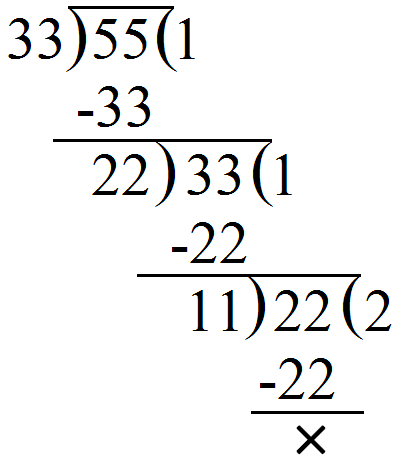
$H.C.F$ of $33$ and $55$ is $11$
$=\frac{-33\div11}{55\div11}=\frac{-3}{5}$
View full question & answer→MCQ 1481 Mark
How many rational numbers are there between $−1$ and $0?$
Answer There are infinite number of rational numbers between any two integers.
View full question & answer→MCQ 1491 Mark
Which of the following rational numbers is negative?
AnswerCorrect option: D. $\frac{3}{-7}$
$(a). -\big(\frac{-3}{7}\big)=\frac{3}{7}$
$(b). \frac{-5}{-8}=\frac{5}{8}$
$(c). \frac{9}{8}=\frac{9}{8}$
$(d). \frac{3}{-7}=\frac{-3}{7}$
View full question & answer→MCQ 1501 Mark
The sum of $\frac{5}{4}+\frac{(-25)}{4} = .......$
View full question & answer→MCQ 1511 Mark
$5.63$ divided by $0.01$ is equal to:
- ✓
$563$
- B
$56.3$
- C
$0.563$
- D
$5630$
Answer$5.63\div{0.01} = \frac{5.63}{0.01}$
$ = \frac{\frac{563}{100}}{\frac{1}{100}}=\frac{563}{100}\times\frac{100}{1}=563$
View full question & answer→MCQ 1521 Mark
Study the following statements. Statement $- 1:$ Rational numbers are always closed under division. Statement $- 2:$ Division by zero is not defined. Which of the following options hold$?$
- A
Both statement $-1$ and statement $-2$ are true.
- B
Statement $-1$ is true but statement $-2$ is false.
- ✓
Statement $-1$ is false but statement $-2$ is true.
- D
Both statement $-1$ and statement $-2$ are false.
AnswerCorrect option: C. Statement $-1$ is false but statement $-2$ is true.
Statement - 1: Rational number can even be simply integers which can be further represented as $\frac{\text{p}}{\text{q}}$ form. So statement $1$ is false
Statement - 2: Any number divided by $0$ is not defined. So statement $2$ is true.
View full question & answer→MCQ 1531 Mark
For any two rational numbers $x$ and $y,$ which of the following properties are correct $(i) x < y (ii) x = y (iii) x > y?$
- A
Only $(i)$ and $(ii)$ are correct
- B
Only $(ii)$ and $(iii)$ are correct
- C
Only $(ii)$ is correct
- ✓
All $(i), (ii)$ and $(iii)$ are correct
AnswerCorrect option: D. All $(i), (ii)$ and $(iii)$ are correct
values of rational numbers $x$ and $y$ is not given For any two rational numbers all three properties are correct as $x < y$ or $x = y$ or $x > y$
View full question & answer→MCQ 1541 Mark
For any two rational numbers $x$ and $y$ which of the following are correct, if $x$ is positive and $y$ is negative$?$
$x < y , x = y, x > y$
- A
Only $1$ and $2$ are correct
- B
Only $2$ and $3$ are correct
- ✓
Only $3$ is correct
- D
All $1, 2$ and $3$ are correct
AnswerCorrect option: C. Only $3$ is correct
If $x$ is positive and $y$ is negative, then the value of $x$ will always be greater than value of $y$
$\therefore x > y$
View full question & answer→MCQ 1551 Mark
There exists ..... number of rational numbers between $\frac{2}{5}$ and $\frac{4}{5}$:
AnswerThere exists infinite number of rational numbers between any two rational numbers. i.e. in this case between $\frac{2}{5}$ and $\frac{4}{5}$.
View full question & answer→MCQ 1561 Mark
Reciprocal of $\frac{-3}{4}$ is:
- A
$\frac{3}{4}$
- B
$\frac{4}{3}$
- ✓
$\frac{-4}{3}$
- D
AnswerCorrect option: C. $\frac{-4}{3}$
We know that the reciprocal of the rational number $\frac{\text{a}}{\text{b}}\text{ is }\Big(\frac{\text{a}}{\text{b}}\Big)^{-1}=\frac{\text{b}}{\text{a}}$
$\therefore$ Reciprocal of $\frac{-3}{4}$
$=\Big(\frac{-3}{4}\Big)^{-1}$
$=\frac{4}{-3}$
$=\frac{4\times(-1)}{-3\times(-1)}$
$=\frac{-4}{3}$
Hence, the correct answer is option $(c).$
View full question & answer→MCQ 1571 Mark
A rational number is a number that can be put in the form $\frac{\text{p}}{\text{q}},$ where $p$ and $q$ are:
- A
Natural numbers and $\text{q}\neq0$
- B
Whole numbers and $\text{q}\neq0$
- C
Non$-$negative integers and $\text{q}\neq0$
- ✓
Integers and $\text{q}\neq0$
AnswerCorrect option: D. Integers and $\text{q}\neq0$
Integers and $\text{q}\neq0$
View full question & answer→MCQ 1581 Mark
Rational number $\frac{-18}{5}$ lies between consecutive integers ........
- A
$-2$ and $-3$
- ✓
$-3$ and $-4$
- C
$-4$ and $-5$
- D
$-5$ and $-6$
AnswerCorrect option: B. $-3$ and $-4$
$\frac{-18}{5} = -3.6 - 4 < -3.6 < -3 - 3.6$ lies between $-3$ and $-4.$
View full question & answer→MCQ 1591 Mark
Difference of these two numbers $99.999$ and $100$ is:
- A
$1.111$
- B
$1.000$
- ✓
$0.001$
- D
$0.01$
AnswerCorrect option: C. $0.001$
Difference of $99.999$ and $100$ is $100 - 99.999 = 100.000 - 99.999 = 0.001$
View full question & answer→MCQ 1601 Mark
$\frac{5}{4}-\frac{7}{6}-\frac{-2}{3}=$
- ✓
$\frac{3}{4}$
- B
$-\frac{3}{4}$
- C
$\frac{-7}{12}$
- D
$\frac{7}{12}$
AnswerCorrect option: A. $\frac{3}{4}$
$\frac{5}{4}-\frac{7}{6}-\frac{-2}{3}$
$=\frac{5}{4}+\Big(\frac{-7}{6}\Big)+\frac{2}{3}$ $\Big[-\Big(\frac{-2}{3}\Big)=\frac{2}{3}\Big]$
$=\frac{5\times3+(-7)\times2+2\times4}{12} (LCM$ of $3, 4$ and $6 = 12)$
$=\frac{15-14+8}{12}$
$=\frac{9}{12}$
$=\frac{9\div3}{12\div3} ($Dividing numerator and denominator by $3)$
$=\frac{3}{4}$
Hence, the correct answer is option $(a).$
View full question & answer→MCQ 1611 Mark
Division of $125.625$ by $0.5.$ is:
- ✓
$251.25$
- B
$2512.5$
- C
$25125$
- D
$25.125$
AnswerCorrect option: A. $251.25$
${125.625}\div{0.5} = \frac{125625}{1000}\times\frac{10}{5}$
$ = \frac{25125}{100} = {251.25}$
View full question & answer→MCQ 1621 Mark
$-\frac{102}{119}$ is standard form is:
- ✓
$-\frac{6}{7}$
- B
$\frac{6}{7}$
- C
$-\frac{6}{17}$
- D
AnswerCorrect option: A. $-\frac{6}{7}$
The denominator of the rational number $-\frac{102}{119}$ is positivr.
In order to write the rational number in standerd form, divide its numerator and denominator by the $HCF$ of $102$ and $119.$
$HCF$ of $102$ and $119 = 17$
Dividing the numerator and denominator of $-\frac{102}{119}$ by $17,$
We have:
$-\frac{102}{119}=-\frac{102\div17}{119\div17}=-\frac{6}{7}$
Thus the standard form of $-\frac{102}{119}\text{ is }-\frac{6}{7}$
Hence, the correct answer is option $(a).$
View full question & answer→MCQ 1631 Mark
While representing $\frac{2}{3}$ on a number line, between which $2$ integers does the point lie$?$
- A
$1$ and $2$
- ✓
$0$ and $1$
- C
$2$ and $3$
- D
$1$ and $3$
AnswerCorrect option: B. $0$ and $1$
$\frac{2}{3} = {0.67}$ It is clear that $0.67$ lies between $0$ and $1$
View full question & answer→