Sample QuestionsIntegers questions
One sample from each question group in this chapter. Select any group above to see the full set with answer keys.
Mark $(\checkmark)$ against the correct answer in the following: $\frac{55}{-66}$ in standard form is:
- ✓
$\frac{5}{-6}$
- B
$\frac{-5}{6}$
- C
$\frac{-55}{66}$
- D
Answer: A.
View full solution →Sum of the numbers $0.3, 0.03$ and $0.003$ is:
- A
$0.999$
- B
$0.393$
- C
$0.636$
- ✓
Answer: D.
View full solution →Mark $(\checkmark)$ against the correct answer in the following: What should be added to $\frac{-5}{9}$ to get $1?$
- A
$\frac{4}{9}$
- B
$\frac{-4}{9}$
- ✓
$\frac{14}{9}$
- D
$\frac{-14}{9}$
Answer: C.
View full solution →Which of the following rational numbers is in the standard form?
- A
$\frac{8}{-36}$
- B
$\frac{-7}{56}$
- C
$\frac{3}{-4}$
- ✓
Answer: D.
View full solution →If a is reciprocal of $b,$ then the reciprocal of $b$ is:
Answer: A.
View full solution →Directions: In the following questions, the Assertions $(A)$ and Reason$(s) (R)$ have been put forward. Read both the statements carefully and choose the correct alternative from the following:
Assertion: $+(-40) = -40$
Reason: Positive of a negative integer is negative.
- ✓
Both Assertion and Reason are correct and Reason is the correct explanation for Assertion.
- B
Both Assertion and Reason are correct and Reason is not the correct explanation for Assertion.
- C
Assertion is true but the reason is false.
- D
Both assertion and reason are false.
Answer: A.
View full solution →Directions: In the following questions, the Assertions $(A)$ and Reason$(s) (R)$ have been put forward. Read both the statements carefully and choose the correct alternative from the following:
Assertion: Manish deposits $Rs. 2000$ in his bank account and withdraws $Rs. 1000$ from it, the next day. Then the balance in Manish’s account after the withdrawal is $Rs. 1000.$
Reason: $2000 - 1000 = Rs. 1000.$
- ✓
Both Assertion and Reason are correct and Reason is the correct explanation for Assertion.
- B
Both Assertion and Reason are correct and Reason is not the correct explanation for Assertion.
- C
Assertion is true but the reason is false.
- D
Both assertion and reason are false.
Answer: A.
View full solution →Directions: In the following questions, the Assertions $(A)$ and Reason$(s) (R)$ have been put forward. Read both the statements carefully and choose the correct alternative from the following:
Assertion: Negative integers are always smaller than positive integers.
Reason: Zero is greater than every positive integer.
- A
Both Assertion and Reason are correct and Reason is the correct explanation for Assertion.
- B
Both Assertion and Reason are correct and Reason is not the correct explanation for Assertion.
- ✓
Assertion is true but the reason is false.
- D
Both assertion and reason are false.
Answer: C.
View full solution →Directions: In the following questions, the Assertions $(A)$ and Reason$(s) (R)$ have been put forward. Read both the statements carefully and choose the correct alternative from the following:
Assertion: $-2$ is cube root of $-8$
Reason: There is no cube root of a negative integer.
- A
Both Assertion and Reason are correct and Reason is the correct explanation for Assertion.
- B
Both Assertion and Reason are correct and Reason is not the correct explanation for Assertion.
- ✓
Assertion is true but the reason is false.
- D
Both assertion and reason are false.
Answer: C.
View full solution →Directions: In the following questions, the Assertions $(A)$ and Reason$(s) (R)$ have been put forward. Read both the statements carefully and choose the correct alternative from the following:
Assertion: $\frac{-132}{12}=-11$
Reason: If the dividend and divisor have unlike signs then the quotient will be negative.
- ✓
Both Assertion and Reason are correct and Reason is the correct explanation for Assertion.
- B
Both Assertion and Reason are correct and Reason is not the correct explanation for Assertion.
- C
Assertion is true but the reason is false.
- D
Both assertion and reason are false.
Answer: A.
View full solution →$x \div 0$ is meaningless.
View full solution →$0 \div a=0$, where $a \neq 0$
View full solution →The product of $8$ and $(-4)$ is $32$.
View full solution →The product of $(-4)$ and $(-9)$ is $36$.
View full solution →On a number line negative integers lie on the right side of $0$.
View full solution →$(-x) \div y=$……….. $[x \div(-y), x \div y, y \div x]$
View full solution →When b is divided by………..the quotient is $(-b). [0. 1. (-1)]$
View full solution →$O………..(-1). (>,=,<)$
View full solution →$……….\times(-53) \times 1=53 [0. (- 1) ,1]$
View full solution →$(-5)+(8+4)=[(-5)+8]+4$ represents……….property of integers for addition. (commutative, associative, distributive)
View full solution →________ $\div 48 = –1$
View full solution →________ $\div 1 = – 87$
View full solution →$– 87 \div \_\_\_\_\_\_\_\_\ = 87$
View full solution →$(–206) \div _\_\_\_\_\_\_\_\ = 1$
View full solution →$(–75) \div \_\_\_\_\_\_\_\_= –1$
View full solution →Verify that a $\div$ $(b + c)$ $\neq$ $(a $$\div$ $b) + (a$ $\div$ $c)$ for the values of $a, b,$ and $c, a = (–10), b = 1, c = 1$
View full solution →Verify that a $\div$ $(b + c)$ $\neq$ $(a$ $\div$ $b) + (a$ $\div$ $c)$ for the values of $a, b,$ and $c, a = 12, b = –4, c = 2$.
View full solution →Starting from $(–1)$ $\times$ $5$, write various products showing some pattern to show $(–1)$ $\times$ $(–1) = 1.$
View full solution →Verify: $(–21)$ $\times$ $[(–4) + (–6)] = [(–21)$ $\times$ $(–4)] + [(–21)$ $\times$ $(–6)]$
View full solution →Verify: $18$ $\times$$ [7 + (–3)] = [18$ $\times$ $7] + [18$ $\times$ $(–3)]$
View full solution →In a class test $(+ 3)$ marks are given for every correct answer and $(–2)$ marks are given for every incorrect answer and no marks for not attempting any question. Radhika scored $20$ marks. If she has got $12$ correct answers, how many questions has she attempted incorrectly?
View full solution →The temperature at $12$ noon was $10^\circ C$ above zero. If it decreases at the rate of $2^\circ C$ per hour until midnight, at which time would the temperature be $8^\circ C$ degrees below zero? What would temperature at midnight ?
View full solution →Write five pairs of integers $(a, b)$ such that a $\div b = –3$. One such pair is $(6, –2)$ because $6 \div (–2) = (–3)$
View full solution →Horizon Glacier is a cold place. The average temperature of the place is less than zero.
The maximum and minimum temperature $($in $^\circ C)$ recorded for seven days in a week are given
below.
$1.$ What was the lowest temperature recorded in the week?
$A. –8^\circ C$
$B. –12^\circ C$
$C. –21^\circ C$
$D. –24^\circ C$
$2.$ The average maximum temperature of Horizon Glacier for the week was $–13.5^\circ C.$
On which days was the maximum temperature greater than the average maximum temperature$?$
$3.$ What is the difference between the maximum and minimum temperature on Friday$?$ View full solution →Jacob and Mariya participated in Archery.
Jacob’s scores for ive shots are given below.
| First shot |
Second shot |
Third shot |
Fourth shot |
Fifth shot |
| $0$ |
$4$ |
$8$ |
$10$ |
$6$ |
Mariya’s scores for three shots are given below.
| First shot |
Second shot |
Third shot |
| $0$ |
$4$ |
$8$ |
Mariya won the competition.
$1.$ How much she did score in her fourth and fifth shots$?$
$2.$ Team Alpha and Beta played the Paint Ball game. Each team had $6$ members and each member shot the paint ball three times.
Team Alpha hit the opponent team $12$ times. Team Beta hit the opponent team $15$ times.
Which team got more penalty points and how many penalty points did they get$?$
$3.$ In another match, each member of team Alpha got hit $3$ times.
$4$ members hit back $5$ times each and the rest hit back $2$ times each.
Which calculation shows the team’s score$?$
$A. 6 × [3 + (-10)] + 4 × (5 + 20) + 2 × (2 + 20)$
$B. 6 × [3 × (-10)] + 4 × (5 × 20) + 2 × (2 × 20)$
$C. 6 + [3 + (-10)] + 4 + (5 + 20) + 2 + (2 + 20)$
$D. 6 + [3 + (-10)] + 4 + (5 + 20) + 2 + (2 + 20)$ View full solution →Richa jumped $10$ times in Trampoline jumping.
Her jump heights (in cm) are given below.
| First |
Second |
Third |
Fourth |
Fifth |
Sixth |
Seventh |
Eighth |
Ninth |
Tenth |
| $38$ |
$43$ |
$47$ |
$56$ |
$75$ |
$82$ |
$75$ |
$68$ |
$64$ |
$59$ |
$1.$ Anshu says ‘Rohit uses Angle-Side-Angle criterion for construction of triangle $ABC’.$
Is Anshu correct? Justify your answer. View full solution →A funfair has activities for both children and adults. Activities can have group or pair or individual
participation. The winner in an activity is decided on the basis of scores. For some activities there
are penalties. Penalty points are subtracted from the scores.
This table below shows the details about the games and their scoring.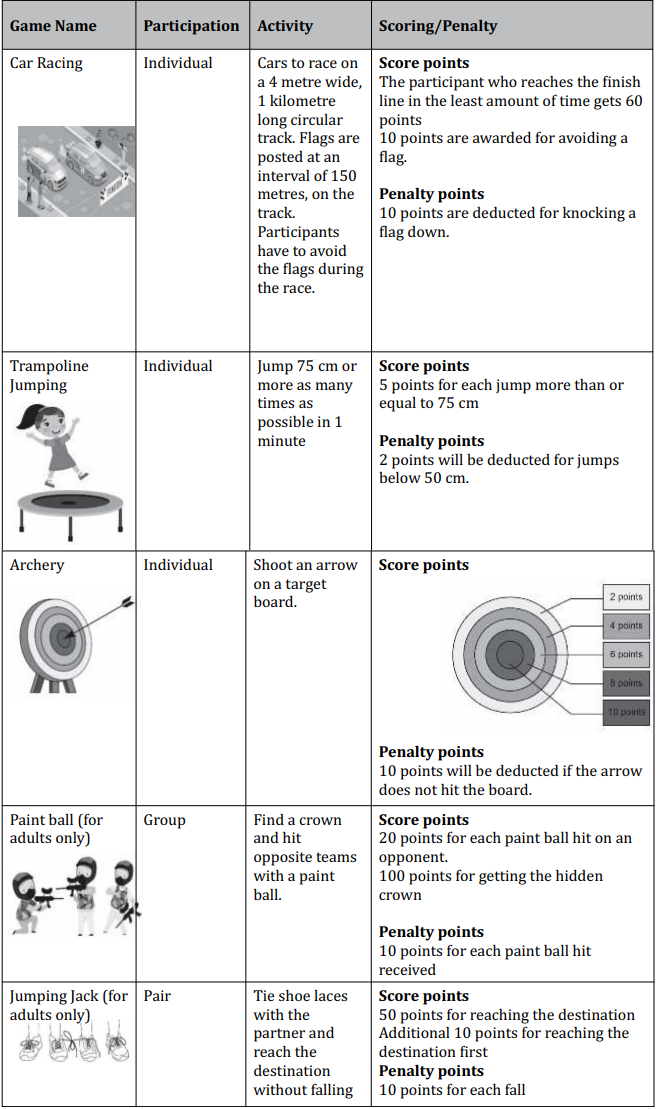
$1.$ Rohan and Samar compete in the car race.
Rohan’s car knocked down ive lags and Samar’s car knocked down one lag. Rohan reached the finish line faster than Samar.
Who is the winner and how many points did he score$?$ View full solution →
| Section $'A'$ |
Section $'B'$ |
Answer |
| $(1)(-6)+(-2)$ |
$( a ) (-3)$ |
$(1-$________$)$ |
| $(2)6+(-2)$ |
$(b) 8$ |
$(2-$________$)$ |
| $(3)(-2)xx6$ |
$(c )3$ |
$(3-$________$)$ |
| $(4)6-:2$ |
$(d)(-4)$ |
$(4-$________$)$ |
| $(5)(-6)+2$ |
$( e ) (-12)$ |
$(5-$________$)$ |
| $( 6)6+2$ |
$(f ) 4$ |
$(6-$________$)$ |
| $(7)(-6)-:2$ |
$(g)(-8)$ |
$(7-$________$)$ |