Questions

2 Marks Questions

Take a timed test

14 questions · self-marked practice — reveal the answer and mark yourself.

Question 12 Marks
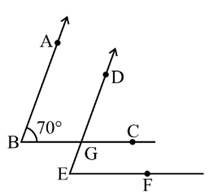
In the given figure, the arms of two angles are parallel. If $\angle ABC = 70^\circ$, then find $\angle DGC$
Answer
From the figure, it is clear that $AB$ is parallel to $DG$ and there is a transversal line $BC$ that is intersecting them
Therefore, $\angle DGC = \angle ABC$ (Corresponding angles)
Given that:
$\angle ABC = 70^\circ$
Therefore,
$\angle DGC = \angle ABC = 70^\circ$
Hence,
The value of $\angle DGC$ is equal to $70^\circ$ 
View full question & answer
Question 22 Marks
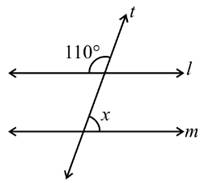
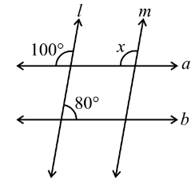
Find the value of $x$ in the figures if $l \| m$
Answer
From the above figure it can be clearly seen that:
$\angle x$ is equal to $100^\circ$ as they are corresponding angles
Therefore, $\angle x = 100^\circ$
View full question & answer
Question 32 Marks
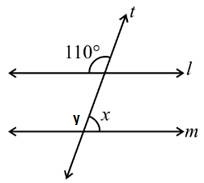
Find the value of $x$ in the figure below, if $l \| m$
Answer
From the above figure, we have

$\angle y = 110^\circ$ (Corresponding angles)
Also,
$\angle x and \angle y$ form a linear pair of angles. Therefore,
$\angle x + \angle y = 180^\circ$ (Linear pair)
$\angle x + 110^\circ = 180^\circ $
$x = 180^\circ - 110^\circ $
$ \angle x = 70^\circ$
Hence, value of $\angle x$ is $70^\circ$
View full question & answer
Question 42 Marks
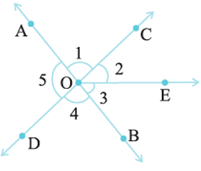
In the figure given below:

Are $\angle BOD$ and $\angle DOA$ supplementary?
Answer
Yes, $\angle BOD$ and $\angle DOA$ are supplementary because:
These angles add up to $180^{\circ} .$
View full question & answer
Question 52 Marks
Can two angles be supplementary, if both of them are right?
Answer
Yes. If both the angles are right angles then the pair of angles must be supplementary because:
Right angle is equal to $90^{\circ}$ and addition of two right angles is equal to $180^{\circ}$
i.e., $90^{\circ}+90^{\circ}=180^{\circ}$
Hence, Two right angles form a supplement pair of angles.
View full question & answer
Question 62 Marks
Can two angles be supplementary, if both of them are obtuse?
Answer
Two obtuse angles can’t be supplementary because:
Obtuse angle is always greater than $90^{\circ}$ and addition of any two angles greater than $90^{\circ}$ can never be equal to $180^{\circ}$
Hence, Two obtuse angles cannot be in a supplementary angle pair.
View full question & answer
Question 72 Marks
Can two angles be supplementary, if both of them are acute?
Answer
Two Acute angles can’t be supplementary because:
Acute angle is always less than $90^{\circ}$ and addition of any two angles less than $90^{\circ}$​​​​​​​ can never be equal to $180^{\circ}$
Hence, Two acute angles cannot be in a supplementary angle pair
View full question & answer
Question 82 Marks
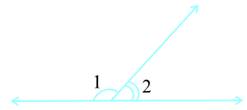
In the given figure, $\angle 1$ and $\angle 2$ are supplementary angles. If $\angle 1$ is decreased, what changes should take place in $\angle 2$ so that both the angles still remain supplementary? 
Answer
Since, $ \angle 1$ and $ \angle 2$ are Supplementary angles
And if $ \angle 1$ is decreased than $ \angle 2$ must be increased by the same measure, so that the pair of both the angles remain supplementary. Here $ \angle 1$ is reduced by $1$ degree, so $ \angle 2$ must be increased by $1$ degree.
View full question & answer
Question 92 Marks
Find the angle which equal to its supplement.
Answer
Let the angle be $x^\circ $
Its supplement $= 180^\circ – x^\circ $
According to the question,
$x^\circ = 180^\circ – x^\circ $
$ \Rightarrow x^\circ + x^\circ = 180^\circ $
$ \Rightarrow 2x^\circ = 180^\circ $
$ \Rightarrow x^\circ = \frac{180^{\circ}}{2} = 90^\circ $
Hence, the required angle is $90^\circ .$
View full question & answer
Question 102 Marks
Find the angle which is equal to its complement.
Answer
Let the angle be $x^\circ $
Its complement $= 90^\circ – x^\circ $
According to the question,
$x^\circ = 90^\circ – x^\circ $
$ \Rightarrow x^\circ + x^\circ = 90^\circ $
$ \Rightarrow 2x^\circ = 90^\circ $
$ \Rightarrow x^\circ = \frac{90^{\circ}}{2} = 45^\circ $
View full question & answer
Question 112 Marks
Identify whether the pair of angles are complementary or supplementary: $80º, 10º$
Answer
We know that two angles are complementary if their sum is $90^{\circ}$
Here, the Sum of the measures of the given pair of angles $=80^{\circ}+10^{\circ}=90^{\circ}$
As the sum of these angles is equal to $90^{\circ}$
Therefore, these angles are complementary angles.
View full question & answer
Question 122 Marks
Identify whether the pair of angles are complementary or supplementary: $45º, 45º$.
Answer
Two angles are complementary, if their sum is $90^{\circ}$
Sum of the measures of given pair of angles $=45^{\circ}+45^{\circ}=90^{\circ}$
As the sum of these angles is equal to $90^{\circ}$
Therefore,
These angles are complementary angles.
View full question & answer
Question 132 Marks
Identify whether the pair of angles are complementary or supplementary: $130º, 50º$.
Answer
Two angles are said to be supplementary if their sum is $180^{\circ}$.
It is given in the question that,
The given pair of angles is $130^{\circ}$ and $50^{\circ}$
and sum of the measures of these angles $=130^{\circ}+50^{\circ}=180^{\circ}$
As the sum of these angles is equal to $180^{\circ}$
Therefore, these angles are supplementary angles.
View full question & answer
Question 142 Marks
Identify the pair of angles are complementary or supplementary: $63º, 27º$.
Answer
We know that:
Two angles are complementary if sum of their measures is $90^{\circ}$
Here, the pair of angles is $63^{\circ}$ and $27^{\circ}$
Sum of the measures of these angles $=63^{\circ}+27^{\circ}=90^{\circ}$
As the sum of these angles is equal to $90^{\circ}$
Therefore, these angles are complementary angles.
View full question & answer