Question types

Lines and Angles question types

414 questions across 9 question groups — pick any mix to generate a Maths paper with step-by-step answer keys.

414
Questions
9
Question groups
5
Question types
Sample Questions

Lines and Angles questions

One sample from each question group in this chapter. Select any group above to see the full set with answer keys.

Consider the following statements relating to $3$ lines $L_1​ , L_2​$​ and $L_3​$ in the same plane
$1.$ If $L_2$ and $L_3​$​ are both parallel to $L_1​,$ then they are parallel to each other.
$2.$ If $L_2​$​ and $L_3$ are both perpendicular to $L_1​,$​ then they are parallel to each other.
$3.$ If the acute angle between $L_1​$​​​​​​​​ and $L_2$​​​​​​​​ is equal to to acute angle between $L_1​$​​​​​​​ and $L_3$, then $L_2​$​​​​​​​​ is parallel to $L_3​$​​​​​​​​.
Of these statements:
  • $(1)$ and $(2)$ are correct
  • B
    $(1)$ and $(3)$ are correct
  • C
    $(2)$ and $(3)$ are correct
  • D
    $(1), (2)$ and $(3)$ are correct

Answer: A.

View full solution
Directions: In the following questions, the Assertions $(A)$ and Reason$(s)$ $(R)$ have been put forward. Read both the statements carefully and choose the correct alternative from the following:
Assertion: Two vertically opposite angles may be unequal
Reason: Two vertically opposite angles can be right angles.
  • A
    Both Assertion and Reason are correct and Reason is the correct explanation for Assertion.
  • B
    Both Assertion and Reason are correct and Reason is not the correct explanation for Assertion.
  • Assertion is true but the reason is false.
  • D
    Both assertion and reason are false.

Answer: C.

View full solution
Directions: In the following questions, the Assertions $(A)$ and Reason$(s)$ $(R)$ have been put forward. Read both the statements carefully and choose the correct alternative from the following:
Assertion: The sum of the measures of the angles in a linear pair is $180^\circ $.
Reason: when two lines intersect each other at a single point, linear pairs of angles are formed.
  • Both Assertion and Reason are correct and Reason is the correct explanation for Assertion.
  • B
    Both Assertion and Reason are correct and Reason is not the correct explanation for Assertion.
  • C
    Assertion is true but the reason is false.
  • D
    Both assertion and reason are false.

Answer: A.

View full solution
Directions: In the following questions, the Assertions $(A)$ and Reason$(s)$ $(R)$ have been put forward. Read both the statements carefully and choose the correct alternative from the following:
Assertion: The complement of $15^\circ $ is $75^\circ $
Reason: Two angles are said to be complementary if the sum of their measures is $90^\circ $.
  • Both Assertion and Reason are correct and Reason is the correct explanation for Assertion.
  • B
    Both Assertion and Reason are correct and Reason is not the correct explanation for Assertion.
  • C
    Assertion is true but the reason is false.
  • D
    Both assertion and reason are false.

Answer: A.

View full solution
Directions: In the following questions, the Assertions $(A)$ and Reason$(s)$
$(R)$ have been put forward. Read both the statements carefully and choose the correct alternative from the following:
Assertion: The measure of the supplement of the angle $0^\circ $ is $180^\circ $
Reason: When the sum of the measures of two angles is $180^\circ $, the angles are called supplementary angles.
  • Both Assertion and Reason are correct and Reason is the correct explanation for Assertion.
  • B
    Both Assertion and Reason are correct and Reason is not the correct explanation for Assertion.
  • C
    Assertion is true but the reason is false.
  • D
    Both assertion and reason are false.

Answer: A.

View full solution
Directions: In the following questions, the Assertions $(A)$ and Reason$(s)$ $(R)$ have been put forward. Read both the statements carefully and choose the correct alternative from the following:
Assertion: two angles are called adjacent if they have commen vertex
Reason: the adjacent angle have common interior point.
  • A
    Both Assertion and Reason are correct and Reason is the correct explanation for Assertion.
  • B
    Both Assertion and Reason are correct and Reason is not the correct explanation for Assertion.
  • Assertion is true but the reason is false.
  • D
    Both assertion and reason are false.

Answer: C.

View full solution
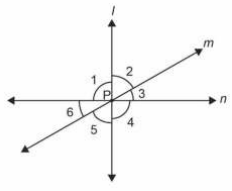
Three lines shown in the igure intersect each other at point $P.$
Image

Line lis perpendicular to line n.
The measure of $\angle 2$ is $65^\circ .$
$1.$ What is the measure of $\angle 6?$
$2.$ What is the sum of the measure of $\angle 3$ and $\angle 4?$
$A. 95^\circ $
$B. 115^\circ $
$C. 120^\circ $
$D. 155^\circ $
View full solution
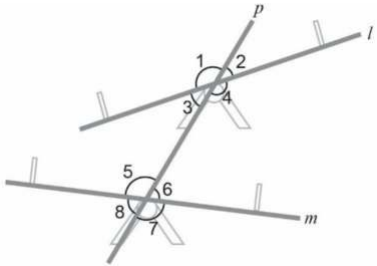
A diagram of a see-saw is given below.​​​​​​​
Image
$1.$ State all the pairs of vertically opposite angles in the given figure.
$2.$ Which of the following is a pair of alternate exterior angles?
$A. \angle 1$ and $\angle 4$
$B. \angle 2$ and $\angle 8$
$C. \angle 3$ and $\angle 8$
$D. \angle 4$ and $\angle 6$
View full solution
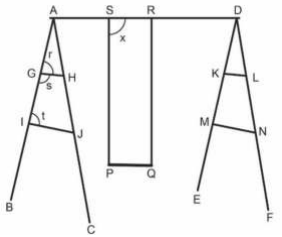
In the igure given below, $AD$ is a straight line. $PS$ and $QR$ are perpendicular to $AD$.
$GH$ is parallel to $IJ$ and $KL$ is parallel to $MN.$
Image
$1.$ What type of angles are $\angle r$ and $\angle t?$
$A.$ Adjacent angles
$B.$ Vertically opposite
$C.$ Corresponding angles
$D.$ Alternate exterior angles
$2.$ The measure of $\angle s = 120^\circ .$
What is the measure of $\angle t?$
$A. 30^\circ $
$B. 60^\circ $
$C. 90^\circ $
$D. 120^\circ $
$3.$ What is the measure of $\angle x?$
$A. 45^\circ $
$B. 60^\circ $
$C. 90^\circ $
$D. 120^\circ $
$4.$ Why are the lines $SP$ and $RQ$ parallel to each other$?$
$5.$ Is $DF$ transversal to $KL$ and $MN?$ Give reason.
$6.$ Which of the following is true for $DE$ and $DF?$
$A.$ They are parallel
$B.$ They intersect at $A$
$C.$ They intersect at $D$
$D.$ They have $AD$ as transversal
View full solution
Section $'A'$ Section $'B'$ Answer
$( 1 )0^{\circ}$ to $90^{\circ}$ $( a )$ Zero angle $(1-$________$)$
$(2) 90^{\circ}$ to $180^{\circ}$ $( b )$ Right angle $(2-$________$)$
$( 3 ) 180^{\circ}$ to $360^{\circ}$ $( c )$ Straight angle $(3-$________$)$
$(4) O ^{\circ}$ $(d)$ Obtuse angle $(4-$________$)$
$( 5 ) 90^{\circ}$ $(e )$ Acute angle $(5-$________$)$
$( 6) 180^{\circ}$ $( f )$ Reflex angle $(6-$________$)$
$( 7 ) 360^{\circ}$ $(g)$ Complete angle $(7-$________$)$
View full solution

Generate a Lines and Angles paper free

Pick question groups from the list above, set marks and difficulty, and export a branded PDF with step-by-step answer keys. First 3 chapters free — no signup.

Download App