Questions

3 Marks Question

Take a timed test

7 questions · self-marked practice — reveal the answer and mark yourself.

Question 13 Marks
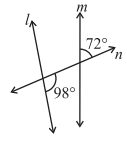
In the given figure, decide whether $l$ is parallel to $m.$
Answer
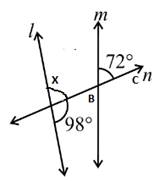

In the above figure we see that, angle $x$ and $98^{\circ}$ are forming a linear pair on the line $I$.
Therefore,
$x+98^{\circ}=180^{\circ}(\text { Sum of angles of linear pair) }$
$\Rightarrow x=180^{\circ}-98^{\circ}=82^{\circ}$
We have to show that I and $m$ are parallel to each other.
For this, Corresponding angles $\angle \mathrm{mBC}$ and $\angle \mathrm{x}$ should be equal
But, $\angle \mathrm{x}=82^{\circ}$
And, $\angle \mathrm{mBC}=72^{\circ}$
So, these angles are not equal.
Therefore, Lines $I$ and $m$ are not parallel to each other.
View full question & answer
Question 23 Marks
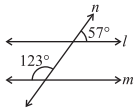
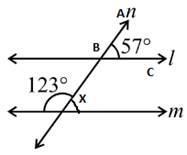
In the given figure, decide whether $l$ is parallel to $m.$
Answer


In the above figure we see that, Angle $x$ and $123^{\circ}$ are forming a linear pair on the line $m$
Therefore,
$x+123^{\circ}=180^{\circ} \text { (Sum of angles of linear pair) }$
$\Rightarrow x=180^{\circ}-123^{\circ}=57^{\circ}$
We have to show that I and $m$ are parallel to each other.
For this, Corresponding angles $\angle \mathrm{ABC}$ and $\angle \mathrm{x}$ should be equal
Now, $\angle \mathrm{x}=57^{\circ}$
And, $\angle A B C=57^{\circ}$
Therefore, Both the angles are equal to each other
Hence, Lines $I$ and $m$ are parallel to each other.
View full question & answer
Question 33 Marks
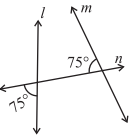
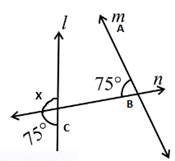
In the given figure, decide whether $l$ is parallel to $m.$
Answer


In the above figure we see that, angle $x$ and $75^{\circ}$ are forming a linear pair on the line $I$
Therefore,
$x+75^{\circ}=180^{\circ} \text { (Sum of angles of linear pair) }$
$x=180^{\circ}-75^{\circ}=105^{\circ}$
For the lines $I$ and m to be parallel, Corresponding angles, $\angle \mathrm{ABC}$ and $\angle \mathrm{x}$ should be equal
But, $\angle \mathrm{x}=105^{\circ}$
And, $\angle A B C=75^{\circ}$
Therefore, Lines $I$ and $m$ are not parallel to each other.
View full question & answer
Question 43 Marks
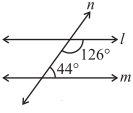
In the given figure, decide whether $l$ is parallel to $m.$
Answer
In the above figure, there is a pair of angles $126^{\circ}$ and $44^{\circ}$ which are on the same side of the transversal $n$.
Sum of these two interior angles on the same side of the transversal $=126^{\circ}+44^{\circ}=170^{\circ}$
Clearly, their sum is not equal to $180^{\circ}$. So, the angles are not supplementary.
Therefore,
The lines I and m are not parallel to each other.
View full question & answer
Question 53 Marks
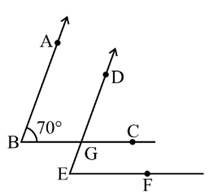
In the given figure, the arms of two angles are parallel. If $\angle ABC = 70^\circ ,$ then find $\angle DEF$
Answer
From the figure, it is clear that $BC$ is parallel to $EF$ and there is a transversal line $DE$ that is intersecting them
Therefore, $\angle DEF = \angle DGC ($Corresponding angles$)$
But $\angle DGC = \angle ABC = 70^\circ ($Corresponding angles$)$
Therefore, $\angle DEF = \angle DGC= 70^\circ $
Hence,
The value of $\angle DEF$ is equal to $70^\circ .$
View full question & answer
Question 63 Marks
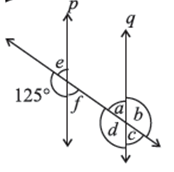
In the adjoining figure, $p || q.$ Find the unknown angles.
Answer
From the above figure, the unknown angles can be obtained as follows:
$\angle \mathrm{d}=125^{\circ}$ (Corresponding angles)
$\angle e=180^{\circ}-125^{\circ}=55^{\circ}$ (Linear pair)
$\angle \mathrm{f}=\angle \mathrm{e}=55^{\circ}$ (Vertically opposite angles)
$\angle \mathrm{c}=\angle \mathrm{f}=55^{\circ}$ (Corresponding angles)
$\angle \mathrm{a}=\angle \mathrm{e}=55^{\circ}$ (Corresponding angles)
$\angle \mathrm{b}=\angle \mathrm{d}=125^{\circ}$ (Vertically opposite angles)
View full question & answer
Question 73 Marks
An angle is greater than $45^{\circ}$. Is its complementary angle greater than $45^{\circ}$ or equal to $45^{\circ}$ or less than $45^{\circ}$ ?
Answer
Let us assume that the two angles are $x$ and $y$
Since, $x$ and $y$ are complementary pair of angles and $x$ is greater $45^{\circ}$
Therefore, $x+y=90^{\circ}$
$y=90^{\circ}-x^{\circ}$
$\text { As } x^{\circ}>45^{\circ}$
$-x^{\circ}<-45^{\circ}$
Add $90^{\circ}$ on both sides to get,
$90^{\circ}-x^{\circ}<90^{\circ}-45^{\circ}$
$y^{\circ}<90^{\circ}-45^{\circ}$
$y^{\circ}<45^{\circ}$
Hence,
Angle $y$ will be less than $45^{\circ}$.
View full question & answer