Questions

2 Marks Questions

Take a timed test

13 questions · self-marked practice — reveal the answer and mark yourself.

Question 12 Marks
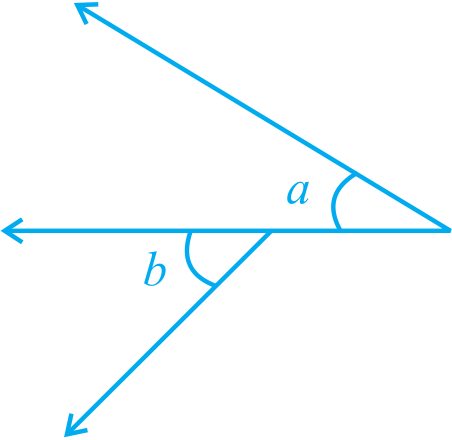
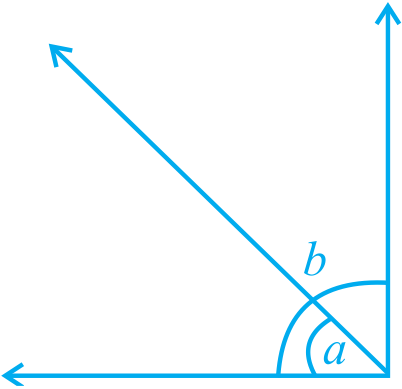
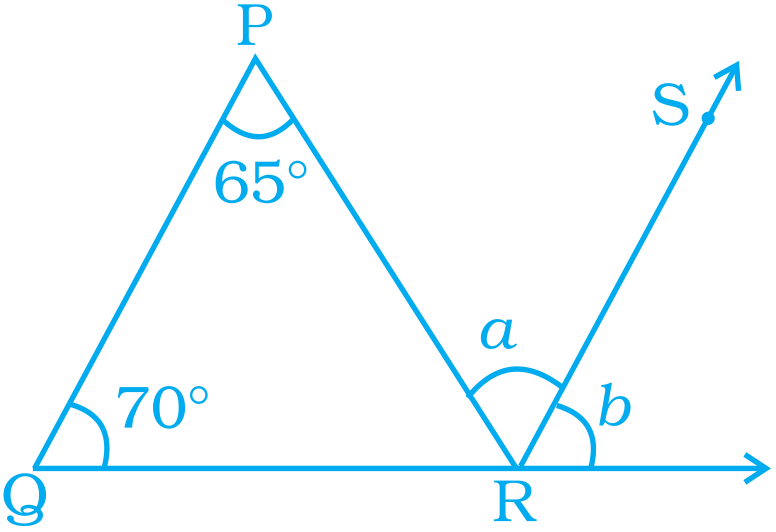
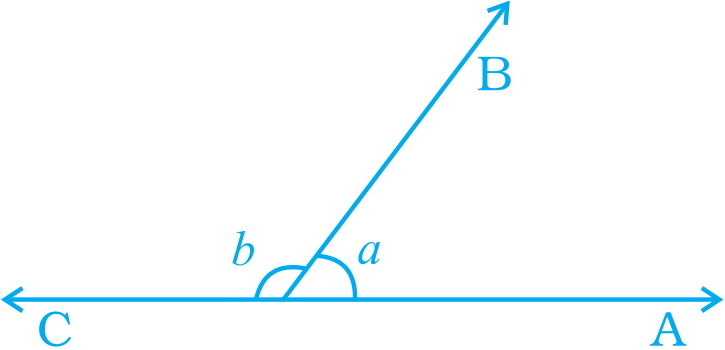
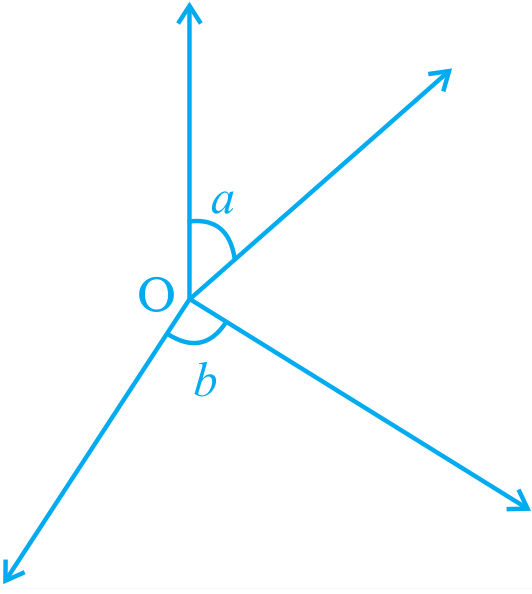
In Fig. are the following pairs of angles adjacent? Justify your answer.
$i.$
$ii.$
$​​​​​​​iii.$

$​​​​​​​iv.$​​​​​​​
Answer
Two angles are called adjacent angles, if they have a common vertex and common arm but no common interior points.
Hence, $a$ and $b$ form a pair of adjacent angle only in $i.$
View full question & answer
Question 22 Marks
Measures (in degrees) of two complementary angles are two consecutive even integers. Find the angles.
Answer
Let the two consecutive angles be $x$ and $x + 2.$
Since, both angles are complementary.
So, their sum will be $90^\circ .$
$\therefore\text{x}+(\text{x}+2)=90^\circ$
$\Rightarrow\text{x}+\text{x}+2=90^\circ$
$\Rightarrow2\text{x}=90^\circ-2$
$\Rightarrow2\text{x}=88^\circ$
$\Rightarrow\text{x}=44^\circ$
Therefore, the angies are $44^\circ $ and $44^\circ + 2 =46^\circ $
View full question & answer
Question 32 Marks
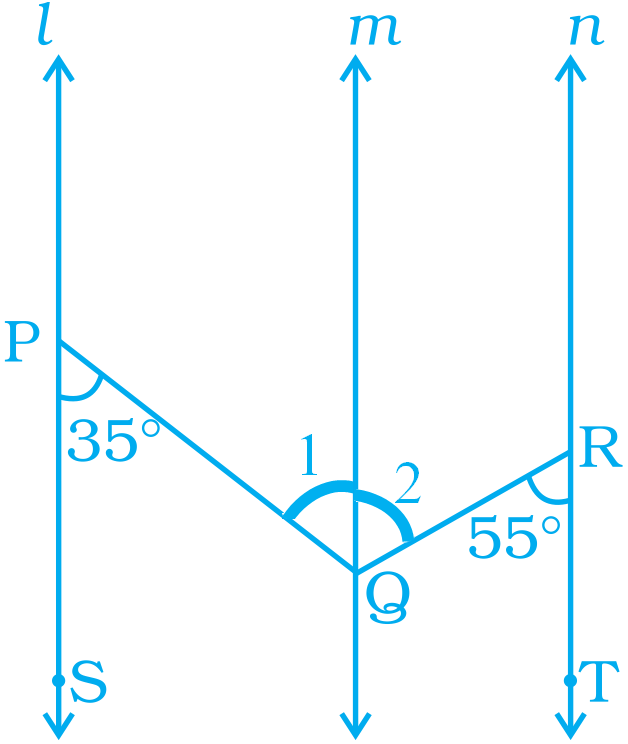
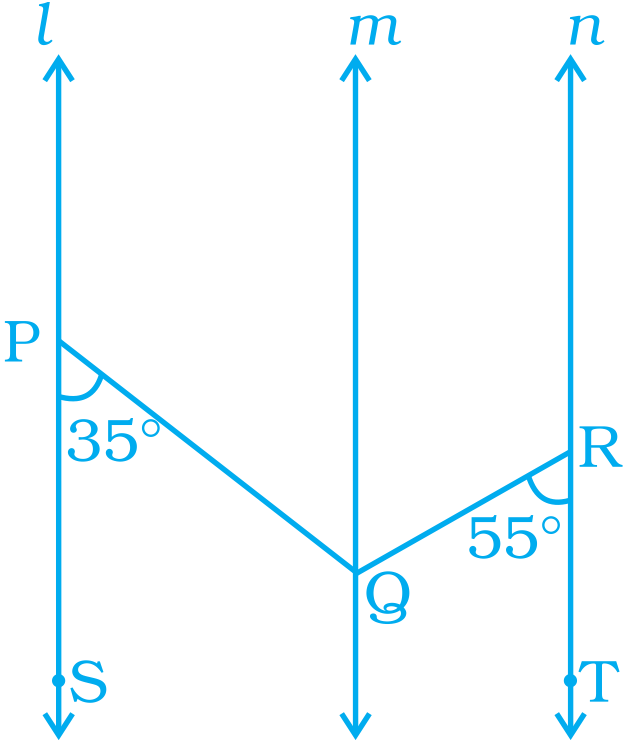
In Fig. $ l || m || n. \angle\text{QPS} = 35^\circ$ and $\angle\text{QRT} = 55^\circ$. Find $\angle\text{PQR}$.
Answer
From the above figure, $\angle1=35^\circ$ [Alternate angles] $\angle2=55^\circ$ [Alternate angles] $\therefore\angle\text{PQR}=\angle1+\angle2=35^\circ+55^\circ=90^\circ$
View full question & answer
Question 42 Marks
Measures (in degrees) of two supplementary angles are consecutive odd integers. Find the angles.
Answer
Let two consecutive odd integers $x, x + 2.$
It is given that both are supplementary angles.
So, their sum will be $180^\circ .$
$\therefore \text{x}+(\text{x}+2)=180^\circ$
$\Rightarrow2\text{x}=180^\circ-2$
$\Rightarrow2\text{x}=178^\circ=\frac{178^\circ}{2}$
$\Rightarrow\text{x}=89^\circ$
Hence, the two angles are $89^\circ $ and $91^\circ .$
View full question & answer
Question 52 Marks
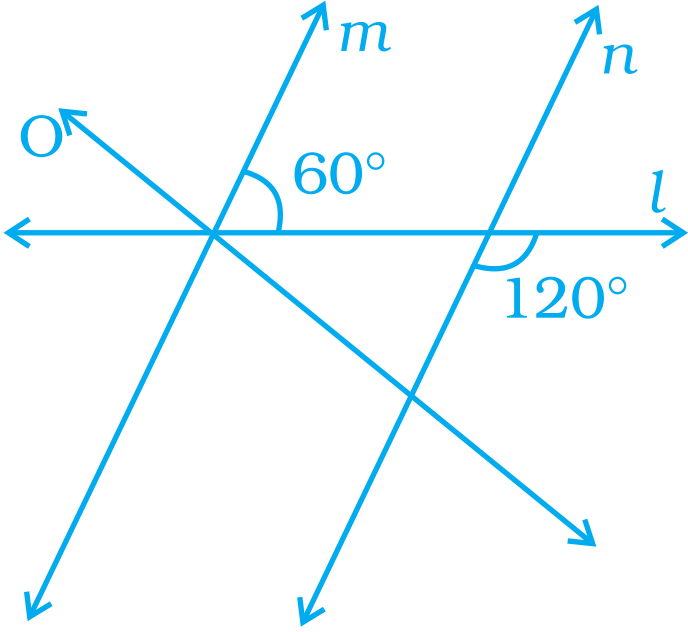
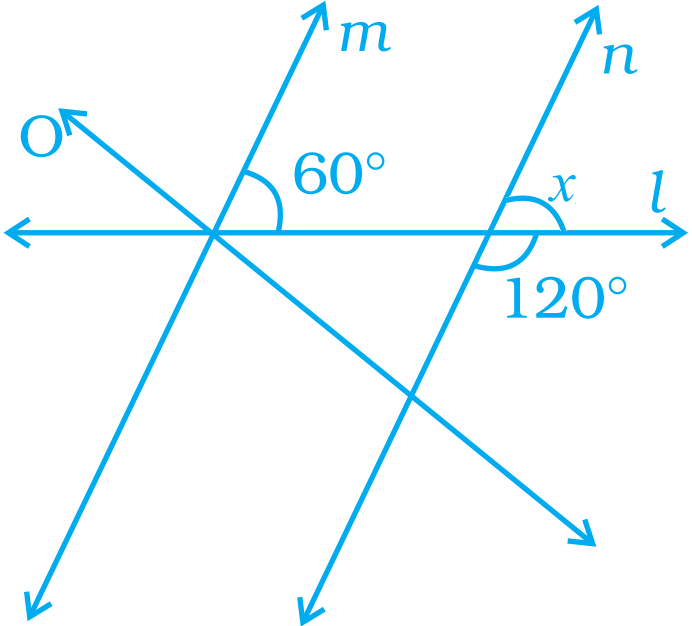
In Fig. state which pair of lines are parallel. Give reason.
Answer

$x = 120^\circ [$Vertically opposite angles$]$
Now, $x + 60^\circ = 120^\circ + 60^\circ = 180^\circ $
Since, the sum of consecutive interior is $180^\circ .$
​​​​​​​Hence, $m$ and $n$ will be parallal.
View full question & answer
Question 62 Marks
The sum of two vertically opposite angles is $166^\circ .$ Find each of the angles.
Answer
When two lines intersect, then vertically opposite angles so formed are equal.
Let $x$ be the measure of each vertically opposite angles.
Then, $\text{x} + \text{x} = 166^\circ$
$\Rightarrow2\text{x}=166^\circ$
$\Rightarrow\text{x}=\frac{166^\circ}{2}=83^\circ$
So, the measure of each angle is $83^\circ $
View full question & answer
Question 72 Marks
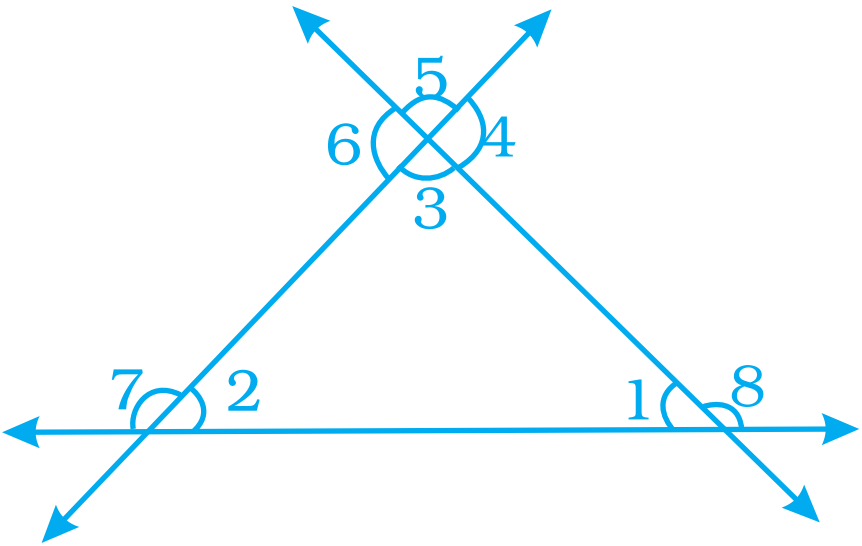
In Fig. write all the pairs of supplementary angles.
Answer
Supplementary angles are those angles whose sum is $180^\circ .$ Hence, following are the pairs of supplementary angles:
$1. \ \angle1,\angle8$
$2. \ \angle2,\angle7$
$3. \ \angle3, \angle4$
$4. \ \angle3, \angle4$
$5. \ \angle5, \angle6$
$6. \ \angle6, \angle3$
View full question & answer
Question 82 Marks
If the complement of an angle is $62^\circ ,$ then find its supplement.
Answer
Let the angle be $x^\circ .$
We know that, sum of two complementary angles is $90^\circ .$
$\therefore x + 62^\circ = 90^\circ $
$ \Rightarrow x = 90^\circ - 62^\circ = 28^\circ $
Supplemant of angle is $(180^\circ \ -$ angle$).$
$\therefore$ Supplemant of $x + 180^\circ - 28^\circ = 152^\circ $
View full question & answer
Question 92 Marks
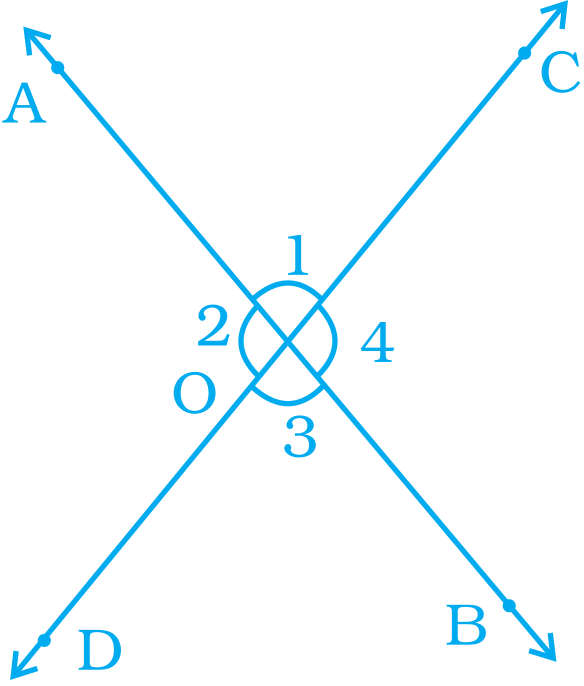
Two lines $AB$ and $CD$ intersect at $O$ Fig. Write all the pairs of adjacent angles by taking angles $1, 2, 3,$ and $4$ only.
Answer
Two angles are called adjacent angles, if they have a common vertex and a common arm,
but no common interior points.
Hence, following are the pairs of adjacent angles taking $1,2, 3, 4$ angles only,
i.e.$ \angle1, \angle2 ; \angle2, \angle3; \angle3, \angle4; \angle4, \angle1.$
View full question & answer
Question 102 Marks
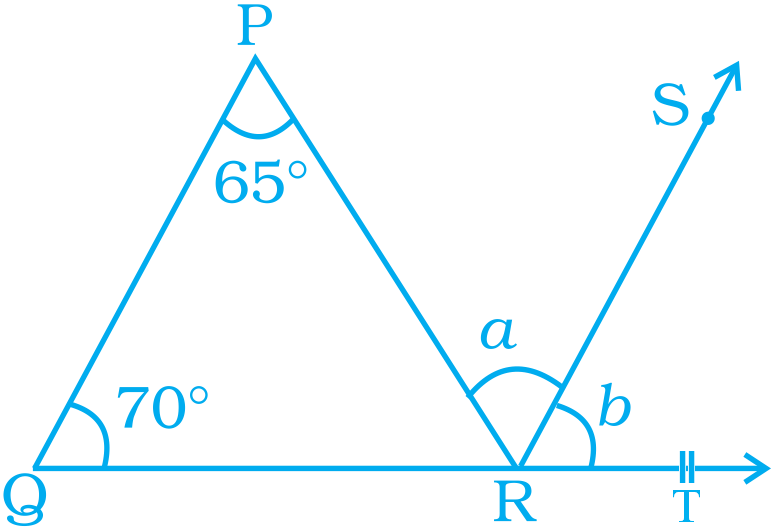
In Fig. $QP || RS.$ Find the values of $a$ and $b.$
Answer
Since, $QP || RS$ and $PR$ is transversal.
Therefore, $\angle\text{QPR}=\angle\text{SRP} [$Alternate interior angles$]$
$\Rightarrow65^\circ=\text{a}$
$\Rightarrow\text{a}=65^\circ$

 Also, $\angle\text{SRT}=\angle\text{PQR} [$Corresponding amgles$]$
$\Rightarrow\text{b}=70^\circ$
View full question & answer
Question 112 Marks
Can two acute angles form a pair of supplementary angles? Give reason in support of your answer.
Answer
Acute angles are those angles which are less than $90^\circ .$
If we add two angles which are less than $90^\circ ,$
we get the result less than $180^\circ ,$ e.g. If we add $60^\circ $ and $70^\circ ,$
we get $60^\circ + 70^\circ = 130^\circ < 180^\circ .$
Hence, two acute angles cannot form a pair of supplementary angles.
View full question & answer
Question 122 Marks
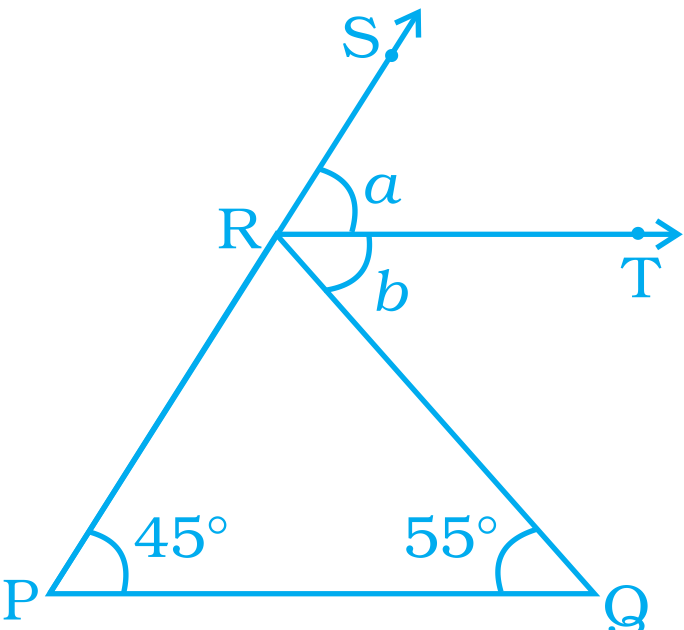
In Fig. $PQ || RT.$ Find the value of $a + b.$
Answer
Since, $PQ || RT$ and $RQ$ is transversal.
Therfore, $\angle\text{TQR}=\angle\text{RQP}$ [Alternate interior angles]
$\Rightarrow\text{b} =55^\circ$
Also, $\angle\text{SRT}=\angle\text{SPQ}$ [Corresponding angles]
$\Rightarrow\text{a} =45^\circ$
$\therefore \text{a}+\text{b}+45^\circ+55^\circ=100^\circ$
View full question & answer
Question 132 Marks
In Fig. $\text{OR} \bot \text{OP}$.
$i.$ Name all the pairs of adjacent angles.
$ii.$ Name all the pairs of complementary angles.
Answer
By definition of adjacent angles and complementary angles, we can say that following pairs are adjacent angles and complementary angles.
Adjacent angles: $\angle\text{x}, \angle\text{y}; \angle\text{x} + \angle\text{y}, \angle\text{z}; \angle\text{y}, \angle\text{z}; \angle\text{x}, \angle\text{y} + \angle\text{z}.$
Complementary angles: $\angle\text{x}, \angle\text{y}$
View full question & answer
2 Marks Questions - Maths STD 7 Questions - Vidyadip