Questions

5 Marks Questions

Take a timed test

18 questions · self-marked practice — reveal the answer and mark yourself.

Question 15 Marks
The ratio of the radii of two circles is $4 : 5.$ Find the ratio of their areas.
Answer
Ratio in the radii of two circles $=4: 5$
Let radius of first circle $\left(r_1\right)=4 x$
and radius of the second circle $\left(r_2\right)=5 x$
$\therefore \text { Area of first circle }=\pi r_1^2$
$=\frac{22}{7} \times 4 \mathrm{x} \times 4 \mathrm{x}$
$=\frac{352}{7} \mathrm{x}^2$
and area of second circle $=\pi \mathrm{r}_2^2$
$=\frac{22}{7} \times 5 \mathrm{x} \times 5 \mathrm{x}=\frac{550}{7} \mathrm{x}^2$
Now Ratio between their areas
$=\frac{352}{7} x^2: \frac{550}{7} x^2$
$=352: 550 \text { (Dividing by } 22)$
$=16: 25$
View full question & answer
Question 25 Marks
Find the area of a rhombus having each side equal to $13\ cm$ and one of the diagonals equal to $24\ cm.$
Answer
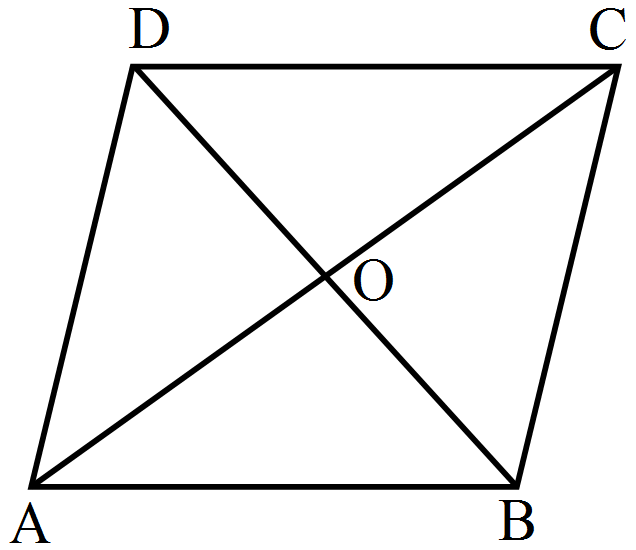
Let $A B C D$ be the rhombus whose diagonals intersect at $O$.
Then, $A B=13 \mathrm{~cm}$
$\mathrm{AC}=24 \mathrm{~cm}$
The diagonals of a rhombus bisect each other at right angles.
Therefore, $\triangle \mathrm{AOB}$ is a right-angled triangle, right angled at O , such that:
$\mathrm{OA}=\frac{1}{2} \mathrm{AC}=12 \mathrm{~cm}$
$\mathrm{AB}=13 \mathrm{~cm}$
By Pythagoras theorem :
$(A B)^2=(O A)^2+(O B)^2$
$\Rightarrow(13)^2=(12)^2+(O B)^2$
$\Rightarrow(O B)^2=(13)^2-(12)^2$
$\Rightarrow(O B)^2=169-144=25$
$\Rightarrow(O B)^2=(5)^2$
$\Rightarrow O B=5 \mathrm{~cm}$
$B D=2 \times O B=2 \times 5 \mathrm{~cm}=10 \mathrm{~cm}$
Area of the rhombus $\mathrm{ABCD}=\frac{1}{2} \times \mathrm{AC} \times \mathrm{BD} \mathrm{cm} \mathrm{cm}^2$
$=\frac{1}{2} \times 24 \times 10$
$=120 \mathrm{~cm}^2$
View full question & answer
Question 35 Marks
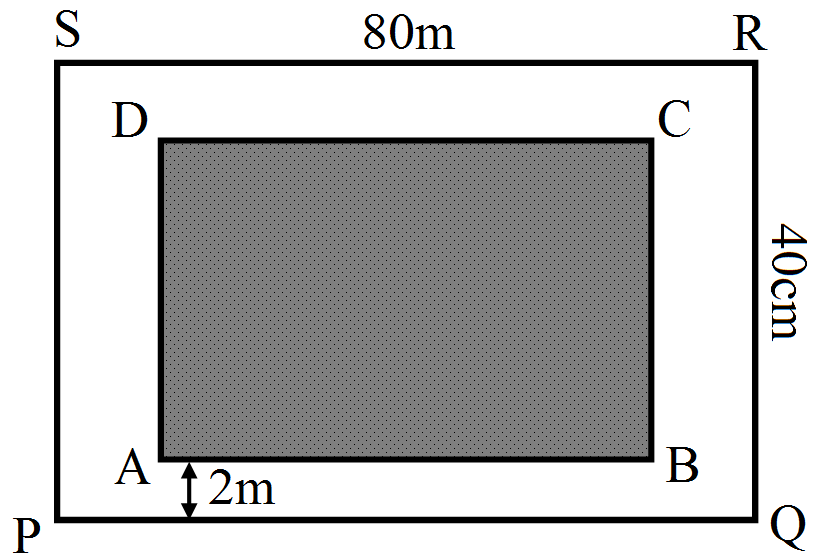
The length and breadth of a park in the ratio $2 : 1$ and its perimeter is $240m.$ A path $2m$ wide runs inside it, along its boundary. Find the cost of paving the path at $Rs.80$ per $m^2$.
Answer
Ratio in length and breadth of the park $= 2 : 1$
Its perimeter $= 240m$​​​​​​​

Let length $=2 \mathrm{x}$
then breadth $=x$
Perimeter $=2(2 x+x)=2 \times 3 x=6 x$
$6 x=240$
$\Rightarrow \mathrm{x}=\frac{240}{6}=40$
Length $=2 x=2 \times 40=80 \mathrm{~m}$
and breadth $=x=40 \mathrm{~m}$
Area $=\mathrm{L} \times \mathrm{B}=80 \times 40 \mathrm{~m}^2=3200 \mathrm{~m}^2$
Width of path inside the park $=2 \mathrm{~m}$
Inner length $(I)=80-2 \times 2=80-4=76 \mathrm{~m}$
and breadth $(b) =40-2 \times 2=40-4=36 \mathrm{~m}$
Inner area $=76 \times 36=2736 \mathrm{~m}^2$
Area of path $=$ Outer area $-$ Inner area $=3200-2736=464 \mathrm{~m}^2$
Rate of paving the path $= Rs. 80\ per\ \mathrm{m}^2$
Total cost $= Rs. 80 \times 464= Rs. 37120$
View full question & answer
Question 45 Marks
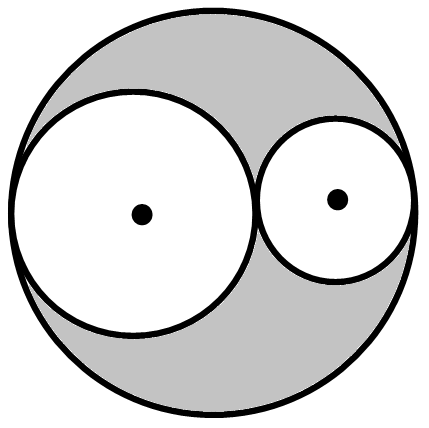
In the given figure, a circle of diameter $21\ cm$ is given. Inside this circle, two circles with diameters $\frac{2}{3}$ and $\frac{1}{3}$ of the diameter of the big circle have been drawn, as shown in the given figure. Find the area of the shaded region.
Answer
Diameter of largest circle (outer circle) $=21 \mathrm{~cm}$
$\therefore \text { Radius }(\mathrm{R})=\frac{21}{2} \mathrm{~cm}$
$\text { Area }=\pi \mathrm{R}^2=\frac{22}{7} \times \frac{21}{2} \times \frac{21}{2}=\frac{693}{2} \mathrm{~cm}^2$
$=346.5 \mathrm{~cm}^2$
Diamerer of bigger circle $=\frac{2}{3}$ or $21$
$=14 \mathrm{~cm}$
$\therefore \text { Radius }\left(\mathrm{r}_1\right)=\frac{14}{2}=7 \mathrm{~cm}$
and area $=\pi \mathrm{r}_1^2=\frac{22}{7} \times 7 \times 7=154 \mathrm{~cm}^2$
Diameter of smaller circle $=\frac{1}{3}$ of $21$
$=7 \mathrm{~cm}$
$\therefore \text { Radius }\left(\mathrm{r}_2\right)=\frac{7}{2} \mathrm{~cm}$
$\text { and area }=\pi \mathrm{r}_2^2=\frac{22}{7} \times \frac{7}{2} \times \frac{7}{2}$
$=\frac{77}{2} \mathrm{~cm}=38.5 \mathrm{~cm}^2$
Area of shaded portion $=346.5-(154+38.5)=(346.5-192.5)=154 \mathrm{~cm}^2$
View full question & answer
Question 55 Marks
The diameter of the wheel of a car is $77\ cm.$ How many revolutions will it make to travel $121\ km?$
Answer
Diameter of the wheel $=77\text{cm}$
$\Rightarrow $ Radius of the wheel $=\Big(\frac{77}{2}\Big)\text{cm}$
Circumference of the wheel $=2\pi\text{r}$
$=\Big(2\times\frac{22}{7}\times\frac{77}2{}\Big)\text{cm}=(22\times11)\text{cm}=242\text{cm}$
$=\Big(\frac{242}{100}\Big)\text{m}=\Big(\frac{121}{50}\Big)\text{m}$
Distance covered by the wheel in $1$ revolution $=\Big(\frac{121}{50}\Big)\text{m}$
Now, $\Big(\frac{121}{50}\Big)\text{m}$ is covered by the car in $1$ revolution.
$(121 \times 1000) m$ will be covered by the car in $\Big(1\times\frac{50}{121}\times121\times1000\Big)$ revolutions, i.e. $50000$ revolutions.
$\therefore$ Required number of revolutions $= 50000$
View full question & answer
Question 65 Marks
A well of diameter $140\ cm$ has a stone parapet around it. If the lenght of the outer edge of the parapet is $616\ cm,$ find the width of the parapet.
Answer
Given: Diameter of the well $(d) = 140\ cm.$
Radius of the well $(r) =\Big(\frac{140}{2}\Big)\text{cm}=70\text{cm}$

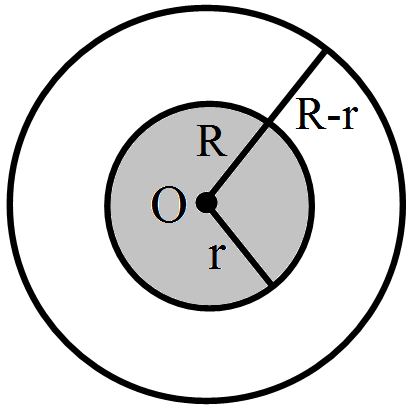
Let the radius of the outer circle (including the stone parapet) be $R\ cm.$
Length of the outer edge of the parapet $=616\text{cm}$
$\Rightarrow2\pi\text{R}=616$
$\Rightarrow\Big(2\times\frac{22}{7}\times\text{R}\Big)=616$
$\Rightarrow\text{R}=\Big(\frac{616\times7}{2\times22}\Big)\text{cm}=98\text{cm}$
Now, width of the parapet $= \{$Radius of the outer circle $($including the stone parapet$)\ -$ Radius of the well$\}$
$= \{98 - 70\}\ cm = 28\ cm$
Hence, the width of the parapet is $28\ cm.$
View full question & answer
Question 75 Marks
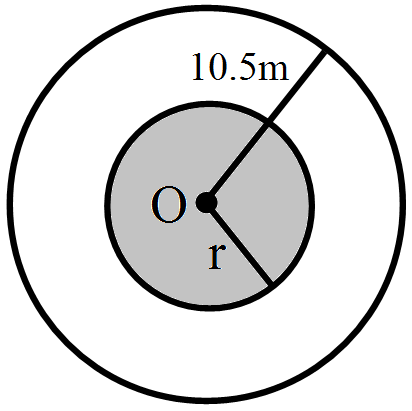
The inner circumference of a circular track is $330m.$ The track is $10.5m$ wide everywhere. Calculate the cost of putting up a fence along the outer circle at the rate of $Rs.20$ per metre.
Answer
Let the inner and outer radii of the track be $r$ metres and $(r + 10.5)$ metres, respectively.

Inner circumference $=330\text{m}$
$\therefore2\pi\text{r}=330=2\times\frac{22}{7}\times\text{r}=330$
$\Rightarrow\text{r}=\Big(330\times\frac{7}{44}\Big)=52.5\text{m}$
Inner radius of the track $= 52.5m$
$\therefore$ Outer radii of the track $= (52.5 + 10.5)m = 63m$
$\therefore$ Circumference of the outer circle $=\Big(2\times\frac{22}{7}\times63\Big)\text{m}=396\text{m}$
Rate of fencing $= Rs. 20$ per metre
$\therefore$ Total cost of fencing the outer circle $= Rs. (396 × 20) = Rs. 7920$
View full question & answer
Question 85 Marks
The base of an isosceles triangle is $12\ cm$ and its perimeter is $32\ cm.$ Find its area.
Answer
Perimeter of an isosceles triangle $=32 \mathrm{~cm}$
Base $=12 \mathrm{~cm}$
Sum of two equal sides $=32-12=20 \mathrm{~cm}$
Length of each equal side $=\frac{20}{2}=10 \mathrm{~cm}$
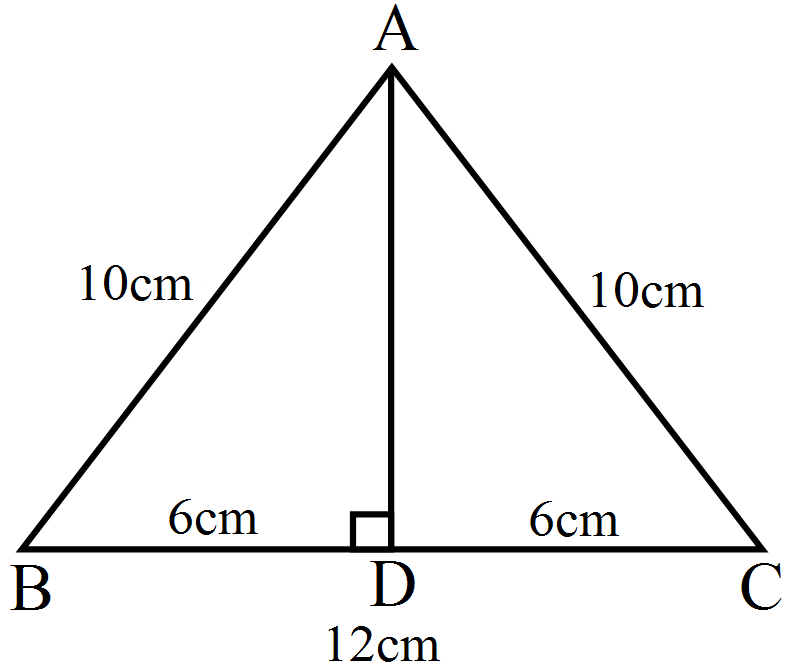
Let $\mathrm{AD} \perp \mathrm{BC}$
$\mathrm{BD}=\mathrm{DC}=\frac{12}{2}=6 \mathrm{~cm}$

Now, in right $\triangle \mathrm{ABD}$
$A B^2=A D^2+B D^2$
$\Rightarrow(10)^2=A D^2+(6)^2$
$\Rightarrow 100=A D^2+36$
$\Rightarrow A D^2=100-36=64=(8)^2$
$\therefore A D=8 \mathrm{~cm}$
Now, area of $\triangle \mathrm{ABC}=\frac{1}{2} \mathrm{BC} \times \mathrm{AD}$
$=\frac{1}{2} \times 12 \times 8 \mathrm{~cm}^2$
$=48 \mathrm{~cm}^2$
View full question & answer
Question 95 Marks
The hour and minute hands of a clock are $4.2\ cm$ and $7\ cm$ long respectively. Find the sum of the distances covered by their tips in $1$ day.
Answer
Length of the hour hand $ (r) =4.2\text{cm}$
Distance covered by the hour hand in $12$ hours $=2\pi\text{r}=\Big(2\times\frac{22}{7}\times4.2\Big)\text{cm}=26.4\text{cm}$
$\therefore$ Distance covered by the hour hand in $24$ hours $=(2\times26.4)=52.8\text{cm}$
Length of the minute hand $(R)=7\text{cm}$
Distance covered by the minute hand in $1$ hour $=2\pi\text{R}=\Big(2\times\frac{22}{7}\times7\Big)\text{cm}=44\text{cm}$
$\therefore$ Distance covered by the minute hand in $24$ hours $=(44\times24))\text{cm}=1056\text{cm}$
$\therefore$ Sum of the distances covered by the tips of both the hands in $1$ day $= (52.8 + 1056)\text{cm}$
$=1108.8\text{cm}$
View full question & answer
Question 105 Marks
A horse is tied to a pole in a park with a string $21m$ long. Find the area over which the horse can graze.
Answer
Length of rope $(r) = 21m$
Area of the circle $=\pi\text{r}^2=\frac{22}{7}\times21\times21\text{m}^2=1386\text{m}^2$
The horse will graze on $1386 \mathrm{~m}^2$ area
View full question & answer
Question 115 Marks
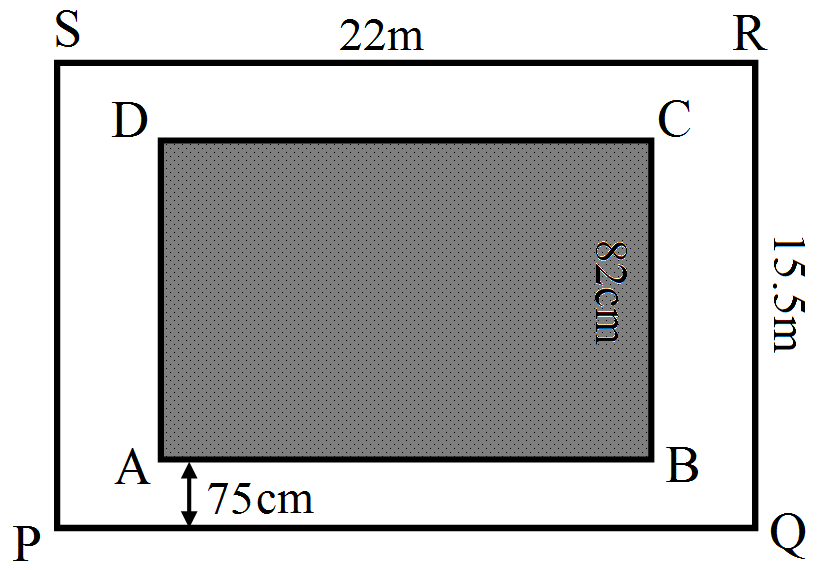
A school has a hall which is $22\ m$ long and $15.5\ m$ broad. A carpet is laid inside the hall leaving all around a margin of $75\ cm$ from the walls. Find the area of the carpet and the area of the strip left uncovered. If the width of the carpet is $82\ cm,$ find its cost at the rate of $Rs.60\ per\ m.$
Answer
Length of hall $(l) = 22m$ Breadth $(b) = 15.5m$

Space left along the walls $=75\text{m}=\frac{3}{4}\text{m}$
Inner length $ (l)=22-2\times\frac{3}{4}=20.5\text{m}$
Inner breadth $(b) =15.5-2\times\frac{3}{4}=15.5-1.5=14\text{m}$
Area of carpet = Inner area $=20.5\times14\text{m}^2=287\text{m}^2$
Outer area $=22\times15.5=341\text{m}^2$
Area of strip left out $=341-287=54\text{m}^2$
Width of carpet $=82\text{cm}=\frac{82}{100}\text{m}$
Length of carpet $=287\div\frac{82}{100}$
$=\frac{287\times100}{82}=350\text{m}$
 Rate of carpet $= Rs. 60$ per metre Total cost $= Rs. 60 \times 350 = Rs. 21000$
View full question & answer
Question 125 Marks
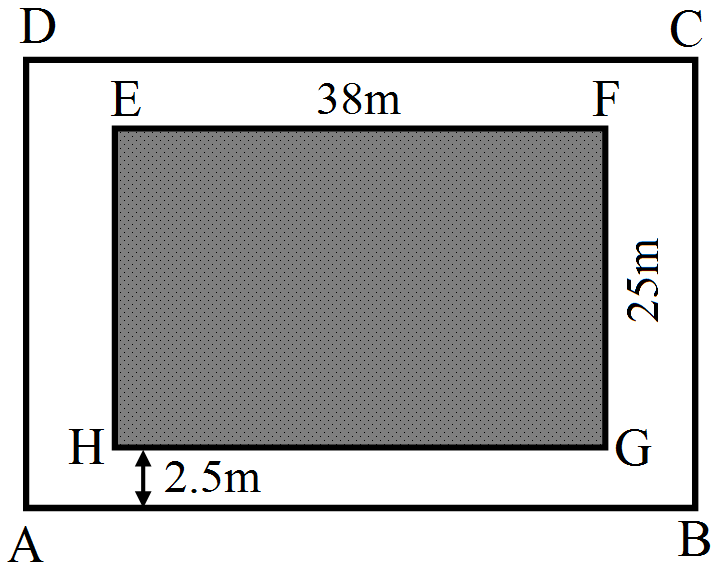
A rectangular grassy lawn measuring $38m$ by $25m$ has been surrounded externally by a $2.5-m-$wide path. Calculate the cost of gravelling the path at the rate of $Rs.120$ per $m^2$.
Answer
Inner length of lawn $(\mathrm{I})=38 \mathrm{~m}$
and breadth $(b)=25 \mathrm{~m}$
Width of path $=2.5 \mathrm{~m}$

$\text { Outer length }(\mathrm{L})=38+2 \times 2.5=38+5=43 \mathrm{~m}$
$\text { and outer breadth }(B)=25+2 \times 2.5=25+5=30 \mathrm{~m}$
$\text { Area of path }=\text { Outer area - Inner area }$
$=(43 \times 30-38 \times 25) \mathrm{m}^2$
$=(1290-950) \mathrm{m}^2=340 \mathrm{~m}^2$
$\text { Rate of gravelling the path = Rs. } 120 \text { per m² }$
$\text { Total cost = Rs. } 120 \times 340=\text { Rs. } 40800$
View full question & answer
Question 135 Marks
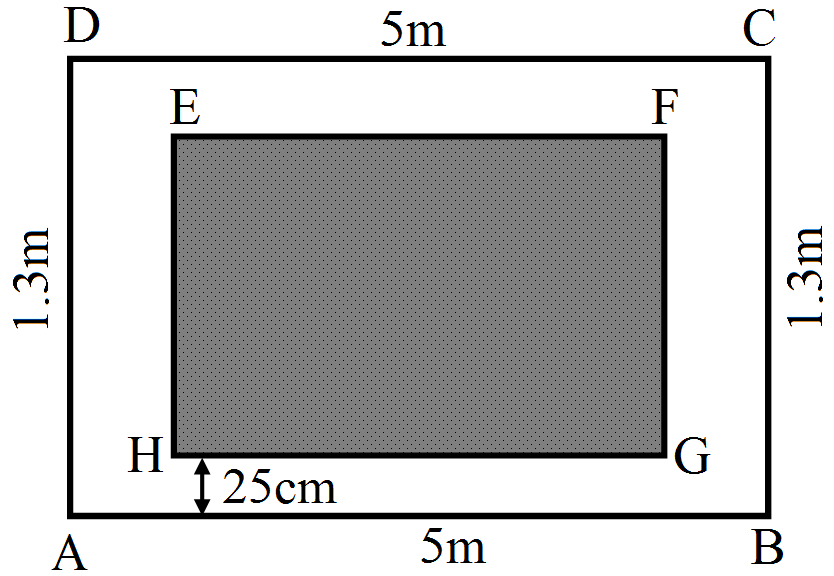
A saree is $5m$ long and $1.3m$ wide. A border of width $25\ cm$ is printed along its sides. Find the cost of printing the border at $Rs.1$ per $10\ cm^2$.
Answer
Let $A B C D$ be the saree and $EFGH$ be the part of saree without border.
Length, $A B=5 \mathrm{~m}$
Breadth, $B C=1.3 \mathrm{~m}$
Width of the border of the saree $=25 \mathrm{~cm}=0.25 \mathrm{~m}$

$\therefore \text { Area of } A B C D=5 \mathrm{~m} \times 1.3 \mathrm{~m}=6.5 \mathrm{~m}^2$
$\text { Length, GH }=\{5-(0.25+0.25)\} \mathrm{m}=4.5 \mathrm{~m}$
$\text { Breadth, FG }=\{1.3-0.25+0.25\} \mathrm{m}=0.8 \mathrm{~m}$
$\therefore \text { Area of } \mathrm{EFGH}=4.5 \mathrm{~m} \times .8 \mathrm{~m}=3.6 \mathrm{~m}^2$
$\text { Area of the border }=\text { Area of } \mathrm{ABCD}-\text { Area of } \mathrm{EFGH}$
$=6.5 \mathrm{~m}^2-3.6 \mathrm{~m}^2$
$=2.9 \mathrm{~m}^2=29000 \mathrm{~cm}^2\left[\text { since } 1 \mathrm{~m}^2=10000 \mathrm{~cm}^2\right]$
$\text { Rate of printing the border }=\mathrm{Rs} 1 \text { per } 10 \mathrm{~cm}^2$
$\therefore \text { Total cost of printing the border }=\mathrm{Rs}\left(\frac{1 \times 29000}{10}\right)$
$=\text { Rs } 2900$
View full question & answer
Question 145 Marks
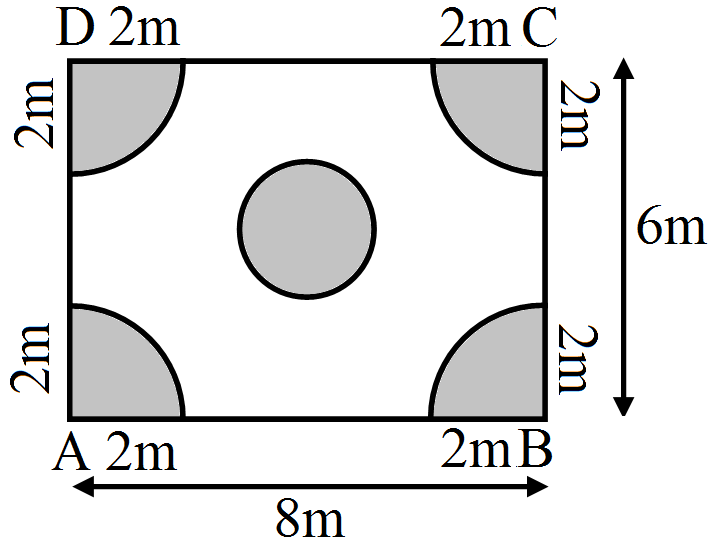
In the given figure a rectangular plot of land measures $8m$ by $6m.$ In each of the corners, there is a flower bed in the form of a quadrant of a circle of radius $2m.$ Also, there is a flower bed in the area of the remaining plot.
Answer
Length of plot $(1)=8 \mathrm{~m}$
and breadth $(b)=6 \mathrm{~m}$
Area of plot $=l \times b=8 \times 6=48 \mathrm{~m}^2$
Radius of each quadrant at the corner $=2 \mathrm{~m}$
$\therefore$ Area of 4 quadrants $=4 \times \frac{1}{4} \pi r^2$
$=\pi \mathrm{r}^2=\frac{22}{7} \times 2 \times 2=\frac{88}{7} \mathrm{~m}^2$
Radius of circle at the centre $=2 \mathrm{~m}$
and area of circle $=\pi \mathrm{r}^2=\frac{22}{7} \times 2 \times 2$
$=\frac{88}{7} \mathrm{~m}^2$
$\therefore$ Area of the remaining plot
$=48-\left(\frac{88}{7}+\frac{88}{7}\right)=\left(48-\frac{176}{7}\right) \mathrm{m}^2$
$=48.00-25.14=22.86 \mathrm{~m}^2$
View full question & answer
Question 155 Marks
Find the area of a rhombus each side of which measures $20\ cm$ and one of whose diagoanls is $24\ cm.$
Answer
Let $ABCD$ be the rhombus, whose diagonals intersect at $O.$

$\mathrm{AB}=20 \mathrm{~cm} \text { and } \mathrm{AC}=24 \mathrm{~cm}$
The diagonals of a rhombus bisect each other at right angles.
Therefore, $\triangle \mathrm{AOB}$ is a right angled triangle, right angled at 0 .
Here, $\mathrm{OA}=\frac{1}{2} \mathrm{AC}=12 \mathrm{~cm}$
$A B=20 \mathrm{~cm}$
By Pythagoras theorem:
$(A B)^2=(O A)^2+(O B)^2$
$\Rightarrow(20)^2=(12)^2+(O B)^2$
$\Rightarrow(O B)^2=(20)^2-(12)^2$
$\Rightarrow(O B)^2=400-144=256$
$\Rightarrow(O B)^2=(16)^2$
$\Rightarrow O B=16 \mathrm{~cm}$
$\therefore B D=2 \times O B=2 \times 16 \mathrm{~cm}=32 \mathrm{~cm}$
$\therefore$ Area of the rhombus $\mathrm{ABCD}=\left(\frac{1}{2} \times \mathrm{AC} \times \mathrm{BD}\right) \mathrm{cm}^2$
$=\left(\frac{1}{2} \times 24 \times 32\right) \mathrm{cm}^2$
$=384 \mathrm{~cm}^2$
View full question & answer
Question 165 Marks
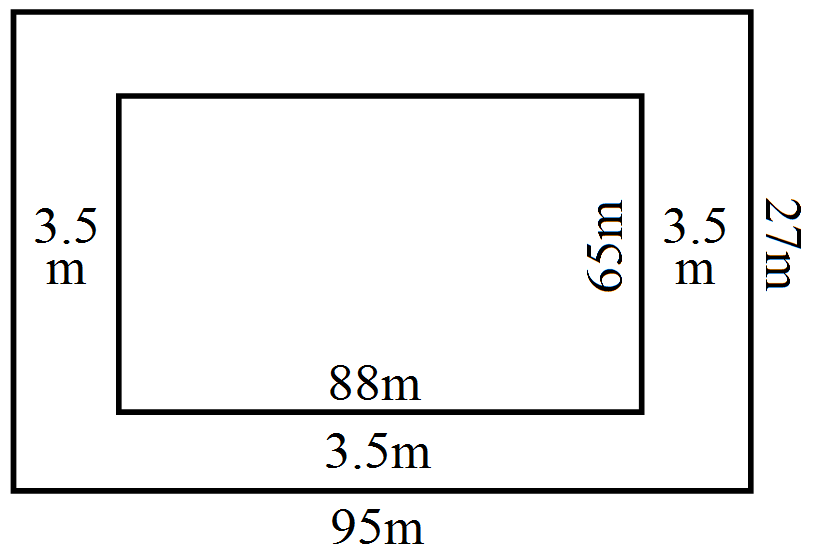
A rectangular plot of land measures $95m$ by $72m.$ Inside the plot, a path of uniform width of $3.5m$ is to be constructed all around. The rest of the plot is to be laid with grass. Find the total expenses involved in constructing the path at $Rs.80$ per $m^2$ and laying the grass at $Rs.40$ per $m^2$.
Answer
Outer length of the plot $(\mathrm{L})=95 \mathrm{~m}$
and breadth $(B)=72 \mathrm{~m}$
Width of path $=3.5 \mathrm{~m}$

Inner length $(l)=95-2 \times 3.5=95-7=88 \mathrm{~m}$
and breadth $=72-2 \times 3.5=72-7=65 \mathrm{~m}$
Outer area $=\mathrm{L} \times \mathrm{B}=95 \times 72 \mathrm{~m}^2=6840 \mathrm{~m}^2$
and inner area $=\mathrm{l} \times \mathrm{b}=88 \times 65 \mathrm{~m}^2=5720 \mathrm{~m}^2$
Area of path $=$ outer area $-$ inner area $=6840-5720=1120 \mathrm{~m}^2$
Rate of constructing it $= Rs. 80 per \mathrm{m}^2$
Total cost $= Rs. 1120 \times 80= Rs. 89600$
and rate of laying grass $= Rs. 40$ per $\mathrm{m}^2$
Total cost $= Rs. 40 \times 5720= Rs. 228800$
Total cost $= Rs. 89600 + Rs. 228800= Rs. 318400$
View full question & answer
Question 175 Marks
A bicycle wheel makes $5000$ revolutions in moving $11\ km.$ Find the circumference and the diameter of the wheel.
Answer
It may be noted that in one revolution, the bicycle covers a distance equal to the circumference of the wheel.
Total distance covered by the bicycle in $5000$ revolutions $= 11\ km$
$\Rightarrow 5000 \ \times $ Circumference of the wheel $= 11000\ m [$since $1\ km = 1000\ m]$
Circumference of the wheel $=\Big(\frac{11000}{5000}\Big)\text{m}=2.2\text{m}=220\text{cm} [$since $1\ m = 100\ cm]$
Circumference of the wheel = $\pi\ \times $ Diameter of the wheel
$\Rightarrow220\text{cm}=\frac{22}{7}\ \times $Diameter of the wheel
$\Rightarrow $ Diameter of the wheel $=\Big(\frac{220\times7}{22}\Big)\text{cm}=70\text{cm}$
Hence, the circumference of the wheel is $220\ cm$ and its diameter is $70\ cm.$
View full question & answer
Question 185 Marks
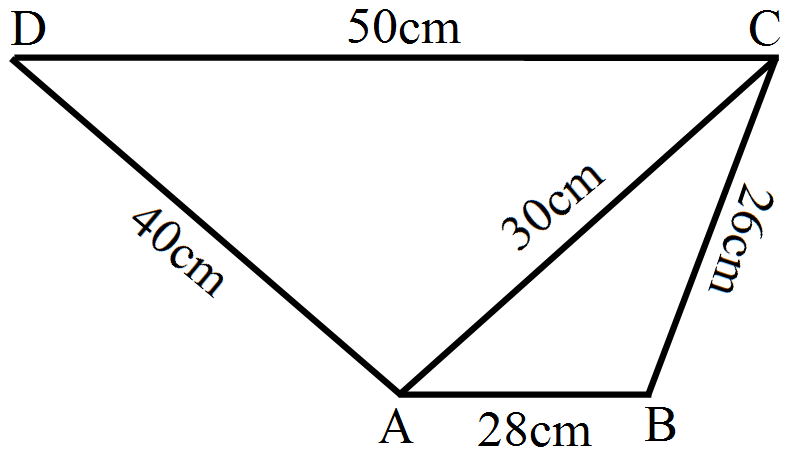
In a quadrilateral $ABCD, AB = 28\ cm, BC = 26\ cm, CD = 50\ cm, DA = 40\ cm$ and diagonal $AC = 30\ cm.$ Find the area of the quadrilateral.
Answer
In quad. $ABCD, AB = 28\ cm, BC = 26\ cm, CD = 50\ cm, DA = 40\ cm$ and diagonal $AC = 30\ cm$
In $\triangle\text{ABC},$
$\text{s}=\frac{\text{sum of sides}}{2}$
$=\frac{26+28+30}{2}$
$=\frac{84}{2}=42$
$\therefore\text{Area of}\triangle\text{ABC}$
$=\sqrt{\text{s(s}-\text{a})\text{(s}-\text{b})\text{(s}-\text{c})}$
$=\sqrt{42(42-26)(42-28)(42-30)}$
$=\sqrt{42\times16\times14\times12}$
$\sqrt{7\times3\times2\times2\times2\times2\times2\times2\times7\times2\times2\times3}$
$=2\times2\times2\times3\times7=336\text{cm}^2$ In $\triangle\text{ADC},$
$\text{s}=\frac{30+40+50}{2}=\frac{120}{2}=60$
$\therefore\text{Area of }\triangle\text{ADC}$
$=\sqrt{\text{s(s}-\text{a})\text{(s}-\text{b})\text{(s}-\text{c})}$
$=\sqrt{60(60-30)(60-40)(60-50)}$
$=\sqrt{60\times30\times20\times10}$
$=\sqrt{360000}=600\text{cm}^2$
$\therefore$ Area of quad.$ ABCD = 336 + 600$
$=936\text{cm}^2$
View full question & answer