Questions

3 Marks Question

Take a timed test

11 questions · self-marked practice — reveal the answer and mark yourself.

Question 13 Marks
Shazli took a wire of length $44\ cm$ and bent int\o the shape of a circle. Find the radius of that circle. Also, find the area. Of the same wire is bent into the shape of a square, what will be the length of each of its side? Which figure encloses more area, the circle or the square$?\ ($Take $\pi= \frac{22}{7})$
Answer
Length of the wire $= 44 \ cm$
Let the radius of the circle be $r \ cm.$
Then, circumference of the circle $= 2 \pi r \ cm$
According to the question,
$2 \pi r = 44$
$\therefore 2 \times \frac{22}{7} \times r = 44$
$ \therefore r = \frac{44 \times 7}{2 \times 22} $
$ \therefore r = 7 \ cm$
Hence, the radius of that circle is $7 \ cm.$
Area of the circle $= \pi r^2 $
$= \frac{22}{7} (7)^2=154 \mathrm{~\ cm}^2$
Length of each side of the square
$= \frac{\text { Perimeter of square }}{4} $
$= \frac{\text { Length of the wire }}{4} $
$= \frac{44}{4} \ cm = 11 \ cm$
$\therefore$ Area of the square $=$ side $\times$ side
$= 11 \times 11 = 121 \mathrm{~\ cm}^2 .$
Hence, the circle encloses more area i.e $154 \mathrm{~\ cm}^2$
View full question & answer
Question 23 Marks
From a circular sheet of radius $4 \ cm,$ a circle of radius $3\ cm$ is removed. Find the area of the remaining sheet. $($Take $ \pi = 3.14)$
Answer
$\text { Radius of outer circle }(R)=4 \mathrm{~cm}$
$\therefore \text { Area of the outer circle }=\pi R^2$
$=3.14(4)^2$
$=3.14 \times 16$
$=50.24 \mathrm{~cm}^2$
$\text { Radius of inner circle }(r)=3 \mathrm{~cm}$
$\therefore \text { Area of the innercircle }=\pi \mathrm{r}^2$
$=3.14(3)^2$
$=3.14 \times 9$
$=28.26 \mathrm{~cm}^2$
$\therefore \text { Area of the remaining sheet }$
$=\text { Area of the outer circle }- \text { Area of the inner circle }$
$=50.24 \mathrm{~cm}^2-28.26 \mathrm{~cm}^2$
$=21.98 \mathrm{~cm}^2$
View full question & answer
Question 33 Marks
A gardener wants to fence a circular garden of diameter $21 m.$ Find the length of the rope he needs to purchase if he makes $2$ rounds of fence. Also find the cost of the rope, if it cost $₹ 4$ per meter. $($Take $\pi= \frac{22}{7})$
Answer
The diameter of the circular garden $= 21 m$
$ \therefore$ The radius of the circular garden $(r) = \frac{21}{2} m$
$ \therefore$ The circumference of the circular garden $= 2 \pi r$
$= 2 \times \frac{22}{7} \times \frac{21}{2} m = 66 m$
$ \therefore$ Length of the rope to make $1$ round of fence $= 66 m$
$ \therefore$ Length of the rope to make $2$ rounds of fence $= 66 \times 2 m = 132 m$
$\therefore$ cost of the rope $= ₹ 132 \times 4 = ₹ 528.$
View full question & answer
Question 43 Marks
A circular flower bed is surrounded by a path $4 m$ wide. The diameter of the flower bed is $66 m$. What is the area of this path$? ($Take $\pi = 3.14)$
Answer
The diameter of the flower bed $=66 \mathrm{~m}$
$\therefore$ Radius of the flower bed $(\mathrm{r})=\frac{66}{2} \mathrm{~m}=33 \mathrm{~m}$
$\therefore$ Area of the flower bed $=\pi r^2$
$=3.14 \times(33)^2 \mathrm{~m}^2$
$=3.14 \times 1089 \mathrm{~m}^2=3419.46 \mathrm{~m}^2$
Radius of the flower bed with path $(R)=33 \mathrm{~m}+4 \mathrm{~m}=37 \mathrm{~m}$
$\therefore$ Area of the flower bed with path $=\pi r^2$
$=3.14 \times(37)^2 \mathrm{~m}^2=3.14 \times 1369 \mathrm{~m}^2$
$=4298.66 \mathrm{~m}^2$
$\therefore$ Area of the path = Area of the flower bed with path - Area of the flower bed
$=4298.66 \mathrm{~m}^2-3419.46 \mathrm{~m}^2$
$=879.20 \mathrm{~m}^2$
View full question & answer
Question 53 Marks
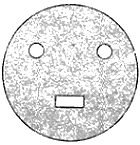
From a circular card sheet of radius $14 \ cm,$ two circles of radius $3.5 \ cm$ and a rectangle of length $3\ \ cm$ and breadth $1 \ cm$ are removed. (as shown in the adjoining figure). Find the area of the remaining sheet. $($Take $\pi =  \frac{22}{7})$
Answer
The radius of the circular card sheet $(r)=14 \mathrm{~cm}$
$\therefore$ Area of the circular card sheet $=\pi r^2$
$\frac{22}{7}(14)^2 \frac{22}{7} \times 14 \times 14$
$=616 \mathrm{~cm}^2$
Area of two circles of radius $3.5\ cm$
$=2\left[\pi(3.5)^2\right] \mathrm{cm}^2$
$=2 \times\left[\frac{22}{7} \times 3.5 \times 3.5\right] \mathrm{cm}^2$
$=77 \mathrm{~cm}^2$
Area of a rectangle of length $3\ cm$ and breadth $1\ cm$
$=1 \times \mathrm{b}=3 \times 1 \mathrm{~cm}^2$
$=3 \mathrm{~cm}^2$
$\therefore$ Area of the remaining sheet
$=$ Area of the circular card sheet $- ($Area of two circles $+$ Area of a rectangle$)$
$=616 \mathrm{~cm}^2-\left(77 \mathrm{~cm}^2+3 \mathrm{~cm}^2\right)$
$=616 \mathrm{~m}^2-80 \mathrm{~cm}^2$
$=536 \mathrm{~cm}^2$
View full question & answer
Question 63 Marks
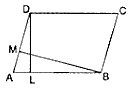
$DL$ and $BM$ are the heights on sides $AB$ and $AD$ respectively of parallelogram $ABCD.$ If the area of the parallelogram is $1470 \mathrm{~cm}^2$ and $AB = 35\ cm$ and $AD = 49\ cm$, Find the length of $BM$ and $DL.$
Answer
Area of the parallelogram $A B C D$
$=(\text { Base } \times \text { Height })$
$=A D \times B M$
$\therefore 1470=49 \times B M$
$\therefore B M=\frac{1470}{49} \mathrm{~cm}$
$\therefore B M=30 \mathrm{~cm}$
Hence, the length of $BM$ is $30\ cm .$
Again, Area of parallelogram $A B C D$
$=\text { Base } \therefore \text { Height }$
$=A B \times D L$
$1470=35 \times \mathrm{DL}$
$\therefore D L=\frac{1470}{35} \mathrm{~cm}$
$\therefore D L=42 \mathrm{~cm}$
Hence, the length of $DL$ is $42\ cm.$
View full question & answer
Question 73 Marks
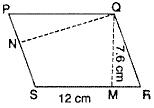
$\text{PQRS}$ is a parallelogram. $QM$ is the height from $Q$ to $SR$ and $QN$ is the height from $Q$ to $PS.$ If $SR = 12\ cm$ and $QM = 7.6\ cm$. Find,

$i.$ the area of the parallelogram $\text{PQRS}$
$ii. QN,$ if $PS = 8 \ cm$
Answer
$i.$ Area of the parallelogram $\text{PQRS}$
$=$ Base $\times$ Height
$=S \mathrm{R} \times \mathrm{QM}$
$=12 \mathrm{~cm} \times 7.6 \mathrm{~cm}$
$=91.2 \mathrm{~cm}^2$
$ii.$ Area of the parallelogram $\text{PQRS}$
$=$ Base $\times$ Height
$=\mathrm{PS} \times \mathrm{QN}$
$\therefore 91.2=8 \times \mathrm{QN}$
$\therefore \mathrm{QN}=\frac{91.2}{8}$
$\therefore \mathrm{QN}=11.4 \mathrm{~cm}$
View full question & answer
Question 83 Marks
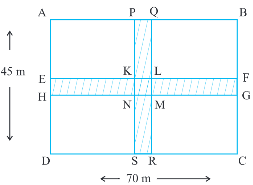
Two cross roads, each of width $5 m,$ run at right angles through the centre of a rectangular park of length $70 m$ and breadth $45 m$ and parallel to its sides. Find the area of the roads. Also find the cost of constructing the roads at the rate of $₹ 105 ~per ~m^2$.
Answer
Clearly, area of the cross roads is the area of shaded portion, i.e., the area of the rectangle $PQRS$ and the area of the rectangle $EFGH.$ But while doing this, the area of the square $KLMN$ is taken twice, which is to be subtracted once to get the required area.
Now, $P Q=5 \mathrm{~m}$ and $P S=45 \mathrm{~m}$
$\mathrm{EH}=5 \mathrm{~m} \text { and } \mathrm{EF}=70 \mathrm{~m}$
$\mathrm{KL}=5 \mathrm{~m} \text { and } \mathrm{KN}=5 \mathrm{~m}$
Therefore, area of the path = Area of the rectangle PQRS + area of the rectangle EFGH - Area of the square KLMN
$=\mathrm{PS} \times \mathrm{PQ}+\mathrm{EF} \times \mathrm{EH}-\mathrm{KL} \times \mathrm{KN}$
$=(45 \times 5+70 \times 5-5 \times 5) \mathrm{m}^2$
$=(225+350-25) \mathrm{m}^2=550 \mathrm{~m}^2$
Hence, cost of constructing the path $=₹ 105 \times 550=₹ 57,750$
View full question & answer
Question 93 Marks
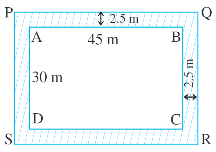
A rectangular park is $45 m$ long and $30 m$ wide. A path $2.5 m$ wide is constructed outside the park. Find the area of the path
Answer
Let $A B C D$ represent the rectangular park and the shaded region between rectangles $A B C D$ and $P Q R S$ represents the path which is $2.5 m$ wide.
To find the area of the path, we need to find $($Area of rectangle $PQRS -$ Area of rectangle $A B C D ).$
Clearly, we have, $\mathrm{PQ}=(45+2.5+2.5) \mathrm{m}=50 \mathrm{~m}$
$P S=(30+2.5+2.5) \mathrm{m}=35 \mathrm{~m}$
Therefore, area of the rectangle $PQRS =l \times b=50 \times 35 \mathrm{~m}^2=1750 \mathrm{~m}^2$
Also, area of the rectangle $A B C D=l \times b=45 \times 30 \mathrm{~m}^2=1350 \mathrm{~m}^2$
Hence, the required s-area of the path $=$ Area of the rectangle $PQRS -$ Area of the rectangle $A B C D$ $=(1750-1350) \mathrm{m}^2=400 \mathrm{~m}^2$
View full question & answer
Question 103 Marks
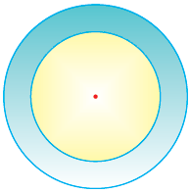
The adjoining figure shows two circles with the same centre. The radius of the larger circle is $10\ cm$ and the radius of the smaller circle is $4\ cm.$ Find:

$i.$ the area of the larger circle
$ii.$ the area of the smaller circle
$iii.$ the shaded area between the two circles.$ (\pi = 3.14)$
Answer
Here, we shall proceed as follows:
$i.$ Radius of the larger circle $=10 \mathrm{~cm}$
So, area of the larger circle $=\pi r^2$
$=3.14 \times 10 \times 10$
$=314 \mathrm{~cm}^2$
$ii.$ Radius of the smaller circle $=4 \mathrm{~cm}$
Therefore, Area of the smaller circle $=\pi r^2$
$=3.14 \times 4 \times 4$
$=50.24 \mathrm{~cm}^2$
$iii.$ Finally, Area of the shaded region $=(314-50.24) \ \mathrm{cm}^2=263.76 \mathrm{~cm}^2$
View full question & answer
Question 113 Marks
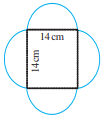
Find the perimeter of the given shape (Fig) (Take $\pi   = \frac{22}{7})$
Answer
In order to find the perimeter of the given shape, we need to find the circumference of semi-circles on each side of the square.
The outer boundary, of this figure is made up of four semi-circles. Diameter of each semicircle is $14\ cm.$
We know that:
Circumference of the circle $= \pi d$
Circumference of one semi-circle $=\frac{1}{2} \pi d$
$=\frac{1}{2} \times \frac{22}{7} \times 14\  cm = 22\ cm$
Circumference of each of the semi-circles is $22\ cm$
Therefore, perimeter of the given figure $= 4 \times 22\ cm = 88\ cm$
View full question & answer