Questions

3 Marks Question

Take a timed test

26 questions · self-marked practice — reveal the answer and mark yourself.

Question 13 Marks
Two poles of $10m$ and $15m$ stand upright on a plane ground. If the distance between the tops is $13m,$ find the distance between their feet.
Answer
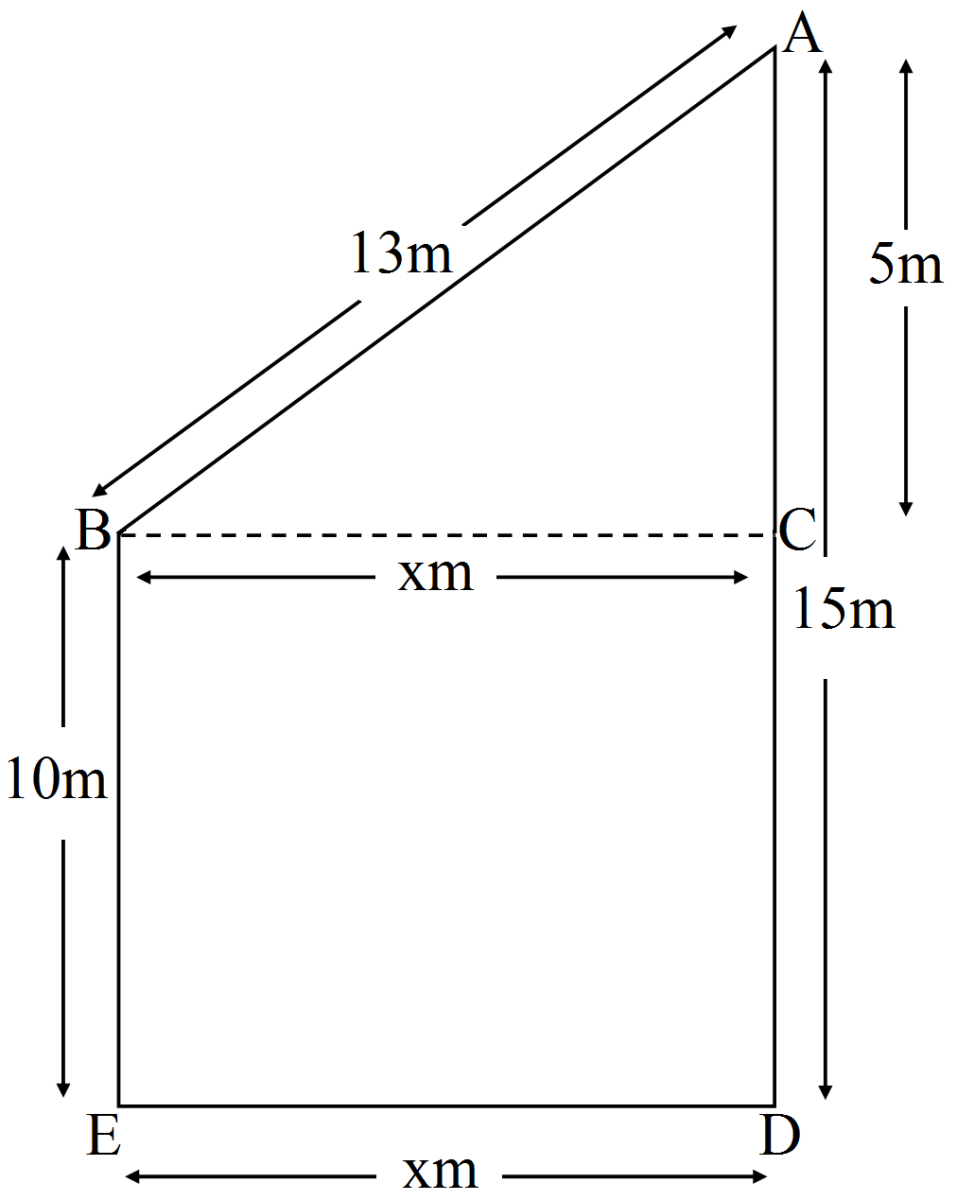

Let $BC = x m$
In right angled $\triangle\text{ACB},$
$A B^2=A C^2+B C^2 \text { [by Pythagoras theoram] }$
$\Rightarrow(13)^2=(5)^2+x^2$
$\Rightarrow 169-25=x^2$
$\Rightarrow 144=x^2$
$\Rightarrow\text{x}=\sqrt{144}$
$\Rightarrow\text{x}=12\text{m}$
Hence, the distance between the feet of two poles is $12m.$
View full question & answer
Question 23 Marks
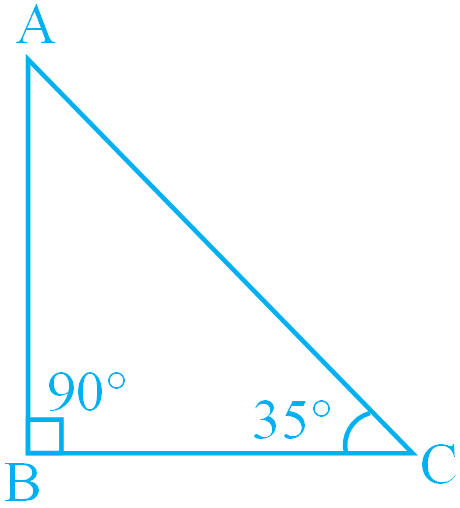
In a right-angled triangle if an angle measures $35^\circ ,$ then find the measure of the third angle.
Answer
In a right angled $\triangle \text{ABC}, $
$\angle\text{A}+\angle\text{B}+\angle\text{C}=180^{\circ}$ [angle sum property of a triangle]
$\Rightarrow\angle\text{A}+{90}^{\circ}+35^{\circ}=180^{\circ}$
$[\because\angle\text{B}=90^{\circ} \text{and} \ \angle\text{C}=35^{\circ},\text{given}]$
$\Rightarrow\angle\text{A}+125^{\circ}=180^{\circ}$
$\Rightarrow\angle\text{A}=180^{\circ}-125^{\circ}=55^{\circ}$
 
View full question & answer
Question 33 Marks
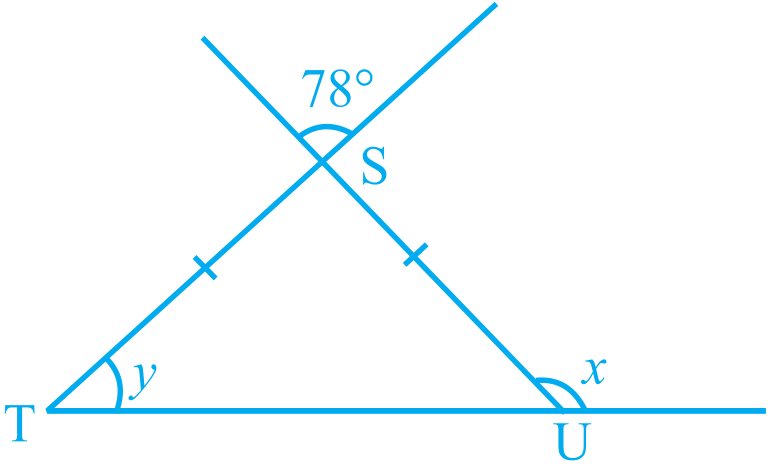
In Figure. if $ST = SU,$ then find the values of $x$ and $y.$
Answer
Given, $ST = SU$
$\therefore\angle\text{SUT}=\angle\text{STU}=\text{y}$
$[\because$ angles opposite to equal sides are equal$]$
Also, $\angle1=78^{\circ}$ [vertically opposite angles]
In $\triangle\text{SUT},$ $78^{\circ}+\text{y}+\text{y}=180^{\circ}$
$\Rightarrow78^{\circ}+\text{2y}=180^{\circ}$
$\Rightarrow \ 2\text{y}=180^{\circ}-78^{\circ}=102^{\circ}$
$\Rightarrow\text{y}=\frac{102^{\circ}}{2}=51^{\circ}$
Also, $\text{x}+\text{y}=180^{\circ}$ [linear pair]
$\Rightarrow \ \text{x}+51^{\circ}=180^{\circ}$
$\Rightarrow\text{x}=180^{\circ}-51^{\circ}$
$\Rightarrow\text{x}=129^{\circ}$
View full question & answer
Question 43 Marks
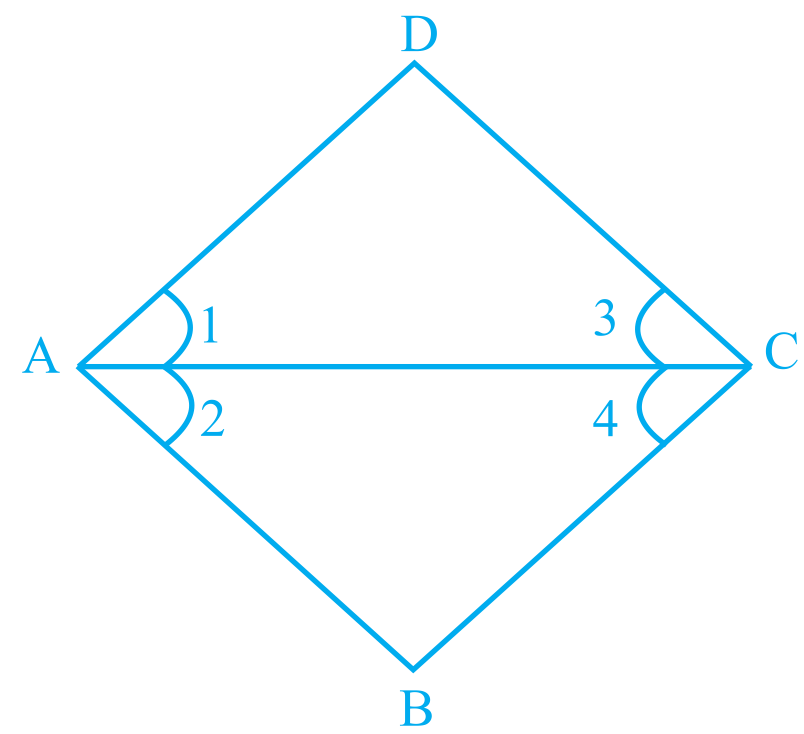
In Figure. $\angle1=\angle2$ and $\angle3=\angle4.$
  1. Is $\triangle\text{ADC}\cong\triangle\text{ABC}?$ why$?$
  2. Show that $AD = AB$ and $CD = CB.$
Answer
  1. In $\triangle\text{ADC}$ and $\triangle\text{ABC},$
$\angle1=\angle2$ [given]
$\text{AC}=\text{AC}$ [common side]
$\angle3=\angle4$ [given]
By $ASA$ congruence criterion, $\triangle\text{ADC}\cong\triangle\text{ABC}$
  1. $\text{AD} = \text{AB} [$by $CPCT]$
$\text{CD} = \text{CB} [$by $CPCT]$
View full question & answer
Question 53 Marks
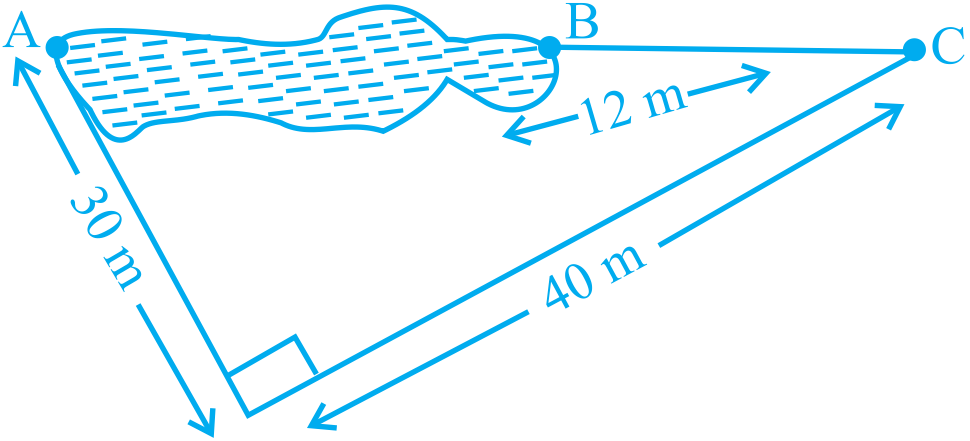
Points $A$ and $B$ are on the opposite edges of a pond as shown in Figure. To find the distance between the two points, the surveyor makes a right-angled triangle as shown. Find the distance $AB.$
Answer
Since, $\triangle\text{ACD},$ is a right angled triangle.
In right angled $\triangle\text{ADC},$ by Pythagoras theoram.
$(A C)^2=(A D)^2+(C D)^2$
$\Rightarrow(A C)^2=(30)^2+(40)^2[\because A D=30 \mathrm{~cm} \text { and } C D=40 \mathrm{~cm} \text {, given }]$
$\Rightarrow(A C)^2=900+1600$
$\Rightarrow(A C)^2=2500$
$\Rightarrow A C=\sqrt{2500}$
$\therefore A C=50 \mathrm{~m}$
Now, $A B=A C-B C=50-12=38 \mathrm{~m}$
Hence, the distance $A B$ is $38 m .$
View full question & answer
Question 63 Marks
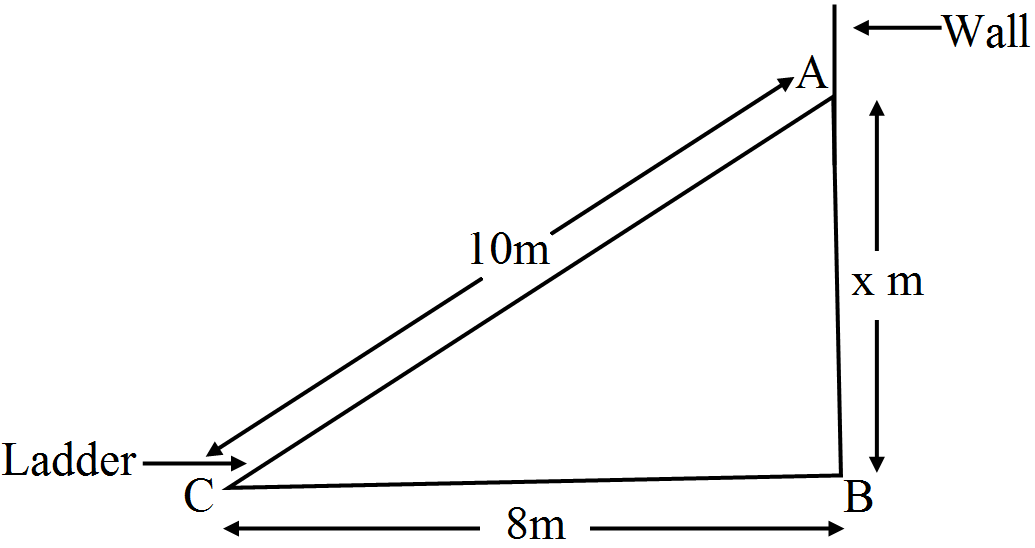
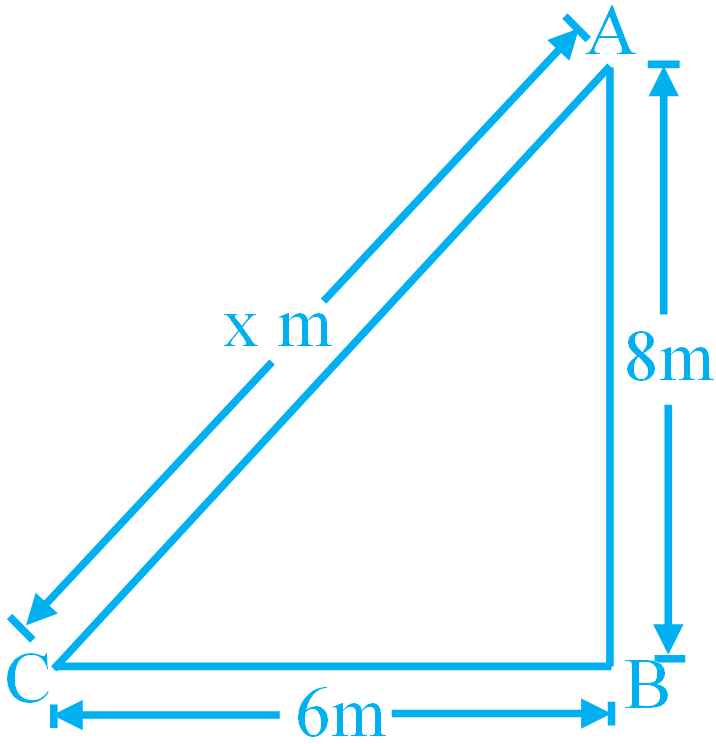
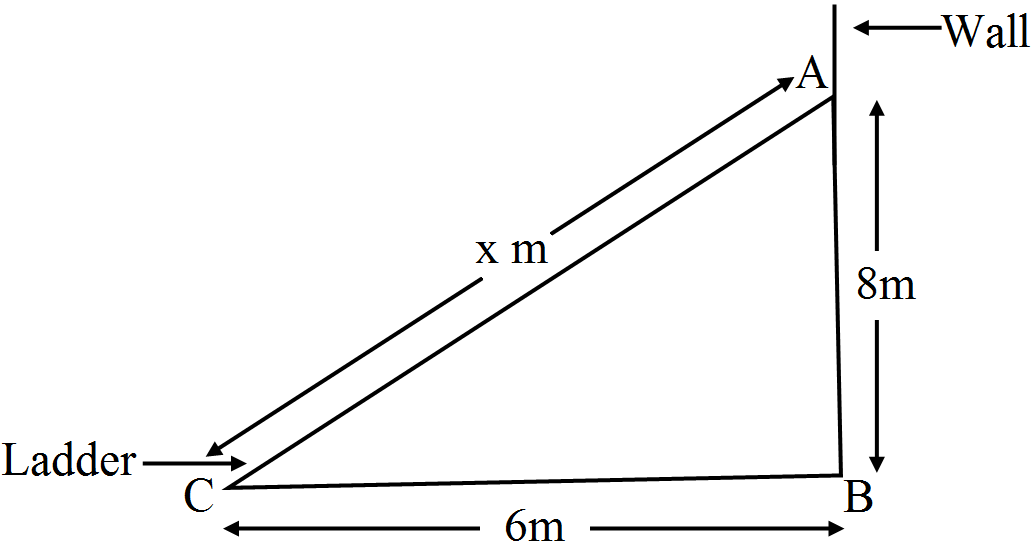
The foot of a ladder is $6m$ away from its wall and its top reaches a window $8 m$ above the ground, If the ladder is shifted in such a way that its foot is $8m$ away from the wall, to what height does its top reach?
Answer
Let the height of the ladder be $x\ m.$

In right angled $\triangle \mathrm{ABC}$,
$\mathrm{AC}^2=\mathrm{AB}^2+\mathrm{BC}^2[\text { by Pythagoras theoram }]$
$\Rightarrow(\mathrm{AB})^2=(\mathrm{AC})^2-(\mathrm{BC})^2$
$\Rightarrow \mathrm{x}^2=(10)^2-(8)^2=100-64$
$\Rightarrow \mathrm{x}=\sqrt{36}$
$\Rightarrow \mathrm{x}=6 \mathrm{~m}$
Hence, the height of the top is $6\ m .$
View full question & answer
Question 73 Marks
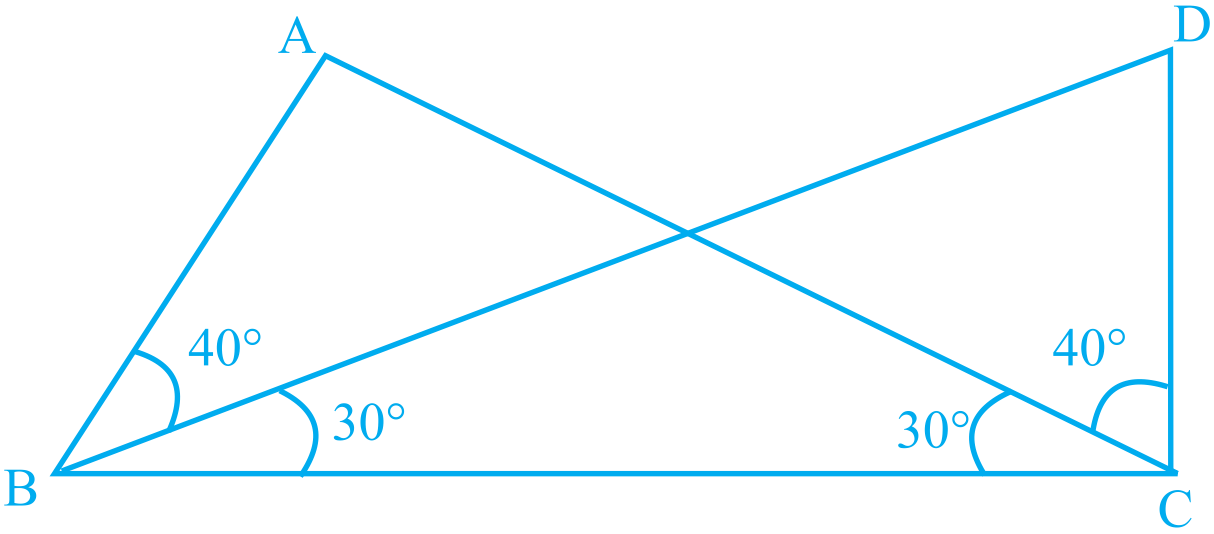
Observe Figure. and state the three pairs of equal parts in triangles $ABC$ and $DBC.$ Is $\triangle\text{ABC}\cong\triangle\text{DCB}?$ Why$?$ Is $AB = DC?$ Why? Is $AC = DB?$ Why$?$
Answer
  1. In $\triangle\text{ABC}$ and $\triangle\text{DCB},$
$BC = BC [$common side$]$
$\angle\text{ABC}=\angle\text{DCB}=70^{\circ}$
$\angle\text{ACB}=\angle\text{DBC}=30^{\circ}$
By ASA congruence criterion, $\triangle\text{ABC}\cong\triangle\text{DCB}$
  1. $\text{AB} = \text{DC} [$by $CPCT]$
  2. $\text{AC} = \text{DB} [$by $CPCT]$
View full question & answer
Question 83 Marks
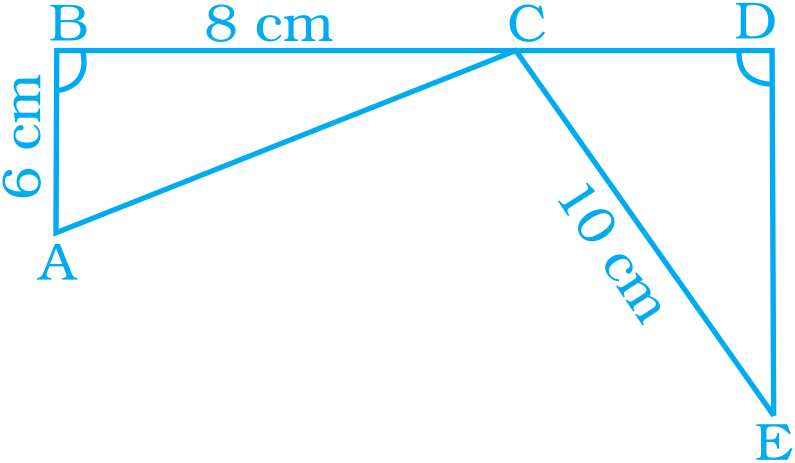
In given pairs of triangles of Figure. using only $RHS$ congruence criterion, determine which pairs of triangles are congruent. In case of congruence, write the result in symbolic form:
Answer
Here, $CD = BD - BC = 14 - 8 = 6\ cm$ In right angled
 $\triangle\text{ABC},$
$\text{AC}=\sqrt{\text{AB}^2+\text{BC}^2}=\sqrt{6^2+8^2}$
$=\sqrt{36+64}$ [by Pythagoras theoram]
$=\sqrt{100}=10\text{cm}$ In right angled
$\triangle\text{CDE},$
$\text{DE}=\sqrt{\text{CE}^2-\text{CD}^2}=\sqrt{10^2-6^2}$
$=\sqrt{100-36}=\sqrt{64}=8\text{cm}$
In $\triangle\text{ABC}$ and $\triangle\text{CDE},$
$\text{AC}=\text{CE}=10\text{cm}$
$\text{BC}=\text{DE}=8\text{cm}$
$\angle\text{ABC}=\angle\text{CDE}=90^{\circ}$
​​​​​​​By $RHS$ congruence criterion, $\triangle\text{ABC}\cong\triangle\text{CDE}$
View full question & answer
Question 93 Marks
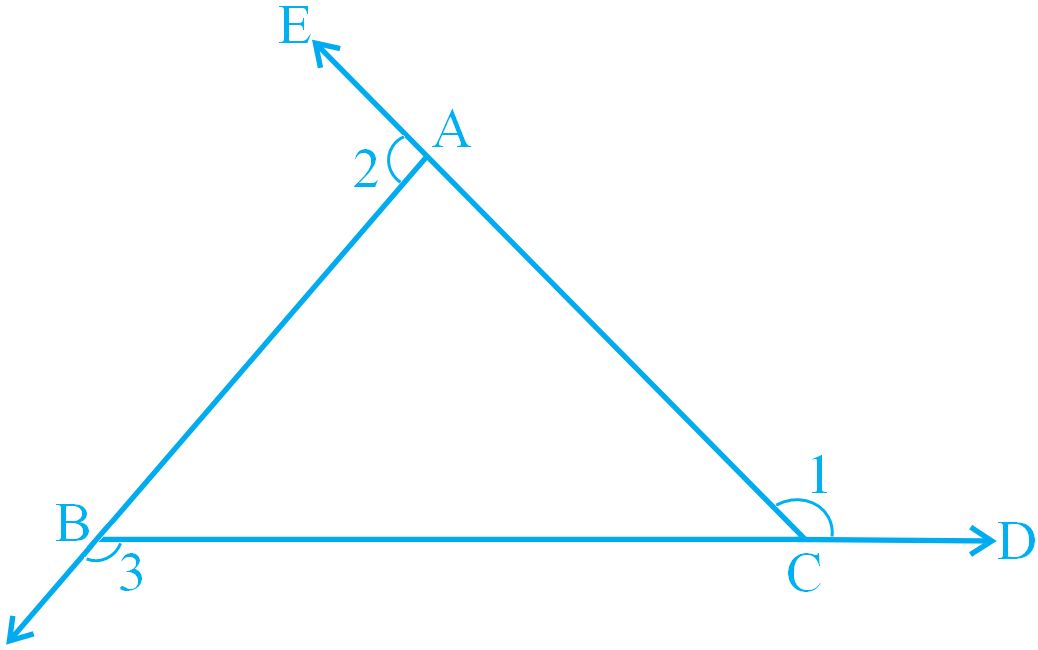
If the sides of a triangle are produced in an order, show that the sum of the exterior angles so formed is $360^\circ .$
Answer
In $\triangle\text{ABC},$ by exterior angle property,

$\text{Exterior}\angle1=\text{Interior}\angle\text{A}+\text{Interior}\angle\text{B}....(\text{i})$
$\text{Exterior}\angle2=\text{Interior}\angle\text{B}+\text{Interior}\angle\text{C}....(\text{ii})$
$\text{Exterior}\angle3=\text{Interior}\angle\text{A}+\text{Interior}\angle\text{C}....(\text{iii})$
On adding Equation $(i), (ii)$ and $(iii),$ we get $\angle1+\angle2+\angle3$
$=2(\angle\text{A}+\angle\text{B}+\angle\text{C}=180^{\circ})$
$\Rightarrow\angle1+\angle2+\angle3=2\times180^{\circ}$
$\Rightarrow\angle1+\angle2+\angle3=360^{\circ}$
Hence, the sum of exterior angles is $360^\circ .$
View full question & answer
Question 103 Marks
Height of a pole is $8 m.$ Find the length of rope tied with its top from a point on the ground at a distance of $6 m$ from its bottom.
Answer
Given, height of a pole is $8 m$. Distance between the bottom of the pole and a point on the ground is $6 m.$ On the basis of given information. we can draw the following figure:

Let the length of the rope be $x\ m.$
$\because AB = $ Height of the pole
$BC =$ Distance between the bottom of the pole and a point on ground,
where rope was tied To find the length of the rope,
we will use pythagoras theoram, in right angled $\triangle\text{ABC}.$
$(A C)^2=(A B)^2+(B C)^2$
$\Rightarrow(x)^2=(8)^2+(6)^2$
$\Rightarrow x^2=64+36$
$\Rightarrow x^2=100$
$\Rightarrow x=\sqrt{100}=10 \mathrm{~m}$
Hence, the legnth of the rope is $10 m .$
View full question & answer
Question 113 Marks
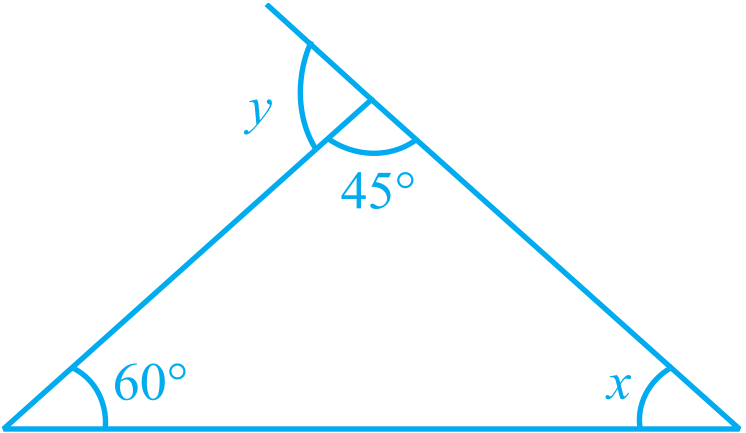
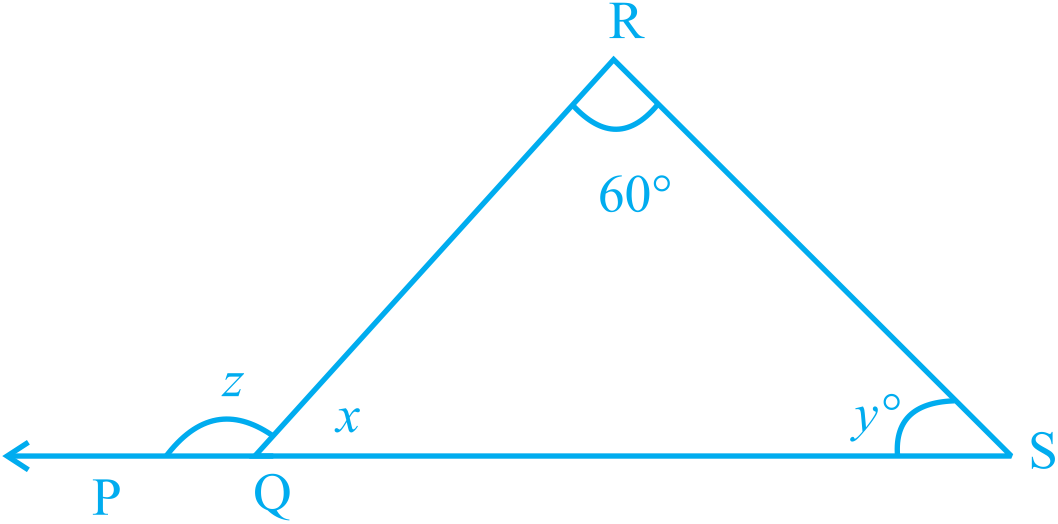
In figure. find the measures of $\angle\text{x}$ and $\angle\text{y}.$
Answer
Since, $\angle\text{y}$ and $45^\circ $ form a linerar pair.
So, $\angle\text{y}+45^{\circ}=180^{\circ} [\because$ linear pair has sum of $180^\circ ]$
$\Rightarrow \ \angle\text{y}=180^{\circ}-45^{\circ}$
$\Rightarrow \ \angle\text{y}=135^{\circ}$
$\because$ The sum of all angles in atriangle is equal to $180^\circ $
So, $45^\circ + 60^\circ + \angle\text{x}=180^{\circ}$
$\Rightarrow \ 105^{\circ}+\angle\text{x}=180^{\circ}$
$\Rightarrow \ \angle\text{x}=180^{\circ}-105^{\circ}=75^{\circ}$
View full question & answer
Question 123 Marks
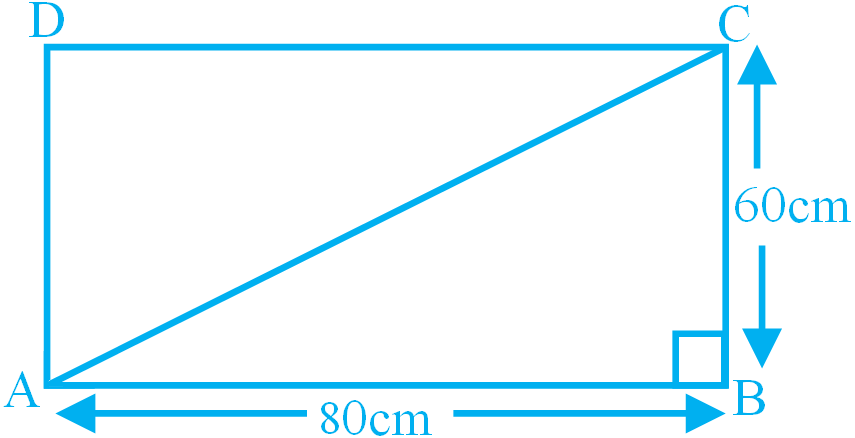
Jayanti takes shortest route to her home by walking diagonally across a rectangular park. The park measures $60$ metres $\times \ 80$ metres. How much shorter is the route across the park than the route around its edges$?$
Answer
As the park is rectangular, ail the angles are of $90^\circ .$
In right angled $\triangle \mathrm{ABC}, \mathrm{AC}^2=\mathrm{AB}^2+\mathrm{BC}^2$ [by pythagoras theoram]
$\Rightarrow A C^2=(60)^2+(80)^2=3600+6400$
$\Rightarrow A C^2=(60)^2=10000$
$\Rightarrow A C=\sqrt{10000}$
$\Rightarrow A C=100 \mathrm{~m}$
IF she goes through $A B$ and $A C$, then total distance covered $=(60+80) \mathrm{m}=140 \mathrm{~m}$
$\therefore$ Difference between two paths $=(140-100) \mathrm{m}=40 \mathrm{~m}$
View full question & answer
Question 133 Marks
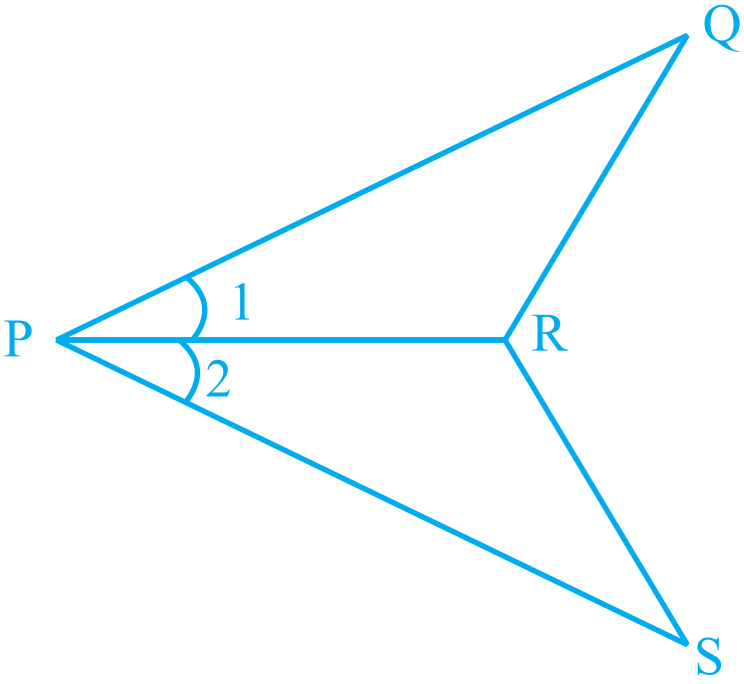
In Figure. $PQ = PS$ and $\angle1=\angle2. $
  1. Is $\triangle\text{PQR}\cong\triangle\text{PSR}?$ give reasons.
  2. Is Is $\text{QR} =\text{ SR}?$ Give reasons.
Answer
Yes,
  1. In $\triangle\text{PQR}$ and $\triangle\text{PSR},$
$PQ = PS [$given$]$
$\angle1=\angle2 [$given$]$
$PR = PR [$common side$]$
  1. By $SAS$ congruence criterion, $\triangle\text{PQR}\cong\triangle\text{PSR}$
Yes, $QR = SR$
View full question & answer
Question 143 Marks
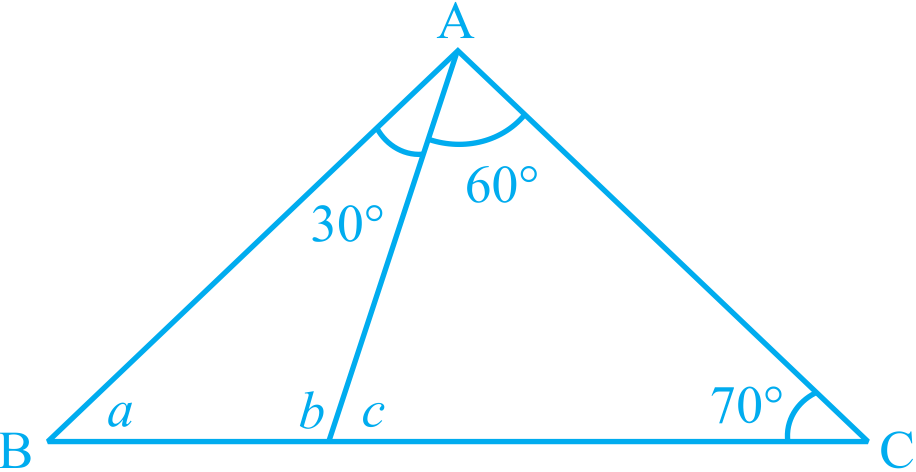
In Figure. find the values of $a, b$ and $c.$
Answer
In figure. $\angle\text{A}+\angle\text{B}+\angle\text{C}=180^{\circ} [$sum of all angles of a triangle is $180^\circ ]$
$\Rightarrow 90^\circ + a + 70^\circ = 180^\circ $
$[\because\angle\text{A}=90^\circ $ and $\angle\text{C }=70^\circ ,$ from the figure$]$
$\Rightarrow a + 160^\circ = 180^\circ $
$\Rightarrow 180^\circ - 160^\circ = 20^\circ $
Since, $C$ is an exterior angle of $\triangle\text{ABD}.$
$\therefore \ \angle\text{c}=\text{a}+30^{\circ}=20^{\circ}+30^{\circ}=50^{\circ}$
$[\because$ exterior angle = the sum of opposite interior angles$]$
Also, b is an exterior angle of $\triangle\text{ADC},$
$\therefore \ \angle\text{b}=60^{\circ}+70^{\circ}=130^{\circ}$
$[\because$ exterior angles = sum of opposite interior angles$]$
View full question & answer
Question 153 Marks
The foot of a ladder is $6m$ away from its wall and its top reaches a window 8m above the ground, Find the length of the ladder.
Answer
Let the length of the ladder be $x\ m.$

In right angled $\triangle \mathrm{ABC}$,
$A C^2=A B^2+B C^2[\text { by Pythagoras theoram }] $
$ \Rightarrow(\mathrm{x})^2=(8)^2+(6)^2$
$ \Rightarrow=\sqrt{(8)^2+(6)^2}=\sqrt{64+36}=\sqrt{100} $
$ \Rightarrow \mathrm{x}=10 \mathrm{~m}$
 
View full question & answer
Question 163 Marks
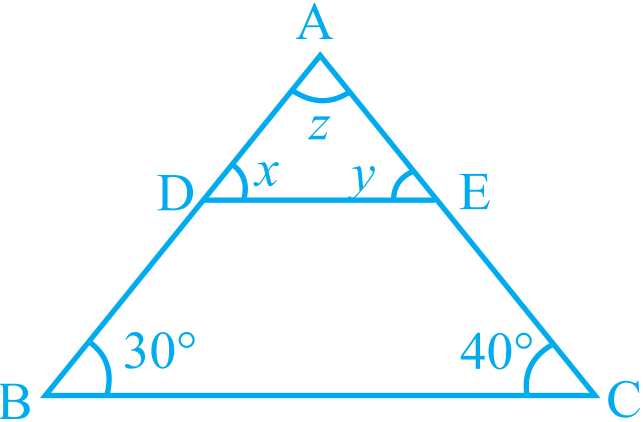
In $\triangle\text{ABC}, DE || BC$ Figure. Find the values of $x, y$ and $z.$
Answer
In $\triangle\text{ABC},$
$\angle\text{A}+\angle\text{B}+\angle\text{C}=180^{\circ}$
$[$sum of all angles of triangles of a triangle is $180^\circ ]$
$\Rightarrow \ \text{z}+30^{\circ}+40^{\circ}=180^{\circ}$
$\Rightarrow \ \text{z}+70^{\circ}=180^{\circ}$
$\Rightarrow \text{z}=180^{\circ}-70^{\circ}=110^{\circ}$
$\because \ \text{DE} \ | \ | \ \text{BC}$
Now, $\angle\text{ADE}=\angle\text{ABC}$
​​​​​​​$[\because$ corresponding angles are equal$]$
$\Rightarrow \ \angle\text{x}=30^{\circ} \ \text{and}\angle\text{AED}=\angle\text{ACB}$
$[\because$ corresponding angles are equal$]$
$\Rightarrow\angle\text{y}=40^{\circ}$
View full question & answer
Question 173 Marks
If one angle of a triangle is $60^\circ $ and the other two angles are in the ratio $1 : 2,$ find the angles.
Answer
Given, one angle of a triangle is $60^\circ .$
Let the other two angles be $x$ and $2x.$
We know that, the sum of all angles in triangle is equal to $180^\circ .$
So, $x + 2x + 60^\circ = 180^\circ $
$\Rightarrow 3x = 180^\circ - 60^\circ $
$\Rightarrow x = 40^\circ $
So, the other two angles will be $x = 40^\circ $ and
$2x = 2 \times 40^\circ = 80^\circ .$
View full question & answer
Question 183 Marks
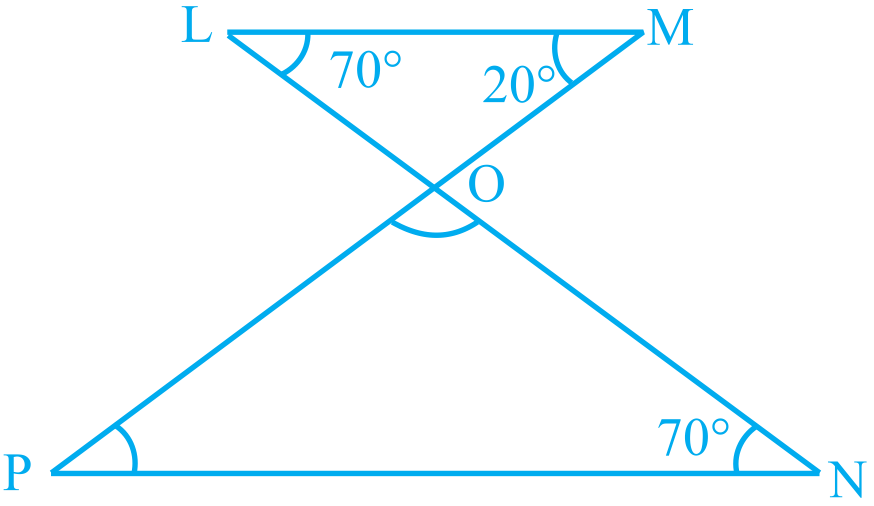
In Figure. find the measures of $ \angle\text{ PON }$ and $\angle\text{NPO}.$
Answer
In $\triangle\text{LOM},$ $\angle\text{OLM}+\angle\text{OML}+\angle\text{LOM}=180^{\circ}$ [angle sum property of a triangle] $\Rightarrow \ 70^{\circ}+20^{\circ}+\angle\text{LOM}=180^{\circ}$$\Rightarrow \ 90^{\circ}+\angle\text{LOM}=180^{\circ}$
$\Rightarrow \ \text{LOM}=180^{\circ}-90^{\circ}=90^{\circ}$ Also, $\angle\text{PON}=90^{\circ}$ [Since, vertically opposite angles are equal] In $\triangle\text{PON},$ $\angle\text{PON}+\angle\text{NPO}+\angle\text{ONP}=180^{\circ}$ [angle sum property of a triangle] $\Rightarrow \ 90^{\circ}+\angle\text{NPO}+70^{\circ}=180^{\circ}$ $\Rightarrow \ \angle\text{NPO}=180^{\circ}-160^{\circ}=20^{\circ}$
View full question & answer
Question 193 Marks
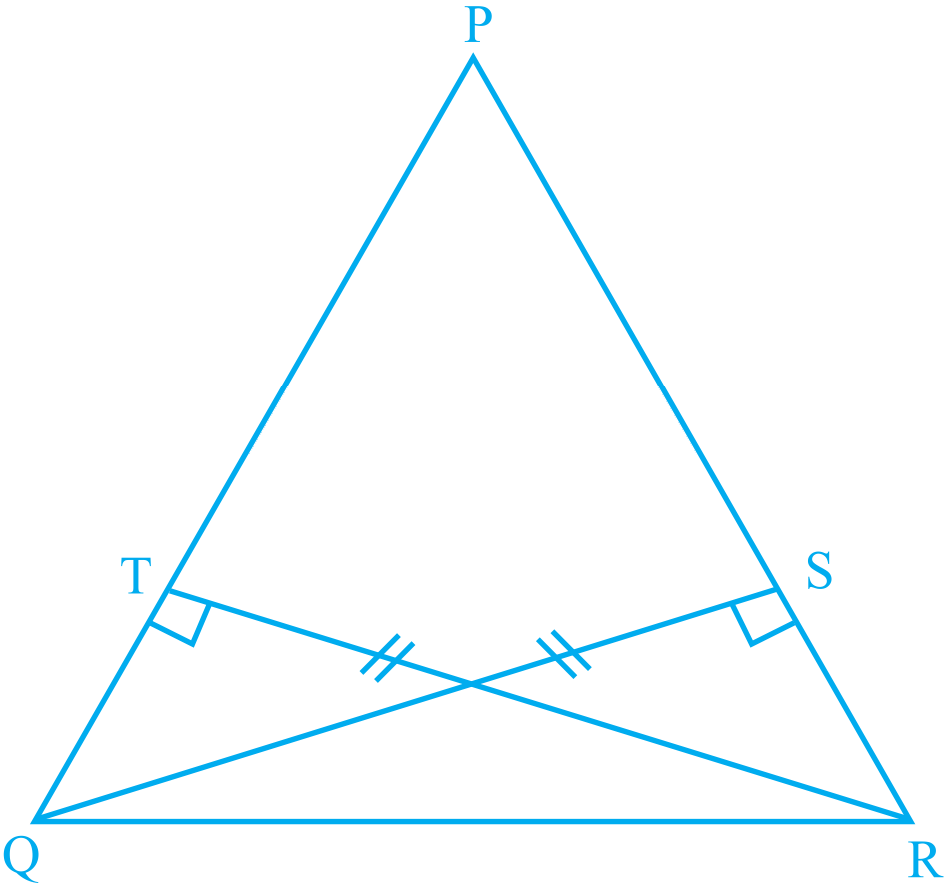
In Figure. $QS \bot PR, RT \bot PQ$ and $QS = RT.$
  1. Is $\triangle\text{QSR}\cong\triangle\text{RTQ}?$ Give reasons.
  2. Is $\triangle\text{PQR}=\triangle\text{PRQ}?$ Giveb reasons.
Answer
  1. In $\triangle\text{QSR}$ and $\triangle\text{RTQ},$
$QS = RT [$given$]$
$\angle\text{QSR}=\angle\text{QTR}=90^{\circ}$
$\text{QR}=\text{QR}$ [common side]
By $RHS$ congruence criterion, $\triangle\text{QSR}\cong\triangle\text{RTQ}$
  1. Yes, $\triangle\text{PQR}=\triangle\text{PRQ}[$ by $CPCT]$
View full question & answer
Question 203 Marks
In Figure. if $y$ is five times $x,$ find the value of $z.$
Answer
Given, $y = 5x$
According to the angle sum property of a triangle.
$60^\circ + x + y = 180^\circ $
$ \Rightarrow 60^\circ + x + 5x = 180^\circ $
$[\because\text{y}=5\text{x}]$
$\Rightarrow 60^\circ + 6x = 180^\circ $
$\Rightarrow 6x = 180^\circ - 60^\circ = 120^\circ $
$\Rightarrow \ \text{x}=\frac{120^{\circ}}{6}=20^{\circ}$
$\therefore\text{y}=5\text{x}=5\times20=100^{\circ}$
According to the exterior angle property.
$z = 60^\circ + y = 60^\circ + 100^\circ $
$[\because\text{y}=100^{\circ}] = 160^\circ $
View full question & answer
Question 213 Marks
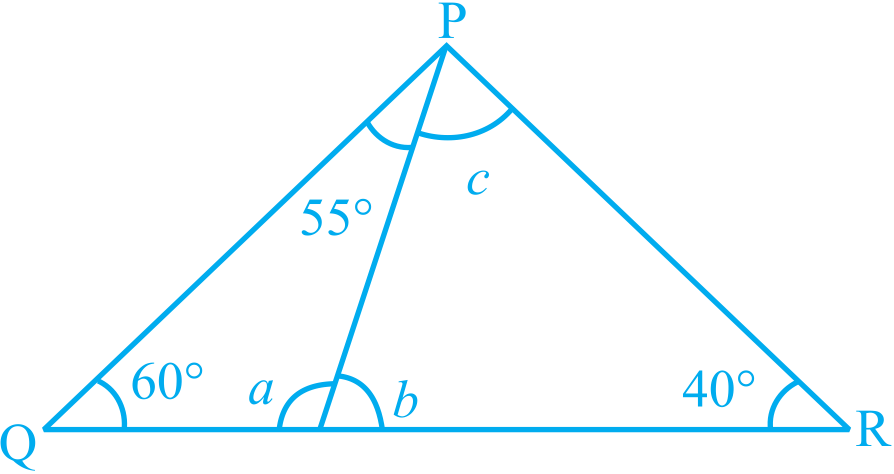
In Figure. find the values of $a, b$ and $c.$
Answer
In figure, In$\triangle\text{PQS},$
$\angle\text{QPS}+\angle\text{PQS}+\angle\text{PSQ}=180^{\circ} [$sum of all the angles of triangle is $180^\circ ]$
$\Rightarrow 55^\circ + 60^\circ + a = 180^\circ $
$\Rightarrow 115^\circ + a = 180^\circ $
$\Rightarrow a = 180^\circ - 65^\circ = 115^\circ $
Now, $a + b = 180^\circ [$linear pair has sum of $180^\circ ]$
$\Rightarrow 65^\circ + b = 180^\circ $
$\Rightarrow b = 180^\circ - 65^\circ = 115^\circ $
In $\triangle\text{PSR},$
$\angle\text{PSR}+\angle\text{SPR}+\angle\text{PRS}=180^{\circ} [$sum of all angles of a triangle is $180^\circ ]$
$\Rightarrow 115^\circ + c + 40^\circ = 118^\circ $
$\Rightarrow 155^\circ + c = 180^\circ $
$\Rightarrow c = 180^\circ - 155^\circ = 25^\circ $
View full question & answer
Question 223 Marks
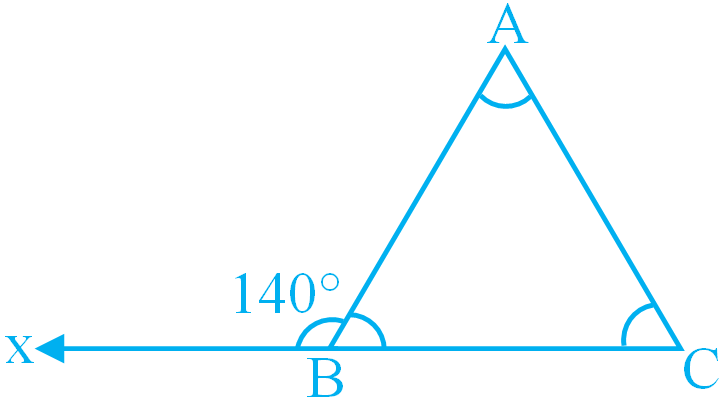
In $\triangle\text{ABC},$ if $\angle\text{A}=\angle\text{C},$ and exterior angle $ABX = 140^\circ ,$ then find the angles of the triangle.
Answer
Given, $\angle\text{A}=\angle\text{C}$ and exterior $\angle\text{ABX}=140^{\circ}$
Let $\angle\text{A}=\angle\text{C}=\text{x}$
According to the exterior angle property,

$\text{Exterior}\angle\text{B}=\text{interior}\angle\text{A}+\text{interior}\angle\text{C}$
$\Rightarrow140^{\circ}=\text{x}+\text{x}$
$\Rightarrow140^{\circ}=\text{2x}$
$\Rightarrow\text{x}=\frac{140^{\circ}}{2}=70^{\circ}$
So, $\angle\text{A}=\angle\text{C}=70^{\circ}$
Now, $\Rightarrow\angle\text{A}+\angle\text{B}+\angle\text{C}=180^{\circ} $ [angle sum property of a triangle]
$\Rightarrow\angle\text{70}^{\circ}+\angle\text{B}+70^{\circ}=180^{\circ}$
$\Rightarrow\angle\text{B}+140^{\circ}=180^{\circ}$
$\Rightarrow\angle\text{B}=180^{\circ}-140^{\circ}$
$\Rightarrow\angle\text{B}=40^{\circ}$
Hence, all the angles of the triangle are $70^\circ , 40^\circ $ and $70^\circ .$
View full question & answer
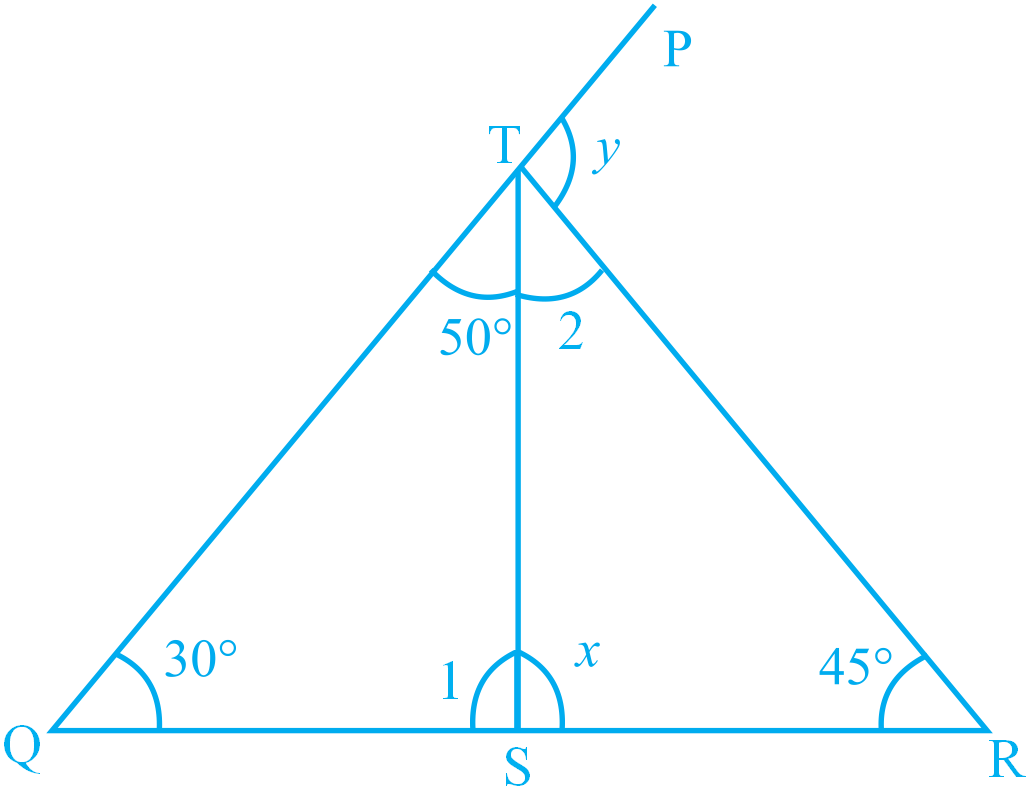
Question 233 Marks
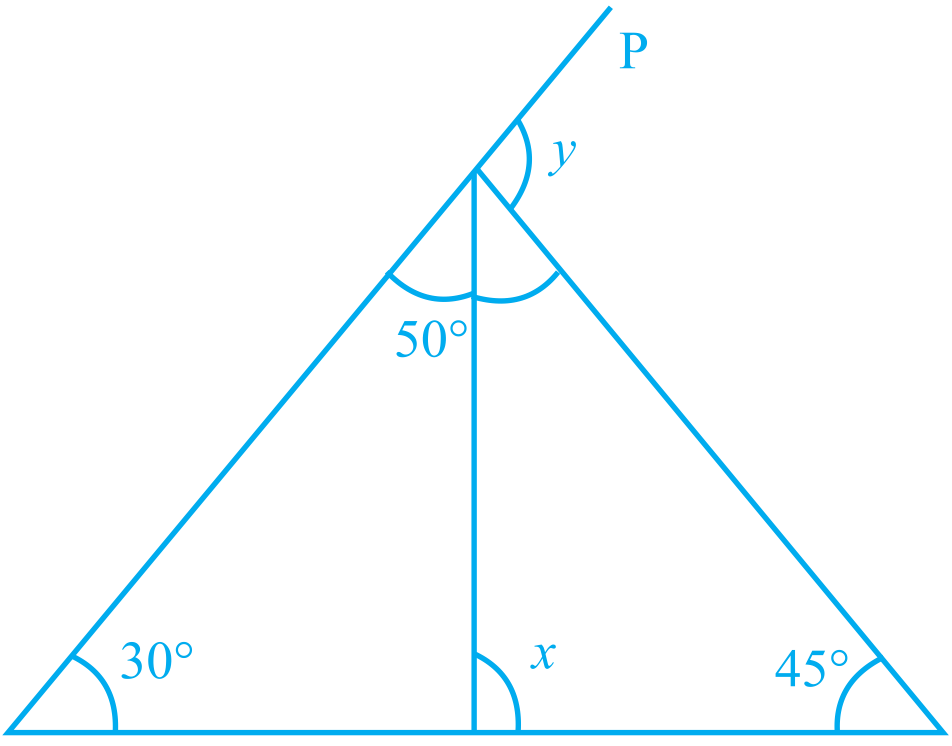
Find the values of $x$ and $y$ in Figure.
Answer

In $\triangle\text{TQS},$
$\Rightarrow\angle\text{T}+\angle\text{Q}+\angle\text{S}=180^{\circ} [$angle sum property of a triangle$]$
$\Rightarrow \ 50^{\circ}+30^{\circ}+\angle1=180^{\circ}$
$\Rightarrow \ 80^{\circ}+\angle1=180^{\circ}$
$\Rightarrow \ \angle1=180^{\circ}- 80^{\circ}=100^{\circ}$
Now, $\angle1+\text{x}=180^{\circ}$ [linear pair]
​​​​​​​$\Rightarrow100^{\circ}+\text{x}=180^{\circ}=180^{\circ}-100^{\circ}$
$\Rightarrow \ \text{x}=80^{\circ}$ In $\triangle\text{TSR},$
$\text{x}+45^{\circ}+\angle\text{2}=180^{\circ}[$angle sum propery of a triangle$]$
$\Rightarrow\angle2=180^{\circ}-80^{\circ}-45^{\circ}=55^{\circ}$
Now, $50^{\circ}+\angle2+\text{y}=180^{\circ} [$linear pair$]$
​​​​​​​$\Rightarrow\text{y}=180^{\circ}-50^{\circ}-55^{\circ}=75^{\circ}$
View full question & answer
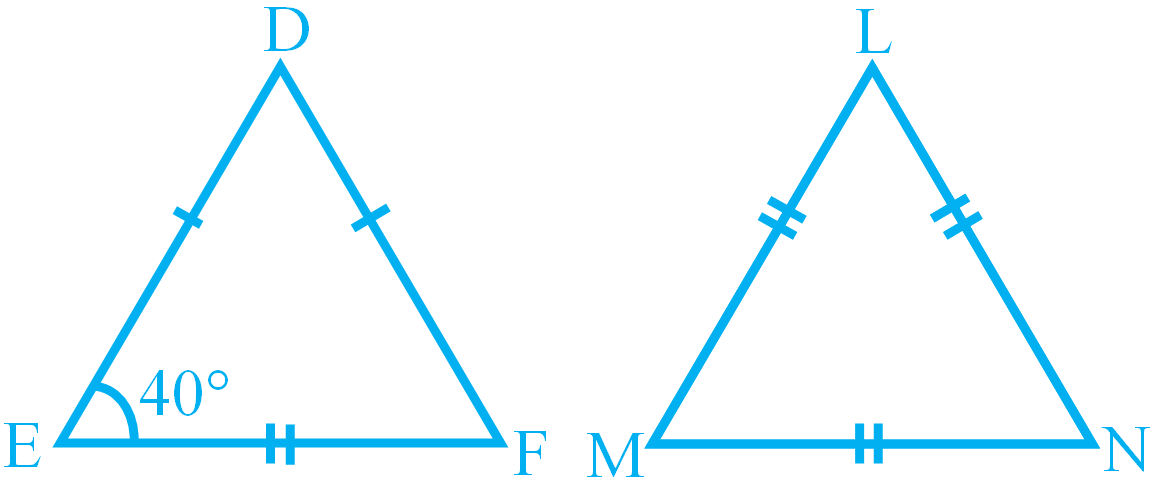
Question 243 Marks
Triangles $DEF$ and $LMN$ are both isosceles with $DE = DF$ and b $LM = LN,$ respectively. If $DE = LM$ and $EF = MN,$ then, are the two triangles congruent? Which condition do you use? If $\angle\text{ E} = 40^\circ ,$ what is the measure of $\angle\text{N}?$
Answer
Here, $DE = DF......(i)$
$ LM = LM.....(ii) $ and
$DE = LM......(iii)$

From Equation, $(i), (ii)$ and $(iii),$
we get $DE = DF =LM = LN$
In $\triangle\text{DEF}$ and $\triangle\text{LMN},$
$DE = LM [$given$]$
$EF = MN [$given$]$
$DF = LN [$proved above$]$
By $SSS$ congruence criterion,
$\triangle\text{DEF}\cong\triangle\text{LMN}$
$\therefore \ \angle\text{E}=\angle\text{M} [$by $CPCT]$
$\angle\text{M}=40^{\circ}$
Also, $ \ \angle\text{M}=\angle\text{N}$
$[\because\angle\text{M}=\angle\text{N}$ and angles opposite to equal sides are equal$]$
​​​​​​​$\Rightarrow \ \angle\text{N}=40^{\circ}$
View full question & answer
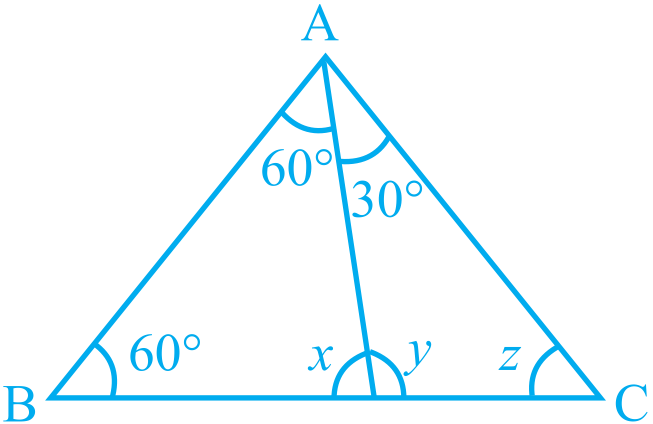
Question 253 Marks
In Figure. find the values of $x, y$ and $z.$
Answer
In the given figure, $\angle\text{BAD}=60^{\circ},\angle\text{ABD}=60^{\circ},\angle\text{ADB}=\text{x},$
$\angle\text{DAC}=30^{\circ},\angle\text{ADC}=\text{y}$ and $\angle\text{ACD}=\text{z}$
We know that, the sum of all angles in triangle is equal to $180^\circ .$
In $\triangle\text{ABD},$
$\angle\text{BAD}+\angle\text{ABD}+\angle\text{ADB}=180^{\circ}$
$\Rightarrow \ 60^{\circ}+60^{\circ}+\text{x}=180^{\circ}$
$\Rightarrow \ 120^{\circ}+\text{x}=180^{\circ}$
$\Rightarrow \ \text{x}=180^{\circ}-120^{\circ}$
$\Rightarrow\text{x}=60^{\circ}$
Now, $[\because$ exterior angle is equal to the sum of interior opposite angles$]$
$\Rightarrow\text{y}=60^{\circ}+60^{\circ}$
$\therefore\text{y}=120^{\circ}$
In $\triangle\text{ADC},$
$\angle\text{DAC}+\angle\text{ADC}+\angle\text{ACD}=180^{\circ} [$angle sum property of triangle$]$
$\Rightarrow \ 30^{\circ} + 120^{\circ} + \text{z} = 180^{\circ}$
$\Rightarrow \ 150^{\circ}+\text{z}=180^{\circ}$
$\Rightarrow \ \text{z}=180^{\circ}-150^{\circ}$
$\Rightarrow \ \text{z}=30^{\circ}$
Hence, $x = 60^\circ , y = 120^\circ $ and $z = 30^\circ $
View full question & answer
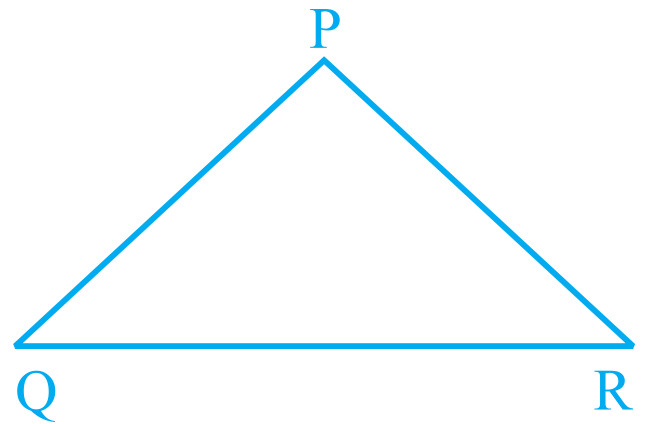
Question 263 Marks
In $\text{PQR},$ if $3\angle\text{P}=4\angle\text{Q}=6\angle\text{R},$ calculate the angles of the triangle.
Answer


Given, $3\angle\text{p}=4\angle\text{Q}=6\angle\text{R}$
Then, $\angle\text{P}=\frac{6}{3}\angle\text{R}=2\angle\text{R}$
$\angle\text{Q}=\frac{6}{4}\angle\text{R}=\frac{3}{2}\angle\text{R}$
In $\triangle\text{PQR},$
$\angle\text{P}+\angle\text{Q}+\angle\text{R}=180^{\circ}[$ angle sum property of a triangle$]$
$\Rightarrow2\angle\text{R}+\frac{3}{2}\angle\text{R}+\angle\text{R}=180^{\circ}$
$\Rightarrow3\angle\text{R}+\frac{3}{2}\angle\text{R}=180^{\circ}$
$\Rightarrow6\angle\text{R}+3\angle\text{R}=180^{\circ}\times2 [$On taking $LCM$ in $LHS]$
$\Rightarrow9\angle\text{R}=360^{\circ}$
$\Rightarrow\angle\text{R}=\frac{360^{\circ}}{9}=40^{\circ}$
$\therefore\angle\text{P}=2\angle\text{R}=2\times40^{\circ}=80^{\circ}$
and $\angle\text{Q}=\frac{3}{2}\angle\text{R}=\frac{3}{2}\times40^{\circ}=60^{\circ}$
Hence, all the angles of the triangles are $80^\circ , 60^\circ $ and $40^\circ $
View full question & answer