Questions

5 Marks Questions

Take a timed test

16 questions · self-marked practice — reveal the answer and mark yourself.

Question 15 Marks
Match the items given in Column $I$ with one or more items of Column $II.$
Column I Column II
A plane mirror Used as a magnifying glass.
A convex mirror Can form image of objects spread over a large area.
A convex lens Used by dentists to see enlarged image of teeth.
A concave mirror The image is always inverted and magnified.
A concave lens The image is erect and of the same size as the object.
  The image is erect and smaller in size than the object
Answer
Column I Column II
A plane mirror The image is erect and of the same size as the object
A convex mirror Can form image of objects spread over a large area
A convex lens Used as a magnifying glass.
A concave mirror Used by dentists to see enlarged image of teeth
A concave lens The image is erect and smaller in size than the object.
View full question & answer
Question 25 Marks
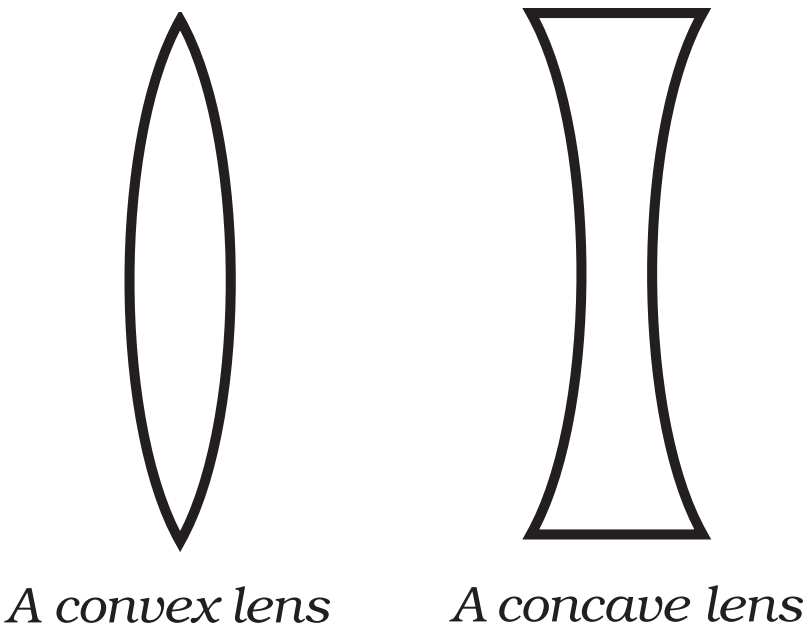
Differentiate between a convex and a concave lens.
Answer
S.No.
Convex Lens
Concave Lens
$1.$
Convex lenses are thicker in the middle than at the edges.
Concave lenses are thinner in the middle than at the edges.
$2.$
A convex lens can forms real and inverted image. When the object is placed very close to the lens, the image formed is virtual, erect and magnified.
A concave lens always forms erect, virtual and smaller image than the object.
$3.$
A convex lens can be used as a.
A concave lens cannot be used as.
$4.$
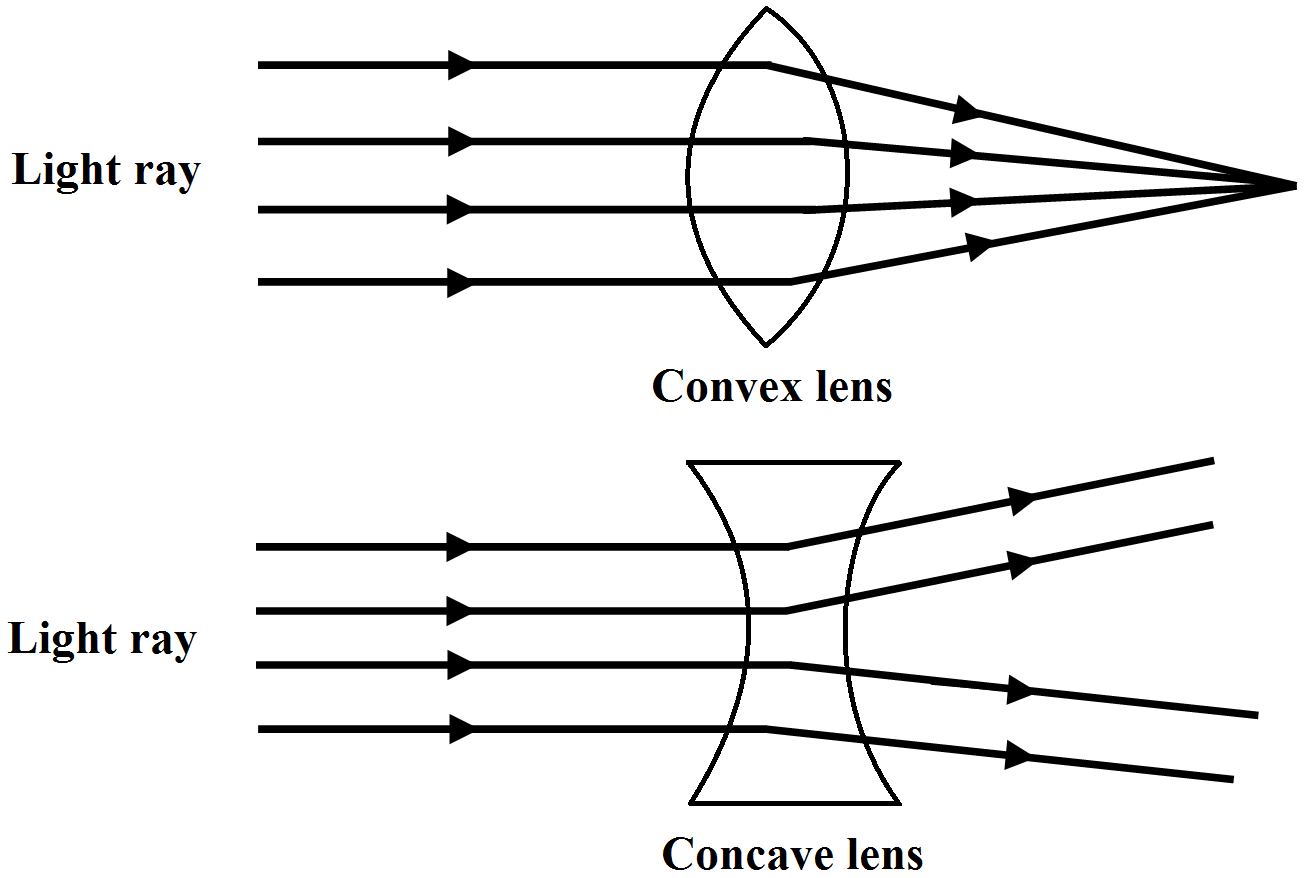
Magnifying glass A convex lens converges (bends inward) the light generally falling on it.
A magnifying glass A concave lens diverges (bends outward) the light.
View full question & answer
Question 35 Marks
What is rectilinear propagation of light? How will you prove it?
Answer
Light travels in a straight line. This is called rectilinear propagation of light. Activity:
  1. Take a straight straw and look at the light rays through it.
  2. Take another straw which is bent and try to look at the light rays through it. You will observe that when the straw was straight you could see the light and when the straw was bent you could not see the light.
  3. This means that we cannot bend the ray of light to travel through the bent straw.
  4. Thus, this activity proves that light travels in a straight line.
View full question & answer
Question 45 Marks
Briefly state the characteristics of image formed by a plane mirror.
Answer
Characteristics of the Images Formed by a Plane Mirror. Now, we will describe the various characteristics of the images formed in a plane mirror by taking the example of the image of the candle.
  1. When we see the mirror, the image of candle appears to be formed behind the mirror.
  2. Now, pW a vertical screen behind the plane mirror (where the image of candle appears to be situated), then we will notice that the image of candle cannot be formed on the screen. Even if the screen is placed in front of the plane mirror, then the image of candle cannot be formed on the screen. Since, the image of candle formed in the plane mirror cannot be formed on a screen, which means that the image of candle in the plane mirror is a virtual image.
  3. If we see the figure, then we will find that the length and breadth of the image of the candle and its flame to be the same as that of the original candle and its flame. The image of candle in the plane mirror is of the same size as the original candle.
  4. Also if we see the figure, then we will find that the candle has a flame at the top and the image of candle also has a flame at the top. So, the top of candle remains at the top in the image. In the same way, the bottom of candle remains at the bottom in an image. Such an image is called an erect image (or upright image). Therefore, the image formed by a plane mirror is erect.
View full question & answer
Question 55 Marks
What is regular and irregular reflection?
Answer
Regular reflection: It is the reflection from a smooth surface such that the light rays are evenly parallel to each other and an image is formed. For example, reflection from the smooth surface of calm lake can produce an image in water. Irregular reflection: It is the diffused reflection from uneven surface such that the light rays are not parallel to each other and do not form an image. For example, reflection of light from the surface of a flowing stream does not form an image.
View full question & answer
Question 65 Marks
Suppose we wish to obtain the real image of a distant tree. Explain two possible ways in which we can do it.
Answer
  1. In first case, we will use a concave mirror and a screen. As we know that a concave mirror forms a real image of a distant object at its focus, therefore, a real image of a distance tree will be formed on the screen placed at the focus of concave mirror.
  2. In second case, we will use a convex lens and a screen. As convex lens forms a real image of a distant object at its focus, therefore, a real image of a distant tree will be formed on the screen placed at the focus of convex lens.
View full question & answer
Question 75 Marks
Match the items given in Column $I$ with one or more items of Column $II.$
  Column I   Column II
$(a)$ A plane mirror. $(i)$ Used as a magnifying glass.
$(b)$ A convex mirror. $(ii)$ Can form image of objects spread over a large area.
$(c)$ A convex lens. $(iii)$ Used by dentists to see enlarged image of teeth
$(d)$ A concave mirror. $(iv)$ The image is always inverted and magnified.
$(e)$ A concave lens. $(v)$ The image is erect and of the same size as the object.
    $(vi)$ The image is erect and smaller in size than the object.
Answer
 
Column I
 
Column II
$(a)$
A plane mirror
$(v)$
The image is erect and of the same size as the object.
$(b)$
A convex mirror
$(ii)$
Can form image of objects spread over a large area.
$(vi)$ The image is erect and smaller in size than the object.
$(c)$
A convex lens
$(i)$
Used as a magnifying glass.
$(d)$
A concave mirror
$(iii)$
Used by dentists to see enlarged image of teeth.
$(e)$
A concave lens
$(vi)$
The image is erect and smaller in size than the object.
Explanation:
  1. A plane mirror forms an image which is erect and of the same size as the object.
  2. A convex mirror forms a virtual, diminished, and upright image and therefore, covers a larger area of view. Its field of view is very large.
  3. A convex lens can form a magnified image of the object. Therefore, it is used as a magnifying glass.
  4. A concave mirror forms an enlarged image of the object. Therefore, it is used to see an enlarged image of teeth by the dentist.
  5. The image formed by a concave lens is always virtual, upright and erect.
View full question & answer
Question 85 Marks
With the help of Newton’s disc, prove that seven colours of the rainbow can be recombined and produce white light.
Answer
Activity:
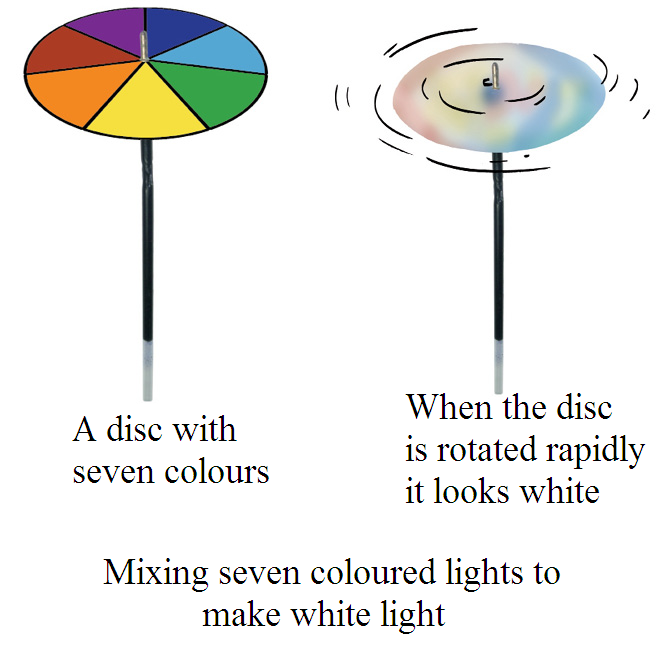
  1. Take a circular cardboard. Split the disc into seven equal sections.
  2. Colour the first section with violet, the second with indigo, the third with blue, and so on in the order of $VIBGYOR$ in an anticlockwise direction.
  3. Drill a suitable hole in the centre of the disc.
  4. Take a piece of round wood as a spindle. Cut the length as required. Glue the spindle into the hole.
  5. Now, spin the coloured disc very quickly. Your eyes would see all the colours at once and disc would appear to be white.
View full question & answer
Question 95 Marks
Give the definition dispersion of light. Also, explain why does it take place? Draw a diagram to show the dispersion of white light by a glass prism.
Answer
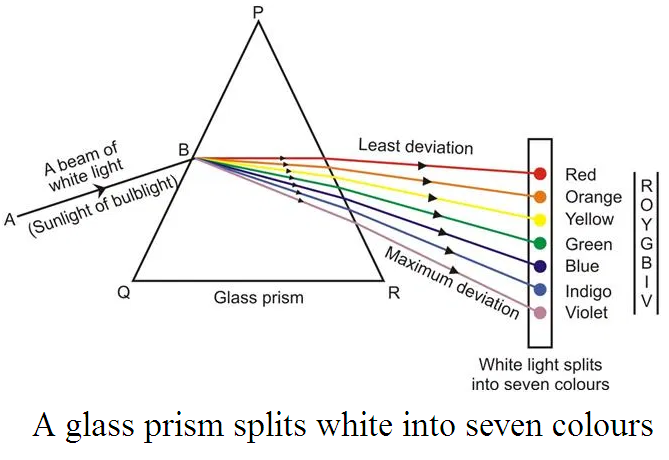
In the year $1665$, Newton discovered by his experiments with glass prisms that white light (like sunlight) consists of a mixture of lights of seven colours. Newton found that if a beam of white light is passed through a glass prism, then the white light splits to form a band of seven colours on a white screen. The band of seven colours formed on a white screen, when a beam of white light is passed through a glass prism, is known as spectrum of white light. The seven colours of the spectrum are Red, Orange, Yellow, Green, Blue, Indigo and Violet.

So, dispersion of light is phenomenon of splitting up of white light into seven colours on passing through a transparent medium like a glass prism. The formation of spectrum of seven colours indicates that white light is a mixture of seven colours. White light can be sunlight. So, now we can say that the sunlight consists of seven colours. We can mix these colours to get white light. This can be done by using Newton’s disc, let us try this.
View full question & answer
Question 105 Marks
Explain the reflection of light on white paper screen with the help of an activity.
Answer
Activity:
  1. Place a concave mirror fixed on a stand, on a table. Make a screen of about $15\ cm \times 10\ cm$ using white paper pasted on a cardboard.
  2. Keep a lighted candle at a distance of $50\ cm$ from the mirror, on a table.
  3. Try to obtain the image of the flame on the screen, by moving the screen till a sharp image of the flame is obtained.
  4. Next, move the candle towards the mirror and place it at different distances from it, so as to obtain the image on the screen.
  5. You will observe that the image formed by a concave mirror can be smaller or larger in size than the object or may be real or virtual.
View full question & answer
Question 115 Marks
Describe the two types of lens and their role in our day to day life.
Answer
S.No.
Convex Lens
Concave Lens
$1.$
Convex lenses are thicker in the middle than at the edges.
Concave lenses are thinner in the middle than at the edges.
$2.$
A convex lens can forms real and inverted image. When the object is placed very close to the lens, the image formed is virtual, erect and magnified.
A concave lens always forms erect, virtual and smaller image than the object.
$3.$
A convex lens can be used as a.
A concave lens cannot be used as.
$4.$
Magnifying glass A convex lens converges (bends inward) the light generally falling on it.
A magnifying glass A concave lens diverges (bends outward) the light.
A piece of transparent material bound by curved surfaces. There are two types of lens concave lens and convex lens. Convex lens is thick at the centre and thinner at edges, it is called converging lens concave lens is thin at the center and thicker at edge, it is called diverging lens.
It is a lens that possesses at least one surface that curves inwards. When light rays are incident on a concave lens, they bend outwards or diverge. The rays diverge away from each other. Thus, a concave lens is also called a diverging lens. A concave lens is thinner at its centre than at its edges, and is used to correct short sightedness. It does not focus at a single point. The image formed by a concave lens is upright, virtual and smaller than the object. For example, the images seen through a peephole are different from normal holes, because these peep holes contain concave lenses.
A convex lens makes the object magnified, when viewed through it. A convex lens is thick in the middle and thin at its edge. When light rays pass through a convex lens, they bend inwards and converge at a common point to form an image of the source of light. Rays from the sun converge to form its image as a bright spot. A convex lens converges light rays. Therefore, it is also called a converging lens. The image formed when the object is placed close to a convex lens is virtual, erect and magnified. Virtual images cannot be caught on a screen. Images that are caught on a screen are called real images. When the object is placed at a distance from a convex lens, the image formed is real, inverted and diminished.
View full question & answer
Question 125 Marks
Match the following:
S.No.
Column 1
 
Column 2
$1.$
A plane mirror.
$(a)$
Used as a magnifying glass.
$2.$
A convex mirror.
$(b)$
Can form image of objects spread over a large area.
$3.$
A convex lens.
$(c)$
Used by dentists to see enlarged image of teeth.
$4.$
A concave mirror.
$(d)$
The image is always inverted and magnified.
$5.$
A concave lens.
$(e)$
The image is erect and of the same size as the object.
 
 
$(f)$
The image is erect and smaller in size than the object.
Answer
S.No.
Column 1
 
Column 2
$1.$
A plane mirror.
$(e)$
The image is erect and of the same size as the object.
$2.$
A convex mirror.
$(b)$
Can form image of objects spread over a large area.
$(f)$ The image is erect and smaller in size than the o
$3.$
A convex lens.
$(a)$
Used as a magnifying
$4.$
A concave mirror.
$(c)$
Used by dentists to see enlarged image of teeth.
$5.$
A concave lens.
$(d)$
The image is always inverted and magnified.
 
 
$(f)$
The image is erect and smaller in size than the object.
View full question & answer
Question 135 Marks
Explain with the help of an activity that when seven colours are mixed together, then white colour is formed.
Answer
Firstly, take a circular cardboard disc of about 10cm diameter, then divide this disc into seven equal segments and paint the seven colours of white light (red, orange, yellow, green, blue, indigo and violet) on these segments (as shown in figure given). Instead of painting the segments, we can also paste seven coloured papers on these segments. So, this disc painted with the seven colours of spectrum is called Newton’s disc. Now, make a small hole at the centre of the disc. Fix the disc loosely on the tip of a refill of a ball pen. Be confirm that the disc can rotate freely. Now, rotate the disc quickly in day light. So, when the disc is rotated very fast, then all the seven colours mix together due to which the disc appears to be white (see figure). Therefore, the rapid rotation of Newton’s colour disc tells us that mixing of seven colours of the spectrum can give us white light.
View full question & answer
Question 145 Marks
State two differences between a convex and a concave lens.
Answer
  1. Convex lens is thicker in the middle while concave lens is thinner in the middle,
  1. A convex lens converges the light ray falling on it, while a concave lens diverges the light ray falling on it.
View full question & answer
Question 155 Marks
Assume, a person is standing in front of a plane mirror. The distance between the mirror and his image is $6m$. If the person moves 2m towards the plane mirror, what would be the distance between the person and his image?
Answer
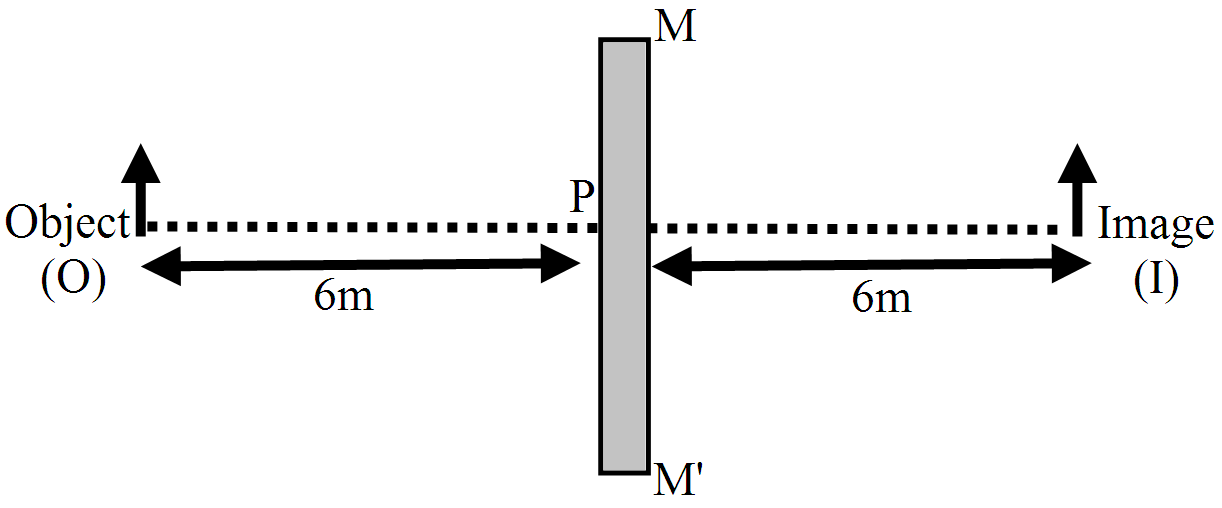
Since, the image is $6m$ away from the plane mirror. So, it means that the object is also $6m$ away from the mirror.

[Because $OP = PI]$
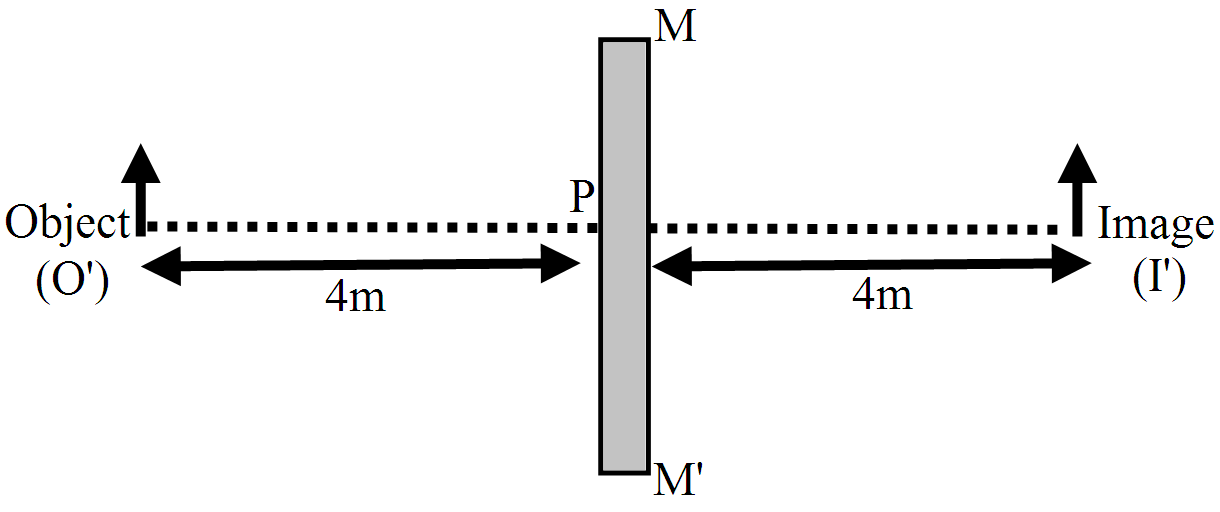
So, when the person moves $2$ m towards the plane mirror, then the distance between the person and the plane mirror will be equal to $(6m - 2m) = 4m,$ this means that distance between the image and the mirror will be $4m.$

The distance between the person and his image $= PO' + PI'= 4 + 4 = 8m$
View full question & answer
Question 165 Marks
Match the Columns $I$ with Column $II.$
S.No.
Column 1
 
Column II
$(a)$
Real image
$(i)$
Cannot be formed on the screen.
$(b)$
Magnified image
$(ii)$
Upside down image.
$(c)$
Erect image
$(iii)$
Smaller than the object.
$(d)$
Diminished image
$(iv)$
Upright image.
$(e)$
Virtual image
$(v)$
Bigger than the object.
$(f)$
Inverted image
$(vi)$
Formed on the screen.
Answer
S.No.
Column 1
 
Column II
$(a)$
Real image
$(vi)$
Formed on the screen.
$(b)$
Magnified image
$(v)$
Bigger than the object.
$(c)$
Erect image
$(iv)$
Upright image.
$(d)$
Diminished image
$(iii)$
Smaller than the object.
$(e)$
Virtual image
$(i)$
Cannot be formed on the screen.
$(f)$
Inverted image
$(ii)$
Upside down image.
View full question & answer