Questions

3 Marks Question

Take a timed test

23 questions · self-marked practice — reveal the answer and mark yourself.

Question 13 Marks
Salma takes $15$ minutes from her house to reach her school on a bicycle. If the bicycle has a speed of $2\ m/s,$ calculate the distance between her house and the school.
Answer
Time taken by Salma to reach her school from her home $=15 \min =15 \times 60=900 s$
Speed of her bicycle $=2\ m / s$
Speed $=\frac{\text { Distance covered }}{\text { Time taken }}$
Distance covered $=$ Speed $\times$ Time taken $=2 \times 900=1800\ m$
$1000\ m =1\ km$
$\therefore 1800\ m =\frac{1}{1000} \times 1800=1.8\ km$
View full question & answer
Question 23 Marks
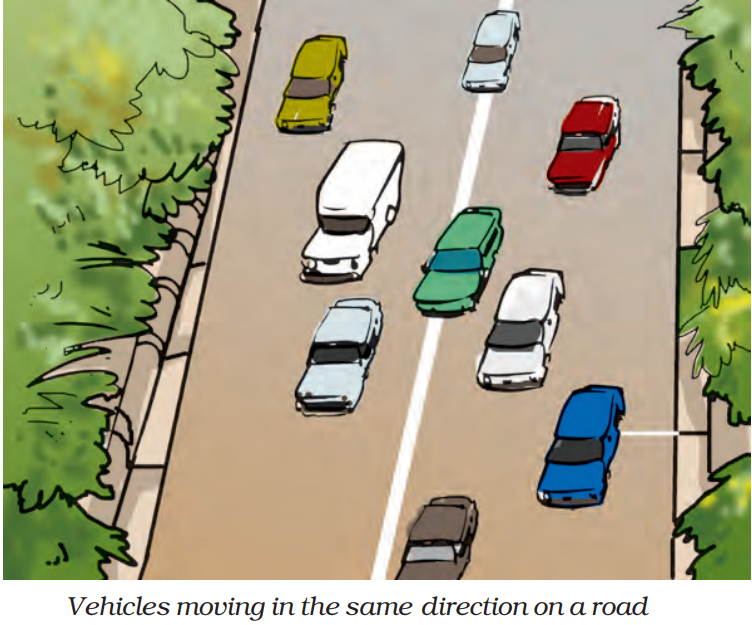
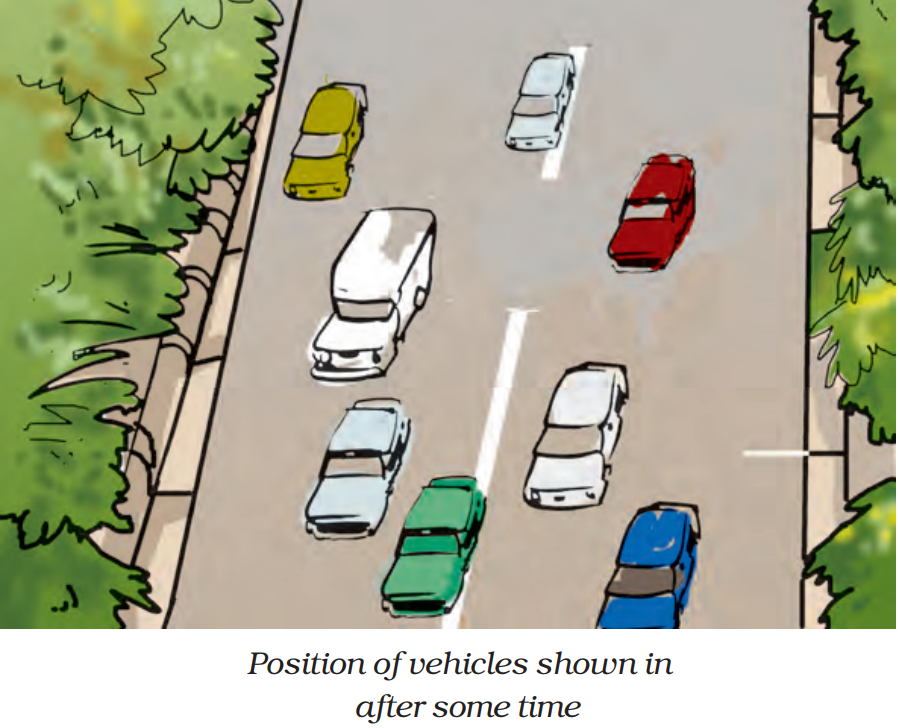
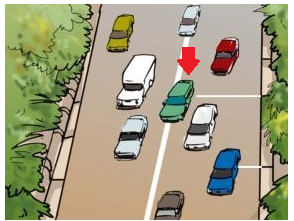
Suppose the two photographs, shown in Figure $1$ and Figure $2,$ had been taken at an interval of $10$ seconds. If a distance of $100$ metres is shown by $1\ cm$ in these photographs, calculate the speed of the blue car.Image
Figure 1 Vehicles moving in the same direction of on a road
Image
Figure 2 Position of vehicles shown in Figure 1 after some time
Answer
The distance covered by the blue car (as evident from the photograph) from one white strip to another, which is measured by scale is $1.4\ cm$.
It is given that $1 cm$ is equivalent to $100\ m$.
Therefore, $1.4 cm$ is equivalent to $140\ m$.
Distance travelled by the car $=140\ m$
Time interval between the two photographs $=10\ s$
$\text { Speed }=\frac{\text { Distance covered }}{\text { Time taken }}=\frac{140}{10}=14\ m / s$
View full question & answer
Question 33 Marks
What are the points that should be kept in mind while choosing scale for drawing graph?
Answer
The following points should be kept in mind while choosing most suitable scale for drawing a graph:
  • The difference between the highest and the lowest values of each quantity.
  • The intermediate values of each quantity to mark the values on the graph.
  • To utilize the maximum part of the paper on which graph is to be drawn.
View full question & answer
Question 43 Marks
Give Reasons: The time measured by quartz clocks is much more accurate than that by the clocks available earlier.
Answer
The time measured by quartz clocks is much more accurate than that by the clocks available earlier. Quartz crystals emit vibrations are fixed frequency. These vibrations (pulses) are counted and are used to measure time. It can measure time up to milliseconds and has high accuracy i.e. a normal quartz wristwatch may lose or gain less than a fraction of a second in a day. While the mechanical clocks used earlier were based on weights and spring which rotate the gears. The lowest time interval these mechanical clocks is up to minute. Hence accuracy of quartz clocks is more accurate than the clocks of earlier times.
View full question & answer
Question 53 Marks
The average age of children of Class $VII$ is $12$ years and $3$ months. Express this age in seconds.
Answer
Given, the average age of children is $12$ years and $3$ months $1$ year $= 365$ days
$= 365 \times 24h = 365 \times 24 \times 3600s = 31536000s$
$\therefore\ 12$ years $= 31536000s \times 12$
$= 378432000s$ and $3$ months $= 3 \times 30$ days$ = 30 \times 3 \times 24h$
$= 30 \times 3 \times 24 \times 36000s$
$​​​​​​​= 7776000s$
​​​​​​​So, total age in second $= 378432000 + 7776000 = 386208000s$
View full question & answer
Question 63 Marks
Salma takes $15$ minutes from her house to reach her school on a bicycle. If the bicycle has a speed of $2\ m/s,$ calculate the distance between her house and the school
Answer
Time taken by Salma to reach her school from her home $= 15 \min = 15 \times 60 = 900s$
Speed of her bicycle $= 2\ m/s$
$\text{Speed}=\frac{\text{Distance covered}}{\text{Time taken}}$
Distance covered $=$ Speed $\times $ Time taken $= 2 \times 900 = 1800\ m$
$1000m = 1\ km$
$\therefore1800\text{m}=\frac{1}{1000}\times1800=1.8\text{km}$
View full question & answer
Question 73 Marks
Suppose the two photographs, shown in Fig. and Fig. had been taken at an interval of $10$ seconds. If a distance of $100$ metres is shown by $1\ cm$ in these photographs, calculate the speed of the fastest car.

Answer
The distance covered by the blue car (as evident from the photograph) from one white.Strip to another, which is measured by scale is $1.4\ cm.$
It is given that $1\ cm$ is equivalent to $100\ m.$
Therefore, $1.4\ cm$ is equivalent to $140\ m.$
Distance travelled by the car $= 140\ m$
Time interval between the two photographs $= 10\ s$
$\text{Speed}=\frac{\text{Distance covered}}{\text{Time taken}}=\frac{140}{10}=14\text{m/s}$
View full question & answer
Question 83 Marks
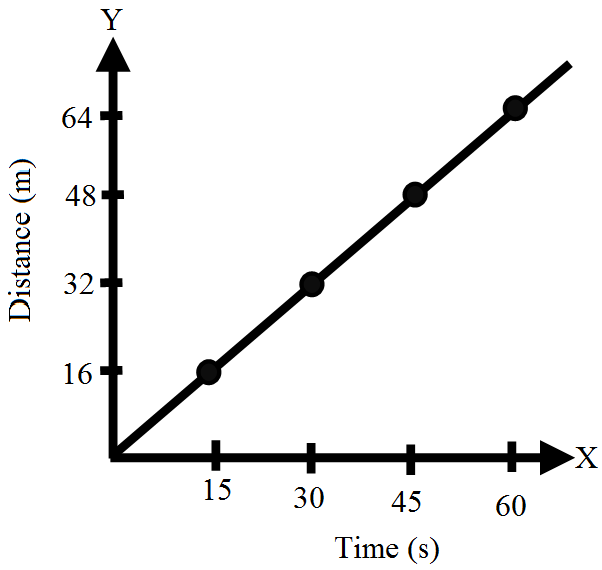
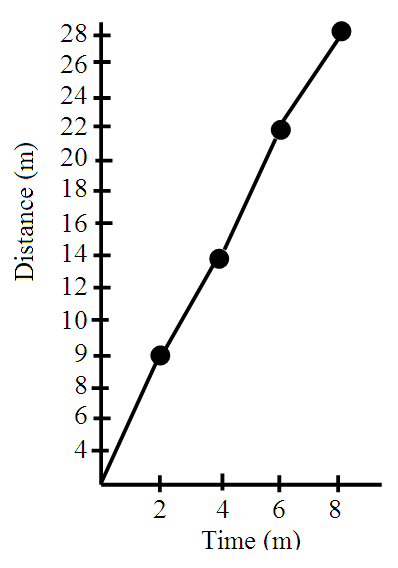
Plot a distance-time graph of the tip of the second hand of a clock by selecting $4$ points on $x-$axis and $y-$axis respectively. The circumference of the circle traced by the second hand is $64\ cm.$
Answer
The circumference of circle traced by a second hand in $60$ sec is $64\ cm.$
Time (s)
$X$
$15$
$30$
$45$
$60$
Distance (cm)
$Y$
$16$
$32$
$48$
$64$
Here, equal distance is covered in equal intervals of time.
So, graph will be a straight line.

View full question & answer
Question 93 Marks
Give Reasons: Average speed is same as actual speed in case of a body having uniform motion.
Answer
Average speed is same as actual speed in case of a body having uniform motion.
Uniform motion means the object covers equal distances in equal intervals of time.
Average speed means total distance covered in total time.
Consider an object in uniform motions goes from $A$ to $B$ in $5$ seconds and then $B$ to $C$ in $5$ seconds.
Let $AB = BC = 20\ m$.
Actual speed of the object $(A$ to $B)$ or $(B$ to $C)$
$=\frac{\text{Distance}}{\text{time}}=\frac{20\text{m}}{5\text{ sec}}=4\text{m/ s}$
Average Speed $=\frac{\text{Total Distance}}{\text{Total Time}}\frac{(20\text{m}+20\text{m})}{(5\text{s}+5\text{s})}=\frac{40\text{m}}{10\text{s}}=4\text{m/ s}$
Thus, Average speed is same as actual speed in case of a body having uniform motion.
View full question & answer
Question 103 Marks
Show the shape of the distance-time graph for the motion in the following cases when a car is moving with a constant speed.
View full question & answer
Question 123 Marks
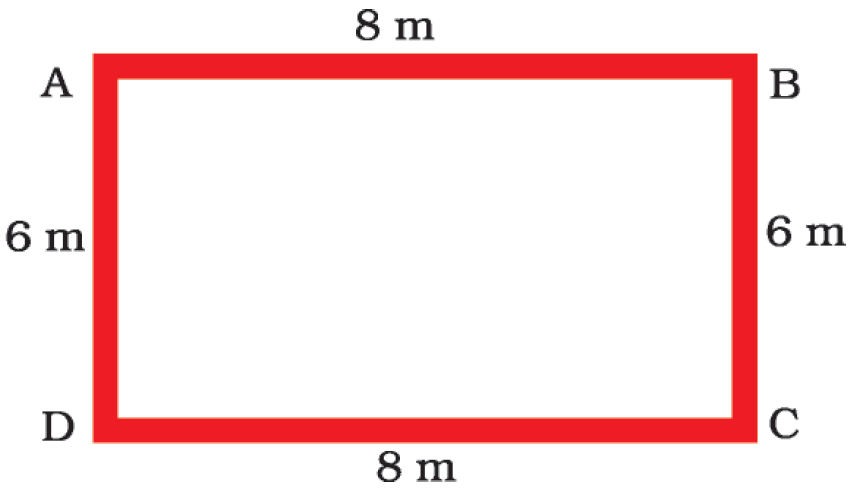
Starting from $A,$ Paheli moves along a rectangular path $ABCD$ as shown in figure. She takes $2 \min$ to travel each side. Plot a distance-time graph and explain whether the motion is uniform or non-uniform.
Answer
Since, the distance covered per unit time for the entire distance covered is not the same, the motion is a non-uniform motion.
View full question & answer
Question 133 Marks
What do you mean by instantaneous speed$?$
Answer
When we say that the car travels at an average speed of $60\ km/ h$ it does not mean that the car would be moving with the speed of $60\ km/h$ throughout the journey. The actual speed of the car may be less than or greater than the average speed at a particular instant of time. The speed of a moving body at any particular instant of time is called instantaneous speed.
View full question & answer
Question 143 Marks
Distance between Bholu’s and Golu’s house is $9\ km$. Bholu has to attend Golu’s birthday party at $7$ o’clock. He started from his home at $6$ o’clock on his bicycle and covered a distance of $6\ km$ in $40$ minutes. At that point he met Chintu and he spoke to him for $5$ minutes and reached Golu’s birthday party at $7$ o’clock. With what speed did he cover the second part of the journey? Calculate his average speed for the entire journey.
Answer
From the question, Bholu covers the remaining $3\ km$ distance in $15$ min So,
$\text{Speed of Bholu}=\frac{\text{Distance}}{\text{Time}}$$=\frac{3\text{km}}{\frac{15}{60}\text{h}}$
$=\frac{3}{15}\times60$ $\Big(\because1\text{min}=\frac{1}{60}\text{h}\Big)$
$=12\text{km/h}$
Now, $\text{Average speed}=\frac{\text{Total distance travelled}}{\text{Total time taken}}$
$=\frac{9}{1}$
$=9\text{km/h}$
View full question & answer
Question 153 Marks
Explain how we can plot a graph.
Answer
To plot a graph on a graph sheet:Take a graph paper. At the centre of the paper, draw two lines perpendicular to each other Mark the point of intersection of the lines as $'O'$. The horizontal line is called the $X$-axis, while the vertical line is called the $Y$-axis. The point of intersection of the two axes is called the origin, $"O"$. Take one quantity along the $X$-axis and the other along the $Y$-axis, after choosing suitable scales for both. For every value along one axis, mark a point matching the related value on the other axis. Join the points, and your graph is ready.
View full question & answer
Question 163 Marks
A car moves with a speed of $40\ km/ h$ for $5$ minutes and then with a speed of $60\ km/h$ for the next $5$ minutes. The total distance covered by the car is:
Answer
Distance covered by the car with a speed of $40\ km/ h$ in $15$ minutes
= Speed $\times $ Time
$= (40\ Km/ h / 60$ minute$) \times 15$ minute
Distance covered by the car with a speed of $40\ km/ h$ in $15$ minutes
= Speed $\times $ Time 
$= (60\ Km/ h / 60$ minute$) \times 15$ minute $= 15\ Km$
Total distance covered by the car $= (10 + 15 )km = 25\ Km$
View full question & answer
Question 173 Marks
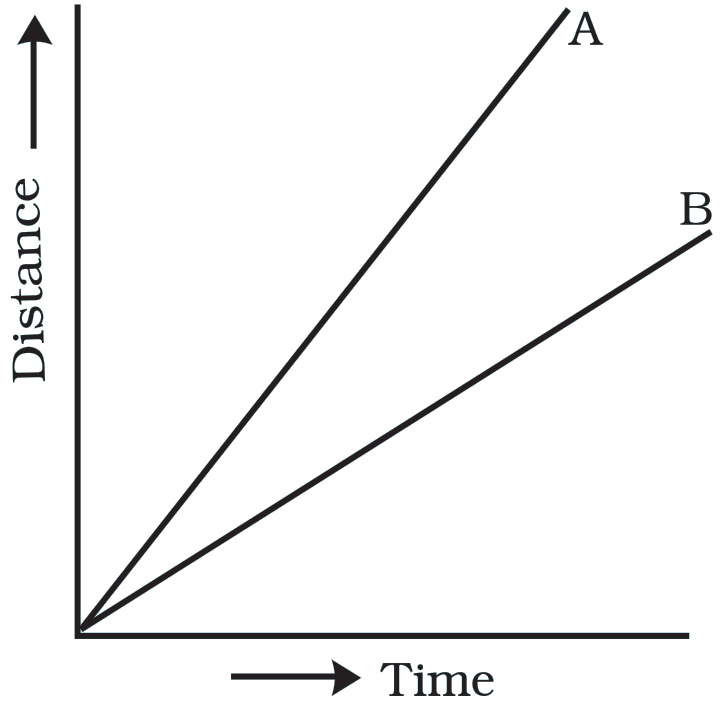
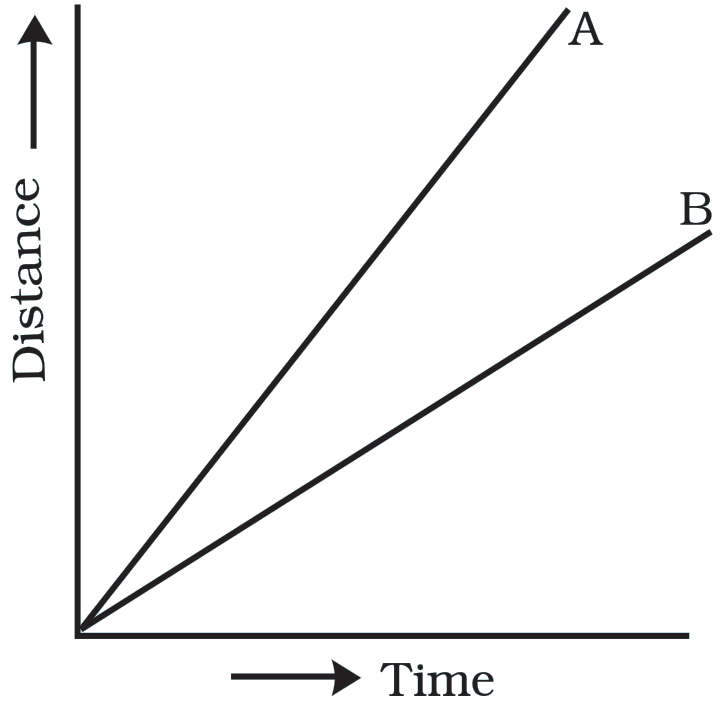
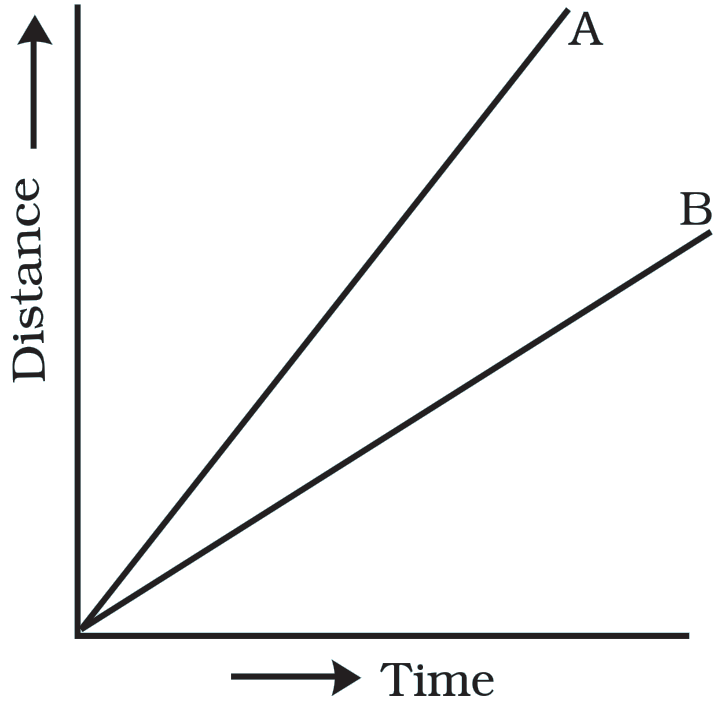
Fig. shows the distance - time graph for the motion of two vehicles $A$ and $B$. Which one of them is moving faster?
Answer
Vehicle $A$ is moving faster than vehicle $B$.

Speed is given by the relation.$\text{Speed}=\frac{\text{Distance covered}}{\text{Time taken}}$
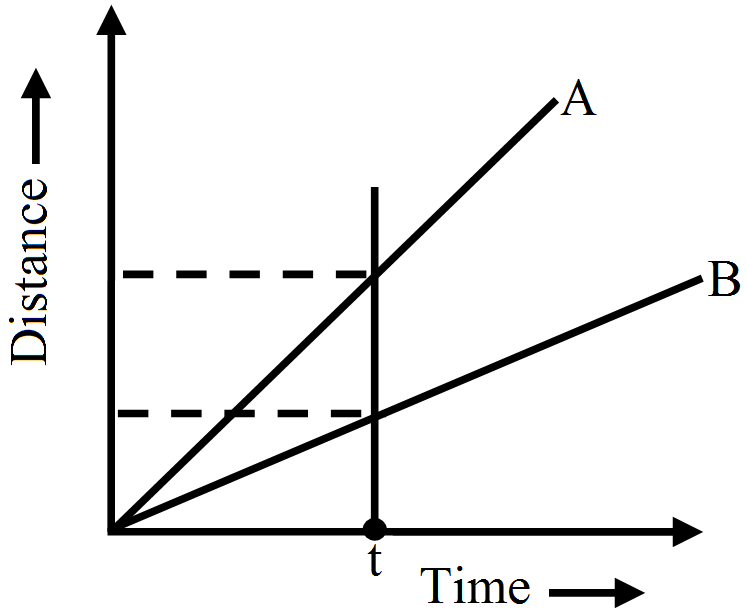
This relation shows that speed of a vehicle is greater if it covers maximum distance in a given interval of time. To compare the distance, draw a line perpendicular to the time axis, as shown in the following distance-time graph.
 From the graph, it is evident that for a given time $t$, the distance covered by vehicle $A$ is more than vehicle $B$.
Hence, vehicle $A$ is moving faster than vehicle $B$.
View full question & answer
Question 183 Marks
Differentiate between uniform speed and average speed.
Answer
An object is said to be moving with uniform speed if it covers equal distances in equal intervals of time. But when we travel in a vehicle the speed of the vehicle changes from time to time depending upon the conditions existing on the road. In such a situation, the speed is calculated by taking the ratio of the total distance travelled by the vehicle to the total time taken for the journey. This is called the average speed.
View full question & answer
Question 193 Marks
Give an example when objects undergo combinations of different types of motion?
Answer
The motion of a ball on the ground. Here the ball is rolling on the ground and rotating as well as moving forward on the ground. Thus, the ball undergoes a rectilinear motion as well as rotational motion.
$\text{Average speed}=\frac{\text{Total distance covered}}{\text{Total time taken}}$
View full question & answer
Question 203 Marks
Give Reasons:Accurate measurements of time became possible much after accurate measurements of length and mass.
Answer
Accurate measurements of time became possible much after accurate measurements of length and mass. Length and mass were the earliest measurements made mankind. Time measurement was done in terms of length as distance and mass. For example position of sun, moon and stars give idea of days, months and years. Later mechanical clocks based on weights and spring can measure time accurately up to minutes. Today atomic clocks measures time accurate upto nano-seconds by measuring waves emitted by Cesium clock in terms of speed of light and frequency. Over the time improvements in accuracy in measuring length and mass help in measuring time with more accuracy and precision.
View full question & answer
Question 213 Marks
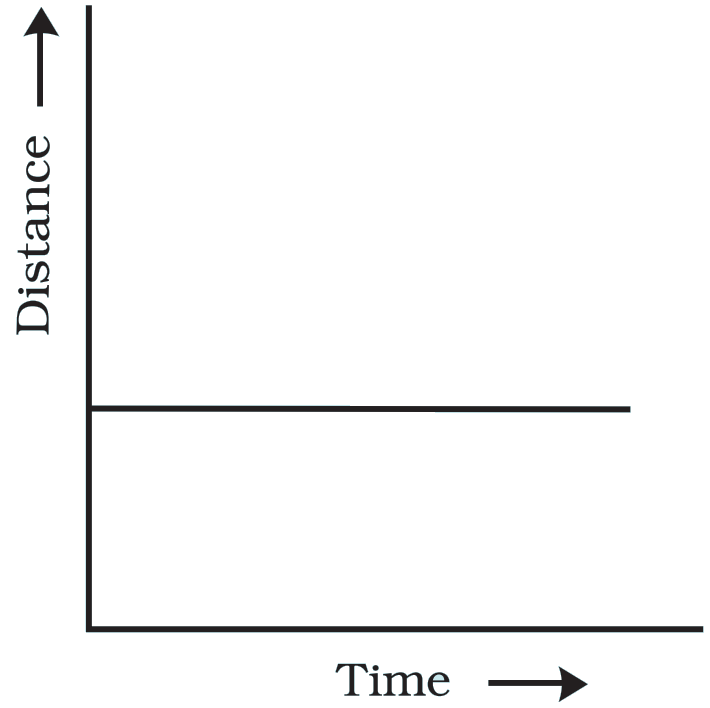
Show the shape of the distance-time graph for the motion in the following cases:A car parked on a side road.
Answer
The distance-time graph of a car parked on a road side is such that with the increase in time, there is no change in distance, as shown in the given figure.
View full question & answer
Question 223 Marks

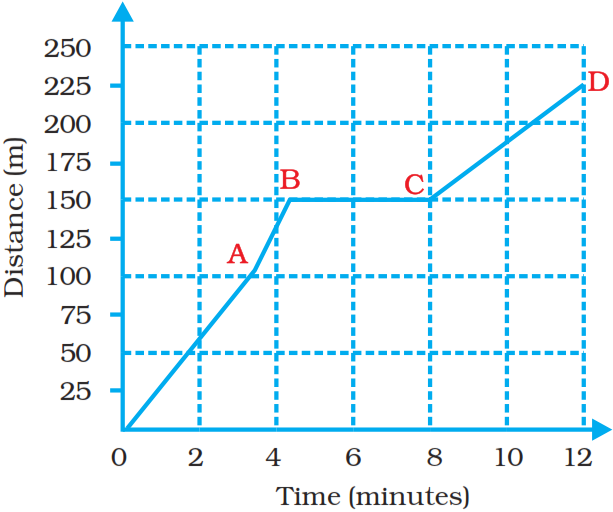
Boojho goes to the football ground to play football. The distancetime graph of his journey from his home to the ground is given as Figure.
  1. What does the graph between point $B$ and $C$ indicate about the motion of Boojho?
  2. Is the motion between $0$ to $4$ minutes uniform or nonuniform?
  3. What is his speed between $8$ and $12$ minutes of his journey?
Answer
  1. Since, the graph between $B$ and $C$ is parallel to time-axis, so it indicates that Boojho is at rest i.e. his speed is zero.
  2. Since, the graph is not straight line, so it is a non-uniform motion.
  3. As, $\text{Speed}=\frac{\text{Distance}}{\text{Time}}$
$=\frac{225-150}{12-8}$
$=\frac{75}{4}$
$=18.75\text{m/min}$
View full question & answer
Question 233 Marks
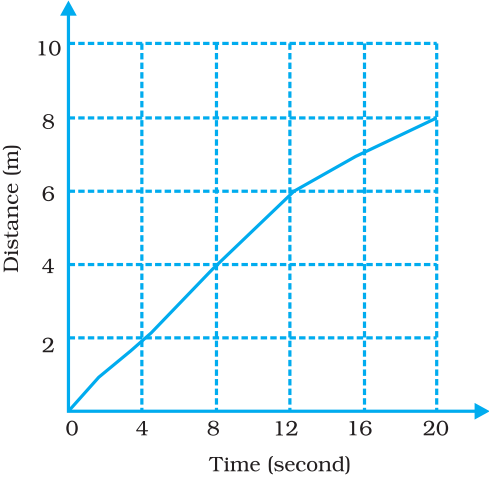
Given below as Figure, is the distance-time graph of the motion an object.
  1. What will be the position of the object at $20s$?
  2. What will be the distance travelled by the object in $12s$?
  3. What is the average speed of the object?
Answer
  1. From the graph, it is clear that the distance at $20s$ is $8m.$
  2. Distance travelled by the object in $12s$ is $6m$.
  3. $\text{Average speed}=\frac{\text{Total distance}}{\text{Total time}}$
$=\frac{8}{20}$
$=0.4\text{m/s}$
View full question & answer