MCQ 11 Mark
The basic unit of speed is:
Answerm/s
The basic unit of distance is metre (m).
The basic unit of time is second (s).
Speed = Distance/Time
Therefore, the basic unit of speed is m/s.
View full question & answer→MCQ 21 Mark
Which of the following relations is correct?
- A
- ✓
Speed $=\frac{\text { Distance }}{\text { Time }}$
- C
Speed $=\frac{\text { Time }}{\text { Distance }}$
- D
Speed $=\frac{1}{\text { Distnace } x \text { Time }}$
AnswerCorrect option: B. Speed $=\frac{\text { Distance }}{\text { Time }}$
Speed of an object is given by the relation
Speed = `"Distance"/"Time"`
View full question & answer→MCQ 31 Mark
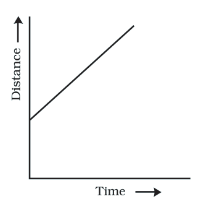
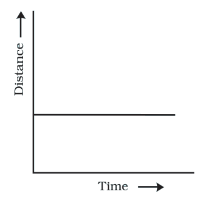
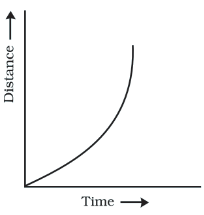
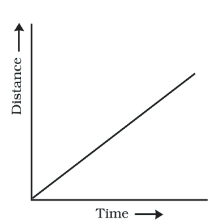
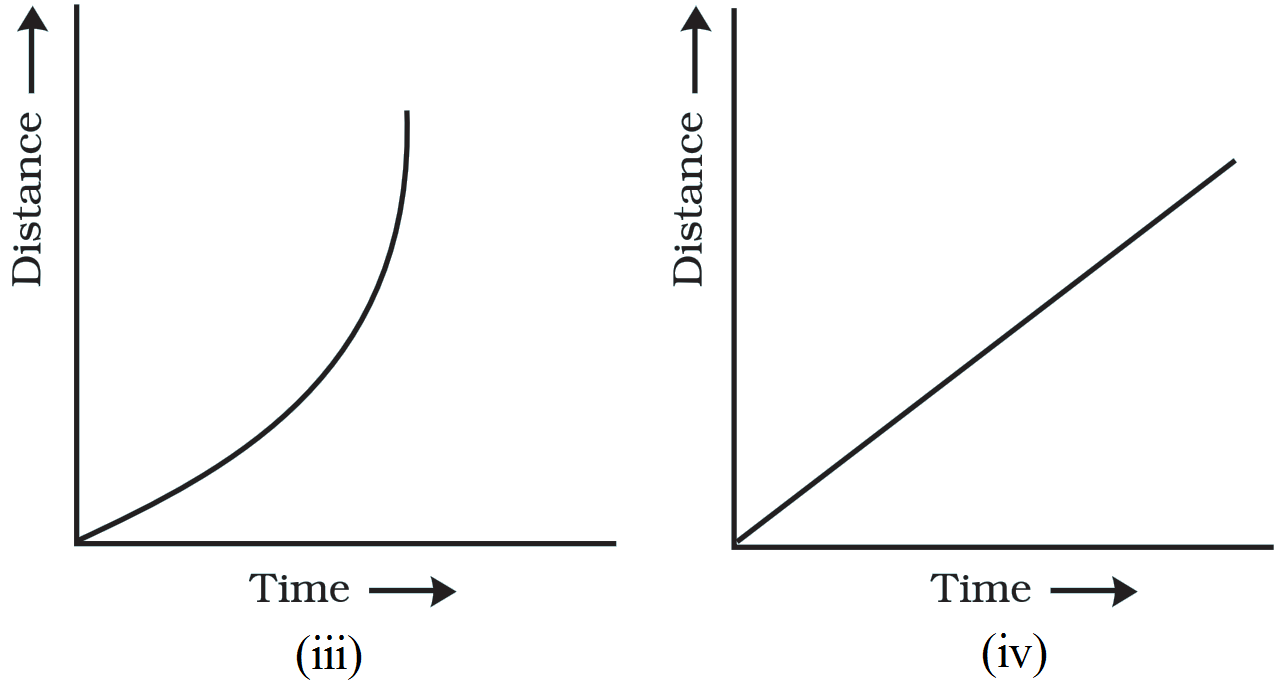
Which of the following distance-time graphs shows a truck moving with speed which is not constant?
AnswerGraph (3)
In a distance-time graph, the constant speed of a truck will be represented by a straight line.
In a distance-time graph, a straight line parallel to the time axis indicates that the truck is not moving.
A curved line on the distance-time graph indicates that the truck is moving with a speed which is not constant.
View full question & answer→MCQ 41 Mark
A car moves with a speed of $40 \ km/h$ for $15$ minutes and then with a speed of $60 \ km/h$ for the next $15$ minutes. The total distance covered by the car is:
- A
$100 \ km$
- ✓
$25 \ km$
- C
$15 \ km$
- D
$10 \ km$
AnswerCorrect option: B. $25 \ km$
$25 km$
Case I
Speed of the car $=40 km / h$
Time taken $=15 min =15 / 60=0.25 h$
Speed $=\frac{\text { Distance Covered }}{\text { Time Taken }}$
Distance covered, $d_1=$ Speed $\times$ Time taken $=40 \times 0.25=10 km$
Case II
Speed of the car $=60 km / h$
Time taken $=15 min =\frac{15}{60}=0.25 h$
Speed $=\frac{\text { Distnace covered }}{\text { Time Taken }}$
Distance covered, $d_2=$ Speed $\times$ Time taken $=60 \times 0.25=15 km$
Total distance covered by the car, $d=d_1+d_2=10+15=25 km$
Therefore, the total distance covered by the car is $25 km$.
View full question & answer→MCQ 51 Mark
A car travels first $60\ km$ of a distance in 1hr, next $70\ km$ of the distance in next hour and remaining $20\ km$ distance in final hour. Then, its motion is:
- A
- ✓
- C
Either uniform or non - uniform motion.
- D
Neither uniform nor non-uniform motion.
AnswerDuring first hour, $\text{Speed}=\frac{60}{1}\text{km/ h}=60\text{km/ hr}$
During second hour, $\text{Speed}=\frac{70}{1}\text{km/ h}=70\text{km/ hr}$
During third hour, $\text{Speed}=\frac{20}{1}\text{km/ h}=20\text{km/ hr}$
So, the car travels different distances in equal time intervals.
This is an example of non - uniform motion.
View full question & answer→MCQ 61 Mark
A bus travels $54\ km$ in $90$ min. The speed of the bus is:
- A
$0.6m/s.$
- ✓
$10m/s.$
- C
$5.4m/s.$
- D
$3.6m/s.$
AnswerCorrect option: B. $10m/s.$
As we know that speed $=\frac{\text{Distance}}{\text{Time}}$
$=\frac{54\times1000}{90\times60}\begin{bmatrix}1\text{km}=1000\text{m} \\1\text{min}=60\text{s}\ \ \ \ \ \ \ \end{bmatrix}=10\text{m/s}.$
View full question & answer→MCQ 71 Mark
Which of the following is not used to measure time?
AnswerThe candle clock was used to measure time in ancient times whereas nowadays, computers, mobiles, and wristwatches are used to measure time.
View full question & answer→MCQ 81 Mark
The unit of speed of train is:
AnswerThe unit of speed of train is kilometer per hour.
View full question & answer→MCQ 91 Mark
Name one unit of time bigger than a second.
Answer$1$ kilosecond $= 1000$ seconds.
View full question & answer→MCQ 101 Mark
A simple pendulum takes $32s$ to complete $20$ oscillations, what is the time period of the pendulum?
- ✓
$1.6s$
- B
$2.6s$
- C
$3.6s$
- D
$4.8s$
AnswerCorrect option: A. $1.6s$
Time taken to complete $20$ oscillations $= 32s$
Time taken to complete $1$ oscillation $ = \frac{32}{20}\text{s} = 1.6\text{s}$
Time period of a pendulum is time taken by it to complete $1$ oscillation.
Time period of pendulum is $1.6$ seconds.
View full question & answer→MCQ 111 Mark
The basic unit of speed is:
- A
$Km/ min.$
- B
$m/ min.$
- C
$Km/ \sec.$
- ✓
$m/ \sec.$
AnswerCorrect option: D. $m/ \sec.$
$m/ \sec.$
View full question & answer→MCQ 121 Mark
An example of Oscillatory motion is:
- A
- B
Movement of a car on a straight road.
- C
Motion of earth around the sun.
- ✓
View full question & answer→MCQ 131 Mark
When a graph between two physical quantities is a straight line, the two quantities are:
- A
- B
Independent of each other
- ✓
- D
AnswerAs we know the equation of a straight line is $Y = mX + C$
Let us assume $X$ and $Y$ are two different physical quantity and $C$ is any constant.
and the graph between them is straight line.
According to above equation,
$\text{Y}\propto\text{X}$
Hence, $X$ and $Y$ are Directly proportional.
View full question & answer→MCQ 141 Mark
A boy cycles a distance of $640m$ in $2$ minutes and $40$ seconds. What is the speed of the cycle?
- ✓
$4m/ s$
- B
$8m/ s$
- C
$12m/ s$
- D
$16m/ s$
AnswerCorrect option: A. $4m/ s$
Distance covered $= 640m$
Time taken $= 2\ min \ 40\ sec$
$= 2 × 60 + 40 = 160s$ (because $1$ minute $= 60$ seconds)
$\therefore\text{Speed}=\frac{\text{Distance}}{\text{Time}}=\frac{640}{160}=4\text{m}/\text{s}$
View full question & answer→MCQ 151 Mark
A person has two hourglasses, one of $30$ seconds and the other of $1$ minute. Which of the following time intervals can he not measure?
- A
$30$ seconds
- B
$60$ seconds
- ✓
$50$ seconds
- D
$90$ seconds
AnswerCorrect option: C. $50$ seconds
A person has two hourglasses, one of $30$ seconds and the other of $1$ minute.
$1$ minute $= 60$ seconds
$H.C.F.$ of $30$ seconds and $60$ seconds $=30$ seconds
He can only measure time intervals of $30, 60$, and $90$ seconds.
But he cannot measure the time interval of $50$ seconds.
View full question & answer→MCQ 161 Mark
Odometer is to mileage as compass is to:
AnswerAn odometer is an instrument used to measure mileage.
A compass is an instrument used to determine direction.
Choices $a, b,$ and $c$ are incorrect because none is an instrument.
View full question & answer→MCQ 171 Mark
The most common example of periodic motion or oscillatory motion is:
AnswerSimple pendulum is periodic or oscillatory motion.
View full question & answer→MCQ 181 Mark
Which of the following is required to facilitate the measurement of time?
- A
- B
- C
A device calibrated to measure time
- ✓
Both $B$ and $C$
AnswerCorrect option: D. Both $B$ and $C$
In order to facilitate the measurement of time, a periodic event is required along with a device to calibrate the measured time.
View full question & answer→MCQ 191 Mark
Speedometer drive is usually taken from:
AnswerSpeedometer drive is usually taken from front wheel.
View full question & answer→MCQ 201 Mark
Time period of a simple pendulum depends upon its.
AnswerThe time period of the simple pendulum depends upon the length of the pendulum and also to some extent it depends upon the degree of the amplitude.
That is the width of the pendulum's swing.
In general, the time period of a pendulum means one complete cycle that is one complete left swing and right swing.
View full question & answer→MCQ 211 Mark
How many days are present between the years $2005$ and $2008$ including these years?
- ✓
$1461$
- B
$1460$
- C
$730$
- D
$731$
AnswerCorrect option: A. $1461$
We know that, in one year, there are $365$ days.
Out of the year $2005, 2006, 2007$ and $2008$, the year $2008$ is a leap year which has $366$ days.
So, total number of days $= 365 + 365 + 365 + 366 = 1461$ days.
View full question & answer→MCQ 221 Mark
Which of the following is/ are good example(s) of non - uniform motion?
- A
When an object is moving in a circular path with uniform speed
- B
A car is travelling in an overcrowded zigzag road
- C
- ✓
Both $B$ and $C$
AnswerCorrect option: D. Both $B$ and $C$
An object covering equal distances in equal time interval, i.e.
moving with a uniform speed is said to be in a uniform motion.
An object moving in a circular path with uniform speed is said to be in a uniform circular motion.
Since, in a motion of a pendulum and in a car travelling in an overcrowded zig zag road, the speed of the object is changing and is not uniform, hence they are examples of non - uniform motion.
View full question & answer→MCQ 231 Mark
The distance-time graph for a vehicle standing on a road side will be:
- A
Straight line inclined by some angle to $x-$axis.
- ✓
Straight line parallel to $x-$axis.
- C
Straight line parallel to $y-$axis.
- D
AnswerCorrect option: B. Straight line parallel to $x-$axis.
Straight line parallel to $x-$axis.
View full question & answer→MCQ 241 Mark
If the an object moving along a straight line, keeps changing its speed then:
- A
The motion is said to be a uniform motion.
- ✓
The motion is said to be a non uniform motion.
- C
The object is said to be stationary.
- D
The motion is said to be a fast motion.
AnswerCorrect option: B. The motion is said to be a non uniform motion.
The motion is said to be a non uniform motion.
View full question & answer→MCQ 251 Mark
- ✓
$100$ years
- B
$100$ months
- C
$100$ seconds
- D
$100$ weeks
AnswerCorrect option: A. $100$ years
$1$ century $= 100$ years
A century has $100$ years.
View full question & answer→MCQ 261 Mark
A speedometer typically has a threshold of about $15 \ km/hr$. If the car starts from rest and accelerates, the speedometer will:
AnswerCorrect option: B. Start reading when the speed reaches $15km/ hr.$
Threshold of the speedometer represents the minimum speed of the vehicle by which it must be moving to display the instantaneous speed of the vehicle.
Thus, $15 km/hr$ threshold of the speedometer means that it starts reading the speed of the vehicle once the speed reaches $15km/ hr.$
View full question & answer→MCQ 271 Mark
Which of the following relations is correct?
- A
$\text{Speed} = \text{Distance × Time.}$
- ✓
$\text{Speed}=\frac{\text{Distance}}{\text{Time}}$
- C
$\text{Speed}=\frac{\text{Time}}{\text{Distance}}$
- D
$\text{Speed}=\frac{\text{1}}{\text{Distance}}\times\text{Time}$
AnswerCorrect option: B. $\text{Speed}=\frac{\text{Distance}}{\text{Time}}$
$\text{Speed}=\frac{\text{Distance}}{\text{Time}}$
View full question & answer→MCQ 281 Mark
Which of the following is used as measuring time?
AnswerAn hourglass $($or sandglass, sand timer, sand clock or egg timer$)$ is a device used to measure the passage of time.
It comprises two glass bulbs connected vertically by a narrow neck that allows a regulated flow of a substance $($historically sand$)$ from the upper bulb to the lower one.
View full question & answer→MCQ 291 Mark
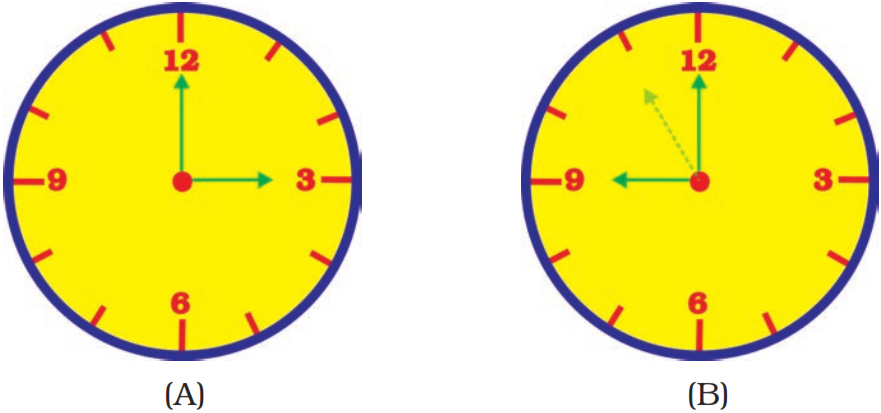
Two clocks $A$ and $B$ are shown in Figure, Clock A has an hour and a minute hand, whereas clock $B$ has an hour hand, minute hand as well as a second hand. Which of the following statement is correct for these clocks?
- A
A time interval of $30$ seconds can be measured by clock $A.$
- B
A time interval of $30$ seconds cannot be measured by clock $B.$
- ✓
Time interval of $5$ minutes can be measured by both $A$ and $B.$
- D
Time interval of $4$ minutes $10$ seconds can be measured by clock $A.$
AnswerCorrect option: C. Time interval of $5$ minutes can be measured by both $A$ and $B.$
The time interval of $5$ min can be measured by both $A$ and $B$. Since, the time interval of $30$ seconds cannot be measured by clock $A$ and can be measured by clock $B$. Also, the time interval of $4$ min $10$ seconds cannot be measured by clock $A$, but can be measured by clock $B.$
View full question & answer→MCQ 301 Mark
The rate of change of displacement is called:
AnswerThe rate of change of displacement is called velocity.
View full question & answer→MCQ 311 Mark
An ancient Time measuring device $"\ce{SUNDIAL}"$ at JantarMantar is in:
View full question & answer→MCQ 321 Mark
The time interval between one sunrise and next sunrise is called a:
AnswerThe time interval between one sunrise to next sunrise is a day.
View full question & answer→MCQ 331 Mark
Which of the following instrument have very high level of accuracy?
AnswerElectronic stopwatch, stop clock, pendulum clock and hour glass are the instruments used for measuring the time.
Among the following, electronic stopwatch has the highest level of accuracy whereas hourglass has the lowest level of accuracy in measuring time.
View full question & answer→MCQ 341 Mark
The speed of a train is $60\ km/ h.$ The distance covered by the train is $4$ hours would be:
- A
$15\ km$
- ✓
$240\ km$
- C
$\frac{1}{15}\text{km}$
- D
AnswerCorrect option: B. $240\ km$
The distance covered by a train would be $240\ km.$
View full question & answer→MCQ 351 Mark
Which of the following relations is correct?
- A
$\text{Speed}=\text{Distance}\times\text{Time}$
- ✓
$\text{Speed}=\frac{\text{Distance}}{\text{Time}}$
- C
$\text{Speed}=\frac{\text{Time}}{\text{Distance}}$
- D
$\text{Speed}=\frac{\text{1}}{\text{Distance}\times\text{Time}}$
AnswerCorrect option: B. $\text{Speed}=\frac{\text{Distance}}{\text{Time}}$
$\text{Speed}=\frac{\text{Distance}}{\text{Time}}$
View full question & answer→MCQ 361 Mark
An ancient Time measuring device $SUNDIAL$ at Jantar Mantar is in:
AnswerThe World's Largest Sundial in Jaipur has been telling time for almost $300$ years.
View full question & answer→MCQ 371 Mark
A device used to measure the distance moved by a vehicle:
AnswerAn odometer measured the distance moved by a vehicle.
View full question & answer→MCQ 381 Mark
Which of the following distance-time graphs shows a truck moving with speed which is not constant?
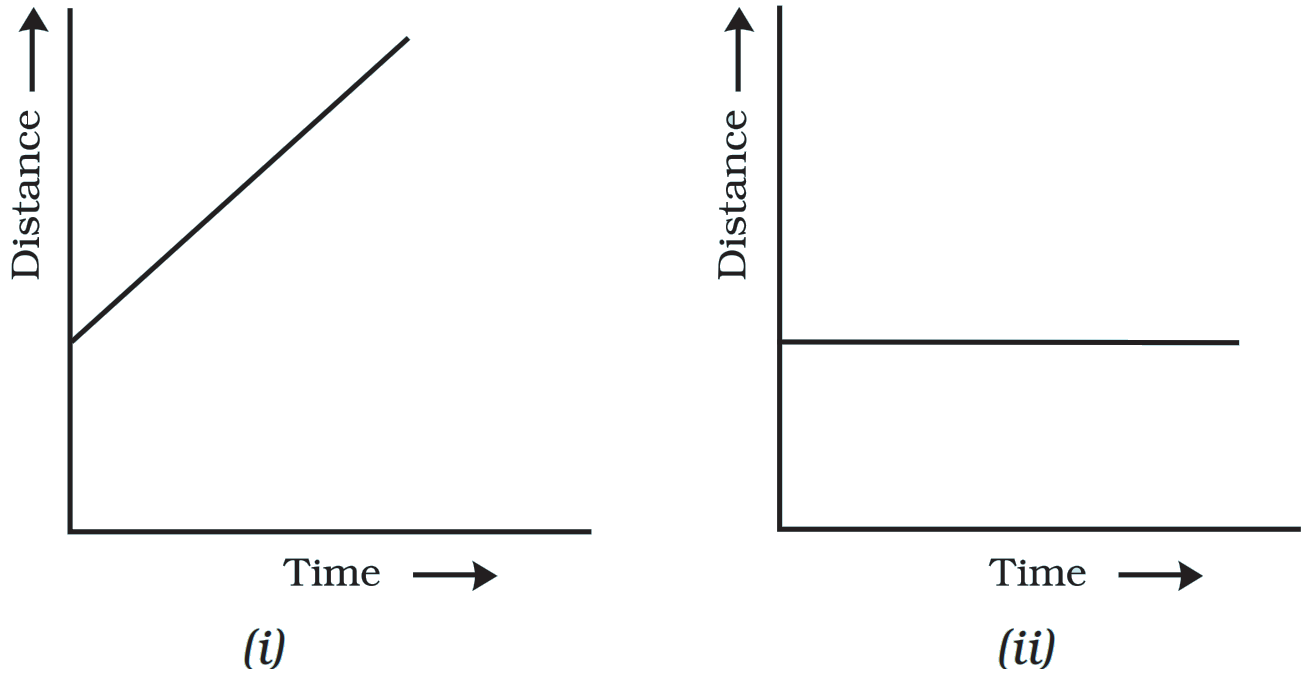
- A
$(i)$
- B
$(ii)$
- ✓
$(iii)$
- D
$(iv)$
AnswerCorrect option: C. $(iii)$
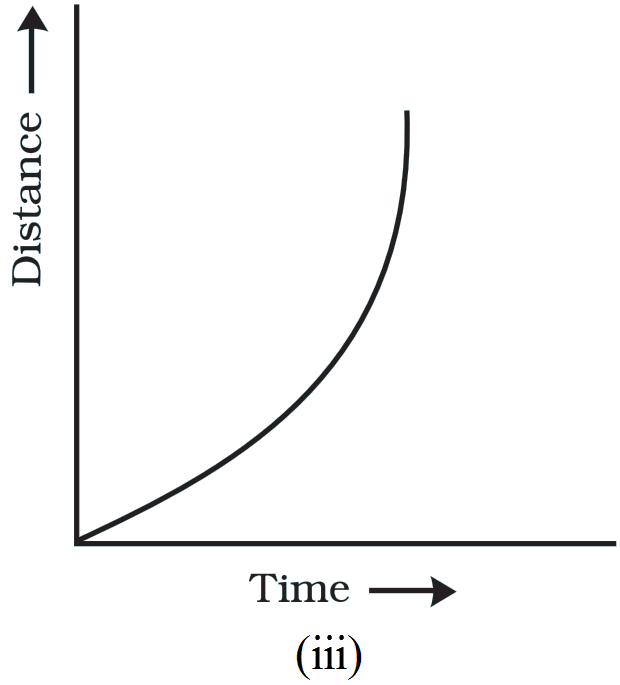 Explanantion:
In a distance - time graph, the constant speed of a truck will be represented by a straight line. In a distance time graph, a straight line parallel to the time axis indicates that the truck is not moving. A curved line on the distance-time graph indicates that the truck is moving with a speed which is not constant.
View full question & answer→MCQ 391 Mark
$4.15 p.m$. in $12$ hour system is written as _____ in $24$ hour clock system.
- A
$11$ hours $46$ minutes
- B
$4$ hours $15$ minutes
- C
$22$ hours $15$ minutes
- ✓
$16$ hours $15$ minutes
AnswerCorrect option: D. $16$ hours $15$ minutes
In $24$ hour clock system, $4.15 p.m.$ will be written as
$12 + 4.15 = 12hrs + 4hrs + 15$ minutes $= 16$ hours $15$ minutes.
View full question & answer→MCQ 401 Mark
The odometer of a car reads $57321.0\ km$ when the clock shows the time $08:30 AM$. What is the distance moved by the car, if at $08:50 AM$, the odometer reading has changed to $57336.0km?$
- A
$75\ km$
- B
$50\ km$
- ✓
$15\ km$
- D
$10\ km$
AnswerCorrect option: C. $15\ km$
An odometer is a device that gives us the distance covered by a car.
Distance covered by the car in the given time is $d = 57336.0 − 57321 = 15.0\ km.$
View full question & answer→MCQ 411 Mark
Which of the following formulae is correct?
- A
$\text{Speed}=\text{Distance}\times\text{time}$
- B
$\text{Speed}=\frac{\text{Time}}{\text{Distance}}$
- C
$\text{Speed}=\frac{1}{\text{Distance}\times\text{Time}}$
- ✓
$\text{Speed}=\frac{\text{Distance}}{\text{time}}$
AnswerCorrect option: D. $\text{Speed}=\frac{\text{Distance}}{\text{time}}$
Speed of an object is defined as distance moved per unit time.
It denotes how fast or how slow the object is moving.
It is given by $\text{Speed}=\frac{\text{Distance}}{\text{time}}$
View full question & answer→MCQ 421 Mark
A particle vibrates $10$ times in $1 sec$. What is the time period of vibration of the particle?
- A
$10sec$
- B
$1sec$
- ✓
$0.1sec$
- D
$0.01sec$
AnswerCorrect option: C. $0.1sec$
Time period of vibration is the time taken for $1$ vibration.
Given:
$10$ vibrations are completed in $1sec.$
$1$ vibration will taken only: $\frac{1}{10}=0.1\text{sec}$
View full question & answer→MCQ 431 Mark
The basic unit of speed is:
AnswerThe basic unit of distance is metre $(m).$
The basic unit of time is second $(s).$
$\text{Speed}=\frac{\text{Distance}}{\text{Time}}$
Therefore, the basic unit of speed is m/s.
View full question & answer→MCQ 441 Mark
The speed of a car is $40 \ km/ h$. What is time taken to reach from one city to another city if the distance between the two cities is $480\ km:$
- A
$10$ hours
- B
$11$ hours
- C
$14$ hours
- ✓
$12$ hours
AnswerCorrect option: D. $12$ hours
The time is taken by a car is $12$ hours.
View full question & answer→MCQ 451 Mark
Which of the following motion is circular motion:
- A
Motion of a child over see saw
- B
Motion of a car running on a straight road
- C
Motion of an electric bell hammer
- ✓
Motion of a child in a merry go round
AnswerCorrect option: D. Motion of a child in a merry go round
A child in a merry $-$ go $-$ round is circular motion.
View full question & answer→MCQ 461 Mark
- A
$\text{t}=\text{d}\times\text{s}$
- B
$\text{t}=\frac{\text{s}}{\text{d}}$
- ✓
$\text{t}=\frac{\text{d}}{\text{s}}$
- D
$\text{t}=\frac{1}{\text{s}\times\text{d}}$
AnswerCorrect option: C. $\text{t}=\frac{\text{d}}{\text{s}}$
$\text{t}=\frac{\text{d}}{\text{s}}$
View full question & answer→MCQ 471 Mark
A car moves with a speed of $80 km/ h$ for $15$ minutes and then with a speed of $60 km/ h$ for the next $15$ minutes. The total distance covered by the car is:
- A
$100\ km.$
- B
$50\ km.$
- ✓
$35\ km.$
- D
$70\ km.$
AnswerCorrect option: C. $35\ km.$
$35\ km.$
View full question & answer→MCQ 481 Mark
On which axis is dependent variable represented?
AnswerCorrect option: B. $y-$axis.
$y-$axis.
View full question & answer→MCQ 491 Mark
Which of the following cannot be used for measurement of time?
- A
- B
- C
Shadow of an object during the day.
- ✓
AnswerBlinking of eyes is not a periodic phenomenon $(i.e.$ it does not repeat after definite intervals of time$),$ so we cannot measure the time using this phenomenon.
View full question & answer→MCQ 501 Mark
The time taken by a vibrating body to complete one vibration is:
AnswerThe time taken by a vibrating body to complete one vibration is time period.
View full question & answer→MCQ 511 Mark
The earliest clocks made by Egyptians in year $800 \ BC$ for measuring time was:
AnswerSundial was the earliest clock made by the Egyptians in year $800 \ BC$ to measure time.
View full question & answer→MCQ 521 Mark
A car covers $40\ km$ in first hour, $115\ km$ in next two hours and $45\ km$ in next one hours. Find out its averages speed:
- A
$100\ km/ h$
- B
$66.6\ km/ h$
- ✓
$50\ km/ h$
- D
AnswerCorrect option: C. $50\ km/ h$
The total averages speed of a car is $50\ km/ h.$
View full question & answer→MCQ 531 Mark
The distance travelled by the vehicles is recorded by:
Answerspeedometer, instrument that indicates the speed of a vehicle, usually combined with a device known as an odometer that records the distance traveled.
View full question & answer→MCQ 541 Mark
The time taken by a pendulum of given length to complete one oscillation is:
- A
Different at different times.
- ✓
- C
Increases at different times.
- D
Decreases at different times.
View full question & answer→MCQ 551 Mark
Which of the following relations is correct?
- A
Speed $=$ Distance $\times $ Time
- ✓
$\text{Speed}=\frac{\text{Distance}}{\text{Time}}$
- C
$\text{Speed}=\frac{\text{Time}}{\text{Distance}}$
- D
$\text{Speed}=\frac{\text{1}}{\text{Distance}\times\text{Time}}$
AnswerCorrect option: B. $\text{Speed}=\frac{\text{Distance}}{\text{Time}}$
$\text{Speed}=\frac{\text{Distance}}{\text{Time}}$
View full question & answer→MCQ 561 Mark
Distance between two cities is measured in:
AnswerDistance between two cities is measrued by kilometers.
View full question & answer→MCQ 571 Mark
Gradient of line of displacement $-$ time graph gives the:
AnswerSlope of line of displacement time graph $=\frac{\text{ds}}{\text{dt}}$
The rate of change of position $i.e.,$ rate of change of displacement with time is called velocity.
View full question & answer→MCQ 581 Mark
The speedometer of a vehicle measures the speed in:
- A
$m/ \sec.$
- B
$m/ min.$
- ✓
$km/ hr.$
- D
$km/ min.$
AnswerCorrect option: C. $km/ hr.$
$km/ hr.$
View full question & answer→MCQ 591 Mark
The motion that repeats itself after regular intervals of time can be $......... ($Find the incorrect option$).$
View full question & answer→MCQ 601 Mark
Measurement of time can be done with the help of a:
AnswerA pendulum is a weight suspended from a pivot so that it can swing freely.
When a pendulum is displaced sideways from its resting, equilibrium position, it is subject to a restoring force due to gravity that will accelerate it back toward the equilibrium position.
When released, the restoring force combined with the pendulum's mass causes it to oscillate about the equilibrium position, swinging back and forth.
The time for one complete cycle, a left swing and a right swing, is called the period.
The period depends on the length of the pendulum.
This time period when known can be used to measure time.
View full question & answer→MCQ 611 Mark
What determine the nature of the path followed by the particle:
AnswerWithout initial velocity and acceleration path of the particle cannot be decided.
So at a time velocity and acceleration are required to determine the path followed by the particle.
View full question & answer→MCQ 621 Mark
In order to measure very short intervals, we mostly use:
AnswerCorrect option: D. $A$ and $B$
Stop clocks and stop watches are generally used to measure time for short intervals while wall clocks are used to measure time for long intervals.
View full question & answer→MCQ 631 Mark
The graph between distance, time for a body at rest is a:
- A
Straight line parallel to a distance axis.
- ✓
Straight line parallel to time axis.
- C
- D
AnswerCorrect option: B. Straight line parallel to time axis.
Straight line parallel to time axis.
View full question & answer→MCQ 641 Mark
The clock used now a days are:
AnswerThese clocks are called quartz clocks.
The time measured by quartz clocks is much more accurate than that by the clocks available earlier.
View full question & answer→MCQ 651 Mark
The most well known periodic motion is that of:
AnswerOne of the most well $-$ known periodic motions is that of a simple pendulum.
A simple pendulum consists of a small metallic ball or a piece of stone suspended from a rigid stand by a thread.
View full question & answer→MCQ 661 Mark
When the distance covered by an object is directly proportional to the time interval, it is said to travel with:
AnswerWhen distance is proportional to time, the ratio of distance and time remains constant.
This means that in equal time intervals, the particle is travelling equal distances.
So clearly the speed of the particle remains constant.
View full question & answer→MCQ 671 Mark
Which of the following is used for measuring time?
AnswerFitbit is used for measuring time nowadays.
Playstation is a gaming console, Oculus Rift is a virtual reality headset whereas $LASER$ is a type of light source.
View full question & answer→MCQ 681 Mark
When will a body have zero speed?
AnswerThe distance travelled by a body per unit time is known as speed.
Speed $=\frac{\text{Distance}}{\text{Time}}$
A body has zero speed when it has zero distance covered in an interval of time and hence the body is at rest.
View full question & answer→MCQ 691 Mark
A body in uniform motion covers:
- A
Different distances in equal intervals of time.
- B
Equal distances in different intervals of time.
- ✓
Equal distances in equal intervals of time.
- D
Different distances in different intervals of time.
AnswerCorrect option: C. Equal distances in equal intervals of time.
A body is said to be in uniform motion if it covers equal distances in equal intervals of time.
View full question & answer→MCQ 701 Mark
In between starting from one station and stopping at the next, the motion of a train is an example of:
AnswerCorrect option: B. Non $-$ uniform motion.
A train starts from a station, accelerates, reaches its highest speed, slows down $($decelerates$)$ and finally stops at the next station.
So, during its motion between two stations, the train moves with different speeds.
View full question & answer→MCQ 711 Mark
Which of the following does not express a time interval?
- A
- B
- C
- ✓
Time of the first bell in the school
AnswerCorrect option: D. Time of the first bell in the school
Time of the first bell in the school
View full question & answer→MCQ 721 Mark
Observe the given figure.
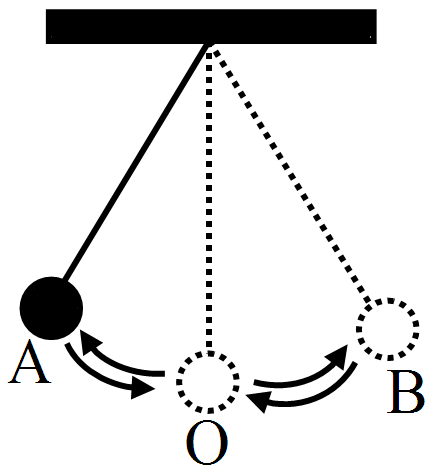
The time period of a simple pendulum is the time taken by it to travel from:
- ✓
$A$ to $8$ and back to $A.$
- B
$O$ to $A, A$ to $8$ and $8$ to $A.$
- C
$8$ to $A, A$ to $8$ and $8$ to $O.$
- D
$A$ to $8.$
AnswerCorrect option: A. $A$ to $8$ and back to $A.$
Time period of a simple pendulum is the total time taken to complete one full cycle.
View full question & answer→MCQ 731 Mark
If the speed of an object along a straight line keeps changing, its motion is said to be:
- A
- ✓
Non $-$ uniform motion
- C
- D
AnswerCorrect option: B. Non $-$ uniform motion
If the speed of an object moving along a straight line keeps changing, its motion is said to be non uniform motion.
View full question & answer→MCQ 741 Mark
Physical quantity which we can’t obtain from a distance $-$ time graph is:
AnswerVelocity is that physical quantity which can be calculated by finding the slope of a distance $-$ time graph.
View full question & answer→MCQ 751 Mark
The motion of a vibrating particle from one extreme position to another extreme position about its mean position is:
AnswerThe motion of vibrating particle is circulation.
View full question & answer→MCQ 761 Mark
- ✓
$366$ days
- B
$365$ days
- C
$364$ days
- D
$363$ days
AnswerCorrect option: A. $366$ days
A leap year is a year containing an extra day.
It has $366$ days instead of the normal $365$ days.
The extra day is added in February, which has $29$ days instead of the normal $28$ days.
Leap years occur every $4$ years.
View full question & answer→MCQ 771 Mark
The speed of the vehicle is recorded by.
AnswerSpeedometer, instrument that indicates the speed of a vehicle, usually combined with a device known as an odometer that records the distance traveled.
View full question & answer→MCQ 781 Mark
A car covers a distance of $220\ km$ in $4$ hours what is its speed:
- A
$50 \ km/ h$
- ✓
$55 \ km/ h$
- C
$224 \ km/ h$
- D
$880 \ km/ h$
AnswerCorrect option: B. $55 \ km/ h$
The speed of a car is $55\ km/ h.$
View full question & answer→MCQ 791 Mark
Motion of a bus moving on a crowded road is an example of:
AnswerCorrect option: B. Non $-$ uniform motion
In a crowded road, moving through different traffic conditions, a bus travels at different speeds at different points of time.
View full question & answer→MCQ 801 Mark
If the velocity of a body does not change with time, its acceleration is:
AnswerAcceleration has to do with changing how fast an object is moving.
If an object is not changing its velocity, then the object is not accelerating.
View full question & answer→MCQ 811 Mark
The distance$-$time graph of an object under uniform motion is a:
AnswerThe distance $-$ time graph of an object moving with a uniform speed $($or constant speed$)$ is a straight line.
View full question & answer→MCQ 821 Mark
What is the distance traveled by the body during the first $100$ seconds?
- ✓
$200m$
- B
$50m$
- C
$100m$
- D
$25m$
AnswerCorrect option: A. $200m$
According to the graph, the body covers a distance of $100$ metres in first $50$ seconds and then it further covers a distance of $100$ metres in next $50$ seconds in return journey.
Thus, the body covers a total distance of $200$ metres during its motion but the net displacement of the body is zero.
View full question & answer→MCQ 831 Mark
A simple pendulum is an example of:
AnswerPeriodic motion is an example of a simple pendulum.
View full question & answer→MCQ 841 Mark
The pictorial representation of two variables inter dependent of one another is known as:
AnswerGraph is pictorial representation of two objects.
View full question & answer→MCQ 851 Mark
Which of the following are examples of non $-$ uniform motion along a straight line?
- A
- ✓
Brakes applied on a fast moving car
- C
Train on a straight bridge
- D
AnswerCorrect option: B. Brakes applied on a fast moving car
In non $-$ uniform motion, the speed of the object changes along a straight line.
It may increase or decrease for different intervals of time.
When brakes are applied, the car decelerates and its speed changes with time.
So applying brakes on a fast moving car is the example of non $-$ uniform motion.
View full question & answer→MCQ 861 Mark
How will you convert the speed given in km/ h to $m/ s?$
- A
By multiplying with $5/16.$
- B
By multiplying with $6/5.$
- C
By multiplying with $18/5.$
- ✓
By multiplying with $5/18.$
AnswerCorrect option: D. By multiplying with $5/18.$
Conversion of $km/ h$ into $m/ s.$
$1km = 1000m$ and $1h = 60min = 3600s$
$\Rightarrow\ \frac{1\text{km}}{1\text{h}}=\frac{1000\text{m}}{3600\text{s}}=\frac{5}{18}\text{m/s}$
View full question & answer→MCQ 871 Mark
The meter that is used to measure speed of a vehicle is:
AnswerSpeedometer is the device used in vehicle to measure speed of that vehicle.
View full question & answer→MCQ 881 Mark
If an object covers equal distance in equal intervals of time, then the object is said to have:
- A
Non $-$ uniform motion
- ✓
- C
- D
AnswerA staight line covers equal distance in equal intervals of time is uniform motion.
View full question & answer→MCQ 891 Mark
The correct symbol to represent the speed of an object is:
- ✓
$5m/s$
- B
$5mp$
- C
$5m/s^{-1}$
- D
$5s/m$
AnswerCorrect option: A. $5m/s$
$5m/s$ is the correct symbol to represent the speed of an object because the unit of speed is $m/s (or\ m/s^{-1}).$
View full question & answer→MCQ 901 Mark
Which of the following instrument measures time with the most accuracy?
- A
- B
- ✓
- D
Mechanical clock with gears.
View full question & answer→MCQ 911 Mark
Which of the following is correct statements:
- ✓
The basic unit of time is second.
- B
Every object moves with a constant speed.
- C
Distance between two cities is measured in metres.
- D
The time period of a given pendulum is not constant.
AnswerCorrect option: A. The basic unit of time is second.
The basic unit of time is second.
View full question & answer→MCQ 921 Mark
Observe Figure:
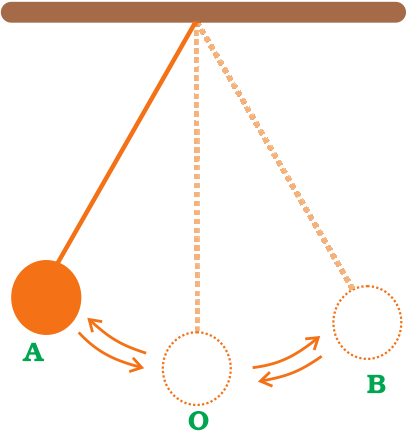
The time period of a simple pendulum is the time taken by it to travel from,
- ✓
$A$ to $B$ and back to $A.$
- B
$O$ to $A, A$ to $B$ and $B$ to $A$.
- C
$B$ to $A, A$ to $B$ and $B$ to $O.$
- D
$A$ to $B.$
AnswerCorrect option: A. $A$ to $B$ and back to $A.$
Time period of a simple pendulum is the total time taken to complete one full cycle, (i.e. from $A$ to $6$ and back to $A).$
View full question & answer→MCQ 931 Mark
The quantity which tells the distance an object travels in a certain time is called:
AnswerThe quantity which tells the distance an object travels in a certain time is called speed.
Speed$=\frac{\text{Distance}}{\text{Time}}$
View full question & answer→MCQ 941 Mark
The meter that is used to measure speed of a vehicle is:
MCQ 951 Mark
The times taken by a pendulum to complete one oscillation is:
AnswerTime period of a pendulum is defined the time taken by it to complete one oscillation.
Time period of simple pendulum $\text{T}=2\pi\sqrt{\frac{1}{\text{g}}}$ where l is the length of pendulum string and g is the acceleration due to gravity.
View full question & answer→MCQ 961 Mark
The time taken by the earth to complete one rotation about is own axis is called:
AnswerSolar day is defined as the time taken by the earth to complete one rotation about its own axis.
View full question & answer→MCQ 971 Mark
The meter that is used to measure the distance moved by the vehicle is known as $.........$
View full question & answer→MCQ 981 Mark
Speedometer of a car measures:
AnswerSpeedometer is device that measure the speed of vehicle, at any instant of time $i.e$ measure instantaneous speed.
View full question & answer→MCQ 991 Mark
The to and fro motion of the particle about its mean position is called:
AnswerTo and fro motion of a particle about mean position is called vibrational motion.
View full question & answer→MCQ 1001 Mark
Which is in uniform motion from the following?
- A
The motion of Cristiano Ronaldo in the field.
- B
The motion of Usain Bolt in the race track.
- ✓
The motion of earth around the sun.
- D
AnswerCorrect option: C. The motion of earth around the sun.
The motion of Christiano Ronaldo in the field, motion of Usain Bolt in the race track and the motion of freely falling body are the examples of non uniform motion whereas motion of earth around the sun is the example of uniform motion.
View full question & answer→MCQ 1011 Mark
The motion of second's hand in a clock is an example of:
AnswerThe head of the second's hand covers equal distance in equal intervals of time.
View full question & answer→MCQ 1021 Mark
A simple pendulum takes $32S$ complete $20$ oscillations. What is the time period of pendulum:
AnswerCorrect option: B. $0.625$
The time period of pendulum is $0.625.$
View full question & answer→MCQ 1031 Mark
Which of the following methods of measurement of time is suitable for a race?
- ✓
- B
- C
- D
Reflection of an object by sun rays
AnswerStop watch is used because of its precise measurement since its least count is less so able to measure fractions of a second which is required in a race because sometimes time taken by two contestants differ only by a fraction of a second so stopwatch helps in determining the winner.
View full question & answer→MCQ 1041 Mark
$36 km/hr$ can also be expressed as:
- ✓
$10m/ s$
- B
$3.6m/ s$
- C
$100m/ s$
- D
$36m/ s$
AnswerCorrect option: A. $10m/ s$
$10m/ s$
View full question & answer→MCQ 1051 Mark
Boojho walks to his school which is at a distance of $3km$ from his home in $30$ minutes. On reaching he finds that the school is closed and comes back by a bicycle with his friend and reaches home in $20$ minutes. His average speed in $km/ h$ is:
AnswerBoojho Home to school to again home
From home to school distance is $3\ km$ time taken is
$30\text{min}=\big(\frac{30}{60}\big)\text{hour}=0.5\text{hour}$
And in returning from school to home time taken
$20\text{min}=\big(\frac{20}{60}\big)\text{hour}=0.33\text{hour}$
$\text{Average speed}=\frac{\text{Total distance}}{\text{time taken}}$
$=\frac{(3+3)}{(0.5+0.33)}\text{km/ h}$
$=7.2\text{km/ h}$
View full question & answer→MCQ 1061 Mark
The basic unit of speed is:
- A
$Km/ min$
- B
$m/ min$
- C
$km/ h$
- ✓
$m/ s$
AnswerCorrect option: D. $m/ s$
$m/ s$
View full question & answer→MCQ 1071 Mark
The distance moved by the object in a unit time is:
AnswerThe distance moved by the object in a unit time is speed.
View full question & answer→MCQ 1081 Mark
Watch used to measure short interval of time is:
AnswerThe stopwatch is used to measure short time intervals.
View full question & answer→MCQ 1091 Mark
The time taken by the earth to make one revolution around the sun is called a:
AnswerThe earth make one revolution around the sun in a year.
View full question & answer→MCQ 1101 Mark
Right sequence in increasing magnitude is:
- A
Decade, second, week, nanosecond.
- B
Nanosecond, week, second, decade.
- ✓
Nanosecond, second, week, decade.
- D
Nanosecond, decade, second, week.
AnswerCorrect option: C. Nanosecond, second, week, decade.
$1\ ns = 10^{−9}s$
$1$ week $= 7$ days $= 604800s$
$1$ decade $= 10$ yrs $= 3.17 \times 10^{−9}s$
View full question & answer→MCQ 1111 Mark
Among the following which was used to measure time in ancient time?
AnswerIn the ancient time, sundial was used to measure time.
View full question & answer→MCQ 1121 Mark
The hammer of an electric bell has motion:
AnswerThe hammer of an electric bell has vibratory motion.
View full question & answer→MCQ 1131 Mark
When weight of bob in a pendulum is increased then the oscillation period of a pendulum is:
AnswerWhen weight of bob in pendulum is increased, the oscillation period of pendulum is decreased.
View full question & answer→MCQ 1141 Mark
- ✓
$\text{D}=\text{S}\times\text{T}$
- B
$\text{D}=\frac{\text{T}}{\text{S}}$
- C
$\text{D}=\frac{\text{S}}{\text{T}}$
- D
$\text{D}=\frac{1}{\text{T}\times{\text{S}}}$
AnswerCorrect option: A. $\text{D}=\text{S}\times\text{T}$
$\text{D}=\text{S}\times\text{T}$
View full question & answer→MCQ 1151 Mark
A faster moving object covers:
- A
Less distance in more time.
- B
More distance in more time.
- C
Less distance in shorter time.
- ✓
More distance in shorter time.
AnswerCorrect option: D. More distance in shorter time.
More distance in shorter time.
View full question & answer→MCQ 1161 Mark
How many seconds are there in a week?
- A
$60480$
- ✓
$604800$
- C
$6048000$
- D
$6048$
AnswerCorrect option: B. $604800$
$1$ week $= 7$days
$= 7$days $\times 24hrs/ day \times 60min/ hr \times 60sec/ min$
$= 604800s$
View full question & answer→MCQ 1171 Mark
An aeroplane cruising in the air is an example of:
- ✓
- B
- C
Either uniform or non uniform motion
- D
Neither uniform nor non uniform motion
AnswerAn aeroplane cruising in the air moves with a constant speed.
So, its motion is uniform motion.
View full question & answer→MCQ 1181 Mark
A device used to measure the speed of vehicles is:
AnswerSpeedometer measure the speed of vehicles.
View full question & answer→MCQ 1191 Mark
The $S.I.$ unit of speed is:
- ✓
$m/ s$
- B
$km/ min$
- C
$km/ h$
- D
$km/ s$
AnswerCorrect option: A. $m/ s$
The $S.I.$ unit of speed is $m/ s.$
View full question & answer→MCQ 1201 Mark
A car moves with a speed of 40km/h for $15$ minutes and then with a speed of 60km/h for the next $15$ minutes. The total distance covered by the car is:
- A
$100\ km.$
- ✓
$25\ km.$
- C
$15\ km.$
- D
$10\ km.$
AnswerCorrect option: B. $25\ km.$
Case I
Speed of the car $= 40 km/h$
Time taken $= 15$ min $=\frac{15}{60}=0.25\text{h}$
$\text{Speed}=\frac{\text{Distance covered}}{\text{Time taken}}$
Distance covered, d1 = Speed $\times $ Time taken $= 40 \times 0.25 = 10km$
Case II
Speed of the car = 60km/h
Time taken $= 15$ min $=\frac{15}{60}=0.25\text{h}$
$\text{Speed}=\frac{\text{Distance covered}}{\text{Time taken}}$
Distance covered, d2 = Speed \times Time taken $= 60 \times 0.25 = 15km$
Total distance covered by the car, $d = d1 + d2 = 10 + 15 = 25km$
Therefore, the total distance covered by the car is 25km.
View full question & answer→MCQ 1211 Mark
Measurement of time can be done with the help of a:
AnswerA pendulum is a weight suspended from a pivot so that it can swing freely.
When a pendulum is displaced sideways from its resting, equilibrium position, it is subject to a restoring force due to gravity that will accelerate it back toward the equilibrium position.
When released, the restoring force combined with the pendulum's mass causes it to oscillate about the equilibrium position, swinging back and forth.
The time for one complete cycle, a left swing and a right swing, is called the period.
The period depends on the length of the pendulum .
This time period when known can be used to measure time.
View full question & answer→MCQ 1221 Mark
The distance travelled by $5$ identical particles is given below in the options $A, B, C, D$ and $E$ respectively at specific time interval. Which object is moving with a constant velocity?
- A
$1m, 4m, 9m, 16m, 25m$
- B
$2m, 2m, 4m 4m, 6m$
- ✓
$2m, 4m, 6m, 8m, 10m$
- D
$6m, 11m, 15m, 18m, 20m$
AnswerCorrect option: C. $2m, 4m, 6m, 8m, 10m$
If the particle moves with constant velocity,
$\text{Velocity v}=\frac{\triangle\text{x}}{\triangle\text{t}}=\text{constant}$
Thus for equal time intervals, the distance traveled must be equal.
The distance traveled by object in option $C$ remains the same for each interval and is equal to $\triangle\text{x}=4\text{m}-2\text{m}=2\text{m}.$
View full question & answer→MCQ 1231 Mark
Which of the following is$/$ are correct regarding uniform and non $-$ uniform motion?
AnswerTwo sentences are correct regarding uniform motion:
$i.$ The body must be moving in a straight line path.
$ii.$ The slope of displacement time graph for uniform motion is constant and gives constant velocity.
In other words, the velocity should be constant, $i.e.$
its direction and magnitude should be constant.
A car coming to half is an example of non $-$ uniform motion as its speed changes with time, the sentence is correct regarding non$-$uniform motion.
View full question & answer→MCQ 1241 Mark
A horse pulling a cart has:
AnswerDuring running the hands move to and fro and as this motion gets repeated after certain time interval.
Therefore it is oscillatory motion.
View full question & answer→MCQ 1251 Mark
The metallic ball in a pendulum is called as$.........$
View full question & answer→MCQ 1261 Mark
Which of the following clocks is most accurate?
AnswerCaesium clocks are the most accurate commercially produced time and frequency standards, and serve as the primary standard for the definition of the second in $SI$ system.
Hence, Caesium clock is most accurate clock.
View full question & answer→MCQ 1271 Mark
The meter that measures the distance moved by a vehicle is:
MCQ 1281 Mark
The time taken by the earth to complete one rotation about is own axis is called:
AnswerSolar day is defined as the time taken by the earth to complete one rotation about its own axis.
View full question & answer→MCQ 1291 Mark
When the distance an object travels is directly proportional to the time, it is said to travel with:
AnswerWhen the distance an object travels is directly proportional to time, it is said to travel with Constant Speed.
$\text{Speed}=\frac{\text{distance travelled}}{\text{time}}$
View full question & answer→MCQ 1301 Mark
The graph between distance and time for a non uniform motion is a:
AnswerThe graph between distance and time is curve line for non $-$ uniform motion.
View full question & answer→MCQ 1311 Mark
The correct symbol to represent the speed of an object is:
- ✓
$5m/s$
- B
$5m$
- C
$5m/s^{-1}$
- D
$5s/m$
AnswerCorrect option: A. $5m/s$
A. $5m/s.$
View full question & answer→MCQ 1321 Mark
An odometer is used to measure:
AnswerDistance is measured by an odometer.
View full question & answer→MCQ 1331 Mark
If the speed of a body moving in a straight line changes then the speed of the body is:
AnswerCorrect option: B. Non $-$ uniform
If the speed of a body moving in a straight line changes then the speed of the body is non $-$ uniform.
View full question & answer→MCQ 1341 Mark
Nearly all the clocks make use of:
AnswerAll the clocks around the world are manufactured to show some circular periodic motion so that the accurate type of time measurement can be featured in all the clocks.
View full question & answer→MCQ 1351 Mark
Boojho walks to his school which is at a distance of $3\ km$ from his home in $30$ minutes. On reaching he finds that the school is closed and comes back by a bicycle with his friend and reaches home in $20$ minutes. His average speed in km/h is:
Answer Given, total distance $= 3 + 3 = 6\ km,$
Total time $= 30 + 20 = 50\min$
$=\frac{50}{60}\text{h}$
$\text{Average speed}=\frac{\text{Total distance}}{\text{Total time taken}}$
$=\frac{6}{\frac{50}{60}}$
$=\frac{6}{50}\times60$ $\big[\because1\text{h}=60\text{min}\big]$
$=7.2\text{km/h}$
View full question & answer→MCQ 1361 Mark
The distance-time graph for the motion of an object moving with a constant speed is:
- A
A curved line leaving towards $x-$axis.
- B
A curved line inclined towards $y-$axis.
- ✓
A straight line inclined at some angles towards $x-$axis.
- D
AnswerCorrect option: C. A straight line inclined at some angles towards $x-$axis.
A straight line inclined at some angles towards $x-$axis.
View full question & answer→MCQ 1371 Mark
The value of $2\ km/ hr$ is equal to:
- A
$\frac49\text{m/ s}$
- ✓
$\frac59\text{m/ s}$
- C
$\frac{13}9\text{m/ s}$
- D
$\frac79\text{m/ s}$
AnswerCorrect option: B. $\frac59\text{m/ s}$
$\frac59\text{m/ s}$
View full question & answer→MCQ 1381 Mark
The standard unit of length is:
- ✓
Metre $(‘m’)$
- B
- C
$m/ s$
- D
$km/ h$
AnswerCorrect option: A. Metre $(‘m’)$
The standard unit of length is meter $(‘m’).$
View full question & answer→MCQ 1391 Mark
Figure shows an oscillating pendulum.
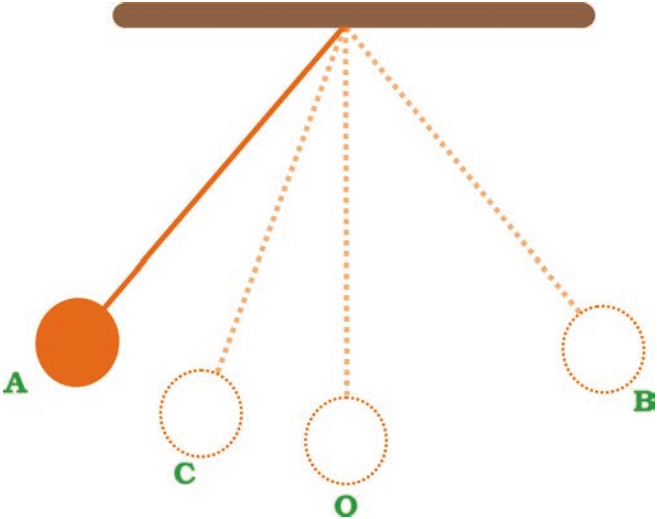
Time taken by the bob to move from $A$ to $C$ is $t_1$ and from $C$ to $O$ is $t_2$. The time period of this simple pendulum is: - A
$(t_1 + t_2)$
- B
$2(t_1 + t_2)$
- C
$3(t_1 + t_2)$
- ✓
$4(t_1 + t_2)$
AnswerCorrect option: D. $4(t_1 + t_2)$
The total time taken by the bob to move from $A$ to $O$ is $(t_1 + t_2)$ which is $\frac{1}{4}\text{th}$ time of one full cycle of pendulum. Time period of pendulum i.e. time taken by pendulum to complete one oscillation from $A$ to $B$ and back to $A$ will be $4(t_1 + t_2)$
View full question & answer→MCQ 1401 Mark
Odometer: Distance $.........$
AnswerCorrect option: A. Weighing scale $:$ Weight
An odometer is an instrument used in a vehicle to measure the distance covered by it.
Similarly, the weighing scale is an instrument used to measure the weight of an object.
View full question & answer→MCQ 1411 Mark
Classify the following as motions is oscillatory motion:
- ✓
Motion of your hands while runnning.
- B
Motion of a horse pulling a cart on a straight road.
- C
Motion of a child in a merry go round.
- D
Motion of a train on a straight line.
AnswerCorrect option: A. Motion of your hands while runnning.
Motion your hands while running is oscillatory motion.
View full question & answer→MCQ 1421 Mark
Which one records the distance travelled by a vehicle?
MCQ 1431 Mark
What is the use of speedometer in a vehicle?
- A
Displays the mileage of the vehicle.
- B
Displays the instantaneous distance of a vehicle.
- ✓
Displays the instantaneous speed of a vehicle.
- D
AnswerCorrect option: C. Displays the instantaneous speed of a vehicle.
Speedometer in the vehicle shows the instantaneous speed of the vehicle.
View full question & answer→MCQ 1441 Mark
Which of the following is$/$are unit of time:
AnswerAll are units of time. The time taken by the earth to complete one rotation about its own axis is called solar day.
View full question & answer→MCQ 1451 Mark
What is the relation between distance and speed?
- ✓
Distance $=$ Speed $\times$ Time
- B
Distance $=\frac{\text{Speed}}{\text{Time}}$
- C
Distance $=\frac{\text{Time}}{\text{Speed}}$
- D
AnswerCorrect option: A. Distance $=$ Speed $\times$ Time
Distance $=$ Speed $\times$ Time
View full question & answer→MCQ 1461 Mark
Motion of a train on a straight
AnswerA train on a straight bridge is straight line motion.
View full question & answer→MCQ 1471 Mark
An earth completes one revolution around the sun in:
- A
$1$ day
- ✓
$1$ year
- C
$1$ hour
- D
AnswerCorrect option: B. $1$ year
An earth complete one revolution around the sun in a year.
View full question & answer→MCQ 1481 Mark
For measuring time in sports events like sprinting, milisecond(ms) is a commonly used unit of time. $1ms=?$
- A
$10^{−12}s$
- B
$10^{−9}s$
- ✓
$10^{−3}s$
- D
AnswerCorrect option: C. $10^{−3}s$
C. $10^{−3}s$
Explanation:
$1\text{ms}=\frac{1}{1000}\text{s}=10^{-3}\text{s}$
View full question & answer→MCQ 1491 Mark
The basic unit of speed is:
- A
$km/ min$
- B
$m/ min$
- C
$km/ h$
- ✓
$m/ s$
AnswerCorrect option: D. $m/ s$
$m/ s$
View full question & answer→MCQ 1501 Mark
Which of the following is a scalar quantity?
MCQ 1511 Mark
A bus travels $54\ km$ in $90$ minutes. The speed of the bus is:
- A
$0.6\ m/ s$
- ✓
$10\ m/ s$
- C
$5.4\ m/ s$
- D
$3.6\ m/ s$
AnswerCorrect option: B. $10\ m/ s$
Distance $= 54\ km$
$= 54 \times 1000\ m$
Distance $= 54000\ m$
Time $= 90$ minutes
$= 90 \times 60$
Time $= 5400s$
Therefore,
Distance $= 54000\ m$
Time $= 5400s$
$\text{Speed}=\frac{\text{Distance}}{\text{Time}}$
$\text{Speed}=\frac{54000}{5400}$
Speed $= 10\ m/ s$
View full question & answer→MCQ 1521 Mark
Speed of a body depends on:
- A
- B
- C
Distance travelled by the body
- ✓
Both $A$ and $C$
AnswerCorrect option: D. Both $A$ and $C$
Speed is defined as
$\text{Speed}=\frac{\text{Distance travelled}}{\text{time interval}}$
Hence speed depends both on time and distance travelled by the body.
View full question & answer→MCQ 1531 Mark
What does the path of an object look like when it is in uniform motion?
AnswerIn uniform motion, the object moves along a straight path $i.e.$ The path of object is a straight line.
View full question & answer→MCQ 1541 Mark
If we denote speed by $S,$ distance by $D$ and time by $T,$ the relationship between these quantities is:
- A
$\text{S}=\text{D}\times\text{T}$
- B
$\text{T}=\frac{\text{S}}{\text{D}}$
- ✓
$\text{S}=\frac{1}{\text{T}}\times\text{D}$
- D
$\text{S}=\frac{\text{T}}{\text{D}}$
AnswerCorrect option: C. $\text{S}=\frac{1}{\text{T}}\times\text{D}$
$\because\text{Speed(S)}=\frac{\text{Distance(D)}}{\text{Time(T)}}$
View full question & answer→MCQ 1551 Mark
Two students were asked to plot a distance-time graph for the motion described by Table $A$ and Table $B.$
Table A
|
Distance moved (m)
|
$0$
|
$10$
|
$20$
|
$30$
|
$40$
|
$50$
|
|
Time (minutes)
|
$0$
|
$2$
|
$4$
|
$6$
|
$8$
|
$10$
|
Table B
|
Distance moved (m)
|
$0$
|
$5$
|
$10$
|
$15$
|
$20$
|
$25$
|
|
Time (minutes)
|
$0$
|
$1$
|
$2$
|
$3$
|
$4$
|
$5$
|
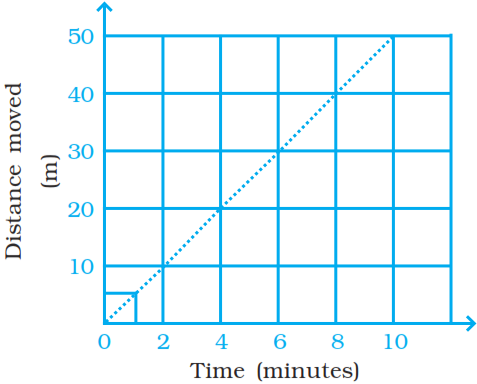
The graph given in Figure is true for: - ✓
Both $A$ and $B.$
- B
$A$ only.
- C
$B$ only.
- D
Neither $A$ nor $B.$
AnswerCorrect option: A. Both $A$ and $B.$
Since, speed is constant for $A$ and $B,$ so graph for $A$ and $B$ will be a straight line as given in figure.
View full question & answer→MCQ 1561 Mark
According to $SI$ system, the standard unit of time is:
AnswerAccording to $SI$ system, the standard unit of time is second.
View full question & answer→MCQ 1571 Mark
A body in uniform motion moves with:
AnswerA motion of a body is said to be uniform when it covers equal distance in equal interval of time.
It can be rectilinear, circular. In uniform motion, direction does not matter whether it is changing or not, but magnitude $i.e.$ speed needs to be constant.
View full question & answer→