Questions

3 Marks Question

Take a timed test

14 questions · self-marked practice — reveal the answer and mark yourself.

Question 13 Marks
The population of a city decreased from $25,000$ to $24,500$ . Find the percentage decrease.
Answer
The decreased population of a city from $25,000$ to $24,500 .$
Population decreased $=25,000-24,500=500$
Decreased Percentage $=\frac{\text { Population decreased }}{\text { Original population }} \times 100=\frac{500}{25000} \times 100=2 \%$
Hence, the percentage decreased is $2 \%$.
View full question & answer
Question 23 Marks
A scooter was bought at $₹ 42,000$. Its value depreciated at the rate of $8 \%$ per annum. Find its value after one year.
Answer
Given: cost price of the scooter $= ₹ 42,000$
Rate of depreciation $=8 \%$ p.a.
Time $=1$ year
Final value of the scooter
$\begin{aligned}
& =\text { Present value } \times\left(1-\frac{ R }{100}\right)^n \\
& =42,000 \times\left(1-\frac{8}{100}\right) \\
& =42,000 \times \frac{23}{25} \\
& =1,680 \times 23=38,640
\end{aligned}$
Hence, the value of scooter after $1$ year $=₹ 38,640$.
View full question & answer
Question 33 Marks
In a Laboratory, the count of bacteria in a certain experiment was increasing at the rate of $2.5 \%$ per hour. Find the bacteria at the end of $2$ hours if the count was initially $5,06,000.$
Answer
Given: Initial count of bacteria $=5,06,000$
Rate $=2.5 \%$ per hour
$n =2$ hours
Number of bacteria at the end of $2$ hours = Number of count of bacteria initially $ \times \left(1+\frac{R}{100}\right)^n$
$\begin{aligned}
& =5,06,000\left(1+\frac{2.5}{100}\right)^2 \\
& =5,06,000 \times\left(\frac{41}{40}\right)^2 \\
& =5,06,000 \times \frac{1681}{1600} \\
& =531616.25
\end{aligned}$
Thus, the number of bacteria after two hours $=5,31,616$ (approx).
View full question & answer
Question 43 Marks
I purchased a hair-dryer for $₹ 5,400$ including $8\%$ $VAT$. Find the price before $VAT$ was added.
Answer
The price includes $VAT$.
Thus, $8\%$ $VAT$ means that if the price without $VAT$ is Rs $100$, then price including $VAT$ will be Rs $108$.
When price including $VAT$ is Rs $108$, original price = Rs $100$
When price including $VAT$ is Rs $5400$, original price $=\operatorname{Rs}\left(\frac{100}{108} \times 5400\right)$
$=\operatorname{Rs} 5000$
Thus, the price of the hair-dryer before the addition of $VAT$ was Rs $5,000$.
View full question & answer
Question 53 Marks
Arun bought a pair of skates at a sale where the discount is given was $20 \%$. If the amount he pays is $₹ 1,600$, find the marked price.
Answer
Let the $MP$ of the skates be $₹ 100$
Discount = ₹ $20 \%$ of $100 = ₹ 20$
Sale price $= ₹ 100 - ₹$ $20=$ $₹ 80$
If $SP$ is $₹ 80$ then $MP = ₹ 100$
If $SP$ is $₹ 1$ then $MP =₹ \frac{100}{80}$
If $SP$ is $₹ 1,600$ then $MP =₹ \frac{100}{80} \times 1600=₹ 2,000$
Thus the $MP = ₹ 2000$ .
View full question & answer
Question 63 Marks
During a sale, a shop offered a discount of $10\%$ on the marked prices of all the items. What would a customer have to pay for a pair of Jeans marked at $₹ 1450$ and two shirts marked at $₹ 850$ each?
Answer
$\begin{aligned}
& \text { Marked Price (MP) of Jeans }=₹ 1,450 \\
& \text { MP of two shirts = ₹ } 850 \times 2=₹ 1,700 \\
& \text { Total MP = ₹ } 1,450+₹ 1,700=₹ 3,150 \\
& \text { Discount }=10 \% \\
& SP = MP \times\left(1-\frac{\text { discount }}{100}\right) \\
& =3,150 \times\left(1-\frac{10}{100}\right) \\
& =3,15 0 \times \frac{90}{100}=₹ 2,835
\end{aligned}$
Thus, the customer will have to pay $₹ 2,835$ .
View full question & answer
Question 73 Marks
If Chameli had $₹ 600$ left after spending $75\ %$ of her money, how much did she have in the beginning?
Answer
Let the money with Chameli be $₹ 100$
Money spent by her $=75 \%$ of $100$
$=\frac{75}{100} \times 100=₹ 75$
The money left with her $= ₹ 100 - ₹ 75 = ₹ 25$
$₹ 25$ are left with her out of $₹ 100$
$₹ 1$ is left with her out of ₹ $\frac{100}{25}$
$₹ 600$ will be left out of ₹ $\frac{100}{25} \times 600=$ $₹ 2400$
Hence, she had $₹ 2400$ in beginning.
View full question & answer
Question 83 Marks
A scooter was bought at $₹ 42,000$. Its value depreciated at the rate of $8\%$ per annum. Find its value after one year.
Image
Answer
self
View full question & answer
Question 93 Marks
In a Laboratory, the count of bacteria in a certain experiment was increasing at the rate of $2.5\%$ per hour. Find the bacteria at the end of $2$ hours if the count was initially $5, 06,000.$
Answer
self
View full question & answer
Question 103 Marks
The population of a place increased to $54,000$ in $2003$ at a rate of $5\%$ per annum
$(i)$ find the population in $2001$.
$(ii)$ what would be its population in $2005$?
Answer
self
View full question & answer
Question 113 Marks
The population of a city was 20,000 in the year 1997. It increased at the rate of $5 \%$ p.a. Find the population at the end of the year 2000.
Answer
Increase at $5 \%=\frac{5}{100} \times 20000 = 1000$
Populationin 1999 = 20000+1000 = 21000
Increase at $5 \%=\frac{5}{100} \times 21000=1050$
Populationin 2000 = 21000+1050 = 22050
Increase at $5 \%=\frac{5}{100} \times 22050 = 1102.5$
At the end of 2000 the population = 22050 + 1102.5 = 23152.5
or, Population at the end of 2000 = $20000\left(1+\frac{5}{100}\right)^3$
$=20000 \times \frac{21}{20} \times \frac{21}{20} \times \frac{21}{20}$
= 23152.5
So, the estimated population = 23153.
View full question & answer
Question 123 Marks
The list price of a frock is ₹ 220. A discount of $20 \%$ is announced on sales. What is the amount of discount on it and its sale price.
Answer
Marked price is same as the list price.
20% discount means that on ₹100 (MP), the discount is 20. 
By unitary method, on ₹1 the discount will be ₹ $\frac{20}{100}$.
On ₹220, discount = ₹ $\frac{20}{100} \times 220$ = ₹ 44
The sale price = (₹220 - ₹44) or ₹176 
Rehana found the sale price like this ---
    A discount of 20% means for a MP of ₹ 100. discount is 20. Hence the sale price is ₹ 80. Using unitary method, when MP is ₹ 100, sale price is ₹80;
When MP is 1, sale price is ₹ $\frac{80}{100}$.
Hence when MP is 220, sale price = ₹ $\frac{80}{100} \times 220$ = ₹ 176.
View full question & answer
Question 133 Marks
ATV was bought at a price of ₹ 21,000 . After one year the value of the TV was depreciated by $5 \%$ (Depreciation means reduction of value due to use and age of the item). Find the value of the TV after one year.
View full question & answer
Question 143 Marks
A picnic is being planned in a school for Class VII. Girls are $60 \%$ of the total number of students and are 18 in number.
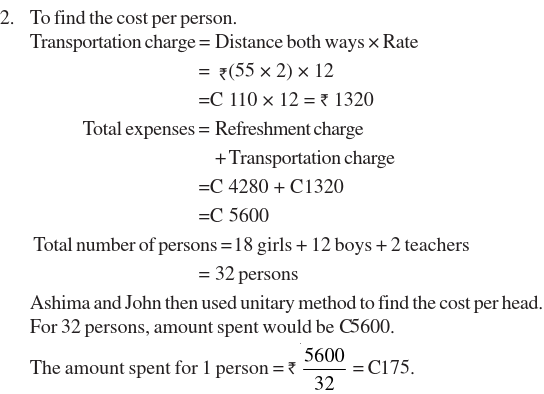
The picnic site is 55 km from the school and the transport company is charging at the rate of ₹ 12 per km. The total cost of refreshments will be ₹ 4280 .
Can you tell.
1. The ratio of the number of girls to the number of boys in the class?
2. The cost per head if two teachers are also going with the class?
3. If their first stop is at a place 22 km from the school, what per cent of the total distance of 55 km is this? What per cent of the distance is left to be covered?
Answer
1. To find the ratio of girls to boys.
Ashima and John came up with the following answers.
They needed to know the number of boys and also the total number of students.
Ashima did this
Let the total number of students.
be $x .60 \%$ of $x$ is girls.
Therefore, $60 \%$ of $x=18$
$\begin{array}{l}\frac{60}{100} \times x=18 \\\text { or, } x=\frac{18 \times 100}{60}=30\end{array}$Number of students $=30$.
So, the number of boys $=30-18=12$.
Hence, ratio of the number of girls to the number of boys is $18: 12$ or $\frac{18}{12}=\frac{3}{2}$.
$\frac{3}{2}$ is written as $3: 2$ and read as 3 is to 2 .

3. The distance of the place where first stop was made $=22 km$.
To find the percentage of distance:
Ashima used this method:
$\frac{22}{55}=\frac{22}{55} \times \frac{100}{100}=40 \%$
She is multiplying the ratio by $\frac{100}{100}=1$ and converting to percentage.
Both came out with the same answer that the distance from their school of the place where they stopped at was $40 \%$ of the total distance they had to travel.
Therefore, the percent distance left to be travelled $=100 \%-40 \%=60 \%$.
View full question & answer