Questions

5 Marks Questions

Take a timed test

14 questions · self-marked practice — reveal the answer and mark yourself.

Question 15 Marks
A car is travelling from city $P$ to city $Q$, which are $350\ km$ apart. The line graph given below describes the distances of the car from the city $P$ at different times.
Study the above graph and answer the questions given below:
$i.$ What information is given on the two axes?
$ii.$ From where and when did the car begin its journey?
$iii.$ How far dis the car go in the first hour?
$iv.$ How far did the car go during $(a)$ the $2^{nd}$ hour and $(b)$ the $3^{rd}$ hour?
$v.$ Was the speed same during first three hours? How do you know it?
$vi.$ Did the car stop for some during at any place? Justify your answer.
$vii.$ When did the car reach city $Q?$
Answer
$1.$ Both boys and girls achieve their maximum height in $18^{th}$ years.
$2.$ Boys grows faster than girls in puberty.
View full question & answer
Question 25 Marks
The following table depicts the maximum temperature on the seven days of a particular week. Study the table and draw a line graph for the same.
Day
Sun
Mon
Tues
Wed
Thurs
Fri
Sat
Maximum temp. (in $^\circ C)$
$25$
$28$
$26$
$32$
$29$
$24$
$31$
View full question & answer
Question 35 Marks
The following table shows the percentage of students who dropped out of school after completing high school.
Year
$2005$
$2007$
$2009$
$2011$
$2013$
$2015$
$2017$
Percentage of students who dropped out of school
$6\%$
$5.5\%$
$5\%$
$4.7\%$
$4.9\%$
$4\%$
$4.5\%$
Study the above table carefully and draw a line graph to depict it.
View full question & answer
Question 45 Marks
Study the table given below and draw a line graph for it.
Side of the square (in cm)
$2$
$3$
$3.5$
$5$
$6$
Perimeter (in cm)
$8$
$12$
$14$
$20$
$24$
Is the graph drawn, a linear graph?
Answer

Yes, we can see that the drawn graph is linear.
View full question & answer
Question 55 Marks
Study the table given below and draw a line graph for it.
Side of the square (in $cm)$
$2$
$3$
$4$
$5$
$6$
Area (in $cm^2$)
$4$
$9$
$16$
$25$
$36$
Is the graph drawn, a linear graph?
Answer
No, the drawn graph is not linear.
View full question & answer
Question 65 Marks
Consider the following input/ output table. Draw a line graph for it.
Input
$1$
$2$
$4$
$5$
$7$
Output
$2$
$5$
$11$
$14$
$20$
View full question & answer
Question 75 Marks
The table given below depicts the annual gross profit of a company for a period of $5$ years. Study the table and draw a line graph for the same.
Year
$2013$
$2014$
$2015$ $2016$
$2017$
Gross profit (in lakhs of Rs.)
$17$
$15.5$
$11.4$
$12.1$
$14.9$
View full question & answer
Question 85 Marks
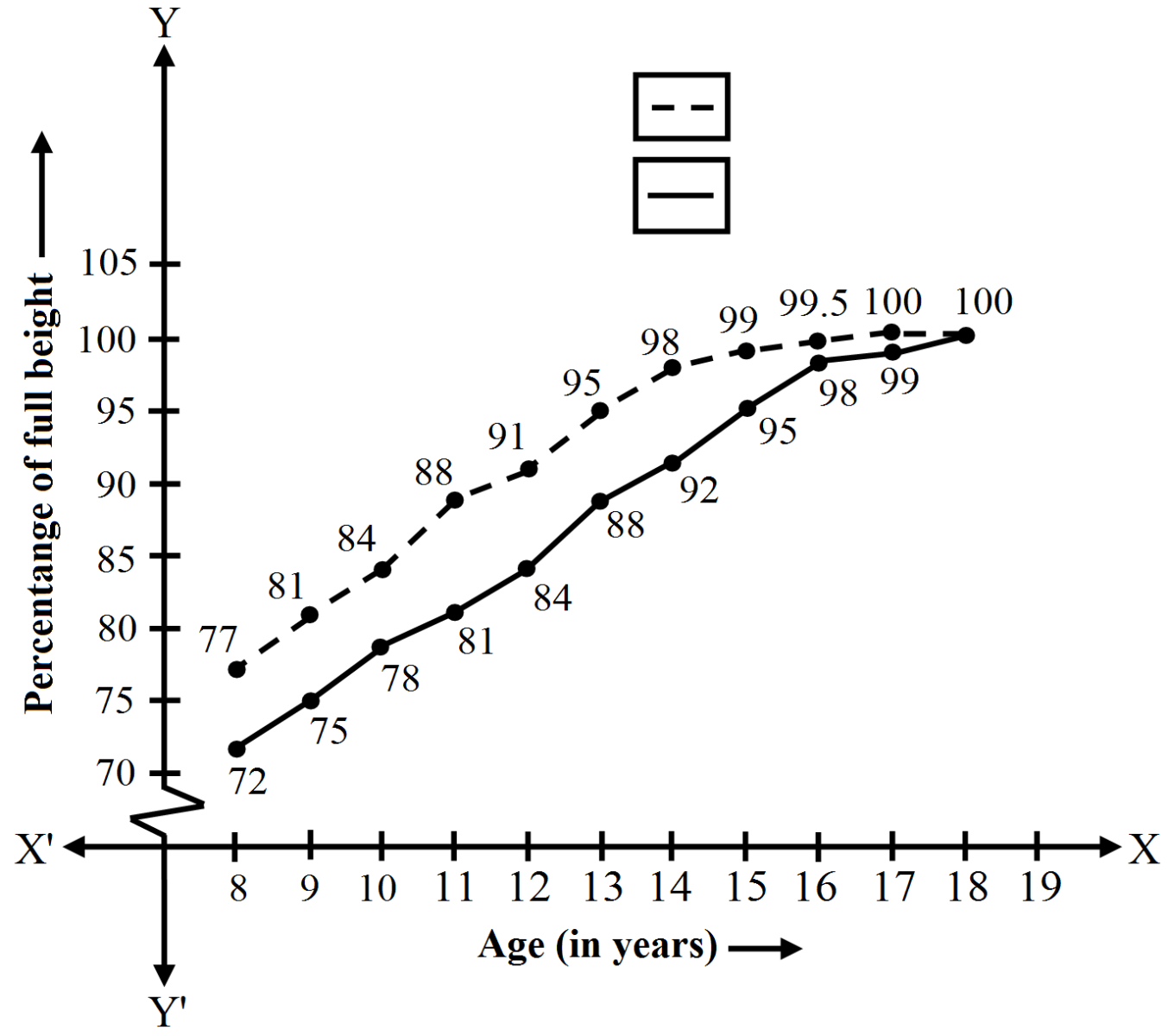
The following table shows the percentage of students who dropped out of school after completing high school.
Age (in Year)
$8$
$9$
$10$
$11$
$12$
$13$
$14$
$15$
$16$
$17$
$18$
Boys
$72\%$
$75\%$
$78\%$
$81\%$
$84\%$
$88\%$
$92\%$
$95\%$
$98\%$
$99\%$
$100\%$
Girls
$77\%$
$81\%$
$84\%$
$88\%$
$91\%$
$95\%$
$98\%$
$99\%$
$99.5\%$
$100\%$
$100\%$
Now, use the graph to answer the following question:
$i.$ In which year both boys and the girls achieve their maximum height?
$ii.$ Who grows faster at puberty $(14$ years to $16$ years of age$)$.
Answer


$i.$ Both boys and girls achieve their maximum height in $18^{th}$ years.
$ii.$ Boys grows faster than girls in puberty.
View full question & answer
Question 95 Marks
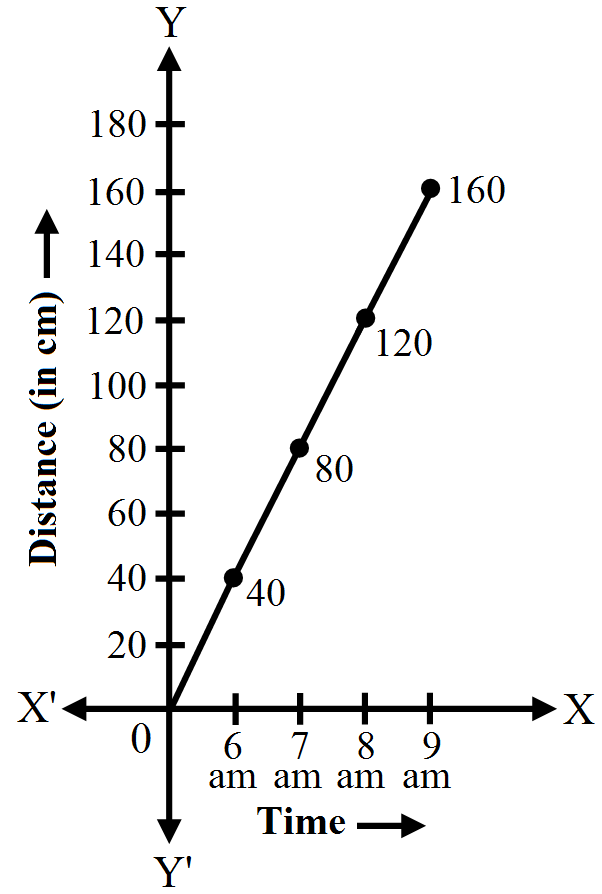
The following table gives the distances travelled by a car at various time$-$intervals. Study the table and draw a linear graph for the same.
Time
$6 a.m.$
$7 a.m.$
$8 a.m.$
$9 a.m.$
Distance $($ in $km)$
$40$
$80$
$120$
$160$
From your graph, answer the questions given below:
$i.$ How much distance did the car cover during the period from $7:30\ a.m.$ to $8\ a.m.$
$ii.$ What was the time when the car had covered a distance of $100\ km$, since its start?
$iii.$ How much distance had the car covered by $8:30\ a.m.?$
Answer

$i.$ The car covers $20\ km$ during the period from $7:30\ a.m$. to $8\ a.m.$
$ii.$ The car covered $100\ km$ at $7:30\ a.m.$
$iii.$ The car covered $140\ km$ by $8:30\ a.m.$
View full question & answer
Question 105 Marks
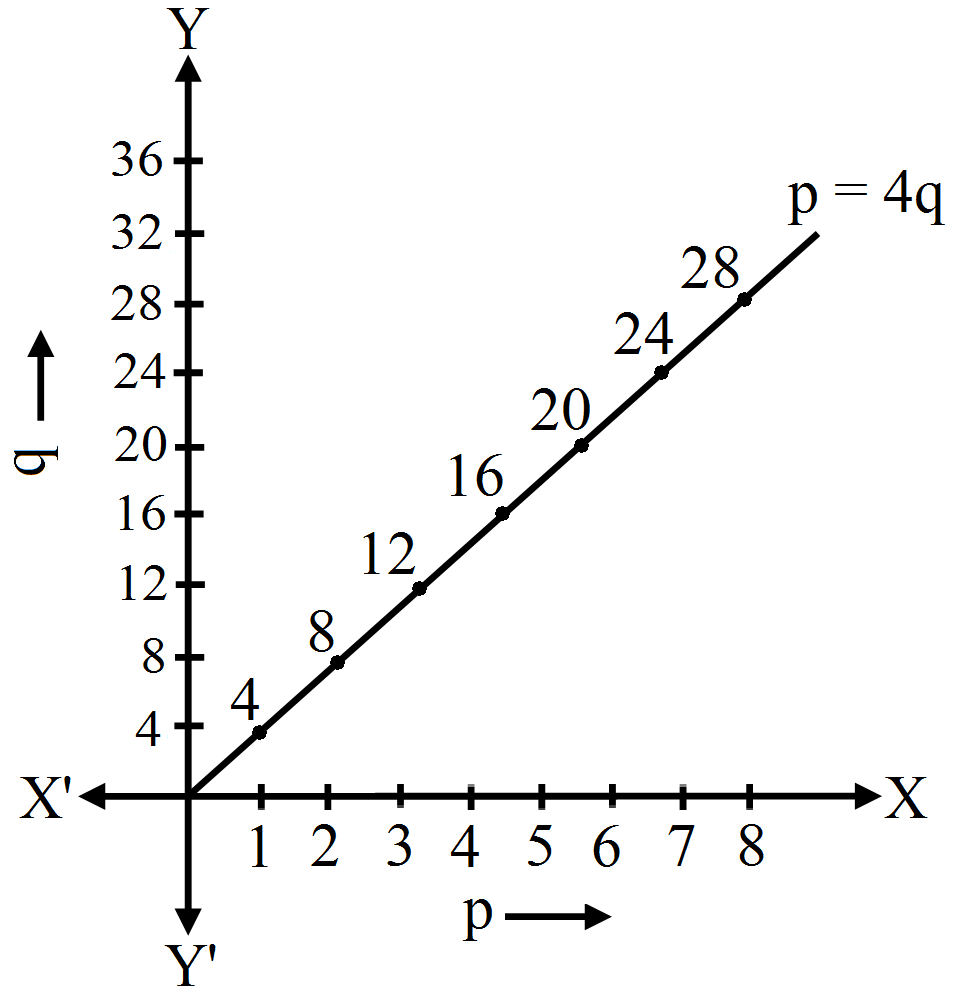
Plot a line graph for the variables $p$ and $q$, where $p$ is four times $q$, i.e., the equation is $p = 4q$. Using the graph, find the value of,
$i. p$, when $q = 6$ and
$ii. q$, when $p = 20$
Answer
We have $p = 4q$
$i.$ When $q = 6$
Then $p = 4 \times 4 = 164$
$ii.$ When $p = 20w$
Then, $20 = 4q$
$5 = q$
And the graph of $p = 4q$ is given by
$p$
$1$
$2$
$3$
$4$
$5$
$6$
$q$
$4$
$8$
$12$
$16$
$20$
$24$
View full question & answer
Question 115 Marks
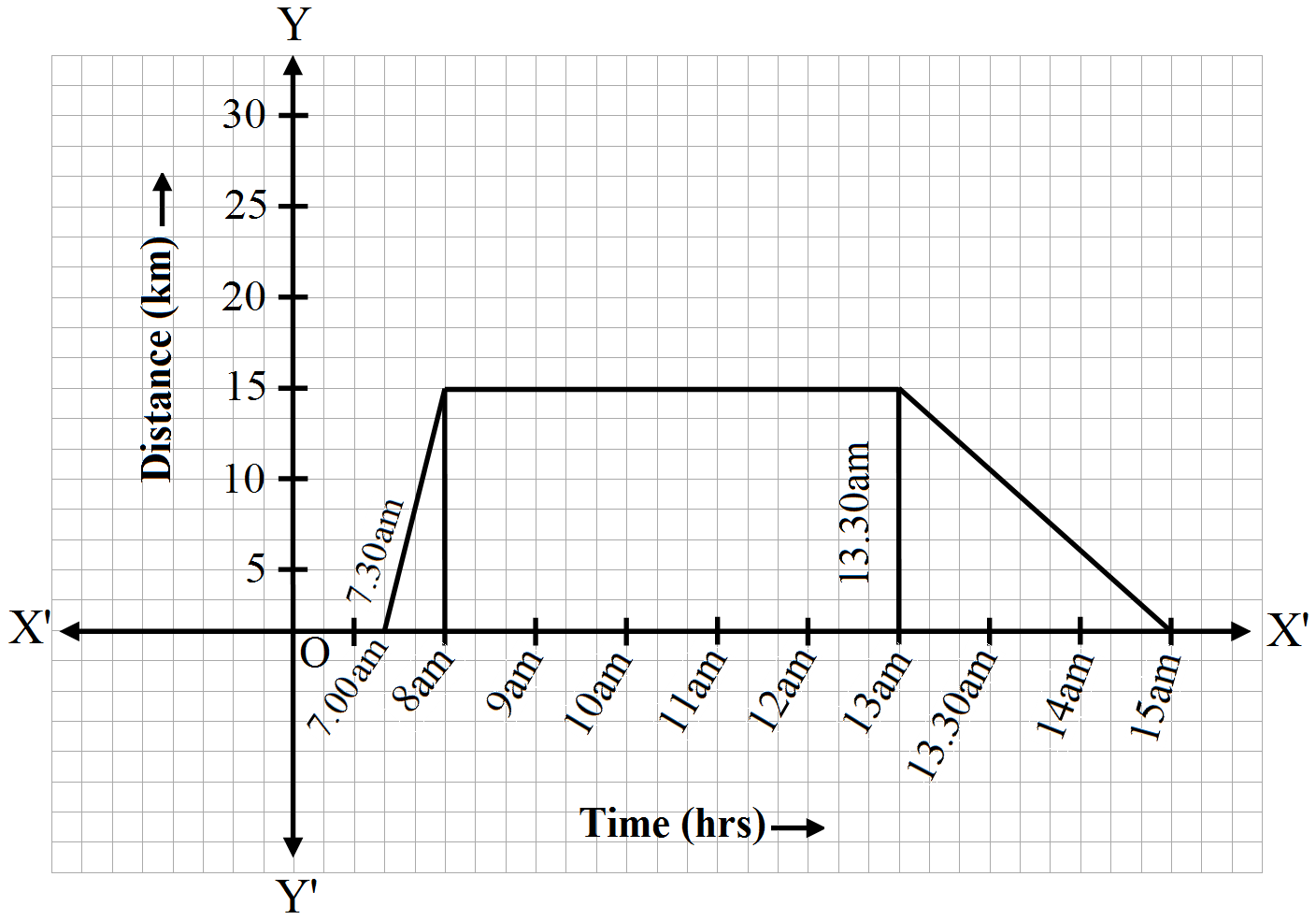
Ajeeta starts off from home at $7\ am$ with her father on a scooter that goes at a uniform speed of $30\ km/ hr$. Her father drops her at her school after half an hour. She stays in the school till $1:30\ pm$ and takes an autorickshaw to return home. The autorickshaw has a uniform speed of $10\ km/ hr$. Draw the line graph for the given situation and also determine the distance of Ajeets's school from her home.
Answer
Distance of Ajeets's school from her home is given by,
$\text{Speed}=\frac{\text{Distansce}}{\text{Times}}$
$30=\frac{\text{Distansce}}{\frac{1}{2}}$
Distance $= 15km$ Distance-Time graph is given by,
 
View full question & answer
Question 125 Marks
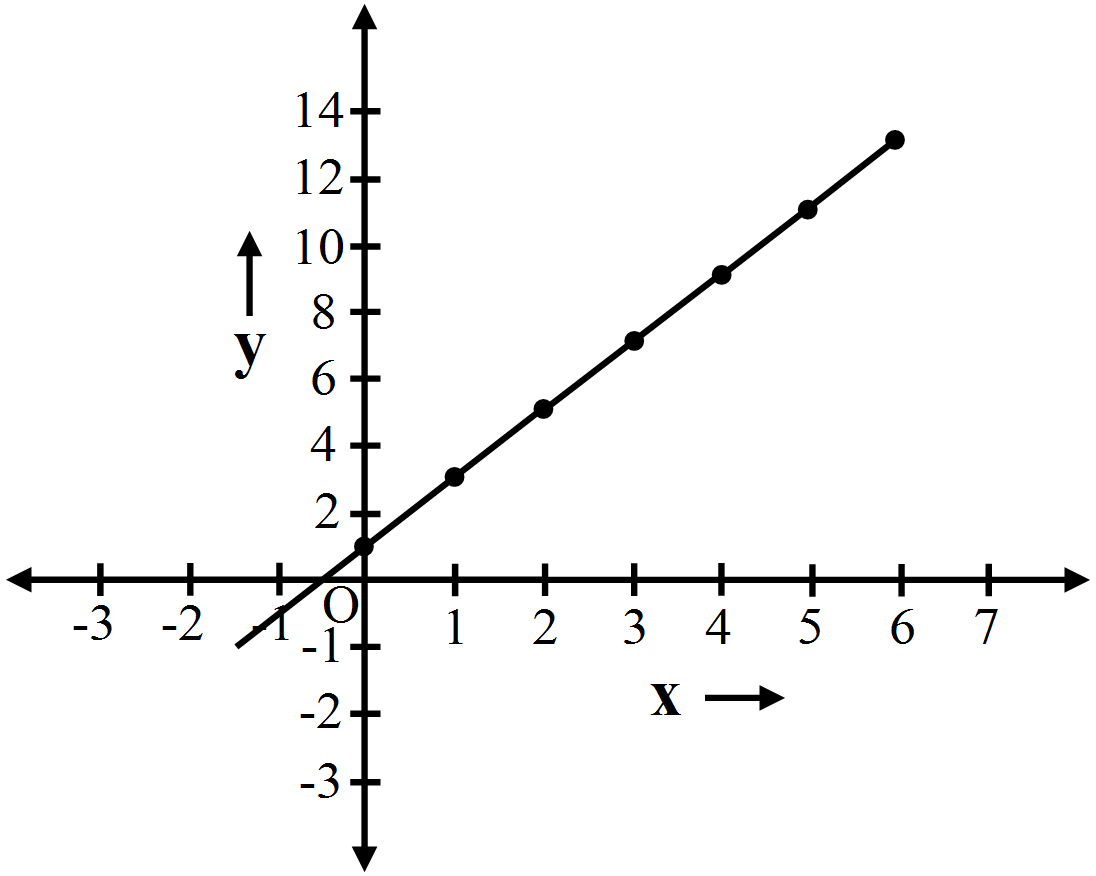
Plot a line graph for the variables $x$ and $y$ , where $y = 2x + 1$. Using the graph, find the value of.
$i. y$, when $x = 5$ and
$ii. x$, when $y = 13$
Answer
We have the following table for $y = 2x + 1$
$x$
$0$
$1$
$2$
$3$
$4$
$y$
$1$
$3$
$5$
$7$
$9$
View full question & answer
Question 135 Marks
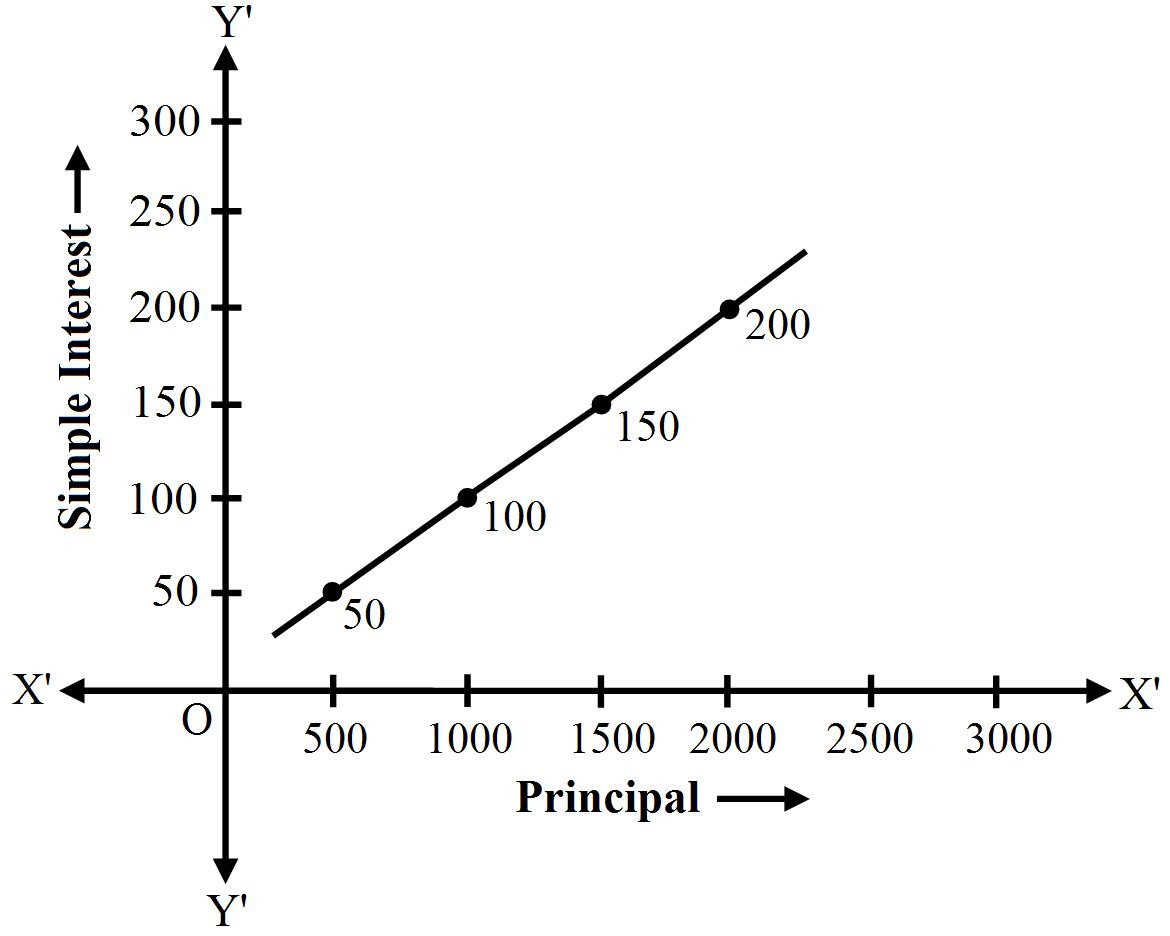
A bank gives $10\%$ simple interest on deposits by senior citizens. Draw a line graph to illustrate the relation between the sum deposited and the simple interest earned. Find from the graph:
$i.$ The annual interest obtainable for a investment of $Rs.250.$
$ii.$ The investment one has to make in order to get an annual simple interest of $Rs. 70.$
Answer
$\text{Using SI}=\frac{\text{P}\times\text{R}\times\text{T}}{100}$
Where, $SI =$ Simple interest.
$P =$ Srincipal.
$R =$ Rate of interest.
$T =$ Time. We have,
$P$ $500$ $1000$ $1500$ $2000$
$SI$ $50$ $100$ $150$ $200$

$i.$ Given sum deposited i.e $P = 250, R = 10\%$, Time $= 1$ year using formula we have,
$\text{SI}=\frac{250\times10\times1}{100}$
$\text{SI}=\text{Rs. }25$
Hence, the annual interest for an investment of $250 Rs.$ is $25 rs.$
$ii.$ Given annual simple interest $= Rs. 70 , R = 10\%, T = 1$ year using formula we have,
$70=\frac{\text{P}\times10\times1}{100}$
$700=\text{P}$
Hence, he has to invest $Rs. 700$ in order to get an annual simple interest of $Rs. 70$
View full question & answer
Question 145 Marks
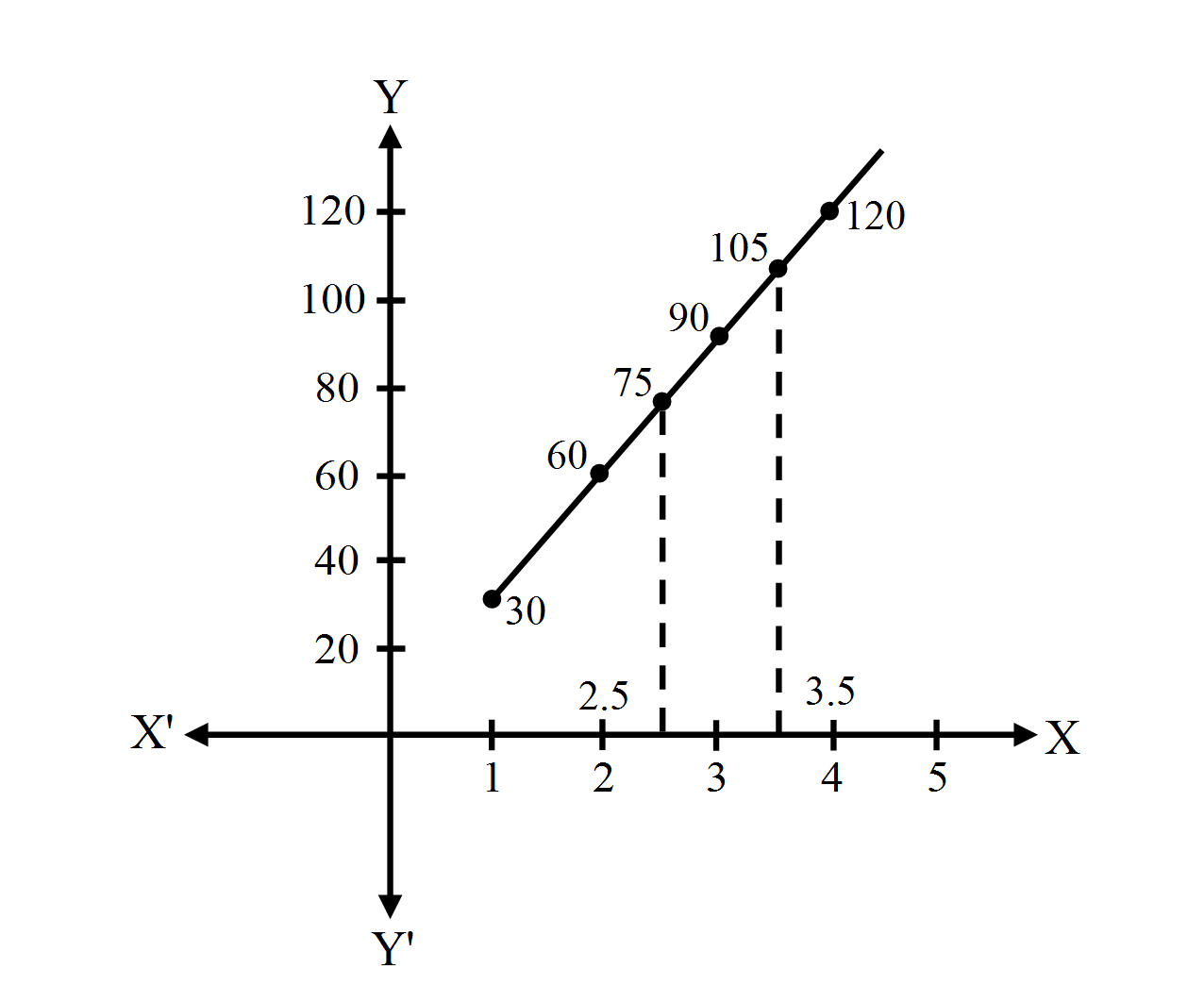
Sajal can ride a scooter constantly at a speed of $30\ km/ hr$. draw a distance$-$time graph for this situation.
Use the graph drawn to find:
$i.$ The time taken by Sajal to ride $75\ km.$
$ii.$ The distance covered by Sajal in $3\frac{1}{2}$ hours.
Answer
We have, $\text{Speed}=\frac{\text{Distance}}{\text{Time}}$ We have the following table for Distance$-$Time graph,
Time $($hrs$)1$
$1$
$2$
$3$
$4$
Distance $(km)$
$30$
$60$
$90$
$120$

$i.$ Given speed $=30 \ km / hr$, distance $=75 \ km$.
Using formula we have,
$30=\frac{75}{\text { Time taken }}$
Time taken $=2.5 hr$
Hence, the time taken by Sajal to ride $75 \ km$ is $2.5 hr .$
$ii.$ Given speed $=30 \ km / hr$, time $=312312 hr$
Using formula we have,
$30=\frac{75}{\frac{7}{2}}$
Distance $=105 \ km$.
Hence, the distance covered by Sajal in $3 \frac{1}{2}$ hours is $105 \ km $.
View full question & answer