Questions

5 Marks Questions

Take a timed test

7 questions · self-marked practice — reveal the answer and mark yourself.

Question 15 Marks
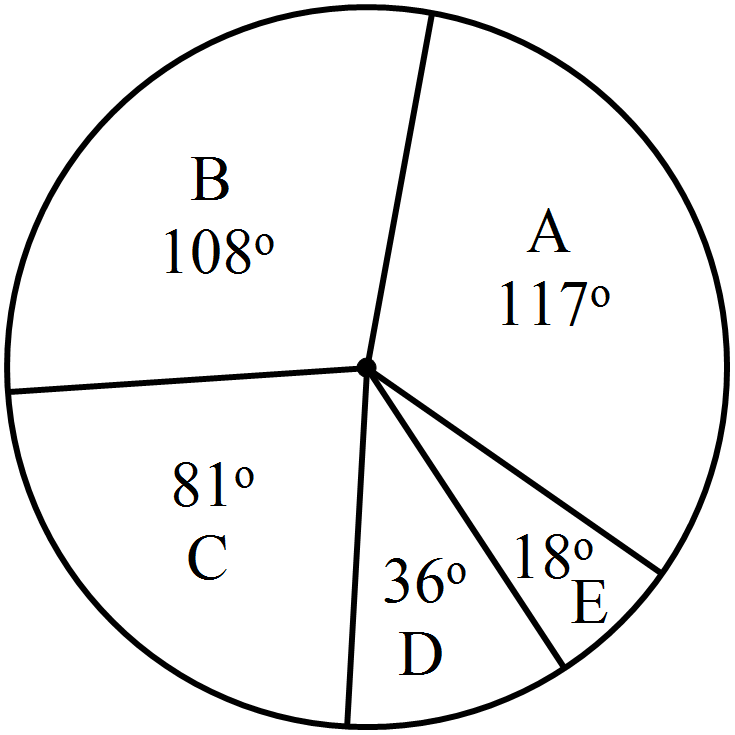
Shoes of the following brands are sold in Nov. $2007$ at a shoe store. Construct a pie chart for the data.
Brand
Number of pair of shoes sold
$A$
$130$
$B$
$120$
$C$
$90$
$D$
$40$
$E$
$20$
Answer
Total number of pairs of shoes sold$ = (130 + 120 + 90 + 40 + 20) = 400$
$\therefore$ Central angle of pie chart representing the brand
$i. \text{A}=\frac{130}{400}\times360^\circ=117^\circ$
$ii. \text{B}=\frac{120}{400}\times360^\circ=108^\circ$
$iii. \text{C}=\frac{90}{40}\times360^\circ=81^\circ$
$iv. \text{D}=\frac{40}{400}\times360^\circ=36^\circ$
$v. \text{E}=\frac{20}{400}\times360^\circ=18^\circ$
View full question & answer
Question 25 Marks
Study the pie chart given below depicting the marks scored by a student in an examination out of $540$. Find the marks obtained by him in each subject.
Answer
From the pie chart we see that, percentage of each subject are, Hindi $= 16.67\%$, English $= 25\%$, Social Science $= 5.55\%$, Mathematics $= 33.33\%$, Science $= 19.44\%$
Given, marks obtained by student in an examination $= 540$
$\therefore\ $The marks obtained in each subject are, $\text{Hindi}=\frac{16.67}{100}\times540=90$
$\text{English}=\frac{25}{100}\times540=135$
$\text{Social Science}=\frac{5.55}{100}\times540=29.97=30$ (approx)
$\text{Mathematics}=\frac{33.33}{100}\times540=179.98=180$ (approx)
$\text{Science}=\frac{19.44}{100}\times540=104.97=105$ (approx)
View full question & answer
Question 35 Marks
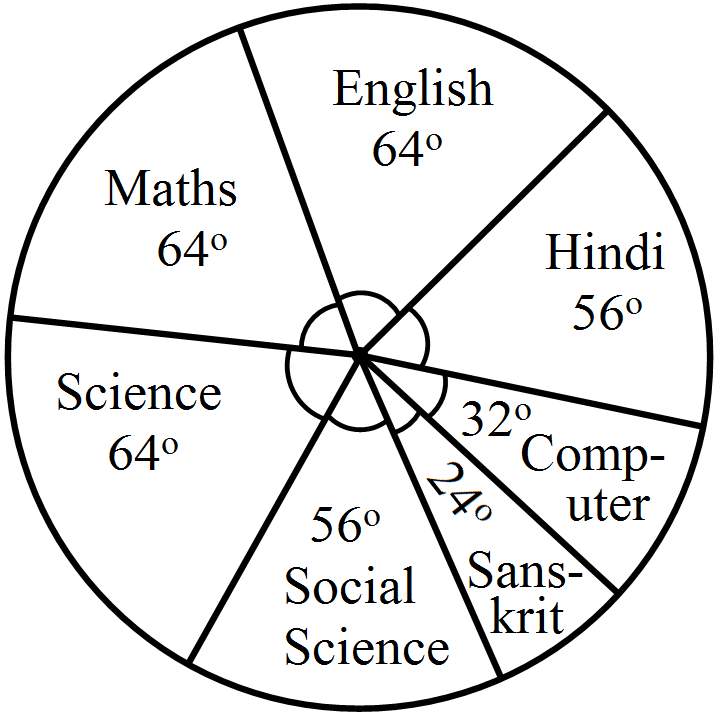
In the time table of a school, periods allotted per week to different teaching subjects are given below:
Subject
Hindi
English
Maths
Science
Social Science Computer Sanskrit
Periods Allotted
$7$
$8$
$8$
$8$
$7$ $4$ $3$
Draw a pie chart for this data.
Answer
Total periods$ = 7 + 8 + 8 + 8 + 7 + 4 + 3 = 45$
Subject Periods allotted Central angle
Hindi $7$ $\frac{7}{45}\times360^\circ=56^\circ$
English $8$ $\frac{8}{45}\times360^\circ=64^\circ$
Maths $8$ $\frac{8}{45}\times360^\circ=64^\circ$
Science $8$ $\frac{8}{45}\times360^\circ=64^\circ$
Social Science $7$ $\frac{7}{45}\times360^\circ=56^\circ$
Computer $4$ $\frac{4}{45}\times360^\circ=326^\circ$
Sanskrit $3$ $\frac{3}{45}\times360^\circ=24^\circ$
The pie chart is a follows:
View full question & answer
Question 45 Marks
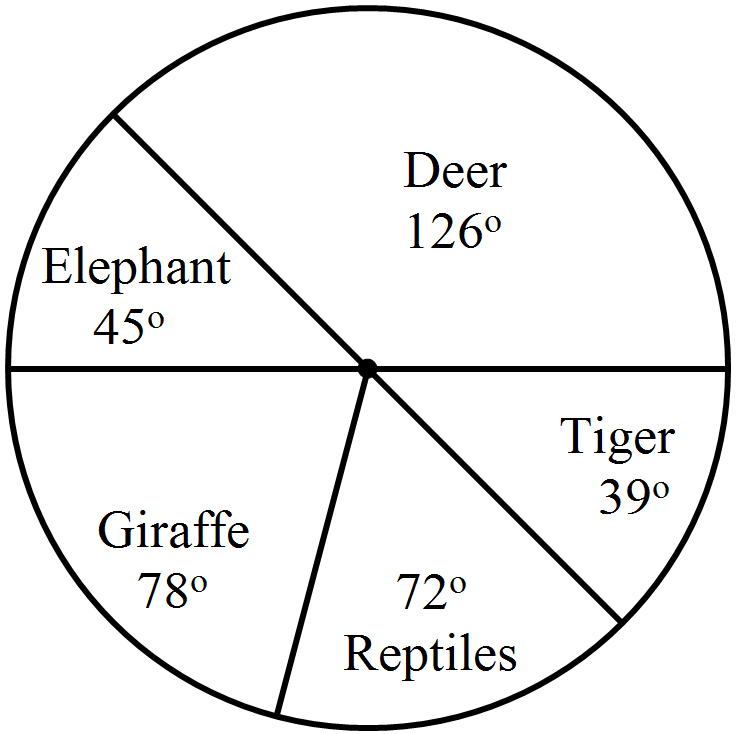
The following data represents the different number of animals in a zoo. Prepare a pie chart for the given data.
Animals
Number of animals
Deer
$42$
Elephant
$15$
Giraffe
$26$
Reptiles
$24$
Tiger
$13$
Answer
Total number of animals in a zoo $= 120$
$\therefore\ $Central angle made in pie chart for representing the animals like
$i. \text{Deer}=\frac{42}{120}\times360^\circ=126^\circ$
$ii. \text{Elephant}=\frac{15}{120}\times360^\circ=45^\circ$
$iii. \text{Giraffe}=\frac{26}{120}\times360^\circ=78^\circ$
$iv. \text{Reptiles}=\frac{24}{120}\times360^\circ=72^\circ$
$v. \text{Tiger}=\frac{13}{120}\times3606^\circ=396^\circ$
View full question & answer
Question 55 Marks
Classify the following statements under appropriate headings.
$a.$ Getting the sum of angles of a triangle as $180^\circ$.
$b.$ India winning a cricket match against Pakistan.
$c.$ Sun setting in the evening.
$d.$ Getting $7$ when a die is thrown.
$e.$ Sun rising from the west.
$f.$ Winning a racing competition by you.
Certain to happen
Impossible to happen
May or may not happen


Answer
$a.$ Certain to happen, because the sum of the angles of a triangle is $180^\circ$.
$b.$ May or may not happen, as the result of the match is unpredictable.
$c.$ Certain to happen, as the Sun always set in the evening.
$d.$ Impossible to happen, as there are only $6$ possible outcomes on throwing a die, i.e. $1, 2, 3, 4, 5$ and $6$.
$e.$ Impossible to happen, as the Sun rise from East.
$f.$ May or may not happen, as the winning of the competition is unpredictable.
View full question & answer
Question 65 Marks
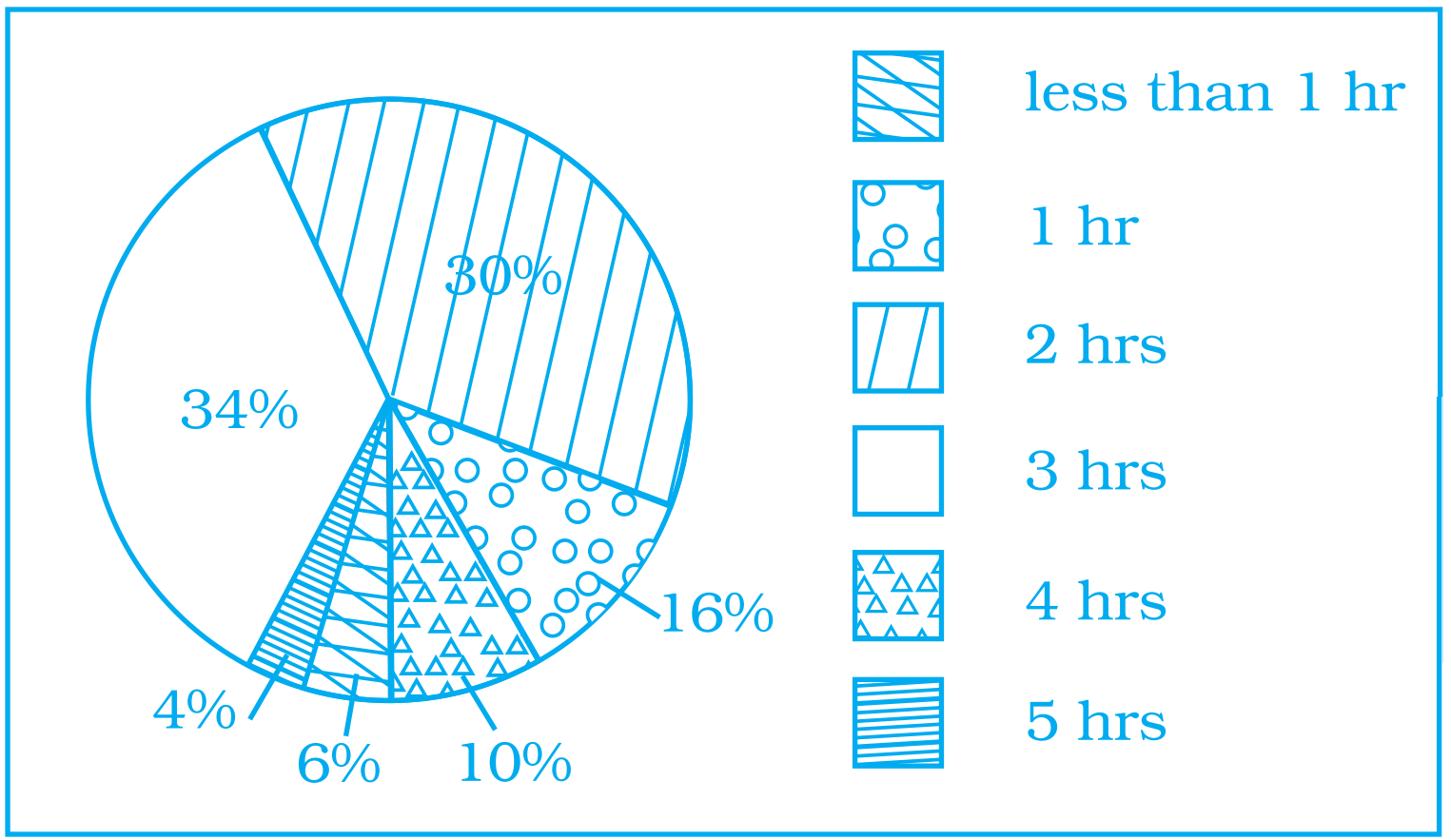
Given below is a pie chart showing the time spend by a group of $350$ children in different games. Observe it and answer the questions thatfollow.

$a.$ How many children spend at least one hour in playing games?
$b.$ How many children spend more than $2$ hours in playing games?
$c.$ How many children spend $3$ or lesser hours in playing games?
$d.$ Which is greater $-$ number of children who spend $2$ hours or more per day or number of children who play for less than one hour?
Answer
$a.$ Number of children who spend atleast $1h$ in playing games i.e. the number of children playing $1h$ or more than $1h$
$= ($Total number of children$) - ($Number of children spend less than $1h)$
$= 350-6\%$ of $350$
$=350-\frac{6}{100}\times350$
$=350-21$
$=329$
$b.$ Number of children who spend more than $2h$ in playing games
$= (34+10+4)\%$ of the total number of students
$=48\%$ of $350$
$=\frac{48}{100}\times350$
$=168$
$c.$ Number of children who spend $3$ or lesser hours in playing games
$= (34+30+16+6)\%$ of total number of students
$=86\%$ of $350$
$=\frac{86}{100}\times350$
$=301$
$d.$ Number of children who spend $2h$ or more per day in playing games
$=(30+34+10+4)\%$ of total number of students $= 78\%$ of total number of students,
Number of children who spend less than one hour $= 6\%$ of total number of students.
Clearly, number of children who play for $2h$ or more per day is greater than the number of children who play for less than $1h.$
View full question & answer
Question 75 Marks
Given below is a frequency distribution table. Read it and answer the questions that follow:
Class Interval
Frequency
$10-20$
$5$
$20-30$
$10$
$30-40$
$4$
$40-50$
$15$
$50-60$
$12$
$a.$ What is the lower limit of the second class interval?
$b.$ What is the upper limit of the last class interval?
$c.$ What is the frequency of the third class?
$d.$ Which interval has a frequency of $10$?
$e.$ Which interval has the lowest frequency?
$f.$ What is the class size?
Answer
$a.$ The lower limit of second class interval $(20-30)$ is $20$.
$b.$ The upper limit of the last class interval $(50-60)$ is $60$.
$c.$ The frequency of the third class $(30-40)$ is $4$.
$d.$ The interval $(20-30)$ has a frequency of $10$.
$e.$ The interval $(30-40)$ has the lowest frequency, i.e. $4$.
$f.$ We know that,
Class size $=$ Upper class limit $-$ Lower class limit Consider first class,
i.e. $10-20$, then class size $= 20 - 10 = 10$.
View full question & answer